Campaign Finance Reporting Violation by Scott Presler and Early Vote Action
Complaint to Pennsylvania Department of State
By Craig Holman, Ph.D. and Liz Iacobucci
On behalf of Public Citizen and the voters of Pennsylvania, we are filing this complaint against Scott Presler and his political action committee, Early Vote Action (EVA), for failing to file and disclose significant expenditures to influence Pennsylvania’s 2025 retention election. Presler and EVA spent significant but unknown sums to influence voters to “Vote No” on the retention of Justices Christine Donohue, Kevin Dougherty and David Wecht on the November 2025 state ballot. They failed to register and disclose the sources and expenditures of their campaign spending with the Pennsylvania Secretary of State as required under 25 P.A. ST § § 2600 and 1621.
Background
During the 2025 judicial cycle, Scott Presler and Early Vote Action (EVA) executed a paid ground and media strategy to unseat Democratic Pennsylvania Supreme Court Justices Christine Donohue, Kevin M. Dougherty, and David Wecht. Despite the significant expenditures for “Vote No” in specific opposition to these candidates, neither appears to have filed campaign finance reports in Pennsylvania. Presler and EVA spent money on paid field staff, digital media, direct mail, and voter-contact texting. This paid electoral activity was coordinated with public calls to action in multimedia platforms, including print advertisements and social media as well as being promoted in national and local media appearances by Presler and Early Vote Action.
Pennsylvania election law includes retention elections as subject to the state’s campaign finance registration and disclosure requirements. Section 1621(c) reads: “The word ‘election’ shall mean any retention, primary, special, municipal or general election at which candidates appear on the ballot for nomination or election or at which questions are to be voted on by the electors of this Commonwealth.” The same election code requires registration and regular disclosure filings of money spent to influence an election in excess of $250 per reporting period. The purpose is to provide voters with critical information who is spending how much to influence their vote choices.
Judging from extensive news coverage as well as self-declarations by Presler and EVA, they spent considerably above that threshold specifically to encourage voters to “Vote No” on the retention of the three justices. Yet, neither Presler nor EVA registered and disclosed that campaign spending, leaving voters unaware who, and how much, was spent to influence their vote choices.
This is not the first time Presler has neglected to file required disclosure records. Public Citizen filed a complaint against Presler on March 13, 2026, for failing to register and disclose his lobbying activities at the federal level under the Lobbying Disclosure Act. Soon thereafter he registered an associated entity as conducting his lobbying activities. We now ask the State of Pennsylvania to ensure proper registration and disclosure by Presler and EVA in their state campaign activities.
Documented Paid Operations & Electoral Activity
- Paid Field Staffing & Ground Deployment
- Paid Staffing: To maintain a presence across key swing counties (e.g., Bucks, Erie, Chester, and Northampton), Early Vote Action employed at least two dozen paid full-time staff members dedicated to Vote No field operations in Pennsylvania.
- Scope of Work: Paid staff set up targeted voter registration booths at county fairs, farmers markets, and gun shows, while handing out physical literature instructing conservative voters to vote “No” on nonpartisan retention questions. In another documented media example, EVA sent tens of thousands of postcards to get the Amish to “vote no”
- Documented Coverage: WHYY News — PA 2025 Election: MAGA Activists Target State Supreme Court (Details EVA’s 28 paid full-time workers operating across Pennsylvania); Washington Examiner — Getting Amish to vote ‘no’ is key in Pennsylvania Supreme Court race.
- Paid Voter Contact and Text Messaging Campaigns
- Paid Text Blitzes: In the final weeks of the campaign, EVA deployed high-volume peer-to-peer SMS blasts targeting low-propensity conservative voters in suburban counties. In Bucks County alone, EVA paid for and sent over 100,000 targeted text messages urging voters to vote “No” on judicial retention.
- P2P Mechanics: These campaigns paired “Vote No” reminders with voter turnout pushes, instructing voters on how to fill out nonpartisan sections of their mail-in or in-person ballots.
- Documented Coverage: Wikipedia — 2025 Pennsylvania Supreme Court Election Campaign Overview (Cites Fox News and campaign reporting on the 100,000+ text deployment)
- Paid Digital Media & Literature (“Vote NO” Marketing)
- Digital Ads & Print Literature: EVA and allied conservative groups produced digital ad buys and custom voter materials painting the three justices as “radical” for past rulings on COVID-19 emergency measures and election laws.
- Custom Promotional Items: Paid campaign items included custom stickers and print pamphlets distributed in front of government centers during early mail-in voting windows.
- Documented Coverage: WITF — Partisan Tensions Flare in Pennsylvania Supreme Court Retention Election (Covers paid literature, field setups, and digital spend targeting the justices);
For these reasons, Public Citizen urges the Pennsylvania Secretary of State to take appropriate actions to ensure that Presler, EVA and others comply with the state’s campaign finance registration and disclosure laws.
Signed,
| Craig Holman, Ph.D. Government affairs lobbyist Public Citizen 215 Pennsylvania Avenue, SE Washington, D.C. 20003 (202) 454-5182 [email protected] |
Liz Iacobucci Protect Elections Campaign Coordinator Public Citizen 1600 20th Street, NW Washington, D.C. 20009 (202) 588-1000 [email protected] |
Stay Updated on Public Citizen
Follow Public Citizen
Support Our Work
Violation of the HATCH Act by Attorney General Todd Blanche
Participation in Campaign Rally Violates the Law
By Craig Holman, Ph.D. and Liz Iacobucci
Office of Special Counsel
1730 M Street, N.W.
Suite 218
Washington, D.C. 20036-4505
[email protected]
RE: Violation of the HATCH Act by Attorney General Todd Blanche
On August 14, 2026, Attorney General Todd Blanche spoke at a campaign rally in Long Island, New York, for the primary effort of boosting the gubernatorial campaign of the Republican candidate Nassau County Bruce Blakeman. Blanch was identified as the current U.S. Attorney General and specifically praised the credentials of New York gubernatorial candidate Blakeman.
“We just heard from our great Nassau County Executive Bruce Blakeman who’s doing everything we need him to do to back the blue, support law enforcement and to make this county a safe county that we can all raise our kids in,” said Blanche at the rally before the Nassau County police department. The rally was cast as a campaign rally for Blakeman. Blanche was introduced as the sitting Attorney General. Though Blanche did not specifically say “vote for,” his participation in the campaign rally along with President Donald Trump constitutes an active endorsement of the Republican candidate.
This partisan political activity by Blanche at a campaign rally constitutes a violation of the Hatch Act [5 U.S.C. § 1216 (a)(1)(2)].
The Attorney General is a position classified as “restricted employee” under the Hatch Act. It is illegal for a restricted employee to take an active part in partisan political campaigns. Specifically, these employees may not use their official authority or influence to interfere with or affect the result of an election, or otherwise engage in political activity in concert with a political party, a candidate for partisan political office, or a partisan political group while on duty. Such employees may not use official resources, including the use of their official title, to take an active part in partisan political campaigns.
In all likelihood, FBI Director Kash Patel – who also participated in the rally – may have violated the Hatch Act as well, but there is no available record of Patel’s speech.
Public Citizen therefore requests that the Office of Special Counsel investigate the political activity of Attorney General Todd Blanche at the campaign rally for violating the Hatch Act, determine an appropriate remedy and instruct Blanche on the perimeters of the law.
Sincerely,
Craig Holman, Ph.D.
Government affairs lobbyist
Public Citizen
215 Pennsylvania Avenue, S.E.
Washington, D.C. 20003
(202) 454-5182
[email protected]
Stay Updated on Public Citizen
Follow Public Citizen
Support Our Work
Challenge to Trump’s Continued Quid Pro Quo Shakedown to push Constitution gas pipeline
By Tyson Slocum
On June 22, we filed a Motion to Hold The Proceeding in Abeyance and Request For Evidentiary Hearing To Investigate the Quid Pro Quo Deal Involving Constitution Pipeline by the President of the United States. We have submitted evidence—based upon President Donald J. Trump’s unambiguous statements—that indicate he is forcing an end to New York offshore wind energy projects to coerce the state’s Governor to support the Constitution pipeline. As part of this malicious scheme, the Trump Administration negotiated the cancellation of three New York offshore wind projects: the June 17 Invenergy $765 million payment to not develop three offshore wind projects, of which the company’s 83,976 acre New York Bight lease was the largest; the April 27 settlement agreement that paid BlackRock, EDP Renewables and ENGIE to vacate their Bluepoint Wind project off the coast of New York; and the March 23 settlement agreement forcing taxpayers to pay TotalEnergies $928 million to abandon two wind leases, including its offshore New York tract.
Our June 22 filing warned that RWE’s offshore wind lease would be the fourth to be cancelled under President Trump’s promised retribution against New York.[5]
On August 6, our forecast materialized, as the Trump Administration enforced the annulment of the fourth New York offshore wind project, with RWE taking $1.2 billion of taxpayer money to terminate its Community Offshore Wind project off the coast of New York. RWE agreed to end the project because the company stated that it “determined there is no path forward to permit these projects in the U.S. for the foreseeable future”—suggesting the Trump Administration made clear there was no permitting pathway available.
The Trump Administration’s arbitrary, capricious and exploitative campaign to threaten resource adequacy in FERC-jurisdictional power markets to coerce support for the Constitution pipeline is contrary to the public interest.
Furthermore, Williams Cos. Constitution pipeline lacks binding contracts with downstream shippers—a so-called precedent agreement—demonstrating there is no commercial need for the gas pipeline. The combination of the Trump Administration’s coercive quid pro quo campaign and the lack of a precedent agreement must result in the Commission rejecting Constitution’s petition.
Read the full pdf filing here RWEConstitution1
You might be interested in
Stay Updated on Public Citizen
Follow Public Citizen
Support Our Work
Public Citizen Comments Regarding Proposed Rule to Codify the Medicare Prescription Drug Price Negotiation Program (CMS-4215-P)
John Brooks
CMS Deputy Administrator and Director of the Center for Medicare
August 17, 2026
Public Citizen Comments Regarding Proposed Rule to Codify the Medicare Prescription Drug Price Negotiation Program (CMS-4215-P)
Dear Director Brooks,
Thank you for the opportunity to provide stakeholder feedback as CMS works to enact the Medicare drug price negotiation program.
Public Citizen is a nonprofit consumer advocacy organization with more than 1,000,000 members and supporters. The Access to Medicines program advocates for access to prescription drugs in the United States and internationally.
Public Citizen and health care access proponents across the nation invested tremendous energy into supporting Medicare drug price negotiation becoming law. We share CMS’ goal of making this program a success to help prevent prescription drug manufacturer price gouging of seniors and people with disabilities with Medicare, and taxpayers who support the program.
Below, we outline several comments and recommendations in response to CMS’ request for comment regarding codifying the policies of sections 1191 through 1198 of the Social Security Act.
In summary of our highest priority comments to this proposed rule:
1a) We strongly urge CMS against continuing to adopt a negotiation starting point using existing prices of therapeutic alternatives, all or some of which have not been negotiated by Medicare, as doing so will lead to inappropriately high maximum fair prices (MFPs) for Medicare beneficiaries and taxpayers.
1b) Instead, we urge CMS to adopt a holistic approach, with stronger consideration for section 1194(e)(1) MFP negotiation factors, through which drug corporations are paid a fair portion of the revenue necessary to recover risk-adjusted R&D costs, accounting for therapeutic advancement and the extent to which a selected drug addresses an unmet health need.
2) Retain CMS’ proposed approach of considering all dosage forms and strengths of a drug with the same active moiety as a qualifying single source drug (QSSD) and including fixed combination products when one of the active moieties creates a new formulation and enables and alternative route of administration for the coadministered active moiety/ies. Doing so is vital to preserving program integrity and consistent with the intent of the legislation.
3) Ensure all Part B drugs sales – including sales reimbursed through Medicare Advantage (MA) – are considered when determining negotiation eligibility. Failing to consider MA Part B spending when determining negotiation eligibility and selection could inappropriately exclude costly medicines from negotiation that would otherwise be included.
4) Fully utilize the MFP renegotiation process to deliver savings to beneficiaries and taxpayers, including by considering percentage changes in MFP lower than 15 as potentially “significant” and considering a wide array of “material changes” that could impact MFP negotiations. CMS should also consider the magnitude of competing material changes when assessing the likely impact on MFP negotiations.
5) Provide greater transparency around R&D costs and other data to instill greater public confidence in the program. CMS’ overly expansive interpretation of what information shall be held confidential would severely limit the impact of the legislation on industry drug pricing practices and the ability of the public to assess whether the Medicare drug price negotiation program is successfully negotiating “the lowest maximum fair price for each selected drug”, as required under the Act.
6) Solicit information from patients, consumers, and other interested parties while promoting transparency around financial conflicts of interest with drug corporations.
7) Calculate negotiation eligibility for deemed biologics based on original approval dates, not the date of deeming.
Thank you again for this opportunity and for your consideration of these comments as CMS works towards implementing the Act.
Recommendation 1a: Do not use the existing prices of therapeutic alternatives as the starting point for developing an initial price offer in drug price negotiations.
§ 429.510(d) outlines the proposed methodology from CMS for developing an initial price offer in drug price negotiations. CMS proposes in § 429.510(d) to take as a starting point for developing its initial negotiated price offer the average prices available for therapeutic alternatives for the selected drug.
Below, we articulate two major concerns with this approach.
I. Starting with the prices of therapeutic alternatives will lead to ongoing inappropriately high prices.
Evidence shows that drug prices paid under Medicare Part D are significantly higher than those paid under other health programs in the United States, including Medicaid and the Department of Veterans Affairs, as well as those paid in other wealthy countries.[1],[2],[3]
Current inappropriately high prices, which burden Medicare beneficiaries and taxpayers, are the underlying reason that Congress passed a law to empower Medicare to negotiate in the first place.
These prices are set by drug corporations under monopoly conditions to maximize profits, while plans face broad coverage obligations under Medicare Part D. Taking prices of therapeutic alternatives set under these conditions as the starting point for developing negotiated price offers would bias the system towards inappropriately high, unfair prices. This would be inconsistent with the statutory requirement that CMS develops a methodology and process for drug price negotiation “that aims to achieve the lowest maximum fair price for each selected drug.”[4]
II. Starting with the prices of therapeutic alternatives would be a missed opportunity for the law to provide virtuous systemic impact.
In support of its negotiated price offer starting point proposal, CMS states that “the cost of therapeutic alternatives in the current market […] is an important factor when considering the overall benefit that the treatment brings to Medicare beneficiaries.”
We agree that pricing of a medicine and its therapeutic alternatives impact Medicare beneficiaries, but it does not follow that prices of therapeutic alternatives should dictate the starting point of prices CMS negotiates. Moreover, while section 1194(e)(2)(A) of the Act requires CMS to consider the prices of therapeutic alternatives in developing a maximum fair price offer, there is a multitude of ways to incorporate that information that do not inordinately prejudice the process toward entrenching current high prices, which are often multiples higher than those paid in other high-income countries. Indeed, analysts found that the Medicare-negotiated prices for the first 10 selected drugs, remain higher in all comparator countries in virtually all cases.[5] For many of these drugs, the Medicare-negotiated prices remain more than three times the prices in comparably large and wealthy countries.[6] At the end of recommendation 1b in these comments, we provide an alternative that will situate the maximum fair price in the context of the prices of therapeutic alternatives, but, crucially, without reinforcing the current regime of excessive prices.
Rather than provide virtuous systemic impact, the current process CMS is considering would reduce incentives for manufacturers of therapeutic alternatives to lower their prices. Using existing drug prices, especially those of branded drugs that have not been negotiated by CMS, as the basis for negotiations risks building inertia for higher prices into the system. By instead negotiating a maximum fair price through alternate methods, such as those we propose below, CMS’ negotiation process could help reduce the prices of the alternative therapies, since the manufacturers of the alternatives may try to compete on price with that of the negotiated product.
Recommendation 1b: Instead, adopt a holistic approach, with stronger consideration for section 1194(e)(1) MFP negotiation factors, through which drug corporations are paid a fair portion of the revenue necessary to recover risk-adjusted R&D costs, accounting for therapeutic advancement and the extent to which a selected drug addresses an unmet health need and other section 1194(e)(2) factors.
When negotiating prices, CMS can deliver access and protect innovation by determining the maximum fair price using the baseline of risk-adjusted research and development (R&D) costs and the extent to which they have been recouped by the manufacturer.
Medicines are information goods. R&D costs—not other welfare metrics like “value”—should form the core basis for negotiating prices because R&D costs can help answer the inquiries central to information economics: how much does innovation cost, and how much compensation is necessary to induce innovation?
Exclusive rights allow prescription drug corporations to charge prices that are not linked to the cost of innovation. As one drug executive noted, “We all look at each other and keep pace with each other. Honestly, there is no science to it.”[7] Pharmaceutical industry pricing practices reduce social welfare by limiting access and create massive inefficiencies in the form of deadweight loss. Governments tolerate this static (short-term) inefficiency in the name of protecting dynamic (long-term) incentives for innovation. HHS can help challenge this false dichotomy by negotiating lower prices that appropriately reward true R&D costs.
The IRA lists a series of negotiating factors to help determine the maximum fair price offers and counteroffers. [8] To develop a maximum fair price offer, CMS should adopt a holistic approach with stronger consideration for selection 1194(e)(1) MFP negotiation factors, through which drug corporations are paid a fair portion of the revenue necessary to recover risk-adjusted R&D costs, accounting for therapeutic advancement and the extent to which a selected drug addresses an unmet health need and other section 1194(e)(2) factors. We explain in further detail below.
I. Risk-Adjusted Research and Development Costs, Accounting for Federal Investment
The cost of innovation should be central in determining the maximum fair price assessment. Unfortunately, § 429.510(f) shows that CMS intends to deprioritize manufacturer-specific data, which represent more than half of the total number of factors provided under statute for CMS to consider in determining its maximum fair price offers and counteroffers.[9] § 429.510(f) of the rule goes so far to suggest that CMS may not even incorporate consideration for this information in its maximum fair price offer.
Under the Act, manufacturers are required to submit information “in a form and manner specified by the Secretary” that CMS requires to carry out the negotiation. To determine actual R&D costs, CMS can require granular information. Drawing on expert reviews[10] and prior legislative proposals[11], we recommend that total expenditures on R&D are itemized by direct and indirect costs, including for:
- Basic and preclinical research;
- Clinical research, reported separately for each clinical trial, per patient, per year, comprising
- Personnel costs (including salary and benefits)
- Administrative staff
- Clinical staff
- Materials and supplies
- Clinical procedures
- Site management
- Site monitoring costs
- Site retention
- Other
- Central laboratory
- Equipment
- Other direct costs
- Publication Costs
- Subawards/Consortium/Contractual Costs
- Other;
- Development of alternative delivery systems, dosage forms, strengths or combinations; and
- Other development activities, such as post-approval testing and record and report maintenance.
- Personnel costs (including salary and benefits)
In the guidance for IPAY 2028, Appendix A, CMS appropriately delineated a wide array of information that would be required to be disclosed by manufacturers, pursuant to section 1194(e)(1) of the IRA,[12] but the proposed rule for IPAY 2029 does not seem to provide similarly detailed information on manufacturer disclosures. To the extent that any ambiguity remains, we recommend CMS clarify that this information, described under definitions relating to R&D costs in Appendix A of the IPAY 2028 guidance, should be applied for IPAY 2029 and be provided in an itemized and disaggregated fashion. This is particularly important with regard to reporting costs separately for each clinical trial, as there are significant differences in risk depending on trial phase, as described further below.
Obtaining disaggregated, detailed information offers two advantages over relying only on more generalized and potentially misleading research and development information disclosed pursuant to SEC requirements. First, CMS can risk-adjust R&D figures in a more sophisticated way, including by stage of clinical development, and better account for federal investment. For example, researchers have estimated success rates across clinical trials, including by drug class, disease and indication.[13] Together with the cost of trials and federal investment, CMS can use these figures to determine the cost of trial failures—and hence, risk-adjusted trial costs incurred by the manufacturer.
Table 1: Drug Development Success Rates (Hay et al., 2014)[14]
| Stage | Phase Success | Likelihood of Approval |
| Phase 1 to Phase 2 | 64.5% | 10.4% |
| Phase 2 to Phase 3 | 32.4% | 16.2% |
| Phase 3 to NDA/BLA | 60.1% | 50.0% |
| NDA/BLA to Approval | 83.2% | 83.2% |
Second, the granularity of R&D costs can increase the integrity of the data and help prevent gaming of R&D cost figures. Aggregate figures, like the ones reported by firms in financial filings, capture many kinds of expenses that inflate the real cost of R&D, making them less useful. For example, firms can include the costs of acquiring a candidate as an R&D expense, even if the acquisition cost was based on the expected revenue the candidate could generate—not necessarily the money that was spent in research and development.[15] (In the case of a drug that was acquired part way through its development, it should be incumbent on drug corporations to disclose disaggregated information on actual R&D expenditures on the drug candidate prior to its acquisition to the extent they want such costs considered by CMS.) In IPAY 2028, CMS excluded acquisition costs from its consideration of R&D costs. We encourage CMS to continue this practice. CMS was correct in its stated understanding that acquisition costs are generally driven by the estimated net of the present value that is assessed based on future revenue expectations for a drug, and that acquisition costs are not driven by R&D. In that context, if higher acquisition costs led to higher MFP offers, it would provide incentive for inflated acquisition costs in the future, which in turn would lead to even higher MFPs for future selected drugs. Successful drug development organizations, like the Drug for Neglected Diseases Initiative, have shown that reporting real R&D costs is possible, and provide crucial insights on how that reporting might be structured.[16]
Furthermore, a three-year House Oversight Committee investigation into drug pricing found that drug corporations can also include in bulk R&D figures “non-innovative R&D expenditures.” The Committee found that the corporations reviewed in their investigation “dedicated a significant portion of their R&D expenditures to research that was intended to extend market monopolies, support the companies’ marketing strategies, and otherwise suppress competition.”[17] A recent study from Department of Health and Human Services officials and coauthors indicates that R&D estimates touted by industry are significantly higher than what a transparent analysis of public data provides – an average of less than $900 million, including costs of capital and failed candidates, rather than more than $2.5 billion.[18]
Under a pure cost-plus payment model, sellers may have a perverse incentive to inflate costs incurred and reported, knowing that higher costs will result in increased payment. If pharmaceutical reimbursement is linked to actual costs reported, then drug corporations could inflate expenditures, especially to the extent they are risk adjusted for payment considerations. CMS is well positioned to overcome this obstacle and better incent efficient drug development by using data-driven proxies for R&D and production and distribution costs.
Importantly, the law requires manufacturers to submit information regarding “[p]rior Federal financial support for novel therapeutic discovery and development with respect to the drug.” The extent to which R&D has been supported and subsidized by the Federal government and other public sources is a key factor in determining privately borne risk in developing a medicine. In addition to requiring companies to report and acknowledge all relevant public R&D contributions in all forms, HHS should work across government to gather such information and make it public.
In collaboration with U.S. Government entities that conduct and fund clinical trials, within HHS as well as elsewhere within the federal government, including the National Institutes of Health (NIH), the Biomedical Advanced Research and Development Authority (BARDA), the Centers for Disease Control and Prevention (CDC), the Food and Drug Administration, the Department of Defense, and the Department of Veteran Affairs, CMS can supplement manufacturer-provided information to develop an R&D cost database and form proxies using average costs of R&D for different categories of therapies, using representative samples of R&D costs for different products. HHS can then use the appropriate category of proxy of demonstrated R&D costs to help determine the maximum fair price offer of a given drug. Optimally, HHS would also obtain as much data as possible on costs of failed clinical trials to best inform its calculation of risk-adjusted R&D costs. HHS and other agencies taking action to increase and systematize compliance with the Stevens Amendment, which requires disclosure of the total costs of programs or projects paid for with federal funds “[w]hen issuing statements, press releases, requests for proposals, bid solicitations and other documents describing projects or programs,” can also provide greater insight into federal support for pharmaceutical R&D.[19]
Using the risk-adjusted, true R&D cost can help provide a fairer baseline from which to reward innovation. This can be adjusted to account for clinical benefit, as described in the following section.
II. Accounting for Therapeutic Value
To promote meaningful innovation, manufacturers that produce drugs with new, clinically meaningful benefit should receive robust rewards, including the ability to make a reasonable profit on risk-adjusted R&D investments that they incur. Manufacturers of products that do not show evidence of improving health outcomes, relative to other therapies at the time of approval, should not be excessively rewarded.
CMS should adjust its MFP offer higher when there is strong evidence showing a selected drug has a preferable safety and efficacy profile compared to therapeutic alternatives and when robust evidence shows it addresses an unmet health need. Conversely, when there is strong evidence that a therapy has a worse safety and efficacy profile or that it is a “me too” drug, which acts similarly to therapeutic alternatives, then the MFP offer should be lowered. Similarly, when there is a lack of strong evidence of benefit relative to other therapies, the MFP offer should be lowered.
The table below illustrates how CMS can incorporate therapeutic value information into its MFP offer determination, taking into account both the magnitude of relative benefit provided by the selected drug compared to other therapies, as well as the certainty of evidence of net clinical benefit[20] compared to other therapies available at the time of approval, taking into account the factors enumerated in the section 1194(e)(2) of the Act, including unmet medical needs.[21] A similar categorization of therapeutic benefit is used in Germany.[22]
Table 2: Adjusting MFP Offers Based on Therapeutic Advancement
| Strength of Evidence | Added Value | ||
| Minor | Significant | Major | |
| Low-to-Moderate | Little or no ↑ adjustment | Small ↑ adjustment | Small-to-modest ↑ adjustment |
| High or Proof | Small ↑ adjustment | Significant ↑ adjustment | Largest ↑ adjustment |
| No Data | ↓ adjustment | ↓ adjustment | ↓ adjustment |
| High or Proof Against | Largest ↓ adjustment | ↓ adjustment | ↓ adjustment |
Adjusting the MFP offer based on the magnitude and certainty of evidence about the therapeutic value of a selected drug can help to ensure pharmaceutical manufacturers are more greatly compensated when they generate more novel therapeutic advancements, while discouraging against developing “me too” drugs that are largely redundant with existing therapies. The table above provides general guidance for determining how to adjust MFP offers that will prevent inappropriately subsidizing corporations for medicines that lack evidence of improving health outcomes and allow for negotiated prices that reward genuine advancements. The appropriate adjustment in MFP offer for a medicine with strong evidence of providing major added health benefit may be large, but should conform to the principle stated at the beginning of this section: how much does innovation cost, and how much compensation is necessary to induce innovation?
By ensuring that drug manufacturers are well rewarded for true, novel therapeutic advancements and, importantly, avoiding inappropriately subsidizing corporations through excessive prices paid by patients and taxpayers for products that are required by statute to be included in formularies but that do not show increased benefit relative to other therapies, IRA drug price negotiations can promote an R&D ecosystem better aligned with serving unmet health needs.
While we take strong exception to CMS’ proposed approach for reaching a starting point for a maximum fair price offer, discussed in recommendation 1a above, the approach CMS takes to analyzing comparative effectiveness between a selected drug and its therapeutic alternatives (described in § 429.510(e) of the proposed rule) could be consistent with this element of our proposal. We are grateful for CMS considering the source, rigor of study methodology, and risk of bias when reviewing literature from the public and manufacturer submissions to help ensure the integrity of the contributing data within the negotiation process, as indicated in § 429.510(e)(1) of the rule.
III. Net and Expected Net Revenues
As noted above, section 1194(e)(1) of the Act requires CMS to consider an array of manufacturer-submitted data, including the extent to which the manufacturer of a selected drug has recouped its research and development costs for the drug. However, Public Citizen is concerned that CMS is not appropriately considering this information, and that MFPs are higher as a result. Determining Medicare’s fair share requires assessing how much additional reward the manufacturer needs to obtain the full appropriate reward during the remaining product life, taking into account the net and expected revenues from other payers. The more progress a manufacturer has made toward recouping risk-adjusted R&D costs through net revenues, the lower an MFP CMS should offer. When CMS finds that the manufacturer of a selected drug has accrued or is expected to accrue net revenues exceeding risk-adjusted R&D costs (including a reasonable profit) by the time the MFP takes effect, then the MFP offer should be lowered significantly.
CMS can obtain information about how much the manufacturer has already recouped and estimate how much the manufacturer expects to make from other payers over the remaining product life, and adjust its MFP offer based on the expected product volume sold to Medicare over the remaining product life to help determine a Medicare price. In IPAY 2028 CMS solicited comments in section 50.1 of draft guidance on whether to consider collection of forward-looking market data for selected drugs to help forecast revenue and volume data. We encourage collecting this data and considering it when assessing the extent to which manufacturers of selected drugs will have recouped risk adjusted R&D costs by the time MFPs take effect as well as future recoupment from other payers.
Because pharmaceutical corporations operate in a global marketplace and are not bound only to market products in the United States, global sales should be included in this calculation. The first factor for consideration for the purpose of negotiating the maximum fair price of a selected drug in the IRA includes “the extent to which the manufacturer has recouped research and development costs,” which necessarily implicates the extent to which such costs have been recouped through U.S. and non-U.S. sales. We appreciate CMS incorporating global sales in its approach to considering net revenues and encourage it to continue to do so.
IV. Examining Patents for Potential Monopoly Abuses
Section 1194(e)(1)(D) of the Act requires CMS to consider data on pending and approved patent applications and other exclusivities when determining an appropriate MFP. In addition to using this data to help determine the remaining monopoly life of the drug before it faces generic competition, CMS can evaluate patent and patent application data to scrutinize whether they cover novel inventions that contribute to the therapeutic value of a selected drug or, rather, if they are more representative of legal maneuvering to lengthen monopolies without clinical benefit. If patent gamesmanship by a manufacturer unfairly extends exclusivity for a selected drug and improperly allows its manufacturer to collect exorbitant revenues without adequate competition, then CMS should lower its MFP offer, with consideration for the prices that might be available in the absence of such inappropriate monopoly extensions, and the continued inflated revenues a manufacturer will obtain from its patent abuses. To the extent negotiated prices exceed those that would be available in the absence of unfair monopoly extensions, companies will not be deterred from future misconduct.
Public Citizen analysis found that four out of 10 drugs subject to Medicare drug price negotiation for initial price applicability year 2026 would likely have faced competition before negotiated prices went into effect, were it not for patent evergreening tactics and other patent abuses.[23] As a result, Medicare will have lost between $4.9 and $5.4 billion in savings that should have accrued from access to competing, lower-cost treatments. These lost savings are nearly as much as what Medicare was expected to save when negotiated prices went into effect on all of the selected drugs in the first year of the program ($6 billion).[24] Evergreening practices were prevalent across the drugs selected for price negotiation for IPAY 2026. Nine out of 10 drugs subject to negotiation show evidence of manufacturers engaging in blatant anticompetitive uses of patents to fend off generic or biosimilar competitors or evergreening abuses representing minor modifications or tweaks that unfairly lengthen monopoly protection on the drugs. Patent protection on the branded drugs could extend well into the 2030s and possibly 2040.[25]
In the case of Enbrel, Public Citizen found that Amgen, Enbrel’s manufacturer, reworked old patent applications from another company to cover Enbrel once Amgen’s patent protection in the drug expired in 2019, so it could protect its monopoly power until 2029.[26] Medicare could have saved more than a billion dollars if biosimilars had been allowed to enter the market when the underlying patent protection was set to expire in 2019. Ignoring industry monopoly abuses that have resulted in inflated prices, as in Enbrel’s case, would detract from CMS’s mandate to deliver the lowest possible MFPs for Medicare’s enrollees. Instead, where a manufacturer has gamed the patent system to unfairly extend exclusive control of a selected drug, CMS should consider (1) the prices that would be in place if proper competition existed, and (2) excessive revenues manufacturers have unfairly obtained from Medicare and its enrollees through this gamesmanship as it determines its MFP offer.
Similarly, analysis from patent experts at the Initiative for Medicines, Access, and Knowledge (I-MAK) found that follow-on patent protection extending the monopoly on Eliquis will generate $11.6 billion in U.S. sales for Bristol Myers Squibb and Pfizer, while Novo Nordisk follow-on patents creating a patent thicket covering formulations and delivery devices for semaglutide provide patent protections until 2042, despite the main compound patents having been filed in 2006.[27]
V. Marginal Production and Distribution Cost
Finally, beyond rewarding medical innovation, CMS should pay for the marginal cost of production and distribution for medicines used by Medicare beneficiaries. Using the marginal cost of production and distribution—rather than the average total—is the most precise way to determine minimum costs. It precludes the manufacturer from adding other costs into the figure.[28]
VI. Note on Negotiation Delay Periods
While our proposed method for CMS to determine maximum fair price offers is constructed to arrive at appropriate prices consistent with promoting medicines access and innovation regardless of how long a product has been on the market, currently negotiations are permitted only for older medicines. Specifically, CMS is allowed to negotiate prices only for drugs and biologics that will have been on the market for at least 9 or 13 years by the time such prices take effect, and longer for drugs first approved for an orphan indication and subsequently approved for a non-orphan indication.
Since CMS will only be negotiating prices of high spend drugs and biologics for which drug corporations have had many years to recoup risk-adjusted R&D costs, they will likely have done so many times over prior to the initial price applicability year. Indeed, experts found that by the time negotiated prices take effect for IPAY 2027 selected drugs, manufacturers will have already accrued net revenues from their sales exceeding risk adjusted R&D costs on each of those drugs[29], yet it is unclear whether that impacted MFPs CMS offered. In the case of semaglutide, Novo Nordisk is estimated to have achieved cumulative earnings of $43.1 billion in under 7 years on the market, compared to $1.6 billion, which is the amount authors estimate to provide an adequate return on risk-adjusted R&D costs when manufacturers are making R&D investment decisions.[30] These findings suggest that for many drugs, Medicare-negotiated prices could approach the marginal cost of production and distribution without impeding R&D investment incentives. CMS should not shy away from approaching marginal cost pricing of medicines that have been super-blockbusters, such as those that have already generated tens-of-billions of dollars in revenues since entering the market, particularly when a selected drug only remains eligible due to patent gamesmanship, as detailed above.
By applying this methodology to determine maximum fair price offers and counteroffers, CMS can reward medical innovation and ensure reasonable prices. Indeed, to preserve the integrity of the system, CMS should only adjust its response to a manufacturer counteroffer if refinements to the input data are presented. Consistent use of this methodology can help realign incentives for pharmaceutical corporations and promote more meaningful medical innovation.
VII. Note on Consideration of Prices of Therapeutic Alternatives
While section 1194(e)(2)(A) of the Act requires CMS to consider the prices of therapeutic alternatives as one of several factors in developing a maximum fair price offer, it certainly does not require it to form the underlying basis for developing a starting point for such an offer. There is nothing in the Act that says or suggests that this or any other factor should be prioritized over or emphasized more than any of the others CMS is required to consider in developing a maximum fair price. As discussed above, it is our strong view that such an approach will inappropriately prejudice CMS toward inappropriately high offers, entrenching the existing regime of price gouging.
Rather than using prices of therapeutic alternatives to form the starting point for CMS’ negotiated price offer, CMS should instead take the approach we have articulated above, and as a final step in the process, compare the maximum fair price reached to the prices of therapeutic alternatives. The maximum fair price CMS plans to offer should be reduced to a price that is no higher than the lowest price of a therapeutic alternative that has demonstrated safety and efficacy matching that of the selected drug, including generic and biosimilar versions of therapeutic alternatives marketed in the United States, if the planned offer is not already below this price. A similar approach to internal reference pricing was incorporated in Denmark’s pharmaceutical reimbursement regime in 2005, wherein reimbursement is based on the lowest domestic price out of all products belonging to a substitution group.[31],[32]
Recommendation 2: Retain CMS’ proposed approach of considering all dosage forms and strengths of a drug with the same active moiety, inclusive of products marketed pursuant to different New Drug Applications (NDAs) and Biologics License Applications (BLAs), as a qualifying single source drug.
§ 429.125(b) of the rule correctly cites section 1192(d)(3)(B) of the Act, which requires CMS to aggregate sales across dosage forms and strengths of a qualifying single source drug in determining whether such drug is negotiation eligible.[33] Additionally, section 1192(b) of the Act[34] requires CMS to select drugs for negotiation based on the rankings of total expenditures under Medicare Part D and Medicare Part B for negotiation-eligible drugs, as clarified under section 1192(d)(3)(B) to include spending “data that is aggregated across dosage forms and strengths of the drug, including new formulations of the drug, such as an extended release formulation, and not based on the specific formulation or package size or package type of the drug.”
This language clarifies the intent of policymakers of applying negotiated prices across dosage forms and strengths of a selected drug, which necessitates the approach CMS proposes in the rule to take for identifying potential qualifying single source drugs.
Further, the approach proposed by CMS will prevent gaming and abuse of the Medicare drug price negotiation program that may occur if prescription drug corporations were able to prevent a high-revenue product from qualifying for negotiation through product hopping and obtaining new NDAs and BLAs, effectively resetting the clock on the statutory 7- and 11-year delay periods before a drug or biologic may qualify for negotiation.[35] We appreciate that CMS plans to continue to take this approach.
Additionally, we urge CMS to move forward with grouping together fixed combination drug products containing at least one but not all of the active moiety(ies) / active ingredient(s) into the same potential qualifying single source drug when one of the active ingredients or active moieties “creates a new formulation and enables an alternative route of administration for the co-administered active moiety(ies)/active ingredient(s).” Experts have noted the example of hyaluronidase reformulations of cancer drugs, in which “the FDA considers hyaluronidase to be an active ingredient, [but] one of its primary purposes appears to be increasing the absorption/availability of other products, rather than treating certain forms of cancer on its own.”[36] If drugs reformulated into combination products with hyaluronidase are considered distinct QSSDs, Medicare and its beneficiaries could be subjected to higher, unnegotiated prices for many years longer.
Recommendation 3: Ensure all Part B drugs sales – including sales reimbursed through Medicare Advantage (MA) – are considered when determining negotiation eligibility.
In IPAY 2028 Medicare Part B was incorporated into the Medicare drug price program. Experts expressed concern that CMS’ proposal to use “Part B claims data” to identify high-spend drugs and determine which Part B drugs are negotiation-eligible and ultimately selected for drug price negotiations will not encompass data from Medicare Advantage plans, which now enroll over half of the Medicare population.[37],[38] We applaud CMS for taking this suggestion into account in § 429.120(b) of the proposed rule and including Medicare Advantage encounter data for Part B items and services to ensure these costs are included when identifying high-spend Part B drugs.
If spending on Part B drugs through Medicare Advantage is not considered, the program would be inappropriately prejudiced against selecting costly Part B drugs for negotiation. To ensure the program achieves the most savings for Medicare and its beneficiaries, it is essential that CMS considers all sales of Medicare Part B drugs, including through Medicare Advantage.
In addition, Public Citizen supports CMS’ plans to use combined sales across Part B and Part D when ranking and selecting negotiation-eligible drugs as selected drugs, as indicated in § 429.105. Using sales combined across Part B and Part D when ranking and selecting negotiation-eligible drugs is consistent with section 1192(b)(1)(A) and (B) of the Act, which require CMS to rank negotiation-eligible drugs “according to total expenditures for such drugs under parts B and D” and “select from such ranked drugs […] the negotiation-eligible drugs with the highest such rankings.” This approach is also consistent with the statutory definition of low spend Medicare drugs considering “total expenditures under parts B and D.”
Lastly, due to a perverse incentive wherein physicians administering Part B drugs are reimbursed based on a percentage of the average sales prices of that medicine, negotiating lower prices on Medicare Part B selected drugs may pose unique access problems.[39] When CMS negotiates a price for a selected Part B drug that is lower than that of therapeutic alternatives, physicians would receive greater reimbursement from prescribing alternatives, costing Medicare and its enrollees more money. CMS should closely monitor beneficiary access to Part B negotiated drugs. Legislation is likely necessary to provide a lasting solution to the perverse incentives inherent in the Part B reimbursement system. However, CMS could consider a demonstration project under which physicians are reimbursed a flat amount, or a percentage of the ASP of all products within a therapeutic class, including biosimilars, or of the lowest-price drug within a therapeutic class. Using a blended payment rate based on prices of reference products and their biosimilars could help lower prices for Part B even beyond the negotiation program.[40]
Recommendation 4: Fully utilize the MFP renegotiation process to deliver savings to beneficiaries and taxpayers, including by considering percentage changes in MFP lower than 15 as potentially “significant” and considering a wide array of “material changes” that could impact MFP negotiations.
IPAY 2029 is the second year in which CMS may renegotiate prices of selected drugs from previous initial payment applicability years. Section 1194(f) of the Act outlines a process through which CMS determines whether selected drugs from previous rounds of negotiation are renegotiation-eligible drugs and choosing from such drugs those to renegotiate. In addition to drugs for which there is a change in status to extended-monopoly or long-monopoly, the Act instructs CMS to determine that selected drugs with a new indication or for which the Secretary determines there has been a material change in a section 1194(e) factor are eligible for renegotiation. CMS is required to select for renegotiation all drugs for which there is a change in status to extended-monopoly or long-monopoly but has discretion to determine amongst other renegotiation-eligible drugs which are likely to result in a significant change in maximum fair price from that previously negotiated. The Act requires the Secretary to select for renegotiation drugs that meet that significant change threshold.
- § 429.605(d) of the rule outlines how CMS intends to consider whether there was a material change in a section 1194(e) factor, while § 429.610 describes plans for determining which renegotiation-eligible drugs to select based on the liklihood of a significant change in MFP.
Public Citizen urges CMS to consider the following non-exhaustive list of factors that should be considered “material changes”, suggested by drug pricing experts at the Brookings Center on Health Policy:[41]
- Section 1194(e)(1)(A): Assuming the manufacturer has not recouped its R&D costs at the time of its initial negotiation, recoupment of R&D costs should qualify as a “material change.”
- Section 1194(e)(1)(B): A significant increase or decrease in the manufacturer’s unit costs of production and distribution should qualify as a “material change.”
- Section 1194(e)(1)(D): If primary patents or FDA-granted exclusivity periods expire or are invalidated and competition has not yet emerged in the form of an approved small-molecule generic or biosimilar, it should qualify as a “material change.”
- Section 1194(e)(2)(A): It should qualify as a “material change” if other drugs are approved or existing drugs have new indications approved that render the selected drug no longer a therapeutic advance as compared to existing therapeutic alternatives; alternatively, it should qualify as a “material change” if the costs of those existing therapeutic alternatives change—for example, if a generic or biosimilar is approved and marketed for a therapeutic alternative, or if an existing therapeutic alternative is selected for negotiation and negotiates an MFP that is lower than its previous price.
- Section 1194(e)(2)(B): It should qualify as a “material change” if the prescribing information for the drug changes meaningfully, such as if an accelerated approval indication is withdrawn or a safety warning, such as a newly identified side effect or contraindication, is added.
- Section 1194(e)(2)(C): It should qualify as a “material change” if additional evidence regarding comparative effectiveness becomes available, particularly one that adds significantly to the existing body of comparative effectiveness evidence. For example, if a new head-to-head study is released regarding the selected drug’s efficacy relative to its most prominent therapeutic alternative.
- Section 1194(e)(2)(D): It should qualify as a “material change” if a selected drug no longer meets an unmet medical need, which may depend on whether other therapeutic alternatives become available for the conditions at issue.
Additionally, Public Citizen encourages CMS to consider as relevant to the question of whether there has been a material change whether the manufacturer has secured longer monopoly protection due to patent thicketing or other abuse, which will delay Medicare and its beneficiaries from realizing savings from biosimilar or generic competition on a selected drugs for a year or longer (Section 1194(e)(1)(D)).
We are grateful for the illustrative examples of material change scenarios presented in Table 2 of the rule. As it weighs competing material changes, CMS should not let multiple changes effectively cancel one another if, when considering the changes holistically, there would still likely be a significant impact on MFP. For example, if the manufacturer of a selected drug secures a new indication that may warrant a minor upward adjustment in MFP, while engaging in anticompetitive monopoly abuses to block competition that would warrant a significant downward adjustment in MFP, overall the change should still be considered material, as when both changes are considered holistically, a significant downward adjustment in MFP would be appropriate.
Regarding the question of what constitutes a likely “significant change” in MFP, we appreciate CMS taking consideration for whether a renegotiation-eligible drug will remain a selected drug by the time the renegotiated price would take effect. Since drugs selected for negotiation often represent billions of dollars in annual spending, even a single year of a lower MFP can have a substantial financial impact on Medicare and its enrollees, so we encourage CMS not to exclude drugs from renegotiation based on this criterion unless the renegotiated price is unlikely ever to apply. Similarly, while we understand the rationale for looking to mandated renegotiation thresholds while establishing that 15 percent constitutes a “significant change” in MFP, we urge CMS to consider more expansively what change in MFP may be significant for Medicare and its beneficiaries. When the underlying prices and costs of prescription drugs for Medicare and its beneficiaries are so large, even a relatively small percentage change in MFP can nonetheless be significant for the payers and patients who bear those costs.
Finally, as CMS undertakes renegotiation, just as with negotiation, we encourage it to adopt the methodology described in Recommendation 1 of these comments.
Recommendation 5: Provide greater transparency around R&D costs and other data to amplify the impact on industry pricing practices and instill public confidence in the Medicare drug price negotiation program.
§ 429.300 of the rule indicates that CMS will treat research and development costs as proprietary, unless the information that is provided to CMS is already publicly available, in which case it would be considered non-proprietary.
This overly expansive interpretation of what information collected by CMS through the drug price negotiation program shall be held confidential would severely limit the impact of the legislation on industry drug pricing practices and the ability of the public to assess whether the Medicare drug price negotiation program is successfully negotiating “the lowest maximum fair price for each selected drug”, as required under the Act, which would instill greater public confidence in the program.[42]
CMS can achieve the lowest maximum fair price for drugs and amplify the impact of the Medicare drug price negotiation program on industry pricing practices by collecting detailed, disaggregated figures around R&D costs, and openly publishing the data. CMS has a unique opportunity to examine the assumptions of the industry business model. Sunshine on this business model would further aid the public discourse and policymakers beyond CMS working to advance measures supporting access to medicines and innovation. Greater disclosure would also be consistent with the U.S.-supported World Health Assembly resolution WHA72.8, “Improving the transparency of markets for medicines, vaccines, and other health products.”[43]
As described above under recommendation 1b, CMS can collect an array of information about R&D costs through the negotiation program. Critically, the Act grants CMS authority to determine whether the submitted information is “proprietary” and hence subject to any disclosure limitations.[44] CMS is also required to publish “the explanation for the maximum fair price” with respect to the factors used to determine it, which include data about R&D costs, production costs, and patents and exclusivities.
The Medicare drug price negotiation statute provides no additional guidance on what information should be considered proprietary. CMS may be guided by trade secrets law. In federal statute, the Defend Trade Secrets Act defines the term “trade secret” as information that:
(A)the owner thereof has taken reasonable measures to keep such information secret; and
(B)the information derives independent economic value, actual or potential, from not being generally known to, and not being readily ascertainable through proper means by, another person who can obtain economic value from the disclosure or use of the information[.][45]
While detailed R&D costs may be kept “secret”, they may not hold independent economic value to others, especially years after the costs have accrued.[46] Historically, NIH has disclosed some cost data in response to Freedom of Information Act requesters, further suggesting such information is not considered by NIH to be trade secret or confidential commercial information.[47] CMS can also aggregate information on a case-by-case basis. Moreover, CMS can share even information that is considered trade secret if it does so under a license for noncompetitive purposes, or limits disclosure to a subset of recipients who are not competitors.[48]
By more critically scrutinizing whether the information it receives is proprietary, CMS can publish much of the data it collects as part of its explanation for pricing determinations. This can help inform the public debate about the benefits and limitations of the current industry business model and have a transformative impact beyond the Medicare drug price negotiation program.[49]
Recommendation 6: Solicit information from patients, consumers and other interested parties while promoting transparency around financial conflicts of interest with drug corporations.
In § 429.515(b) of the rule, CMS indicates its plans once again to host public engagement events “to bring together patient-focused interested parties to share feedback with us on patient experiences with the conditions or diseases treated by the selected drug”. In the sign-up form for patient-focused listening sessions for each of the selected drugs for initial price negotiation year 2026, applicants were asked to voluntarily disclose whether they had a conflict of interest, and the disclosure of a conflict was announced during the sessions. At those listening sessions for IPAY 2026 selected drugs, a CMS representative then stated whether or not a stakeholder indicated a financial conflict in the sign-up form. While limited, we were grateful for CMS taking that modest step towards promoting transparency. However, we are concerned that the absence of such a policy may make industry influence of groups receiving funding from drug corporations opaque, compromising the integrity of the stakeholder contribution process.
In IPAY 2028, section 60.4.1 of the guidance indicated that CMS planned to “omit identifying information for patient advocacy organization representatives”. It is unclear if CMS intends to carry out this practice for IPAY 2029 public engagement events. While privacy rules may require CMS to omit names of patients, there is not a compelling privacy rationale for omitting the names of patient advocacy organizations who are participating in the stakeholder process. To the contrary, financial conflicts between patient advocacy organizations and drug corporations repeatedly have been shown to be common. That potential risk of bias in information presented by stakeholders should be transparent and understood by CMS and the public to promote the integrity of the negotiation program and its ability to reach the lowest possible MFPs, as required under law.
Public Citizen research has found that drug manufacturers and their affiliated foundations and industry groups maintain vast networks of financial relationships with patient advocacy groups, universities, and professional associations, identifying more than $6 billion in grants dispersed by the trade group, the Pharmaceutical Research and Manufacturers of America (PhRMA), and its members from 2010 through 2022.[50]
In the context of a virtual ocean of drug corporation money flooding stakeholder groups that may speak at patient-focused listening sessions or other events, it is essential that disclosures of conflicts of interest resulting from financial relationships with drug corporations or other participants in the prescription drug supply chain are required to be disclosed and that such information is included in subsequent public readouts of the listening sessions. This includes financial relationships held by the individuals participating in stakeholder sessions as well as organizations they represent. Moreover, rather than only disclosing the existence of a conflict, the nature of the conflict should also be described. For example, CMS might announce that a participant in a stakeholder session represents an organization that has received funding from drug corporation A, drug corporation B, drug corporation C, and industry group Z.
We also encourage CMS to closely scrutinize public information available on conflicts of interest held by stakeholders that participate in patient-focused events in order to appropriately weigh the information provided, especially when it is consistent with positions espoused by manufacturers of selected drugs.
Any stakeholder session, regardless of format or scope, should be made as public and transparent as possible, including by livestreaming the event. Publication of event summaries or redacted transcripts should only be supplements to making the event available to the public through livestreaming, not as replacements for it.
We support CMS holding sessions which allow CMS to ask participants clarifying questions, to better elucidate understanding of stakeholder perspectives.
To the extent that CMS hosts events that invite discussion between stakeholders, it is essential that it is fully transparent whether participants have conflicts of interest with drug corporations or other participants in the prescription drug supply chain. It is essential that patients and other stakeholders without conflicts of interest have the opportunity to have their views heard without being undermined by participants with conflicts of interest.
As indicated above in these comments, we are grateful for CMS planning to consider the source, rigor of study methodology, and risk of bias when reviewing literature from the public and manufacturer submissions to help ensure the integrity of the contributing data within the negotiation process. It is essential that CMS extends this scrutiny to the stakeholder events it hosts, as well.
Recommendation 7: Calculate negotiation eligibility for deemed biologics based on original approval dates, not the date of deeming.[51]
In § 429.125(c)(2)(ii) of the proposed rule, CMS indicates its plans not to begin the negotiation delay clock for deemed biologics until March 23, 2020, even for products that were first approved a decade or more before 2020. In IPAY 2027, CMS failed to select Creon under this misguided policy, despite it being on the market since 2009.
After a lengthy process of rulemaking and guidance and a transition period, the FDA issued a list of the products approved under NDAs that were deemed to be BLAs on March 23, 2020.[52] The list of drugs includes a range of products, some approved more than 50 or 60 years ago.
A prime motivation for converting these medicines from NDAs to BLAs was that their complexity made it difficult to get a substitutable generic approved.[53] Once classified as BLAs, the biosimilar pathway offered an opening to bring down costs.
This history makes CMS’s IRA policy interpretation baffling, as CMS’s policy does the opposite of what the BPCIA intended: allowing these drugs another way to maintain high prices for more years. The FDA, on the other hand, understood that the conversion of these NDAs to BLAs did not suddenly make old products new again. For example, FDA guidance made clear that the transition from NDA to BLA would not entitle a product to obtain the 12-year exclusivity period the BPCIA granted for newly licensed biologics. FDA specifically distinguishes a drug that was first licensed under the biological pathway to be different from a drug that was originally approved as an NDA and later “deemed licensed” under the pathway due to the BPCIA.
CMS’s policy on deemed biologics will give a select group of drug companies extra time to rake in higher profits before the government can negotiate the cost of those drugs. This will cost the government more money and compromise patient access. The IRA requires that drugs selected for the Medicare price negotiation program be covered by all Medicare Part D plans, which has improved coverage of these drugs.[54] Medicare beneficiaries also may pay higher coinsurance due to a high-spend drug’s escaping negotiation.
Moreover, some experts have predicted that due to the exclusion of drugs with less than $200 million in annual Medicare spending and other exemptions, there may be a point at which there are fewer drugs eligible for negotiation than the 20 CMS is obligated to select for price negotiation each year. In that scenario, if Medicare defers negotiation on a drug like Creon due to the March 2020 start of the negotiation delay clock, then there will not be another drug negotiated in its place, further raising taxpayer costs.
Delaying a drug like Creon’s eligibility for Medicare negotiation also could mean that some of these drugs never have a negotiated price because biosimilar competition comes on the market before or during the negotiated period. Only single-source drugs without generic or biosimilar competitors are eligible for negotiation. If Creon faces biosimilar competition before IPAY 2034, then it will evade price negotiations entirely.
Public Citizen identified two other drugs that would stand a good chance of being picked for Medicare drug price negotiations in the next few years if it weren’t for the deeming policy. Those drugs include Novo Nordisk’s Tresiba (insulin degludec) which was first approved in September 2015.
There is a real possibility that CMS’s deeming policy could impact other products not on the FDA’s 2020 list of drugs that were converted from NDAs to BLAs due to the BPCIA, as there is reason to believe that in the future the agency could have to reclassify other drugs. The FDA is currently tasked with better defining biologics due to an ongoing legal battle with Eli Lilly.[55] The BPCIA updated the definition of biological product to include “protein” or “analogous product.” In 2020, the FDA finalized its definition of protein in rulemaking. Since that decision, the FDA has faced legal challenges related to its interpretation of “analogous to a protein.”
Eli Lilly believes the FDA misclassified its experimental GLP-1 retatrutide as a small molecule, not a biologic. In Sept. 2025, an Indiana district court judge ruled that the FDA’s classification of Lilly’s drug wasn’t arbitrary, but it also set aside a secondary FDA determination that the product is not “at least analogous to a protein” and asked the agency to better define this classification.[56] FDA’s eventual definition of products that are analogous to proteins could impact what products are regulated as drugs or biologics. If any drugs are converted to biologics post-approval, under CMS’s current interpretation, they’d likely get to restart their clock under the Medicare drug price negotiation program and delay or escape price negotiation.
The implications of a potential reclassification of a drug like retatrutide post-approval would be huge, as the drug, which is currently being studied for obesity and a range of related conditions, including diabetes, heart and kidney problems, and liver disease, is expected to be a multi-billion-dollar blockbuster.[57] Every year that CMS is prevented from negotiating the price of this drug could cost the U.S. government vast sums of money.
Treatments’ initial FDA approval dates should start the negotiation eligibility clock, not the date the application was converted from a drug to a biologic. Doing the latter unfairly gives preferential treatment to certain products and harms patients at the expense of big pharma. CMS should immediately rectify this policy in final rulemaking for IPAY 2029.
Additional Recommendations:
- We recommend CMS clarify that the information on R&D costs should be provided in an itemized and disaggregated fashion.[58]
As indicated above, in the guidance for IPAY 2028, Appendix A, CMS appropriately delineated a wide array of information that would be required to be disclosed by manufacturers, pursuant to section 1194(e)(1) of the IRA,[59] but the proposed rule for IPAY 2029 does not seem to provide similarly detailed information on manufacturer disclosures. To the extent that any ambiguity remains, we recommend CMS clarify that this information, described under definitions relating to R&D costs in Appendix A of the IPAY 2028 guidance, should be applied for IPAY 2029 and be provided in an itemized and disaggregated fashion. This is particularly important with regard to reporting costs separately for each clinical trial, as there are significant differences in risk depending on trial phase, as described further in recommendation 1b.
- As CMS considers manufacturer-specific data provided under section 1194(e)(1) of the Act, it must critically scrutinize the assumptions and calculations provided in manufacturers’ narrative texts.
- 429.510(f) of the rule indicates that CMS may use “the assumptions and calculations in the accompanying narrative text” submitted by the manufacturer in its consideration of this data. Manufacturers may make unrealistic assumptions about cost of capital and risk and otherwise seek to use this narrative to inflate the price implicated by the data it provides under section 1194(e)(1) of the Act. CMS must remain vigilant to prevent such mischaracterizations from leading to inappropriately high maximum fair prices. In that context, we were grateful that CMS indicated in IPAY 2028 guidance Appendix A that when calculating monetary values, there would no longer be adjustments for cost of capital due to observations in previous initial price applicability years. We encourage CMS to continue that policy.
- Take a more holistic approach to considering federal financial contributions to drug development, including with consideration for other forms of support, such as critical scientific contributions to underlying inventions, upstream research and funding thereof, and other support from public sector research institutions and publicly supported research programs.
The FY2026 NIH budget is approaching $50 billion dollars, the vast majority of which funds extramural research through competitive grants to researchers at universities, medical schools, and other research institutions in every state.[60] For decades, the NIH and the public have played an integral role in drug development and the NIH role in basic research is understood by many. Researchers recently found that “[o]verall, NIH funding contributed to research associated with every new drug approved from 2010-2019, totaling $187 billion.”[61]
While traditionally the NIH is understood to provide support for foundational basic research, increasingly, the public sector is providing more contributions later in drug discovery. A recent review of patents associated with all drugs having a new molecular entity approved by FDA over a 10-year period found that 19% of the drugs had origins in publicly supported research and development and 6% originated in companies spun off from a publicly supported research program.[62] An earlier study showed that over 40 years, 153 new FDA-approved drugs, vaccines, or new indications were discovered by public sector research institutions, more than half of which were used in the treatment or prevention of cancer or infectious diseases.[63] CMS should account for these vital public contributions as it develops maximum fair price offers.
Additionally, when pending and approved patent applications disclose U.S. government scientists as inventors, or it is the position of an agency of the U.S. Government that its scientists should be listed as coinventors,[64] this should be considered in-kind financial support and the maximum fair price offer from CMS should be adjusted downward to take account for this public support, which de-risks drug development.
- Do not use inflated value metrics for coupons, goods donated, or other forms of voluntary access concessions when calculating the global, total lifetime manufacturer net revenue for the selected drug.
In IPAY 2028, Appendix A of the negotiation guidance indicated that CMS intended to consider coupons and donated goods in its “Global, including U.S., Total Lifetime Manufacturer Net Revenue for the Selected Drug” definition. It is unclear how CMS intends to approach coupons, goods donated and other voluntary concessions in IPAY 2029. If it retains the IPAY 2028 approach, manufacturers may seek to argue for aggressively high offsets to their revenues from such coupons and donations, such as the full list price that would have been paid for a donated product, or the difference between such price and a coupon price and the amount paid by an insurer. It would be more appropriate to understand such price concessions, including any provided through patient assistance programs, as voluntary. They should not be considered in the net revenue calculation.
If CMS declines to take this position, it should use the cost of goods donated and should not use a hypothetical price a party may have paid for the product absent such voluntary concession(s).
- Move forward with plans to publish a list of negotiation eligible drugs, but instead of only 30, publish all negotiation eligible drugs.
We are grateful for CMS plans to continue to disclose publicly a list of negotiation eligible drugs, rather than only announcing the list of selected drugs. CMS can provide even greater transparency by releasing a list of all the negotiation-eligible drugs, which may include up to 50 drugs from Medicare Part B and 50 drugs from Medicare Part D.
- Do not weigh the utilization when considering the prices of therapeutic alternatives in determining an appropriate MFP.
As detailed above in these comments, we strongly discourage CMS from utilizing the prices of therapeutic alternatives when determining the starting point for a potential MFP offer. Additionally, CMS indicates its intention in § 429.510(d)(3)(ii) to weigh utilization of therapeutic alternatives when assessing how their prices should contribute to an MFP starting point. We strongly discourage CMS from taking this approach due to concern that it could inappropriately underweight considering lower prices of biosimilar therapeutic alternatives which may not yet have captured a significant share of the market. In analysis of this provision in IPAY 2027 guidance, experts noted that “[p]lacing significant emphasis on the price of a reference biologic therapeutic alternative when lower-priced biosimilars of that reference product are approved and marketed would bake in the existing challenges of our system in encouraging biosimilar competition, and benefits (with a higher starting point) biologics manufacturers for their ability to discourage use of biosimilars.”
Stay Updated on Public Citizen
Follow Public Citizen
Support Our Work
Trump’s Billionaire Boys Club:
How Donald Trump has stacked his administration with investment bankers and billionaire businessmen and women
By Douglas S. Pasternak
The economic divide in America between the politically powerful and financially privileged and the general populace has never been greater. And it has never been more extreme than in the current Trump administration. In the Bush and Biden administration’s they each had five individuals worth as much as $100 million or more. President Obama’s administration had three individuals worth as much as $100 million or more. Donald Trump’s administration has 57 individuals, excluding Trump, worth as much as $100 million, including eight billionaires. To put that into perspective, the Trump administration has more than 1,000% more of these ultra-millionaires than in either the Bush or Biden administrations.[1]
While the average annual salary nationwide is currently $64,505,[2] according to the U.S. Bureau of Labor Statistics, and the median household net worth is $192,900,[3] the Trump administration has dozens of senior officials with personal assets reaching $100 million or higher, according to Public Citizen’s new analysis. This disconnect between the billionaires and ultra-millionaires running the government under Donald Trump’s administration and average day Americans has ripple effects throughout the government and across the entire nation.
A recent poll by the Brennan Center for Justice found that 97% of the 2,000 registered voters (35% Republicans, 34% Democrats, and 27% Independents) they polled believed corruption included government “officials using their position for personal gain” and 94% believed corruption included “prioritizing the interests of billionaires and big corporations over those of the public.”[4] This report helps to identify who these ultra-millionaires and billionaires are and what parts of the United States government they are now running.
Donald Trump, his family, and his billionaire bureaucrats have reaped financial rewards from their time in office due to conflicts, corruption, and monetary self-interest, as the American public has been left in their wake with dwindling critical services, disabled vital government programs, and diminished chances to obtain the American dream of economic prosperity.
Under the Trump administration billionaires and ultra-millionaires have taken the reigns at a multitude of federal agencies, including the Department of Commerce, Department of the Treasury, Department of Education, Securities and Exchange Commission (SEC), National Aeronautics and Space Administration (NASA), Social Security Administration (SSA), Small Business Administration (SBA), Office of Personnel and Management (OPM), Federal Housing Finance Agency, and the U.S. International Development Finance Corporation. Other ultra-millionaire officials have been placed in the senior ranks at the Department of Defense, Department of Health and Human Services (HHS), Department of Agriculture, Department of State, and Federal Reserve Board.
This analysis makes clear President Trump’s penchant for hiring investment bankers and other wealthy businessmen and women who have shown their loyalty to him by funding his political campaigns. Among Public Citizen’s key findings:[5]
- President Trump has hired at least 57 individuals with assets of ‘as much as’ $100 million or more to run the government’s public agencies or to act as U.S. ambassadors overseas;[6]
- The combined declared assets of those 57 individuals range from $13.9 billion to more than $34.8 billion;
- At least 31 of these individuals have declared assets of $100 million or more;[7]
- Eight of the individuals are worth as much as $1 billion or more;
- Nearly 34% of Trump’s cabinet are worth as much as $100 million or more;
- Seventeen of these 57 ultra-millionaires are U.S ambassadors, the remaining 40 individuals have senior positions within a wide range of federal agencies;
- The appointment of some individuals to senior government positions indicates a striking correlation to multimillion dollar donations to Trump’s presidential political campaign, associated political action committees, or his 2025 Presidential Inaugural Committee;
- In total, 30 of the 57 individuals listed in the table below provided more than $65 million in campaign contributions to Trump associated political committees during the 2024 Presidential election cycle.
What seems to be a pay to play political extravaganza in the Trump administration has never been clearer, and the financial disparity between government officials and the general public has never been greater than in Donald J. Trump’s presidency. The enormous wealth of Trump administration officials raises questions about whether they are driven by their sweeping personal financial interests or the interests of the American public at large which they have an obligation to serve.
The President’s cabinet is composed of 23 members, including the Vice President, but does not include the President himself. Six of Trump’s cabinet members have assets of less than $1 million. However, eight of his cabinet members have assets reaching $100 million or more.[22] The myriad investments and businesses these and the other Trump ultra-millionaire government officials have accumulated make avoiding ethical quagmires cumbersome at best. However, Trump has made it clear that he views ethical guidelines as a mere nuisance to his own personal monetary interests and that message may echo among the ultra-millionaires sitting beside him as he uses his public office to enhance his personal financial interests.
A graphic identifying the declared assets[23] of each of Trump’s cabinet members is included below:
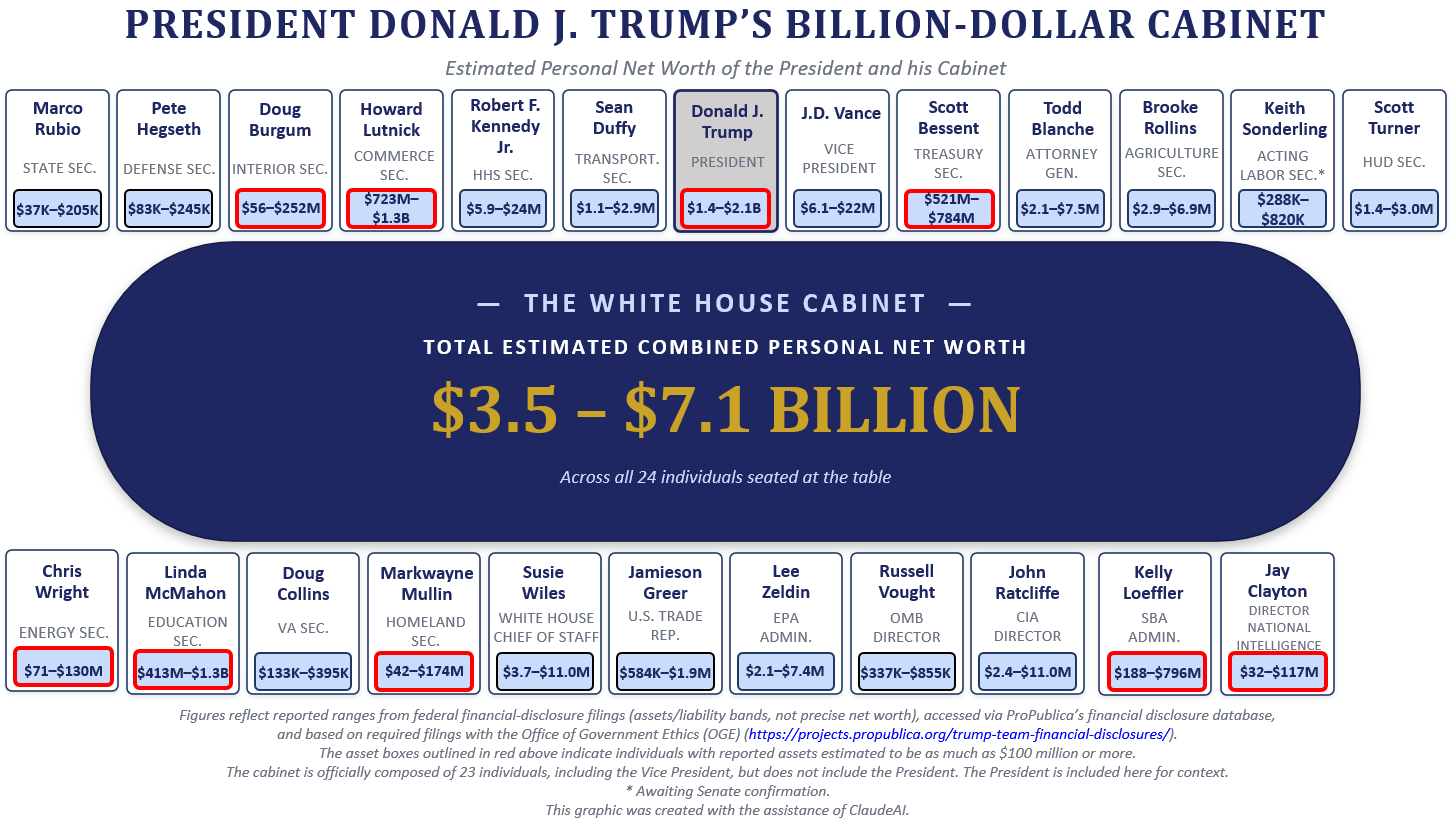
The Road to an Oligarchy
There is no bar against hiring individuals who happen to be wealthy to help serve an administration, and rewarding those who have financially supported presidential political campaigns has occurred for decades in various administrations. Campaign donors have often been rewarded with being appointed U.S. ambassadors, representing the United States overseas. Seventeen of the 57 ultra-millionaires and billionaires identified by Public Citizen in the Trump administration are U.S. ambassadors, but 40 of them are now running America’s governmental institutions. This is unprecedented and paves a troubled path towards an oligarchic form of government, where the wealthy elite hold the reins of power over the American public.
For comparison, Joe Biden had five individuals in his administration who were worth $100 million or more, which included four U.S. ambassadors and Special Presidential Envoy for Climate John Kerry.[8] Two of these individuals were billionaires.
During the Obama administration, only one administration official had assets of $1 billion or more, Penny Pritzker, the Secretary of Commerce. In addition, two others had assets of $100 million or more, including Secretary of State John Kerry and the U.S. ambassador to France.[9]
During both Presidential terms of George W. Bush his administration had a total of five administration officials worth as much as $100 million that included at least one billionaire, the only U.S. ambassador in this group, Roland Arnall, U.S. ambassador to the Netherlands.[10]
What makes the proliferation of the super wealthy having their hands on the levers of power in the Trump administration so troubling is the blatant ethical disregard Donald J. Trump has set for profiting off of the Office of the Presidency.[11] Recently released financial disclosure reports show that Trump, or his investment advisors, made more than 21,000 stock trades last year alone.[12] ABC News reported that President Biden made a total of 13 stock trades during his entire Presidency.[13] In addition, Donald Trump made an estimated $2.2 billion in 2025 in ethically questionable transactions, more than $1 billion of it from his crypto ventures.[14] He also touted the intelligence company Palantir on Truth Social after buying stock in the company,[15] and he purchased Netflix and Warner Bros. bonds at the height of a bidding war with Paramount.[16] The federal government played a central role in approving the eventual merger of Paramount and Warner Brothers.[17]
Even more morally morose is the fact that on July 16, 2026, the Trump Media & Technology Group (TMTG), that owns and operates the social media platform Truth Social, announced an ethically dubious business venture where they would sell paid access to the company’s highest ranking accounts, which presumably include President Trump who has made a consistent habit of posting newsworthy policy positions and actions on his Truth Social platform, to Wall Street brokers and investors before the general public, so that they could cash in and profit off of Donald Trump’s policies, positions, and often rambling political commentary.[18] This ethically shameless venture became a reality on August 1, 2026.[19] For a monthly fee of $100,000 (or $1.2 million per year) trading firms can obtain early access to what the company is calling “Truth API” to gain an edge on President Trump’s public predilections and pontifications.
Of all of the ethically troubling actions Trump has taken in recent years, this is certainly a stand-out event. “It’s insane” one Wall Street executive, who requested anonymity for fear of retaliation from the Trump administration, told National Public Radio (NPR). “I can say for myself and 200 of my friends in finance, we’re not getting anywhere near this.”[20] Perhaps stating the blatantly obvious, he said: “In another administration, this would be considered criminal.”[21] Indeed.
This also sets an ethical bar for others in the Trump administration that leaves little, if any, ethical principles on the table.
A Seat at the Table
Many of those who have obtained senior positions in the Trump administration at the highest levels of government appear to have paid their way to public service positions via large financial donations to Donald Trump’s Presidential campaign, affiliated political campaign committees, or President Trump’s inaugural committee. With no ceiling on campaign donations as a result of the 2010 Citizens United case,[24] Trump’s wealthy supporters have provided him with generous financial support, and many have been rewarded by Trump with a seat at the table in his administration. From 2022 to 2025, 30 of Trump’s 57 ultra-millionaires paid more than $65 million to Trump affiliated political campaign committees.[25] The vast majority of these donations were made in 2024. The timing of some donations and Trump’s nomination of these individuals to senior government positions is curious. Some examples are highlighted below:
Warren Stephens, Trump’s ambassador to the United Kingdom donated more than $9 million in 2024 and 2025 to various Trump campaign committees. President-elect Donald Trump nominated Stephens, an investment banker, to be the U.S. ambassador to the United Kingdom on December 2, 2024, prior to taking office for his second term.[26] On that very same day, Stephens donated $4 million to the Trump Vance Inaugural Committee and an additional $1 million to Trump’s Make America Great Again (MAGA) super PAC.[27] Two months prior he donated another $1 million to the MAGA super PAC on October 11, 2024, and one week prior to his nomination, on November 25, 2024, Stephens made a separate $1 million donation to the Trump Vance 2025 Transition committee. Additionally, in April 2024 Stephens donated $250,000 to the Trump 47 Committee, and he made two separate donations of $1 million each to Trump’s MAGA super PAC in July and August 2024.[28]
Stephens was the Chief Executive Officer of Stephens Inc., a Broker Dealer and Investment Bank, up until January 2025. Although he resigned from this position, he did not diversify his interest in the company. Instead, he became a non-managing shareholder of the parent company SI Holdings, Inc. and he still receives “passive income” from the company, according to his financial disclosure form. Stephens was confirmed as the U.S. ambassador to the United Kingdom in April 2025. Last month, CNBC conducted an analysis of Donald Trump’s 21,000 stock trades in 2025 and identified five companies that have been involved in handling these trades for the President, including Stephens Inc.
Trump nominated Tilman Fertitta to be the U.S. ambassador to Italy on December 21, 2024.[29] Since at least 2018, Tilman and his family had been long-time donors to Donald Trump’s political campaigns. In total, Fertitta donated $1.4 million to Trump campaign committees during the 2024 Presidential election cycle.[30] His two cousins, also donated $924,600 each to the Trump 47 Committee on the same day, August 27, 2024. In addition, his wife, Lauren Fertitta also donated $924,600 to the Trump 47 Committee on October 1, 2024, two months before her husband was nominated by Trump to be U.S. ambassador to Italy.[31]
Between December 2023 and October 2024, Howard Lutnick, Trump’s Secretary of Commerce, donated nearly $9 million to MAGA Inc., Trump’s super PAC.[32] This included a $5 million donation on August 5, 2024, to MAGA Inc., and just under $3 million to MAGA Inc. again on October 21, 2024.[33] Less than one month later, on November 19, 2024, Donald Trump nominated Howard Lutnick to be Secretary of Commerce.[34]
In other cases, Lutnick’s large political donations appear to coincide with politically sensitive issues. On April 1, 2026, while he was serving as Commerce Secretary, Lutnick made a $5 million donation[35] to the Congressional Leadership Fund (CLF), a super PAC dedicated to electing Republican Members of the U.S. House of Representatives.[36] Lutnick testified five weeks later in a closed-door nonpublic deposition to the House Oversight and Government Reform Committee about his relationship with child sexual predator Jeffrey Epstein.[37]
President Trump nominated another investment banker, Scott Bessent, to be Treasury Secretary on November 22, 2024.[38] Bessent donated a total of $1 million to Trump’s Make America Great Again PAC, with a donation of $250,000 in December 2023, $250,000 in January 2024, and $500,000 in February 2024. He also donated $100,000 to a Trump aligned super PAC,[39] Right for America, in June 2024, and $50,000 to the Trump 47 Committee on August 23, 2024, three months before Trump nominated him to be Secretary of Treasury.[40]
Not all of the ultra-millionaires in Trump’s administration are men. Linda McMahon, Trump’s Secretary of Education, was nominated to that position on November 19, 2024.[41] During the 2024 Presidential election cycle she donated more than $22 million to Trump affiliated campaign committees. On November 2, 2023, she donated $250,000 to Trump’s MAGA super PAC, and seven weeks later on December 20, 2023, she made a separate $5 million donation to the MAGA super PAC.[42] This was followed by three more donations of $5 million each to the MAGA super PAC in March, June, and September 2024.[43] She made a separate donation of $113,300 to the Trump 47 Committee, Inc. on September 23, 2024, just two months before she was nominated by Trump to be Education Secretary.[44] She also made a separate donation of $814,600 in March 2024 to the Trump 47 Committee, Inc., and another $1 million donation to the Trump aligned America First Action Fund on October 18, 2024, just one month before Trump nominated her to be Secretary of Education.[45]
Trump initially nominated Jared Isaacman as the Administrator of the National Aeronautics & Space Administration (NASA) on December 4, 2024, but then withdrew his nomination in May 2025, before renominating Isaacman for this position on November 4, 2025.[46] In a July 6, 2025, Truth Social post, President Trump explained his rationale for withdrawing his nomination of Isaacman to head NASA:
“Elon asked that one of his close friends run NASA and, while I thought his friend was very good, I was surprised to learn that he was a blue blooded Democrat, who had never contributed to a Republican before. Elon probably was, also. I also thought it inappropriate that a very close friend of Elon, who was in the Space Business, run NASA, when NASA is such a big part of Elon’s corporate life. My Number One charge is to protect the American Public!”[47]
Apparently, a $2 million dollar donation by Isaacman to Trump’s MAGA super PAC appears to have changed Trump’s mind. Isaacman made a $1 million donation to the MAGA super PAC in June 2025, one month after Trump withdrew his nomination for him, and he made another $1 million donation to the MAGA super PAC in September 2025, two months before Trump renominated him to this position.[48]
Since 2020 Isaacman has been Chairman of the Board and Chief Executive Officer of Shift4 Payments, Inc., a financial technology company providing credit card processing, point-of-sale hardware, and software integration. In January 2025, the company came to a settlement with the Securities and Exchange Commission (SEC) and was fined $750,000 for failing to disclose multiple large payments to the family members of company executives, violating SEC regulations.[49] In several individual incidents a sibling and a child of two separate executive officers of the company had been compensated $1.1 million and $167,947, respectively while employed at the company. A separate “sibling” of an executive received commission as an independent sales agent for the company received $281,609 in 2020, $492,096 in 2021, and $463,565 in 2022.[50] It is unclear who exactly these payments went to, but Isaacman’s father and half-brother Michael Isaacman both worked at the company during these alleged violations.[51] The lack of disclosures involving payments to family members violated SEC regulations.
Kelly Loeffler, the Administrator of the Small Business Administration (SBA) donated more than $5 million to Trump associated political campaign committees in 2024 and 2025. On December 4, 2024, she was nominated by Trump to lead the Small Business Administration.[52] In 2024, prior to her nomination she made five sizeable donations to Trump aligned political committees, including MAGA Inc. totaling $2.8 million.[53] Loeffler was confirmed by the U.S. Senate to head the SBA in February 2025.[54] Four months later, in June 2025, she made a separate $2.5 million donation to MAGA Inc.[55]
Trump nominated John Phelan as Secretary of the U.S. Navy on November 26, 2024.[56] Phelan had donated a little less than $1 million to the Trump 47 Committee in 2024, including a $93,300 donation on October 10, 2024, about six weeks before he was nominated to be Secretary of the U.S. Navy.[57] Phelan apparently ran into conflicts with other Pentagon officials, including Secretary of Defense Pete Hegseth over shipbuilding issues, and the Pentagon had also reportedly begun an ethics investigation into Phelan, but the substance of the alleged allegations have not been made public.[58] Phelan was reportedly fired from his position in April 2026.[59]
Frank Bisignano was nominated to be the Commissioner of the Social Security Administration by Donald Trump on December 4, 2024.[60] He is also currently the Chief Executive Officer (CEO) of the Internal Revenue Service (IRS). According to Federal Election Commission (FEC) records Bisignano only gave a single donation of $648.00 to the Trump National Committee JFC (Joint Fundraising Committee), Inc. on December 15, 2025.[61] However, his wife, Tracy Bisignano had donated more than $125,000 to Donald Trump’s political campaigns in 2019, and also donated $924,600 to the Trump 47 Committee, Inc. on October 11, 2024, two months before her husband was nominated by Trump to lead the Social Security Administration.[62]
From 2019 to May 2025, Bisignano served in senior roles at Fiserv, a global financial technology company, as President and Chief Operation Officer, Chief Executive Officer, and Chairman of the Board.[63] Months after Bisignano divested nearly $600 million in Fiserv investments in May and June 2025[64] the company’s stock plummeted by more than 40% (or lost $30 billion in market value) based on news that the company, under Bisignano’s leadership, issued grossly inflated earnings forecasts, according to a report in Government Executive.[65] Bisignano was confirmed by the U.S. Senate for his position as Administrator of the Social Security Administration on May 6, 2025. Two months later, on July 24, 2025, he was named as a defendant in a class action lawsuit filed by Fiserv investors.[66] These lawsuits which claim Bisignano, and others, mislead investors are still ongoing.[67]
Meanwhile, an explosive story in the Wall Street Journal on July 20, 2026, claimed that Bisignano “spied on co-workers” when he was the co-Chief Operating Officer at JPMorgan Chase, prior to working for Fiserv, allegations Bisignano vehemently denied.[68]
In addition, as the CEO of the Internal Revenue Service, Bisignano co-signed the IRS settlement deal for Donald Trump that created the $1.8 billion “anti-weaponization” fund.[69] On July 23, 2026, U.S. District Judge Kathleen Williams voided the settlement and referred Trump’s private attorney to the Florida bar for possible disciplinary actions.[70]
They say timing is everything.
Clearly, timing of political donations appears to have played a role in at least some of Trump’s picks to serve in senior positions in the U.S. government, ostensibly to help the American public.
Private Interests vs. Public Service
The U.S. Office of Government Ethics (OGE) was established in the wake of the Watergate scandal in 1978 and is supposed to provide guidance to federal officials, based on U.S. laws and regulations, to help “prevent and resolve conflicts of interest.”[71] Importantly, the agency’s website says: “OGE’s mission is part of the very foundation of public service.”[72]
The Director of the Office of Government Ethics is a nonpartisan position, and they are appointed to a five-year term of office, specifically intended to cross over from one administration to another to help shield them from political interference. Perhaps not surprisingly, in February 2025, President Trump removed the Director of the Office of Government Ethics (OGE), David Huitema, who had been confirmed by the Senate in December 2024.[73] Huitema was the only OGE Director since the founding of the office to be removed from office by a President.[74] The current Acting Director of the Office of Government Ethics is Keith Sonderling, who is also awaiting confirmation as the Secretary of Labor.
Under the guidance of OGE, federal employees are supposed to divest of assets that create conflicts of interest or recuse themselves from involvement in issues involving former employers or corporate entities in which they have had financial ties to in the past.
However, the personal financial interests of many of Trump’s senior officials given their extensive personal and family assets and business relationships as ultra-millionaire mega investors create massive financial conflicts in their role running federal agencies that can have significant economic consequences for the companies’ they may have financial investments in or previously managed. In several cases, following Donald Trump’s lead, senior Trump administration officials have failed to fully divest their assets or resolve apparent conflicts of interest, and instead placed their assets in trusts managed by their children, for instance. As a result, the ongoing conflicts are inescapable.
Howard Lutnick was the Chairman and Chief Executive Officer (CEO) of Cantor Fitzgerald, L.P., a major financial services firm before being appointed Commerce Secretary by President Trump.[75] Through his previous positions, particularly at Cantor Fitzgerald, Lutnick has been tied to more than 800 businesses, most often as president, chairman or Chief Executive Officer (CEO) in fields including financial services, real estate, cryptocurrency, artificial intelligence, technology, satellites, energy, gaming and other fields that may be directly impacted by policy decisions at the Department of Commerce.
In January 2026, the Department of Commerce and USA Rare Earth (USAR) announced a deal in which the U.S. government would take a 10% stake in the company.[76] As part of the deal USAR raised $1.5 billion in private stock offerings and selected Cantor Fitzgerald, the very company Lutnick had run, as the placement agent for the deal potentially resulting in multimillion dollar fees to Cantor Fizgerald.[77] When Lutnick left his role at Cantor Fitzgerald to become a federal employee his son Brandon assumed the role of Chairman and CEO of Cantor Fitzgerald and his other son Kyle took on the position as Vice Chairman.[78] They now appear to be on the road to benefitting from the actions of the Department of Commerce where their father is Secretary of Commerce, showing that Lutnick’s “divestiture” from Cantor Fitzgerald, turning his ownership interests in the company over to his adult children, may have been inadequate in preventing these sorts of glaring conflicts of interest.[79]
Democratic lawmakers have been investigating if the deal with USA Rare Earth, Inc., a critical minerals company, created a conflict of interest by benefiting Cantor Fitzgerald and Commerce Secretary Howard Lutnick’s sons.[80] They have repeatedly sought records from Lutnick about these transactions and how his former employer Cantor Fitzgerald, now run by his children, may benefit from the deal. So far, Lutnick has reportedly failed to provide any of the requested records to the U.S. Senate.
Scott Bessent, Trump’s Secretary of the Treasury, who previously ran a hedge fund investment group called Key Square Group,[81] was required by federal law to divest of certain investments or sell off certain assets by April 28, 2025, 90 days after he was confirmed as Secretary of the Treasury by the U.S. Senate. However, he failed to meet that deadline, according to reports in August 2025, and he indicated he would comply by December 15, 2025, eight months late.[82] There has been no public indication since the reporting on Bessent’s failure to comply with the Office of Government Ethics (OGE) deadline in August 2025 that he has yet fully complied.
More recently, in July 2026, Bessent defended serious and substantive questions about President Donald Trump’s potential conflicts-of-interest by accumulating an estimated $1.2 billion in crypto related ventures during the first year of his second term as President, last year.[83]
In 1992, the Deputy Secretary of Defense, Stephen Feinberg, co-founded Cerberus Capital Management, an investment firm with approximately $70 billion in assets, including in multiple national defense and security related companies.[84] The Deputy Secretary of Defense has sweeping powers within the Pentagon’s massive $1 trillion dollar plus budget,[85] overseeing investments in a huge assortment of military contracts and U.S. government economic stakes in military related private companies.[86]
For Feinberg, in his current role, this presents a hornet’s nest of conflicts of interest that appear unavoidable, even if he is not profiting personally. That is exactly what a recent investigative report in The Guardian by investigative reporter Aram Roston found.[87] The web of Pentagon ties to Cerebus, the company founded by Feinberg, still exist and continue to evolve. In January 2026, for example, the Pentagon announced an investment of more than $90 million in a Cerebus owned hypersonic flight test company called Stratolaunch.[88]
The Guardian also noted that Senator Elizabeth Warren wrote to Feinberg in April 2026 regarding DOD contracts awarded to at least four companies either owned or partially owned by Cerberus for the Pentagon’s estimated $185 billion Golden Dome missile defense program.[89] On July 27, 2026, Senator Warren again wrote to Feinberg, who never responded to her April 2026 letter, but noted that her staff had learned that one of the four companies, NetCentrics, that she indicated was owned by Cerebus in her April letter had reportedly been sold in December 2024, according to NetCentrics officials.[90] However, the company refused to disclose who currently owns it. In her letter, Senator Warren reiterated her request for information regarding details about the other three Cerebus owned companies’ contract awards for the Golden Dome project. Those three Cerebus owned companies are: North Wind, Stratolaunch, and Red River Technology.
In addition, in 2024 Cerebus acquired a controlling interest in M1 Support Services, an aviation maintenance, repair, modification, flight training, and logistics support company.[91] Since Feinberg was confirmed as Deputy Secretary of Defense in March 2025,[92] M1 has received at least $784 million in new or modified Pentagon contract awards. In December 2025, the company announced it had won a $115 million contract with the Air Force. That same month the Pentagon announced the company was also awarded a $601 million modification to an Army aviation maintenance contract,[93] and in January 2026 it received a separate $68 million modification on the same contract, bringing the contract total to $5.5 billion.[94]
Feinberg’s ethics agreements with OGE have raised concerns about his continuing conflicts. He reportedly placed his Cerberus holdings in trusts for his adult children rather than fully divesting his interest in the company, for instance.[95] In addition, he has maintained a contract with Cerberus Capital Management (CCM) for administrative services, including accounting, tax compliance, and health-care coverage. Feinberg initially made a commitment in April 2026 to fully divest of his financial relationship with Cerberus but in January 2026 he amended his ethics agreement, with the approval of OGE, to indefinitely maintain his relationship with Cerberus Capital Management because he claimed he could not identify any other company to provide these services for him.[96]
The conflicts of interest by Trump’s team of ultra-millionaire and billionaire officials take many forms. In June 2025, for instance, Fortune magazine published an exclusive story revealing that Kelly Loeffler, Trump’s Small Business Administration head, who had appeared numerous times on Newsmax since her confirmation in February 2025, owns 136,555 shares worth of stock in the parent company of Newsmax.[97]
The “Billionaire” Idaho Rancher
Michael Boren is often described as a ‘billionaire’ Idaho rancher by the media, although he only disclosed between $222 million and $834 million in assets in his financial disclosure forms. Donald J. Trump has described him as a “successful businessman,” which appears to be, in many instances, Trump’s sole criteria for managing federal agencies that are supposed to serve the American public. Boren apparently founded six companies, including Clearwater Analytics, a global financial technology automated investment data management company.[98]
In October 2025, Boren was confirmed by the U.S. Senate as the Undersecretary of Agriculture for Natural Resources and Environment (NRE). In that role he oversees 30,000 federal employees at the U.S. Forest Service,[99] 193 million acres of national forests and grasslands,[100] and a $1.75 billion wildland fire budget.[101]
Boren is not someone most people would have picked for this job.
As a “billionaire” rancher, Boren had a reputation for confronting U.S. Forest Service workers and violating environmental laws. A company he reportedly owned at the time, Galena Mines, built a cabin on federal land without authorization from the U.S. Forest Service.[102] Separately Boren allegedly diverted a hot spring-fed stream from public land to his private ranch without any required federal permit or environmental review.[103] In 2020, according to a U.S. Forest Service employee, Boren personally flew a helicopter about 10 feet off the ground in an attempt to harass federal Forest Service workers.[104] Boren denied he intended to harass or otherwise harm anyone.[105]
In addition, he reportedly built a private airstrip in the Sawtooth National Recreation Area in Idaho without a permit on his 480-acre cattle ranch, named Hell Roaring Ranch, that he purchased in 2015. Private property is permitted within the Sawtooth recreation area but there are strict rules about development, which neighbors have claimed Boren has consistently ignored.[106] In February 2021, Boren finally applied for a county permit for the airstrip, which was widely opposed, but he obtained the permit from the county anyway.[107] He also claimed the airstrip was an irrigated pasture used to land aircraft, and not an airstrip.[108] Yet, he apparently built a 6,000 square-foot aircraft-hanger at the site.[109]
Boren, like Donald Trump, has filed defamation suits against those that have voiced opposition to his actions. In June 2026, an Idaho judge dismissed Boren’s defamation suit that he filed against 20 unnamed individuals and four named defendants, including a video producer, two county commissioners, and a local search and rescue commander.[110] The suit surrounded opposition to Boren’s airstrip.
None of this is surprising but it is still disturbing, nevertheless.
Tax Scams & Congressional Affairs
In other cases, Donald Trump has hired ultra-millionaires despite the fact that they have been embroiled in unethical conduct in the past. One key example is the case of Frank Schuler, who was hired as a Senior Advisor at the General Services Administration (GSA) and later served as Acting Head of Congressional Affairs for the agency.
Ironically, in 2020, Frank Schuler was the subject of a bipartisan investigation from the U.S. Senate Committee on Finance, led by Chairman Charles Grassley and Ranking Member Ron Wyden, on “Syndicated Conservation-Easement Transactions.”[111] These transactions are “highly abusive tax shelters,” according to the committee’s bipartisan investigative report, where promoters sell inflated charitable tax deductions through land partnerships.[112] Frank Schuler, of the Ornstein-Schuler Investments group, was one of six individuals who was subpoenaed by the committee for failure to voluntarily comply with the committee’s records requests. The committee found that the Ornstein-Schuler “syndicated conservation-easement transactions were quick ways for upper-income taxpayers to shelter income from tax.”[113]
Although these transactions had originally been adopted by the government as a method for conserving land, the committee found the Ornstein-Schuler transactions, and others, were a “sham,” essentially developed as a means of defrauding investors by grossly inflating the worth of property easements they sold. Property easements are legal rights that allow non-owners use of someone else’s land for a defined purpose. The Internal Revenue Service (IRS) has listed these transactions in its “Dirty Dozen” list of “the worst of the worst tax scams.”[114]
In 2024 a U.S. tax court disallowed roughly $180 million of $187 million in claimed tax deductions that Schuler and his companies promoted to investors as methods of tax savings.[115] A separate class action case brought in 2020 against two of Schuler’s companies Ornstein-Schuler Investments LLC and Ornstein-Schuler Capital Partners LLC alleged, “This case involves the development and implementation of a fraudulent scheme to sell a flawed and defective tax-savings strategy: a Syndicated Conservation Easement Strategy.”[116] The case is ongoing, but the judge described some of Schuler’s explanations regarding his assessment of the land valuation he provided to investors as “wholly implausible.” A ProPublica report in February 2025 detailed Frank Schuler’s controversial background.[117] However, Schuler was not personally charged in these cases. Schuler resigned from GSA in July 2025[118] and his LinkedIn profile says he has been a Principal at WinCo Partners, Intersect Development Group, since January 2026.[119]
The Schuler case appears to be a clear fraudulent scam. Corruption, however, comes in different shapes and sizes. The corrupting influence from the financial web Trump’s ultra-millionaires and billionaires have previously maintained and in some cases still do in one form or another is difficult to fully decipher or quantify, but its very existence should give pause to the American public about who’s interests are on the table in the conference rooms at the federal agencies these ultra wealthy individuals now oversee.
Below is a table that details the declared assets of Trump’s 57 ultra-millionaire managers as well as what they have paid into the political machinery that helped to get Donald Trump elected.
Table 1: Trump Administration Officials with Disclosed Assets of As Much As $100 Million or More
Sources: The nomination dates below are based on the date President Trump first publicly announced his intention to nominate the individuals listed in the table, not the date the U.S. Senate officially received notice of the nomination, with a few exceptions. The confirmation dates are based on when the U.S. Senate officially confirmed the individual to the government position. The range of personal assets listed below are based on official “Form 278” financial disclosure records of Trump administration officials filed with the U.S. Office of Government Ethics (OGE) that have been made publicly available by ProPublica in a searchable database (https://projects.propublica.org/trump-team-financial-disclosures/). Campaign donations were obtained from the Federal Election Commission’s (FEC) publicly available data, unless otherwise indicated. ChatGPT and ClaudeAI assisted in identifying individuals in this table, but all references and sources were reviewed and confirmed by the author.
| Trump Administration Officials With Disclosed Assets of As Much As $100 Million or More | ||||||||
|---|---|---|---|---|---|---|---|---|
| Name | Position / Agency | Nomination | Confirmation | Personal Assets | Campaign Donations to Trump-Affiliated Political Organizations | Brief Background and Corporate Affiliations | ||
| Donation Details | Additional Donations | |||||||
| Stephen A. Feinberg | Deputy Secretary of Defense, Department of Defense | December 22, 2024 | March 14, 2025 | $2.0 billion- $4.6 billion+ | Co-founder and co-chief executive of Cerberus Capital Management, an alternative-investment and private-equity firm, and member, director or officer of multiple other companies. | |||
| Warren Stephens | U.S. Ambassador to the United Kingdom, Department of State | December 2, 2024 | April 29, 2025 | $1.1 billion- $2.6 billion+ | Total: $5.25 million • $250,000 to Trump 47 Committee, Inc. (4.3.2024) • $1 million to MAGA Inc. (7.26.2024) • $1 million to MAGA Inc., (8.26.2024) • $1 million to MAGA Inc. (10.11.2024) • $1 million to MAGA Inc. (12.02.2024) • $1 million to MAGA Inc. (2.24.2025) | Stephens listed campaign donations in the information he provided to the U.S. Senate during his nomination process that were not identified in the FEC filings listed above. These additional campaign disclosures include: Total: $5.25 million • $3,300 to Trump 47 Committee (4.3.2024) • $3,300 to Trump 47 Committee (4.3.2024) • $41,300 to Trump 47 Committee (4.3.2024) • $123,900 to Trump 47 Committee (4.3.2024) • $78.200 to Trump 47 Committee (4.3.2024) • $1,000,000 to Trump Vance 2025 Transition, Inc. (11.25.2024) • $4,000,000 to Trump Vance Inaugural Committee, Inc. (12.2.2024) | Chairman and former chief executive of Stephens Inc., Capitol Hotel Holdings, Inc.; also led Stephens Insurance and numerous Stephens family investment entities. | |
| John Phelan | Former Secretary of the Navy, Department of Defense (March 25, 2025-April 22, 2026) | November 26, 2024 | March 24, 2025 | $791 million- $2.2 billion+ | Total: $928K • $834,600 to Trump 47 Committee, Inc. (4.4.2024) • $93,300 to Trump 47 Committee, Inc. (10.10.2024) | Founder and managing member of Rugger Management, Rugger Investments and Rugger Capital; and managing member of many other companies. Phelan was fired from his position after clashes with Secretary of Defense Pete Hegseth, reportedly regarding implementation of shipbuilding reforms. In addition, some news accounts reported that Phelan was under an ethics investigation, but the details of the investigation were not clear and never made public. | ||
| Charles Kushner | U.S. Ambassador to France and Monaco, Department of State | November 30, 2024 | May 19, 2025 | $514 million- $2.0 billion+ | Total: $2 million • $1 million to MAGA Inc. (6.5.2023) • $844,600 to Trump 47 Committee, Inc. (6.3.2024) • $155,400 to MAGA Inc. (6.5.2024) | Founder of Kushner Companies LLC and manager or president of numerous affiliated real-estate entities. | ||
| Melinda Hildebrand | U.S. Ambassador to Costa Rica, Department of State | February 7, 2025 | October 7, 2025 | $603 million- $1.7 billion+ | Total: $210K • $200,000 to Trump 47 Committee, Inc. (7.18.2024) • $10,121.39 to Trump 47 Committee, Inc. (10.2.2024) | President of the Hildebrand Foundation and River Oaks Donuts; officer of Hilcorp Realty, Hilcorp Ventures, Hildebrand Enterprises and related family entities. | ||
| Howard Lutnick | Secretary of Commerce, Department of Commerce | November 19, 2024 | February 18, 2025 | $723 million- $1.3 billion+ | Total: $9.4 million • $250,000 to MAGA Inc. (12.29.2023) • $750,000 to MAGA Inc. (1.26.2024) • $413,000 to Trump 47 Committee, Inc. (4.1.2024) • $5 million to MAGA Inc. (8.5.2024) • $2,996,465.76 to MAGA Inc. (10.1.2024) | Longtime chairman and chief executive of Cantor Fitzgerald; also led BGC Group and Newmark Group. His financial disclosure report lists him as the president, manager, chairman or CEO of more than 800 companies. | ||
| Linda McMahon | Secretary of Education, Department of Education | November 19, 2024 | March 3, 2025 | $413 million- $1.3 billion+ | Total: $21.2 million • $250,000 to MAGA Inc. (11.2.2023) • $5,000,0000 to MAGA Inc. (12.20.2023) • $814,600 to Trump 47 Committee, Inc. (3.22.2024) • $5,000,000 to MAGA Inc. (3.22.2024) • $5,000,000 to MAGA Inc. (6.26.2024) • $5,000,000 to MAGA Inc. (9.5.2024) • $113,300 to Trump 47 Committee, Inc. (9.23.2024) | Co-founder and former chief executive of World Wrestling Entertainment and former director of Trump Media & Technology Group. | ||
| Kenneth Howery | U.S. Ambassador to Denmark, Department of State | December 22, 2024 | October 7, 2025 | $507 million- $1.1 billion+ | Co-founder of PayPal and Founders Fund, a venture capital fund; previously an executive at Clarium Capital Management and a consultant to Gemini Space Station. | |||
| Benjamin Leon Jr. | U.S. Ambassador to Spain and Andorra, Department of State | January 2, 2025 | December 18, 2025 | $379 million- $980 million+ | Total: $3.1 million • $185,400 to MAGA Inc. (3.25.2024) • $1 million to MAGA Inc. (6.13.2024) • $1 million to MAGA Inc. (11.19.2024) • $814,600 to Trump 47 Committee, Inc. (3.25.2024) • $113,300 to Trump 47 Committee, Inc. (9.24.2024) | Founder and executive of Leon Medical Centers; chairman of Comprehensive Care Group, Analytics of Aging, Leon Pharmaceutical Solutions, Leon Advertising & Public Relations, and chairman, manager, president or owner of dozens of other companies. | ||
| West Cuthbert | Former Associate Deputy Secretary, Department of Health and Human Services (April 2025 to April 2026). He is now a director at the August Strategy Group. | Not a Senate-confirmed position | $605 million- $901 million | Vice President of True North Management Group and consultant to Pluris Real Estate. | ||||
| Tilman Fertitta | U.S. Ambassador to Italy and San Marino, Department of State | December 21, 2024 | April 29, 2025 | $459 million- $837 million+ | Total: $494K • $6,600 to Trump Save America Joint Fundraising Committee (6.26.2023) • $407,300 to Trump 47 Committee, Inc. (4.5.2024) • $25,000 to Trump 47 Committee, Inc. (9.4.2024) • $55,000 to Trump 47 Committee, Inc. (10.8.2024) | Fertitta listed campaign donations in the information he provided to the U.S. Senate during his nomination process that were not identified in the FEC filings listed above. These additional campaign disclosures were listed as coming from the “Tilman J. Fertitta Company” and include: Total: $915K $100,000 to MAGA, Inc. (10.31.2022) $814,600 to Trump 47 Committee, Inc. (4.5.2024) In addition, Fertitta’s family has also made generous contributions to Donald Trump’s political campaigns. Fertitta’s two cousins, Lorenzo Joseph Fertitta and Frank J. Fertitta III each donated $924,600 to the Trump 47 Committee, Inc. on August 27, 2024, and his wife, Lauren Fertitta, made a $924,600 donation to the Trump 47 Committee on October 1, 2024. | Chairman and chief executive of Fertitta Entertainment, President of Post Oak Motors, a luxury car company, several restaurant chains, and owner of the Houston Rockets; involved in scores of other companies. | |
| Michael Boren | Under Secretary of Agriculture for Natural Resources and Environment | January 16, 2025 | October 7, 2025 | $222 million- $834 million+ | Co-founder of Clearwater Analytics; principal of Obsidian Investments, Sawtooth Investment Management and Sockeye Trading Company, manager of many other businesses. | |||
| Kelly Loeffler | Administrator, Small Business Administration | December 4, 2024 | February 19, 2025 | $188 million- $796 million+ | Total: $5.4 million • $220,000 to MAGA Inc. (2.9.2024) • $500,000 to MAGA Inc. (2.27.2024) • $824,600 to Trump 47 Committee, Inc. (3.27.2024) • $10,000 to Trump 47 Committee, Inc. (6.26.2024) • $1,000,000 to MAGA Inc. (6.26.2024) • $90,000 to Trump 47 Committee, Inc. (8.16.2024) • $250,000 to MAGA Inc. (9.9.2024) • $2,500,000 to MAGA Inc. (6.25.2025) | Former chief executive of Bakkt, a digital finance company, and senior executive at Intercontinental Exchange, a global financial technology company; founder of Red Sky Holdings and Descante Capital. | ||
| Richard Duke Buchan III | U.S. Ambassador to Morocco, Department of State | March 7, 2025 | October 7, 2025 | $213 million- $787 million+ | Founder and chief executive of Hunter Global Investors; previously worked at Merrill Lynch. Former U.S. Ambassador to Spain from 2017 to 2021, during the first Trump administration, and then served as finance chair of the Republican National Committee from 2022 to 2025. | |||
| Scott Bessent | Secretary of the Treasury, Department of the Treasury | November 22, 2024 | January 27, 2025 | $521million- $784 million+ | Total: $1.4 million • $11,600 to Trump Save America Joint Fundraising Committee (9.19.2023) • $250,000 to MAGA Inc. (12.28.2023) • $250,000 to MAGA Inc. (1.10.2024) • $500,000 to MAGA Inc. (2.1.2024) • $250,000 to Trump 47 Committee, Inc. (3.28.2024) • $100,000 to Trump 47 Committee, Inc. (6.10.2024) • $50,000 to Trump 47 Committee, Inc. (8.23.2024) | Founder, chief executive and chief investment officer of Key Square Group; previously chief investment officer of Soros Fund Management. | ||
| Leandro (“Lee”) Rizzuto Jr. | U.S. Permanent Representative to the Organization of American States | December 10, 2024 | October 7, 2025 | $358 million- $753 million+ | Former executive and co-founder of Conair Corporation and manager or trustee of family investment entities. He also previously served as U.S. Consul General in Bermuda and Chairman of the Professional Beauty Association. | |||
| Steven C. Witkoff | Assistant to the President and Special Envoy for Peace Missions | Not a Senate-confirmed position | $400 million- $714 million+ | Total: $262K • $11,600 to Trump Save America Joint Fundraising Committee (5.1.2023) • $250,000 to MAGA Inc. (12.27.2023) | Founder and managing member of the Witkoff Group and numerous affiliated real-estate investment and development entities. | |||
| Paul S. Atkins | Chairman, Securities and Exchange Commission | January 20, 2025 | April 9, 2025 | $324 million- $579 million+ | Total: $3K • $3,437.81 to Trump National Committee JFC, Inc. (8.1.2024) | Founder and chief executive of Patomak Global Partners; director or trustee of TAMKO entities and private investment funds, family trusts, and other companies. | ||
| Scott A. Kupor | Director, Office of Personnel Management | January 13, 2025 | July 9, 2025 | $182 million- $573 million+ | Managing partner and former chief operating officer of AH Capital Management, better known as Andreessen Horowitz; served vice president and general manager at Hewlett-Packard (HP), as Chairman of the National Venture Capital Association, and on numerous technology-company boards. | |||
| Frank J. Bisignano | Commissioner, Social Security Administration and Chief Executive Officer of the Internal Revenue Service (IRS) | December 4, 2024 | May 6, 2025 | $250 million- $561 million+ | Total: $648.00 • $648 to Trump National Committee JFC, Inc. (12.15.2025) Bisignano’s wife, Tracy, made separate donations to Trump aligned political committees in 2019 and 2024: • $125,000 to Trump Victory (5.23.2019) • $2,800 to Donald J. Trump for President, Inc. (5.23.2019) • $924,600 to Trump 47 Committee, Inc. (10.11.2024) | Former chairman, president and chief executive of Fiserv, a global financial technology and payments company; previously held positions at JPMorgan Chase, Morgan Stanley, and Citigroup. He has also served as the CEO of the Internal Revenue Service (IRS) since October 2025. | ||
| Joseph Popolo Jr. | U.S. Ambassador to the Netherlands, Department of State | January 3, 2025 | October 7, 2025 | $169 million- $552 million+ | Total: $816K • $275,000 to Trump 47 Committee, Inc. (3.26.2024) • $215,000 to Trump 47 Committee, Inc. (6.24.2024) • $3,300 to Trump 47 Committee, Inc. (7.10.2024) • $10,000 to Trump 47 Committee, Inc. (7.12.2024) • $313,000 to Trump 47 Committee, Inc. (9.19.2024) | Chief executive of Charles & Potomac Capital and president of the Connelly Family Office; former chief executive of The Freeman Company, an event planning business. | ||
| Jared T. Isaacman | Administrator, National Aeronautics and Space Administration | December 4, 2024 Nomination Withdrawn: May 2025 | December 17, 2025 Renominated: November 4, 2025 | $314 million- $492 million+ | Total: $2 million • $1,000,000 to MAGA Inc. (6.30.2025) • $1,000,000 to MAGA Inc. (9.15.2025) | Founder and longtime chief executive of Shift4 Payments; founder of Draken International and executive of related aviation and payments companies. Isaacman also commanded Inspiration4, the first all-civilian spaceflight using SpaceX’s rockets and later led Polaris Dawn and became the first private citizen to perform a spacewalk. | ||
| Melissa Argyros | U.S. Ambassador to Latvia, Department of State | March 24, 2025 | December 18, 2025 | $126 million- $476 million+ | Total: $200K • $200,000 to Trump 47 Committee, Inc. (6.13.2024) | Co-chief executive and co-chair of the Argyros Family Foundation; adviser to Arnel Development Company, and real estate investor. She is the daughter of billionaire George Argyros, who served as U.S. ambassador to Spain from 2001 to 2004. | ||
| Jacob Helberg | Under Secretary of State for Economic Growth, Energy, and the Environment, Department of State | December 10, 2024 | October 7, 2025 | $112 million- $426 million+ | Total: $1.9 million • $11,600 to Tramp Save America Joint Fundraising Committee (1.25.2024) • $844,600 to Trump 47 Committee, Inc. (4.26.2024) • $1,000,000 to MAGA Inc. (7.10.2024) • $371.00 to Trump National Committee JFC, Inc. (7.16.2024) | Senior adviser to Palantir Technologies; managing member of Outbuild, a construction scheduling software company; previously worked at Google. | ||
| Jared Novelly | U.S. Ambassador to New Zealand, Samoa, the Cook Islands and Niue, Department of State | January 24, 2025 | May 18, 2026 | $160 million- $359 million+ | Total: $125K • $25,000 to Trump 47 Committee, Inc. (7.25.2024) • $25,000 to Trump 47 Committee, Inc. (7.31.2024) • $25,000 to Trump 47 Committee, Inc. (11.5.2024) • $25,000 to Trump 47 Committee, Inc. (11.18.2024) • $25,000 to Trump 47 Committee, Inc. (12.11.2024) | Executive and investor in family-owned real estate, petroleum-products, hospitality and investment businesses; majority owner of the Illawarra Hawks, an Australian professional basketball team. | ||
| Thomas J. Barrack | U.S. Ambassador to Turkey, Department of State, and Special Presidential Envoy for Syria and Iraq. | December 10, 2024 | April 29, 2025 | $112 million- $320 million+ | Total: $100K • $100,000 to Trump 47 Committee, Inc. (10.24.2024) | Founder and former executive chairman of Colony Capital, later DigitalBridge, a global digital infrastructure investment firm; founder or manager of numerous Barrack investment partnerships. | ||
| Dr. Mehmet Cengiz Oz | Administrator, Centers for Medicare & Medicaid Services, Department of Health and Human Services | November 19, 2024 | April 3, 2025 | $88 million- $308 million+ | Owner or managing member of various television and media businesses, a property company, and medical and investment holding companies. | |||
| William J. Pulte | Director, Federal Housing Finance Agency | January 16, 2025 | March 13, 2025 | $118 million- $306 million+ | Total: $50K • $50,000 to Trump 47 Committee, Inc. (7.15.2024) • $50,000 to Trump 47 Committee, Inc. (10.20.2024) • $1.00 to Trump National Committee JFC, Inc. (10.26.2024) • $205.00 to Trump National Committee JFC, Inc. | Founder and chief executive of Pulte Capital Partners; manager of Pulte Family Office and numerous private-investment and real-estate entities. | ||
| Kevin Warsh | Nominee for Chairman and Member, Board of Governors of the Federal Reserve System | January 30, 2026 | May 13, 2026 | $184 million- $301 million+ | Former Federal Reserve Board governor; former executive director at Morgan Stanley; partner at Duquesne Family Office; director of United Parcel Service and Coupang; fellow at the Hoover Institution. | |||
| Frank Schuler | Senior Advisor, General Services Administration. (Also served as Acting Head of Congressional Affairs at GSA. He served in the Trump administration from January to July 2025.) | Not a Senate-confirmed position | $81 million- $289 million+ | Founder and co-CEO of Ornstein-Schuler Investments, a real estate investment firm, Ornstein-Schuler Capital Partners, and Fortem Holdings, a private equity firm. In 2020, Schuler was the subject of a bipartisan investigation by the U.S. Senate’s Committee on Finance for his role promoting Syndicated Conservation-Easement Transactions, described as abuse tax shelters by the Internal Revenue Service (IRS). His companies have also been the subject of a class action lawsuit that is still ongoing and in 2024 a U.S. tax court disallowed $187 of $180 million in claimed tax deductions by investors that Schuler promoted these transactions to through his companies. | ||||
| John Breslow | Nominee for U.S. Ambassador to Cyprus, Department of State | October 21, 2025 | Awaiting confirmation | $96 million- $278 million+ | Total: $858K • $3,435.35 to Trump Save America Joint Fundraising Committee (3.4.2024) • $250,000 to Trump 47 Committee, Inc. (4.10.2024) • $50,000 to Trump 47 Committee, Inc. (7.17.2024) • $544,600 to Trump 47 Committee, Inc. (7.25.2024) • $10,000 to Trump 47 Committee, Inc. (10.30.2024) | Managing member of Breslow Enterprises, Nevada Realty Holdings, JAB Ventures and other companies. Former owner and chairman of LinWeld, Inc., a supplier of welding goods and industrial gases, and has ownership interests connected to the Vegas Golden Knights hockey team and the T-Mobile Arena in Las Vegas. | ||
| Gregory Beard | Senior Advisor, Department of Energy (In January 2026 Beard was promoted to Director, of DOE’s Office of Energy Dominance Financing (EDF). | Not a Senate-confirmed position | $71 million- $278 million+ | Board member of Skeena Resources Ltd., former CEO of Stronghold Digital Mining and Beard Energy Transition Acquisition Corp., and Senior Advisor to Andros Capital Partners, LLC. | ||||
| Emil G. Michael | Under Secretary of Defense for Research and Engineering | December 22, 2024 | May 14, 2025 | $121 million- $277 million+ | Former chief business officer of Uber; owner of M8, M9 and M10 Enterprises, co-owner of Nomadic Ventures, and board member of various technology companies, including D-Wave Quantum, Inc. and Perplexity. | |||
| Stacey Feinberg | U.S. Ambassador to Luxembourg, Department of State | December 16, 2024 | October 7, 2025 | $73 million- $276 million+ | Managing director of 33 Capital LLC, a global investment firm, private funds and family investment entities. | |||
| Benjamin (“Ben”) Black | Chief Executive Officer, U.S. International Development Finance Corporation | January 31, 2025 | October 7, 2025 | $115 million- $268 million+ | Total: $50K • $50,000 to Trump 47 Committee, Inc. (8.21.2024) | Founder and managing partner of Managing partner of Fortinbras Enterprises and related investment entities; previously a managing director at Apollo Global Management. Black’s father is the controversial ultra-conservative Leon Black, co-founder of the private equity firm Apollo Global Management. Multiple stories have raised ethics concerns about Black’s quiet influence on members of the U.S. Supreme Court. | ||
| Howard Brodie | U.S. Ambassador to Finland, Department of State | February 10, 2025 | October 7, 2025 | $175 million- $267 million+ | Total: $845K • $844,600 to Trump 47 Committee, Inc. (7.11.2024) | Co-president and general counsel of Brodie Generational Capital Partners; executive of Wynnefield Brother International and related private funds. | ||
| Doug Burgum | Secretary of Interior, Department of the Interior | November 15, 2024 | January 30, 2025 | $56 million- $252 million+ | Founder of Great Plains Software; General Partner at Arthur Ventures, former Microsoft executive; private investment and real-estate interests. | |||
| Linda Whitridge | Special Advisor, Department of the Treasury | Not a Senate-confirmed position | $80 million- $233 million+ | Co-trustee of her family trust. She was part of Elon Musk’s DOGE Team at the Department of Treasury. | ||||
| Edward (“Ed”) Forst | Administrator, General Services Administration. (Since April 2026 he has also been serving as the Acting Archivist at the National Archives and Records Administration (NARA). | July 31, 2025 | December 18, 2025 | $54 million- $218 million+ | Manager, General Manager, and Investment Manager at various companies, including Lion Capital, Forst 2000 LLC, Wellde Investment Partners LLC, and Solamere Capital LLC, Vice Chairman of the Board of Directors of Rose Technologies Corporation, and former senior advisor to the Treasury Department during President George W. Bush administration. | |||
| Bernardo Navarro | U.S. Ambassador to Peru, Department of State | May 22, 2025 | December 18, 2025 | $75 million- $202 million+ | President of Benworth Capital Partners, LLC, Manager of Benworth Financial LLC and Benworth Management LLC, and related real estate and finance entities. | |||
| Peter Lamelas | U.S. Ambassador to Argentina, Department of State | December 12, 2024 | September 18, 2025 | $54 million- $201 million+ | Total: $517K • $11,600 to Trump Save America Joint Fundraising Committee (4.7.2023) • $5,800 to Trump Save America Joint Fundraising Committee (1.5.2024) • $100,000 to MAGA Inc. (2.13.2024) • $100,000 to Trump 47 Committee, Inc. (3.27.2024) • $100,000 to Trump 47 Committee, Inc. (5.3.2024) • $200,000 to Trump 47 Committee, Inc. (7.24.2024) | Lamelas is a medical doctor and founder of MD Now Urgent Care, Managing Member of various other companies, including Big Red Investments Holdings LLC and El Gato Negro LLC, and Vice President of the Lamelas Foundation. | ||
| John Figueroa | Senior Advisor to the Secretary, Department of Veterans Affairs. (In 2026 Figueroa became the Acting Under Secretary for Health (AUSH) at the VA.) | Not a Senate-confirmed position | $57 million-$ 195 million+ | Total: $925K • $11,600 to Trump Save America Joint Fundraising Committee (2.19.2024) • $100,000 to Trump 47 Committee, Inc. (4.17.2024) • $360.00 to Trump National Committee JFC, Inc. (7.18.2024) • $5,000 to Trump 47 Committee, Inc. (7.22.2024) • $10,000 to Trump 47 Committee, Inc. (7.22.2024) • $25,000 Trump 47 Committee, Inc. (8.6.2024) • $772,640 Trump 47 Committee, Inc. (9.23.2024) | Former Chairman of CarePathRx Midco, Inc., and former Vice Chairman of Nystrom & Associates, and Apotheco Pharmacy Group, founder and former managing member of SempiternusRx, LLC, and former Executive Chairman of ExactCare Pharmacy, LLC and ProHealth Parent LLC. | |||
| Duane (“Duey”) Stroebel | Regional Administrator, Region V, Department of Housing and Urban Development | Not a Senate-confirmed position | $55 million- $187 million+ | Former Wisconsin State Senator, managing member of various real estate companies, including Mequon Senior Housing LLC, Cedarburg Senior Apartments LLC, Woodmere Townhomes LLC and West Heather Business Center LLC, among others. | ||||
| Geoffrey G. Jervis | Director, Office of Manufacturing and Energy Supply Chains, Department of Energy | Not a Senate-confirmed position | $82 million- $175 million+ | Former CEO of Mint Eco Car Wash Holdings, LLC and manager of multiple related companies. He also worked as a Chief Financial Officer at Capital Trust, The Blackstone Group, STAG Industrial, Inc., and iStar. | ||||
| Markwayne Mullin | Secretary of Homeland Security, Department of Homeland Security | March 5, 2026 | March 23, 2026 | $42 million- $175 million+ | Former U.S. Senator, managing member of Mullin Properties LLC, Mullin Realty LLC, Mullin Ranch LLC and various other businesses. | |||
| David E. Shapiro | Special Advisor and Chief Counsel, U.S. Investment Accelerator, Department of Commerce | Not a Senate-confirmed position | $57 million- $166 million+ | Former law partner at Wachtell, Lipton, Rosen & Katz, and former Member and Secretary of Figue Acquisition LLC, a women’s apparel company. | ||||
| Michael Cole | Senior Team Leader on Government Efficiency, Department of Agriculture (February 2025-August 2025). | Not a Senate-confirmed position | $40 million- $157 million+ | Former CEO of Shareholder Capital LLC and former President and CFO of eMed LLC. He also held positions at Madison Dearborn Partners, a private equity firm, founded Seven Saoi Capital and served as Co-Chief Restructuring Officer of RadioShack. He is currently serving on the Board of Directors of Edesia Nutrition. | ||||
| Dario Gil | Under Secretary for Science, Department of Energy | January 16, 2025 | September 18, 2025 | $29 million- $143 million+ | Long-time Senior Vice President and Director of Research at IBM and Director of the Semiconductor Industry Association. | |||
| Audrey Robertson | Assistant Secretary for Efficiency and Renewables, Department of Energy | February 12, 2025 | October 7, 2025 | $46 million- $139 million+ | Co-founder, CFO and Executive Vice President of Franklin Mountain Operating, LLC, an oil and gas company, also a Member of the Board of Directors of Liberty Energy, Inc., and various positions with other energy related companies. | |||
| David Barker | Assistant Secretary for Postsecondary Education, Department of Education | May 9, 2025 | October 7, 2025 | $28 million- $135 million+ | Total: $50K • $374.77 to Trump 47 Committee, Inc. (7.17.2024) • $50,000 to Trump 47 Committee, Inc. (10.11.2024) | General Partner of Eastlake Partnership, and president, director or manager of multiple property and real estate related companies. | ||
| Brad Smith | Senior Advisor, Bureau of Global Health, Department of State | Not a Senate-confirmed position | $33 million- $132 million+ | Total: $550K • $50,000 to Trump 47 Committee, Inc. (8.23.2024) • $500,000 to Trump 47 Committee, Inc. (8.27.2024) | Founder and CEO of health care startup firm Russell Street Ventures, Co-founder of Aspire Health, CareBridge and Main Street Health. Former member of Elon Musk’s DOGE team at the Department of Health and Human Services (HHS). | |||
| Christopher (Chris”) Allen Wright | Secretary of Energy, Department of Energy | November 16, 2024 | February 3, 2025 | $71 million- $130 million+ | Total: $229K • $175,000 to Trump 47 Committee, Inc. (7.30.2024) • $53,990.35 to Trump 47 Committee, Inc. (8.22.2024) | Founder and former chief executive of Liberty Energy and Director of various other energy companies and associations, such as the Domestic Energy Producers Alliance. | ||
| Edward Eppler | Nominee for Chief Financial Officer, Department of Transportation | October 21, 2025 | Awaiting confirmation | $45 million- $129 million+ | Former CFO at BETA Technologies, Inc., Managing Member of Eppler & Company LLC, Zirkel Acquisition Corp., LLC, and Director of Benchmark Space Systems, Inc. He was also Global Head of Aerospace & Defense Investment Banking at Goldman Sachs & Co, LLC. | |||
| Christopher Landau | Deputy Secretary of State, Department of State | December 8, 2024 | March 24, 2025 | $36 million- $126 million+ | Total: $50K • $50,000 to Trump 47 Committee, Inc. (6.11.2024) | Of counsel at Ellis George LLP, and former partner at Quinn Emanuel, and previously served as U.S. ambassador to Mexico from 2019 to 2021. | ||
| Walter Joseph (“Jay”) Clayton | Director of National Intelligence (DNI) | June 11, 2026 | July 28, 2026 | $32 million- $117 million+ | Former U.S. Attorney for the Southern District of New York and Chair of the Securities and Exchange Commission (SEC) from 2017 to 2020. Independent Chairman, Apollo Global Management, Inc., Senior Policy Advisor & Counsel, Sullivan & Cromwell LLP, Director, American Express Company, Advisory Board Member, Coinbase Asset Management. | |||
| Bryan Bedford | Administrator, Federal Aviation Administration, Department of Transportation | March 17, 2025 | July 9, 2025 | $29 million- $116 million+ | President and CEO, Republic Airways Holdings, Inc., president and CEO of various other aviation companies, Secretary of the Executive Committee, Regional Airline Association. | |||
| Nicholas A. Merrick | U.S. Ambassador to the Czech Republic, Department of State | February 6, 2025 | October 7, 2025 | $36 million- $111 million+ | Total: $3K • $3,300 to Trump Save America Joint Fundraising Committee (11.17.2023) | President, Mt. Vernon Investments LP, Chairman of the Board of Trustees, Dallas Police & Fire Pension System, member or director of various other family investment and real estate companies. | ||
| TOTALS | Minimum total: • $13.9 billion Maximum total: • $34.8 billion + | Total Trump-related campaign donations: • $65 million | ||||||
ENDNOTES:

[1] See the table at the end of this report.

[2] Jennifer Simonson, “Average Salary By State,” FORBES (July 10, 2026), https://www.forbes.com/advisor/business/average-salary-by-state/

[3] Emily Sherman and Jessica Walrack, “What Is the Average American Net Worth by Age?” U.S. NEWS & WORLD REPORT (March 19, 2026), https://money.usnews.com/money/personal-finance/articles/what-is-the-average-american-net-worth-by-age

[4] Alex Brunet and Marina Pino, “Poll: Voters Want Solutions for Government Corruption,” BRENNAN CENTER FOR JUSTICE, New York University School of Law (June 2, 2026), https://www.brennancenter.org/our-work/analysis-opinion/poll-voters-want-solutions-government-corruption

[5] See the table starting at the end of this report.

[6] Mandatory financial disclosures for federal employees that must be filed with the Office of Government Ethics (OGE) provide a range of declared assets. If an individual had declared assets that was as high as $100 million, such as $78 million to $101 million, for example, then they were included in Public Citizen’s analysis, which found 57 individuals had declared assets of ‘as much as’ $100 million or more.

[7] These 31 individuals had declared assets that ranged from at least $100 million or more. For instance, if an individual had declared assets of $100 million to $128 million, or $578 million to $1.3 billion, they were included in this category.

[8] The five individuals in the Biden administration that Public Citizen identified that had declared assets of as much as $100 million or more were: 1) Margaret (“Meg”) Whitman, former U.S. ambassador to Kenya, had declared assets of between $860.3 million-$3.0 billion; 2) Alan M. Leventhal, former U.S. ambassador to Denmark, had declared assets of between $463.9 million-$1.5 billion; 3) John F. Kerry, former Special Presidential Envoy for Climate, had declared assets of between $165-$626 million; 4) Jane D. Hartley, former U.S. ambassador to the United Kingdom, had declared assets of between $65.7-$253.1 million; and 5) Scott C. Miller, former U.S. ambassador to Switzerland and Liechtenstein, had declared assets of between $56.1-$142.8 million. ChatGPT was utilized to help identify these individuals.

[9] The three individuals in the Obama administration that Public Citizen identified that had declared assets of as much as $100 million or more were: 1) Penny Pritzker, former Secretary of Commerce, had declared assets of more than $1 billion; 2) John F. Kerry, former Special Presidential Envoy for Climate, had declared assets of between $165-$626 million; 3) Jane D. Hartley, former U.S. ambassador to France and Monaco, had declared assets of between $65.7-$253.1 million. ChatGPT was utilized to help identify these individuals.

[10] The five individuals in the Bush administration that Public Citizen identified that had declared assets of as much as $100 million or more were: 1) Henry M. Paulson Jr., former Secretary of the Treasury, had declared assets of more than $700 million; 2) Roland E. Arnall, former U.S. ambassador to the Netherlands, was estimated by Forbes to have a net worth of an estimated $3 billion; 3) Samuel W. Bodman, former Deputy Secretary of Commerce, Deputy Secretary of the Treasury, and Secretary of Energy, had an estimated net worth of between $49-$164 million; 4) Donald H. Rumsfeld, former Secretary of Defense, had estimated assets of between $35–$135 million; and 5) Paul H. O’Neill, former Secretary of the Treasury, had estimates assets of between $54-$111 million. ChatGPT was utilized to help identify these individuals.

[11] Dearbail Jordan and Emer Moreau, “Bibles, Home Alone and perfume: Six takeaways from Trump's 2025 finances,” BRITISH BROADCASTING CORPORATION (BBC) (July 1, 2026), https://www.bbc.com/news/articles/cy9rg133lrjo

[12] Will Lennon, Nicholas Kerr, Laura Romero, and Peter Charalambous, “Trump discloses 21,000 securities trades during first year in office,” ABC NEWS (July 2, 2026), https://abcnews.com/Politics/trump-discloses-21000-securities-trades-year-office/story?id=134427666

[13] Ibid.

[14] Nick Lichtenberg, “‘A witches’ brew’: Washington’s ethics establishment reacts to Trump’s $2.2 billion windfall—they’re shocked but not surprised,” FORTUNE (July 2, 2026), https://fortune.com/2026/07/02/trump-2-2-billion-income-disclosure-reactions-eisen-gephardt/

[15]Samantha Subin, “Trump touted Palantir on Truth Social after buying the company's stock, records show,” CNBC (May 15, 2026), https://www.cnbc.com/2026/05/15/trump-palantir-stock-truth-social.html

[16] Trevor Hunnicutt and Matt Tracy, “Trump bought Netflix and Warner Bros bonds at height of bidding war with Paramount,” REUTERS (March 9, 2026), https://www.reuters.com/sustainability/sustainable-finance-reporting/trump-bought-netflix-warner-bros-bonds-height-bidding-war-with-paramount-2026-03-09/

[17] “Statement of the Department of Justice Antitrust Division on the Closing of Its Investigation of the Merger of Paramount Skydance and Warner Bros.,” Press Release, U.S. DEPARTMENT OF JUSTICE (June 12, 2026), https://www.justice.gov/opa/pr/statement-department-justice-antitrust-division-closing-its-investigation-merger-paramount

[18] See: Bernard Condon, “Paying for early access to Trump’s Truth Social could raise big money and major ethical issues,” ASSOCIATED PRESS (AP) (JULY 17, 2026), https://apnews.com/article/truth-social-trump-conflicts-of-interest-8020da39fe2d3810138b39f056d286e0; Mark Swaney, “‘Brazen corruption’: critics denounce Trump Media plan to sell priority access to Truth Social posts,” THE GUARDIAN (July 17, 2026), https://www.theguardian.com/us-news/2026/jul/16/trump-media-truth-social-posts; and “Trump Media and Technology Group Launches Truth API, a New Licensed Data Service for Financial Services Partners That Provides the Fastest Access to Truth Social’s Most Influential Accounts,” Press Release, TRUMP MEDIA & TECHNOLOGY GROUP (TMTG) (July 16, 2026), https://markets.businessinsider.com/news/stocks/trump-media-and-technology-group-launches-truth-api-a-new-licensed-data-service-for-financial-services-partners-that-provides-the-fastest-access-to-truth-social-s-most-influential-accounts-1036332436?

[19] Bobby Allyn, “For sale: early access to Trump's Truth Social posts,” NATIONAL PUBLIC RADIO (NPR) (August 1, 2026), https://www.npr.org/2026/08/01/nx-s1-5912219/trump-truth-social-access-insider-trading

[20] Ibid.

[21] Ibid.

[22] See the table at the end of this report.

[23] The assets listed in the graphic below were pulled from U.S. Office of Government Ethics (OGE) financial disclosure forms made publicly available by ProPublica in a searchable database: https://projects.propublica.org/trump-team-financial-disclosures/.

[24] Daniel I. Weiner, “Citizens United, Explained,” BRENNAN CENTER FOR JUSTICE, New York University (NYU) School of Law, (December 12, 2019. Updated January 29, 2025), https://www.brennancenter.org/our-work/research-reports/citizens-united-explained

[25] See the table at the end of this report.

[26] Kayla Epstein, “Trump picks investment banker Warren Stephens as UK ambassador,” BBC NEWS (December 2, 2024), https://www.bbc.com/news/articles/c20e79nlpe6o

[27] “Executive Reports of Committees,” (Committee on Foreign Relations), CONGRESSIONAL RECORD – SENATE (April 9, 2025), https://www.congress.gov/119/crec/2025/04/09/171/64/CREC-2025-04-09-pt1-PgS2510-2.pdf

[28] “Executive Reports of Committees,” (Committee on Foreign Relations), CONGRESSIONAL RECORD – SENATE (April 9, 2025), https://www.congress.gov/119/crec/2025/04/09/171/64/CREC-2025-04-09-pt1-PgS2510-2.pdf

[29] “Tilman Ambassador of Italy,” TILMAN J. FERTITTA, https://tilmanfertitta.com/featuring/Tilman-Ambassador-of-Italy/

[30] “Executive Reports of Committees,” (Committee on Foreign Relations), CONGRESSIONAL RECORD – SENATE (April 9, 2025), https://www.congress.gov/119/crec/2025/04/09/171/64/CREC-2025-04-09-pt1-PgS2510-2.pdf

[31] “Executive Reports of Committees,” (Committee on Foreign Relations), CONGRESSIONAL RECORD – SENATE (April 9, 2025), https://www.congress.gov/119/crec/2025/04/09/171/64/CREC-2025-04-09-pt1-PgS2510-2.pdf

[32] Joseph Konig, “Trump to attend dinner at his golf course to help raise millions for super PAC,” SPECTRUM NEWS (April 24, 2025), https://spectrumlocalnews.com/us/snplus/news/2025/04/24/trump-maga-inc-fundraiser-super-pac-golf-course

[33] Howard Lutnick, FEC Contributions to Trump Affiliated Political Entities, FEDERAL ELECTION COMMISSION (FEC), https://tinyurl.com/5f74mpcz

[34] “Statement by President-elect Donald J. Trump Announcing the Nomination of Howard Lutnick as Secretary of Commerce,” THE AMERICAN PRESIDENCY PROJECT, University of California, Santa Barbara (November 19, 2024), https://www.presidency.ucsb.edu/documents/statement-president-elect-donald-j-trump-announcing-the-nomination-howard-lutnick

[35] Sarah Davis, “Lutnick donated $5M to House GOP super PAC ahead of Epstein deposition,” THE HILL (via AOL) (May 23, 2026), https://www.aol.com/articles/lutnick-donated-5m-house-gop-135119000.html

[36] Congressional Leadership Fund (CLF), https://congressionalleadershipfund.org/

[37] Sarah Davis, “Lutnick donated $5M to House GOP super PAC ahead of Epstein deposition,” THE HILL (via AOL) (May 23, 2026), https://www.aol.com/articles/lutnick-donated-5m-house-gop-135119000.html

[38] “Statement by President-elect Donald J. Trump Announcing the Nomination of Scott Bessent as Secretary of the Treasury,” THE AMERICAN PRESIDENCY PROJECT, University of California, Santa Barbara (November 22, 2024), https://www.presidency.ucsb.edu/documents/statement-president-elect-donald-j-trump-announcing-the-nomination-scott-bessent-secretary

[39] Mike Allen, “Scoop: Trump super PAC, Right for America, plans biggest buy,” AXIOS (September 25, 2024), https://www.axios.com/2024/09/25/trump-super-pac-right-for-america-plans-biggest-buy

[40] “Donor Detail: Scott Bessent,” OPENSECRETS, https://www.opensecrets.org/outside-spending/donor_detail/2024?id=U0000004895&name=Bessent%2C+Scott&super_only=S&type=I

[41] “Statement by President-elect Donald J. Trump Announcing the Nomination of Linda McMahon as Secretary of Education,” THE AMERICAN PRESIDENCY PROJECT, University of California, Santa Barbara (November 19, 2024), https://www.presidency.ucsb.edu/documents/statement-president-elect-donald-j-trump-announcing-the-nomination-linda-mcmahon-secretary

[42] Linda McMahon, FEC Contributions to Trump Affiliated Political Entities, FEDERAL ELECTION COMMISSION (FEC), https://tinyurl.com/46tn8vyt

[43] Ibid.

[44] Ibid.

[45] Ibid.

[46] Miles Jamison, “Jared Isaacman Confirmed as NASA Administrator,” EXECUTIVEGOV (December 18, 2025), https://www.executivegov.com/articles/jared-isaacman-nasa-administrator

[47] Donald J. Trump, Truth Social Post, TRUTH SOCIAL (July 6, 2025), https://truthsocial.com/@realDonaldTrump/posts/114808616176041421

[48] Jared Isaacman, FEC Contributions to Trump Affiliated Political Entities, FEDERAL ELECTION COMMISSION (FEC), https://tinyurl.com/2mww4sej

[49] See: “Order Instituting Cease-and-Desist Proceedings, In the Matter of Shift4 Payments, Inc., “ Release No. 102146, SECURITIES AND EXCHANGE COMMISSION (SEC) (January 10, 2025), https://www.sec.gov/files/litigation/admin/2025/34-102146.pdf and “SEC Charges Shift4 for Reporting and Proxy Violations,” Administrative Proceeding, File No. 3-22393, SECURITIES AND EXCHANGE COMMISSION (SEC) (January 10, 2025), https://www.sec.gov/enforcement-litigation/administrative-proceedings/34-102146

[50] Ibid.

[51] Patrick Cooley, “Shift4 makes $4.7M in undisclosed payments to executives’ relatives,” LEGAL DIVE (January 16, 2025), https://www.legaldive.com/news/shift4-makes-47m-in-undisclosed-payments-to-executives-relatives/737642/

[52] “Confirmation process for Kelly Loeffler for administrator of the Small Business Administration,” BALLOTPEDIA, https://ballotpedia.org/Confirmation_process_for_Kelly_Loeffler_for_administrator_of_the_Small_Business_Administration

[53] Kelly Loeffler, FEC Contributions to Trump Affiliated Political Entities, FEDERAL ELECTION COMMISSION (FEC), https://tinyurl.com/mppuznta

[54] “Confirmation process for Kelly Loeffler for administrator of the Small Business Administration,” BALLOTPEDIA, https://ballotpedia.org/Confirmation_process_for_Kelly_Loeffler_for_administrator_of_the_Small_Business_Administration

[55] Kelly Loeffler, FEC Contributions to Trump Affiliated Political Entities, FEDERAL ELECTION COMMISSION (FEC), https://tinyurl.com/mppuznta

[56] “Statement by President-elect Donald J. Trump Announcing the Nomination of John Phelan as Secretary of the Navy,” THE AMERICAN PRESIDENCY PROJECT, University of California, Santa Barbara (November 24, 2024), https://www.presidency.ucsb.edu/documents/statement-president-elect-donald-j-trump-announcing-the-nomination-john-phelan-secretary

[57] John Phelan FEC Contributions to Trump Affiliated Political Entities, FEDERAL ELECTION COMMISSION (FEC), https://tinyurl.com/3s7t7j58

[58] Joseph Gedeon and Hugo Lowell, “Trump’s navy secretary ousted over dispute about shipbuilding,” THE GUARDIAN (April 23, 2026), https://www.theguardian.com/us-news/2026/apr/23/john-phelan-trump-navy-secretary-firing

[59] Nick Mordowanec, “What Led to Navy Secretary John Phelan Losing His Job? What We Know,” MILITARY.COM (April 24, 2026), https://www.military.com/daily-news/2026/04/23/what-led-navy-secretary-john-phelan-losing-his-job-what-we-know.html

[60] Aliss Higham, “Frank Bisignano, Trump’s Social Security Pick, Faces Potential Headaches,” NEWSWEEK (December 5, 2024), https://www.newsweek.com/frank-bisignano-trump-social-security-pick-headaches-1995846

[61] Frank & Tracy Bisignano FEC Contributions to Trump Affiliated Political Entities, FEDERAL ELECTION COMMISSION (FEC), https://tinyurl.com/yh9c6fsz

[62] Ibid.

[63] Frank Bisignano Bio, D’ANIELLO INSTITUTE FOR VETERANS & MILITARY FAMILIES, https://ivmf.syracuse.edu/team-member/frank-bisignano/

[64] “Frank J. Bisignano, OPEN CABINET, https://open-cabinet.org/officials/bisignano-frank-j

[65] Erich Wagner, “Bisignano draws scrutiny as his former company falters,” GOVERNMENT EXECUTIVE (October 30, 2025), https://www.govexec.com/oversight/2025/10/bisignano-draws-scrutiny-his-former-company-falters/409196/

[66] “FISERV: Commitments and Contingencies, Litigation and Investigation Matters,” filed with the SECURITIES AND EXCHANGE COMMISSION (SEC) (December 31, 2025), https://www.sec.gov/Archives/edgar/data/798354/000079835426000009/R27.htm

[67] “Fiserv, Inc. Shareholder Class Action Lawsuit,” FEDERMAN & SHERWOOD (January 30, 2026), https://www.federmanlaw.com/blog/fiserv-inc-shareholder-class-action-lawsuit/

[68] Tanya Rawat, “IRS Chief Frank Bisignano Fires Back After WSJ Spying Report, Says He 'Wouldn't Even Know How' to Access Confidential Files: 'None of It's True...',” YAHOO!NEWS (July 23, 2026), https://www.yahoo.com/news/politics/articles/irs-chief-frank-bisignano-fires-013104425.html

[69] Devan Cole and Curt Merrill, “The Trump ‘Anti-Weaponization Fund’ documents, annotated,” CNN (May 20, 2026), https://www.cnn.com/interactive/2026/05/politics/donald-trump-irs-settlement-annotated-vis/

[70] See: Rebecca Beitsch and Julia Shapero, “Judge finds Trump, DOJ colluded with settlement behind ‘anti-weaponization’ fund,” THE HILL (July 13, 2026) https://thehill.com/regulation/court-battles/5966060-trump-irs-settlement-voided-federal-judge/ and Tierney Sneed and Holmes Lybrand, “Judge: Trump sought to ‘manipulate the judicial process’ with his IRS lawsuit and attempted $1.8B fund,” CNN (July 13, 2026), https://www.cnn.com/2026/07/13/politics/trump-irs-judge-ruling-settlement-sanctions and Dan Mangan, “Judge says Trump sued IRS for ‘improper purpose;’ refers his lawyer to bar,” CNBC (July 13, 2026), https://www.cnbc.com/2026/07/13/trump-irs-doj-lawsuit-blanche.html

[71] “About OGE,” U.S. OFFICE OF GOVERNMENT ETHICS, https://www.oge.gov/web/oge.nsf/section_landing_about

[72] Ibid.

[73] Myah Ward, “Trump removes Government Ethics Office director,” POLITICO (February 10, 2025), https://www.politico.com/news/2025/02/10/trump-removes-government-ethics-office-director-00203418?

[74] Fredreka Schouten. “Trump removes top government ethics czar,” CNN (February 10, 2025), https://www.cnn.com/2025/02/10/politics/office-of-government-ethics-david-huitema-trump

[75] Howard Lutnick Biography, U.S. DEPARTMENT OF COMMERCE, https://www.commerce.gov/about/leadership/howard-lutnick

[76] Ari Natter, “Democrats Probe Cantor Fitzgerald Ties in USA Rare Earth Deal,” BLOOMBERG (via YAHOO!FINANCE) (July 7, 2026), https://finance.yahoo.com/economy/policy/articles/democrats-probe-cantor-fitzgerald-ties-151359384.html

[77] “USA Rare Earth Announces Letter of Intent with the U.S. Government for Access to $1.6 Billion in Funding to Accelerate the Domestic Heavy Rare Earth Value Chain. Concurrently, USA Rare Earth Raises $1.5 Billion in Private Sector Investment,” Press Release, USA RARE EARTH (via Securities and Exchange Commission (SEC) filing) (January 26, 2026), https://www.sec.gov/Archives/edgar/data/1970622/000121390026007457/ea027403101ex99-1_usarare.htm

[78] Todd Gillespie and Max Abelson, “Howard Lutnick gives top Cantor Fitzgerald jobs to his sons Brandon and Kyle,” FORTUNE (February 20, 2025), https://fortune.com/2025/02/20/howard-lutnick-sons-brandon-kyle-cantor-fitzgerald-ceo-chairman-dynasty/

[79] Leo Almazora, “Commerce chief Howard Lutnick divesting ownership in Cantor Fitzgerald,” INVESTMENT NEWS (May 19, 2025), https://www.investmentnews.com/ria-news/commerce-chief-howard-lutnick-divesting-ownership-in-cantor-fitzgerald/260569

[80] Ari Natter, “Democrats Probe Cantor Fitzgerald Ties in USA Rare Earth Deal,” BLOOMBERG (via YAHOO!FINANCE) (July 7, 2026), https://finance.yahoo.com/economy/policy/articles/democrats-probe-cantor-fitzgerald-ties-151359384.html

[81] “Key Square Group LP,” RADIENT, https://radientanalytics.com/firm/adv/key-square-group-lp-281932

[82] Dan Ennis, “Ethics questions cloud Bessent’s assets,” BANKINGDRIVE (August 14, 2025), https://www.bankingdive.com/news/bessent-ethics-farmland-divest-assets-investments-china-north-dakota-treasury-crapo-wyden-oge/757703/

[83] “Treasury Secretary Defends Donald Trump’s Crypto Profits, Dismissing Conflict of Interest Concerns,” OK! POLITICS (July 7, 2026), https://okmagazine.com/p/treasury-secretary-defends-donald-trumps-crypto-profits/

[84] Cerberus, https://www.cerberus.com/

[85] Christina Stassis, “House passes $1.15 trillion defense bill in near party-line vote,” MILITARY TIMES (July 22, 2026), https://www.militarytimes.com/news/pentagon-congress/2026/07/22/house-passes-115-trillion-defense-budget-in-near-party-line-vote/

[86] “DOD Directive 5105.02, Deputy Secretary of Defense,” DEPARTMENT OF DEFENSE (March 20, 2025), https://www.esd.whs.mil/Portals/54/Documents/DD/issuances/dodd/510502p.pdf?ver=2018-07-19-074141-960

[87] Aram Roston, “The billionaire hidden behind the curtain inside Trump’s Pentagon,” THE GUARDIAN (June 18, 2026), https://www.theguardian.com/us-news/2026/jun/18/stephen-feinberg-trump-pentagon

[88] Ibid.

[89] Ibid.

[90] Letter from Senator Elizabeth Warren (D-Mass.) to Stephen Andrew Feinberg, Deputy Secretary of Defense, UNITED STATES SENATE (July 27, 2026), https://www.warren.senate.gov/wp-content/uploads/2026/07/Follow-Up-Letter-from-Senator-Warren-to-Stephen-Feinberg-on-Golden-Dome.pdf

[91] “Cerberus Acquires Controlling Interest in Leading Government Aviation Services Provider M1,” Press Release, CERBERUS (May 28, 2024), https://www.cerberus.com/media/cerberus-acquires-controlling-interest-in-leading-government-aviation-services-provider-m1/

[92] Steve Feinberg Biography, U.S. DEPARTMENT OF DEFENSE, https://www.war.gov/About/Biographies/Biography/Article/4122887/steve-feinberg/

[93] “Contracts For Dec. 16, 2025,” U.S. DEPARTMENT OF DEFENSE (December 16, 2025), https://www.war.gov/News/Contracts/Contract/Article/4361740/contracts-for-dec-16-2025/

[94] “Contracts For Jan. 8, 2026,” U.S. DEPARTMENT OF DEFENSE (January 8, 2026), https://www.war.gov/News/Contracts/Contract/Article/4373866/contracts-for-jan-8-2026/

[95] “To Consider the Nomination of Stephen A. Feinberg to be Deputy Secretary of Defense,” Hearing, U.S. SENATE COMMITTEE ON ARMED SERVICES (February 25, 2025), https://www.congress.gov/119/chrg/CHRG-119shrg62893/CHRG-119shrg62893.pdf

[96] Corey G. Johnson, Brandon Roberts, and Al Shaw. “Documents Reveal a Web of Financial Ties Between Trump Officials and the Industries They Help Regulate,” PROPUBLICA (March 5, 2026), https://www.propublica.org/article/trump-administration-financial-disclosures-steve-feinberg

[97] Dave Levinthal, “Exclusive: Kelly Loeffler, a Trump Cabinet appointee who regularly appears on Newsmax, has quiet financial ties to its parent company,” FORTUNE (June 11, 2025), https://fortune.com/2025/06/11/kelly-loeffler-newsmax-stock-shares-pete-jennifer-hegseth-kari-lake/

[98] Clearwater Analytics, https://cwan.com/

[99] Tom Schultz, 21st Forest Service Chief, U.S. Forest Service, U.S. DEPARTMENT OF AGRICULTURE, https://www.fs.usda.gov/about-agency/newsroom/leadership-biographies

[100] Ibid.

[101] “Wildland Fire,” U.S. DEPARTMENT OF THE INTERIOR, https://www.doi.gov/wildlandfire

[102] Marc Heller, “Trump USDA nominee tussles with Forest Service over land use,” E&E NEWS (May 26, 2025), https://www.eenews.net/articles/trump-usda-nominee-tussles-with-forest-service-over-land-use/

[103] “A billionaire’s ascent to power on America’s public lands,” WESTERN WATERSHED PROJECT (October 16, 2025), https://westernwatersheds.substack.com/p/a-billionaires-ascent-to-power-on

[104] Keith Ridler, “U.S. drops injunction request in dispute over trail project,” ASSOCIATED PRESS (AP) (July 10, 2020), https://apnews.com/general-news-b69aaafb7780c7b862dfc8be362312ae

[105] Greg Moore, “Helicopter pilot denies harassing trail crew,” IDAHO MOUNTAIN EXPRESS (July 13, 2020), https://www.mtexpress.com/news/environment/helicopter-pilot-denies-harassing-trail-crew/article_17272e88-c54f-11ea-8c1a-7757d3ab42b2.html

[106] Hiroko Tabuchi, “He built an airstrip on protected land; now he’s in line to lead the Forest Service,” NEW YORK TIMES (via Bozeman Daily Chronicle) (June 5, 2025), https://www.bozemandailychronicle.com/news/forest-service-michael-boren-central-idaho/article_27a8dc7b-d2a2-4cc9-8fc7-436f6266efb1.html

[107] Nicole Camarda, “Stanley residents, ranch owner at odds over use of private aircraft,” IDAHO6NEWS, (August 26, 2021), https://www.kivitv.com/news/stanley-residents-ranch-owner-at-odds-over-use-of-private-aircraft

[108] Hiroko Tabuchi, “He built an airstrip on protected land; now he’s in line to lead the Forest Service,” NEW YORK TIMES (via Bozeman Daily Chronicle) (June 5, 2025), https://www.bozemandailychronicle.com/news/forest-service-michael-boren-central-idaho/article_27a8dc7b-d2a2-4cc9-8fc7-436f6266efb1.html

[109] Katija Stjepovic, “Property owner seeks Custer County's permission for private airstrip,” KTVB7 (April 1, 2021), https://www.ktvb.com/article/news/local/208/property-owner-seeks-custer-countys-permission-for-private-airstrip/277-2cfa5bee-1379-42b7-a802-d737c385db2d

[110]  Nicole Blanchard, “Idaho judge dismisses Boren’s Sawtooth airstrip defamation suit over ‘neglect’,” IDAHO STATESMAN (June 29, 2026), https://www.idahostatesman.com/news/northwest/idaho/article316314796.html

[111] “Syndicated Conservation-Easement Transactions,” Bipartisan Investigative Report As Submitted By Chairman Grassley and Ranking Member Wyden, U.S. SENATE COMMITTEE ON FINANCE (August 2020), https://www.finance.senate.gov/imo/media/doc/Committee%20Print.pdf

[112] Ibid.

[113] Ibid.

[114] “Dirty Dozen tax scams for 2026: IRS reminds taxpayers to watch out for dangerous threats,” INTERNAL REVENUE SERVICE (IRS) (March 5, 2026), https://www.irs.gov/newsroom/dirty-dozen-tax-scams-for-2026-irs-reminds-taxpayers-to-watch-out-for-dangerous-threats

[115] Peter Elkind, “Trump Vowed to Clean Up Washington, Then His Team Hired a Man Who Pushed a Scam the IRS Called the “Worst of the Worst” PROPUBLICA (February 18, 2025), https://www.propublica.org/article/frank-schuler-gsa-doge-syndicated-conservation-easements-tax-scam

[116] Turk v. Morris, Manning & Martin, LLP (1:20-cv-02815), U.S. District Court for the Northern District of Georgia, COURT LISTENER (Filed July 3, 2020), https://www.courtlistener.com/docket/17327686/turk-v-morris-manning-martin-llp/?page=3

[117] Peter Elkind, “Trump Vowed to Clean Up Washington, Then His Team Hired a Man Who Pushed a Scam the IRS Called the “Worst of the Worst” PROPUBLICA (February 18, 2025), https://www.propublica.org/article/frank-schuler-gsa-doge-syndicated-conservation-easements-tax-scam

[118] Natalie Alms and Eric Katz, “DOGE and other day 1 Trump appointees head for the exits at multiple agencies,” GOVERNMENT EXECUTIVE (July 29, 2025), https://www.govexec.com/management/2025/07/doge-and-other-day-one-trump-appointees-head-exits-multiple-agencies/407075/

[119] Frank Schuler Profile, LINKEDIN, https://www.linkedin.com/in/frank-schuler-723a47385/
Stay Updated on Public Citizen
Follow Public Citizen
Support Our Work
Civil Wrongs: Meet the Attorneys Harmeet Dhillon Installed to Turn the Civil Rights Division Against Its Mission
By Zach Everson
Introduction
On July 8, 2026, Assistant Attorney General Harmeet Dhillon tweeted that she had sworn in more than 100 new attorneys and staff members in the Justice Department’s Civil Rights Division, which is responsible for protecting “the civil and constitutional rights of all persons in the United States by enforcing anti-discrimination laws.” Alongside two portraits of herself presiding over the ceremony, Dhillon posted two group shots of her new charges.

Her top deputy, Jesus Osete, marked the occasion by likening the new hires to stonemasons building a cathedral.
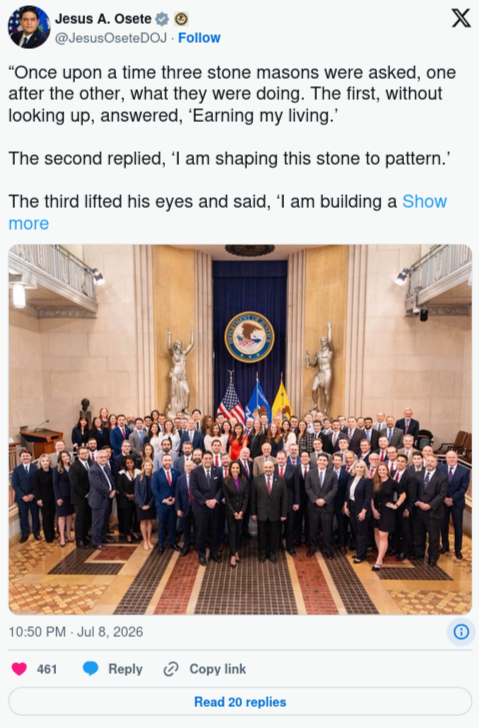
These hires aren’t in addition to existing staff, but rather they are replacing employees in a division that has been decimated under Trump. By July 2025, 98 attorneys or other staff members resigned or retired while another 270 accepted deferred retirement, according to the Justice Department.
Beyond calling them “civil rights warriors,” though, Dhillon did not identify any of the almost all-white, mostly male group that she said would “enforce our nation’s laws to benefit ALL Americans, not just a select few.” But the division’s court filings shed some sunlight on who’s been tasked to implement President Donald Trump and Project 2025’s civil-rights agenda.
Between the published photo and the department’s court filings, Public Citizen identified 11 of the attorneys Dhillon has installed to remake the division. This report profiles those 11, along with Dhillon herself. Of the 11, at least five arrived with documented records of misconduct, controversy, or extraordinary hiring irregularities.
Leadership
Harmeet Dhillon, assistant attorney general for the civil rights division
While Dhillon isn’t a new hire, she is the one who administered their oath. Having overseen both the hollowing out of the division’s career ranks and the installation of those refilling them, she is the architect of everything that follows.
Dhillon was confirmed in April 2025 in a near-party-line 52–45 vote, with one Republican crossing over. Dhillon founded the Dhillon Law Group in 2006 in San Francisco. There, her firm represented former Google engineer James Damore after the company fired him for penning a 10-page screed against the company’s diversity efforts; the Republican National Committee, alleging Google discriminated against it in the runup to the 2022 midterms; and descendants of the first chief justice of the state of California’s Supreme Court, Serranus Clinton Hastings, after UC Hastings College of the Law in San Francisco removed his name amid revelations that he had “support[ed] atrocities against Native Americans.” Other clients included President Donald Trump, Project Veritas, and Tucker Carlson.
Dhillon also founded the Center for American Liberty, which purports to defend “the civil liberties of Americans left behind by civil rights legacy organizations.” Weeks after Dhillon took over, the Civil Rights Division moved to tear up consent decrees with prejudice in Minneapolis and Louisville, reached after the murders of George Floyd and Breonna Taylor. It also retracted Biden-era findings of unconstitutional policing in those cities, and closed similar investigations into six more police departments.
Jesus Osete, principal deputy assistant attorney general for civil rights
Osete was sworn in to the division’s second-highest job in August 2025. Previously he served in Missouri’s attorney general offices, where he personally argued the state’s challenge to the federal healthcare-worker COVID vaccine mandate before the Supreme Court (Biden v. Missouri, 2022). Osete also attended meetings, beginning in fall 2025, of lawyers whom Trump tasked to reinvestigate his 2020 loss, according to ProPublica. Those meetings preceded the FBI’s seizure of approximately 700 boxes of election records from Fulton County, Georgia in January 2026.
Jeffrey Morrison, deputy assistant attorney general for civil rights
Morrison was a career Justice Department attorney whose status has skyrocketed under Trump. After Trump’s 2024 election, Morrison, with help from the anti-union National Right to Work Foundation, filed a challenge at the Federal Labor Relations Authority in early 2025 to block his colleagues from unionizing. His challenge went nowhere, but his status did: by August 2025, he had been tapped to serve as acting chief of both the Civil Rights Division’s Employment Litigation and Educational Opportunities Sections. And by May 2026, he had been elevated to Deputy Assistant Attorney General and is listed as counsel on the department’s Title VI suit against the University of California.
Eric Sell, deputy assistant attorney general for civil rights
Sell followed Dhillon to Justice from the Center for American Liberty, where he had spent almost three years as an associate litigation counsel and served as counsel for a Chico, California mother who sued her daughter’s school district over a policy that allowed students to socially transition without notifying parents. At the Justice Department’s Civil Rights Division, he has worked on its Title VII suit against Minnesota’s affirmative-action program.
Matthew Zandi, chief of staff and special counsel
Zandi’s specialty—the False Claims Act, an 1863 law that says anyone who submits false claims to the government is liable for three times the government’s damages, plus penalties—has become one of the division’s sharpest new tools under Trump. In May 2025, the Justice Department announced its “civil rights fraud initiative”—which then-Deputy Attorney General Todd Blanche said would target “inherently divisive policies like DEI” among recipients of federal funds—by using the False Claim Act to launch investigations and pursue claims for violating civil rights laws.
Section Chiefs and Senior Counsel
Barry Arrington, acting chief of the Second Amendment section
Arrington leads the new Second Amendment Section, as the Civil Rights Division under Trump has expanded its mission to “ensure that law-abiding American citizens may responsibly possess, carry, and use firearms.” To that end, Arrington’s section investigates law-enforcement agencies and searches for litigation opportunities, working to “advance a broad interpretation of the Second Amendment.” Previously, in private practice, Arrington represented Rocky Mountain Gun Owners in its 2019 lawsuit seeking to overturn a Colorado law banning large-capacity gun magazines; served as co-counsel for the plaintiff in Chiles v. Salazar, the challenge to Colorado’s conversion-therapy ban that the Supreme Court decided in 2026; and represented a Colorado charter school that refused to let the class valedictorian deliver a graduation speech in which he came out as gay. He also represented Sidney Powell in the defamation suit brought by former Dominion Voting Systems executive Eric Coomer over 2020 election conspiracy theories.
Eric Neff, acting chief of the voting section
Neff came from the Los Angeles County District Attorney’s office, where in October 2022 he charged the CEO of the election-software company Konnech, Eugene Yu, with storing information about Los Angeles poll workers on Chinese servers. The investigation had been sparked by the election-conspiracy group True the Vote. Within weeks, the District Attorney’s office moved to dismiss the charges, citing potential bias in how the evidence had been presented. Neff was placed on administrative leave, and Los Angeles County paid $5 million to settle Yu’s civil-rights lawsuit and publicly declared his innocence. He now oversees the section of the Civil Rights Division that “enforces the civil provisions of the federal laws that protect the right to vote” and signs the division’s lawsuits demanding voter rolls.
Gregory Dolin, senior counsel
Dolin comes out of the conservative legal movement’s campaign against the administrative state, having served as an adjunct scholar at the Cato Institute and on the executive committee of the Federalist Society’s administrative law and regulation practice group. Before the DOJ, he was senior litigation counsel at the New Civil Liberties Alliance—an anti-regulatory group backed by Charles Koch and entities tied to Leonard Leo, according to Bloomberg Law. There he represented suspended Federal Circuit Judge Pauline Newman, a Reagan appointee in her late 90s, whose colleagues barred her from hearing cases in 2023, after she refused cognitive testing—in her unsuccessful argument that she could be removed only by impeachment. Dolin, who condemned the administrative removal of a judge without due process, now serves an administration that has driven out officials and career staff en masse. Dolin is listed as counsel on the division’s Title VII suit against Minnesota’s affirmative-action program.
Daniel Flickinger, senior counsel, educational opportunities section
In 2020, Flickinger was forced to resign from a Birmingham, Alabama, law firm over his Facebook post about the murder of George Floyd. According to the Alabama Supreme Court’s opinion in a defamation suit Flickinger later filed, the post read,
“Things I think about: If I were a seven-time felon, with my most recent prison stint stemming from robbing and holding a pregnant woman at gunpoint in her home, would I choose to die in a fentanyl and methamphetamine numbed strangulation if it meant being worshipped in a nationwide funeral and my family receiving millions of dollars? Purely hypothetical.”
He now helps run the federal office that polices civil-rights compliance on campuses.
The Rank and File
Greta Gieseke, attorney
Gieseke has drawn congressional scrutiny for how she was hired. According to Sen. Peter Welch, D-Vt., she was brought on as a career trial attorney with just 11 months of non-clerkship legal experience and then immediately detailed to Dhillon’s office in August 2025—despite an internal policy requiring three years of service before being eligible for detail to another section. She has been counsel on the department’s Title VII suit against Minnesota’s affirmative-action program and its intervention in California’s voter-approved congressional redistricting.
David Goldman, trial attorney
A 2019 University of Virginia law graduate and clerkship chair of the school’s Federalist Society chapter, Goldman clerked for two Trump appointees to the federal courts of appeals—Judge David Stras and Judge Amul Thapar, who has appeared on Trump’s 2016 Supreme Court shortlist. As a Civil Rights Division trial attorney, he is one of the lawyers representing the United States in its intervention against California’s voter-approved congressional map, which the department is challenging as an unconstitutional racial gerrymander.
Joshua Zuckerman, trial attorney
Zuckerman helped run his law school’s Federalist Society; clerked for Judge Diane Sykes, a conservative on the Seventh Circuit; and spent four years at the law firm Gibson Dunn before joining the division as a trial attorney in August 2025. Within months he was staffing its most politically charged cases: he signed the department’s Title VI suit against Regents of the University of California, and was among the counsel on its intervention to overturn California’s voter-approved congressional map and its admissions-records suit against Harvard.
Conclusion
The 11 attorneys profiled here are a fraction of the more than 100 Harmeet Dhillon swore in, but their records point in a single frightening direction: A division created to protect America’s most vulnerable has been gutted and refilled with lawyers drawn largely from the conservative legal movement, several carrying documented histories of controversy, others with limited experience. They are implementing the division’s new mission by suing states for voters’ personal data; intervening to block a voter-approved congressional map; and turning anti-discrimination laws against DEI programs, transgender people, and universities. Meanwhile, as Public Citizen has documented, the division has walked away from its traditional calling, for example, freezing its case against SpaceX and other corporate defendants in the administration’s first days.
What’s happening at the Civil Rights Division follows the Project 2025 playbook Public Citizen has traced across the government: the record purge of inspectors general and the installation of industry insiders in the agencies meant to police them. Who these 12 people are matters. The work they do will outlast this administration. Congress, the courts, and the public can hold accountable only those they can name.
Stay Updated on Public Citizen
Follow Public Citizen
Support Our Work
Close the Commercial Data Broker Loophole by Passing the Fourth Amendment Is Not For Sale Act
Chairman Chuck Grassley
Ranking Member Dick Durbin
Senate Committee on the Judiciary
Chairman Rand Paul
Ranking Member Gary Peters
Committee on Homeland Security and Government Affairs
Close the Commercial Data Broker Loophole by Passing the Fourth Amendment Is Not For Sale Act
Dear Chairmen Grassley, Paul and Ranking Member Durbin, Peters:
We, the undersigned organizations, write to express our deep concern regarding recent reporting that the Department of Homeland Security and U.S. Immigration and Customs Enforcement have entered into a multi-year agreement with Thomson Reuters Special Services to access CLEAR, a commercial investigative platform capable of aggregating extensive personal information about millions of people in the United States.[1]
The reporting highlights a problem that has continued to grow in recent years: federal agencies are purchasing access to commercially aggregated personal information that they could not otherwise obtain without judicial oversight.[2] This growing practice threatens to erode the protections guaranteed by the Fourth Amendment and underscores the urgent need for Congress to close the data broker loophole.
The Fourth Amendment was designed to prevent the government from conducting unreasonable searches of the American people.[3] However, advances in the commercial surveillance marketplace have fundamentally altered that constitutional balance.[4] Indeed, partial DHS legal analysis obtained under the Freedom of Information Act that shows the agency contorting itself to distinguish the cell phone location data that the Supreme Court held requires a warrant in Carpenter v. United States, from the equivalently sensitive and revealing location information to which the government is now purchasing access in bulk.[5]
Today, private companies collect, aggregate, analyze, and monetize extraordinary amounts of information about nearly every person in America.[6] Rather than obtaining a warrant supported by probable cause, government agencies can purchase these comprehensive datasets using taxpayer dollars. According to former deputy director of the CIA Michael Morell, “[t]he information that is available commercially would kind of knock your socks off. If we collected it using traditional intelligence methods, it would be top secret sensitive. And you wouldn’t put it in a database; you’d keep it in a safe.”[7]
While this practice continues to grow across law enforcement and intelligence agencies, very little transparency exists as to the scope as to what data is being purchased and for what purposes.[8] For instance, a report from the Office of the Director of National Intelligence found that while the intelligence community is collecting increasing amounts of commercially available information, it does not know how much it is collecting, what types, or what it is doing with the data.[9]
According to public reporting, CLEAR enables investigators to rapidly compile detailed profiles using information drawn from numerous public and proprietary sources, including addresses, telephone records, utility information, vehicle registrations, license plate records, social media activity, geolocation information, and other identifying data.[10] Although individual records may independently exist in different places, aggregating them into searchable investigative dossiers dramatically expands government surveillance capabilities which further run the risk of being supercharged by the rapid growth and use of artificial intelligence by the federal government.
The contract may expressly contemplate use of the platform in investigations relating to voter fraud in addition to immigration fraud and national security.[11] This demonstrates the broad range of government functions now supported by commercially acquired surveillance tools. Without clear statutory guardrails, agencies across the federal government will continue to circumvent constitutional safeguards and expand their reliance on commercially purchased personal information.
The Constitution requires judicial oversight precisely because unchecked government access to personal information threatens liberty, democratic participation, and public trust. Therefore, we urge that you prioritize and advance the Fourth Amendment Is Not For Sale Act, which would prohibit government agencies from purchasing Americans’ sensitive information from commercial data brokers in circumstances where a warrant or other legal process would otherwise be required.[12] Closing this loophole reaffirms the vital constitutional principle that the government should not be permitted to purchase their way around the Fourth Amendment.
In addition, we urge your Committees to:
- Hold oversight hearings examining federal agencies’ acquisition and use of commercially available information obtained from data brokers.
- Require comprehensive transparency regarding federal contracts for commercially aggregated personal data, including the categories of information purchased, agencies involved, legal authorities relied upon, and oversight mechanisms governing their use.
- Examine whether existing procurement laws adequately protect constitutional rights when agencies acquire commercial surveillance capabilities.
Technological innovation has transformed the government’s practical ability to learn intimate details about people’s lives. Congress must ensure that constitutional protections evolve alongside those technological changes. The reports concerning Thomson Reuters’ CLEAR platform are a reminder that the commercial surveillance economy has become deeply intertwined with government enforcement. The American people should not lose their Fourth Amendment protections simply because the government chooses to purchase information from a private company instead of obtaining it through a lawful judicial process.
We respectfully urge you to advance the Fourth Amendment Is Not For Sale Act and reaffirm that constitutional rights cannot be bought and sold.
Sincerely,
Public Citizen
American Civil Liberties Union
Access Now
Advocacy for Principled Action in Government
Asian Americans Advancing Justice | AAJC
Autistic Women & Nonbinary Network
Black Voters Matter Fund
Brennan Center for Justice at NYU School of Law
Center for Democracy & Technology
Common Cause
Consumer Federation of America
Defending Rights & Dissent
Electronic Privacy Information Center (EPIC)
Fiat Fiendum
Fight for the Future
Free Press Action
Government Information Watch
Immigrant Legal Resource Center (ILRC)
National Action Network
New America’s Open Technology Institute
Open MIC (Open Media and Information Companies Initiative)
Project On Government Oversight
Restore The Fourth – Action
Secure Elections Network
Sikh American legal Defense and Education Fund
TechEquity
The Leadership Conference on Civil and Human Rights
UnidosUS
Vera Institute of Justice
[1] Caroline Haskins & Vittoria Elliott, ICE Is Using Data Broker Tools to “Identify Unaccompanied Minors” and “Fraud” WIRED, (July 17, 2026) https://www.wired.com/story/ice-unaccompanied-minors-fraud-suspects-trss-contract/; Olivia Bowden, Canadian Government Urged to Block Thomson Reuters Data Deal with U.S. ICE, Guardian (July 24, 2026) https://www.theguardian.com/world/2026/jul/24/canada-government-mark-carney-block-data-sharing-deal-thomson-reuters-us-ice-avi-lewis
[2] Emile Ayoub & Elizabeth Goitein, Closing the Data Broker Loophole, Brennan Ctr. for Just. (Feb. 13, 2024), https://www.brennancenter.org/our-work/research-reports/closing-data-broker-loophole; Jude Joffe-Block, Your Data Is Everywhere. The Government Is Buying It Without a Warrant, NPR (Mar. 25, 2026), https://www.npr.org/2026/03/25/nx-s1-5752369/ice-surveillance-data-brokers-congress-anthropic ; Anika Venkatesh & Lauren Yu, DHS is Circumventing Constitution by Buying Data It Would Normally Need a Warrant to Access, ACLU (Jan. 12, 2026), https://www.aclu.org/news/privacy-technology/dhs-is-circumventing-constitution-by-buying-data-it-would-normally-need-a-warrant-to-access.
[3] U.S. Const. amend. IV.
[4] Carpenter v. United States, 585 U.S. 296 (2018), https://www.supremecourt.gov/opinions/17pdf/16-402_h315.pdf
[5] Anika Venkatesh & Lauren Yu, DHS is Circumventing Constitution by Buying Data It Would Normally Need a Warrant to Access, ACLU (Jan. 12, 2026), https://www.aclu.org/news/privacy-technology/dhs-is-circumventing-constitution-by-buying-data-it-would-normally-need-a-warrant-to-access.
[6] See supra note 2.
[7] Byron Tau, U.S. Spy Agencies Know Your Secrets. They Bought Them., Wall St. J. (Mar. 8, 2024).
[8] See supra note 2.
[9] Office of the Dir. of Nat’l Intel., Senior Advisory Group, Panel on Commercially Available Information: Report to the Director of National Intelligence 5–7 (Jan. 27, 2022), https://www.govinfo.gov/content/pkg/GOVPUB-PREX28-PURL-gpo214640/pdf/GOVPUB-PREX28-PURL-gpo214640.pdf
[10] See supra note 1.
[11] Alex Barrientos, ICE Plans $125 Million Thomson Reuters Contract to Hunt “Voter Fraud”, Yahoo News (July 15, 2026), https://www.yahoo.com/news/politics/articles/ice-plans-125-million-thomson-184157977.html
[12] Protect Liberty and End Warrantless Surveillance Act of 2026, H.R. 7816, 119th Cong. (2026). https://www.congress.gov/bill/119th-congress/house-bill/7816/all-info; Press Release, Sen. Ron Wyden, Wyden, Paul and Bipartisan Senators Reintroduce the Fourth Amendment Is Not For Sale Act (July 27, 2023), https://www.wyden.senate.gov/news/press-releases/wyden-paul-and-bipartisan-senators-reintroduce-the-fourth-amendment-is-not-for-sale-act
Stay Updated on Public Citizen
Follow Public Citizen
Support Our Work
End the Sale of Commercial Surveillance Products Circumventing Fourth Amendment Protections
Steve Hasker
President and Chief Executive Officer
Thomson Reuters
End the Sale of Commercial Surveillance Products Circumventing Fourth Amendment Protections
Dear Mr. Hasker,
We, the undersigned organizations, write to express our deep concern regarding reports that Thomson Reuters Special Services continues to provide federal law enforcement agencies access to CLEAR, an investigative platform capable of aggregating vast amounts of personal information about millions of people in the United States.[1] At its core, this issue is about whether private companies should profit by selling the government access to information that would otherwise require a warrant to obtain.[2] We urge you to stop the practice of selling such information, including by withdrawing from existing contracts and refraining from entering into any future such agreements.
The Fourth Amendment exists to protect people from unreasonable government searches.[3] It requires judicial oversight before the government may intrude upon some of our most sensitive private information.[4] Yet an expanding commercial surveillance marketplace has created a dangerous loophole.[5] Rather than obtaining a warrant or demonstrating probable cause, government agencies increasingly circumvent constitutional protections by purchasing access to commercially assembled dossiers containing extraordinarily revealing information about our lives.[6]
According to public reporting, CLEAR enables investigators to rapidly compile extensive profiles using information drawn from numerous public and proprietary sources, including addresses, telephone records, utility records, vehicle registrations, license plate information, social media activity, geolocation information, and other personal data.[7] Their aggregation creates an extraordinarily detailed portrait of a person’s life, movements, relationships, and activities.[8]
The Supreme Court has repeatedly recognized that digital technologies capable of revealing the “privacies of life” require heightened constitutional scrutiny.[9] Constitutional protections cannot depend upon whether the government collects this information directly or simply purchases access to a commercially assembled version. And they should not be so simple to circumvent through private contracts between the federal government and companies like yours.
Thomson Reuters is actively participating in the creation and expansion of a commercial surveillance ecosystem that enables unprecedented access to Americans’ personal information. As one of the world’s most prominent legal and information companies, Thomson Reuters has long offered legal resources and education to court systems, law students, and nonprofit organizations.[10] That commitment should extend beyond the courtroom. Respect for constitutional rights requires refusing to facilitate practices that undermine the fundamental protections upon which our constitutional system depends.
Accordingly, we call upon Thomson Reuters to:
- Immediately cease providing government agencies access to products that enable the warrantless acquisition of commercially aggregated personal information.
- Commit not to develop, market, or sell investigative products whose primary value derives from enabling government agencies to circumvent constitutional privacy protections.
- Publicly disclose all government contracts involving CLEAR or substantially similar investigative platforms, including the agencies involved, categories of data made available, and oversight mechanisms governing their use.
- Publish a comprehensive human rights and civil liberties impact assessment evaluating how CLEAR and related products affect privacy, constitutional rights, and democratic participation.
- Adopt a publicly available corporate policy committing that Thomson Reuters will not profit from products that undermine Americans’ constitutional protections through commercial data aggregation.
The rapid growth of the commercial surveillance industry presents one of the defining civil liberties challenges of the digital age. Technology has dramatically expanded the government’s practical ability to know where people go, whom they associate with, what they read, what they buy, and how they live. Constitutional protections must evolve to preserve meaningful privacy in that environment. The fact that loopholes in current law may permit a particular business practice does not mean that it is compatible with the values of privacy, liberty, and the rule of law.
We urge Thomson Reuters to cease eroding our privacy protections by ending the sale of products that enable government surveillance through commercial circumvention of constitutional protections.
Sincerely,
Public Citizen
American Civil Liberties Union
Access Now
Advocacy for Principled Action in Government
Asian Americans Advancing Justice | AAJC
Autistic Women & Nonbinary Network
Black Voters Matter Fund
Center for Democracy & Technology
Common Cause
Consumer Federation of America
Defending Rights & Dissent
Electronic Frontier Foundation
Electronic Privacy Information Center (EPIC)
Fiat Fiendum
Fight for the Future
Free Press Action
Immigrant Legal Resource Center (ILRC)
Independent
NC Environmental Justice Network
Open MIC (Open Media and Information Companies Initiative)
Project On Government Oversight
Restore The Fourth
Sikh American Legal Defense and education fund
TechEquity
UnidosUS
[1] Caroline Haskins & Vittoria Elliott, ICE Is Using Data Broker Tools to “Identify Unaccompanied Minors” and “Fraud”, WIRED, (July 17, 2026) https://www.wired.com/story/ice-unaccompanied-minors-fraud-suspects-trss-contract/; Olivia Bowden, Canadian Government Urged to Block Thomson Reuters Data Deal with U.S. ICE, Guardian (July 24, 2026) https://www.theguardian.com/world/2026/jul/24/canada-government-mark-carney-block-data-sharing-deal-thomson-reuters-us-ice-avi-lewis
[2] Emile Ayoub & Elizabeth Goitein, Closing the Data Broker Loophole, Brennan Ctr. for Just. (Feb. 13, 2024), https://www.brennancenter.org/our-work/research-reports/closing-data-broker-loophole; Jude Joffe-Block, Your Data Is Everywhere. The Government Is Buying It Without a Warrant, NPR (Mar. 25, 2026), https://www.npr.org/2026/03/25/nx-s1-5752369/ice-surveillance-data-brokers-congress-anthropic ; Anika Venkatesh & Lauren Yu, DHS is Circumventing Constitution by Buying Data It Would Normally Need a Warrant to Access, ACLU (Jan. 12, 2026), https://www.aclu.org/news/privacy-technology/dhs-is-circumventing-constitution-by-buying-data-it-would-normally-need-a-warrant-to-access.
[3] U.S. Const. amend. IV.
[4] Carpenter v. United States, 585 U.S. 296 (2018), https://www.supremecourt.gov/opinions/17pdf/16-402_h315.pdf
[5] See supra note 2.
[6] Id.
[7] Supra note 1.
[8] Id.
[9] See supra note 4.
[10] Company History, Thomson Reuters, https://www.thomsonreuters.com/en/about-us/company-history
Stay Updated on Public Citizen
Follow Public Citizen
Support Our Work
Comment Letter in Response to Proposed California Corporate Greenhouse Gas Reporting and Climate-Related Financial Risk Disclosure Initial Regulation
August 11, 2026
Clerks’ Office
California Air Resources Board
1001 I Street
Sacramento, California 95814
Re: Proposed California Corporate Greenhouse Gas Reporting and Climate-Related Financial Risk Disclosure Initial Regulation
Honorable members of the California Air Resources Board,
Thank you for the opportunity to comment on the modifications the California Air Resources Board (CARB) has made to the Proposed California Corporate Greenhouse Gas Reporting and Climate-Related Financial Risk Disclosure Initial Regulation. The modifications are insufficient as CARB has not removed § 96071(b)(2) exempting entities regulated by the California Department of Insurance (CDI) and other entities in the business of insurance from the proposed regulation. The undersigned organizations strongly urge CARB to remove this exemption before finalizing the regulation.
The proposal, offered by CARB staff at the July 21 public workshop, to subject insurance companies to the requirements of SB 253 beginning in 2027 is an insufficient remedy to the exemption for insurance companies included in the Initial Regulation. The Initial Regulation is not clearly limited to 2026 and thus by finalizing this regulation, CARB would be exempting insurers from emissions reporting under SB 253 unless and until the exemption is reversed in a future regulation. Moreover, future regulation that may subject insurance companies to the requirements of SB 253 will be in conflict with the Initial Regulation. Rather than take this cumbersome and unlawful approach, CARB should remove the exemption for insurance companies outright in the Initial Regulation.
Exempting insurance companies exceeds CARB’s authority as it is contrary to statute and legislative intent.
As we have argued previously, the exemption for insurance companies in the proposed Initial Regulation would exceed CARB’s authority as it is contrary to statute and legislative intent (See February 9, 2026 and April 13, 2026 Comment Letters attached hereto and incorporated herein by reference). The California legislature originally considered versions of both SB 253 and SB 261 that did not exempt insurance companies. However, an exemption was ultimately added to SB 261 in recognition that the climate financial risk disclosure required by SB 261 significantly overlapped with the National Association of Insurance Commissioners’ (NAIC) Climate Risk Disclosure Survey administered by CDI. By contrast, SB 253 was signed into law without an exemption for insurance companies. At CARB’s February 26 hearing, SB 253 sponsor Senator Scott Wiener testified that the insurance industry was intentionally included in SB 253. CARB lacks the authority to carve out an exemption that does not exist in the statute and that the bill sponsor confirmed is contrary to legislative intent.
CARB has justified the exemption as a measure to avoid “duplicative effort” for reporting entities, claiming that requiring insurers to report their greenhouse gas emissions under this rule would be duplicative with the NAIC’s Climate Risk Disclosure Survey. But the NAIC report is not duplicative with the reporting requirements of SB 253. While SB 253 mandates that all covered entities disclose their Scope 1, 2, and 3 emissions, the NAIC survey simply encourages insurers to “disclose Scope 1, Scope 2, and if appropriate, Scope 3 greenhouse gas emissions.” There is no statute or regulation requiring insurers to report greenhouse gas emissions to CDI, nor does CDI have any authority to enforce fines or penalties against insurers who decline to disclose emissions. In March, Public Citizen published an analysis confirming that insurer reports to CDI do not satisfy the requirements of SB 253, finding 75 percent of the largest property & casualty insurers in California disclose their Scope 1 and 2 emissions but only 10 percent of the largest insurers make meaningful emissions disclosures to CDI inclusive of Scope 1, 2, and 3 emissions.
Furthermore, even if the emissions disclosures insurers made to CDI were comprehensive, these disclosures would not justify exempting insurers from submitting emissions disclosures to CARB. SB 253 does not authorize CARB to exempt insurers or any other sector from disclosing to CARB. Instead, the statute permits a reporting entity already reporting emissions to another national or international entity to submit those emissions disclosures to CARB as well, so long as those disclosures meet the requirements of SB 253.
The insurance exemption included in the Initial Regulation is not limited to 2026 and thus would be in conflict with future regulations requiring emissions disclosure from insurance companies.
CARB staff have since acknowledged the gap between insurer emissions reporting to CDI and the requirements of SB 253. CARB materials from the July 21 SB 253 public workshop include the following: “Staff found that CDI reporting may not satisfy the requirements of SB 253 in future years (starting with 2027), as it does not include Scope 3 or assurance requirements.” In response to this gap, CARB staff proposed that “Beginning in 2027, …insurance entities may submit the same report to satisfy both CDI and SB 253 requirements, provided it meets reporting requirements under CARB’s regulation implementing SB 253. If a CDI report does not address all CARB requirements, reporting entities must supplement their report with the remaining required information.”
The problem with the solution CARB staff propose is that the Initial Regulation is not clearly limited to 2026 and thus by finalizing this regulation, CARB would be exempting insurers from emissions reporting under SB 253 unless and until the exemption is reversed in a future regulation. This is a legally dubious and unnecessarily cumbersome approach, given the Initial Regulation has yet to be finalized. Furthermore, workshop materials are not a guarantee that future regulation will be undertaken to remove the insurance exemption or do so effectively. The proposed solution also fails to address the core issues at hand—that the insurance exemption in the Initial Regulation is unlawful as it exceeds CARB’s authority. The only plausible way to implement CARB staff’s proposal would be to expressly limit the exemption by modifying the Initial Regulation to 1) provide that it applies only to insurers who make SB253-compliant Scope 1 and 2 emissions disclosures to CDI in 2026 and 2) by clarifying that the exemption is only in effect for 2026 reporting, and will not be in effect for all future years. Without this change, which is not in the current proposed language, the Initial Regulation plainly exempts insurers from the fee structure and reporting program into the future, and subsequent regulations that do cover insurers would be in perpetual conflict.
We urge CARB to remove the exemption for entities regulated by CDI and other entities in the business of insurance from the regulation and to finalize the regulation thereafter.
Sincerely,
Americans for Financial Reform Education Fund
Consumer Watchdog
Dave Jones, CA Insurance Commissioner, Emeritus
Public Citizen
Sierra Club California
cc: Kenneth J. Pogue, Director
California Office of Administrative Law
300 Capitol Mall, Suite 1250
Sacramento, CA 95814-4339
You might be interested in
Stay Updated on Public Citizen
Follow Public Citizen
Support Our Work
Public Citizen Comments re Section 301 Investigation on Germany’s Drug Pricing Policies
Public Citizen is a nonprofit consumer advocacy organization with more than one million members and supporters. The Access to Medicines program advocates for access to prescription drugs in the United States and internationally.
Section 302(b)(1)(A) of the Trade Act authorizes the U.S. Trade Representative to initiate an investigation to determine whether an act, policy, or practice of a foreign country is actionable under Section 301 of the Trade Act. Actionable conduct under Section 301 includes acts, policies, and practices of a foreign country that are unjustifiable, unreasonable or discriminatory, and burden or restrict U.S. commerce. An act, policy, or practice is unreasonable if, while not necessarily in violation of, or inconsistent with, the international legal rights of the United States, it is otherwise unfair and inequitable.[1]
On June 18, 2026, the U.S. Trade Representative initiated a “Section 301” investigation focusing on “the extent to which Germany engages in acts, policies, and practices that have the effect of suppressing the prices of pharmaceuticals in its market below fair market value, thereby forcing American patients to underwrite a disproportionate amount of global pharmaceutical R&D.”[2]
Our comment will focus on three points:
- Germany’s drug price negotiation framework informed the United States’ efforts to lower drug costs; USTR should not attack country practices that the U.S. uses or would consider using to lower drug costs;
- Germany’s pharmaceutical pricing policies are not unjustifiable, unreasonable or discriminatory; and
- Germany’s prices are not “suppressed” and do not burden or restrict U.S. commerce.
Based on these points, Public Citizen urges USTR to drop its investigation.
1. Germany’s drug price negotiation framework informed the United States’ efforts to lower drug costs; USTR should not attack country practices that the U.S. uses or would consider using to lower drug costs.
The United States pays the highest drug prices in the world for prescription drugs because the patent-based pharmaceutical industry operates largely without government negotiations as a check on price. But now that is changing, precisely because the U.S. is implementing policies more similar to those used in other countries to address high drug prices. The U.S. government should not attack legitimate policies that countries the world over use to make medicines more accessible and affordable.
Until recently, and in contrast to many other countries, the largest drug purchaser in the United States was barred from negotiating drug prices. The Medicare Drug Price Negotiation Program established in 2022 is projected to save taxpayers billions of dollars.[3]Negotiated prices from the first and second rounds of negotiations are estimated to save Medicare $6 billion and $8.5 billion, and patients $1.5 billion and $685 million, respectively, in the first year prices take effect.[4] The program is also hugely popular — 88% of Americans say it’s important for the government to negotiate drug prices and two-thirds of Americans want to see the program expanded.[5] Several components of Germany’s negotiation framework were informative for our own system.
Many new drugs add little clinical value but come at great expense (so-called ‘me-too’ drugs, that piggy back on related innovations). An analysis of 216 drugs entering the German healthcare system between 2011 and 2017 found that over half showed no proof of added benefit over existing therapies.[6] Another found that fewer than half of approved first indications for new drugs in the U.S. and Europe between 2011 and 2020 add substantial therapeutic value over existing treatments.[7]
To help ensure prices reward genuine innovation, price negotiation frameworks in the U.S. and Germany assess clinical value compared to existing treatments. In Germany, a health technology assessment body evaluates added clinical value over a therapeutic alternative based on data submitted by the drug’s manufacturer.[8] If the assessment shows no evidence of added benefit, statutory health insurers will only cover a certain amount of the cost, based on a price comparable to existing drugs, where applicable.[9] If the drug is determined to offer minor, considerable, or major added benefit, the manufacturer and statutory health insurers’ body negotiate a higher reimbursement price.[10] When making price offers in the Medicare Drug Price Negotiation Program, the Centers for Medicare and Medicaid Services (CMS) is required to consider evidence of therapeutic value, including the extent to which selected drugs represent a therapeutic advance as compared to existing therapeutic alternatives and the costs of those alternatives, as well as the comparative effectiveness of selected drugs and therapeutic alternatives, among other factors.[11] In contrast to Germany’s process independent from negotiations that relies on a standardized value assessment and categorization system, CMS considers factors itself without clear guidance on how to weigh the degree of benefit over alternatives. However, approaches used in Germany and other countries continue to inform ongoing policy debates in the United States regarding how more systematic clinical evidence appraisal could inform pricing decisions.[12]
Another aspect of Germany’s price negotiation framework, called binding arbitration, was among proposals put forward for Medicare’s negotiation framework.[13] In Germany, if a drug manufacturer and the statutory health insurance body cannot agree, an arbitration board determines the final price.[14] The board includes representatives from the statutory health insurers’ body and the pharmaceutical industry, among others.[15] Legislators in the United States ultimately opted for a less conservative approach. Instead of deferring final price determinations to a third party, CMS retains the power to make final price offers it deems appropriate, including in circumstances where negotiations fail because pharmaceutical companies are not negotiating in good faith. As leverage to encourage the successful resolution of price negotiations, the Medicare negotiation program penalizes manufacturers that fail to reach a final price by subjecting them to a tax equal to a percentage of the drug’s sales, or allowing them to avoid the tax by withdrawing all of their drugs from Medicare and Medicaid.[16] The strategies in both Germany and the U.S. have had success. In the five years after Germany instituted its negotiation system, drugs with no added therapeutic benefit were more likely to be withdrawn from the market than those with added benefit (25% vs 2%).[17] In the United States, courts have upheld the Medicare Drug Price Negotiation Program in each of myriad lawsuits raised by the pharmaceutical industry, including those targeting the financial penalty for refusing to complete negotiations with CMS.[18]
2. Germany’s pharmaceutical pricing policies are not unjustifiable, unreasonable or discriminatory.
Governments have the right and the responsibility to manage healthcare costs to protect the public and steward taxpayer resources. Governments also recognize that expansive patent monopolies enable high drug prices, which contribute to rising healthcare costs. National policies targeting patented products are often readily explained by the reasonable need to manage healthcare costs, informed by the local context.
Germany’s 2026 Statutory Health Insurance Contribution Rate Stabilization Act (GKV-BStabG),[19] referenced in the Section 301 investigation notice, includes several measures intended to respond to the budget shortfall (EUR15 billion by 2027, rising to EUR40 billion by 2030) facing public insurers’ funds which would lead to higher costs for the 90% of Germans that rely on statutory health insurance.[20]
Among other suggestions, Germany’s Health Finance Commission recommended an adjustment to the statutory rebate imposed on patented pharmaceutical products in order to “sustainably stabilize expenditures for patented pharmaceuticals.”[21] The Commission identified pharmaceutical spending among the areas where costs have increased since 2024. Spending on patented pharmaceuticals, which averaged an eight percent increase annually over five years, drove costs for the category.[22] The report also noted that spending was driven by higher prices of new patented drugs, rather than prescription volumes.[23]
The proposed “dynamic,” or “variable,” which was referenced in the Section 301 investigation notice, was not included in the final law. Instead of the proposed expenditure-linked rebate, which would have adjusted rebates based on spending growth for patented drugs and the financial capacity of the statutory health insurance system, the law includes a fixed rebate set at 8.5% of a company’s sales price.[24] This is in addition to the existing rebate of 7%.
These changes are not unreasonable, but national efforts to respond to a key driver of rising costs and impending funding shortfalls in the health system. Notably, in response to pharmaceutical company concerns, the German government changed from the proposed variable rebate to a static rebate to be less burdensome to the industry.[25]
Germany’s Federal Constitutional Court has previously ruled that an increase in the mandatory rebate is constitutional. The court rejected pharmaceutical company complaints, noting that the rebate “serves the legitimate purpose of ensuring the financial stability of the statutory health insurance system,” the financing of which “constitutes an exceptionally significant interest of the common good.”[26]
Thus, the rebate policy is justified by a rational public policy goal. It is also not discriminatory: it is equally applicable to foreign and domestic entities.
The Section 301 investigation notice also states that “Germany conditions the confidentiality of manufacturers’ pharmaceutical pricing on certain criteria, including acceptance of a 9 percent price discount and payment of additional administrative costs” as one of the claimed “means and tools that Germany uses to implement its unfair pricing policies and practices.”[27]
This is misleading. Germany’s new law offers drugmakers a new advantage: confidentiality.[28] Under the usual system, drugmakers are obligated to report prices, as they should be.[29]
Pharmaceutical corporations defend price secrecy to avoid scrutiny of their pricing practices.[30] This impedes the public’s interest in fair prices by preventing accountability, cross-market comparison, and potentially fostering high, unreasonable prices.[31]Countries across the globe, including the United States, recognize that health price transparency can support affordability and healthy markets, and are implementing transparency rules to that end.[32][33]
Far from being unfair to drugmakers, Germany’s law is creating more flexibility for them by letting them opt out of price reporting requirements. Public Citizen would prefer Germany apply a much tougher standard. If anything, Germany is overly generous in allowing drugmakers to elect to conceal their prices, even if they are asked to choose between rebates and secrecy.
3. Germany’s prices are not “suppressed” and do not burden or restrict U.S. commerce.
The statute defines an “unreasonable” act, policy, or practice as one that “while not necessarily in violation of, or inconsistent with, the international legal rights of the United States, is otherwise unfair and inequitable.”[34] Such policies include those that deny “fair and equitable […] nondiscriminatory market access opportunities for United States persons that rely upon intellectual property protection,” including “restrictions on market access related to the use, exploitation, or enjoyment of commercial benefits derived from exercising intellectual property rights in protected works or fixations or products embodying protected works.”[35]
Insulated by patents and other exclusivities, pharmaceutical companies charge prices beyond what would be seen in a competitive market. This market power is reflected in rising launch prices for new drugs in both Germany and the United States. In Germany, launch prices increased by an average of six percent per year between 2011 and 2022.[36] Between 2008 and 2021, U.S. launch prices increased by 20 percent per year, or 11 percent after accounting for rebates.[37] Drugmakers also regularly hike prices after market launch. Between 2022 and 2023, among drugs with price increases, changes in list prices averaged out to an additional $590 per product, driven by increases in already expensive medicines.[38] Among drugs already on the market between 2007 and 2018, net prices increased every year by an average of 4.5 percentage points.[39] U.S. prices are not more fair because they take place in a supposedly “free market” — nor are they influenced by prices in other countries, as the Department of Commerce found in its 2004 drug pricing investigation.[40] Rather, shielded by monopoly protections, companies set prices based on what the market will bear.[41]
Pharmaceutical companies do not have a right to these pricing excesses. Patents grant the right to exclude competitors, a consequence of which is significant market power to set high prices; patents do not confer the right to a particular price or pricing authority. U.S. courts have affirmed this, noting that while patent rights “permit greater profits during a product’s exclusivity period,” they do not “create any affirmative right to make, use, or sell anything.”[42] Where “federal patent laws do not confer a right to sell at all, they do not confer a right to sell at a particular price.”[43] Based on this, courts have rejected claims that the Medicare Drug Price Negotiation Program infringes property rights by limiting companies’ ability to sell products at “market rates,” concluding, “[t]here is no protected property interest in selling goods to Medicare beneficiaries […] at a price higher than what the government is willing to pay when it reimburses those costs.”[44]
In the absence of typical competitive constraints, and in response to high prices that do not reflect “fair value” but the market power of the industry, Germany’s pricing policies help ensure they do not overpay.
This does not mean that German prices do not support research and development (R&D). As previously mentioned, Germany’s drug price negotiation framework is designed to reward innovation.
Indeed, patented drug prices are not reflective of R&D costs. Research finds no association between R&D costs and prices.[45] Top drug companies receive 163% of their global R&D costs from just the excess revenue generated in the United States,[46]underscoring that these companies earn well beyond their R&D spending and don’t need to raise prices to maintain R&D investments. Exorbitant U.S. prices are not necessitated by R&D costs and there is no evidence to support the claim that lower prices in other countries burden the United States with higher costs.
This investigation should not conflate revenue with R&D. The vast majority of company revenue is not spent on R&D. Large pharmaceutical companies spend billions enriching shareholders through stock buybacks and dividends rather than investing in new treatments. Over the past four years (2022 to 2025), the 15 publicly traded companies whose drugs were selected for the first and second rounds of Medicare drug price negotiations collectively spent roughly as much enriching their shareholders through stock buybacks and dividends as they did on research and development.[47] Moreover, pharmaceutical companies regularly overstate claims that pricing regulations will harm innovation. For example, despite research showing that high-spend drugs approved for one or more orphan (affecting fewer than 200,000 U.S. patients) indications recover R&D costs at rates comparable to or faster than other high-spend drugs, pharmaceutical industry stakeholders continue to lobby for and win lucrative carve-outs for these drugs from price negotiations.[48][49]
Allowing high prices and revenues alone to guide R&D discussions can actually undermine innovation as the industry shifts investments to high margin products. For example, one study found that clinical trials for cancer medicines made up 46.6% of all trials assessed, indicating seemingly disproportionate levels of research compared to other disease areas.[50] Pharmaceutical corporations also sometimes neglect investments in products that would serve patients’ needs but not profit motives, such as research into new antibiotics (the pipeline of new antibiotics from large research-based pharmaceutical companies has shrunk by 35% since 2021)[51] and neglected diseases (private industry contributed just 15% of the global funding for neglected diseases in 2023).[52]
This dynamic also fails to take into account the massive public-sector contributions to innovation. In the United States, the National Institutes of Health (NIH) plays a critical role in basic research and drug development. NIH research contributed to virtually every new drug approved from 2010-2019.[53] While omitting public-sector contributions to drug development from their pricing decisions, the pharmaceutical industry is also not transparent with its R&D costs, and industry-reported R&D costs per new drug are twice as much or more than figures from independent researchers.[54]
In the best case, monopolies and extreme pricing behaviors they enable are an inefficient way to pay for research. Instead of focusing innovation support through these indirect means, policymakers should consider other mechanisms—such as grants and prizes—to incentivize private sector investment and help deliver products at affordable prices.[55] In the worst case, such as continuing a monopoly-based system but limiting pricing policies that would help moderate it, this approach can harm patients.
As people in the United States know well, higher prices raise costs and make needed medicines harder to access. Four-in-ten Americans struggle to afford their medicines.[56] The U.S. pharmaceutical pricing agreement with the U.K. underscores the risks posed to patients, with the deal expected to redirect billions in health spending toward patented drugs over other health services, leading to an estimated 229,000 excess deaths over ten years, according to a recent study.[57]
In sum, there is no evidence that the U.S. bears a higher cost burden due to lower drug prices in other countries. U.S. prices are not reflective of fair value or justified by R&D costs. Drug prices are lower in other countries compared to the United States because those countries have systems in place to moderate the monopoly pricing excesses of prescription drug corporations. The United States is now implementing domestic policies, including the Medicare Drug Price Negotiation Program, to address these pricing excesses, which is reasonable considering the need to ensure medicines are affordable for patients and taxpayers. We urge USTR to take no action and to drop its investigation.
[1]https://www.federalregister.gov/documents/2026/06/24/2026-12671/initiation-of-section-301-investigation-hearing-and-request-for-public-comments-germanys-persistent
[2]https://www.federalregister.gov/documents/2026/06/24/2026-12671/initiation-of-section-301-investigation-hearing-and-request-for-public-comments-germanys-persistent
[3] https://www.cbo.gov/system/files/2026-07/62549-Medicare-Part-D.pdf (showing the Congressional Budget Office’s recent adjustments to projected savings regarding drug provisions in the 2022 Inflation Reduction Act).
[4] https://www.cms.gov/files/document/fact-sheet-negotiated-prices-initial-price-applicability-year-2026.pdf; https://www.cms.gov/files/document/fact-sheet-negotiated-prices-ipay-2027.pdf
[5] https://www.arnoldventures.org/resources/national-targeted-cd-registered-voter-surveys
[6] https://www.bmj.com/content/366/bmj.l4340
[7] https://www.bmj.com/content/382/bmj-2022-074166
[8]https://www.iqwig.de/en/presse/in-the-focus/new-drugs-approval-benefit-assessment-coverage/1-drug-approval-and-early-benefit-assessment-in-germany/
[9]https://www.commonwealthfund.org/sites/default/files/documents/___media_files_publications_issue_brief_2013_oct_1711_schlette_early_benefit_assessment_rx_germany_intl_brief.pdf; https://www.g-ba.de/english/benefitassessment/
[10]https://www.iqwig.de/en/presse/in-the-focus/new-drugs-approval-benefit-assessment-coverage/1-drug-approval-and-early-benefit-assessment-in-germany/; https://www.commonwealthfund.org/sites/default/files/documents/___media_files_publications_issue_brief_2013_oct_1711_schlette_early_benefit_assessment_rx_germany_intl_brief.pdf; https://www.g-ba.de/english/benefitassessment/
[11] https://www.kff.org/medicare/key-facts-about-medicare-drug-price-negotiation/; 42 U.S. Code § 1320f-3(e)(1)–(2) (stating that, alongside evidence about therapeutic alternatives [including therapeutic advancement compared to existing alternatives and the cost of those alternatives, prescribing information for a selected drug and its therapeutic alternatives, comparative effectiveness, and the extent to which a drug and its therapeutic alternatives address unmet medical needs not addressed adequately by available therapy], CMS is required to consider manufacturer-specific data, including research and development costs; production and distribution costs; data on patent applications, regulatory exclusivities, and FDA applications and approvals; and market data, revenue, and sales volume data).
[12]https://www.sciencedirect.com/science/article/abs/pii/S1098301526001038; https://www.commonwealthfund.org/publications/issue-briefs/2026/apr/international-lessons-pricing-and-financing-high-cost-medicines; https://pmc.ncbi.nlm.nih.gov/articles/PMC10906446/
[13]https://www.kff.org/wp-content/uploads/2019/07/Issue-Brief-Whats-the-Latest-on-Medicare-Drug-Price-Negotiations.pdf; https://www.fiercehealthcare.com/payer/medpac-debates-reference-pricing-arbitration-to-bring-down-prices-part-b (noting that the Medicare Payment Advisory Commission also suggested binding arbitration related to negotiation of Medicare Part B drugs).
[14] https://www.g-ba.de/english/benefitassessment/
[15] https://www.commonwealthfund.org/blog/2019/how-drug-prices-are-negotiated-germany
[16] https://www.kff.org/medicare/key-facts-about-medicare-drug-price-negotiation/; https://www.healthaffairs.org/content/forefront/ira-litigation-pharma-s-failed-challenges-medicare-drug-pricing
[17] https://www.healthaffairs.org/doi/full/10.1377/hlthaff.2018.05142
[18]https://www.healthaffairs.org/content/forefront/ira-litigation-pharma-s-failed-challenges-medicare-drug-pricing
[19] https://www.recht.bund.de/bgbl/1/2026/228/VO.html
[20] https://www.dw.com/en/how-to-fix-germanys-costly-health-care-system/a-76597471
[21]https://www.bundesgesundheitsministerium.de/fileadmin/Dateien/3_Downloads/F/FinanzKommission_Gesundheit/FinanzKommissionGesundheit_Erster_Bericht_20260330.pdf, at 276.
[22]https://www.bundesgesundheitsministerium.de/fileadmin/Dateien/3_Downloads/F/FinanzKommission_Gesundheit/FinanzKommissionGesundheit_Erster_Bericht_20260330.pdf, at 276.
[23]https://www.bundesgesundheitsministerium.de/fileadmin/Dateien/3_Downloads/F/FinanzKommission_Gesundheit/FinanzKommissionGesundheit_Erster_Bericht_20260330.pdf, at 269-71.
[24]https://www.insideeulifesciences.com/2026/07/29/what-does-the-gkv-bstabg-reform-change-for-pharma-pricing-reimbursement-in-germany/
[25]https://www.bundesgesundheitsministerium.de/presse/pressemitteilungen/bundestag-beschliesst-gkv-beitragssatzstabilisierunggesetz-pm-10-07-2026 (“The originally planned dynamic manufacturer’s discount will be replaced by a legally mandated increase in the static manufacturer’s discount to 15.5 percent. This is intended to address the legitimate interest of companies in planning certainty and at the same time ensure that the pharmaceutical industry makes a direct contribution to containing expenditures.”).
[26]https://www.bundesverfassungsgericht.de/SharedDocs/Pressemitteilungen/EN/2025/bvg25-061.html?nn=68112
[27]https://www.federalregister.gov/documents/2026/06/24/2026-12671/initiation-of-section-301-investigation-hearing-and-request-for-public-comments-germanys-persistent
[28] Sozialgesetzbuch (SGB) V [Social Code Book V] §130b(1c) (providing pharmaceutical companies the option to keep reimbursement prices for new drugs confidential if they give evidence that they are conducting research in Germany. In exchange for confidentiality, the company agrees to a nine percent discount on the reimbursement price).
[29] Sozialgesetzbuch (SGB) V [Social Code Book V] §131(4) (showing the requirements for price data transmission).
[30] https://yjolt.org/sites/default/files/22_yale_j.l._tech._61_naked_price.pdf
[31]https://www.citizen.org/article/open-letter-to-medical-procurers-say-no-to-secrecy-in-medical-product-agreements/
[32]https://cdn.who.int/media/docs/default-source/essential-medicines/intellectual-property/gspa/a72_r8-en.pdf?sfvrsn=8ecefe84_3&download=true
[33]https://www.whitehouse.gov/presidential-actions/2025/02/making-america-healthy-again-by-empowering-patients-with-clear-accurate-and-actionable-healthcare-pricing-information/
[34] 19 U.S. Code § 2411(d)(3)(A)
[35] 19 U.S. Code § 2411(d)(3)(B), (F)(ii)
[36] https://jamanetwork.com/journals/jama-health-forum/fullarticle/2827325
[37] https://jamanetwork.com/journals/jama/fullarticle/2792986
[38]https://aspe.hhs.gov/sites/default/files/documents/e24f630a33f0a0585337c65745904487/aspe-drug-price-tracking-brief.pdf
[39] https://jamanetwork.com/journals/jama/fullarticle/2762310
[40] https://web.archive.org/web/20190414170009/https:/2016.trade.gov/td/health/DrugPricingStudy.pdf
[41] https://jamanetwork.com/journals/jama/article-abstract/2545691
[42] https://litigationtracker.law.georgetown.edu/wp-content/uploads/2024/05/AstraZeneca_2025.05.08_OPINION.pdf
[43] Id.
[44]https://litigationtracker.law.georgetown.edu/wp-content/uploads/2024/05/AstraZeneca_2025.05.08_OPINION.pdf
[45] https://jamanetwork.com/journals/jamanetworkopen/fullarticle/2796669; https://www.cbo.gov/publication/57126
[46]https://www.healthaffairs.org/content/forefront/r-d-costs-pharmaceutical-companies-do-not-explain-elevated-us-drug-prices
[47] https://www.citizen.org/article/false-choice-between-affordability-and-innovation/
[48] https://www.healthaffairs.org/doi/10.1377/hlthaff.2026.00209
[49] https://www.citizen.org/article/hundreds-of-lobbyists-hired-to-undermine-drug-price-negotiations/
[50] https://iris.who.int/server/api/core/bitstreams/7a5517d6-1077-4ecd-bf32-d6d664add439/content
[51]https://accesstomedicinefoundation.org/in-the-media/antibiotic-innovation-shrinks-as-drug-resistant-infections-rise-globally-says-new-report
[52] https://cdn.impactglobalhealth.org/media/G-FINDER%202024_Full%20report.pdf
[53] https://doi.org/10.36687/inetwp133
[54] https://pmc.ncbi.nlm.nih.gov/articles/PMC7054832/; https://pmc.ncbi.nlm.nih.gov/articles/PMC11704977/
[55] https://www.keionline.org/book/prizes-to-stimulate-innovation
[56] https://www.kff.org/health-costs/public-opinion-on-prescription-drugs-and-their-prices/
[57] https://www.bmj.com/content/394/bmj-2026-340588