Banquet of Greed: Trump Ballroom Donors Feast on Federal Funds and Favors
By By Robert Weissman, Michael Tanglis, Eileen O’Grady, Jon Golinger, Rick Claypool and Alan Zibel
Americans have reacted with shock and dismay to the video showing President Donald Trump’s demolition of the East Wing of the White House to build a new ballroom, a project the White House estimates will cost $300 million.
Trump has sought to reassure Americans, emphasizing that the ballroom would be built with private funds. “We’ve raised over $350 million. It’s a beautiful room,” he told reporters.
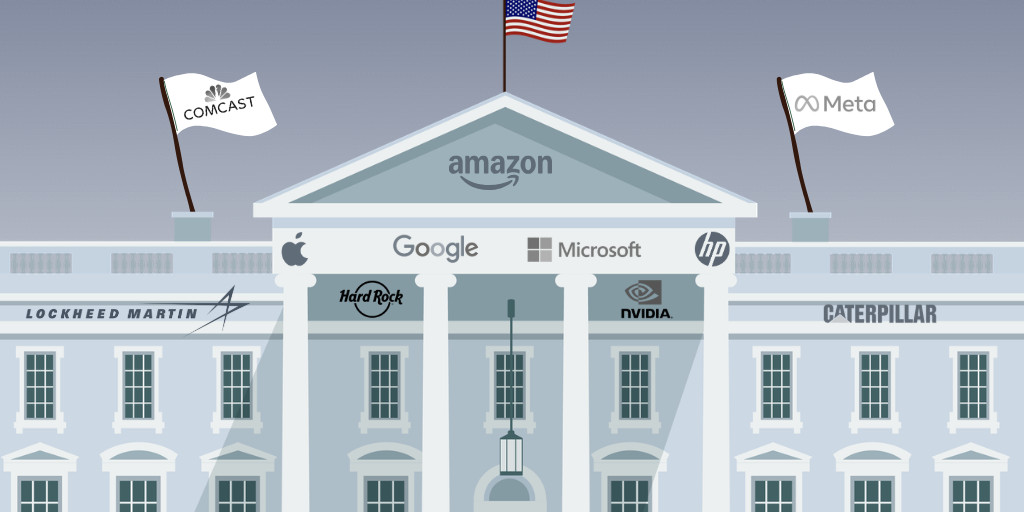
The White House has released a list of 36 donors to the ballroom project, including 21 corporations and 15 individuals and family foundations. The White House has not revealed how much they have each contributed. The White House list is also incomplete; CBS News has identified at least three additional corporate donors and there may be others.
Asked by CBS News if these private donations raised any conflict-of-interest concerns, White House Press Secretary Karoline Leavitt replied in a statement: “The same critics who are wrongly claiming there are conflicts of interest, would complain if taxpayers were footing the bill.”
But the contributions from the corporate and super-rich donors in fact constitute massive, inescapable and irremediable conflicts of interest.
Public Citizen analyzed the government interests of the disclosed corporate donors, including the 21 corporations released by the White House and three identified by CBS News, for a total of 24. The analysis finds that:
- Two-thirds of corporate donors – 16 out of a total of 24 – have entered into government contracts. Lockheed is the largest of these government contractors, having received $191 billion in contracts over the last five years. Altogether, the corporate donors benefited from nearly $43 billion in contracts last year and $279 billion over the last five years.
- Most of the corporate donors – 14 out of 24 – are facing federal enforcement actions and/or have had federal enforcement actions suspended by the Trump administration. These include major antitrust actions involving Amazon, Apple, Meta, Microsoft, Nvidia and T-Mobile; labor rights cases involving Amazon, Apple, Caterpillar, Google, Lockheed and Meta; and SEC matters involving Coinbase and Ripple.
- The companies and wealthy individual donors have invested gargantuan sums in combined lobbying and political contributions, totaling more than $960 million during the last election cycle and $1.6 billion over the last five years.
- The companies self-report a stunningly wide array of interests before the federal government, involving everything from taxation to trade policy, battlefield domain awareness to telephone poles, consumer privacy to product liability rules, appropriations to cybersecurity – and much more.
The following are analyses of political spending, lobbying, federal contracts and federal enforcement actions of donors to Trump’s ballroom, as well as summaries of what each donor has at stake.
Table 1: Political Spending By Trump Ballroom Donors (By Total Political Spending)
| Donor | Total Political Spending 2021 – 2025 |
Combined 2022 and 2024 Election Cycle Contributions | 2021 – 2025 Lobbying Spending** | Sources (OpenSecrets & FEC) |
|---|---|---|---|---|
| Adelson Family Foundation* | $171,947,600 | $171,947,600 | Link | |
| Susquehanna International Group | $157,895,230 | $157,895,230 | Link | |
| Stephen A. Schwarzman* | $114,912,997 | $91,192,997 | $23,720,000 | Link |
| Meta Platforms | $110,598,348 | $7,858,348 | $102,740,000 | Link |
| Amazon | $106,956,249 | $13,061,249 | $93,895,000 | Link |
| $102,764,435 | $36,130,435 | $66,634,000 | Link. | |
| Coinbase | $93,992,826 | $79,377,826 | $14,615,000 | Link |
| Comcast Corporation | $81,580,485 | $16,459,485 | $65,121,000 | Link |
| Lockheed Martin | $76,455,908 | $9,539,698 | $66,916,210 | Link |
| Altria Group | $73,831,287 | $15,421,287 | $58,410,000 | Link |
| Microsoft | $71,320,211 | $22,137,088 | $49,183,123 | Link |
| Ripple | $69,681,005 | $64,861,005 | $4,820,000 | Link |
| Reynolds American* | $50,828,143 | $30,828,143 | $20,000,000 | Link |
| T-Mobile* | $50,644,433 | $3,808,433 | $46,836,000 | Link |
| Apple | $48,668,663 | $7,858,663 | $40,810,000 | Link |
| NextEra Energy | $42,010,692 | $5,862,552 | $36,148,140 | Link |
| Palantir Technologies | $25,498,413 | $5,298,413 | $20,200,000 | Link |
| Caterpillar | $21,964,673 | $2,212,873 | $19,751,800 | Link |
| The Lutnick Family* | $20,763,496 | $19,953,496 | $810,000 | Link |
| Union Pacific Railroad | $20,282,287 | $3,629,018 | $16,653,269 | Link |
| Micron Technology | $15,202,254 | $492,254 | $14,710,000 | Link |
| HP Inc. | $14,431,590 | $721,590 | $13,710,000 | Link |
| The Laura & Isaac Perlmutter Foundation | $12,657,775 | $12,657,775 | Link | |
| Cameron and Tyler Winklevoss* | $9,864,733 | $9,864,733 | Link | |
| J. Pepe and Emilia Fanjul* | $9,250,267 | $4,080,267 | $5,170,000 | Link |
| Harold Hamm* | $7,996,511 | $7,916,511 | $80,000 | Link |
| Booz Allen Hamilton | $7,241,754 | $1,661,754 | $5,580,000 | Link |
| Nvidia | $6,688,688 | $1,988,688 | $4,700,000 | Link |
| Hard Rock International* | $5,609,000 | $2,014,000 | $3,595,000 | Link |
| Benjamin Leon Jr.* | $3,909,762 | $3,909,762 | Link | |
| Kelly Loeffler and Jeff Sprecher | $3,220,000 | $3,220,000 | Link | |
| Tether America* | $2,839,500 | $2,839,500 | Link | |
| ExtremityCare | $2,260,485 | $2,000,485 | $260,000 | Link |
| Betty Wold Johnson Foundation* | $2,044,764 | $2,044,764 | Link | |
| Charles and Marissa Cascarilla* | $1,843,200 | $603,200 | $1,240,000 | Link |
| Edward and Shari Glazer* | $1,144,821 | $1,144,821 | Link | |
| Paolo Tiramani | $142,800 | $112,800 | $30,000 | Link |
| Totals | $1,618,945,285 | $819,767,243 | $799,178,042 |
*NOTE: Adelson Family Foundation includes contributions from Miriam Adelson. Stephen A. Schwarzman includes political spending associated with Blackstone. Reynolds American includes political spending associated with British American Tobacco. T-Mobile includes political spending associated with Deutsche Telekom. The Lutnick Family includes political spending associated with Cantor Fitzgerald. Cameron and Tyler Winklevoss include political spending associated with Winklevoss Capital Management. J. Pepe and Emilia Fanjul include political spending associated with Fanjul Corp. Harold Hamm includes political spending associated with Continental Resources. Hard Rock International includes political spending associated with the Seminole Tribe of Florida. Benjamin Leon Jr. includes political spending associated with Leon Medical Centers. Tether America includes political spending associated with iFinex. Betty Wold Johnson Foundation includes political spending associated with Robert Woody Johnson. Charles and Marissa Cascarilla include political spending associated with Paxos Trust. Edward and Shari Glazer include political spending association with the Tampa Bay Buccaneers.
** 2025 lobbying includes lobbying spending through the first three quarters only.
Table 2: Corporate Ballroom Donors With Government Contracts
| Donor | Corporate Sector | FY 21-FY26 Contracts |
|---|---|---|
| Lockheed Martin | Aerospace/Defense | $191,200,000,000 |
| Booz Allen Hamilton | Consulting/Tech | $79,600,000,000 |
| Palantir Technologies | Consulting/Tech | $2,330,800,000 |
| Microsoft | Big Tech | $2,301,300,000 |
| HP Inc. | Big Tech | $1,431,010,350 |
| Caterpillar | Construction | $852,200,000 |
| Amazon | Big Tech | $631,400,000 |
| Comcast Corporation | Telecommunications | $424,461,306 |
| Big Tech | $66,630,940 | |
| T-Mobile | Telecommunications | $52,025,911 |
| NextEra Energy | Energy | $43,165,010 |
| Nvidia | Big Tech | $10,209,651 |
| Coinbase | Crypto | $7,983,100 |
| Apple | Big Tech | $1,855,820 |
| Meta Platforms | Big Tech | $49,599 |
| Union Pacific | Transportation | $9,332 |
| Total | $278,953,101,019 |
Source: Public Citizen analysis of USA Spending data. Note: HP Inc., Comcast, Google and NextEra Energy have multiple entities listed as contractors, which are summed up in our tally.
Table 3: Ongoing or Recently Closed Federal Enforcement Actions Against Corporate Ballroom Donors
| Donor | Corporate Sector | Federal Enforcement Faced |
|---|---|---|
| Altria Group | Tobacco | – |
| Amazon | Big Tech | DOJ investigation into allegations Amazon fraudulently concealed worker injuries. CPSC litigation alleging Amazon is legally a distributor of products responsible for ensuring recalled and defective products that violate federal safety standards are removed from its online marketplace. Amazon is contesting the allegations and the agency’s constitutionality. EEOC investigation into alleged discrimination against pregnant workers. FCC investigation into alleged sales of illegal wireless frequency jammers. FTC investigation into alleged deception in online advertising. FTC litigation alleging illegal monopolistic behavior in the e-commerce superstore and fulfillment provider market. NLRB cases alleging unfair labor practices; Amazon is contesting the agency’s constitutionality. |
| Apple | Big Tech | DOJ litigation alleging antitrust violations to monopolize the smartphone market. EPA investigation for alleged misclassification of hazardous waste and other environmental violations. Trump’s NLRB withdrew claims Apple violated worker rights. |
| Booz Allen Hamilton | Government Contractor | – |
| Caterpillar | Construction | Caterpillar is contesting OSHA fines of more than $30,000 imposed by the agency following the death of an employee in 2024. |
| Coinbase | Crypto | Trump’s SEC dismissed charges the agency filed previously alleging sales of unregistered securities and other securities violations. A separate SEC investigation into alleged misstatements of its number of users on SEC filings is ongoing. |
| Comcast | Telecommunications | – |
| ExtremityCare | Medical Products | – |
| Big Tech | DOJ investigation into whether its “acqui-hire” deal with founders of CharacterAI violated antitrust law. FTC investigation into alleged deception in online advertising. NLRB cases alleging unfair labor practices. |
|
| Hard Rock International | Entertainment | – |
| HP Inc. | Big Tech | – |
| Lockheed Martin | Government Contractor | NLRB cases alleging unfair labor practices. |
| Meta Platforms | Big Tech | CFPB investigation into alleged improper access of user financial data. FTC litigation alleging antitrust violations monopolizing social media. NLRB cases alleging unfair labor practices. |
| Micron Technology | Big Tech | – |
| Microsoft | Big Tech | Two FTC antitrust cases, one about the structure of a deal with an AI startup, one into allegations of anticompetitive actions related to AI and cloud computing. |
| NextEra Energy | Energy | – |
| Nvidia | Big Tech | Facing a DOJ Antitrust investigation into allegations the company abused its market dominance |
| Palantir | Big Tech / Government Contractor | – |
| Reynolds American | Tobacco | – |
| Ripple | Crypto | Trump’s SEC withdrew its appeal seeking higher penalties against Ripple over alleged securities law violations |
| Susquehanna International Group | Finance, Tech | SIG holds a $15 billion stake in Bytedance, which, in addition to facing a ban in the U.S. that Trump thwarted, also faces a civil suit brought by the DOJ and FTC over alleged COPPA violations and NLRB cases alleging unfair labor practices. |
| T-Mobile | Telecommunications | DOJ’s Antitrust Division under Trump closed its investigation into the allegedly anticompetitive T-Mobile-U.S.cellular merger, allowing it to proceed. |
| Tether America | Crypto | Allegedly faced a DOJ investigation into possible violations of sanctions and anti-money laundering rules. |
| Union Pacific Railroad | Transportation | Union Pacific’s proposed $85 billion merger with Norfolk Southern faces antitrust scrutiny by the Surface Transportation Board, a federal railway regulator. Trump fired board member Robert Primus, who opposed the merger, in August. |
Source: Analysis of Public Citizen’s Corporate Enforcement Tracker
Corporate Donor Federal Policy Concerns
Altria
Formerly Philip Morris, Altria opposed the Biden administration’s proposed ban on menthol cigarettes. In January 2025, the Trump administration withdrew a Food and Drug Administration plan to ban menthol cigarettes. The Trump administration also gutted the U.S. government’s tobacco regulatory agencies, severely hampering the government’s ability to effectively engage in oversight, regulation, and enforcement of new tobacco/nicotine products, including vapes, e-cigarettes and others.
In its SEC filings, Altria states its business is affected by the following policy issues, among others: Tort law; bonding requirements in litigation; cigarette regulation, including rules on menthol and advertising; regulation of new tobacco products; rules on and enforcement regarding the illicit trade of tobacco; climate change policy; and taxation.
Lobbying priorities: Tobacco regulation; smokeless tobacco regulation; corporate tax rates, including dividend rates and expensing of capital expenditures; federal excise taxes on tobacco products; defense spending bill provisions on illicit e-cigarettes; flavored tobacco; FDA regulation over nicotine.
Amazon
The giant e-commerce, cloud services, entertainment and retail company has numerous ties to the Trump administration. Amazon founder Jeff Bezos contributed to Trump’s inauguration and Amazon’s video streaming service paid $40 million for a documentary about Melania Trump. A former Amazon executive now leads the Occupational Health and Safety Administration. The Trump-tied lobbying firm Ballard Partners facilitated a donation to build the East Wing ballroom on behalf of Amazon and other clients, the Free Press reported. Meanwhile, Amazon announced in October that it will lay off 14,000 workers.
In its SEC filings, Amazon states its business is affected by the following policy issues, among others: privacy and data laws, consumer protection laws, energy and climate rules, labor and employment policy, trade policy, e-commerce rules, and taxation.
Lobbying priorities: taxes; digital goods and services; renewable energy tax credits; data protection; cross-border data flows; privacy; cloud computing; and AI policy.
Apple
Trump announced 100% tariffs on semiconductors (including cellphones and parts) but also said that Apple would not have to pay the tariff due to forthcoming U.S. investments. Appearing at the White House, Apple CEO Tim Cook presented Trump with a gift of 24-karat gold and glass engraved with his name. Miller Strategies, led by MAGA lobbyist and fundraiser Jeff Miller, helped Apple and other companies make donations to the ballroom, the Free Press reported.
In its SEC filings, Apple states its business is affected by the following policy issues, among others: Antitrust; privacy, data security and data localization; consumer protection; e-commerce rules; product liability standards; rules around artificial intelligence; labor and employment laws; trade policy and export controls, climate change policy and taxation.
Lobbying priorities: Artificial intelligence; taxation; patent, trademark and copyright policy; consumer privacy; anti-counterfeit policy; tariffs and non-tariff trade barriers; and children’s online privacy.
Booz Allen Hamilton
The technology consulting company is one of the largest recipients of federal contracts, and was on the defensive earlier this year as DOGE cuts threatened large government contractors. In October 2025, Booz Allen announced it will initiate more layoffs after laying off 7% of its 35,800 employees in May.
In its SEC filings, Booz Allen states its business is affected by the following policy issues, among others: federal spending levels; contracting rules; data protection requirements; federal contractor conflict of interest rules; artificial intelligence policy; accounting standards; and taxation.
Lobbying priorities: Quantum computing; critical minerals; cybersecurity; aviation information technology; and disaster planning.
Caterpillar: Construction and mining equipment maker Caterpillar, which has been vocal about headwinds related to Trump’s tariffs, stands to gain substantially from a potential farm and agricultural manufacturer bailout.
In its SEC filings, Caterpillar states its business is affected by the following policy issues, among others: Monetary and fiscal policy; trade policy and tariffs; anti-corruption and sanctions policies; financial service regulation; environmental laws; and taxation.
Lobbying Priorities: Right to repair legislation; patent policy; workforce development; tax credits; Pell grants; global taxation policy; bonus depreciation; tax policy; tariffs; USTR trade actions; and the Highway Trust Fund.
Coinbase
Crypto token company Coinbase is a major political donor whose federal contracting was the subject of a Public Citizen FEC complaint in 2024. Under Trump, crypto corporations have garnered major victories, including enforcement and pro-crypto stablecoin legislation, which Congress passed and Trump signed in July. Trump’s bank regulators have taken a pro-crypto stance as well. Coinbase has applied for a federal trust charter under the crypto-friendly Trump administration and Treasury Secretary Scott Bessent has cited stablecoins as a source of demand for U.S. bond issuance. A Coinbase spokesperson said, “Coinbase is pleased to support Trust for the National Mall, a 501c3 partner of the National Park Service,” Roll Call reported.
In its SEC filings, Coinbase states its business is affected by the following policy issues, among others: laws and regulations for the crypto industry, including U.S. regulations imposed by the CFTC, SEC and FinCEN or other U.S regulators; anti-money laundering requirements; taxation.
Lobbying priorities: Stablecoins; anti-money laundering rules; digital asset market structure; broker rules for digital assets; SEC crypto oversight; and crypto regulations.
Comcast
The cable giant Comcast, which has millions of dollars worth of government contracts, may soon be seeking approval from Trump’s regulatory apparatus for its bid for Warner Bros. Discovery Inc. The Free Press reported that Comcast was among several companies advised by Miller Strategies, the firm of the MAGA lobbyist and fundraiser Jeff Miller. Comcast’s ballroom donation was criticized by TV hosts Rachel Maddow and Lawrence O’Donnell, who work for MSNBC, a network Comcast has spun off into a new company.
In its SEC filings, Comcast states its business is affected by the following policy issues, among others: communications law and policy issues, including privacy protections and net neutrality; artificial intelligence policy; labor law; and taxation.
Lobbying priorities: Privacy and data security; rural broadband; BEAD Implementation; media reform; elements of the Communications Act; media diversity; defense spending; AI; tax issues; advertising rules; permitting standards; and the FAA’s drone rule.
ExtremityCare
The “skin substitute” company ExtremityCare’s donation to the ballroom project was reported by CBS News, citing sources familiar with the matter. The company contributed $5 million to Trump SuperPAC MAGA Inc. Trump shared an ExtremityCare flyer criticizing price caps on its product on social media the day after Trump hosted a “candlelight dinner” fundraiser at Mar-a-Lago attended by the company’s co-founder and other corporate donors. On April 11, 40 days after Trump’s post, the Centers for Medicare & Medicaid Services (CMS) announced the rule would be delayed until at least January 1, 2026, allowing ExtremityCare to continue to charge exorbitant prices to Medicare for its products. However, in an apparent major defeat for the company, CMS finalized the price cap rule in October 2025. ExtremityCare is not publicly traded and does not file disclosures with the SEC. It did not report lobbying activities in 2025. In 2024, it reported lobbying on medical issues.
Hard Rock International
The casino company, owned by the Seminole tribe of Florida, has several expansion projects underway, including a new Las Vegas resort and an $8 billion resort next to Citi Field in Queens, a project led by billionaire New York Mets owner Steven Cohen. The project, dubbed Hard Rock at Metropolitan Park, is a finalist for three available downstate licences in New York. Hard Rock is among the biggest tribal-owned companies in the U.S. The company purchased the former Trump Taj Mahal casino in Atlantic City in 2017 for $50 million. Hard Rock CEO Jim Allen, a former Trump executive, led the rebranding of the former Trump property in Atlantic City under Hard Rock ownership.
Hard Rock International is not publicly traded and does not file disclosures with the SEC. It is represented by Brian Ballard of the Trump-tied lobbying firm Ballard Partners and disclosed that it would “monitor and track legislation” on gambling without providing further details.
Owned by Alphabet Inc., Google is one of the world’s largest corporations. Known for its dominance in the online search market, the company manages a vast array of businesses and products – from YouTube to the Chrome browser – that are reliant primarily on advertising revenue. It is a major investor in new AI technologies. Once known for its close relationship to the Obama administration, the company has maneuvered to ally closely with the Trump administration, most visibly with company CEO Sundar Pichai’s prominent presence at Trump’s inauguration.
In its SEC filings, Alphabet states its business is affected by the following policy issues, among others: data privacy laws, AI regulations, competition policy, copyright rules, content moderation requirements, consumer protection law, export controls and taxation.
Lobbying priorities Intellectual property enforcement; AI and copyright and patent protection; tort-related issues; FISA; online consumer protection issues; online child safety protection issues; privacy; data breach issues; AI policy; whistleblower protections; health data policy; health and AI; global trade policy; H-1B visas; content moderation; cybersecurity; workforce development; competition and antitrust policy; cloud computing; quantum computing; artificial Intelligence research and development regarding AI; CHIPS implementation; internet intermediary liability; FCC regulation; digital services taxation; various tax issues; sustainability; and permitting rules.
HP Inc
HP Inc. is a leading provider of computers, printers, software, and technology services. The company contributed to Trump’s inauguration fund this year amid fears about how technology tariffs might impact hardware makers that source components from around the world.
In its SEC filings, HP states its business is affected by the following policy issues, among others: Trade policy, labor and employment law; environmental, safety and governance (ESG) standards, right to repair rules; reuse, recyclability and take-back legislation; AI policy; climate legislation; and taxation.
Lobbying priorities: Digital equity; semiconductors; AI; tariffs; the defense spending bill; defense appropriations and other appropriations bills; government procurement policy; and energy efficiency. HP is a separate company from Hewlett Packard Enterprise, the corporation whose antitrust case was dropped earlier this year
Lockheed Martin
Lockheed Martin is the world’s largest military contractor and the largest U.S. government contractor. It has a long history of contractor controversy. A Lockheed subsidiary paid a fine of nearly $ million to resolve charges of misusing taxpayer money for lobbying. It is the prime contractor on the F-35 fighter jet – the Pentagon’s costliest weapon system program. The F-35 fighter fleet is expected to cost $1.7 trillion, even though the aircraft does not yet operate correctly, the program is rife with delays and cost overruns, a substantial number of the aircraft will be procured before they are proved to have reached “an acceptable level of performance and reliability,” according to an April 2022 GAO analysis, and efforts to address deficiencies and add new capabilities with updated software are chronically behind schedule and falling short.
In its SEC filings, Lockheed states its business is affected by the following policy issues, among others: Federal government budget; federal military spending; funding for specific weapons systems such as the F-35; government procurement rules and audit standards; global military conflicts; U.S. policy on overseas weapons sales; environmental law; and taxation.
Lobbying priorities Lockheed cited issues related to the defense spending legislative package, including spectrum governance, acquisition policy, space programs, missile defense, classified programs, strategic programs, tactical aircraft, hypersonic weapons programs, procurement, RDTE, precision munitions, integrated air and missile defense systems, rotary wing aircraft, sensor programs, command control and battle management systems, transport aircraft, and radars; and foreign military sales.
Meta
Founder and CEO Mark Zuckerberg has rebranded himself and his company in a Trump-friendly fashion. Shortly before Trump’s inauguration, Meta announced it will end its third-party fact-checking program, opting for a “community note” model where users can dispute the accuracy of content posted on the social media network. Zuckerberg tied the move to the 2024 election, and said fact-checking had led to “too much censorship.” The company’s desire to curry favor with Trump appears connected to Meta’s ambition to expand its reach beyond its core social media businesses.
In its SEC filings, Meta states its business is affected by the following policy issues, among others: Restrictions on Facebook, content moderation requirements, restrictions on ad targeting, privacy and data laws, rules for internet payment processors, and taxation.
Lobbying priorities taxes; digital services taxes; trade agreements; data localization and cross-border trade flows; trade promotion authority and digital trade; China; intermediary liability; export controls; privacy; youth online safety; human trafficking; data breach; AI; Section 230 of the Communications Decency Act and issues related to intermediary liability; EU online rules; whistleblower protections; the tax and budget reconciliation bill; CFPB payment processing rules; export regulations; state preemption of AI rules; human rights; and advertising and civil rights.
Micron Technology
A U.S.-based maker of advanced memory chips, Micron Technology was lauded by the Trump White House for a $200 billion investment in the United States, including the construction of a new facility in Idaho. The company gave $1 million to Trump’s 2025 inaugural committee.
In its SEC filings, Micron states its business is affected by the following policy issues, among others: implementation of the CHIPS Act; conferral of government subsidies; trade policy and export restrictions; data protection rules; AI policy; responsible sourcing rules; and taxation.
Lobbying priorities: environmental policy; science; and the federal budget
Microsoft
Like many tech executives, Microsoft CEO Sataya Nadella has tried to make nice with Trump, but has not gone along with some extreme Trump demands, such as firing a Biden Justice Department official, Lisa Monaco, the company’s president of global affairs.
In its SEC filings, Microsoft states its business is affected by the following policy issues, among others: privacy and data laws, AI regulations, cybersecurity rules, trade policy, and taxation.
Lobbying priorities Government procurement; health IT procurement and health policy; interoperability; cloud computing; government IT modernization; cybersecurity; appropriations; trade and trade agreements; the EU U.S. Privacy Shield agreement; privacy; AI policy; facial recognition; data breach; children’s privacy; online child safety and video gaming issues; K-12 computer science education; the tax and budget reconciliation bill; corporate tax and transfer pricing policy; U.S.-China relations; climate change policy including carbon pricing and direct air capture technologies; defense appropriations; quantum computing; and cybersecurity.
NextEra Energy
The Florida-based utility company is a major owner of power plants nationwide, with more than half of its portfolio comprising renewables, as well as gas and nuclear sources. The company has proposed to restart a nuclear power plant in Idaho in partnership with Google. NextEra Energy is also the owner of Florida Power & Light, the largest utility in Florida. During the Biden years, the company’s home page boasted that “NextEra Energy has a plan to lead the decarbonization of America.” Now, the same corporate website has a more Trump-friendly flavor, saying it is “dedicating more resources to U.S. energy infrastructure than any other company in America.”
In its SEC filings, NextEra Energy states its business is affected by the following policy issues, among others: utility regulation, including permitting, planning, construction and operation of electric generation, natural gas and oil facilities, decommissioning costs; commodities trading and derivatives rules; environmental laws; clean energy standards; greenhouse gas emissions rules; and taxation.
Lobbying priorities: Electricity transmission; clean energy; nuclear energy; energy infrastructure in general; grid technologies; renewable energy; tax incentives; and the defense budget.
Nvidia
The California-based big tech company makes computer processing chips, develops graphics processing units, and application programming interfaces for data science for high-intensity computer uses. WIth the AI boom, a flurry of new deals, and strong backing from Trump, Nvidia is the first company to hit $5 trillion in market value. In 2024, the U.S. Department of Justice opened an antitrust probe into Nvidia to investigate complaints that it allegedly abused its market dominance in AI chips. Nvidia CEO Jensen Huang has lavished praise on Trump and agreed to a deal with the administration permitting sales of high-end chips in China in exchange for paying 15 percent of proceeds to the U.S. government.
In its SEC filings, Nvidia states its business is affected by the following policy issues, among others: corporate sustainability standards, AI policy, data privacy and taxation.
Lobbying priorities: Issues related to semiconductor trade policy, AI, competition policy, workforce development and R&D.
Palantir Technologies
The Peter Thiel-founded data analytics company is a major federal contractor whose role has grown dramatically under the second Trump administration.
In its SEC filings, Palantir states its business is affected by the following policy issues, among others: Privacy and data laws; AI regulations, taxation
Lobbying priorities: Defense spending bill, including Army intelligence and readiness programs, battlefield domain awareness, space, and Air Force data analytics.
Miller Strategies, led by MAGA lobbyist and fundraiser Jeff Miller, helped Palantir and other companies make donations to the ballroom, the Free Press reported.
Ripple
A tech firm that developed and issues XRP cryptocurrency. Ripple CEO Brad Garlinghouse is reportedly being considered for President Trump’s Crypto Advisory Board. The company battled with the Biden administration and was a major donor to political action committees supporting crypto-friendly candidates. Trump’s SEC withdrew its appeal seeking higher penalties against Ripple over alleged securities law violations
Lobbying priorities: Among the lobbying priorities Ripple reports are issues related to: cryptocurrency legislation. Ripple is not publicly traded and does not file disclosures with the SEC.
Reynolds American
Formerly RJ Reynolds, the company strongly opposed the Biden administration’s proposed ban on menthol cigarettes. In January 2025, the Trump administration withdrew a Food and Drug Administration plan to ban menthol cigarettes. The Trump administration also gutted the HHS/FDA tobacco regulatory agencies, eliminating the government’s ability to effectively engage in oversight, regulation, and enforcement of vapes, e-cigarettes and other new tobacco/nicotine products. Lobbying firm Ballard Partners facilitated the East Wing donation on behalf of their client Reynolds American, the Free Press reported.
In its investor filings, Reynolds American parent British American Tobacco lists: tobacco regulation, including bans on menthol; regulation of smokeless tobacco products; rules on and enforcement regarding the illicit trade of tobacco.
Susquehanna International Group is a trading firm co-founded by billionaire Republican megadonor Jeff Yass. Susquehanna is reportedly the country’s largest investor in ByteDance, TikTok’s parent company, with a $15 billion stake as of 2024. In early 2025 Yass donated $16 million to a Trump super PAC weeks before the president abruptly reversed course on a potential TikTok ban.
Lobbying priorities: Susquehanna, as a major Wall Street market participant, is subject to CFTC and SEC oversight for some of its functions but has expanded into new areas such as event contracts and operates a crypto business based in the Bahamas.
T-Mobile
Wireless carrier T-Mobile said in a statement to press outlets that it donated to the Trust for the National Mall for several projects and “has no role in the use of those funds or decisions related to the construction of the ballroom.” T-Mobile has reportedly provided cell phone bandwidth of a new wireless service announced by Trump, dubbed Trump Mobile. Democratic lawmakers have criticized the deal as a conflict of interest.
In its SEC filings, T-Mobile states its business is affected by the following policy issues, among others: wireless laws and regulations, including related to roaming, interconnection, spectrum allocation and licensing, facilities siting, pole attachments, intercarrier compensation and robocalls; consumer protection; cybersecurity rules; funding for the FCC and its programs; preemption of state law; privacy law; and AI policy.
Lobbying priorities: the tax and budget reconciliation bill; spectrum; broadband buildout; the defense spending bill, including provisions related to cybersecurity, 5G development and deployment, supply chain security, spectrum policy and federal contractors; rural broadband; BEAD; the FCC; FAA authorization; consumer privacy; net neutrality; robocalls; and artificial intelligence.
Tether America
El Salvador-based crypto firm Tether is the world’s largest stablecoin issuer. It recently announced plans to set up a U.S. entity by the end of 2025 which would be led by Bo Hines, a former crypto official for Trump. Commerce Secretary Howard Lutnick’s former firm, Cantor Fitzgerald, holds a bond investment that could convert into a 5% ownership stake in Tether worth $25 billion. Cantor is pitching the company to investors in a deal that “could notch one of the most lucrative balance-sheet bets by a Wall Street firm in recent history,” according to Bloomberg News.
Lobbying priorities: Stablecoins; anti-money laundering rules; digital asset market structure; broker rules for digital assets; SEC oversight of crypto; and crypto regulatory rules. Tether is not publicly traded and does not file disclosures with the SEC.
Union Pacific Railroad
The railroad operator has announced plans for a $85 billion merger with Norfolk Southern as early as the end of November. The merger would for the first time give a single company control of a coast-to-coast rail line. Union Pacific will need approval from the Trump-controlled Surface Transportation Board (STB). Trump fired STB board member Robert Primus in August after Primus made clear his opposition to the proposed merger.
In its SEC filings, Union Pacific states its business is affected by the following policy issues, among others: railroad laws and regulations; health and safety laws; labor and employment laws; environmental standards; and taxation.
Lobbying priorities: broadband and telecommunications; rail safety; the Surface Transportation Board; the proposed merger with Norfolk Southern; truck size; trade and tariffs; locomotive emissions; collective bargaining; rail ports of entry at the U.S.-Mexico border; cybersecurity; the tax and budget reconciliation bill.
Table 4: Individual and Foundation Donors
| Donor | Biographical Information | Interest |
|---|---|---|
| Adelson Family Foundation | Miriam Adelson is the widow of Republican mega-donor Sheldon Adelson and owns a majority stake in the Dallas Mavericks | Israel, gambling, sports |
| Stefan E. Brodie | Biotech entrepreneur | It’s unclear if he has petitioned Trump for a pardon after his request was denied by President Joe Biden in 2023 after being convicted in 2002 of violating the federal embargo on trade with Cuba. |
| Betty Wold Johnson Foundation | A foundation named for the mother of Woody Johnson, the Johnson & Johnson heir and New York Jets owner | Woody Johnson is a longtime Trump friend who was the ambassador to the UK during the first Trump administration. |
| Charles and Marissa Cascarilla | Charles Cascarilla is founder of Paxos, a stablecoin company | Crypto |
| J. Pepe and Emilia Fanjul | Founder of Fanjul Corporation (parent of Central Romana Corporation); owners of Florida Crystals Corp. sugar company. | Sugar Import Policy, Labor Standards |
| Edward and Shari Glazer | Real estate holdings, owners of Tampa Bay Buccaneers and the Manchester United UK soccer team. | Unknown |
| Harold Hamm | Oklahoma oil billionaire and Close Trump ally who founded Continental Resources Inc. | Energy policy. Hamm has been a key investor in a carbon capture pipeline and recently praised Trump’s decision to refill the nation’s strategic petroleum reserve – a move that would put a floor under sinking oil prices. |
| Benjamin Leon Jr. | Founder of a Florida health care company and a Trump donor. | Leon has been nominated to be U.S. ambassador to Spain |
| The Lutnick Family | Commerce Secretary Howard Lutnick’s sons run Cantor Fitzgerald | Wall Street regulation, crypto |
| The Laura & Isaac Perlmutter Foundation | Billionaire former chairman of Marvel Entertainment, Trump friend. | Unofficial adviser for Veterans Administration in the first Trump administration. |
| Stephen A. Schwarzman | CEO and chairman of private equity giant Blackstone Group. | Business interests before the federal government that touch a range of issues, including finance, housing, healthcare, energy, and AI. |
| Konstantin Sokolov | An infrastructure and energy investor through his private equity firm IJS Investments. Little information is publicly available about IJS, which does not appear to be registered with the SEC and whose website did not exist before 2025. According to his Linkedin profile, Sokolov previously worked in various energy and telecom roles including at Lumen Technologies, Direct Energy, and Northern Pillar Energy Consortium, a project led by Sokolov that says it aims to build energy and telecommunications lines between Europe and Morocco. | |
| Kelly Loeffler and Jeff Sprecher | Sprecher is founder, chairman, and CEO of Intercontinental Exchange, and chairman of the New York Stock Exchange and husband of Kelly Loeffler, administrator of the Small Business Administration under Trump. | Financial regulation |
| Paolo Tiramani | Founder, with his son Galiano Tiramani, of Boxabl, a modular housing startup company. | Galiano Tiramani Told Bloomberg News he wants Trump to allow federal approval, rather than state approval for modular housing. “As far as federal approval for modular housing, I would hope that Trump would put an executive order in to put pressure, and then he would go with Congress to pass a law,” he said. “If it wasn’t for the regulation, I would have billions in revenue right now.” |
| Cameron and Tyler Winklevoss | The brothers are executives of the crypto company Gemini. | Gemini was under investigation by the SEC over allegations of the offer and sale of unregistered securities. Trump’s SEC dropped its investigation in February and agreed to settle a separate SEC case in September. |