FOIA Documents: Trump-Pharma MFN Drug Pricing Deals
The Trump administration has signed dozens of “most favored nation” (MFN) agreements with pharmaceutical companies, claiming to provide Americans with drug prices on par with those charged in peer countries. Drug companies that sign MFN agreements avoid the administration’s threatened 100% tariffs on patented pharmaceuticals.
The administration is making bold claims about potential cost savings from the deals. However, the White House has refused to make the agreements public, making it impossible to fully judge their impact.
Public Citizen filed FOIA requests with the Department of Health and Human Services (HHS) and the Department of Commerce (DOC) to obtain the administration’s MFN agreements. This page will be updated as we receive records from the administration.
Pfizer
- HHS-Pfizer Most Favored Nation Drug Pricing Definitive Agreement (Feb. 23, 2026)
- HHS-Pfizer Letter of Agreement – Implementing Voluntary Most Favored Nation (MFN) Drug Pricing in the United States (Sept. 30, 2025)
- DOC-Pfizer Letter of Agreement – Implementing Voluntary Most Favored Nation (MFN) Drug Pricing in the United States through Tariff Measures (Sept. 30, 2025)
Eli Lilly
- HHS-Eli Lilly Most Favored Nation Drug Pricing Definitive Agreement (Feb. 23, 2026)
- HHS-Eli Lilly Letter of Agreement – Implementing Voluntary Most Favored Nation (MFN) Drug Pricing in the United States (Nov. 6, 2025)
- DOC-Eli Lilly Letter of Agreement – Implementing Voluntary Most Favored Nation (MFN) Drug Pricing in the United States through Tariff Measures (Nov. 6, 2025)
You might be interested in
Stay Updated on Public Citizen
Follow Public Citizen
Support Our Work
Testimony at the FDA’s Public Meeting on Generic Drug User Fee Amendments (GDUFA) Reauthorization
By Michael T. Abrams, M.P.H., Ph.D.
I’m Dr. Michael Abrams, Senior Health Researcher with Public Citizen. We are a nonprofit consumer research and advocacy organization with over 1 million supporters. We have no financial conflicts of interest related to generic drug regulation.
Having reviewed the latest draft generic drug user fee amendments (GDUFA) commitments,[1] and having participated on the non-industry stakeholder side of these generic and other user fee negotiations (biosimilars, prescription drugs, and medical devices) over the last many months, I have two concrete suggestions.
First, the generics commitments should promise to create an FDA-based reporting structure that informs the public when manufacturers fail facility inspections. This system must be timely and must name the specific drugs implicated so that prescribers and consumers stay current on manufacturing problems related to their medications.
In 2025, the independent news service ProPublica created its own manufacturing database to fill this gap.[2] That dataset allows users to look up medications by generic name, manufacturer name, and National Drug Code numbers (on the container) to determine where a drug was manufactured and whether there were any inspection concerns associated with that facility. ProPublica created this resource because their reporting in 2025 specifically observed that the FDA:
- sometimes “quietly allows” substandard factories to continue shipping drugs, even if they were banned from importation;
- does not regularly test the quality of those imported generics, even when they are sourced from concerning facilities; and
- routinely redacts drug names from its inspection reports.
The FDA should fix these problems with great haste. Prescribers and patients depend upon the agency for such critical information about the specific drugs they use. I and others made this inspection-database suggestion during the non-industry stakeholder meetings, apparently to no avail. We thus encourage this apparent error of omission to be corrected before any commitments are transmitted to Congress.
And second, the FDA should make specific, regulatory commitments promising to optimize the disclosure of Drug Master File[3] information so that generic makers can release “pharmaceutically equivalent” drugs soon after the last patent on a drug expires.[4] Presently, the FDA’s inactive ingredient database lists the presumably inert chemical components of a drug.[5] However, this inactive-ingredient resource is not connected to active ingredients, and it only gives maximum, rather than more precise, concentration recommendations.[6] Separately, the Orange Book lists patents connected to a given branded drug,[7] but formal evaluations by the Federal Trade Commission suggest that those entries are often incomplete or inaccurate.[8]
Because patent thickets — sometimes even including Risk Evaluation and Mitigation Strategies (REMS) protocols[9] — are a key barrier to efficient generic drug creation, mediating reasonable information flow from brand to generic makers should be developed as an essential aspect of the FDA’s drug regulatory effort and, thus, added explicitly to all written commitments.[10]
In summary, this comment suggests two straightforward additions to the generic drugs commitments draft, both proposing information resources: one for patients and prescribers (i.e., timely warnings about failed factory inspections), the other for manufacturers (i.e., reasonable disclosure of patent and chemical guidance regarding drugs soon to be entering the public domain). The former advances generic drug safety; the latter advances the availability of substitutes for typically high-priced brand-name drugs.
Finally, I would like to note that the two suggestions proposed here for generics are also relevant to commitments related to biosimilars. I hope the FDA is harmonizing these efforts.
Thank you.
[1] Food and Drug Administration. GDUFA reauthorization performance goals and procedures fiscal years 2028 through 2032. https://www.fda.gov/media/194166/download?attachment. Accessed September 14, 2026.
[2] ProPublica. Look up where your generic prescription drugs were made. https://projects.propublica.org/rx-inspector/. Accessed September 14, 2026.
[3] Food and Drug Administration. Drug Master File. December 12, 2025. https://www.fda.gov/drugs/forms-submission-requirements/drug-master-files-dmfs. Accessed September 14, 2026.
[4] Food and Drug Administration. FDA fact sheet: What’s involved in reviewing and approving generic drug applications? https://www.fda.gov/media/99163/download. Accessed September 14, 2026.
[5] Food and Drug Administration. Inactive Iingredient search for approved drug products. https://www.accessdata.fda.gov/scripts/cder/iig/index.cfm. Accessed September 14, 2026.
[6] Malkin B. Deedar S. Spencer Fane. Q1/Q2 sameness transparency provision expected to save $800 over 10 years. February 11, 2026. https://www.spencerfane.com/insight/q1-q2-sameness-transparency-provision-expected-to-save-800-million-over-10-years/. Accessed September 14, 2026.
[7] Food and Drug Administration. Orange Book preface. January 15, 2026. https://www.fda.gov/drugs/development-approval-process-drugs/orange-book-preface. Accessed September 14, 2026.
[8] Federal Trade Commission. FTC renews challenge of more than 200 improper patent listings. May 21, 2025. https://www.ftc.gov/news-events/news/press-releases/2025/05/ftc-renews-challenge-more-200-improper-patent-listings?utm_source=govdelivery. Accessed September 14, 2026.
[9] Sarpatwari A, Kohli S, Tu SS, Kesselheim AS. Patents on Risk Evaluation and Mitigation Strategies for prescription drugs and generic competition. JAMA. 2024;331(11):976-978.
[10] Love, J. Proposals for reform: pricing, innovation & access to biomedical products. Knowledge Ecology International. August 27, 2026. https://www.keionline.org/kei-bn-2026-5. Accessed September 14, 2026.
You might be interested in
Stay Updated on Public Citizen
Follow Public Citizen
Support Our Work
Huge Majorities Want AI Stopped Immediately
Huge majorities of Republicans, Democrats, and Independents are telling lawmakers to pull the plug on AI and crack down on Big Tech before catastrophe strikes. These findings are consistent across dozens of polls conducted over the past decade – with public opinion turning even more sharply against AI and Big Tech in the last few years, as AI company recklessness and abuses have become more evident. Voters overwhelmingly oppose AI’s development and deployment, support aggressive regulation or prohibition of AI, support state-level regulation of AI, do not want data centers, and want Big Tech companies forcefully punished and stopped.
Across Parties, the Public Agrees AI Must be Regulated
Voters Chose Mandatory Safety and Security Standards for AI Whenever It Was an Option (AI Policy Institute: June 2026).
- 78% of voters support mandatory regulation of AI over any alternative.
- 63% of voters would rather ban AI completely rather than leave it unregulated.
- 86% of voters want a guaranteed off-switch for AI – including 88% of Democrats, 86% of independents, and 83% of Republicans.
- 82% of voters say companies should not build smarter-than-human AI until they can show that it can be controlled.
Almost all Americans (97%) Agree That AI Safety and Security Should Be Subject to Rules and Regulations (Gallup / Special Competitive Studies Project: Sept. 2025).
- 80% of U.S. adults believe the government should maintain rules for AI safety and data security, even if it means developing AI capabilities more slowly. This view is held by 88% of Democrats and 79% of Republicans and Independents.
- More than seven in 10 (72%) say independent experts should conduct safety tests and evaluations of AI products and services.
- Six in 10 Americans distrust AI somewhat (40%) or fully (20%).
- Only 2% of U.S. adults fully trust AI’s capability to make fair and unbiased decisions, a figure within the poll’s margin of error.
AI is the Industry Americans Most Want to Regulate (YouGov: Sept. 2024).
- 72% of Americans want more regulation of the AI industry, a 15-point increase since a similar poll a year earlier. This includes 83% of Harris supporters and 66% of Trump supporters.
- Across the 40 industries asked about in the poll, AI is the industry that Americans in general and Trump supporters specifically are most eager to regulate.
Two Thirds of Americans Want AI Regulation (Center Square Voters’ Voice / Noble Predictive Insights: April 2025).
- 64% of registered voters want the government to regulate AI.
On a Bipartisan Basis, Voters Overwhelmingly Favor Candidates Who Support AI Regulation (Artificial Intelligence Policy Institute: Jan. 2024).
- 76% of voters, including 71% of Republicans, prefer a candidate running in their district who supports regulating AI because the risks it poses are so large.
- 77% of voters, including 75% of Republicans, say the government should do more to regulate AI.
By a 6-1 Margin, Americans Reject Tech Industry Self-Regulation of AI Risks (YouGov / Artificial Intelligence Policy Institute: Aug. 2023).
- 72% percent of voters said they preferred slowing down the development of AI.
- 82% of voters said they don’t trust tech company executives to self-regulate, and 56% said they would support a federal agency to regulate AI.
Only 13% of Trump 2024 Voters Say the Federal Government Should Stay Out of Regulating AI (Politico / Public First: April 2026).
- 3 out of 4 Trump supporters want either strict regulations on the AI industry or broad principles for companies to work out.
- About half of Trump supporters fear AI will eliminate more jobs than it creates.
Young People Hate AI CEOs So Passionately That It’s Almost Hard to Believe. They’re More Unpopular Than Data Centers. (CNBC’s Generation Labs: Aug. 2026)
- Around 80% of young people don’t trust Palantir CEO Alex Karp and Peter Thiel.
- Around 70% of young people don’t trust Mark Zuckerberg, Elon Musk, and Sam Altman.
Americans Losing Faith in AI’s Potential for the Economy
Young Adults in the U.S. Are Increasingly Wary of AI, Concerned It Will Take Jobs (Pew Research Center: Aug. 2026)
- 71% of adults think AI will lead to fewer jobs in the U.S. over the next two decades, up from 64% in 2024.
- 73% of adults under 30 now say AI will lead to fewer jobs, up from 61% two years ago.
- 52% of American adults were more concerned than excited about the increased use of AI in daily life.
Most Americans Think AI Development is Moving Too Fast (Economist / YouGov: May 2026).
- 71% of Americans feel that the pace of AI development is moving too fast.
- Nearly two-thirds (64%) of Americans say it is slightly or very unlikely that AI will create economic gains that benefit everyone.
- A majority of Americans (51%) feel pessimistic about AI’s long-term effects on society, twice as many as those who feel optimistic (25%).
Many Americans Are Pessimistic About AI’s Future Impact (Annenberg Public Policy Center: May 2026).
- Only 17% say the impact of AI over the next 10 years will be somewhat or very positive, compared with 42% who say it will be somewhat or very negative.
- Nearly two-thirds (65%) say the government has done too little to regulate AI, including 77% of Democrats, 72% of independents, and 53% of Republicans.
- Nearly half of Americans (49%) oppose construction of new data centers in their area, while just one out of five (21%) support it.
There is a Large Lack of Trust in AI (IPSOS: March 2026).
- Almost 75% of Americans believe there needs to be action taken by the government to prevent job loss from AI.
- 66% of Americans agreed that the development of AI needs to slow down, while 76% feel that people need to keep up with the advancement of AI.
- Only 11% of corporate communicators believe existing ethical policies are sufficient for widespread AI adoption.
Voters Increasingly Think AI Is Likely to Hurt the Economy (Data For Progress: February 2026).
- 46% of voters think AI will likely hurt the economy, rising nine points from December 2025.
- Only 28% of voters think AI will likely help the economy, down eight points from December 2025.
Americans Overwhelmingly Oppose New Data Centers Near Them (Heatmap Pro / Embold Research: June 2026).
- At least seven in ten Americans oppose data centers being built near their home.
- More than half of Americans blame data centers “a lot” for rising electricity prices and demand.
Advancements in AI Will Likely Lead to Decreased Job Opportunities According to 70% of Americans (Quinnipiac: March 2026).
- These views are shared among Americans regardless of work environment, with 71% of white-collar workers and 73% of blue-collar workers believe AI will lead to a decrease in job opportunities.
- Gen Z is the most concerned, with 81% thinking there will be a decrease.
- Americans are overwhelmingly unwilling (80%) to work in a job where their direct supervisor was an AI program.
Americans Overwhelmingly Reject the Idea that Competition with China Justifies Leaving AI Unregulated (Artificial Intelligence Policy Institute: July 2024).
- Three out of four American voters are skeptical of the argument that the U.S. should race ahead to build ever more powerful artificial intelligence, unconstrained by domestic regulations, in an effort to compete with China.
- 75% of Democrats and 75% of Republicans believe that “taking a careful, controlled approach” to AI by preventing the release of tools that terrorists and foreign adversaries could use against the U.S. is preferable to “moving forward on AI as fast as possible to be the first country to get extremely powerful AI.”
Americans Reject Federal Preemption of State AI Regulation
Americans Overwhelmingly Oppose Federal Preemption of State AI Regulations (YouGov / Institute for Family Studies: Nov. 2025).
- American voters oppose adding artificial intelligence preemption provisions to the National Defense Authorization Act by a decisive 3-to-1 margin. 57% of Americans oppose congressional efforts to block states from regulating AI through military spending legislation, while only 19% support such measures.
- Among Trump voters, 43% oppose preemption compared to just 25% who support it. Among Harris voters, 70% oppose the provision.
By a Greater Than 2-1 Margin, Voters Overwhelmingly Reject Federal Preemption of State AI Regulation (Echelon Insights / Common Sense Media: May 2025).
- Nearly three out of five likely voters oppose a moratorium on state-level AI regulation, including half of Republicans. A majority (53%) of likely voters said they trusted state and local leaders more than politicians in Congress when it comes to regulating AI appropriately.
- By a more than three-to-one margin, voters trust states to regulate AI over the federal government.
- 81% of likely voters agree that Congress should not ban states from enacting or enforcing their own laws when it comes to protecting kids’ safety and privacy online. 87% agree that states should be able to enforce laws and regulations around social media, including requiring warning labels for children.
Americans Are Demanding Stronger AI Regulation
68% of US Voters Back Sanders/Casar Bill for AI Pause, Ban on Superintelligence (Data for Progress: Sept. 2026)
- 72% of Democrats, 70% of independent and third-party voters, and 63% of Republicans support the bill.
80% of Voters Say Go Slow on AI Development (Fox News: Dec. 2025)
- 8 in 10 voters favor a careful approach to developing AI to manage potential risks to the U.S.
- Only 1 in 10 voters think the president should regulate AI.
Americans Overwhelming Support (73%) “Slow, Heavily Regulated” Development of AI (Future of Life Institute: Oct. 2025).
- 57% of adults reject the development of “expert-level AI” under current conditions; 17% feel it should never be developed; and 40% think it should be halted until proven controllable and safe. Shockingly, only 5% of adults agree that AI should be developed “as quickly as possible.”
- Almost three-in-four Americans support regulation “like pharmaceuticals with extensive testing before deployment.” Two-thirds (64%) of adults would like to see an “immediate pause” on the development of advanced AI until the technology is proven to be safe.
Public Worries About Inadequate AI Regulation (Pew Research Center: April 2025).
- Both the public and experts worry the U.S. government will not go far enough in regulating AI. About six in ten U.S. adults and 56% of experts surveyed say they’re more concerned about this than about the government going too far.
- Majorities in both parties – 64% of Democrats and 55% of Republicans – are concerned about insufficient AI regulation.
- 59% of the public and 55% of surveyed experts have little or no confidence in U.S. companies to develop and use AI responsibly.
Americans Agree the Country Needs More AI Regulation (Quinnipiac: April 2025).
- 73% of Americans think that businesses are not doing enough to be transparent about their use of AI.
- 69% of Americans think that the government is not doing enough to regulate AI.
- 86% of Americans are either very or somewhat concerned about political leaders using AI to distribute fake or misleading information.
Americans Are Worried About AI Risks (Pew Research Center: Sept. 2025)
- A majority of Americans (57%) rate the risks of AI for society as high. Far fewer (25%) see high benefits.
Americans Support a Wide Range of Specific AI Regulations
Americans Want Stronger Rules for AI in Schools (The Century Foundation: Aug. 2026)
- 77% of voters want stricter rules to limit AI use in school or the government to set stronger standards concerning how such tools are used, including 76% of Democrats and 80% of Republicans.
Americans Support Required Pre-Approval of New AI Technologies (AI Policy Institute for Transformer: Jan. 2025).
- 73% of Americans support requiring companies to implement safety measures and security standards for advanced AI models, and mandatory pre-deployment approval from a government board that certified companies have properly accounted for extreme risks. Democrats and Republicans gave this proposal identical levels of support.
- Only 7% of Americans want no regulation of AI.
Americans Overwhelmingly Favor Requiring Disclosure of Deepfake Political Ads (Tech Policy Press / YouGov: Aug. 2024).
- 87% of voters back a disclosure requirement for generative AI in political ads.
- 78% of voters want a ban on deceptive AI-generated content on social media that targets a candidate for federal office with the intent of influencing an election or soliciting funds.
- 77% of voters want candidates for federal office to be able to sue to take down content when their voice or likeness is used in deceptive AI-generated content.
Voters Overwhelmingly Believe in Regulating Deepfakes and the Use of Artificial Intelligence (Data for Progress / Accountable Tech: Feb. 2024)
- 85% of Democrats, 84% of Independents, and 81% of Republicans believe AI companies should be required to label AI-generated content when it’s used to influence an election.
Americans Favor Regulation to Protect Creators from AI Training (Artificial Intelligence Policy Institute: May 2024).
- 60% of respondents said AI companies should not be able to train freely on public data, and nearly three out of four respondents said companies should be required to compensate the creators of that data.
- 78% said there should be regulations on the use of public data to train AI models.
- 61% favored taxing AI companies’ high energy use to support and upgrade the electrical grid infrastructure.
Parents Want More Guardrails on AI for Their Children (Echelon Insights: February 2026).
- 79% of parents want to be involved in decisions relating to AI tools at their children’s schools.
- Parents overwhelmingly (86%) believe AI chatbots should be required by law to provide warnings to minors before displaying text or content related to violence, self-harm, or abuse.
- 85% of parents think it should be required by law to alert a minor’s parents if their child discusses something harmful or illegal with a chatbot.
- 84% of parents would prefer having parental controls over AI chatbots, allowing them to limit what topics their children can discuss with chatbots.
- 79% of parents feel minors need permission from a parent before using chatbots.
There is Massive Public Concern About Impact of AI Chatbots and Companions on Kids (Echelon Insights / Common Sense Media: May 2025).
- 85% of registered voters are concerned about the effect of AI chatbots and AI companions on kids and teenagers.
- 92% of registered voters are concerned about the impact of deepfakes.
- 93% of registered voters are concerned about kids being exposed to AI-generated sexualized content.
Americans Worried About AI Deployment in Transportation, Job Decisions, Lending Decisions (Axios / Illinois Institute of Technology: Dec. 2021).
- More than 70% of respondents distrust the use of AI for self-driving buses and airplane autopilot systems.
- 69% percent said they would limit the use of AI for hiring decisions.
- Nearly 60% distrust AI for loan applications and mortgage rates.
- More than seven in ten liberals and conservatives overwhelmingly agree that there should be public or government oversight of the use of algorithms.
- Three-quarters of those polled said tech companies are too big (80% of liberals and 83% of conservatives).
- 81% think the government should be doing more to protect online privacy.
About 79% of Americans Say a Human Being Should Always Make The Final Decision Before Any Use of Lethal Force (Information Technology and Innovation Foundation: Feb. 2026).
- 81% of Republicans and Democrats believe humans should always make the final decision before any use of lethal force.
- About 75% feel that AI technology isn’t reliable enough to be trusted with life-or-death military decisions.
- A little over half (54%) of adults are very concerned about AI-controlled weapons that select and fire on targets without human involvement.
- Only 21% of Americans support developing and deploying AI-controlled weapons.
Americans Oppose AI Data Centers
Worries About AI Transcend All Demographic Divides (NBC News Decision Desk: Aug. 2026)
- 69% of Americans oppose an AI data center being built in their local area, including 45% who strongly oppose the idea.
- 70% are more worried about AI compared to just 30% who are excited about it.
Massive Collapse in Support for AI Data Centers (Embold Research and Heatmap Pro: Aug. 2026)
- 75% of Americans now oppose building AI data centers in their area, including 61% registering strong opposition.
- Data centers are 43 points underwater with Republicans, 65 points underwater with independents, and 75 points underwater with Democrats.
Cool Your Servers! Voters Reject Data Centers (Fox News: July 2026)
- By a 40-point margin, 70% of voters oppose building data centers in their area to support artificial intelligence (30% favor).
- Nearly 8 in 10 voters prefer slower data center construction to address environmental and community concerns.
- About 7 in 10 voters in every age group oppose building data centers.
Nearly Two-Thirds of Americans Oppose Data Center Construction in Their Community (Economist/YouGov: Aug. 2026)
- 63% of Americans would somewhat or strongly oppose a new data center being built in their community, while only 19% would support such a project.
- About half of Americans say that the construction of new data centers is a bad thing for the country.
- Majorities of Democrats (71%) and Independents (66%) would oppose such construction, as would about half (52%) of Republicans.
Americans Back a Moratorium on Construction of AI Data Centers (Data for Progress: June 2026).
- 63% of voters – including 67% of Democrats, 66% of Independents, and 58% of Republicans – support pausing the construction of AI data centers for at least one year.
You might be interested in
Stay Updated on Public Citizen
Follow Public Citizen
Support Our Work
Testimony at the FDA’s Public Meeting on Prescription Drug User Fee Act (PDUFA) Reauthorization
By Michael T. Abrams, M.P.H., Ph.D.
I’m Michael Abrams, Senior Health Researcher with Public Citizen. I have no financial conflicts of interest related to PDUFA.
The draft commitment letter, like previous ones, does not address many patient and consumer concerns. The absence of public-health–oriented measures remains a critical deficiency. Here is a short list of measures that should be added to the commitment letter:
For each newly approved medication, including supplemental approvals, FDA performance measures should include consideration of:
- The number of clinical trials reviewed, and how many were positive and how many were not
- Timely posting of all trials on clinicaltrials.gov
- A record of the time to posting of review documents at Drugs@FDA (after approval, in days)
- A flag (or flags) indicating whether the trial participants were sufficiently representative of the U.S. population for age, race, and gender
- A flag indicating whether the approval decision was unanimous among: FDA scientists, FDA leadership, and external advisors
For medications approved in the most recent year or in prior years:
- Information on outcomes, including withdrawals, recalls, warnings, missed PMR (post-marketing report) deadlines, fraudulent marketing, and other adverse events
The FDA should facilitate independent evaluation of all these data to grade the agency’s performance in regulating prescription drugs.
Although these are reasonable asks of the FDA’s drug approval program, such performance measures have been mostly ignored during the latest user-fee negotiations and in the draft commitment letter. Adjustments to the “commitments” might help address ongoing concerns about “industry capture” of the FDA and other deficiencies that harm prescribers and consumers.
Thank you.
References
Aaron DG, Boyden G. Reimagining FDA’s corporate funding: pathways to reform or abolition of user fees. September 3, 2026. https://papers.ssrn.com/sol3/papers.cfm?abstract_id=7398281. Accessed September 13, 2026.
Abrams MT. Comments to the FDA about the eighth reauthorization of the prescription drug user fee act. August 14, 2025. https://www.citizen.org/article/comments-to-the-fda-about-the-eighth-reauthorization-of-the-prescription-drug-user-fee-act/. Accessed September 13, 2026.
Ahn-Horst RY, Turner EH, Kesselheim AS. Characteristics of trials preceding FDA approval of novel psychiatric drugs. JAMA Netw Open. 2025;8(1):e2456588.
Ulrich I, Lurie PG. Toward greater transparency at FDA. December 2025. Centers for Science in the Public Interest. https://www.cspi.org/sites/default/files/2026-03/CSPI%20Transparency%20Report.pdf. Accessed September 13, 2026.
Turner EH, Powers JH 3rd, Ahn-Horst RY, Kesselheim AS. Assessing drug efficacy after multiple negative trials— gepirone’s journey through the FDA. JAMA Psychiatry. 2026;83(8):864-869.
Ziaks TJ, Koda A, Ramachandran R, et al. Characterizing public participation in Prescription Drug User Fee Act reauthorization, 2010-2021. Health Aff Sch. 2026 Jul 4;4(7):qxag169.
You might be interested in
Stay Updated on Public Citizen
Follow Public Citizen
Support Our Work
Public Citizen Comments to the Texas House Committee on Energy Resources Regarding the Railroad Commission’s Elimination of Public Comment Opportunities
To: Chairman Drew Darby and the Members of the House Committee on Energy Resources
CC: Rep. Eddie Morales, Rep. Tom Craddick, Rep. Jay Dean, Rep. Paul Dyson, Rep. Josey Garcia, Rep. Gary Gates, Rep. Stan Gerdes, Rep. R.D. “Bobby” Guerra, Rep. Ron Reynolds, Rep. Jon Rosenthal.
Via hand delivery and by email.
From: Kamil Cook and Adrian Shelley
Re: Agency Oversight of the Railroad Commission
Dear Chairman Darby and Members of the Committee:
On behalf of 30,000 members and supporters in Texas, Public Citizen’s Texas office appreciates the opportunity to provide comments on the proposed elimination of public comment from Railroad Commission (RRC) hearings. We believe the recommendations below, namely changing the name of the commission to more accurately reflect its mission and keeping public comment will ensure that there is a robust and healthy public participation process that is necessary for a functioning government.
- Do not Remove Public Comment from RRC Monthly Meetings
Public comment is one of the foundations of a properly functioning government agency. It increases transparency by making it easier for the public to ask questions to the agency; it increases accountability of appointed officials who must listen to the public; it also increases the visibility of the agency and agency actions by the public. These are all vital for building trust in the agency and the government writ large, especially at a time when the agency is facing increasing scrutiny over the ballooning number of abandoned and orphaned wells that cover the state. In 2025, Texas supplied half of the US with oil.[1] If the data center buildout continues to develop at the pace that we’ve seen over this year, there will be even more oil pumped and gas fracked in the state, which will, in turn, lead to even more produced wastewater and abandoned wells.
These abandoned wells and produced wastewater can negatively impact neighboring land, water, and surrounding air—a concern for anyone who cares about landowners’ rights, water quality, and air quality.
- Change the name of the Railroad Commission to more accurately represent its mission statement
Despite the name of the agency, the Railroad commission does not primarily oversee railroads. It regulates the oil and gas industry, gas utilities, pipelines, and mining industries. It’s long overdue for a change of name to something that more accurately reflects the mission statement of the agency. This is important for at least two reasons. One, it’s important for Texans to understand how their government works for them. Titles that do not reflect the mission of a government agency make it harder for Texans to understand how their government functions. Two, and more dangerously, we believe that this agency name works to shield public oversight from the oil and gas industry. If people don’t know what official they need to go to when they take issue with the oil and gas industry (or mining industry) in Texas, this reduces their ability to practice their right to be heard and to influence their government. A government agency that’s name doesn’t reflect its mission adds another barrier to effectively engaging with our government. Removing the open public comment section from the monthly meetings would only make this worse.
We recognize that the removal of public comment from RRC monthly meetings is part of a pattern of actions by the RRC to reduce the ability for the pubic to adequately participate in the government process—if one can even recognize that the Railroad Commission is the agency assigned to protect the average Texan from the excesses of the oil and gas industry, it may become even harder for that citizen to tell the commissioners at their monthly meeting in Austin. This is especially important since the RRC’s purview covers matters that impact landowners’ rights, water quality, and air quality of our state.
Thank you for your consideration of these recommendations as you work on this rulemaking.
Sincerely,
Kamil Cook & Adrian Shelley
Public Citizen’s Texas office
[1] See https://www.texastribune.org/2026/08/28/texas-railroad-commission-public-comment/
Stay Updated on Public Citizen
Follow Public Citizen
Support Our Work
Trump’s Venezuela Deals Open the Door to a California Oil Company With a Troubled Past
Note to Readers (September 24, 2026): After this report was published, Public Citizen heard from Rubenstein Communications, a reputation design and narrative creation firm identifying itself as representing Pacific Coast Energy Company (“Pacific Coast”). Based on the additional information they shared, two updates have been added to this report.
- According to Rubenstein Communications, Pacific Coast prevailed in a trial on September 11, 2026, in a case involving a whistleblower’s claim that the company had retaliated against him in October 2024. We’ve updated accordingly.
- Second, the report’s description of the company’s new ownership has been amended to clarify that Scott Y. Wood was terminated as CEO in 2020.
Rubenstein Communications is run by Steven Rubenstein. His family runs several communications and public relations companies. The exact relationship, if any, between Rubenstein Communications and other Rubenstein family companies is not entirely clear from publicly available information. What PC has found is that his father, Howard Rubenstein, previously described the family businesses as sharing a brand, and a Rubenstein Associates representative has described the firms in legal filings as a “family of companies.” He once told the New Yorker, who described the companies as affiliates, “I see myself leading, with my sons, a communications business that is not merely a publicists’ haven.”
At least some members of the family have deep ties to the Trump administration: Steven’s father represented Jeffrey Epstein in his indictment for sex crimes, as well as Donald Trump in the 1980s. His brother, Richard, who heads Rubenstein Public Relations, Inc., (“Rubenstein PR”) also worked for Donald Trump for many years prior to his presidency, including promoting “many of Mr. Trump’s most recognizable development projects.” Rubenstein PR’s other recent clients include the newly created U.S. company Greenland Energy, which aims to break ground drilling oil in Greenland, despite the prohibition on future oil development there. The company’s emergence comes on the heels of President Trump’s stated interest in acquiring Greenland. “Rubenstein PR’s leadership in shaping our message,” explained Greenland Energy’s executive chairman, “will help stakeholders understand the true value of what we aim to build.” Securities and Exchange Commission filings reveal that the company agreed to issue 10,000 shares to Rubenstein PR as partial payment for their services. In May, Rubenstein PR also took on a mining company Copper Intelligence, a copper exploration and development company focused on mineral projects in the Democratic Republic of Congo. (For further information on the Trump administration’s critical minerals hand-outs, including policy changes impacting the Congo, see Public Citizen’s recent “Mining Billions in the Dark” report.)
For his part, Steven’s company, Rubenstein Communications, has previously represented clients including SL Green, where Donald Trump’s son-in-law Jared Kushner worked as an intern and which later gave Kushner’s company $85 million; and MDC Holdings, whose founder was Colorado’s Victory Finance Chair for Donald Trump in 2016, and a repeated Trump campaign donor.
For the sake of transparency, at the bottom of the report is a link to the comments we received from Rubenstein Communications about our report in full.
###
A tiny California oil company with no track record of overseas operations is one of the first American companies moving into Venezuela after the Trump administration’s effective seizure of its oil industry.
Nine months after the U.S. invasion, the federal government unveiled an unprecedented plan to assume control of Venezuelan oil production by taking a 35 percent stake in a Venezuelan oil venture, according to a post by President Trump on TruthSocial on Friday. The deal puts Alejandro Betancourt, a man who has spent most of the last decade under investigation on three continents, among the leading beneficiaries of the United States’ invasion.
Among the American companies working closely with Betancourt is Pacific Coast Energy Company, a small, Santa Barbara-based oil producer whose entire prior business was a shrinking cluster of aging California fields. In July, Pacific Coast announced that it was close to a production-sharing agreement with Venezuela’s state oil company to develop fields in the Orinoco Belt region. The company said it had raised $800 million to fund the initial phase of operations, an unusually large amount for a private producer with no apparent operating presence outside California. Pacific Coast has not disclosed who supplied that capital, describing the backers only as “unnamed European investors.”
At the same time, previously unreported financial filings show that Pacific Coast is embroiled in a long-running dispute over the costs of abandoning its onshore California wells. The company previously created a publicly traded vehicle, Pacific Coast Oil Trust, and conveyed interests in some of its California oil properties to it. A former employee turned whistleblower has alleged to federal and state regulators that the company provided false information about its operations and the clean-up liabilities. Investors voted overwhelmingly to remove the Trust’s trustee in 2023. Three years later, it still has not been replaced.
From Caracas, With Connections
The deal is part of a broader push by the Trump administration to get U.S. companies producing Venezuelan oil after the U.S. military removed Nicolás Maduro from power in January 2026 and installed Delcy Rodríguez as acting president. It was brokered by Alejandro Betancourt, a Venezuelan businessman who made his first fortune as part of a group nicknamed the “boliburgueses.” His company, Derwick Associates, received no-bid power plant contracts from the Hugo Chávez government and has been accused of overcharging the Venezuelan state by billions of dollars. Many of the power plants went on to fail.
In 2018, a U.S. Department of Justice complaint filed in the Southern District of Florida alleged that a network of Venezuelan businessmen embezzled roughly $1.2 billion from the state oil company through a currency-exchange scheme, and laundered it into Miami real estate. It doesn’t explicitly name Betancourt, but the Miami Herald reported in 2019 that he is “Conspirator 2,” described in court filings as obtaining roughly $85 million from the scheme via his cousin, Francisco Convit Guruceaga. Convit was indicted in the same case in September 2018, and remains a fugitive.
“I’m not nominating anyone for sainthood here. What I am telling you is that this is a person that has, in the past, been helpful to the United States government.”— UNNAMED GOVERNMENT OFFICIAL
Betancourt has never been criminally charged in the United States, but he’s also faced multiple investigations in Switzerland and Spain over alleged money laundering. While he fought extradition, he decamped to an estate in the U.K. that previously hosted Princess Diana. The Washington Post recently reported that after Betancourt became the Trump administration’s fixer in Venezuela, Todd Blanche, then deputy attorney general, pressed Swiss authorities to drop charges and allow him to travel to the United States. At the same time as Rudy Giuliani was working as Donald Trump’s personal attorney in 2019, he was also representing Betancourt, meeting with senior DOJ officials to ask that charges be dropped.
In 2024, Betancourt founded North American Blue Energy Partners (NABEP) with Florida energy businessman Harry Sargeant III, a close friend of Maduro’s. Sergeant was previously accused of overbilling the U.S. military in Iraq. On August 7, Sargeant agreed to sell his stake in NABEP through an offshore company for $300 million, in a deal that transferred his interest to a buyer linked to Betancourt. The sale came after the Trump administration pressured Sargeant to divest: The Treasury Department froze assets tied to his offshore company and issued a license to make it easier to divest his interests. The deal left Betancourt in control of NABEP just before Trump announced the government’s new role in the company. Simultaneously, Trump ally and informal fixer Mauricio Claver-Carone–who originally connected Betancourt into the Trump orbit–”retired” from Venezuela, amid reports that he was ousted.
The Washington Post reported that President Trump had initially wanted to take a stake in Petróleos de Venezuela, S.A., (PDVSA) the state-owned oil company. Secretary of State Marco Rubio suggested Betancourt could serve as a consigliere for the administration instead. When Rubio’s old friend Claver-Carone reached out, the paper reported Betancourt jumped at the chance, saying, “I’m all in.” These details make Claver-Carone’s July ouster all the more striking, with his removal coming just as the Venezuela deal he helped shape was gaining momentum.
Despite years of investigation, Betancourt now holds tremendous sway in Venezuela. His growing influence has attracted a new cast of American business figures, including Fred Ehrsam, the Coinbase co-founder, who is now exploring entering the country’s oil industry, along with prominent Republic donor Alex Cranberg, who met directly with Trump at the White House in January. “This is a proven operator,” said an official speaking to the press on condition of anonymity after NABEP’s deal was announced. “I’m not nominating anyone for sainthood here. What I am telling you is that this is a person that has, in the past, been helpful to the United States government.”
Betancourt helped facilitate Pacific Coast’s entry into Venezuela, and his own company, NABEP signed a procurement agreement with the company. Pacific Coast told reporters that it has discussed potential crude-oil offtake with Trafigura and Vitol. Trafigura pleaded guilty in 2024 to a U.S. bribery charge involving Petrobras, paying more than $126 million, and separately paid another $55 million to settle Commodities Future Trading Commission charges involving insider trading market manipulation.
A Well-Timed Pivot
Pacific Coast’s path to Venezuela began in 2019, when the company was acquired by NewBridge Resources, a partnership owned by California oilman Scott Y. Wood, and K4 Oil.
Wood, an adventurous wildcatter straight out of “Landman” casting, was also a polo enthusiast. He fielded his own polo team, named after his Houston-based oil company that went bankrupt in 2015. Wood became a fixture at the Santa Barbara Polo & Racquet Club, where his parties were reportedly filled with “endless drinks.” According to allegations in bankruptcy records, Wood’s polo operation cost the company about $5 million. Another $2.5 million went to his divorce lawyer, and $800,000 to his personal landscaping.
Wood’s relationship with the sport was not always genteel. In 2014, he was suspended for a day after cussing out and striking an opposing player with his mallet. Wood returned the next day to berate the umpires, and the club banned him for a year. By then, his oil company was foundering. In one federal complaint, a company alleged that Wood backdated transfers of oil-and-gas royalty interests between entities he controlled, concealing assets from creditors, and then sold them for $17.5 million. It offers an early indication of the kind of financial and governance questions that have plagued the company Betancourt is now doing business within Venezuela.
Wood’s financial troubles did not keep Pacific Coast from attracting wealthy investors. Among them was Alshair Fiyaz, a wealthy businessman associated with a British insider-trading scandal. While Fiyaz was not charged, a convicted trader testified that Fiyaz had been one of his sources of tips, including information connected to the transactions at the center of the case. He also appeared in the Panama Papers as a shareholder of several British Virgin Islands companies.
The new ownership at Pacific Coast inherited a company whose California business contained aging oil fields in the Los Angeles and Santa Barbara areas that require injections of water or gas to maintain pressure and push out the remaining oil out of the ground. This process, called secondary recovery, extends the life of mature oil fields, but once it no longer makes economic sense to keep a well producing, the operator is supposed to fill and seal it permanently before shutting down the site.
Paying for this process can be expensive, a liability that’s ostensibly recorded on company balance sheets as asset retirement obligations. The true cost is uncertain and tends to rise over time, while bonding requirements are often insufficient. Plugging and cleaning up an orphan well can cost more than $180k. California faces an estimated $18.4 billion shortfall in funds needed to clean up its wells and associated infrastructure, meaning taxpayers could be left to pick up the tab. Slightly less than half of the 436 oil and gas wells that PCEC owns are active, the rest are either idled or abandoned.
Until 2022, Pacific Coast was unusually dependent on a single customer, Phillips 66, which bought the bulk of its production and provided the sole pipeline connection for its Orcutt crude. In 2022, the company lost its connection to the infrastructure that kept its business alive. Phillips 66 notified the company that it was canceling the pipeline agreement connecting Pacific Coast’s fields to its Santa Maria refinery. When the Phillips refinery shut down, Pacific Coast lost the route responsible for roughly 91 percent of its production. A replacement deal moved less oil at a higher cost.
As a result, Pacific Coast began downsizing. In December 2024, the company announced that it planned to terminate oil and gas production at its West Pico site in Los Angeles, and redevelop the property for housing. In June 2026, it said production at the site would end within five years as part of its application to modify a conditional-use permit so that workover rigs could plug and abandon its wells.
Pacific Coast had previously spun off some of its California royalties into a publicly traded entity called Pacific Coast Oil Trust. It paid out investors based on net profits calculated by the company, and reported to a trustee, The Bank of New York Mellon Trust Company. Shortly after the new ownership was signed, the Trust’s outside auditor quit. PricewaterhouseCoopers (PwC) told the Securities and Exchange Commission at the time that “information had come to PwC’s attention that causes PwC to be unwilling to be associated with the Trust’s financial statements in the future.” A later filing shows that the bank understood this was associated with the change of ownership, and referenced Wood’s role and his former bankruptcy. The Trust’s last completed audit by PwC covered 2018. It has not completed an annual audit since.
The next month, Pacific Coast started revising how much it thought retiring its wells might cost. By February of 2020, the company had subtracted about $11 million dollars from those liabilities. It forecast that about half of its estimated $46 million obligation would be spent within five years, but deducted the entire liability from Trust payments immediately, starting in 2020. The Trust hired its own independent reviewer, who concluded that Pacific Coast’s altered deductions “does not produce the most equitable result for the existing Trust unitholders.” Pacific Coast proceeded anyway.
Scott Y. Wood was terminated as CEO of Pacific Coast in 2020. In 2022, investors challenged Pacific Coast’s accounting, alleging the company was sticking the Trust with abandonment costs that company should have paid, and taking those costs out of investors’ distributions. In a letter to Bank of New York Mellon, shareholders wrote “discovery in the class action produced an alleged ‘second set of books’ showing much smaller environmental liabilities than what was represented in the Trust’s SEC filings.” They also alleged that Pacific Coast’s own expert admitted under deposition that its accounting “does not accord” with standard accounting rules.
Evergreen Capital Management sued on behalf of the Trust, but the original agreement gave the trustee, rather than individual investors, the authority to bring those claims. The trial court found that Evergreen lacked standing, and its claims were ultimately dismissed with prejudice.
Next, investors sought to remove Bank of New York Mellon as the trustee. The proposal received 95.7 percent of votes in July of 2023, but Pacific Coast wanted to appoint financial firm Province, LLC as a replacement, while the shareholders wanted investigator Barclay Leib. Three years later, Bank of New York Mellon has remained in place because no successor trustee has been appointed.
A former employee then sued for whistleblower retaliation in October 2024, alleging he had faced retaliation after filing complaints with state and federal agencies when the company “purposefully provided false data to the Trustee and to the Trust’s independent registered public accounting firm regarding Pacific Coast’s operations, including the calculation of its asset retirement obligations.” A federal judge denied Pacific Coast’s motion to dismiss his claim in April 2025, but Pacific Coast prevailed in the District Court on September 11, 2026.
This spring, a new group of investors is suing Bank of New York Mellon for allegedly breaching its fiduciary duty and gross negligence over how the trustee handled Pacific Coast’s abandonment costs. The Trust has been technically dissolved, but is still in the process of winding up.
Its environmental record is equally checkered. After Pacific Coast took over the Orcutt field in Santa Barbara county in 2004, the company increased steam injections. Heat and pressure can create new pathways for oil to reach the surface, but it also fractured the rock above, creating numerous leaks. This resulted in what one county official described as “spill after spill after spill after spill.” Regulators ordered the company to reduce steam volumes, but dozens of contained seeps remained. Pacific Coast installed containment cisterns, an approach ProPublica found operators were using to capture leaked oil and sell what they recovered.
It’s not the company’s only violation. In 2018, the Environmental Defense Center sued Pacific Coast under the Clean Water Act, alleging that runoff from the field was carrying oil and other pollution into nearby waterways. The company settled the case two years later, agreeing to donate $115,000 to fund watershed restoration.
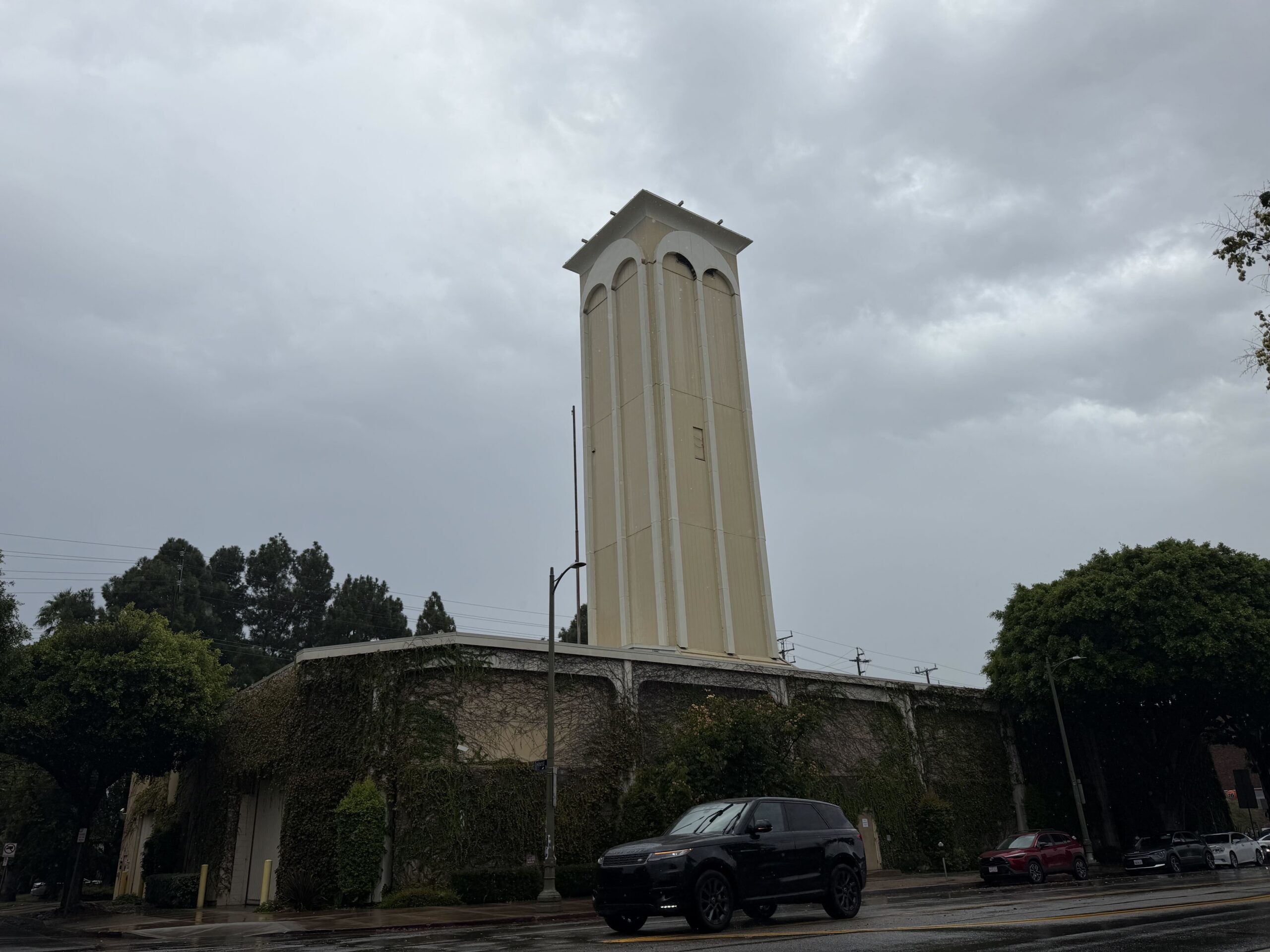
At another of the company’s properties, in the Pico-Robertson neighborhood of Los Angeles, Pacific Coast operated a drilling site and oil wells designed to resemble a synagogue. In 2021, city officials found the company in violation of multiple conditions, including rules governing fire safety, well drilling, and required environmental reviews. Later that year, a pipeline on the site leaked into a public alley. This history offers concrete examples of the concerns about the company’s conduct, and the need for oversight of the companies rushing into Venezuela.
The $100 Billion Question
The White House now says that NABEP will receive 100-year rights to 17 oil fields, containing about 65 billion barrels of proven reserves. It includes the right to buy 20 percent of NABEP’s production at cost; veto power of the board of directors, the majority of whom must be American citizens; and the right of first refusal for the remainder. In return, Betancourt’s company says it will invest up to $100 billion in rebuilding Venezuela’s infrastructure.
| $100B
PROMISED INVESTMENT |
100-year
RIGHTS TO VENEZUELA OIL FIELDS |
1/5
FIRST RIGHTS TO FIELDS HOLDING 20% OF THE COUNTRY’S RESERVES |
When asked, Pentagon spokesman Sean Parnell told Reuters that the Office of Strategic Capital “does not take equity stakes in private companies.” It is limited by law to providing loans, loan guarantees and technical assistance, including help structuring transactions. That appears to conflict with the White House’s description of the deal, which says NABEP granted OSC a 35% equity stake in its corporate parent. The Wall Street Journal had reported that the stake would be structured through “penny warrants,” which give the holder the right to acquire shares for a nominal price. The administration has not publicly explained how those warrants would be held or reconciled with OSC’s statutory limits. Senator Jack Reed (D-RI) on the Senate Armed Services Committee has requested “a full accounting of the legal authority for this transaction.”
Other legal issues arise around Venezuela’s constitution, which says that hydrocarbon deposits are government property that cannot be sold or transferred, and previously required the state to retain all shares of PDVSA. Changes after the U.S. invasion loosened those restrictions, but don’t clearly authorize the kind of 100-year long, majority-private control outlined in the NABEP deal. The company is also required to work in partnership with PDVSA, the state-owned oil company, under Venezuelan law.
Even less clear is whether NABEP will be able to raise that much capital. ExxonMobil, for example, spent about $29 billion on capital expenditures in 2025, and expects to spend about the same this year. Saudi Aramco spent $52.2 billion last year. In other words, NABEP’s promise is the equivalent of several years of an oil major’s spending—a remarkable undertaking for a much smaller, privately held producer.
Nor are those fields ready to produce. NABEP is taking over projects that were previously operated by Chinese and Russian companies, some in partnership with Venezuela’s state oil company, PDVSA. Beijing has already called for protection of Chinese interests in Venezuela.
Conclusion
Venezuela has a long history of nationalization and government intervention in the oil industry. That may contribute to why major international oil companies have been cautious about reinvesting. Rehabilitating mature oil fields can sometimes happen quickly, but Venezuela’s infrastructure has deteriorated for years, and requires substantial investment in pipelines and upgrading. On top of that massive capital commitment, equity investors are essentially paying a 35 percent tax on equity to the U.S. government on a project that can’t generate profit on at least 20 percent of its product. The administration hasn’t publicly provided enough detail to calculate what those rights are worth, or how associated costs will be allocated. None of this means Betancourt can’t make money from the venture. His company could find investors willing to bet on Venezuela, with the U.S. government’s involvement making the gamble feel a little safer. The real question is whether his wildcat network can deliver on this remarkable deal—and who gets stuck with the bill if it can’t.
# # #
Link to the comments we received from Rubenstein Communications about our report in full.
Stay Updated on Public Citizen
Follow Public Citizen
Support Our Work
Public Citizen Testimony to the Texas House Environmental Regulation Committee Regarding the Texas Commission on Environmental Quality
To: Chairman Brooks Landgraf and the Members of the House Environmental Regulation Committee
CC: Vice Chair Rep. Claudia Ordaz, Rep. Rafael Anchía, Rep. Keith Bell, Rep. Ben Bumgarner, Rep. Penny Morales Shaw, Rep. Tom Oliverson, Rep. Ron Reyolds, and Rep. Steve Toth
From: Kathryn Guerra, [email protected]; Adrian Shelley, [email protected].
Re: Agency Oversight, the Texas Commission on Environmental Quality (TCEQ)
Dear Chairman Landgraf and Members of the Committee:
Public Citizen is a nonprofit consumer advocacy organization with over one million members and supporters (including 30,000 in Texas) that champions public interest in the halls of power. On behalf of its members and supporters in Texas, Public Citizen appreciates the opportunity to testify before this committee on the Texas Commission on Environmental Quality (TCEQ).
In 2025, Public Citizen launched the TCEQ Watchdog Campaign to hold the TCEQ accountable to Texans and build the capacity of communities to engage effectively with the agency.
This committee is charged with ensuring that the TCEQ supports economic growth in Texas while environmental safeguards remain in place. This testimony summarizes many, but not all, of the issues our campaign has identified that fail the latter part of that mission. In some instances, TCEQ has expressed a need for a legislative remedy.
Summary of TCEQ Issues and Concerns
- The TCEQ’s own data shows that the agency issues more authorizations than it can effectively investigate or enforce.
- TCEQ’s performance metrics indicate failures to enforce environmental rules and protect the air and water. This includes reaching just 42% of a goal for all Texans to breathe clean air and 54% of a goal for clean water across Texas.
- TCEQ’s response to reported environmental concerns is significantly delayed – taking between two weeks and 30 days for an initial response in 54% of 9,200 complaints.
- In 2025, the TCEQ conducted the fewest on-site investigations the agency has reported in eight years, including years when the COVID-19 pandemic made in-person investigations challenging. The number of 2025 investigations was 3,600 fewer than in 2024 and 5,200 fewer than in 2023.
- More than half of the facilities the TCEQ regulates have not been investigated once in the past 5 years.
- TCEQ issued just 1,170 enforcement actions in FY 2025. The agency regulates 834,000 entities. This means that only 0.14% of all polluters in Texas received any formal enforcement action.
- TCEQ has an extensive enforcement case backlog of more than 900 unresolved cases. While this number has decreased from 1,480 cases since the beginning of the 2025 fiscal year, TCEQ closed more than 100 cases without an agreed order, without any demonstration of compliance, and without any penalty.
- Data centers are misusing Clean Air Act permitting to circumvent public notice and public participation, and the TCEQ is letting it happen.
- TCEQ canceled two public meetings on air permits for data centers in Amarillo and San Antonio without rescheduling them and refuses to tell the public why they were canceled.
- The TCEQ has taken liberties in its implementation of required rulemakings, including the Public Participation, Compliance History and the Section 185 rules.
Public Citizen has presented this information to the TCEQ in a good-faith attempt to collaboratively address the concerns we are hearing from communities across Texas. However, agency leadership has taken very few demonstrative actions to address these issues.
The data in this testimony was published by the TCEQ in fiscal year 2025 or prior. We anticipate agency reports for fiscal year 2026 and the 2025-2026 biennium will become available in the coming weeks, and we will provide our assessment of that data prior to the start of the 90th regular legislative session.
TCEQ Annual Performance Metrics
The TCEQ sets incredibly modest goals to reduce pollution or improve air and water quality, which it often fails to meet. Conversely, the TCEQ met or exceeded most of its goals for issuing permits. TCEQ issued 8,917 new authorizations in fiscal year 2025.
Air Quality
In 2025, the TCEQ reportedly met 112% of its annual performance goal to issue state and federal New Source Review air quality permits (1.2.1 EX 1), issuing 7,855 authorizations. In addition, the agency issued nearly 600 federal operating permits (1.2.1 EX 2). But the TCEQ’s performance of its core functions – to investigate and to enforce permits and environmental rules – was mediocre.
The TCEQ’s failures translate to poor outcomes for clean air and clean water in Texas. The TCEQ has a key performance measure: the “Percent of Texans living where the air meets federal air quality standards” (1.1 OC 3). The TCEQ’s target was just 43%. It achieved 42% of that goal. This agency must take responsibility for upholding the air quality standards for the other 58% of Texans who also deserve to breathe clean air.
In 2021, the agency’s target for clean air across Texas was 100%. Over the past decade, the agency has not achieved greater than 45% of this goal for clean air. So instead of continuing to work toward actions that would help the agency meet that goal for Texans, TCEQ simply lowered the bar for itself.
Similarly, in 2025, TCEQ failed to meet another key performance measure regarding the “Percent of stationary and mobile source pollution reductions in ozone non-attainment areas” (1.1 OC 1). TCEQ had a meager 3% reduction goal. Instead, TCEQ achieved -147% of its goal, meaning air pollution increased.
The TCEQ failed its goal to conduct more than 1,000 on-road mobile source air quality assessments (1.1.1 OP 3), conducting just 360 (36%). Between 15 and 18 million people – representing well over half of the total population of Texas – live in designated federal ozone non-attainment areas, where the air quality fails to meet National Ambient Air Quality Standards. On-road mobile source air quality assessments are one of the main tools to combat ozone precursor pollution in Texas.
Water Quality
The TCEQ issued approximately 760 water quality permits last year. That was approximately 90% of its target for that goal. TCEQ has a key performance measure to determine the “Percent of Texas classified surface waters meeting or exceeding water quality standards” (1.1 OC 5). TCEQ almost met its unimpressive target of 54%. The other 46% of Texas surface waters that fail to meet clean water standards do not seem to concern the agency.
TCEQ also failed to meet its modest goal to reduce pollution from permitted wastewater facilities discharging to waters of the state by 0.10% (1.1 OC 4). Instead, wastewater pollution increased.
Enforcement
The TCEQ reported in 2025 that it met just 58% of its key measure for “Percent of identified noncompliant sites and facilities for which timely and appropriate enforcement action is taken” (3.1 OC 4). Delays in enforcement have a tremendous impact on communities, which we discuss below in greater detail.
Potential Legislative Remedies
- The TCEQ’s performance goals must be robust and reflect measures that actually protect the health of all Texans through clean air and water.
- The TCEQ must decenter permitting as its primary objective and instead balance it with other core functions, such as enforcement and compliance.
- The TCEQ must seek adequate funding for staffing resources to meet the agency’s dire enforcement needs.
TCEQ Response to Reported Environmental Concerns
A report published by Public Citizen’s TCEQ Watchdog Campaign using the TCEQ’s own publicly available data shows that in fiscal year 2025, the TCEQ’s response to reported environmental complaints was significantly delayed.
Table 2: 2025 TCEQ Complaint Response Times
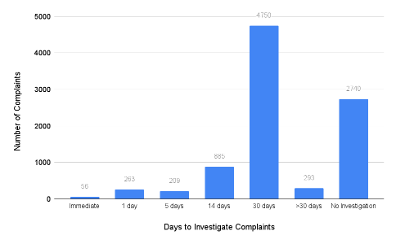
In FY 2025, TCEQ received 9,200 complaints. Of those:
- Investigators responded to just 300 complaints (3%) within one day.
- The agency took up to two weeks to investigate nearly 900 complaints (10%).
- The remaining 5,000 complaints (54%) took at least 14 days, but some took more than 30 days to initiate an investigation.
- The agency closed more than 2,700 complaints (30%) without ever investigating them.
The agency reported that the most common environmental complaint was odor or dust, an air quality concern. The likelihood that a reported air quality matter results in a confirmed violation (and mandate to remedy it) depends on the investigator’s observation of the violation, which can only happen if the investigator responds. By waiting 14-30+ days to investigate, the agency almost guarantees it cannot confirm a violation or take enforcement action. Weather and conditions at the facility are likely to change over such a long period, resulting in closure of the complaint until the neighbor experiences the issue again and files another complaint. Neighbors in communities across the state have told us they’ve stopped reporting complaints to the TCEQ because it either does not respond or does not take action to resolve the issue.
In one of the most egregious public nuisance cases in Texas in recent years, it took the TCEQ years to address pervasive odors that neighbors described as “festering dog vomit on fire,” emanating from the Darling Ingredients animal rendering facility in Bastrop County. According to local elected officials, the smell was regularly observed in communities as far as 15 miles from the plant.
It took 1,440 complaints before the TCEQ took additional steps to enforce the facility’s permits and refer the case to the Attorney General. One neighbor testified in the state’s civil suit that, “If my neighbor was outside burning tires, I would actually go over there and thank them because I didn’t have to smell Darling Ingredients anymore, it’s that bad.” And it was not just a bad odor. The TCEQ investigator found that on multiple occasions, Darling Ingredients emitted extremely toxic hydrogen sulfide gas at “levels that far exceeded the emissions allowed by state regulations,” and reported smells of decaying animals, burned cooking grease and sewage onsite.
The TCEQ told Public Citizen that once a facility goes to enforcement for a violation, its policy is not to initiate additional enforcement of the same violation while the existing case was pending. But it takes the TCEQ a year and a half on average to process a single enforcement case – in many cases, much longer. This meant that Darling Ingredients was granted a pass for ongoing, pervasive emissions violations. At the same time, TCEQ processed its enforcement case, leaving residents to endure emissions that prevented them from enjoying their own yards and community spaces – for years.
Potential Legislative Remedies
- The TCEQ’s budget for staff resources – specifically for investigations – should be increased, as proposed in the agency’s FY 28-29 LAR base request.
- The TCEQ should prioritize response to reported environmental complaints, especially because agency data shows a decrease in proactive on-site investigations (below).
On-Site Investigations
In FY 2025, agency data shows that while the TCEQ conducted 101,000 investigations, only 63,000 were conducted on-site. This is the fewest on-site investigations the agency has reported in eight years, including years when the COVID-19 pandemic made in-person investigations challenging. The number of 2025 investigations was 3,600 fewer than in 2024 and 5,200 fewer than in 2023.,, The TCEQ also conducts record review investigations, where an investigator requests copies of records via email without visiting the facility. TCEQ conducted 38,000 such investigations.
Table 1: TCEQ On-Site Investigations by Fiscal Year
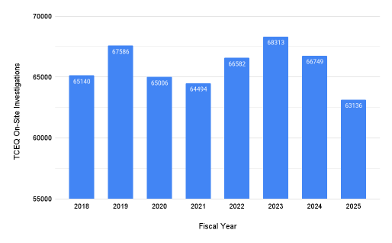
Of the 63,000 investigations, just 6,400 (10%) were for air quality, 5,400 (8.6%) were for petroleum storage tanks, 3,900 (6%) were for public water supply, 3,000 (4.7%) were for water quality, 1,400 (2%) were for on-site sewage and 1,000 (1.6%) were for municipal solid waste. The majority of on-site investigations were for water rights – 38,470 (61%).
The TCEQ has not investigated a facility with an “unclassified” Compliance History ranking in the preceding 5-year period. According to the TCEQ’s 2025 Compliance History report, 273,700 (53%) of 521,000 regulated facilities that are subject to the Compliance History program in Texas had not been investigated in the preceding 5-year period. This figure does not include the 313,000 facilities not subject to the program, but highlights just how large the problem is.
In August 2025, TCEQ staff told Public Citizen that the agency had no intention of reducing the number of uninspected or unclassified entities because the Sunset Commission did not recommend, and the legislature did not mandate, that it do so.
The lack of a mandate to adopt procedures that meet the goals of TCEQ and of the Sunset Commission does not prohibit doing so. The TCEQ (and the Compliance History program) cannot function as intended unless the agency addresses the volume of facilities it has failed to inspect in the preceding 5-year period.
Potential Legislative Remedies
- No regulated entity should be left to self-monitor for more than 5 years. The TCEQ should be mandated to implement a performance metric and goal to reduce uninspected and unclassified entities.
Enforcement
TCEQ issued just 1,170 enforcement actions in FY 2025. The agency’s Annual Enforcement Report states that it aims to issue just 1,000 administrative orders each year and reports that it “consistently meets” that goal. But there are 834,000 regulated entities in Texas, according to TCEQ’s most recent Legislative Appropriation Request. This means that only 0.14% of all polluters in Texas received any formal enforcement action in 2025.
Despite the agency’s failures to promptly respond to reported environmental complaints and to conduct thousands of on-site investigations, in April, the agency posted a message to its social media channels thanking industry and making a false correlation between high compliance rates and the agency’s inability to sufficiently investigate and enforce environmental laws.
Enforcement Backlog
Meanwhile, the TCEQ struggled to process its extensive backlog of enforcement cases. The TCEQ started the 2025 fiscal year with a backlog of 1,490 cases and ended the fiscal year with 1,480 cases., At that rate, the backlog will take 148 years to resolve, not including any new enforcement cases. The backlog is almost entirely of the agency’s own making – a failed enforcement policy among many that continue to erode public confidence in the agency.
Agency enforcement staff disclosed during a public meeting in September 2025 that it had recently ended its long-standing practice of arbitrarily delaying enforcement cases for years to process them in batches, creating the complex backlog the agency is now struggling to work through.
Enforcement delays often result in ongoing, unremediated pollution and harmful public health outcomes. We’ve asked TCEQ leadership to make a serious, expeditious effort to address the backlog in our TCEQ Year in Review report, in press, on social media and in recent public comments directly to agency leadership.
The enforcement backlog began steadily growing in 2021 and reached a peak of 1,700 cases in early 2024. The oldest case in the backlog is a ten-year-old case against Cal-Maine Foods for discharging approximately 8 million gallons of wastewater from a concentrated animal feeding operation into the waters of the state over 10 days, resulting in multiple documented fish kills.
It doesn’t outwardly appear that the agency has taken a single step toward aggressive enforcement in this case, which has surpassed every compliance deadline outlined in the agency’s enforcement process. In fact, the TCEQ has renewed the facility’s wastewater permit twice since the incident – once in 2019 and again in 2024, despite TCEQ records showing it hasn’t conducted an on-site inspection of this facility since 2018.,
According to agency data, it takes the TCEQ an average of 528 days to process a single enforcement case. TCEQ says it prefers to “promote and foster voluntary compliance with environmental laws and provide flexibility in achieving environmental goals.”
The TCEQ doesn’t consider a case behind schedule until it’s been on the books for six months from the date it was referred for enforcement action. If the TCEQ hasn’t mailed the polluter a proposed agreed order – a template letter that details the alleged violation(s) and penalty – within that time, the agency counts the case as backlogged. But then TCEQ mails the agreed order, and the case is removed from the backlog list.
According to staff, if, after 550 days (1.5 years) from the original enforcement referral date, the polluter still has not signed the agreed order and voluntarily agreed to come into compliance, the TCEQ returns the case to the backlog list.
In some cases, years-long delays were caused solely by TCEQ’s inability to draft and mail the proposed agreed order to the polluter. To remove them from backlog status, all TCEQ did was stick a postage stamp on an envelope and mail a template letter. If a community is suffering from pollution, resolution doesn’t come in a template letter. It comes when pollution stops and fines are paid.
In other cases where TCEQ has issued a default order, it took the agency multiple years to mail an enforcement letter to the respondent. After many years, businesses have closed or changed ownership, contact information has changed, and respondents have become much more difficult to reach.
In response to our requests to address the backlog, in April 2026, TCEQ leadership told us that the TCEQ lacked the funding needed to address the enforcement backlog and that the public needed to advocate for more agency funding during the upcoming legislative session if they wanted to see it resolved.
But just a few weeks later, TCEQ leadership reported it had a newly dedicated “strike-force” of five full-time attorneys in its Office of Legal Services specifically to address the enforcement backlog and that it had created a new team in the Office of Compliance and Enforcement who are focused on backlogged cases, “with the ultimate goal of appropriately managing all of these cases by the end of the fiscal year.” The TCEQ did not meet its goal, and as of August 2026, more than 900 backlogged cases remain.
Closed or Non-Suited Enforcement Cases
Between January and July 2026, data obtained by public information request shows that the TCEQ closed or withdrew more than 100 backlogged enforcement cases, counting them as “resolved” in its monthly progress reporting, despite no agreed order, no compliance demonstration and no payment of any penalty.
The TCEQ told Public Citizen it doesn’t have to tell the public how the cases were closed, if the violation(s) were resolved, or if the pollution was remediated.
We reviewed each closed case, which have been removed from the agency’s most recent report of active enforcement actions and indicate a closed status in the TCEQ’s Commissioners Integrated Database.
Some closed enforcement cases involved serious environmental disasters.
In Fort Worth, the TCEQ alleged that in December 2019, the U.S. Navy spilled approximately 2,600 gallons of PFAS-containing 3% Aqueous Film-Forming Foam (AFFF) solution (a synthetic fire-fighting concentrate used to extinguish fuel fires) from an above-ground tank directly into the storm drain at the Naval Air Station Joint Reserve Base (NASJRB). The spill contaminated a local creek, but the Navy failed to contain it or respond. The TCEQ requested sampling of the impacted creek, but the Navy did not respond. The City of Fort Worth is suing the U.S. Department of Justice for contaminating the city’s drinking water with PFAS, which they allege also came from the use of AFFF for fire suppression at the Joint Reserve Base and a nearby Lockheed Martin site. TCEQ closed this enforcement case in February, after six years – seemingly without requiring sampling, remediation or payment of a penalty.
The TCEQ closed cases against known repeat violators, including two air quality enforcement cases against the Chevron Phillips Cedar Bayou plant in Baytown and a wastewater enforcement case against the Formosa Plastics Corporation facility in Calhoun County.,
While actively managing cases is progress, removing records and claiming victory on paper is not. Only the closure of resolved cases indicates that the TCEQ’s enforcement process is functioning as it should.
The TCEQ’s extensive enforcement backlog highlights the problems created by the agency’s lax enforcement approach. Voluntary compliance can still occur with strong agency-enforced deadlines and accountability to communities, but the TCEQ shouldn’t wait ten years for voluntary compliance. The agency should issue default orders – that come with fines and corrective action to stop environmental harm – and refer these significantly delayed cases to the Attorney General for civil enforcement in a court of law.
Potential Legislative Remedies
- The TCEQ should be mandated to adhere to clear timelines regarding the issuance of agreed orders, issuance of default orders and the referral of a case to the Attorney General.
- A mandate or time limitation requiring the TCEQ to draft and send an agreed order within 30-60 days would resolve the self-made problem that often leads to default orders and backlogged cases.
- The TCEQ should be mandated to report its progress toward resolving its extensive enforcement backlog and to limit its use of discretionary closure of unresolved backlogged cases without an agreed order or payment of a penalty.
- The TCEQ must end its enforcement policy of not issuing subsequent enforcement action while an enforcement case is pending. Each violation must count as an actionable enforcement case until the issue is resolved.
- TCEQ should develop a policy that prohibits new permits to be issued while outstanding enforcement actions remain unresolved because the respondent is unwilling to voluntarily settle the matter.
Public Participation
In 2023, the TCEQ was labeled a “Reluctant Regulator” by the Texas Sunset Advisory Commission, which found that “TCEQ’s policies and processes lack full transparency and opportunities for meaningful public input, generating distrust and confusion among members of the public,” among numerous other issues. The Texas legislature mandated the TCEQ to improve its public participation processes.
In January 2026, as mandated by the TCEQ Sunset Bill (SB 1397) signed into law in 2023, the TCEQ adopted a rulemaking ostensibly aimed at improving public participation. Despite the bill’s clear intent, the TCEQ’s final rule fell short of the reforms lawmakers and the state’s Sunset Advisory Commission envisioned. The TCEQ received more than 50 comments from community and environmental advocates asking the agency to align the rule with the Sunset Advisory Commission’s recommendations, increase transparency and make participation less confusing. The agency rejected each of those 50 comments. Instead, the TCEQ modified this rule proposal after it was presented to the public, based on more than 30 comments from corporate interest groups.
Data Centers
An increasing number of data centers are obtaining TCEQ air quality authorizations that do not require public notice or public participation. Data centers with onsite power generation in the form of gas turbines or diesel generators are obtaining low-level permit-by-rule authorizations for back-up diesel generators and standard permits for electric generating units. Both are pre-construction permits that grant the facility permission to build before the public has any right to object or weigh in. Permits-by-rule are issued quickly through an administrative process that typically takes 1-2 days. Some facilities are obtaining major-source air permits, which include public opportunities, such as notice and comment, public meetings, and the opportunity for a contested case hearing.
Through our review of permits and permit applications by data centers, we are concerned that some facilities are underpermitted. If a company can avoid a major source designation, it can get permitted more quickly without public involvement. There is a significant incentive to do this by undercounting potential emissions, understating the project’s true scale, or segmenting the project. We don’t believe the TCEQ is equipped to determine when data center developers are under-permitting their facilities.
We have seen data center developers request permit-by-rule registrations with emissions limits right under the federal major source threshold (see attached slides). Often, their representation that they are a minor source is based on a stated maximum number of operating hours. If the backup power runs too long, these facilities may emit pollutants beyond the public notice threshold. Registrations and permits-by-rule do not require TCEQ staff to analyze or confirm compliance. We are concerned that facilities might regularly exceed their permit limits without being detected.
In recent interim hearings, it has been said that federal regulations require backup generators to operate for about 50 or 100 hours per year. EPA regulations state that RICE engines may be operated for 100 hours per year for maintenance and testing, including 50 hours of that for non-emergency purposes. 40 C.F.R. § 63.6640(f)(2)(i).
However, EPA guidance is clear that generators used for backup power can be assumed to be operated for as much as 500 hours per year. In a letter explaining this guidance, the EPA said:
EPA determined that 500 hours was a reasonable and realistic “worst-case” estimate of the number of hours that an emergency generator could be expected to operate per year. However, the guidance is only applicable to a generator “whose sole function is to provide back-up power when electric power from the local utility is interrupted.”
Air permits are issued based on a source’s potential to emit. Backup power generators at a data center fall within this EPA guidance and should therefore be permitted based on 500 hours of operation.
We know that data centers generally do not act like other large loads that respond to price signals and curtail load when ERCOT demands. Additionally, even a few minutes without power can be incredibly undesirable for a data center. We are concerned that future grid emergencies will cause data centers to run backup power as long as needed to stay online, even if that means going beyond their emissions limits. We believe this scenario could happen, especially as our grid faces increasing strain from the growing demand of interconnecting data centers.
We understand that to a data center developer, the penalties for breaking their emissions limits are a slap on the wrist compared to the penalty of going offline and not providing AI or cloud services. To fenceline communities, though, the threat of data centers violating their emissions limits means exposure to toxic chemicals in violation of the law and their rights as Texans.
We believe a policy is needed to protect Texans from the dangers that under-permitted backup generators for data centers pose.
TCEQ seems to apply site aggregation rules inconsistently for data centers, allowing some data centers and their collocated power plants to be permitted separately, as two smaller authorizations instead of together as one site.
Lastly, the TCEQ recently canceled two public meetings for hyperscale AI data centers – seemingly without any reason., These meetings were opportunities meant for communities to voice opposition to the pollution in their neighborhoods from gas plants that would power those facilities.
The TCEQ canceled the August 17 public meeting for the Vantage Data Center in San Antonio and the August 24 public meeting for the Fermi Data Center near Amarillo. The meetings have not been rescheduled as of the date of this testimony.
Initially, the TCEQ wouldn’t tell us why those meetings were canceled or when they would be rescheduled. But the agency told the press the meetings were canceled “Due to high public interest.” That is the same reason given by the agency as justification for holding the meetings in the first place. The TCEQ could have added additional meetings to the calendar instead of canceling the meetings the public was already planning to attend.
Emails obtained via public information request show that a week before the August 17 public meeting for the Vantage Data Center in San Antonio, a TCEQ staffer in the Chief Clerk’s office emailed agency staff.
“Leadership has asked us to cancel this hearing and reschedule for a later date.” Moments later, he sent the same email to the staff organizing the August 24 public meeting on the Fermi America Project Matador permits near Amarillo.
TCEQ refused to disclose whether the agency’s own leadership or higher state leadership made the call to cancel. Instead, it sought a ruling from the Texas Attorney General under the Texas Public Information Act to withhold all remaining communications from the public.
In a letter to the Attorney General, TCEQ seeks to hide the names of staff it says met with agency attorneys for legal advice and help with the legal justifications and implications of canceling and rescheduling public meetings.
Meanwhile, neighbors arrived at empty meeting venues. And while TCEQ said its “normal precedent” is to send agency staff to canceled meeting locations if the public didn’t receive notice, it decided in emails it didn’t need to show up to redirect residents. “My vote is that mailing out the notice and updating calendars must be good enough. We can’t afford to go all the way to Amarillo just to say it is cancelled,” the Chief Clerk told her staffer. “I agree,” the staff responded.
Potential Legislative Remedies
- Create a new permit/registration for data centers with public notice required at a lower emissions level for NOx, VOCs, Particulate Matter, etc., than the existing permit-by-rule and standard permit limits so that the public has meaningful opportunities to participate before the facility is built.
- Create a new permit class for data centers with significant penalties for exceeding limits.
- Require minor permit holders to submit proof of backup-generation operating hours and emissions calculations.
- TCEQ should require source aggregation determination for every data center and collocated power plant.
Rulemakings
Compliance History Rule Revision
The Sunset Bill mandated revising the agency’s Compliance History program. The Sunset Bill directed TCEQ to “review and update the agency’s compliance history rating formula to ensure it accurately reflects a regulated entity’s record of violations.” It also required TCEQ to “specifically consider major, moderate, and repeat occurrences of the same minor violations when calculating compliance history ratings.” (Emphasis added.) But the TCEQ proposed and adopted a final rule that largely excluded Notices of Violation and relied primarily on compliance history formulas based on formal Notice of Enforcement actions.
Despite numerous environmental advocacy organizations submitting relevant comments that would have further strengthened the agency’s Compliance History rule revision and aligned it with the Sunset Advisory Commission’s recommendation, the agency rejected or refuted all public comments. Instead, the agency amended the rule from its original draft to accommodate industry, which has proposed a 5-tier classification system that makes it easier to avoid repeat-violator status. Those revisions came after the comment period ended, without any further opportunity for the public to have input considered in any meaningful way.
While the agency noted that this rulemaking considered the duration of the appeal window for regulated entities, it did not include any measures for transparency for the appeals process. The public should be granted access upon request to any documentation or reasoning submitted to or considered by the TCEQ when determining whether to grant a requested appeal of a Compliance History or Repeat Violator Designation.
A public information request response found that the agency’s Executive Director used discretion to change the assessed 2025 compliance history rankings for two entities: ConocoPhilips and Brushy Creek Wastewater Treatment Plant., But the agency refused to provide more information about the changes, including staff communications, saying they were protected under attorney-client privilege or deliberative process privilege. ConocoPhilips’ ranking went from a 75 (unsatisfactory) to a 55 (satisfactory). If the agency cannot transparently explain the reason for changing a Compliance History ranking, it should not be granted the discretion to do so.
Section 185 Fees
Section 185 of the Clean Air Act is triggered when a region in severe or extreme nonattainment fails to meet federal deadlines to reduce air pollution. If air quality does not improve, Section 185 requires states to impose a financial penalty on certain large stationary sources that emit pollutants contributing to non-attainment. In Texas, for example, the Dallas-Fort Worth and Houston-Galveston-Brazoria areas are in ozone non-attainment.
The TCEQ adopted this rule program, which failed its primary goal of improving air quality by using an accounting trick to forgive an obligation Congress imposed on industry and instead passing those costs on to Texans. Commissioners approved using funds the agency already collects through the Texas Emissions Reduction Plan (TERP), which is funded by Texas drivers through vehicle title and registration fees, rather than creating a fund that polluters would pay into. The agency will count public dollars toward the debt owed by private industry, significantly reducing or eliminating that debt. This failed rulemaking is yet another example of how the agency serves industry interests. The TCEQ estimated that, as intended, implementing the Section 185 fee program would have generated over $200 million annually for the Houston-Galveston-Brazoria and Dallas-Fort Worth areas.
Potential Legislative Remedies
- TCEQ should be mandated to implement the Section 185 fee program as Congress intended without balancing industry’s debt against the public’s dollars.
- TCEQ should not be allowed to eliminate its annual TERP report, by consolidating it with its biennial report, as requested, because it should be required to publicly disclose how much of industry’s debt it wipes clean each year.
Legislative Appropriations Request for Fiscal Years 2028-2029
The TCEQ’s leadership has expressed little interest in our concerns that the agency’s enforcement resources are insufficient, approving a new Legislative Appropriations Request for FY 2028-2029 that failed to adequately increase agency funding for investigations and enforcement, despite the significant increase in the number of regulated entities across the state and the agency’s poor performance across its enforcement activities.
TCEQ’s 28-29 LAR proposes funding just $78,402,500 for Field Inspections and Complaints each fiscal year, a decrease of $36,430,800 from FY 2025. The TCEQ proposes just $21,743,950 for Enforcement & Compliance Support, a modest increase of $1,321,350 from 2025, despite the agency’s significant needs.
In an Exceptional Item Request, the agency asks for $9,175,110 for Front Line Support, including funding for staffing necessary for compliance and enforcement. This funding is not guaranteed, and the agency’s core functions will suffer without it. It should have been included in the agency’s base request. We plan to present our concerns to the Legislative Budget Board during the upcoming hearing.
Conclusion
Communities across Texas depend on the TCEQ to protect public health, our state’s natural resources and the environment. In many ways, the TCEQ seems determined to live up to its “Reluctant Regulator” title. Residents have expressed frustration with the agency’s inability to prioritize people over corporate profits and the agency’s unwillingness to improve, despite past legislative efforts.
We are hopeful that this committee can begin to address these issues. We are available to discuss any of these issues further.
Kathryn Guerra
TCEQ Campaign Director | Public Citizen
Stay Updated on Public Citizen
Follow Public Citizen
Support Our Work
Independent Health Experts
Many health experts who appear in the media and play a role in policymaking at federal health agencies have problematic conflicts of interest that are never disclosed to the public. They and their work are funded by giant corporations and Big Money with vested financial interests in spreading their beliefs and views.
This page hosts a list of public health and health policy experts in a variety of domains who have no such conflicts and are available to speak with reporters. Their views do not necessarily align with those held by Public Citizen and our allies. These independent health experts are listed here because their views are unconflicted. If you are a member of the press and interested in connecting with one or more of them, please reach out to David Rosen at [email protected].
| LAST NAME | FIRST NAME | DEGREES | TITLE | AFFILIATION | PRIMARY SPECIALTY | SECONDARY SPECIALTY | ADDITIONAL EXPERTISE | COUNTRY | CITY | AVAILABILITY |
|---|---|---|---|---|---|---|---|---|---|---|
| Abi-Jaoude | Elia | MD, PhD | Assistant Professor | University of Toronto | Psychiatry, Tourette syndrome | Critical appraisal, research methodology, Ethics and conflicts of interest | Tourette syndrome, pharmaceutical industry bias and medicalization in psychiatriy | Canada | Toronto, Ontario | Any media |
| Abramson | John | MD | Lecturer (adjunct), Department of Health Care Policy | Harvard Medical School | Family Medicine | Critical appraisal of the quality of scientific evidence available to practicing physicians and other heatlhcare professionals | United States | Boston, MA | Any media | |
| Andrew | Louise B | MD, JD | Former Assistant Professor | Johns Hopkins | Emergency Medicine | Internal Medicine | Mental Health and Disability Law and Medical regulation, and malpractice litigation | United States, Canada | Victoria BC and Port Angeles WA | Any media |
| Antonuccio | David | PhD | Professor Emeritus | Dept. of Psychiatry and Behavioral Sciences, University of Nevada, Reno, School of Medicine | Psychiatry | Clinical Psychology | Critical appraisal, research methodology, Drug and device approval, Ethics and conflicts of interest, Medical investigative journalism | United States | Reno | Any media |
| Baral | Stefan | MD, MPH | Associate Professor | Johns Hopkins University | Preventive Medicine & Public Health | Health disparities, Social medicine | Infectious Diseases, HIV, Epidemiology | Baltimore | National and international media only | |
| Baretich | Matt | PhD, PE | Baretich Engineering, Inc. | Clinical engineering | Medical devices | United States | Fort Collins, CO | Any media | ||
| Barrett | Bruce | MD, PhD | Professor | University of Wisconsin Schoool of Medicine and Public Health | Family Medicine | Preventive medicine and Public Health | Critical appraisal, research methodology, Ethics and conflicts of interest, Health disparities, Social medicine | United States | Madison | National and international media only |
| Barry | Michael | MD | Professor | Massachusetts General Hospital, Harvard Medical School | Internal Medicine | Prostate diseases | Critical appraisal, research methodology, Ethics and conflicts of interest, patient outcomes research, shared decison making | United States | Boston | Any media |
| Basu | Arindam | MD, PhD, MPH | Senior Lecturer Above the Bar | University of Canterbury School of Health Sciences | General Surgery | Otorhinolaryngology (ear, nose, throat) | Critical appraisal, research methodology, Drug and device approval, Preventive medicine, environment | Canterbury | Any media | |
| Batt | Sharon | PhD | Adjunct | Department of Bioethics, Dalhousie University | Hematology/Oncology | Drug and device approval, Ethics and conflicts of interest, Health disparities, Social medicine, Health systems, insurance, politics of healthcare, Medical investigative journalism, Patient organizations | Canada | Halifax, Nova Scotia | Any media | |
| Bero | Lisa | PhD | Professor (University of Colorado) Affiliated Professor (University of Sydney) | The University of Colorado, Schools of Medicine and Public Health, Center for Bioethics and Humanities; Affiliated Professor at the University of Sydney, Australia. | Public health | Preventive medicine | Critical appraisal, research methodology, Drug and device approval, Ethics and conflicts of interest | United States & Australia | Denver, CO | Any media |
| Bewley | Susan | MD, MA (law & ethics), FRCOG | Professor (emeritus) of Obstetrics and Women's Health | Obstetrics-Gynecology | Ethics and conflicts of interest | London | Any media | |||
| Bezruchka | Stephen | MD, MPH | Associate Teaching Professor | University of Washington | Public health | Preventive medicine and Public Health | Health disparities, Social medicine, Health Olympics | United States | Seattle | Any media |
| Bijl | Dick | MD, PhD | International Society of Drug Bulletins, Institute for Scientific Freedom | Family Medicine | Surgery | Critical appraisal, research methodology, Drug and device approval, Medical devices, Medical investigative journalism, Regulatory Affairs | Nederland | Utrecht | Any media | |
| Biollaz | Jerome | MD | Emeritus professor | Internal Medicine | Pharmacology | Critical appraisal, research methodology, Drug and device approval, Ethics and conflicts of interest | Switzerland | Chamoson | Regional or local media only | |
| Biswas | Rakesh | MD | Professor | Kamineni Institute of Medical sciences | Internal Medicine | Ethics and conflicts of interest, Health disparities, Social medicine, Medical investigative journalism | India | Hyderabad | Any media | |
| Boussageon | Rémy | MD, PhD | Professor | Collège Universitaire de Médecine Générale, Université Claude Bernard, Lyon 1 | Family Medicine | Preventive Medicine & Public Health | Evidence based medicine, placebo effect, critical appraisal, research methodology, Ethics and conflicts of interest | France | Lyon | Any media |
| Braillon | Alain | MD, PhD | Senior consultant | University Hospital, France | Pharmacology, Public Health, Hepatology, Alcohol, Tobacco, Screening, Shared Decision Making | Hepatology (liver and gall bladder) | Critical appraisal, research methodology, Drug and device approval, Ethics and conflicts of interest, Alcohol, tobacco, Quality of care, EBM | France | Amiens | Any media |
| Breggin | Peter | MD | Director, Center for the Study of Empathic Therapy | Center for the Study of Empathic Therapy | Psychiatry | Critical appraisal, research methodology, Drug and device approval, Ethics and conflicts of interest, Medical investigative journalism, Regulatory Affairs, Politics of Psychiatry | United States | New York State | Any media | |
| Brewer | Phillip | MD | Adjunct Professor and University Medical Director | Emergency Medicine | Internal medicine | Health systems, insurance, politics of healthcare | United States | Cheshire | Any media | |
| Brezis | Mayer | MD, MPH | Professor of Medicine | Hebrew University of Jerusalem | Internal Medicine | Preventive medicine and Public Health | Ethics and conflicts of interest, Health disparities, Social medicine, Health systems, insurance, politics of healthcare | Israel | Jerusalem | Any media |
| Brito de Sá | Armando | MD, PhD | Ministry of Health, Portugal | Family Medicine | Preventive medicine and Public Health | Critical appraisal, research methodology, Drug and device approval, Health systems, insurance, politics of healthcare | Portugal | Setúbal | Any media | |
| Brophy | James | MD, PhD | Professor | McGill University | Cardiology | Critical appraisal, research methodology, Drug and device approval | Canada | Montreal QC | Any media | |
| Brown | David | MD | Professor | Washington University in St. Louis | Cardiology | Critical appraisal, research methodology, Drug and device approval, Ethics and conflicts of interest, Health disparities, Social medicine, Health systems, insurance, politics of healthcare, Medical devices | United States | St. Louis | Any media | |
| Brown | Michael | MD | Professor | Michigan State University | Emergency Medicine | United States | Grand Rapids | Any media | ||
| Carragee | Eugene | MD, Editor in Chief, The Spine Journal | Professor, Standford University School of Medicine | Stanford University | Orthopedic Surgery | United States | Stanford, California | Any media | ||
| Cassels | Alan | MPA | Adjunct professor | Faculty of Human and Social Development, University of Victoria | Preventive Medicine & Public Health | Health policy | Ethics and conflicts of interest, Health systems, insurance, politics of healthcare, Medical investigative journalism | Canada | British Columbia | Any media |
| Chatterjee | Pranab | MD | Professor of International Health | Johns Hopkins Bloomberg School of Public Health | Preventive Medicine & Public Health | Infectious diseases | Health disparities, Social medicine | India | Kolkata, West Bengal | Any media |
| Cifu | Adam | MD | Professor of Medicine | University of Chicago | Internal Medicine | Critical appraisal, research methodology | United States | Chicago | Any media | |
| Cook-Deegan | Robert | MD | Professor | Arizona State University | Public policy | Genomics | Ethics and conflicts of interest | United States | Accokeek, MD | Any media |
| Cosgrove | Lisa | PhD | Professor | University of Massachusetts-Boston | Psychiatry | United States | Boston | Any media | ||
| Cristea | Ioana | PhD | Assistant Professor | University of Pavia | Psychiatry | Critical appraisal, research methodology, Drug and device approval, Ethics and conflicts of interest | Pavia | Any media | ||
| Dachs | Robert | MD | Clinical Associate Professor of Family Medicine, Albany Medical College | Emergency Medicine | Family medicine | Schenectady, NY | Any media | |||
| Davis | John | MD | Professor | Psychiatry | Critical appraisal, research methodology | United States | Chicago | Any media | ||
| De Fiore | Luca | PhD | Associazione Alessandro Liberati Network italiano Cochrane | Preventive Medicine & Public Health | Ethics and conflicts of interest, Health systems, insurance, politics of healthcare | Italy | Rome | Any media | ||
| Del Mar | Chris | MD | Professor | Bond University | Critical appraisal, research methodology | Australia | Queensland | Any media | ||
| Delgado Figueroa | Netzahualpilli | MD, MS in Innovation & Management | Professor | Universidad de Guadalajara | Emergency Medicine | Pediatrics, Preventive Medicine & Public Health | Critical appraisal, research methodology, Drug and device approval, Ethics and conflicts of interest, Health disparities, Social medicine, Health systems, insurance, politics of healthcare, Medical investigative journalism, Regulatory Affairs, Humanitarian Health & Migration | Mexico | Guadalajara | Any media |
| Deyo | Richard | MD, MPH | Professor | Oregon Health & Science University | Internal Medicine | Critical appraisal, research methodology | United States | Portland, OR | Any media | |
| Dhruva | Sanket | MD | Assistant Professor of Medicine | Cardiology | Internal medicine | Drug and device approval, Medical devices, Regulatory Affairs | San Francisco | Any media | ||
| Diller | Lawrence | MD | Assistant Clinical Professor | University of California, San Francisco | Psychiatry | Pediatrics | Drug and device approval, Ethics and conflicts of interest, Health systems, insurance, politics of healthcare | United States | Walnut Creek, California | Any media |
| DuBroff | Robert | MD | Clinical Professor of Medicine | University of New Mexico School of Medicine | Cardiology | Critical appraisal, research methodology, Ethics and conflicts of interest | United States | Albuquerque | Any media | |
| Elliott | Carl | MD, PhD | Professor, Center for Bioethics | University of Minnesota | Bioethics | Ethics and conflicts of interest, Medical investigative journalism | United States | Minneapolis, Minnesota | Any media | |
| Elpern | David | MD | Dermatology | United States | Williamstown | Any media | ||||
| Ewen | Margaret | PhD | Health Action International | Preventive Medicine & Public Health | Medicine prices. insulin | Netherlands | Amsterdam | Any media | ||
| Fabbri | Alice | MD, PhD | Research Fellow | Tobacco Control Research Group, Department for Health, University of Bath, UK | Ethics and conflicts of interest | United Kingdom | Bath | Any media | ||
| Fatovich | Daniel | MD, PhD | Professor | University of Western Australia | Emergency Medicine | Australia | Perth | National and international media only | ||
| Fierlbeck | Katherine | PhD | Professor | Dalhousie University | Preventive Medicine | Public Health | Health disparities, Social medicine, Health systems, insurance, politics of healthcare | Canada | halifax | Any media |
| Fingerman | Eileen | MD | Clinical Assistant Professor of Family Medicine at University of New England ; Clinical Assistant Professor of Community and Family Medicine Geisel School of Medicine at Dartmouth | Family Medicine | Preventive Medicine & Public Health | nutrition | United States | sidney | Any media | |
| Ford | Anne Rochon | Ms. | N/A | York University | Preventive Medicine & Public Health | Environmental health | Health disparities, Social medicine | Canada | Ontario | Any media |
| Gagnon | Marc-Andre | PhD | Associate Professor | School of Public Policy and Administration, Carleton University | Health policy | Drug and device approval, Ethics and conflicts of interest, Health systems, insurance, politics of healthcare, Regulatory Affairs | Canada | Quebec | Any media | |
| Gavilán | Enrique | MD | Doctor in Medicine. | Research coordinator, Laboratory of Polypharmacy | Family Medicine | Polypharmacy, deprescribing | Spain | Plasencia | National and international media only | |
| Gervas | Juan | MD, PhD | Professor | National School of Public Health | Family Medicine | Preventive Medicine & Public Health | Health disparities, Social medicine, Preventive activities | Spain | Madrid | Any media |
| Gillibert | André | MD, MPH | Doctor | CHU de Rouen (Rouen University Hospital) | Preventive Medicine & Public Health, Statistics & Methodology in clinical research and epidemiology | Statistics & Methodology in clinical research and epidemiology | Critical appraisal, research methodology | France | Rouen | Any media |
| Gomes | Luís Filipe | MD | Professor Auxiliar Convidado (AP) | EURACT (European Academy of Teachers in General Practice/Family Medicine | Family Medicine | Patient Centredness | Portugal | Portimao | Any media | |
| Goozner | Merrill | MS | Modern Healthcare | Drug and device approval, Ethics and conflicts of interest, Health systems, insurance, politics of healthcare, Medical investigative journalism, Regulatory Affairs | United States | Chicago | Any media | |||
| Gøtzsche | Peter C | MD | Professor | Nordic Cochrane Centre | Internal Medicine | Psychiatry | Critical appraisal, research methodology, Drug and device approval, Ethics and conflicts of interest | Denmark | Copenhagen | Any media |
| Green | Jonas | MD, MPH, MSHS | Cedars-Sinai Medical Care Foundation | Internal Medicine | Ethics and conflicts of interest, Health systems, insurance, politics of healthcare | United States | Los Angeles | Any media | ||
| Green | Lydia | RPh | RxBalance | Pharmaceutical advertising | Drug Marketing: How life science companies use advertising, CME, thought leaders etc to communicate science, expand demand for their products and increase market share. | United States | Redwood City | Any media | ||
| Grundy | Quinn | PhD, RN | Assistant Professor | University of Toronto | Preventive Medicine & Public Health | Ethics and conflicts of interest | Canada | Ontario | Any media | |
| Gyawali | Bishal | MD, PhD | Assistant Professor | Queen's University, Kingston | Hematology/Oncology | Critical appraisal, research methodology, Drug and device approval, Ethics and conflicts of interest, Health disparities, Social medicine, Regulatory Affairs | Canada | Kingston, Ontario | Any media | |
| Heath | Iona | MD | Family Medicine | Ethics and conflicts of interest, Health disparities, Social medicine | United Kingdom | London | National and international media only | |||
| Heneghan | Carl | DPhil | Professor | Centre for Evidence-Based Medicine, University of Oxford | Family Medicine | Evidence-based medicine | Critical appraisal, research methodology, Drug and device approval, Medical devices, Medical investigative journalism | United Kingdom | Oxford | Any media |
| Hengartner | Michael | PhD | Senior Lecturer | Zurich University of Applied Sciences | Psychiatry | Critical appraisal, research methodology, Drug and device approval, Ethics and conflicts of interest | Switzerland | Zurich | Any media | |
| Henry | David | MD | Professor Emeritus | University of Toronto | Internal Medicine | Preventive Medicine & Public Health | Critical appraisal, research methodology, Drug and device approval | Australia, Canada | Toronto | National and international media only |
| Herder | Matthew | JSM, LLM | Associate Professor | Dalhousie University | Health Law | Drug and device approval, Ethics and conflicts of interest, Intellectual Property Law | Canada | Nova Scotia | Any media | |
| Himmelstein | David | MD | Distinguished Professor (CUNY) Lecturer (Harvard Medical School) | City University of New York at Hunter College and Harvard Medical School | Internal Medicine | Critical appraisal, research methodology, Health disparities, Social medicine, Health systems, insurance, politics of healthcare | United States | New York | Any media | |
| Hoffman | Jerome | MD | Professor Emeritus of Medicine / Emergency Medicine | UCLA School of Medicine | Emergency Medicine | Preventive Medicine & Public Health | Critical appraisal, research methodology, Ethics and conflicts of interest, Health disparities, Social medicine, Health systems, insurance, politics of healthcare | United States | Santa Barbara | Any media |
| Hoffman | Geoffrey | PhD | Post-doctoral fellow (will convert to assistant professor Fall 2017) | University of Michigan School of Nursing | Preventive Medicine & Public Health | Gerontology | United States | Ann Arbor | Any media | |
| Hoffmann | Tammy | PhD | Professor | Institute for Evidence-Based Healthcare, Bond University | Shared decision making | Evidence-based medicine | reporting of research studies | Australia | Queensland | Any media |
| Hohl | Corinne | MD | Associate Professor | University of British Columbia | Emergency Medicine | Critical appraisal, research methodology | patient safety | Canada | Vancouver | National and international media only |
| Holland | Earle | Bachelor's degree | Asst Vice President, Research Communications (ret.) | Ohio State University | Health Communication | Ethics and conflicts of interest, Medical investigative journalism | United States | Westerville, OH | Any media | |
| Ioannidis | John | MD, DSc | professor | Stanford University | Internal Medicine | Preventive Medicine & Public Health | Critical appraisal, research methodology, Ethics and conflicts of interest, Health disparities, Social medicine, Health systems, insurance, politics of healthcare, Medical investigative journalism | United States | Stanford, CA | National and international media only |
| James | John | PhD | Founder and CEO | Patient Safety America | Cardiology | Drug and device approval, Ethics and conflicts of interest, Medical errors | United States | Houston, TX | Any media | |
| Jarvinen | Teppo | MD, PhD | Professor | University of Helsinki | Orthopedic Surgery | Ethics and conflicts of interest | Finland | Helsinki | Any media | |
| Jureidini | Jon | MD, PhD | Professor | Critical and Ethical Mental Health research group, Robinson Research Institute, University of Adelaide | Psychiatry | Critical appraisal, research methodology, Ethics and conflicts of interest | Australia | Adelaide | Any media | |
| Kanter | Genevieve | PhD | Assistant Professor | University of Pennsylvania | Health Economics and Health Policy | Drug and device approval, Ethics and conflicts of interest, Health systems, insurance, politics of healthcare, Medical devices, Regulatory Affairs, medical technologies | Philadelphia | Any media | ||
| Kellermann | Arthur | MD, MPH | Professor and Senior Vice President for Health Sciences, Virginia Commonwealth University and CEO, VCU Health | Virginia Commonwealth University and VCU Health System | Emergency Medicine, Preventive Medicine & Public Health, health policy; violence and injury prevention | Preventive Medicine & Public Health, health policy; violence and injury prevention | Ethics and conflicts of interest, Health disparities, Social medicine, Health systems, insurance, politics of healthcare, Cost of health care, inefficiencies in US approach | United States | Richmond, VA | Any media |
| Kim | Scott | MD, PhD | Adjunct Professor of Psychiatry | University of Michigan | Psychiatry | Ethics and conflicts of interest | United States | Maryland | Any media | |
| Knopf | Kevin | MD | Division Chief, Hematology/Oncology | Alameda Health Systems | Hematology/Oncology | Critical appraisal, research methodology, Drug and device approval, Ethics and conflicts of interest, Health disparities, Social medicine, Health systems, insurance, politics of healthcare | United States | Oakland | Any media | |
| Kostic | Milutin | MD, PhD | Teaching assistant | Institute of Mental Health | Psychiatry | Critical appraisal, research methodology, Health disparities, Social medicine | Serbia | Belgrade | Any media | |
| Kramer | Barrett | MD, MPH | Contractor, NCI Division of Cancer Control and Population Sciences. | National Cancer Institute | Hematology/Oncology | Preventive Medicine & Public Health | Critical appraisal, research methodology | United States | Rockville | National and international media only |
| Kramer | Peter | MD | Emeritus Clinical Professor | Brown University Medical School | Psychiatry | United States | Providence | Any media | ||
| Krimsky | Sheldon | PhD | Professor | Tufts University | Preventive Medicine & Public Health | Critical appraisal, research methodology, Ethics and conflicts of interest, Regulatory Affairs | United States | Medford | Any media | |
| Labos | Christopher | MD | Cardiology | Statistics | Critical appraisal, research methodology | Canada | Toronto and Montreal | Any media | ||
| Lacasse | Jeffrey | PhD | Assistant Professor | Florida State University | Family Medicine | Psychiatry | Critical appraisal, research methodology, Ethics and conflicts of interest, Medical investigative journalism | United States | Tallahassee, FL | Any media |
| Lederer | Philip | MD | Instructor | Harvard Medical School | Internal Medicine | Preventive Medicine & Public Health | Health disparities, Social medicine, Health systems, insurance, politics of healthcare, Medical investigative journalism | United States | Boston | National and international media only |
| Lemmens | Trudo | DCL (doctorate in law McGill) | Professor and Scholl Chair in Health Law and Policy | Faculty of Law and Dalla Lana School of Public Health | Health Law & Policy | Regulation | Drug and device approval, Ethics and conflicts of interest, Health systems, insurance, politics of healthcare, Regulatory Affairs, Data transparency; research integrity; publication ethics | Canada | Ontario | Any media |
| Leo | Jonathan | PhD | Professor of Neuroscience | Lincoln Memorial Univeristy | Psychiatry | United States | Harrogate | National and international media only | ||
| Lexchin | Joel | MD | Professor Emeritus | York University and University Health Network | Emergency Medicine | Drug and device approval, Ethics and conflicts of interest, Regulatory Affairs | Canada | Toronto, Ontario | Any media | |
| Light | Donald | PhD | Professor | Psychiatry | Health disparities, Social medicine, Health systems, insurance, politics of healthcare | United States | Princeton | National and international media only | ||
| Lin | Kenneth | MD, MPH | Associate Professor of Family Medicine | Family Medicine | Internal Medicine | Critical appraisal, research methodology, Health systems, insurance, politics of healthcare | United States | Washington, DC | Any media | |
| Lindberg | Mats Jacob Hermansson | MD, MHA | Læger uden Sponsor (=Doctors without Sponsor), DENMARK | Emergency Medicine | Internal Medicine | Ethics and conflicts of interest | Aabenraa | Any media | ||
| Lopert | Ruth | MD, MPH | Adjunct Professor | Department of Health Policy & Management, George Washington University | Preventive Medicine & Public Health | pharmaceutical policy and pricing; HTA; drug regulation; IP, trade, globalisation and access to medicines | Netherlands, France | The Hague | Any media | |
| Lundberg | George | MD, MS, ScD (hon) | Editor in Chief | Cancer Commons | Hematology/Oncology | Pathology | Critical appraisal, research methodology, Ethics and conflicts of interest, Health disparities, Social medicine, Health systems, insurance, politics of healthcare, Medical investigative journalism, Medical Journalism | United States | Los Gatos, CA | Any media |
| Lundh | Andreas | MD, PhD, MSc | Senior researcher | Centre of Evidence-Based Medicine Odense, Cochrane Denmark and Department of Infectious Diseases at Hvidovre Hospital | Infectious Diseases | Critical appraisal, research methodology, Drug and device approval, Research on conflicts of interest | Denmark | Odense and Hvidovre | Any media | |
| Macklin | Ruth | PhD | Distinguished University Professor Emerita | Dept. of Epidemiology & Population Health, Albert Einstein College of Medicine | Bioethics | Critical appraisal, research methodology, Ethics and conflicts of interest, ethics in research; public health ethics | United States | Bronx, New York | Any media | |
| Maher | Christopher | PhD | Professor | The University of Sydney | Physiotherapy (back pain) | Clinical trials, systematic reviews | Australia | Sydney | Any media | |
| Mansfield | Peter | OAM BMBS | Dr | University of Adelaide | Family Medicine | Critical appraisal, research methodology, Ethics and conflicts of interest, misleading persuasion e.g. pharmaceutical promotion, marketing, careful decision making | Australia | SA | Any media | |
| Mayer | Dan | MD | Professor of Emergency Medicine (Retired) | Emergency Medicine | Critical appraisal, research methodology, Drug and device approval, Medical devices | United States | Albany, NY | Any media | ||
| Meier | Diane | MD | Professor | Icahn School of Medicine at Mount Sinai | Palliative Medicine | United States | New York | Any media | ||
| Michal-Teitelbaum | Claudina | MD | MedCritic | Pediatrics | Preventive Medicine & Public Health | Critical appraisal, research methodology, Drug and device approval, Ethics and conflicts of interest, Health disparities, Social medicine, Health systems, insurance, politics of healthcare | France | Lyon | Any media | |
| Musini | Vijaya | MD | Assistant Professor | The University Of British Columbia | Evidence Based Medicine | Critical appraisal, research methodology | Canada | Vancouver, BC | Regional or local media only | |
| Naudet | Florian | MD, PhD | Professor | Rennes 1 University | Therapeautics | Psychiatry | Critical appraisal, research methodology, Drug and device approval | France | Rennes | Any media |
| Nunan | David | PhD | Senior Research Fellow | Centre for Evidence-Based Medicine, University of Oxford | Critical appraisal, research methodology | Oxford | Any media | |||
| O'Keeffe | Mary | PhD | Senior Research Fellow | National University of Ireland Galway (Ireland). University of Sydney (Australia). | Physical Medicine | Rehabilitation, Back pain, chronic pain | Critical appraisal, research methodology, Medical investigative journalism | Ireland | Limerick | Any media |
| Olivieri | Nancy | MD | Professor, Pediatrics, Medicine, Public Health Sciences | University of Toronto, Canada | Hematology/Oncology | Ethics and conflicts of interest | Canada | Toronto | Any media | |
| Otte | Jessica | MD | Clinical Instructor | University of British Columbia | Family Medicine | Geriatrics | Health systems, insurance, politics of healthcare | Canada | Nanaimo, BC | Any media |
| Persaud | Nav | MD | Canada Research Chair in Health Justice | University of Toronto and St Michael's Hospital | Family Medicine | Critical appraisal, research methodology, Ethics and conflicts of interest, Health disparities, Social medicine, Health systems, insurance, politics of healthcare, Medical investigative journalism | Medicine selection, Essential medicines, Medicine access, Health equity | Canada | Toronto, Ontario | Any media |
| Pizzanelli | Miguel | MD, MSc | Assistant Professor Family and Community Medicine Department. UdelaR. | Family Medicine | Preventive Medicine & Public Health | Critical appraisal, research methodology, Ethics and conflicts of interest, Quaternary Prevention | Uruguay | Florida | National and international media only | |
| Pollock | Allyson | MD, MPH | Professor | Newcastle University | Preventive Medicine & Public Health | Critical appraisal, research methodology, Drug and device approval, Ethics and conflicts of interest, Health disparities, Social medicine, Health systems, insurance, politics of healthcare, Regulatory Affairs | United Kingdom | London Newcastle and Edinburgh | National and international media only | |
| Ponte | Jose | MD, PhD, FRCA | Emeritus Professor | Retired from University of Algarve, Portugal (2006-13) and from King's College London (1982-2005)fro | Anaesthesiology and Intensive Care | Critical appraisal, research methodology, Drug and device approval, Medical devices | Cuba, United Kingdom, Portugal | London | Any media | |
| Poses | Roy | MD | Clinical Associate Professor of Medicine | Alpert Medical School, Brown University | Internal Medicine | Critical appraisal, research methodology, Ethics and conflicts of interest, Health systems, insurance, politics of healthcare | United States | Rhode Island | Any media | |
| Price | Amy | DPhil | Senior Research Scientist and BMJ Research eeditor | University of Oxford | Preventive Medicine & Public Health | Evidence Based Medicine | Critical appraisal, research methodology, Ethics and conflicts of interest, Mental illness, Brain injury | United States | Delray Beach | Any media |
| Radecki | Ryan | MD | Clinical Assistant Professor of Emergency Medicine | The University of Texas Medical School at Houston; Kaiser Permanente NW | Emergency Medicine | Critical appraisal, research methodology | United States | Portland, OR | Any media | |
| Ramachandran | Reshma | MD, MPP | Physician Fellow | Yale National Clinician Scholars Program | Family Medicine | Drug and device approval, Ethics and conflicts of interest | United States | New Haven | Any media | |
| Redberg | Rita | MD | Professor of Medicine | University of California San Francisco | Cardiology | United States | San Francisco | Any media | ||
| Rickert | James | MD | The Society for Patient Centered Orthopedics | Orthopedic Surgery | Ethics and conflicts of interest | United States | Bloomington, IN | National and international media only | ||
| Roberts | Richard | MD, JD | Professor Emeritus | University of Wisconsin | Family Medicine | Health systems, insurance, politics of healthcare | Madison, WI | Any media | ||
| Rubin | Robert T | MD, PhD | Distinguished Professor Emeritus, Department of Psychiatry and Biobehavioral Sciences | David Geffen School of Medicine at UCLA | Psychiatry | Critical appraisal, research methodology | United States | Oxnard, CA | Any media | |
| Rutanen | Jarno | MD, PhD | Tampere University Hospital, Tampere | Rheumatology | Drug and device approval | Tampere | Any media | |||
| Salomon | Jean-Claude | MD | Internal Medicine | Drug and device approval, Health systems, insurance, politics of healthcare | France | Paris | Any media | |||
| Sasich | Larry | PharmD | Preventive Medicine & Public Health | Pharmaceuticals | Drug and device approval, Health systems, insurance, politics of healthcare, Pharmacy Compounding | Canada | Burlington, Ontario | Any media | ||
| schriger | david | MD, MPH | Professor | Emergency Medicine | Critical appraisal, research methodology, Health disparities, Social medicine | United States | Los Angeles | Any media | ||
| Shah | Jignesh | MD, MS | Previously Assistant Prof. at Univ of Kentucky and Program director for Cardiac EP fellowship program | Cardiology | Critical appraisal, research methodology, Drug and device approval, Ethics and conflicts of interest, Health systems, insurance, politics of healthcare | United States | Louisville | Any media | ||
| Sharav | Vera | Mrs. | Alliance for Human Research Protection | Family Medicine | Medical investigative journalism | United States | New York City | Any media | ||
| Shaughnessy | Allen | PharmD, MMedEd | Professor | Department of Family Medicine, Tufts University | Family Medicine | Critical appraisal, research methodology, Ethics and conflicts of interest | United States | Boston | Any media | |
| Shnier | Adrienne | PhD, JD Candidate | Health policy | Pharmaceuticals | Ethics and conflicts of interest | Canada | Ontario | Any media | ||
| Shorter | Edward | PhD, I have also gone to medical school for two years but no MD degree | Professor | Faculty of Medicine, University of Toronto, where I have the academic rank of Professor of Psychiatry | Psychiatry | psychopharmacology: critical appraisal | Canada | Toronto | Any media | |
| Sinha | Michael | MD, MPH, JD | Assistant Professor of Law | Center for Health Law Studies, Saint Louis University School of Law | Preventive Medicine & Public Health | Drug and device approval, Ethics and conflicts of interest, Health disparities, Social medicine, Health systems, insurance, politics of healthcare, Medical devices, Regulatory Affairs | United States | Saint Louis, MO | Any media | |
| Sismondo | Sergio | PhD | Professor | Queen's University | medical information | Ethics and conflicts of interest, Medical investigative journalism, Pharmaceutical industry marketing | Canada | Kingston, Ontario | Any media | |
| Siwek | Jay | MD | Professor, Family Medicine | Georgetown University Medical Center | Family Medicine | Ethics and conflicts of interest | United States | Washington, DC | Any media | |
| Slawson | David | MD | Professor of Family Medicine | University of Virginia Department of Family Medicine | Family Medicine | Critical appraisal, research methodology, Ethics and conflicts of interest, Health disparities, Social medicine, Health systems, insurance, politics of healthcare | United States | Charlottesville | Any media | |
| So | Anthony | MD, MPA | Professor of the Practice; Director, IDEA (Innovation + Design Enabling Access) Initiative; Director, Strategic Policy Program, ReAct--Action on Antibiotic Resistance | Johns Hopkins Bloomberg School of Public Health | Health policy | Antimicrobials | Pharmaceutical policy issues | United States | Baltimore, Maryland | Any media |
| Solomon | Robert | MD | UPMC | Emergency Medicine | Critical appraisal, research methodology, Ethics and conflicts of interest, Health systems, insurance, politics of healthcare | United States | Pittsburgh | Any media | ||
| Spielmans | Glen | PhD | Professor of Psychology | Metropolitan State University | Psychiatry | Psychology | Critical appraisal, research methodology, Drug and device approval | United States | Saint Paul, MN | Any media |
| Spiesel | Sydney | MD, PhD | clinical professor | Yale University | Pediatrics | Critical appraisal, research methodology, Regulatory Affairs, medical information systems; immunology | United States | Woodbridge, CT | Any media | |
| Sud | Abhimanyu | MD | Professor | University of Toronto | Family Medicine | Preventive Medicine & Public Health, Pain Medicine, Opioid Use | Critical appraisal, research methodology, Drug and device approval, Health disparities, Social medicine, Health systems, insurance, politics of healthcare | Canada | Ontario | Any media |
| Susman | Jeff | MD | Emeritus Dean and Vice President of Health Affairs | Northeast Ohio Medical University | Family Medicine | Psychiatry | Critical appraisal, research methodology, Health systems, insurance, politics of healthcare | United States | Cincinnati | Any media |
| Terrell | Jeffrey | MD | Professor of Otolaryngology | University of michigan (Michigan Medicine) | Otolaryngology | United States | Ann Arbor, MI | Any media | ||
| Tiefer | Leonore | PhD | Sexology | Ethics and conflicts of interest, Marketing | United States | NY | Any media | |||
| Tikkinen | Kari | MD, PhD | Professor of Urology | Department of Urology, University of Helsinki and Helsinki University Hospital | Urology | Clinical epidemiology | Critical appraisal, research methodology, Ethics and conflicts of interest | Finland | Helsinki | Any media |
| Tsai | Alexander | MD, PhD | Associate Professor of Psychiatry | Harvard Medical School | Psychiatry | Preventive Medicine & Public Health | Critical appraisal, research methodology, Ethics and conflicts of interest, Health disparities, Social medicine | United States | Boston | Any media |
| Turner | Erick | MD | Associate Professor | Oregon Health & Science University | Psychiatry | Critical appraisal, research methodology, Drug and device approval, Ethics and conflicts of interest, Regulatory Affairs, publication bias | United States | Portland | Any media | |
| Urato | Adam | MD | Associate Professor | Tufts University School of Medicine | Obstetrics-Gynecology | Ethics and conflicts of interest | United States | Boston | Any media | |
| Valtonen | Jussi | PhD | Visiting professor | University of the Arts Helsinki | Psychiatry | Psychology | Helsinki | Any media | ||
| Ward | Ed | MD | Internal Medicine | Preventive Medicine & Public Health | Health disparities, Social medicine | United States | Minnesota | Any media | ||
| Watson | Gretchen LeFever | PhD | Adjunct Professor, Old Dominion University | www.drgretchenwatson.com | Pediatrics | Psychiatry | Ethics and conflicts of interest, patient safety, hospital safety, child development | United States | Norfolk, VA | Any media |
| Weed | Harrison | MD | Professor of Internal Medicine | The Ohio State University College of Medicine | Internal Medicine | United States | Columbus | Any media | ||
| Whitehouse | Peter | MD, PhD | Professor | Case Western Reserve University | Neurology | Psychiatry | Critical appraisal, research methodology, Drug and device approval, Ethics and conflicts of interest, Health disparities, Social medicine, Health systems, insurance, politics of healthcare | United Kingdom, United States | Shaker Heights | National and international media only |
| Wilkes | Michael | MD, PhD, MPH | Professor of Medicine and Global Health | University of California | Internal Medicine | Preventive Medicine & Public Health | Drug and device approval, Ethics and conflicts of interest, Health disparities, Social medicine, Health systems, insurance, politics of healthcare, medical and health provider education | United States | Sacramento | Any media |
| Wolfe | Sidney | MD | Adjunct Professor of Medicine , Case School of Medicine | Senior advisor and Founder, Public Citizen's Health Research Group | Internal Medicine | Preventive Medicine & Public Health | Critical appraisal, research methodology, Drug and device approval, Ethics and conflicts of interest, Regulatory Affairs | United States | Washongton, DC | Any media |
| Woolhandler | Steffie | MD | Distinguished Professor | City University of New York at Hunter College (also a Lecturer at Harvard Medical School) | Internal Medicine | Preventive Medicine & Public Health | Health disparities, Social medicine, Health systems, insurance, politics of healthcare | United States | New York and Cambridge MA | National and international media only |
| Wright | James | MD, PhD | Professor | University of BC | Cardiology | Family medicine | Critical appraisal, research methodology, Drug and device approval, Ethics and conflicts of interest, Medical investigative journalism | Canada | Vancouver, BC | Any media |
| Yeung | Kai | PharmD, PharmD, PhD | Assistant Professor | Kaiser Permanente School of Medicine | Prescription drug prices | Drug and device approval, Health systems, insurance, politics of healthcare | United States | Seattle | National and international media only | |
| Young | Richard | MD | Professor of Family Medicine | JPS Health Network Family Medicine Residency Program | Family Medicine | Health services research | Health systems, insurance, politics of healthcare, Cost effectiveness, healthcare costs | United States | Fort Worth | Any media |
You might be interested in
Stay Updated on Public Citizen
Follow Public Citizen
Support Our Work
Regulating Insurance in the Dark
Executive Summary
In July 2026, Public Citizen surveyed state insurance commissioners regarding a June 2026 initiative to collect data from insurers on homeowners insurance (known as a “data call”), including information on premiums and nonrenewals.[1] Commissioners should not only collect this information so they can regulate the industry effectively but, amid a growing climate-driven insurance crisis, make the data public to promote competition among insurers and enable the public and policymakers to oversee the industry and its regulators. Public Citizen’s key findings are as follows:
- Most insurance commissioners’ offices did not respond to multiple inquiries about the homeowners market data call.
- Of those who did respond, most are participating in the data call.
- Too often, whether the public will be able to see a state’s data depends on staff capacity and the whims of individual insurance commissioners.
- Without public access to this data, markets can neither be considered competitive, nor provide meaningful signals about climate risk.
America’s home insurance crisis is also an information crisis. Homeowners and renters are burdened by rising premiums, shrinking coverage options, and slower and stingier resolution of claims. Although the insurance industry argues that competitive markets and price signals give consumers information they need to make informed decisions, much of the most basic information about homeowners insurance markets is not readily available to the public or even regulators themselves.
Public Citizen surveyed all 56 state and territorial insurance commissioners about their participation in the 2026 homeowners market data call and their plans to make the resulting information publicly available at the ZIP-code level. Twenty-three offices responded in some fashion: 18 answered our questions and 5 responded to our outreach without addressing the questions. Among the 18 offices that answered the questions, 78%—14 offices—affirmed that they were participating in the homeowners market data call. However, since over half of the insurance offices did not respond, we cannot be sure how many states are participating.
However, participation in data collection does not necessarily mean a commitment to transparency. While 28% of responding offices said they support publication of homeowners insurance data at the ZIP-code level, 56% did not directly answer the question and another 17% gave conditional answers tied to the National Association of Insurance Commissioners’ (NAIC) forthcoming recommendations. In other words, most insurance commissioners who responded to our survey were unwilling to say whether they believe the public should have access to granular information about their own insurance markets.
Some states already make varying categories of ZIP-code-level information publicly available. Others deferred the question to the NAIC, and still others have no plans to publish this data. This fragmented landscape means that the amount of information available to a consumer too often depends solely on the whim of their insurance commissioner. It also makes it more difficult to compare insurance markets across state lines, identify regional trends, and determine whether insurers are providing consumers with meaningful choices.
Dramatically unequal staffing and resources are available to state and territorial insurance departments. When some regulators oversee thousands of insurers with only a handful of staff, transparency cannot depend entirely on the resources of individual insurance departments.
Competition is supposed to be a central pillar of insurance regulation. The NAIC itself describes its mission as ensuring “fair, competitive, and healthy insurance markets to protect consumers.” But when consumers cannot meaningfully compare insurance companies’ premiums, claims and denials, nonrenewals, and other basic information, insurance companies cannot be meaningfully said to be competing for their business.
In order to overcome disparities of staff capacity and ensure foster more competitive state insurance markets, state insurance regulators and the NAIC should work together to maintain a standardized publicly accessible national dataset.
At a minimum, regulators should publish data on average premiums, losses, deductibles, nonrenewal notices, and mitigation discounts by year, ZIP code, and policy type; update the information regularly; and formally recognize consumer access to market information as a fundamental component of a competitive insurance market, as well as a critical tool for the public and policymakers to oversee insurers and insurance regulators.
Introduction: The Opaque Home Insurance Crisis
The homeowners insurance crisis is also an information crisis.
If you live in the United States, you’ve almost certainly seen your housing costs dramatically rise over the last several years and had a harder time finding home insurance.[2] If you filed a claim, you were almost as likely to see it denied as paid,[3] and if it was paid, then there is a strong chance it was delayed[4] or underpaid.[5]
Property and casualty insurance companies blame climate-driven extreme weather for rising prices and falling quality. While such disasters are certainly part of the problem, Public Citizen, partner organizations, and independent ratings agencies have reported on the industry’s historic profits,[6] historic executive compensation,[7] billion-dollar advertising wars,[8] and regulatory capture[9] that most certainly also contribute to soaring rates.
The insurance industry claims that its competitive marketplace and price signals provide consumers valuable information about where to live and which policies to purchase in order to minimize their risks, minimize their costs, and maximize the value they receive from their property insurance.
However the public, researchers, and regulators themselves were blind[10] to how the most basic insurance metrics varied from place to place until late 2024 and early 2025, when data released by Treasury’s Federal Insurance Office (FIO)[11] and the Senate Budget Committee (SBC)[12] provided a long-awaited window into the insurance crisis.[13] That data call proceeded despite the intense opposition of more than half of state insurance commissioners.[14] In 2024, as part of the effort to oppose FIO’s collection and release of data, the NAIC recommended state commissioners conduct their own data calls on the homeowners market in 2024. In 2025, it again recommended a state data call which then began in March of 2026.[15]
Methodology
In early July 2026, just ahead of the states’ data collection deadline, Public Citizen contacted all 56 state and territorial insurance commissioners/offices.
We used the state insurance commissioner tracker maintained by the Revolving Door Project to find contact information for all insurance commissioners.[16] The NAIC does not maintain a complete public list of insurance commissioner contacts, and some insurance commissioner offices do not provide contact information.
Our outreach included an initial email, three follow-up emails, and attempted phone contact. When we received out of office messages, bounced emails, or were redirected to other state offices, we followed up with different staff members’ emails, a phone call, and reached out after the date indicated by the out of office messages.
We asked each insurance commissioner the following three questions:
- Is your department participating in the NAIC’s ongoing homeowners market data call?
- Does your department support the NAIC publishing homeowners market data at the ZIP-code level?
- Does your department plan to publish ZIP-code-level homeowners market data for your state or territory, regardless of whether the NAIC publishes it nationally?
We then categorized the commissioners’ responses to each question as follows:
- Yes: The office responded affirmatively.
- Maybe: The office provided a conditional response or its position remains uncertain.
- No Response: The office did not answer the question.
As a number of commissioners replied in some way to our outreach, but did not answer any questions, we categorized the commissioners’ reply to our outreach as follows:
- Yes: The office responded to at least one question.
- Inconclusive: The office responded to our outreach, but did not address any of our questions.
- No: The office did not respond to our outreach.
Findings
Of the 56 state and territorial insurance commissioners we surveyed, 23 responded in some way. Of those, 5 offices replied to our emails but did not address the questions and 18 responded to our inquiries. Their responses are summarized in the table below.
Table 1: Summary of Insurance Commissioner Responses
| State/Territory | Commissioner | Replied | Q1: Participating? | Q2: Supports the NAIC publishing zip-code level data? | Q3: Plans to publish state zip-code level data? |
| Arizona | Director Charles “Chuck” Bassett | Yes | Yes | No Response | No Response |
| Colorado | Commissioner Michael Conway | Yes | Yes | No Response | Maybe |
| Connecticut | Commissioner Joshua Hershman | Yes | Yes | Yes | Yes |
| District of Columbia | Commissioner Karima Woods | Yes | Yes | No Response | Yes |
| Guam | Commissioner Michelle B. Santos | Yes | No | Yes | No |
| Iowa | Commissioner Doug Ommen | Yes | Maybe | No Response | No Response |
| Kentucky | Commissioner Sharon Clark | Yes | No Response | No Response | No Response |
| Maryland | Commissioner Marie Grant | Yes | Yes | No Response | No Response |
| Massachusetts | Commissioner Michael Caljouw | Yes | Yes | No Response | Yes |
| Minnesota | Commissioner Grace Arnold | Yes | Yes | Maybe | Maybe |
| Mississippi | Commissioner Mike Chaney | Yes | Yes | Yes | Yes |
| Missouri | Director Angela Nelson | Yes | Yes | Maybe | Maybe |
| New Mexico | Superintendent Alice Kane | Yes | Yes | Yes | No |
| North Dakota | Commissioner Jon Godfread | Yes | Yes | Maybe | Maybe |
| Ohio | Director Judith French | Yes | No Response | No Response | No Response |
| Pennsylvania | Commissioner Michael Humphreys | Yes | Yes | No Response | No Response |
| Texas | Commissioner Amanda Crawford | Yes | Yes | Yes | Yes |
| Vermont | Commissioner Kaj Samson | Yes | Yes | No Response | No Response |
| Illinois | Director Ann Gillespie | Inconclusive | |||
| Indiana | Commissioner Holly Lambert | Inconclusive | |||
| Nevada | Commissioner Ned Gaines | Inconclusive | |||
| Oregon | Commissioner TK Keen | Inconclusive | |||
| Puerto Rico | Commissioner Suzette M. Del Valle | Inconclusive | |||
| Alabama | Commissioner Mark Fowler | No | |||
| Alaska | Director Heather Carpenter | No | |||
| American Samoa | Commissioner Peter Fuimaono | No | |||
| Arkansas | Commissioner Jimmy Harris | No | |||
| California | Commissioner Ricardo Lara | No | |||
| Delaware | Commissioner Trinidad Navarro | No | |||
| Florida | Commissioner Michael Yaworsky | No | |||
| Georgia | Commissioner John King | No | |||
| Hawaii | Commissioner Scott Saiki | No | |||
| Idaho | Director Dean Cameron | No | |||
| Kansas | Commissioner Vicki Schmidt | No | |||
| Louisiana | Commissioner Tim Temple | No | |||
| Maine | Superintendent Robert Carey | No | |||
| Michigan | Commissioner Anita Fox | No | |||
| Montana | Commissioner James Brown | No | |||
| Nebraska | Director Eric Dunning | No | |||
| New Hampshire | Commissioner D.J. Bettencourt | No | |||
| New Jersey | Commissioner Susan Ochs | No | |||
| New York | Superintendent Kaitlin Asrow | No | |||
| North Carolina | Commissioner Mike Causey | No | |||
| Northern Mariana Islands | Secretary Remedio C. Mafnas | No | |||
| Oklahoma | Commissioner Glen Mulready | No | |||
| Rhode Island | Superintendent Elizabeth Dwyer | No | |||
| South Carolina | Director Michael Wise | No | |||
| South Dakota | Director Larry Deiter | No | |||
| Tennessee | Commissioner Carter Lawrence | No | |||
| U.S. Virgin Islands | Lieutenant Governor Tregenza Roach | No | |||
| Utah | Commissioner Jon Pike | No | |||
| Virginia | Commissioner Scott White | No | |||
| Washington | Commissioner Patty Kuderer | No | |||
| West Virginia | Commissioner Erin Hunter | No | |||
| Wisconsin | Commissioner Nathan Houdek | No | |||
| Wyoming | Commissioner Jeff Rude | No |
Finding One: Most Commissioners Who Answered the Survey Are Participating.
Among offices that answered question 1, 78% (14 out of 18) affirmed that they are participating in the homeowners market data call.
Finding Two: Capacity Challenges Limit Participation and Oversight.
The Guam Insurance Commissioner Michelle B. Santos stands out as the singular respondent who is not participating in the homeowners market data call. While Commissioner Santos responded that she would like to participate in the data call and supports the NAIC publishing zip-code level data, she stated that her office’s limited capacity prevents their participation.
1. Is your department participating in the NAIC’s ongoing homeowners market data call?
“No. We are short handed with staff and cannot do so at this time.”
-Guam Insurance Commissioner Michelle B. Santos
Commissioner Santos’s predicament reflects a broader problem of insurance commissioner office capacity documented by the Revolving Door Project.
Kenny Stancil, deputy research director at the Revolving Door Project, notes,
Staffing and budgets also vary between [state insurance commissioner] jurisdictions. This is a key issue because without sufficient resources, it’s impossible for state-level insurance offices to adequately oversee the powerful financial institutions they’ve been tasked with regulating.[17]
Research conducted by the Revolving Door Project shows that state insurance departments have dramatically different staffing levels and regulatory capacities. California employs 1,398 department staff who regulate 1,441 insurance companies, a near 1:1 ratio, while Wyoming’s 26 insurance department staff are responsible for overseeing 1,485 insurance companies.
In a decentralized regulatory system wherein each state and territory is responsible for overseeing and reporting on its own insurance market, uneven regulatory capacity makes nationwide insurance data transparency even more important. A regulator with limited staff may struggle to collect, analyze, and publish market data even when it recognizes the value of doing so. Public access to standardized, granular data can help compensate for these uneven resources by allowing consumers, researchers, journalists, and policymakers to independently assess insurance markets. When regulatory capacity varies dramatically from one jurisdiction to another, transparency should not depend solely on the resources of individual insurance departments.
Finding Three: Most Regulators Are Unwilling to Talk About Transparency
A striking contrast emerged in the insurance commissioners’ responses. While 78% said their states will participate in the data call, their commitment to data transparency was much less clear.
Most respondents did not directly answer Question 2: “Does your department support the NAIC publishing homeowners market data at the ZIP-code level?”
While some (28%) of respondents replied that they supported the NAIC publishing zip-code level data, most offices either did not address the question (56%), or replied that their support depended on the NAIC’s forthcoming recommendations (17%).
The Arizona Department of Insurance was one of several offices that said it preferred to keep the data confidential. This stance echoes how the insurance industry consistently uses a “trade secrets” defense against demands for information.
Replies from Kentucky and Missouri illustrate a divide in the level of deference the commissioners give to the NAIC. Kentucky Commissioner Clark’s brief response directing us to the NAIC was echoed by several offices. On the other hand, several offices responded similarly to Missouri Commissioner Nelson, who asserted state sovereignty over the NAIC and the data call.
“. . .[T]he questions appear to assume that the data call is being initiated by the NAIC. I want to clarify that this data call is a collaborative effort among states, facilitated by the NAIC. But, at least as to specific Missouri data, the data call was initiated by and is being conducted under Missouri law and the responsive data will be handled accordingly.”
-Missouri Insurance Commissioner Angela Nelson
2. Do you support the NAIC publishing zip-code level data?
“I will refer you to the NAIC Homeowners Market Report Working Group for any questions on this issue.”
-Kentucky Insurance Commissioner Sharon Clark
States such as Missouri that make zip-code level data available upon request, as opposed to publishing it affirmatively, create a serious hurdle for consumer understanding of their state insurance markets.
In these states, the insurance commissioner acts as a gatekeeper of information the public needs to navigate an opaque and confusing industry, and researchers, lawmakers, and advocates need to understand trends in the market.

On the other hand, states such as Connecticut, the insurance capital of the country, Mississippi, and Texas offered full throated support for national data transparency.
Texas’s position represents a tide shift from one insurance commissioner’s tenure to the next. The former commissioner lobbied against[18] and refused to participate[19] in the previous data call. Under the current commissioner, Texas publishes homeowners insurance information through a user-friendly interactive map at the county-level of granularity.[20]
Similarly, Massachusetts has published much of the data currently being collected at the zip-code level for decades.[21]
These states prove that collecting and publishing such information is possible, but that the decision is often left to the whim of an individual state regulator.
Finding Four: Most Consumers Are Left in the Dark.
Consumers have vastly different access to information depending on where they live in the country. If someone in Texas wanted to move to where the insurance market was safest, with the lowest average premiums and fewest nonrenewals, they could easily refer to the state’s insurance map. Someone in Massachusetts could find similar information, but they would have to wade through a few hundred pages of the Statistical Supplement to the Annual Home Insurance Report to do so.
Meanwhile, in most of the country, consumers have little to no access to such information outside of the (already outdated) few years of data captured and published by FIO and SBC, and which was subsequently mapped by Public Citizen and the Revolving Door Project.[22]
As a result, most people cannot use property insurance data to inform their decisions about where to live to minimize the risks they face or the costs they incur.
Finding Five: The Uneven Regulatory Landscape Fosters Regulatory Arbitrage.
Such an uneven regulatory landscape provides opportunity for regulatory arbitrage. Anecdotally, legislators and insurance commissioners in numerous states have told Public Citizen that insurance companies have threatened to abandon their states if policymakers impose new rules. Insurance insiders confirm this activity, as Chris Tobe, a public pension investment consultant and former insurance company executive told NBC News,
Insurance companies don’t simply compete for customers—they compete for regulators. When management decided where to domicile a new insurance company, one of the first questions was not, “Which state has the toughest consumer protections?” Instead, it was, “Which state offers the most favorable regulatory environment?”[23]
As a result of this competition for weak regulation instead of the best service to consumers, 16 states lack even some basic consumer protections such as the NAIC’s Unfair Property/Casualty Claims Settlement Practices Model Regulation.[24] When consumers face different basic definitions of fairness across state insurance markets, the industry enjoys a race to the bottom of what it is expected to pay out when disaster strikes. This phenomenon has been described at length by legal scholar Jay M. Feinmann in his definitive book, Delay Deny Defend: Why Insurance Companies Don’t Pay Claims and What You Can Do About It.
Ratings agencies and the industry’s financials confirm Feinmann’s thesis. Weiss Ratings, the nation’s only independent insurance company rating agency, revealed that in 2024, 13 large U.S. property insurers flatly denied 40% to 70% of the 3.9 million homeowner claims from the previous year.[25]
The trend has continued, with Weiss reporting that “15 large U.S. insurers, including State Farm of Florida and other State Farm subsidiaries, flat-out denied at least 50% of homeowner and farmowner claims in 2025.”[26] The reason for such delays and denials is plain: for just a single day of merely delayed claims, homeowners insurance companies collectively take in an extra $8.8 million in interest and investment income.[27] Due in no small part to these practices, the industry’s investment and underwriting profits have surged to historic highs in recent years.[28]
It looks like the property and casualty industry may have overplayed its hand of late. In just this current year, the California Department of Insurance is poised to issue the highest penalty in its history against State Farm for its treatment of survivors of the 2025 Los Angeles Wildfires;[29] the Oklahoma Attorney General has sued State Farm and Allstate for unjustly denying or underpaying wind- and hail-related claims in systematic racketeering schemes engineered to defraud policyholders whose roofs were damaged during severe storms;[30] and a class action and racketeering lawsuit is being investigated by the American Policy Holders Institute against the Texas Windstorm Insurance Association, the insurer of last resort composed of every traditional private property insurer in the state.[31]
An opaque and fragmented market is a market in which fraud is only a matter of time.
Finding Six: Data Silos Impede Consumer Protection.
While insurance is regulated at the state level, climate-driven extreme weather disasters and property insurance disruptions don’t stop at state borders, and trends cannot be identified with a one time exercise.
This fragmented data environment makes it difficult to identify regional patterns, affordability trends, geographic disparities, and illegal cross-state market subsidization (that is, consumers in low regulation states subsidizing consumers in high regulation states). In an attempt to protect the residents of Illinois, Attorney General Kwame Raoul is suing State Farm in order to uncover the very information inquired about by this survey and which is required to be disclosed by state law.[32]
Finding Seven: Most States Have a De Facto Noncompetitive Home Insurance Market.
This lack of transparent and accessible data undermines the basis of insurance regulation: that a competitive state insurance market is the principle foundation of consumer protections and the most important concern for state regulators.
It is worth quoting the opening sentences of the NAIC’s mission statement in full:
Our members are state insurance regulators from diverse backgrounds—but are united in their shared commitment to set standards and ensure fair, competitive, and healthy insurance markets to protect consumers. The singular mission of the NAIC is to support our members in these noble causes. [Emphasis added].
Consumers in the vast majority of states lack basic information about insurance premiums and nonrenewals by zip-code, let alone by company. In some states, statistics about the largest insurers may be available, as they are in Massachusetts, where a resident can find the total premium written, total loss, and cancellation/nonrenewal history of the top 25 insurers.[33]
When consumers lack basic information by which to compare insurers, insurance companies are not forced to compete properly. What could those companies possibly be competing on? What incentive does an insurer have to reduce premiums, discount home and community resilience improvements, pay claims more quickly and reliably, or even provide responsive service when a consumer has no way of knowing the insurer does these things and can’t see whether it compares favorably to other companies?
When consumers lack information to allow them to make an educated choice between insurance companies, a state insurance market cannot be adequately competitive. Such a lack of consumer information in the majority of states indicates that many insurance commissioner offices have failed at their self-described primary job for decades.
Policy Recommendations
The United States Needs Ongoing, Granular, and Publicly Accessible Homeowners Insurance Data.
State insurance regulators and the NAIC can take steps to ameliorate opaque and noncompetitive markets by doing the following:
- Publish homeowners insurance average premiums, losses, deductibles, nonrenewal notices and mitigation discounts by year, ZIP code and policy type (home, renter, condominium or mobile home).
- Update the data regularly rather than treating each data call as a one-time exercise.
- Fix the regulators’ capacity limitations by increasing industry fees to cover adequate oversight, working with partner states with large enough offices to share capacity, or creating a capacity-sharing mechanism through the NAIC.
- Create pathways for public access to insurance regulators beyond consumer complaints at state insurance offices and the NAIC’s consumer representative role. People should have access to their state regulator, especially as rates climb and coverage dwindles.
- Define a competitive state insurance market to include consumer access to information on average premiums, losses, deductibles, nonrenewal notices and mitigation discounts by year, ZIP code and policy type (home, renter, condominium or mobile home).
Conclusion: The Public Has a Right to See the Market.
Ongoing, granular, and publicly accessible information can help homeowners and renters by making insurance companies compete for their business, by informing their decisions about where to live, and by allowing regulators, lawmakers, academics, and consumer advocates to work on their behalf.
Without access to such information, consumers are left vulnerable to being grossly overcharged[34] while valid claims are delayed, denied, and underpaid—all while property and casualty insurers enjoy historic profits, funnel our money to CEOs and shareholders,[35] and engage in billion-dollar advertising wars.[36]
The whims of individual state insurance commissioners should not determine whether critical information is accessible to the public or is even collected at all. Among the subset of insurance commissioners who responded to our survey, the majority are collecting this information. But it remains to be seen whether their peers are participating in the data call, whether insurance commissioners themselves will be able to see the data from beyond their own states’ borders, and to what extent the rest of us will be able to access the information.
Consumers should not have to rely on industry talking points, anecdotes, incomplete data, or advertising mascots to compare companies and to understand whether insurance markets are functioning in their states. If regulators believe that competition protects consumers, they should provide their states’ consumers the information necessary to make informed choices. The public cannot trust an insurance market that it is not allowed to see.
Endnotes:
[1] https://content.naic.org/industry/data-call/property-ho.htm
[2]https://content.naic.org/article/naic-releases-first-its-kind-national-analysis-homeowners-insurance-market-trends “Average premium per policy increased across every NAIC region since 2018, with inflation-adjusted increases ranging from 18.3% to 43.3%.” Notably, these figures are only for those who can still find coverage in the traditional market. The NAIC also reports that “during the same period, company-initiated non-renewal rates increased between 96% and 216%.” Those homeowners may have then either gone without insurance, as is the case for many lower income heirs property owners, or turned to state administered FAIR plans which provide more limited coverage at even higher costs in the 33 states and District of Columbia which offer them.
[3] https://weissratings.com/en/weiss-news/14-large-u-s-insurers-closed-nearly-half-of-homeowner-claims-with-no-payment-in-2024
[4]https://consumerfed.org/news/press-releases/new-analysis-homeowners-insurance-companies-earn-millions-in-interest-and-investment-income-with-every-day-of-claim-delay/
[5]https://cdn−order.weissratings.com/media/wri/PDF/WN/SixSneakyTacticsHomeInsurersAreUsingtoStiffConsumers.pdf See “Sneaky Tactic #3 Cutting Claims to the Bone” on pp. 6-9.
[6] https://www.citizen.org/article/insurers-score-record-profits-while-consumers-pay/
[7] https://www.citizen.org/article/insurers-score-record-profits-while-consumers-pay/
[8]https://www.spglobal.com/market-intelligence/en/news-insights/articles/2025/3/progressives-advertising-expenditure-hits-record-high-in-2024-88020488
[9] https://insurancenewsnet.com/innarticle/switching-sides-many-ex-insurance-commissioners-go-straight-to-industry-roles
[10] https://scholarship.law.umn.edu/cgi/viewcontent.cgi?article=1582&context=faculty_articles
[11] https://home.treasury.gov/news/press-releases/jy2791
[12]https://www.budget.senate.gov/chairman/newsroom/press/budget-committee-releases-sweeping-new-report-highlighting-economic-budgetary-costs-of-climate-change
[13] https://www.citizen.org/article/mapping-the-home-insurance-crisis/
[14] https://therevolvingdoorproject.org/mapping-the-home-insurance-crisis-anti-fio-states/
[15] https://content.naic.org/industry/data-call/property-ho.htm
[16] https://therevolvingdoorproject.org/tracking-state-insurance-commissioners/
[17] https://therevolvingdoorproject.org/mapping-home-insurance-regulation/
[18] https://therevolvingdoorproject.org/mapping-the-home-insurance-crisis-anti-fio-states/
[19] https://www.nytimes.com/interactive/2025/01/16/climate/home-insurance-cancellations.html
[20] https://www.tdi.texas.gov/general/texas-homeowners-insurance-market-overview.html
[21] https://www.mass.gov/info-details/the-commissioners-report-on-home-insurance
[22] See: https://www.citizen.org/article/mapping-the-home-insurance-crisis/
[23]https://www.nbcnews.com/business/business-news/21-billion-problem-regulators-missed-mark-walters-insurance-empire-rcna595774
[24] See the model regulation here: https://content.naic.org/sites/default/files/model-law-902.pdf States that lack this regulation: CT, HI, ID, IN, IA, ME, MA, MI, MS, MT, NM, ND, SD, SC, WI, WY. (Unpublished research from Americans For Financial Reform, courtesy of Alex Martin.)
[25]https://weissratings.com/en/weiss-ratings-daily/homeowners-beware-big-insurers-deny-half-of-damage-claims
[26]https://weissratings.com/en/weiss-news/15-large-u-s-insurers-denied-more-than-half-of-homeowner-claims-in-2025
[27] https://consumerfed.org/news/press-releases/new-analysis-homeowners-insurance-companies-earn-millions-in-interest-and-investment-income-with-every-day-of-claim-delay/
[28] https://www.citizen.org/article/insurers-score-record-profits-while-consumers-pay/
[29] https://www.insurance.ca.gov/0400-news/0100-press-releases/2026/release019-2026.cfm
[30] https://prospect.org/2026/08/26/cracking-down-on-big-insurance-in-oklahoma/
[31]https://www.houstonchronicle.com/politics/texas/article/twia-hurricane-beryl-lawsuit-22393410.php
[32]https://illinoisattorneygeneral.gov/news/story/attorney-general-raoul-sues-to-force-state-farm-to-turn-over-homeowners-insurance-data-to-illinois-department-of-insurance
[33]https://www.mass.gov/doc/statistical-supplement-to-the-massachusetts-market-for-home-insurance-2024/download
[34]https://apnews.com/article/insurance-regulations-housing-costs-trump-affordability-0b70d9a4131a0772f2771b155400cd5a
[35] https://www.citizen.org/article/home-insurance-executives-are-raking-it-in-at-your-expense/
[36] https://revolvingdoorproject.substack.com/p/dont-let-home-insurers-fool-you-theyre
Stay Updated on Public Citizen
Follow Public Citizen
Support Our Work
Trump’s “Agreements on Reciprocal Trade” (ARTs) Threaten Equitable Access to the Internet in Developing Countries
By Public Citizen & Engage Media
Around the world, one in every three people has no reliable access to the internet. Unequal access to the internet creates digital divides that can limit civic participation, undermine access to education and healthcare, and deepen inequality. It can also reduce innovation, industrial growth, and economic output. Reducing digital divides is recognized as essential for progress on the UN’s Sustainable Development Goals, as reaffirmed by the more recent Global Digital Compact, 2024.
However, this goal could be threatened by the controversial reciprocal trade agreements (ARTs) signed by the U.S. since February 2025. To date, the U.S. has signed ARTs with 10 countries — Malaysia, Cambodia, El Salvador, Argentina, Ecuador, Guatemala, Bangladesh, Taiwan, Jordan, and Indonesia — with framework deals in place with several others.
Hidden in most of these deals is a provision that requires these countries to refrain from using information and communication technology (ICT) suppliers that may “compromise the security, safeguards, and intellectual property of ICT infrastructure, including 5G, 6G, communication satellites, and undersea cables.” The ARTs with El Salvador, Guatemala, Indonesia, and Malaysia further require them to consult with the U.S. on which suppliers meet these standards (see the annexure for the relevant provisions).
The purpose of this provision is, simply put, to give the U.S. the ability to exclude Chinese ICT suppliers such as Huawei and ZTE from these countries, should it so choose. This could also benefit U.S. suppliers such as CISCO and Hewlett Packard, amongst others.
This provision therefore gives the U.S. a great deal of power, which, if misused, could significantly limit network rollout and development in the signatory countries, adversely affecting digital connectivity, increasing digital divides, and reducing economic growth.
This is significant, as most of the countries that have signed up to ARTs are developing nations with significant digital divides. For example, internet penetration in Bangladesh, El Salvador, Indonesia, Guatemala, and Cambodia is 53.4%, 66.5%, 72.8%, 60.2%, and 68.5%, respectively. This has major implications for the connectivity of essential public infrastructure, especially in rural communities. For instance, over 100,000 schools lack internet connectivity in Indonesia, while approximately 12% of schools lack access to the internet in Guatemala. Cambodia fares worse, with only about 22% of schools having functional computers, let alone internet access.
A primary reason for the persistence of digital divides is the absence of necessary ICT infrastructure. The International Telecommunication Union has estimated a USD 1.6 trillion investment gap in ICT infrastructure by 2030.
In many parts of the developing world, China has filled the ICT infrastructure investment gap, including through soft loans provided through the Digital Silk Road (DSR), part of the Belt and Road Initiative. These loans are often provided at below-market rates and tied to the use of Chinese ICT suppliers. The scale of funding provided under the DSR is huge. For example, Chinese ICT infrastructure financing across Africa as far back as 2017 dwarfed the combined funds from African governments, multilateral agencies, and G7 nations.
Developing countries are caught between a rock and a hard place as it’s increasingly clear that foreign financial aid and investment —whether from China or the West — rarely comes without strings attached.
The fact that China is able and willing to subsidize network development on a global scale can be a draw for developing countries faced with significant budgetary pressures. However, excessive reliance on imported equipment comes with costs. For instance, a reliance on imports can create technological dependencies that could chill domestic technological sector growth by locking in foreign vendors. Many have also highlighted the possibility of foreign state surveillance or the possibility of “kill switches” being built into network equipment, giving rise to human rights, economic, and security-related concerns. Equally, development aid or loans can be leveraged in support of foreign geopolitical goals.
That said, it appears that American and EU competitors may not have the capacity to service the burgeoning need for ICT equipment across the developing world. This is for many reasons ranging from Chinese control over the supply chains for critical elements required in the production of ICT equipment, the large subsidies, cheap labor, and access to manufacturing processes enjoyed by Chinese companies, as well as control over a significant number of essential patents in 5G and related technologies.
In fact, the U.S. has attempted to exclude Chinese ICT suppliers from its own telecom and communication networks for many years, but with limited success. Reports indicate that from 2019 through 2024, only 12% of Chinese equipment in the U.S. was actually replaced. It appears that Chinese ICT suppliers are deeply entrenched in U.S. communications systems, making the cost of replacement prohibitively high.
Despite being unable to replace Chinese equipment in its own networks, the U.S. government has pushed several of its allies, notably in the EU, to restrict market access for Chinese ICT companies. However, these countries have faced similar problems to the U.S. The European Commission, for instance, has pointed to how Chinese equipment can be up to 60-70% cheaper than equipment manufactured by Western counterparts, apparently due to large subsidies provided by the Chinese government. Replacing Chinese equipment is therefore difficult in practice, with some estimates suggesting a total cross-sectoral replacement cost of Chinese ICT equipment in the EU to be in the region of USD $430 billion.
This is why the provisions in the ARTs that could restrict the use of ICT equipment manufactured by Chinese companies are problematic. Even if Western companies want to fill the gap left by the exclusion of Chinese companies, they may not have the ability to do so quickly, at a reasonable cost and at scale — particularly if China cuts them off from accessing crucial inputs and technologies.
All of this means that rollout of new-age ICT networks — 5G, 6G and beyond — could be dramatically slowed in countries that have signed up to the ARTs. In fact, countries that have already contracted with Chinese manufacturers to build out their ICT infrastructure may well be placed in a predicament if they are forced to choose between an incumbent (Chinese) provider and an uncertain (Western) provider.
What is the alternative?
For developing countries, trade agreements must promote a competitive global ICT hardware market, where they have a choice of global suppliers. This is particularly important given that developing nations are unlikely to wean themselves off foreign technological imports any time soon. That said, they must be able to adopt policy measures that would enable them to develop their domestic industries, including by taking measures to enable fledgling industries to get off the ground. Key aspects of this may lie in ensuring technology transfers to enable domestic capacity building, promoting the use of innovative decentralised ICT networks that could utilise more domestic hardware, and also by enhancing global development financing.
Allowing any foreign country the power to decide which ICT equipment a country can purchase may prove a short-sighted move which, in addition to eroding sovereignty, could affect the country’s quality of life, economic growth, and competitiveness. It should be left to each country to decide what ICT equipment best suits its security, budgetary, technical needs, and other requirements. Such a model would eliminate constraints on domestic policy space and support progress towards globally accepted public interest goals.
Annexure – Provisions in ARTs
| Country | Provisions |
|---|---|
| Argentina | A. 3.2 - 1. Argentina shall commit to using only communication technology suppliers that do not compromise the security, safeguards, and intellectual property of ICT infrastructure, including 5G, 6G, communication satellites, and undersea cables. |
| Bangladesh | N/A |
| Cambodia | N/A |
| Ecuador | N/A |
| El Salvador | A. 3.3 - 2. El Salvador shall only use communication technology and security scanning equipment suppliers that do not compromise the security, safeguards, and intellectual property of information and communication technology (ICT) infrastructure, including 5G, 6G, communication satellites, and undersea cables. El Salvador and the United States shall consult on standards and security specifications. |
| Guatemala | A. 3.2 - 2. Guatemala shall only use communication technology and security scanning equipment suppliers that do not compromise the security, safeguards, and intellectual property of information and communication technology infrastructure, including 5G, 6G, communication satellites, and undersea cables. Guatemala shall consult with the United States on identifying suppliers that are unable to meet these standards. |
| Indonesia | A. 5.2 - 1. Indonesia shall use only communication technology suppliers that do not compromise the security, safeguards, and intellectual property of ICT infrastructure, including 5G, 6G, communication satellites, and undersea cables. Indonesia shall consult with the United States on which suppliers are unable to meet these standards. |
| Malaysia | A. 5.2 - 1. Malaysia commits to only using communication technology suppliers that do not compromise the security, safeguards, and intellectual property of ICT infrastructure, including 5G, 6G, communication satellites, and undersea cables. Malaysia and the United States will consult on whether suppliers are unable to meet these standards. |
| Taiwan | A. 5.2 - 7. TECRO, through its Designated Representative, shall phase out existing technology from countries of concern and shall not allow any technology from countries of concern into the critical digital infrastructure of the territory represented by TECRO, including 5G and 6G wireless networks, subsea cables, cloud systems, internet data centers, imaging technology used at airports and seaports, and cranes used at seaports. |
| Jordan | N/A |