The Secretive Commodity Traders Profiting from Trump’s Critical Minerals Agenda
Key Findings
- Commodity traders have spent over $2.75 million on lobbying in the first half of 2026, much of it through lobbying firms with direct ties to the administration, including the current White House Chief of Staff. That’s up from only $320,000 in lobbying in 2024.
- A former Mercuria executive now oversees the agency behind Project Vault, a $12 billion federal critical minerals stockpile that counts the company among its suppliers. The program’s conflict-of-interest rules and criteria remain largely opaque.
- Mercuria and many of the same trading houses are positioned to potentially pocket hundreds of millions after the administration chose to loan, rather than sell, oil from the Strategic Petroleum Reserve.
Source: Senate LDA filings;Public Citizen research.
On a gray day last November, a group of Swiss business leaders filed into the Oval Office for a meeting with President Donald Trump. Among them was Daniel Jaeggi, the president of the commodity trader Mercuria, a company that has stayed largely out of public view, despite playing a key role in many of the administration’s recent mining and energy deals.
Commodity traders’ influence is often hidden in plain sight. Historically, they rarely own the mines, oil fields, or refineries that produce the resources they distribute. Instead, trading houses operate in the middle of the global supply chain—arranging financing, logistics, storage, shipping, and marketing for some of the world’s most valuable raw materials. That’s no longer the full picture. In recent years, some of the largest trading houses have expanded beyond trading and logistics into owning or investing in physical infrastructure, including storage facilities, terminals, refineries, and, in some cases, mines and oil fields. Their ability to move commodities quickly across borders has made them indispensable partners for the Trump administration’s critical minerals agenda which has directed government-backed deals towards companies with close ties to the administration.
A month before last year’s White House meeting, Mercuria and Partners Group, Jaeggi’s private equity business, had announced more than $6 billion in investments in U.S. energy projects in a bid to lower tariffs on goods imported from Switzerland. Their sit-down with Trump appeared to build on that effort. The meeting drew little attention in the American press. In Switzerland, however, it quickly became a political firestorm. Reports that the delegation’s access to Trump had been accompanied by gifts—including a Rolex watch and a gold bar—led leaders of the Swiss Green Party to question whether the country’s anti-bribery laws had been violated. Ten days later, tariffs on Swiss goods were cut from 39 percent to 15 percent.
Companies like Mercuria have enjoyed an extraordinary level of access to this White House. According to Bloomberg, in his first year back in office, President Trump had more meetings with trading firms’ executives than all the presidents in the preceding quarter-century combined. After donating $100k to Trump’s second-term inauguration, Mercuria quickly gained a prominent role in the new administration’s mineral policies, and has been in regular conversation with the White House. Its 2026 lobbying disclosures, for example, indicate that the company directly lobbied the Executive Office of the President.
Table 1: Commodity Traders’ Federal Lobbying Spending (2023–2026) |
||||
| Company | 2023 Spending | 2024 Spending | 2025 Spending | 2026 Spending (through 2Q) |
| Gunvor Group | $0 | $0 | $1,350,000 | $1,630,000 |
| Mercuria Energy Group | $0 | $0 | $28,388 | $330,000 |
| Traxys | $0 | $0 | $390,000 | $310,000 |
| Hartree Partners | $0 | $0 | $0 | $160,000 |
| Vitol Group | $240,000 | $320,000 | $410,000 | $160,000 |
| Trafigura Group | $0 | $0 | $160,000 | $160,000 |
| Total Lobbying Spending | $240,000 | $320,000 | $2,338,388 | $2,750,000 |
Source: Senate Lobbying Disclosures
The relationship with the Trump administration has been mutually beneficial. Commodity traders profit from volatility, and Trump’s geopolitical brinkmanship has repeatedly created it. Before Trump’s return to office, the industry was in a slump. In 2024, global commodity trader Trafigura reported its weakest profits in years, with its net income falling 60 percent as pandemic-era supply disruptions eased and markets recovered.
The reversal after Trump returned to office was swift. Firms that were struggling rebounded sharply as trading opportunities expanded under a new wave of foreign conflict. Trafigura recovered from its downturn, while Mercuria’s profits climbed 122 percent over 2025 levels during the first nine months of this year, putting the company on track for one of its strongest annual returns. The company “profit[s] from the risk we take in price arbitrage,” Jaeggi told Swiss publication Die Volkswirtschaft. (Mercuria did not answer Public Citizen’s questions for comment). Last year, the company made $1.3 billion in profits, while paying only $1 million dollars in taxes.
But the relationship extends beyond simply profiting from market turmoil. Under Trump, these firms have moved closer to policymaking itself, gaining inside access to government decisionmakers who influence the markets they trade in. As a result, trading houses like Mercuria are positioned not only to capitalize on geopolitical shocks, but also to observe—and potentially anticipate—major, market-changing policy moves.
The Traders at the Table
White House access became even more consequential as the administration began reshaping global commodity flows through its haphazard foreign policy. During the U.S. standoff with Iran over the closure of the Strait of Hormuz in February, Treasury Secretary Scott Bessent brought executives from commodity trading houses Mercuria, Trafigura, and Vitol into the White House to discuss measures to stabilize energy markets. After the administration’s military operations and takeover in Venezuela in January, the White House met with representatives from Trafigura and Vitol to discuss the marketing of Venezuelan oil.
The Trump administration called on both companies to export oil out of the country, while Mercuria and brokerage firm Heeney Capital were given offtake agreements–a binding contract that secures advance purchases–of bulk Venezuelan commodities like gold. Mercuria’s managing director of investments attended the ceremony at the presidential Miraflores Palace in Caracas, with the Trump administration delegation that brokered unlocking $2.2 billion in mineral exports for Mercuria. These trading houses became among the first beneficiaries of the U.S. invasion, gaining access to previously sanctioned oil and minerals. As a result, this month Mercuria is preparing to ship roughly 30 million pounds of aluminum to the United States, the first such shipment in years.
The Venezuela agreements also helped accelerate consolidation among the industry. Eni, the largest Italian oil and gas company, participated in the White House’s January discussions on marketing Venezuelan oil. In the months that followed the invasion, Eni entered into a joint venture with Mercuria to combine their global energy trading operations. The partnership concentrates influence among a small group of firms with privileged access to the administration’s resource deals. More recently, Harold Hamm, an oil tycoon who advises Trump and donated over $2 million to his campaign, emerged as another beneficiary of the president’s push into Venezuela. In September, Hamm’s company Continental Resources announced a partnership with Venezuela’s state-owned petroleum company to develop an oil field in the Orinoco Belt. The same network of players tied to the administration has also expanded into Argentina: In August, Continental Resources purchased a 50 percent stake in Phoenix Global Resources, an oil and gas firm also controlled by Mercuria, to boost oil and gas production in Vaca Muerta. The deal came months after the Trump administration intervened in Argentina’s currency markets in support of President Javier Milei.
At the same time, Mercuria and other commodity traders have positioned themselves to advance the administration’s agenda. As the Trump administration sought to reduce Chinese and Russian influence over strategic supply chains, Mercuria ended a decade of Chinese state-linked ownership, shortly before receiving a lucrative federal contract. In February 2026, the company bought back the roughly 5 percent stake that the Chinese state-backed fund CNIC Corp had held. The buyback came several weeks before the Trump administration selected Mercuria, along with Trafigura, Vitol, and others, to participate in a Strategic Petroleum Reserve (SPR) release after its attack on Iran.
Following the closure of the Strait of Hormuz, the DOE released 172 million barrels from the SPR. Unlike past SPR releases, this involved loaning the companies oil from the reserve, meaning these traders can sell at current high prices and potentially buy cheaper oil to replace it later. According to energy consultant Hal Connolly, if oil prices drop to pre-Iran-war levels, Trafigura, Vitol, and Mercuria stand to make $453 million, $101 million, and $56 million, respectively.
Mercuria’s Man on the Inside
The Trump administration is now building a new federal program for critical minerals, modeled off of the Strategic Petroleum Reserve. Commodity traders, including Mercuria, are also at the center of its operation.
Mercuria’s former investment director, John Jovanovic, currently serves as president and chairman of the U.S. Export-Import Bank (EXIM). Under his leadership, EXIM launched Project Vault, the administration’s flagship critical minerals initiative, to build a strategic reserve of materials. It is providing a $10 billion loan, the largest in the bank’s history, to purchase and store critical minerals through an independently governed public-private partnership named VaultCo. The federal financing will be supplemented with $2 billion of private investment. The bank has said it has two existing financing programs and a private-sector structure. It has not been authorized by Congress to manage government-owned reserves.
The reserve is intended to give manufacturers access to critical minerals during periods of market disruption, but the details on who will be able to draw from the stockpile, and on what terms, has not been disclosed. Jovanovic’s former employer was one of three companies initially selected to develop the stockpile this spring, along with Traxys and Hartree Partners. EXIM did not disclose the criteria it used in the closed-door selection process. In April, Jovanovic told Bloomberg that Mercuria helped “brainstorm and stress test” Project Vault during its development.
As a procurement partner, Mercuria will help determine where these minerals are sourced, when they are purchased and sold, and which suppliers gain access to the federally backed market. Although the initiative claims to support U.S. production and shift away from Chinese resources, no sourcing requirements have been disclosed. During a recent Council on Foreign Relations event, Jovanovic described the role of traders like Mercuria in Project Vault as “a very boring, vanilla business. ” VaultCo is structured as a pooled supply buffer, meaning commodities from multiple suppliers are aggregated rather than kept as individual traders’ inventories. The structure is intended to prevent market manipulation, such as traders using the stockpile to unload older inventory at inflated prices. But the administration’s trade policies have made the routine commodity transactions envisioned under Project Vault potentially lucrative for traders.
Haphazard tariffs and foreign policy have widened price gaps between U.S. and international markets, creating unique arbitrage opportunities. The clearest example is copper. In summer 2025, Trump announced a 50 percent tariff on copper imports, minutes after copper prices surged 13 percent. As a result, U.S. copper prices on New York’s COMEX exchange traded roughly 28 percent higher than prices on the London Metal Exchange, factoring in a tariff premium. For traders who could source copper globally and deliver it to the United States to capture the difference, that price gap was a boon. Commodity traders moved large quantities of copper into the United States to capture the spread. According to the Financial Times, Mercuria shipped in nearly 488 million pounds of copper last summer before tariffs went into effect.
The episode illustrates the commercial opportunity created when government policy causes commodity prices to diverge across markets. A trader that can source metal internationally, arrange transportation and sell it into the higher-priced U.S. market is positioned to profit from the gap. Mercuria is positioned to do exactly that with Project Vault.
Mercuria’s reach extends beyond trading the metal. The company is also helping build the overseas supply chains that the administration wants to redirect toward the United States through offtake agreements.
One partner is Robert Friedland, who stood alongside President Trump at the launch of Project Vault. He was an outspoken supporter of the administration’s copper tariff policy. Friedland frequently posts on social media about rising copper prices and the bullish market outlook for the metal. In one X post, Friedland wrote, “Copper’s uber bull predicts new record on most-profitable-ever trade… I agree with my friend Kostas on this,” referring to Kostas Bintas, the Global Head of Metals & Minerals at Mercuria. This shoutout isn’t just friendly, Ivanhoe Mines and Mercuria are business partners in the Democratic Republic of Congo (DRC). Mercuria is working with Ivanhoe Mines to supply critical minerals from its Kipushi mine in DRC to supply Project Vault.
After decades of conflict, Rwanda and the DRC signed an agreement negotiated by the Trump administration in June 2025. Without congressional consultation or transparency, the administration secured an American right of first refusal to critical minerals from the DRC, granting the U.S. the ability to claim critical minerals from the DRC before other countries and companies. This is one of several international critical minerals trade deals by the Trump administration that are under scrutiny.
Production, meanwhile, is racing ahead. In December 2025, the U.S. International Development Finance Corporation signed a letter of interest to make an equity investment in a copper-cobalt joint venture between Gécamines and Mercuria—adding yet another layer to the company’s growing network of government-supported financial relationships. Mercuria is contracted to ship 220 million pounds of copper from the DRC’s state mining company Gécamines. This year, copper sales doubled to the U.S. and Europe from 2025.
The government support surrounding Friedland’s ventures links him to a broader network of commodity traders and public financing. Trump recently announced that EXIM is also “working to provide” Ivanhoe Electric with over $1 billion in financing for the company’s Santa Cruz copper project in Arizona. Last month, another Friedland venture, I-Pulse Inc., which develops semiconductors and pulsed-power technology, received a $250 million equity investment from the Department of Commerce’s CHIPS program. Govind Friedland, Robert Friedland’s son, also participated in Interior Secretary Doug Burgum’s visit to Venezuela.
The Access Machine
Trump has repeatedly taken direct government equity stakes in mining and tech companies. As of early September, there are at least 32 such investments to date. That approach has created apparent conflicts where the same companies stand to benefit both from Trump administration decisions and federal financing. Government equity stakes may create incentives to favor those companies when approving permits, enforcing regulations, or awarding contracts. Mercuria, for example, is now a government contractor with access to market-making information, a potential recipient of federal investment, and a firm whose former investment director leads the institution financing policy that affects its business.
Mercuria’s hired lobbying firm, Continental Strategy, has deep ties to the Trump administration. Its lobbying team includes Carlos Trujillo, the former U.S. ambassador to the Organization of American States during Trump’s first term, and Alberto Martinez, former chief of staff to Secretary of State Marco Rubio, both officials with extensive experience with the administration’s foreign policy decisions. Among Continental Strategy’s other clients are Elemental Fuels, an upstart America First Refining project backed by Trump Jr., and cryptocurrency stablecoin company Tether, whose close financial relationship with Commerce Secretary Howard Lutnick’s former firm, Cantor Fitzgerald, has drawn congressional scrutiny over potential conflicts of interest. Mercuria’s U.S. lobbying disclosures cite “license process, energy markets, and oil/mineral development projects” but do not list specific legislation or regulatory interactions.
The network of influence extends to foreign sovereign investors with their own ties to the U.S. government. Qatar Investment Authority, which has drawn scrutiny over its ties to Trump’s business and political network, is a major shareholder of TechMet, a critical minerals company also backed by a $105 million equity stake during the first Trump administration, along with an investment from the U.S. government’s International Development Finance Corporation, and $68 million from Mercuria. QIA separately acquired a $500 million equity stake in Friedland’s Ivanhoe Mines.
Mercuria’s Growing Network
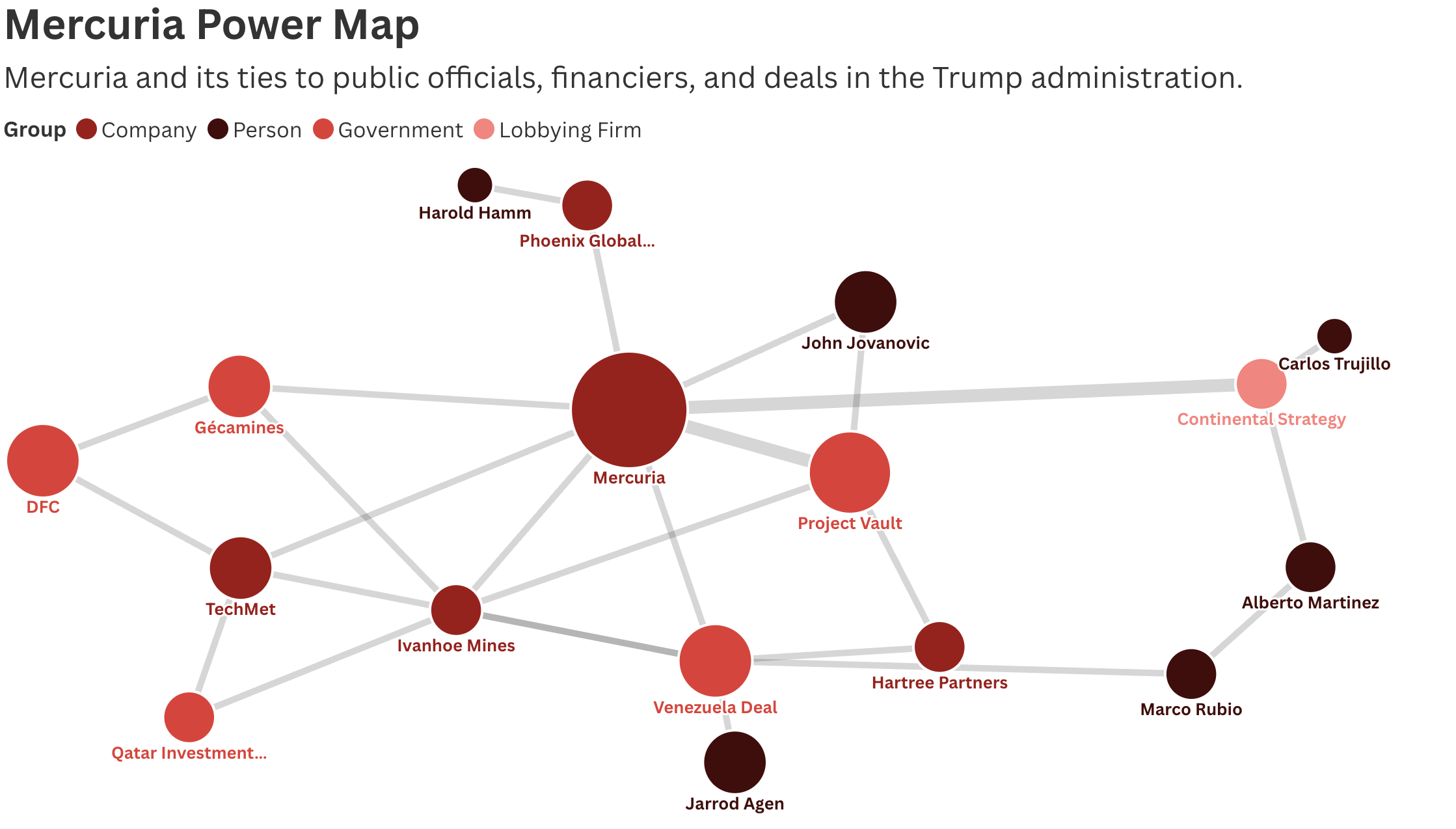
Conclusion
Massive commodity trading firms, which employ thousands of traders based in Geneva Switzerland, are no longer simply facilitating the machinery of global energy markets and trade. They have become central beneficiaries of the Trump administration’s resource decisions. Commodity traders have repeatedly parlayed access to the administration into lucrative financing deals, turning federal forays in Africa and Latin America into private gains. In Trump’s chaotic critical-minerals policy, which favors short-term gains in an industry that requires long-term investment, commodity traders can prioritize speed and getting deals done ahead of transparency, accountability, and other safeguards. This offers a way to produce quick results without making the responsible investments needed to build a sustainable mining supply chain.
If taxpayer dollars are being used for private gain, the public has a right to understand who is making and benefiting from these decisions. The administration’s critical-minerals strategy increasingly relies on public financing to support private companies and projects, through funding from EXIM, OSC, and DFC. When government-backed loans, equity investments, or other forms of public capital are deployed, Congress and the public should be able to see who is receiving the money, on what terms, what obligations and safeguards apply, and how the government will protect taxpayers if projects fail or generate private gains. With the reauthorization of the EXIM Bank this year, Congress has an opportunity to establish financial guardrails for Project Vault and clarify EXIM’s authority over VaultCo to implement stronger governance structures to prevent corruption.
At a minimum, EXIM should disclose the identities and qualifications of Project Vault’s board members, including any government or commodity affiliations. The selection criteria for any private partnerships within the Vault program should be made public, along with details of its governance, including its sourcing decisions and triggers for releasing reserves. EXIM should also disclose its terms governing potential losses, including whether the bank or private partners will absorb any shortfalls. The bank should also adopt a formal conflicts-of-interest policy, including a cooling-off period barring board members from participating in decisions involving their former employers for a set number of years. Finally, there should be transparent accounting of how and when EXIM funds have been committed or disbursed, and under what conditions future funding will be released.
Currently, no public record exists to allow the public or Congress to evaluate Project Vault’s performance, risks, or safeguards against conflicts of interest. Meanwhile, vast opportunities are being handed out to trading houses, raising broader questions about whether federal policy is rewarding cronyism rather than fostering competitive markets.
Appendix: Commodity Traders Benefiting From Trump Administration
| Vitol Group · Energy & Commodity Trading | |
| Headquarters | Geneva, Switzerland |
| Access | Senior Vitol trader John Addison donated $6 million to Trump’s campaign. Addison attended the January 2026 White House meeting on Venezuela oil marketing.In 2025, Vitol spent $360k and $50k to BGR and Crossroads Strategies, respectively, for lobbying. |
| Outcomes | Vitol received one of the first U.S. Treasury licenses to import and export Venezuelan crude following the U.S. military operation that removed Nicolás Maduro. It bought Venezuelan oil from state-owned PDVSA at a steep discount of $15 below Brent benchmark, and resold it into the market at only an $8-9 discount. Also, Vitol received releases from the Strategic Petroleum Reserve, and is set to profit over $100 million if prices return to pre-Iran War levels. |
| Trafigura Group · Energy & Commodity Trading | |
| Headquarters | Geneva, Switzerland |
| Access | In 2025, Trafigura paid $160k to Ragnar Group to retain lobbyist Robert Wasinger. During Trump’s first term, Wasinger held positions in his campaign and transition team as director of Senate and gubernatorial outreach. Trafigura’s non-ferrous metals division posted record profits for its fiscal year ending September 2025. CEO Richard Holtum attended a White House meeting at the White House in January 2026. |
| Outcomes | Trafigura secured a license to lift and resell Venezuelan crude in January. Trafigura also received oil releases from the Strategic Petroleum Reserve to control prices from the Iran War; they are set to profit over $400 million if prices return to pre-Iran War levels. |
| Mercuria Energy Group · Energy & Commodity Trading | |
| Headquarters | Geneva, Switzerland |
| Access | Mercuria spent $100,000 for Trump’s 2025 inauguration. It reportedly bought back shares previously held by an entity linked to the Chinese state just in time to participate in the Strategic Petroleum Reserve releases. John Jovanovic, a previous investment director at Mercuria, was appointed as head of EXIM Bank. So far, in 2026, Mercuria has spent $330,000 on lobbying via Continental Strategy. Its lobbyists include Carlos Trujillo, former OAS ambassador, and Alberto Martinez, former chief of staff to Marco Rubio. Katie Wiles, the daughter of Trump’s chief of staff, Susie Wiles, is a partner at Continental Strategy. |
| Outcomes | Mercuria is one of the three commodity houses initially picked to run the $12 billion national strategic stockpile of critical minerals, Project Vault, funded with an EXIM bank loan. Mercuria is set to profit $56 million from SPR releases if prices reach pre-Iran War levels. After the US’s military campaign in Venezuela, Mercuria also was one of the companies that received over $2.2 billion in oil and mining contracts. |
| Traxys · Energy & Commodity Trading | |
| Headquarters | Strassen, Luxembourg |
| Lobbying | In 2025 and 2026 to date, Traxys has spent $700k on lobbying on critical minerals issues via Ballard Partners. Ballard Partners is deeply entwined with the Trump administration: Brian Ballard is a major MAGA fundraiser, and current White House chief of staff Susie Wiles previously worked as a lobbyist at Ballard Partners |
| Outcomes | Selected alongside Mercuria and Hartree Partners to help source materials for the U.S. government’s $12 billion critical-minerals stockpile Project Vault. |
| Hartree Partners · Energy & Commodities Trading | |
| Headquarters | New York, United States |
| Lobbying | In 2026 to date, Hartree spent $160k on lobbying via the Transnational Strategy Group. |
| Outcomes | Selected alongside Mercuria and Traxys to help source materials for the U.S. government’s $12 billion critical-minerals stockpile Project Vault. |
| Gunvor · Energy & Commodities Trading | |
| Headquarters | Geneva, Switzerland |
| Lobbying | One of Ballard Partners’ biggest clients so far this year has been Gunvor USA which has paid the firm $1.5 million in lobbying fees, compared with $500,000 last year. To “promote interests and transparency,” according to its lobbying disclosure, the company retained Micah Ketchel, the former chief of staff to then-U.S. Rep. Michael Waltz, now serving as U.S. ambassador to the United Nations. |
| Outcomes | Gunvor will profit $97 million from SPR releases if oil prices reach pre-Iran War levels. |
Stay Updated on Public Citizen
Follow Public Citizen
Support Our Work
Congress Should Prepare a Strategic, Effective Oversight Agenda Now
Dear Member of Congress:
We, the undersigned organizations, write to urge congressional committees to prepare now for a strategic and effective oversight agenda in the next Congress. Public concern about corruption is at historic levels. According to Gallup, 90% of Americans say corruption in government is widespread, with substantial majorities of Republicans, Democrats, and independents sharing that view.
The question is not whether the public wants accountability, but whether Congress can conduct the meaningful oversight that exposes abuses of power, holds powerful corporate and political actors accountable, and points towards reforms that improve people’s lives. Our collective organizations are hearing a loud call from our millions of members for this type of bold accountability agenda.
Effective oversight should do more than generate headlines. Committees should identify consequential targets, investigate the relationship between government decisions and corporate influence, and focus on issues that affect working families’ daily lives, including higher costs, record levels of household debt, weakened consumer protections, corporate misconduct, attacks on democratic safeguards, and the use of public office for private gain. Oversight should also be designed to succeed even, and especially, when an administration refuses to cooperate.
Every committee should be clear-eyed that this administration is likely to stonewall investigative efforts, and there must be plans for immediate escalation when that occurs to compel disclosure and testimony. This also requires using the full range of congressional tools and information sources available, including testimony from corporate executives, former government officials, whistleblowers, state and local officials, independent experts, affected workers and consumers, public records, inspector general findings, litigation records, and documents available outside the executive branch.
Just as importantly, investigations should build toward action. Hearings and reports should establish the factual record necessary for legislation, stronger enforcement, ethics reforms, consumer protections, and other durable policy changes in the next governing moment that speak to the real harms and economic stressors Americans are experiencing. Oversight should help explain not only what went wrong, but who benefited, who paid the price, and what Congress can do to prevent those abuses from happening again. We encourage committees to begin this planning now, including identifying priority investigations, developing witness and document strategies, building investigative staff capacity, and determining how hearings and investigations can reinforce a broader legislative and accountability agenda.
Finally, we encourage congressional committees to establish formal, ongoing channels to partner with outside organizations. Regular communication can help committees develop hearing and investigation ideas, identify witnesses, surface documents and investigative leads, protect and support whistleblowers, connect committees with affected communities and subject-matter experts, and troubleshoot obstacles as investigations develop. The public is demanding accountability. Congress should be prepared to deliver it in a strategic, disciplined way that focuses on the real harms that corruption and corporate power impose on everyday Americans.
Signed,
Acacia Center for Justice
Affordable Homeownership Foundation Inc.
American Bird Conservancy
American Civil Liberties Union
American Economic Liberties Project
American Federation of Teachers
American Sustainable Business Network
Americans for Financial Reform
Americans for Tax Fairness
Autistic Women & Nonbinary Network
Bend the Arc: Jewish Action
Beta Cell Action
Black South Rising
Breathe Project
Center for Biological Diversity
Center for Digital Democracy
Center for Environmental Health
Center for Law and Public Trust
Center for Progressive Reform
Center for Science in the Public Interest
Citizens for Responsibility and Ethics in Washington (CREW)
Clean Elections Texas
Coalition on Human Needs
Common Cause
Court Accountability Action
Defend the Vote Action Fund
Democracy Defenders Action
Democratic Messaging Project
Endangered Species Coalition
Fix Democracy First
Government Information Watch
Greenpeace USA
Groundwork Action
Healthcare is a Human Right WA
Indivisible
Just Solutions
Lawyers for Good Government
MassCOSH
MOVI, Money Out Voters In
MPower Change Action Fund
National Immigration Law Center
National Organization for Women
National Partnership for Women & Families
National Women’s Law Center
NETWORK Lobby for Catholic Social Justice
Our Revolution
Patriotic Millionaires
People For the American Way
People Power United
Private Equity Stakeholder Project
Protect Borrowers
Protect Democracy
Public Advocacy for Kids (PAK)
Public Citizen
Rachel Carson Council
Revolving Door Project
Rise Up WV
RootsAction
Save HIV Funding Campaign
Secure Elections Network
SEIU
Social Security Works
Stand Up America
The Workers Circle
Until Justice Data Partners
Voters Not Politicians
Washington CAN
Stay Updated on Public Citizen
Follow Public Citizen
Support Our Work
The Cost of Canceled Corporate Enforcement
Introduction
Corporations and billionaires are pouring eye-popping sums into super PACs to influence how Americans vote in the 2026 midterms. Many of these same corporations are benefiting from decisions by the Trump administration to cancel enforcement actions against them.
A previous Public Citizen report found that more than 200 corporations have benefited from the Trump administration canceling federal enforcement against them. The canceled enforcement actions include federal investigations, enforcement lawsuits, prior settlements, and other accountability measures for alleged lawbreaking.
This report documents that many of the corporations benefiting from canceled enforcement actions made direct multi-million-dollar payments to the Trump-aligned super PAC MAGA Inc. and similar entities. Many other beneficiaries are backed by the venture capital firm Andreessen Horowitz, which with its founders gave $12 million to MAGA Inc.
These political payments raise serious questions about what corporations expect in exchange when they make campaign contributions. Observers often cite industry interests in advancing favorable policy through regulation or legislation. The Trump administration’s seizure of authority from independent agencies means it is uniquely poised to cancel federal enforcement against alleged misconduct by corporations when they position themselves as insiders and allies.
Many, apparently, are getting what they paid for.
Key Findings
- Corporations, executives, and investors benefiting from canceled enforcement gave or pledged $210.5 million toward MAGA Inc. and other Trump-aligned super PACs.
- The biggest spenders were:
- Crypto.com, which benefited from the Trump administration’s cancelation of the Securities and Exchange Commission’s investigation into allegations the crypto platform engaged in trading unregistered securities, gave $35 million to MAGA Inc. and $2 million to Keep America Great, both Trump-affiliated super PACs.
- Gemini, which also benefited from the Trump administration’s cancelation of an SEC investigation into allegations of trading unregistered securities, gave with its co-founders Tyler and Cameron Winklevoss $40 million to MAGA Inc.
- Elon Musk, CEO of SpaceX and Tesla. Tesla benefited from four canceled enforcement actions – three canceled investigations by the National Highway Traffic Safety Administration and one planned inspection by the Department of Labor’s Office of Federal Contract Compliance Programs. SpaceX also benefited from four canceled actions – a dismissed lawsuit from the Department of Justice’s Civil Rights Division, a dismissed National Labor Relations Board lawsuit, a presumably closed investigation into data center pollution by the Environmental Protection Agency, and a settled and dismissed lawsuit brought against Musk by the SEC alleging misconduct related to the acquisition of Twitter (now X, a SpaceX subsidiary). Musk gave $5 million to MAGA Inc. and pledged to spend $100 million in the 2026 midterms, largely through America PAC, which Musk controls.
- Nine of the corporations benefiting from canceled enforcement are part of the investment portfolio of Andreessen Horowitz, which with its co-founders Marc Andreessen and Ben Horowitz gave $12 million to MAGA Inc.
A Note on Data and Methodology
The underlying data for this report is derived from analysis of the new October 2026 update to Public Citizen’s Corporate Enforcement Tracker.
The tracker compiles data on federal investigations, lawsuits, and other accountability measures the Trump administration inherited from the Biden administration when Trump took office in 2025.
Data sources include government records, legal filings, securities filings, and news reports. The database is not comprehensive, as not all government enforcement data is publicly disclosed and the information that is disclosed often is not consistently or neatly presented. As such, tracker data should be seen as a resource highlighting significant corporate enforcement actions.
Differences between the numbers of enforcement actions and corporations in this analysis are a result of some individual enforcement actions targeting multiple corporations, such as when an antitrust investigation targets the anticompetitive merger of two corporations.
The existence of investigations and/or allegations of misconduct do not necessarily mean that any laws were broken, or that an enforcement action necessarily would have been brought under a different administration.
Analysis
Officials in the Trump White House have made no secret of their practice of tracking corporations based on their perceived loyalty to the administration and its priorities. They employ a “dynamic scorecard” for tracking hundreds of corporations, and Big Tech corporations have engaged in particularly shameless campaigns to ingratiate themselves with President Trump.
Contributions from corporations and executives to MAGA Inc. and other Trump-aligned super PACs represent a particularly corrosive vector of political influence. Trump himself has characterized MAGA Inc.’s funds as “my money I control,” drawing complaints that the operation’s actions violate federal election law. Multi-million-dollar payments from corporations to these super PACs strengthen Trump’s influence over congressional elections across the United States.
Canceled enforcement appears to be a benefit enjoyed by many corporate campaign donors. Two years ago, Public Citizen noted that while Elon Musk was spending hundreds of millions to help elect Trump in 2024 was in part to avoid accountability for alleged misconduct, he and his companies faced numerous federal investigations and enforcement lawsuits. Subsequently, Musk and his companies became the top beneficiary of Trump’s corporate enforcement retreat (see Table 1).
Table 1: Corporations Benefiting from Canceled Enforcement and Led by Trump Super PAC Megadonor Elon Musk
| Corporation | Agency | Alleged Misconduct | Trump Admin Intervention | Corporate Payment Benefiting Trump (and Other Ties) |
|---|---|---|---|---|
| SpaceX | NLRB | NLRB complaint alleges SpaceX illegally fired workers who signed onto a letter publicly criticizing Musk, whose behavior the signers say has harmed the company’s reputation. | Trump's NLRB sided with SpaceX argument the company falls outside of the agency's jurisdiction, and dismissed. | CEO is Elon Musk, who spent more than $290 million in 2024 to help elect Trump, gave $5 million to MAGA Inc., and pledged $100 million toward his candidates of choice in 2026. Musk led the "Department Of Government Efficiency," an effort to impose severe cuts to regulators. David Sacks, who Trump appointed to be the White House "AI & Crypto Czar," made a "notable investment" in the company according to the Craft Ventures website. SpaceX employs Miller Strategies, a lobbying firm founded by Trump Inauguration finance chair Jeff Miller. |
| DOJ Civil Rights | Accuses SpaceX of discriminating against asylees and refugees in hiring decisions | Trump's DOJ filed to dismiss the case on 2/20/25 | ||
| Tesla | DOL (OFCCP) | Potential workplace discrimination | A Trump Executive Order halted anti-discrimination enforcement by the Labor Department's Office of Federal Contract Compliance Programs. OFCCP staff informed Tesla that its investigation stopped. | CEO is Elon Musk, who spent more than $290 million in 2024 to help elect Trump, gave $5 million to MAGA Inc., and pledged $100 million toward his candidates of choice in 2026. Musk led the "Department Of Government Efficiency," an effort to impose severe cuts to regulators. |
| NHTSA | Crashes resulting from the Tesla self-driving feature "actually smart summon" | Trump's NHTSA closed the investigation. | ||
| Reports of loss of steering control in Tesla Model 3 and Y vehicles after some owners reported an inability to turn the steering wheel or an increase in required effort | ||||
| Over incidents of unexpected deceleration or "phantom braking" involving 695,000 Tesla vehicles | ||||
| X (formerly Twitter, SpaceX) | SEC | Misconduct related to Musk’s $44 billion takeover of Twitter, now X. | Trump's SEC settled the case, which originally sought a $150 million penalty, for $1.5 million, and dismissed the case. | CEO is Elon Musk, who spent more than $290 million in 2024 to help elect Trump, gave $5 million to MAGA Inc., and pledged $100 million toward his candidates of choice in 2026. Musk led the "Department Of Government Efficiency," an effort to impose severe cuts to regulators. David Sacks, who Trump appointed to be the White House "AI & Crypto Czar," made a "notable investment" in the company according to the Craft Ventures website. X donated $1 million to Trump's inaugural fund. |
| xAI (SpaceX) | EPA | "EPA is aware of concerns that have been raised about air quality and regulatory applicability regarding the xAI facility in Memphis. EPA Region 4 is reviewing these concerns, working with the Shelby County Health Department (SCHD) to better understand the specific details, and consulting with other EPA offices." | Trump's DOJ intervened to block the NAACP's private citizen lawsuit alleging Clean Air Act violations by the xAI "Colossus" data center, citing a Trump Executive Order promoting AI and casting regulatory oversight as "overly burdensome" | Trump's EPA administrator Lee Zeldin reportedly met with xAI as EPA officials consider granting a permit to the data center. CEO is Elon Musk, who spent more than $290 million in 2024 to help elect Trump, gave $5 million to MAGA Inc., and pledged $100 million toward his candidates of choice in 2026. Musk led the "Department Of Government Efficiency," an effort to impose severe cuts to regulators. David Sacks, who Trump appointed to be the White House "AI & Crypto Czar," made a "notable investment" in the company according to the Craft Ventures website. |
Another seven corporations that benefited from canceled enforcement are also connected with multi-million-dollar donations to MAGA Inc., either directly or through executives or affiliated corporations (see Table 2).
Table 2: Seven More Corporations Benefiting from Canceled Enforcement And Contributions to Trump Super PACs in the 2026 Midterms
| Corporation | Canceled Enforcement Action | 2026 Campaign Gift to Trump | Gift Description |
|---|---|---|---|
| Central Romana Corporation | Trump’s U.S. Customs and Border Protection lifted the order barring imports from Central Romana that were imposed following allegations of the use of forced labor in its operations | $3,000,000 | Contribution from Florida Crystals, owned by the Fanjuls, who co-own Central Romana, to MAGA Inc |
| Chevron and Hess | Trump’s Federal Trade Commission reopened the final consent order barring Hess CEO John B. Hess from Chevron’s board, which was imposed following allegations of anticompetitive misconduct involving Hess’s communications about oil prices with OPEC and a Saudi official. | $2,000,000 | Hess CEO John Hess and his wife Susan gave $2 million to MAGA Inc |
| Crypto.com (Foris Dax) | Trump’s Securities and Exchange Commission closed its investigation into Crypto.com allegedly facilitating trades of unregistered securities. | $37,000,000 | Crypto.com gave $35 million to MAGA Inc and $2 million to Keep America Great, both Trump-aligned super PACs |
| Gemini | Trump’s SEC closed its investigation into Gemini allegedly facilitating trades of unregistered securities. | $40,000,000 | Gemini gave $20 million to MAGA Inc, and co-founders Tyler and Cameron Winklevoss also gave $10 million each |
| GEO Group | Trump’s National Labor Relations Board withdrew its case against GEO Group alleging immigrant detainees were subjected to punishments including solitary confinement because they protested over pay and working conditions and supported labor strikes. | $4,413,000 | GEO Group gave $4.4 million to MAGA Inc. |
| Ondo Finance | Trump’s SEC closed its investigation into Ondo Finance into whether its tokenization of real-world assets complied with federal securities laws, and whether the native ONDO token itself should be treated as a security. | $2,100,000 | Ondo Finance gave $2.1 million to MAGA Inc |
| UnitedHealth | Trump’s DOJ permitted the UnitedHealth’s allegedly anticompetitive acquisition of home health and hospice provider Amedisys with divestiture remedies and a civil penalty. | $5,000,000 | UnitedHealth gave $5 million to MAGA Inc. |
Another nine corporations that benefited from canceled enforcement are listed within the investment portfolio of Andreessen Horowitz, the Silicon Valley venture capital firm helmed by Trump allies, billionaire Marc Andreessen and Ben Horowitz (see Table 3). The firm and its co-founders have spent $115.5 million to influence the 2026 elections so far, including $12 million to MAGA Inc. ProPublica reporting shows that Andreessen, who helped staff Musk’s destructive DOGE Initiative, was particularly enthusiastic about eviscerating the Consumer Financial Protection Bureau, which he claimed exists “terrorize finance, terrorize financial institutions, prevent fintech, prevent new competition, new startups that want to compete with the big banks.”
Table 3: Nine Corporations Benefiting from Canceled Enforcement and Backed by Trump Super PAC Megadonor Andreessen Horowitz
| Corporation | Agency | Alleged Misconduct | Trump Admin Intervention | Ties to Trump Administration |
|---|---|---|---|---|
| Coinbase | SEC | Charged with operating its crypto asset trading platform as an unregistered national securities exchange, broker, and clearing agency. The SEC also charged Coinbase for failing to register the offer and sale of its crypto asset staking-as-a-service program. | Trump's SEC agreed to dismiss its case. | Coinbase is among the corporate donors backing Trump's $300 million "Golden Ballroom" in the East Wing of the White House. Coinbase is among the sponsors of America 250. Coinbase donated $1 million toward Trump's inaugural fund. Coinbase hired the Trump campaign's 2024 co-manager, Chris LaCivita, as an advisor. Listed among corporations in the Andreessen Horowitz portfolio. |
| Greenlight Financial Technology | CFPB | Allegations that the company wasn’t allowing kids immediate access to their money as it had advertised that it would, leaving some users unable to pay for purchases | Investigation "effectively ended" according to ProPublica report. | Backed by Andreessen Horowitz, the vc firm co-founded by Trump ally Marc Andreessen |
| Kalshi | CFTC | The CFTC determined in 2023 that Kalshi's proposed contracts involve gaming and activity that is unlawful under state law and are contrary to the public interest, and so are prohibited and cannot be listed or made available for clearing or trading on or through Kalshi | Trump's CFTC on 5/5/25 dismissed its appeal of a ruling allowing Kalshi to take bets on US election outcomes | Trump named former Kalshi board member Brian Quintenz to serve as CFTC chair. Kalshi named Donald Trump Jr. as a strategic advisor in January. Kalshi hired Miller Strategies, a lobbying firm founded by Trump Inauguration finance chair Jeff Miller, to lobby the CFTC. Listed among corporations in the Andreessen Horowitz portfolio. |
| Kraken (Payward) | SEC | Charged with operating crypto trading platform as an unregistered securities exchange, broker, dealer, and clearing agency. | The Trump administration's SEC filed to dismiss the case on 3/3/25 | Kraken co-founder Jesse Powell donated $1 million in cryptocurrency backing Trump for president. Kraken donated $1 million toward Trump's inaugural fund. Kraken hired Trump ally Brian Ballard to lobby in 2025. Trump chief of staff Susie Wiles and former Attorney General Pam Bondi are former lobbyists with Ballard's firm. Listed among corporations in the Andreessen Horowitz portfolio. |
| Meta | CFPB | Allegations that it improperly used financial data obtained from third parties in its highly-lucrative advertising business | According to a Meta SEC filing, Trump's CFPB closed the investigation is closed. | Meta is among the corporate donors backing Trump's $300 million "Golden Ballroom" in the East Wing of the White House. Meta is listed as a sponsor of the Trump White House's April 2025 Easter egg roll. Meta donated $1 million toward Trump's inaugural fund. CEO Mark Zuckerberg attended a dinner President Trump hosted at the White House for tech executives. He was seated next to Trump and thanked the president for his policies. Zuckerberg also was among the nine Big Tech billionaires Trump announced would join the President’s Council of Advisors on Science and Technology. Rick Dearborn, who lobbied for Meta in 2024, worked on Trump's 2016 transition team and in the White House, and authored a section of Project 2025. David Sacks, who Trump appointed to be the White House "AI & Crypto Czar," made a "notable investment" in the company according to the Craft Ventures website. Facebook is listed among corporations in the Andreessen Horowitz portfolio. |
| DOL (OFCCP) | Preventative audits planned to prevent workplace discrimination at government contractors | A Trump Executive Order halted anti-discrimination enforcement by the Labor Department's Office of Federal Contract Compliance Programs. | ||
| Point Digital Finance | CFPB | Whether Point deceived its customers about the true costs of its product, unfairly calculated repayment amounts or failed to follow the laws and rules that govern loans secured by a home | Investigation "effectively ended" according to ProPublica report. The Trump administration ordered a freeze on all CFPB investigations and cases on 2/3/25. | Backed by Andreessen Horowitz, the vc firm co-founded by Trump ally Marc Andreessen |
| Robinhood Markets | SEC | Securities violations within crypto unit | The Trump administration moved to dismiss the case on 2/24/25. | Robinhood donated $2 million toward Trump's 2024 inaugural fund. Robinhood hired Trump ally Brian Ballard to lobby on crypto issues in 2024. Trump chief of staff Susie Wiles is a former lobbyist with Ballard's firm. Listed among corporations in the Andreessen Horowitz portfolio. |
| Uniswap Labs | SEC | Allegedly acting as an unregistered securities broker and unregistered securities exchange | Trump's SEC reportedly closed the case on 2/25/25 and will take no action | Uniswap CEO Hayden Adams donated $245,000 to Trump's inaugural fund. Listed among corporations in the Andreessen Horowitz portfolio. |
| Yuga Labs | SEC | Into whether the company behind Bored Ape Yacht Club NFTs violated laws prohibiting sale of unregistered securities. | Trump's SEC reportedly closed its Yuga Labs investigation on 3/3/25 | Yuga Labs donated $100,000 to Trump's inaugural fund. Listed among corporations in the Andreessen Horowitz portfolio. |
Conclusion
Allowing corporations to make political payments in order to make enforcement go away is hardly a model for governing that supposedly prioritizes “law and order.” On the contrary, it is indicative of a profoundly unjust and arbitrary mode of enforcement organized around the principles of rewarding insiders, punishing outsiders, and concentrating power in the hands of an increasingly authoritarian president. Even as enforcement against corporate misconduct shrinks, enforcement personnel and resources are being channeled toward punishing immigrants, activists, and perceived political opponents. Restoring the rule of law will be a challenge for the future – and path forward will requiring a rebalance of priorities that ensures that corporations and the powerful cannot pay to protect themselves from federal enforcement that holds them accountable when they break the law.
Stay Updated on Public Citizen
Follow Public Citizen
Support Our Work
Resources to Help Teachers, Parents, and Students Navigate AI Risks
Between everything else they already do, teachers are now being asked to consider how artificial intelligence (AI) is influencing students’ learning and to what extent it should concern them.
AI chatbots have dominated students’ lives. Students use chatbots to do homework for them, for advice, or to just have a conversational partner. According to a Pew Research Center survey, 64% of U.S. teens have used AI chatbots with 32% of those teens saying they use them daily.
Teachers and parents are struggling to protect children from the potential dangers brought about by AI chatbots, many of which they don’t even fully understand.
Public Citizen understands the need for concerned and educated adults to proactively interact with students about AI. That is why they created five user-friendly, risk resources: educational materials teachers, parents and students can use to promote conversation about AI risks.
Resources for Teachers, Families, and Students
Our new guides address some of the most pressing concerns surrounding AI use among young people, including misinformation, privacy, emotional dependence on chatbots, and AI-generated sexual deepfakes.
Each guide offers practical information and steps people can take:
- What Every Teacher Should Know About AI in the Classroom: Helps educators understand the risks of AI, establish classroom expectations, and discuss responsible technology use with students.
- Talking to Your Kids About AI: Gives parents practical advice for discussing chatbot safety, protecting personal information, and recognizing potentially harmful interactions.
- That AI Chatbot Isn’t Your Friend: Explains to teens why chatbots can seem caring or trustworthy, even though they cannot replace real friendships, family relationships, or trusted adults.
- What to Do If Someone Makes an AI Deepfake of You: Provides guidance for people targeted by harmful AI-generated images, including how to document incidents, report content, and seek help.
- Someone Made a Deepfake. What Do You Do Now?: Offers students straightforward steps to take if they or a classmate become the target of an AI-generated deepfake.
Giving Families and Educators the Tools They Need
AI companies are putting AI technologies into kids’ hands without putting in place safeguards. Teachers and parents cannot do it alone. Though stronger protections and more accountability for tech companies are critical and long overdue, we can and should act in the near-term to support young people to stay safer online.
We have included conversation starters to help teachers talk with kids about the risks of using AI in the classroom, help parents bring up the challenges they may have talking with their kids about online safety, and help kids determine when a conversation with a chatbot has gone too far.
Educators and schools can adapt and customize the materials to support kids, families, and communities. These materials can also be beneficial for Parent Teacher Associations (PTAs).
You might be interested in
Stay Updated on Public Citizen
Follow Public Citizen
Support Our Work
Trump’s Cascade of Canceled Corporate Enforcement Against Over 200 Corporations
Introduction
Public Citizen’s Corporate Enforcement Tracker is an online resource for watchdogging the Trump administration’s cancellation of federal enforcement actions brought against corporations prior to President Trump’s second term. These enforcement actions include investigations, enforcement lawsuits, and other accountability measures for alleged lawbreaking by many of the largest and most powerful corporations, from Amazon to Zoom and hundreds in between. This updated analysis documents the extent of Trump’s retreat from enforcement against corporate crime and lawbreaking.
Key Findings
- So far, the Trump administration has canceled enforcement actions inherited from the Biden administration against 205 corporations. The canceled enforcement actions include federal investigations, enforcement lawsuits, prior settlements, and other accountability measures for alleged lawbreaking.
- Corporations with ties to Trump and/or the administration make up 44% (90 out of 205) of those benefiting from enforcement cancellations, and include:
- 53 corporate gift givers that contributed to Trump’s inaugural committee, pro-Trump super PACs, the demolition of the East Wing of the White House, and other Trump priorities;
- 32 Trump crony employers that hired a Trump-allied lobbyist, lawyer, or official to curry favor with the administration;
- 15 corporate business partners that have or have had deals with Trump’s private businesses; and
- 8 former employers of executives, employees, and/or investors selected for leadership roles within the Trump administration.
- The 212 canceled enforcement actions against 205 corporations include:
- 80 closed investigations (including 10 criminal investigations);
- 67 dismissed enforcement lawsuits the federal agencies were actively litigating (including 10 criminal cases); and
- 54 canceled consequences in which the Trump administration terminated or reversed enforcement actions that were resolved before Trump’s second term, including 14 pardons of corporations and executives and five canceled corporate leniency deals.
- The corporate sectors that have benefited most from canceled enforcement actions are the banks and the financial sector (50), Big Tech and other technology companies (28), and corporations operating in the cryptocurrency and financial technology space (26).
- Top beneficiaries of the cancellation of corporate enforcement actions include:
- Corporations where Elon Musk is CEO, which benefited from at least eight canceled enforcement actions. Tesla received four – three canceled investigations by the National Highway Traffic Safety Administration and one planned inspection by the Department of Labor’s Office of Federal Contract Compliance Programs. SpaceX also received four – a dismissed lawsuit from the Department of Justice’s Civil Rights Division, a dismissed National Labor Relations Board lawsuit, a presumably closed investigation into data center pollution by the Environmental Protection Agency, and a settled and dismissed lawsuit brought against Musk by the Securities and Exchange Commission alleging misconduct related to the acquisition of Twitter (now X, a SpaceX subsidiary). Musk is the top corporate gift-giver, having spent or pledged about $400 million, including spending to elect Trump and Republicans in 2024, pledged election spending in 2026, a $5 million gift to the Trump-aligned MAGA Inc. super PAC, and a corporate gift of $1 million from X to Trump’s inaugural fund.
- Wells Fargo, the scandal-plagued megabank, benefited from the cancellation of five enforcement actions, including the dismissal of a Consumer Financial Protection Bureau (CFPB) case brought under the Biden administration, the termination of two CFPB consent orders, and the termination of two consent orders with the U.S. Treasury Department’s Office of the Comptroller of the Currency (OCC);
- Pfizer, the pharmaceutical giant and previous employer of Attorney General Pam Bondi, with three enforcement actions led by the U.S. Department of Justice (DOJ) canceled since Trump took office. Pfizer contributed $1 million toward Trump’s inaugural fund, employed Trump ally Jeff Miller to lobby on its behalf, and is a former employer of former Attorney General Pam Bondi; and
- Corporations that benefited from two canceled enforcement actions each include Amazon, Bank of America, Binance, Biogen, Capital One, Charles River Laboratories International, Clarus Corporation, GE Healthcare, Globe Life, Meta, Morgan Stanley, National Collegiate Student Loan Trusts, Patriot Bank, Peloton, Polymarket, Toyota, and Washington Federal Bank.
A Note on Data and Methodology
The underlying data for this report is available in spreadsheet form here and is derived from analysis of the new September 2026 update to Public Citizen’s Corporate Enforcement Tracker.
The tracker compiles data on federal investigations, lawsuits, and other accountability measures the Trump administration inherited from the Biden administration when Trump took office in 2025.
Data sources include government records, legal filings, securities filings, and news reports. The database is not comprehensive, as not all government enforcement data is publicly disclosed and the information that is disclosed often is not consistently or neatly presented. As such, tracker data should be seen as a resource highlighting significant corporate enforcement actions.
Differences between the numbers of enforcement actions and corporations in this analysis are a result of some individual enforcement actions targeting multiple corporations, such as when an antitrust investigation targets the anticompetitive merger of two corporations.
The existence of investigations and/or allegations of misconduct do not necessarily mean that any laws were broken, or that an enforcement action necessarily would have been brought under a different administration.
Analysis
With the cancellation of enforcement actions against more than 200 corporations, the Trump administration’s broad retreat from law enforcement against corporate misconduct has surpassed an alarming new milestone.
It also should come as no surprise. Enforcement against corporate lawbreaking plummeted under the first Trump administration. For all the administration’s bluster about “law and order,” under Trump, corporations that break the law often get a pass – especially if they are seen as corporate insiders.
As Public Citizen previously noted, President Trump’s day-one executive order on “Ending the Weaponization of the Federal Government” threatened to herald an era of corporate lawlessness.
With the rampant recklessness by Big Tech and AI corporations, the summer’s plague tainted food outbreaks, and record-high wage theft victimizing low-wage workers, that era is, unfortunately, upon us.
Since January 2025, the administration has taken numerous actions and adopted a raft of policies to reduce enforcement against corporate crime and lawbreaking, including:
- Applying, apparently for the first time in U.S. history, the president’s clemency authority to pardon not just individuals, but the corporate entities themselves that were convicted of crimes. As precedent, White House officials reportedly internally cited King Charles II pardoning a company over 300 years ago. So far, the administration has pardoned nine corporations;
- The reckless “DOGE” initiative by Trump backer and CEO of alleged lawbreaking corporations Elon Musk, which self-servingly targeted agenciesresponsible for protecting the public from corporate lawbreaking, claiming to be reducing “waste” and attacking “fraud” while in fact sabotaging enforcement against Musk’s businesses;
- Illegally attempting to defund and dismantle the Consumer Financial Protection Bureau, resulting in the cancellation of at least 44 enforcement actions against corporations whose alleged financial misconduct harmed consumers;
- A corporate enforcement policy that practically guarantees corporations that self-disclose criminal misconduct to the DOJ will not face prosecution for their crimes;
- An executive order claiming that enforcement against discrimination based on disparate-impact liability is unconstitutional, resulting in the cancelation of enforcement actions against multiple corporations by several federal agencies, including the DOJ, EEOC, and CFPB, and the removal of environmental justice from the Environmental Protection Agency’s enforcement considerations.
- A DOJ policy memo on “Ending Regulation by Prosecution” announcing the pullback from enforcement against cryptocurrency corporations. The DOJ repeated the phrase as justification for canceling the prosecution of Abbott Laboratories over allegations related to tainted baby formula. SEC chair Paul Atkins, acting CFPB director Russ Vought, and acting CFTC chair Caroline Phamhave all, in recent months, used the phrase “regulation by enforcement” to describe what they characterize as heavy handed enforcement under Biden.;
- An executive order discouraging enforcement agencies from prosecuting criminal misconduct by the regulated entities they oversee;
- A permissive approach to antitrust enforcement – especially with regards to mergers and acquisitions – that accelerated following the firing of DOJ Antitrust Division head Gail Slater and has led to states taking on the burden of anti-monopoly enforcement;
- Following an executive order characterizing enforcement of the Foreign Corrupt Practices Act as an impediment to U.S. foreign policy and harmful to American economic competitiveness, narrowing enforcement of the law and apparently resulting in the cancelation of over a dozen enforcement actions against multinational corporations;
- The re-naming of the DOJ’s Environment and Natural Resources Division to the “Energy and Natural Resources Division,” the appointment of a senior Exxon Mobil attorney to lead it, and the policy of not enforcing against crimes under the Clean Air Act based on the use of defeat devices that unlawfully modify emission-measuring technology; and
- Actions disproportionately benefiting Big Tech lawbreakers, including an AI Action Planthat explicitly recommends reviewing and canceling enforcement by the Federal Trade Commission that the administration views as unduly burdensome to AI innovation.
Americans should expect fair application of the rule of law to ensure even the most powerful and well connected can be held accountable. But with 44% (90 out of 205) of corporations with publicly known ties to the administration receiving the benefit of canceled enforcement, the pattern of favoritism toward corporate insiders is clear. These ties are mostly transactional, with most involving payments directly toward Trump-aligned political campaign groups or administration initiatives, such as the replacement of the East Wing of the White House with Trump’s “Golden Ballroom;” the hiring of administration insiders as lobbyists or lawyers, such as Brad Bondi, the brother of former Attorney General Pam Bondi; and corporations with direct business ties to Trump’s private businesses, such as Binance, the world’s largest crypto exchange, which Trump crypto business World Liberty Financial relies on for access to crypto traders.
These conflicts of interest are indicative of systematic corruption, rather than ad hoc, as the White House confirmed that officials maintain a “dynamic scorecard” for tracking over 500 corporations based on their perceived loyalty to Trump administration priorities. Big Tech corporations have engaged in particularly shameless campaigns to ingratiate themselves with Trump, which the President himself crassly observed, noting, “If you look at some of these internet people, I know so many of them, Elon is so terrific. But I know, now all of them, you know they all hated me in my first term, and now they’re kissing my ass.”
Canceled enforcement is a corporate wish that the Executive Branch is uniquely positioned to grant with relative ease. Unlike passing friendly legislation, which requires coordination and cooperation with congressional majorities, or formal deregulation, which can require formal processes including outside input intended to ensure careful and deliberate decision making, agency leaders derelict in their duties claim canceling enforcement is a matter merely of prosecutorial discretion. As a result, Trump appointees are directing enforcement resources toward certain priorities – such as federal immigration enforcement, which has greatly expanded under Trump – and away from others, such as corporate misconduct. A ProPublica analysis found that the DOJ dropped 23,000 criminal investigations to focus on immigration.
The top-down nature of canceled enforcement under Trump has been strengthened by the administration’s dismissal of DOJ independence along with the U.S. Supreme Court in Trump v. Slaughter permitting the White House to seize authority from independent regulatory agencies. Now, independent agency directors who enforce the law fear removal as punishment for taking action against administration allies, and agencies overseen by commissions are or risk becoming stacked with administration loyalists.
The result is that power over federal agencies is more concentrated than ever with the President’s inner circle – and that courting favor with President Trump is a distinctly powerful lever for taking advantage of the enforcement retreat.
Table: 50 Corporations that Made Payments Benefiting Trump and Had Enforcement Actions Canceled
View the full spreadsheet of canceled enforcement against over 200 corporations and their ties to the Trump administration with links to underlying sources here.
| Corporation | Agency | Alleged Misconduct | Trump Administration Intervention | Corporate Payment Benefiting Trump (and Other Ties) |
|---|---|---|---|---|
| Abbott Laboratories | DOJ | Misconduct connected with tainted baby formula | Trump's DOJ reportedly closed the criminal investigation and is pursuing a civil settlement | Abbott Labs donated $500,000 toward Trump's inaugural fund. |
| Amazon | EEOC | A disparate-impact-based charge of discrimination with the EEOC, alleging that Amazon’s strict delivery quotas, which made it difficult or impossible for delivery drivers to use a bathroom during their shifts, had a disparate impact on female drivers. | After Trump signed an executive order directing agencies not to rely on disparate impact, EEOC closed its investigation | Amazon gave $5 million toward Trump's $300 million "Golden Ballroom" in the East Wing of the White House. Amazon is listed among the sponsors of the federal government's official 250th Anniversary celebration. Amazon is listed among the sponsors of the Trump White House's April 2025 Easter egg roll. Amazon's licensing deal for a documentary about Melania Trump reportedly includes a payment of $28 million for the first lady. Amazon announced a licensing deal to stream all seven seasons of The Apprentice, resulting in unspecified payments to Trump, who starred and was executive producer. Amazon donated $1 million toward Trump's inaugural fund and made a $1 million in-kind donation by streaming the event on Amazon Video. Attorney General Pam Bondi worked as a registered lobbyist for Amazon in 2020 and 2021. Trump ally Brian Ballard lobbied on Amazon's behalf in 2024. |
| DOL (OFCCP) | Preventative audits planned to prevent workplace discrimination at government contractors | A Trump Executive Order halted anti-discrimination enforcement by the Labor Department's Office of Federal Contract Compliance Programs. | Amazon gave $5 million toward Trump's $300 million "Golden Ballroom" in the East Wing of the White House. Amazon is listed among the sponsors of the federal government's official 250th Anniversary celebration. Amazon is listed among the sponsors of the Trump White House's April 2025 Easter egg roll. Amazon's licensing deal for a documentary about Melania Trump reportedly includes a payment of $28 million for the first lady. Amazon announced a licensing deal to stream all seven seasons of The Apprentice, resulting in unspecified payments to Trump, who starred and was executive producer. Amazon donated $1 million toward Trump's inaugural fund and made a $1 million in-kind donation by streaming the event on Amazon Video. Attorney General Pam Bondi worked as a registered lobbyist for Amazon in 2020 and 2021. Trump ally Brian Ballard lobbied on Amazon's behalf in 2024. |
|
| Anchorage Digital | OCC | The bank’s failure to adopt and implement a compliance program that adequately covers the required Bank Secrecy Act/anti-money laundering program elements | Trump's OCC terminated the consent order | CEO Nathan McCauley gave $300,000 to the Trump 47 Committee, a Trump-backing super PAC, and attending a White House Crypto Summit in 2025. Kevin Warsh, Trump's nominee for chairman of the Federal Reserve, previoiusly served as an advisor to Anchorage Digital. |
| Apple | CFPB | Illegally mishandling transaction disputes and misleading iPhone purchasers about interest-free payment options | Trump's CFPB terminated the consent order four years early | Apple CEO Tim Cook donated $1 million toward Trump's inaugural fund. Apple donated an undisclosed sum toward the Trump's replacement of the East Wing of the White House with a "Golden Ballroom" Cook attended a dinner President Trump hosted at the White House for tech executives. He thanked Trump for "setting the tone" such that the company could make investments in the U.S. and for "helping American companies around the world." Apple employs Miller Strategies, a lobbying firm founded by Trump Inauguration finance chair Jeff Miller. Apple CEO Tim Cook personally gifted Trump a glass sculpture of the Apple logo with a 24-karat gold base during a meeting at the Oval Office |
| Applied Materials | DOJ and SEC | For potentially evading export restrictions on Chinese chipmaker SMIC | Trump's DOJ and SEC closed investigations into Applied Materials. | Applied Materials donated $1 million toward Trump's inaugural fund |
| Bank of America | CFPB | Alleged misconduct related to Zelle Network banks not doing enough to reimburse customers who were defrauded by scammers using the network | The Trump administration filed to dismiss the Zelle Network cases on 3/4/25. | Bank of America donated $500,000 to Trump's 2024 inaugural fund. Trump's Commerce Secretary, billionaire Howard Lutnick, borrowed $100 million from Bank of America in 2019 and 2023, according to financial disclosures. |
| Allegedly failing to collect required demographic data on mortgage applicants | Trump's CFPB terminated the BofA consent order three years early | Bank of America donated $500,000 to Trump's 2024 inaugural fund. Trump's Commerce Secretary, billionaire Howard Lutnick, borrowed $100 million from Bank of America in 2019 and 2023, according to financial disclosures. |
||
| BlackRock | SEC | Investment advisers’ compliance with record retention requirements relating to certain types of electronic communications | Blackrock removed the reference to the SEC investigation from its annual SEC filing. | BlackRock donated $1 million toward Trump's inaugural fund. BlackRock is among the corporate donors backing Trump's $300 million "Golden Ballroom" in the East Wing of the White House. |
| Boeing | DOJ | Failure to remediate as required following legal agreements to reform following Boeing deceiving the FAA and subsequent deadly 737 Max crashes | Trump's DOJ negotiated a deal with Boeing to allow the corporation avoid prosecution, resolving the matter via a non-prosecution agreement instead of pleading guilty. | Boeing donated $1 million toward Trump's inauguration. |
| Caterpillar | DOL (OFCCP) | Preventative audits planned to prevent workplace discrimination at government contractors | A Trump Executive Order halted anti-discrimination enforcement by the Labor Department's Office of Federal Contract Compliance Programs. | Caterpillar is among the corporate donors backing Trump's $300 million "Golden Ballroom" in the East Wing of the White House. |
| Central Romana Corporation | CBP | The use of forced labor in its operations | Trump's CBP lifted the order barring imports from Central Romana Corporation | Central Romana is partly owned by the Fanjul family, which also owns Fanjul Corporation. Fanjul Corporation donated $1 million donation to a super PAC backing Trump for president and $413,000 donation to the RNC. Pepe Fanjul attended a fundraiser at Mar-a-Lago for Trump's MAGA Inc super PAC. Central Romana hired Continental Strategy, a lobbying firm founded by Trump ally Carlos Trujilo, to lobby the White House. |
| Chevron and Hess | FTC | The FTC in 2024 alleged Hess communicated with OPEC and an official from Saudi Arabia and alleged this conduct would heighten the risk of harm to competition if Hess joined Chevron's board. | Trump's FTC reopened the final consent order so Hess is no longer formally barred from joining Chevron's board | Hess donated $1 million to Trump's first inauguration and was a member of Trump’s Opening the Country Council during the COVID-19 pandemic. Chevron hired Trump ally Brian Ballard to lobby in 2025. Trump chief of staff Susie Wiles and Attorney General Pam Bondi are former lobbyists with Ballard's firm. |
| Citibank | CFPB | Allegedly violating the Equal Credit Opportunity Act and its implementing Regulation B | Trump's CFPB terminated the 2023 consent order Citibank entered to resolve alleged violations | Citi donated $100,000 to Trump's 2024 inauguration. Eric Trump, the president's son, set up a trust with Citigroup to manage the president's wealth. |
| Cognizant | DOJ | Alleged FCPA violations in India | Trump's DOJ agreed to dismiss its case | Cognizant donated $50,000 to Trump's inaugural fund |
| Coinbase | SEC | Charged with operating its crypto asset trading platform as an unregistered national securities exchange, broker, and clearing agency. The SEC also charged Coinbase for failing to register the offer and sale of its crypto asset staking-as-a-service program. | Trump's SEC agreed to dismiss its case. | Coinbase is among the corporate donors backing Trump's $300 million "Golden Ballroom" in the East Wing of the White House. Coinbase is among the sponsors of America 250. Coinbase donated $1 million toward Trump's inaugural fund. Coinbase hired the Trump campaign's 2024 co-manager, Chris LaCivita, as an advisor. |
| Consensys | SEC | Charged with engaging in the unregistered offer and sale of securities through a service it calls MetaMask Staking and with operating as an unregistered broker | The Trump administration's SEC filed to dismiss the case on 2/27/25 | Consensys donated $100,000 to Trump's inaugural fund |
| Crypto.com (Foris Dax) | SEC | Allegedly trading unregistered securities | Trump's SEC dropped its investigation | Crypto.com donated $1 million to Trump's inauguration under its business name, Foris Dax $TRUMP meme coins are traded on Crypto.com's platform. Crypto.com is reportedly partnering with Trump Media to launch ETFs. Crypto.com hired Miller Strategies, a lobbying firm founded by Trump Inauguration finance chair Jeff Miller, to lobby the SEC and White House. |
| Exxon Mobil and Pioneer Natural Resources | FTC | The FTC in 2024 alleged Sheffield attempted to collude with OPEC to reduce output of oil and gas, resulting in Americans paying higher prices at the pump and inflating profits for his company | Trump's FTC reopened the final consent order so Sheffield is no longer formally barred from joining Exxon's board | In 2024, Sheffield's son Bryan donated $844,600 to Trump 47 Committee and $3,300 directly to Trump's presidential campaign |
| Fat Brands | DOJ | Fat Brands is charged with two counts of extension and maintenance of credit in the form of personal loan from issuer to executive officer. Former CEO and controlling shareholder Andrew Wiederhorn was indicted on federal charges alleging a scheme to conceal $47 million in distributions he received in the form of shareholder loans from the IRS, FAT’s minority shareholders, and the broader investing public. | According to news reports, Trump directly fired the DOJ prosecutor leading the case against Fat Brands and Wiederhorn shortly after Laura Loomer called for his firing. Sourced told the Los Angeles Times the firing was in part motivated by the prosecution of Wiederhorn. On 7/29/25, Trump's DOJ filed to dismiss the charges against Fat Brands and Wiederhorn. | Fat Brands donated $100,000 to Trump's inaugural fund. Wiederhorn donated $3,300 to Trump's presidential campaign. |
| Gemini | SEC | For the unregistered offer and sale of securities to retail investors through the Gemini Earn crypto asset lending program | Trump's SEC closed the case on 2/26/25 | Twin brothers Cameron and Tyler Winklevoss, who together founded and run Gemini, contributed a $2.65 million to groups backing Trump for president. Gemini has since then contributed $10 million to the Trump-aligned MAGA Inc super PAC |
| GEO Group | NLRB | Allegedly subjected detained immigrants to punishments including solitary confinement because they protested over pay and working conditions and supported labor strikes. | Trump's NLRB reportedly withdrew its case against GEO Group on 3/19/25 | GEO Group donated $1 million to a super PAC backing Trump for president and $500,000 to Trump's inaugural committee. |
| Goldman Sachs | DOJ | Whether there was collusion or a conspiracy to collude to control prices during urgent meetings banks held to limit exposure to the Archegos Capital Management meltdown | Trump's DOJ closed the investigation | Goldman Sachs is listed among sponsors of the federal government's official 250th Anniversary celebration. Goldman Sachs donated $1 million to Trump's 2024 inaugural fund. |
| DOL (OFCCP) | Preventative audits planned to prevent workplace discrimination at government contractors | A Trump Executive Order halted anti-discrimination enforcement by the Labor Department's Office of Federal Contract Compliance Programs. | Google is giving $22 million to Trump's "Golden Ballroom" to settle a lawsuit Trump filed over his suspension from YouTube after the January 6 riots. YouTube is listed as a sponsor of the Trump White House's April 2025 Easter egg roll. Google donated $1 million to Trump's inaugural fund. Google co-founder Sergey Brin and CEO Sundar Pichai attended a dinner President Trump hosted at the White House for tech executives. Pichai remarked "I'm glad it's over" regarding the DOJ antitrust suit and praised the administration's AI Action Plan. Google hired Continental Strategy, a lobbying firm founded by Trump ally Carlos Trujilo, to lobby the White House. |
|
| Hewlett Packard Enterprise and Juniper Networks | DOJ Antitrust | Anticompetitive Hewlett Packard Enterprise-Juniper Networks merger sought | Trump's DOJ permitted the merger to proceed | HPE donated $250,000 to Trump's 2024 inaugural fund. HPE hired Trump administration allies Mike Davis and Arthur Schwartz to advocate for the merger. HPE hired Miller Strategies, a lobbying firm founded by Trump Inauguration finance chair Jeff Miller. |
| JBS | DOJ | On December 23, 2020 and October 29, 2021, received civil investigative demands from the DOJ related to the fed cattle and beef packing industry. | Trump's DOJ reportedly closed meatpacking investigations opened prior to Trump's second term (and subsequently called for new investigations) | Pilgrim's Pride, a JBS subsidiary, donated $5 million to Trump's inaugural fund. JBS hired Miller Strategies, a lobbying firm founded by Trump Inauguration finance chair Jeff Miller. |
| Johnson & Johnson | DOJ | Alleged misconduct involving Brazilian subsidiary in violation of the FCPA | Trump signed an executive order on 2/10/25 halting FCPA enforcement for at least 180 days, claiming FCPA enforcement disadvantages US businesses. J&J announced that the Trump administration closed the investigation in February 2025. | J&J donated $1 million to Trump's inaugural fund |
| JPMorgan | CFPB | Disclosed the bank was “responding to inquiries from civil government authorities ... regarding the handling of disputes related to transfers of funds through the Zelle Network.” | The Trump administration filed to dismiss the Zelle Network cases on 3/4/25. | JPMorgan donated $1 million to Trump's inaugural fund. CEO Jamie Dimon has reportedly served for months as an informal policy advisor to Trump. JPMorgan is among the banks that manage Trump's personal investments. |
| Kraken (Payward) | SEC | Charged with operating crypto trading platform as an unregistered securities exchange, broker, dealer, and clearing agency. | The Trump administration's SEC filed to dismiss the case on 3/3/25 | Kraken co-founder Jesse Powell donated $1 million in cryptocurrency backing Trump for president. Kraken donated $1 million toward Trump's inaugural fund. Kraken hired Trump ally Brian Ballard to lobby in 2025. Trump chief of staff Susie Wiles and Attorney General Pam Bondi are former lobbyists with Ballard's firm. |
| Live Nation-Ticketmaster | DOJ | For monopolization and other unlawful conduct that thwarts competition in markets across the live entertainment industry | Live Nation donated $500,000 to Trump's inaugural fund Live Nation added Trump advisor Richard Grenell, who is Trump’s presidential envoy for special missions and the president of the Kennedy Center, to its board of directors |
|
| Merck | DOJ | False Claims Act investigation | Merck removed references to the False Claims Act investigation from its quarterly SEC filings. A reference to a new Trump DOJ investigation focused on Merck's diversity policies was added. | Merck donated $1 million to Trump's inaugural fund. Merck agreed to reduce prices for some prescription drugs for US consumers in exchange for relief from Trump's tariffs |
| Meta | CFPB | Allegations that it improperly used financial data obtained from third parties in its highly-lucrative advertising business | According to a Meta SEC filing, Trump's CFPB closed the investigation is closed. | Meta is among the corporate donors backing Trump's $300 million "Golden Ballroom" in the East Wing of the White House. Meta is listed as a sponsor of the Trump White House's April 2025 Easter egg roll. Meta donated $1 million toward Trump's inaugural fund. CEO Mark Zuckerberg attended a dinner President Trump hosted at the White House for tech executives. He was seated next to Trump and thanked the president for his policies. Zuckerberg also was among the nine Big Tech billionaires Trump announced would join the President’s Council of Advisors on Science and Technology. Rick Dearborn, who lobbied for Meta in 2024, worked on Trump's 2016 transition team and in the White House, and authored a section of Project 2025. David Sacks, who Trump appointed to be the White House "AI & Crypto Czar," made a "notable investment" in the company according to the Craft Ventures website. |
| DOL (OFCCP) | Preventative audits planned to prevent workplace discrimination at government contractors | A Trump Executive Order halted anti-discrimination enforcement by the Labor Department's Office of Federal Contract Compliance Programs. | Meta is among the corporate donors backing Trump's $300 million "Golden Ballroom" in the East Wing of the White House. Meta is listed as a sponsor of the Trump White House's April 2025 Easter egg roll. Meta donated $1 million toward Trump's inaugural fund. CEO Mark Zuckerberg attended a dinner President Trump hosted at the White House for tech executives. He was seated next to Trump and thanked the president for his policies. Zuckerberg also was among the nine Big Tech billionaires Trump announced would join the President’s Council of Advisors on Science and Technology. Rick Dearborn, who lobbied for Meta in 2024, worked on Trump's 2016 transition team and in the White House, and authored a section of Project 2025. David Sacks, who Trump appointed to be the White House "AI & Crypto Czar," made a "notable investment" in the company according to the Craft Ventures website. |
|
| Microsoft | FTC | Anticompetitive Microsoft-Activision merger sought | After losing an effort to temporarily block the merger, Trump's FTC dismissed the case instead of bringing it to trial. | Microsoft donated $1 million toward Trump's inaugural fund. |
| Nikola Corporation | DOJ | CEO Trevor Milton sentenced in 2023 to four years in prison for engaging in securities and wire fraud in connection with his scheme to defraud and mislead investors about the development of products and technology by the company he founded, Nikola Corporation | Trump pardoned Milton on 3/27/25. | Milton and his wife donated more than $1.8 million to a Trump reelection campaign fund. Milton also was represented by two lawyers with Trump connections: Brad Bondi, brother of Attorney General Pam Bondi, and Marc Mukasey, who has represented The Trump Organization. |
| Oak View Group | DOJ | Alleged to be a "functionary for aspects of Live Nation’s anticompetitive scheme" and to have "colluded" with Live Nation in DOJ's antitrust lawsuit against Live Nation-Ticketmaster. | Trump's DOJ resolved allegations with a non-prosecution agreement and indicted Timothy J. Leiweke, co-founder and CEO of Oak View Group, for allegedly orchestrating a bid rigging conspiracy. Trump pardoned Leiweke in December. | Oak View Group donated $250,000 to Trump's inaugural fund Oak View hired Miller Strategies, a lobbying firm founded by Trump Inauguration finance chair Jeff Miller, who lobbied the Trump White House and DOJ for the company with Stefan Passantino, deputy White House Counsel during Trump's first term. |
| Ondo Finance | SEC | Whether Ondo's tokenization of real-world assets complied with federal securities laws, and whether the native ONDO token itself should be treated as a security | Trump's SEC closed its confidential investigation into Ondo Finance, which began under the Biden administration | Ondo donated $1 million toward Trump's inaugural fund. The company announced a "strategic collaboration" with the Trump family crypto business, World Liberty Financial in February 2025 |
| PayPal | SEC | PayPal's PYUSD stablecoin | Trump's SEC closed the investigation on 4/30/25 | PayPal donated $250,000 to Trump's inaugural fund. Several former PayPal executives and investors who constitute the "PayPal Mafia" are particularly influential in the Trump administration, including Elon Musk, Trump's AI & Crypto Czar David Sacks, and billionaire megadonor Peter Thiel. |
| PepsiCo | FTC | Allegedly engaging in illegal price discrimination by providing one customer—a large, big box retailer—with unfair pricing advantages, while raising prices for competing retailers and customers. | Trump's FTC voted to dismiss the lawsuit against Pepsi on 5/22/25 | PepsiCo donated $500,000 to Trump's inaugural fund |
| Pfizer | DOJ | Relating to the company's operations in Mexico | Pfizer removed references to ongoing FCPA investigations from its quarterly SEC filings. Trump signed an executive order on 2/10/25 halting FCPA enforcement for at least 180 days, claiming FCPA enforcement disadvantages US businesses. | Pfizer agreed to reduce prices for some prescription drugs for US consumers in exchange for relief from Trump's tariffs Pfizer donated $1 million to Trump's inaugural fund. Attorney General Pam Bondi provided legal services to Pfizer, Inc. over the past year while working as Of Counsel to the law firm Panza, Maurer & Maynard. Jeff Miller, a lobbyist who represents Pfizer and pharmaceutical industry group PhRMA, is a finance chair for Trump's inaugural committee. |
| DOJ, SEC | Possible non-compliance with FCPA in China | Pfizer removed references to ongoing FCPA investigations from its quarterly SEC filings. Trump signed an executive order on 2/10/25 halting FCPA enforcement for at least 180 days, claiming FCPA enforcement disadvantages US businesses. | Pfizer agreed to reduce prices for some prescription drugs for US consumers in exchange for relief from Trump's tariffs Pfizer donated $1 million to Trump's inaugural fund. Attorney General Pam Bondi provided legal services to Pfizer, Inc. over the past year while working as Of Counsel to the law firm Panza, Maurer & Maynard. Jeff Miller, a lobbyist who represents Pfizer and pharmaceutical industry group PhRMA, is a finance chair for Trump's inaugural committee. |
|
| DOJ | In October 2018, received a subpoena from the U.S. Attorney’s Office for the Southern District of New York seeking records relating its relationship with another drug manufacturer and its production and manufacturing of drugs including, but not limited to, Quillivant XR. | Trump's DOJ declined to intervene in the related qui tam action | Pfizer donated $1 million to Trump's inaugural fund. Attorney General Pam Bondi provided legal services to Pfizer, Inc. over the past year while working as Of Counsel to the law firm Panza, Maurer & Maynard. Jeff Miller, a lobbyist who represents Pfizer and pharmaceutical industry group PhRMA, is a finance chair for Trump's inaugural committee. |
|
| Robinhood Markets | SEC | Securities violations within crypto unit | The Trump administration moved to dismiss the case on 2/24/25. | Robinhood donated $2 million toward Trump's 2024 inaugural fund. Robinhood hired Trump ally Brian Ballard to lobby on crypto issues in 2024. Trump chief of staff Susie Wiles is a former lobbyist with Ballard's firm. |
| Scale AI | DOL | Compliance with the Fair Labor Standards Act | Trump's DOL closed the investigation into Scale AI, Upwork, and HireArt on 5/9/25. Trump's DOL on 5/1/25 announced a retreat from enforcing a 2024 DOL rule finalized under Biden to protect workers from misclassification as contractors. | ScaleAI donated $125,000 to Trump's inaugural fund. Trump nominated former Scale AI executive Michael Kratsios to be director of the White House’s Office of Science and Technology Policy |
| SpaceX | NLRB | NLRB complaint alleges SpaceX illegally fired workers who signed onto a letter publicly criticizing Musk, whose behavior the signers say has harmed the company’s reputation. | For most of 2025, Trump's removal of Democratic board member Gwynne Wilcox meant NLRB had only one sitting member, and so lacked quorum for decision making. Two additional commissioners were confirmed in December. Trump's NLRB sided with SpaceX argument the company falls outside of the agency's jurisdiction, and dismissed. | CEO is Elon Musk, who spent more than $290 million in 2024 to help elect Trump and pledged $100 million toward electing Republicans in 2026. Musk led the "Department Of Government Efficiency," an effort to impose severe cuts to regulators. David Sacks, who Trump appointed to be the White House "AI & Crypto Czar," made a "notable investment" in the company according to the Craft Ventures website. SpaceX employs Miller Strategies, a lobbying firm founded by Trump Inauguration finance chair Jeff Miller. |
| DOJ Civil Rights | Accuses SpaceX of discriminating against asylees and refugees in hiring decisions | Trump's DOJ filed to dismiss the case on 2/20/25 | CEO is Elon Musk, who spent more than $290 million in 2024 to help elect Trump and pledged $100 million toward electing Republicans in 2026. Musk led the "Department Of Government Efficiency," an effort to impose severe cuts to regulators. David Sacks, who Trump appointed to be the White House "AI & Crypto Czar," made a "notable investment" in the company according to the Craft Ventures website. SpaceX employs Miller Strategies, a lobbying firm founded by Trump Inauguration finance chair Jeff Miller. |
|
| T-Mobile | DOJ Antitrust | Anticompetitive merger of T-Mobile and UScellular sought | Trump's DOJ closed the antitrust investigation, allowing the T-Mobile-UScellular merger to proceed | T-Mobile is among the corporate donors backing Trump's $300 million "Golden Ballroom" in the East Wing of the White House. Facing pressure from from Trump's FCC, T-Mobile pledged to discontinue its DEI policies “not just in name, but in substance.” |
| Tesla | DOL (OFCCP) | Potential workplace discrimination | A Trump Executive Order halted anti-discrimination enforcement by the Labor Department's Office of Federal Contract Compliance Programs. OFCCP staff informed Tesla that its investigation stopped. | CEO is Elon Musk, who spent more than $290 million in 2024 to help elect Trump and pledged $100 million toward electing Republicans in 2026. Musk led the "Department Of Government Efficiency," an effort to impose severe cuts to regulators. |
| NHTSA | Crashes resulting from the Tesla self-driving feature "actually smart summon" | Trump's NHTSA closed the investigation. | CEO is Elon Musk, who spent more than $290 million in 2024 to help elect Trump and pledged $100 million toward electing Republicans in 2026. Musk personally donationed $5 million to the Trump-aligned MAGA Inc. super PAC in 2025. Musk led the "Department Of Government Efficiency," an effort to impose severe cuts to regulators. |
|
| Reports of loss of steering control in Tesla Model 3 and Y vehicles after some owners reported an inability to turn the steering wheel or an increase in required effort | Trump's NHTSA closed the investigation. | CEO is Elon Musk, who spent more than $290 million in 2024 to help elect Trump and pledged $100 million toward electing Republicans in 2026. Musk personally donationed $5 million to the Trump-aligned MAGA Inc. super PAC in 2025. Musk led the "Department Of Government Efficiency," an effort to impose severe cuts to regulators. |
||
| Over incidents of unexpected deceleration or "phantom braking" involving 695,000 Tesla vehicles | Trump's NHTSA closed the investigation. | CEO is Elon Musk, who spent more than $290 million in 2024 to help elect Trump and pledged $100 million toward electing Republicans in 2026. Musk personally donationed $5 million to the Trump-aligned MAGA Inc. super PAC in 2025. Musk led the "Department Of Government Efficiency," an effort to impose severe cuts to regulators. |
||
| Toyota | CFPB | Directing customers to dead-end cancellation hotline, withholding refunds, and knowingly tarnishing credit reports with false data | Trump's CFPB terminated the consent order early, specifically waiving requirements that Toyota pay tens of millions of dollars in refunds and redress to allegedly harmed consumers | Toyota donated $1 million to Trump's inaugural fund. |
| DOJ, SEC | Possible anti-bribery violations related to a Thai subsidiary | Toyota announced in a June 2025 SEC filing that Trump's DOJ closed its investigation. Trump signed an executive order on 2/10/25 halting FCPA enforcement for at least 180 days, claiming FCPA enforcement disadvantages US businesses. | Toyota donated $1 million to Trump's inaugural fund. | |
| Tyson Foods | DOJ | In 2020 and 2021, Tyson received civil investigative demands from the DOJ’s Civil Antitrust Division seeking information related to the fed cattle and beef packing markets. The Offices of the Attorney General for multiple states are participating in the investigation and coordinating with the DOJ. | Trump's DOJ reportedly closed meatpacking investigations opened prior to Trump's second term (and subsequently called for new investigations) | Trump appointed former Tyson executive Dr. Justin Ransom to serve as administrator of USDA's Food Safety and Inspection Service. Tyson donated $1 million to Trump's inaugural fund. |
| Uniswap Labs | SEC | Allegedly acting as an unregistered securities broker and unregistered securities exchange | Trump's SEC reportedly closed the case on 2/25/25 and will take no action | Uniswap CEO Hayden Adams donated $245,000 to Trump's inaugural fund |
| UnitedHealth | DOJ | Anticompetitive acquisition of home health & hospice provider (Amedisys) by hospital giant (UnitedHealth) | Trump DOJ settled with divestiture remedies and a civil penalty | Before Trump's inauguration, UnitedHealth gave $5 million to the Trump-backing MAGA Inc super PAC United Healthcare hired Trump ally Brian Ballard to lobby in 2024. Trump chief of staff Susie Wiles and Attorney General Pam Bondi are former lobbyists with Ballard's firm. UnitedHealth sponsored the Trump-aligned Freedom250 for the July 4 anniversary celebrations |
| Walmart | CFPB | For forcing delivery drivers to use costly deposit accounts to get paid and for deceiving workers— “last mile” drivers in Walmart’s Spark Driver program—about how they could access their earnings | Trump's CFPB dismissed the case against Walmart and Branch Messenger on 5/13/25 The Trump administration ordered a freeze on all CFPB investigations and cases on 2/3/25 | Walmart is listed among sponsors of the federal government's official 250th Anniversary celebration. Walmart donated $150,000 to Trump's inaugural fund |
| X (formerly Twitter, SpaceX) | SEC | Misconduct related to Musk’s $44 billion takeover of Twitter, now X. | Trump's SEC settled the case, which originally sought a $150 million penalty, for $1.5 million, and dismissed the case. | CEO is Elon Musk, who spent more than $290 million in 2024 to help elect Trump and pledged $100 million toward electing Republicans in 2026. Musk led the "Department Of Government Efficiency," an effort to impose severe cuts to regulators. David Sacks, who Trump appointed to be the White House "AI & Crypto Czar," made a "notable investment" in the company according to the Craft Ventures website. X donated $1 million to Trump's inaugural fund |
| xAI (SpaceX) | EPA | "EPA is aware of concerns that have been raised about air quality and regulatory applicability regarding the xAI facility in Memphis. EPA Region 4 is reviewing these concerns, working with the Shelby County Health Department (SCHD) to better understand the specific details, and consulting with other EPA offices." | Trump's DOJ intervened to block the NAACP's private citizen lawsuit alleging Clean Air Act violations by the xAI "Colossus" data center, citing a Trump Executive Order promoting AI and casting regulatory oversight as "overly burdensome" | Trump's EPA administrator Lee Zeldin reportedly met with xAI as EPA officials consider granting a permit to the data center. CEO is Elon Musk, who spent more than $290 million in 2024 to help elect Trump and pledged $100 million toward electing Republicans in 2026. Musk led the "Department Of Government Efficiency," an effort to impose severe cuts to regulators. David Sacks, who Trump appointed to be the White House "AI & Crypto Czar," made a "notable investment" in the company according to the Craft Ventures website. |
| Yuga Labs | SEC | Into whether the company behind Bored Ape Yacht Club NFTs violated laws prohibiting sale of unregistered securities. | Trump's SEC reportedly closed its Yuga Labs investigation on 3/3/25 | Yuga Labs donated $100,000 to Trump's inaugural fund |
You might be interested in
Stay Updated on Public Citizen
Follow Public Citizen
Support Our Work
Public Citizen Comments to the Texas House Committee on Insurance Regarding Cost Drivers Impacting Property and Casualty Insurance Premiums
To: Chairman Jay Dean and the Members of the House Committee on Insurance
CC: Vice Chair Hubert Vo, Rep. Jessica González, Rep. Vikki Goodwin, Rep. Andy Hopper, Rep. Matt Morgan, Rep. Dennis Paul, Rep. David Spiller, Rep. Trey Wharton
Via hand delivery and by email.
From: Elyse Schupak and Adrian Shelley
Re: Cost Drivers Impacting Property and Casualty Insurance Premiums; Consumer Protection – testimony of Public Citizen
Dear Chairman Dean and Members of the Committee:
Public Citizen appreciates the opportunity to testify before this committee on the subjects of cost drivers impacting property and casualty insurance premiums and consumer protection. Public Citizen’s mission is to be the voice of the people in the halls of power. We have one million members and supporters across the United States including 60,000 in Texas.
I. Climate change is destabilizing property insurance markets in Texas and across the country.
The impacts of climate change are having significant destabilizing effects on property insurance markets in Texas and across the country. In response to increasingly frequent, severe, and costly climate disasters, property insurers are raising rates at a rapid pace. Property insurance prices increased by an estimated 12% nationally in 2025 following an estimated 24% increase between 2021 and 2024.[1] Though insurance costs are rising across geographies, costs are most burdensome in particularly climate-vulnerable areas. In Texas, the average property insurance premium topped $4,900 this year, making Texas the fifth most expensive state for property insurance in the country.[2]
The cost of property insurance is creating financial strain for many homeowners. Research published by the Federal Reserve Bank of Dallas found that rising property insurance costs are driving up household indebtedness as well as mortgage and credit card delinquencies.[3] In some geographies, high quality private insurance is unavailable entirely, as major insurers have stopped writing policies in these areas. In communities where insurers have retreated, homeowners are turning to non-admitted carriers (surplus lines) or residual markets (FAIR plans). These insurers frequently provide low-quality coverage for a high price. In the case of non-admitted carriers, these plans can also forgo key consumer protections.
In other cases, rising prices are causing homeowners to cut back on their insurance coverage or forgo insurance coverage altogether. Researchers estimate that if insurance price increases continue at current rates, between 17 percent and 31 percent of households will be forced to substantially reduce insurance coverage due to cost constraints.[4] Uninsured and underinsured homeowners can face financial devastation in the event of a climate disaster, taking on repair and rebuilding costs left by gaps in their coverage or the absence of coverage altogether.
The rising cost and reduced availability of property insurance is having significant and growing impacts on communities. Banks and other mortgage lenders require borrowers to purchase homeowners insurance to protect against losses, as a lack of insurance can impair a borrower’s ability to make mortgage payments in the event of a disaster. As such, the loss of insurance in an area can bring about the loss of other financial services. As Chair Powell testified at a Senate Banking Committee hearing in February 2025, “If you fast forward 10 or 15 years, there will be regions of the country where you can’t get a mortgage, there won’t be ATMs, banks won’t have branches and things like that.”[5] Lack of insurance and mortgage credit, alongside other climate-related impacts, are expected to erode real estate values in climate-vulnerable geographies. First Street estimates a $1.4 trillion reduction in unadjusted real estate values due to climate-related risks by 2055.[6] Sharp declines in property values, the largest store of wealth for American households, will increase financial precarity and depress economic activity.
II. The insurance industry remains profitable despite climate change impacts.
The insurance industry’s approach of managing growing losses through rate increases and retreat has proved profitable for insurers. The industry has posted record profits in recent years, making $68.7 billion in underwriting profit last year—the strongest underwriting gain in nearly 20 years—and $111.6 billion in investment income.[7] In 2025, property insurance net loss ratios averaged 66.5%, meaning insurers paid out just two thirds of the premiums they collected in claims, net of reinsurance costs. At year-end, the insurance industry’s surplus—the financial cushion that insurance companies keep on hand to ensure they can pay claims—hit a new all-time high of $1.27 trillion.
Despite the risks climate change poses to property insurance markets and the financial well-being of policyholders and communities, insurers continue to underwrite and invest in projects and activities that worsen the climate crisis. The largest U.S. insurers each collect upward of $500 million in annual premiums from fossil fuel companies, and through their aggregate $9 trillion investment portfolios, insurers finance fossil fuel companies and other carbon-intensive industries.[8]
III. Texas must protect consumers from rising prices and growing climate risks.
Require insurers to invest in resilience rather than retreat.
Across states—including Oklahoma, Mississippi, and Louisiana—insurance departments are incentivizing investments in climate resilience by providing grant funding to homeowners for property-level resilience upgrades. The majority of these programs provide grant funding for upgraded roofs that can better withstand high winds and hail from hurricanes and severe convective storms. Many of these property-level resilience grant programs are modeled off the Strengthen Alabama Homes Program, through which owners of existing, owner-occupied, single-family homes in certain counties in Alabama are eligible for a grant up to $10,000 for a roof upgrade meeting the IBHS FORTIFIED Roof standard.[9] Funding for the Alabama program and several other state programs comes from fees or premium taxes on the insurance industry. In July, Governor Abbott proposed a Texas Roof Fortification Program to provide grant funding for fortified roof upgrades.[10] Texas should follow the lead of Alabama and require that insurance companies operating in Texas help fund this program. For more information on these programs, see: Principles for Resilient Homes Grant Programs.
Insurers should also be required to offer minimum premium discounts, commensurate with cost savings, set by the state for properties that have made resilience upgrades. Texas can look to action taken by Alabama and Louisiana, among other states, in setting benchmark discounts that insurers must provide to homeowners for resilience upgrades.[11] Insurers should also be required to update catastrophe models and wildfire risk models to reflect resilience measures that have been taken by property owners to further lower prices, as Colorado has required.[12]
Address insurer underwriting and investment in fossil fuels.
Texas should address the role that insurance companies play in worsening the climate crisis and destabilizing property insurance markets through their underwriting and investment in fossil fuels. Legislators can look to existing legislation, for example, the Rhode Island Insurance Market Protection Act, that would require insurers to reduce underwriting and investment in industries driving the climate crisis.[13] The Rhode Island Insurance Market Protection Act would prohibit insurers from underwriting new fossil fuel projects and expanding fossil fuel investments and would require insurers to phase out their existing fossil fuel underwriting and investments by 2035. The bill would also address insurer withdrawals—prohibiting insurers from leaving the state unless they can prove withdrawal is necessary to preserve their solvency or the insurer can identify replacement carriers for current policyholders. Another approach to address the insurance industry’s role supporting fossil fuel companies and projects has been proposed in Connecticut. A proposed bill would establish a 5% surcharge on insurance policies for oil, gas and coal projects, the proceeds of which would fund flood mitigation projects in the state.[14]
Institute consumer protections.
Texas can expand consumer protections to promote property insurance market functioning and protect consumers from predatory practices by the insurance industry.
- Extend nonrenewal notice periods: Texas should increase the required notice period insurers must give policyholders for nonrenewals from 60 days. Insurance companies should also be required to disclose the reason for a dropped policy in writing, along with any specific near-term actions the homeowner could take to reinstate coverage. Gaps in insurance coverage due to short nonrenewal notice periods can have significant financial consequences for homeowners. Inability to find insurance coverage with another admitted carrier can push homeowners onto expensive surplus lines or residual market plans. Homeowners with a mortgage that fail to find alternative coverage can be put into a lender-placed (also known as forced-placed) insurance plan, expensive and incomplete coverage that protects the lender but not the homeowner’s equity in their property. Property owners that choose to go without coverage entirely following nonrenewal, even for a short period of time, open themselves up to financial devastation in the event of a disaster.
- Penalize insurers for outrageous claims practices: Too many insurers low-ball, deny, and delay claims, leaving policyholders in a state of financial uncertainty when they are most vulnerable. Texas should stand up to these abuses by establishing tighter timelines for payouts, increasing the amount and frequency of penalties, and requiring payment of interest on claims to disincentivize delays. Texas should also require insurers to provide immediate payout of contents coverage for total losses, removing the onerous burden of collecting and filing receipts for every item. Texas should also ensure policyholders have access to the courts to sue insurers who engage in bad faith, an essential form of recourse.
- Ban the use of credit-based scores in property insurance: Texas should prohibit insurance companies from using credit-based scores in underwriting and pricing decisions for property insurance. Credit scores have no connection to property-level risk and using them to price insurance perpetuates racial discrimination and penalizes low-income homeowners.[15] Insurance companies’ use of credit scores to determine home insurance premiums disproportionately exposes lower-credit-score households to unaffordable insurance premiums and disproportionately raises prices on low-income policyholders and homeowners of color. Moreover, insurance is not a credit product and thus credit-based scores have no place in insurance.
Thank you for your attention to this important issue. Public Citizen welcomes the opportunity to work with members of the committee to advance these policy recommendations.
[1] Matt Brannon, Insurify Projects Home Insurance Rates Will Rise for the 5th Consecutive Year, After a 12% Increase in 2025, Insurify (2026); Sharon Cornelissen et al., Overburdened: The Dramatic Increase in Homeowners Insurance Premiums and its Impacts on American Homeowners, The Consumer Federation of America (April 2025).
[2] Rachael Green, These 10 States Have the Most Expensive Home Insurance in 2026, Kiplinger (Aug, 7, 2026).
[3] Shan Ge, Stephanie Johnson, and Nitzan Tzur-Ilan, Climate Risk, Insurance Premiums, and the Effects on Mortgage and Credit Outcomes, the Federal Reserve Bank of Dallas (Jan. 2025).
[4] Parinitha Sastry et al., The Limits of Insurance Demand and the Growing Protection Gap, Harvard Business School (May 31, 2024).
[5] Claire Boston, Powell predicts a time when mortgages will be impossible to get in parts of US, Yahoo Finance (Feb. 15, 2025).
[6] First Street, Property Prices in Peril, (Feb. 3, 2025).
[7] Lois Parshley and Kenny Stancil, Insurers Score Record Profits While Consumers Pay, Public Citizen and Revolving Door Project (June 16, 2026).
[8] Insure our Future, Pollution Premiums (Nov. 2023); Michele Wong, U.S. Insurance Industry’s Cash and Invested Assets Rise Over 5% to Close in on $9 Trillion as of Year-End 2024, National Association of Insurance Commissioners (May 2025).
[9] Alabama Department of Insurance, Strengthen Alabama Homes, https://www.strengthenalabamahomes.com/.
[10] Megan Kimble and Benjamin Wermund, Greg Abbott pushes $400M plan to help homeowners install storm-resilient roofs, Houston Chronicle (July 15, 2026).
[11] Carleen Bongat, Louisiana orders every property insurer to discount fortified homes by January 2027, Insurance Business (May 13, 2026); Smart Home America, Fortified Policy And Incentives.
[12] Risk Model Use in Property Insurance Policies, H.B.25-1182, 75th Gen. Assem., 1st Sess. (Colo. 2025)
[13] Rhode Island Insurance Market Protection Act, H.B. 8219, 2025-2026 Gen. Assem., 2nd Sess. (R.I. 2026)
[14] An Act Concerning a Climate Change Related Surcharge of Insurance Policies, No. 453, 115th Gen. Assem., 2nd Sess. (Conn. 2026)
[15] Annie Norman & Caroline Nagy, AFREF Commentary: 4 Reasons Why We Should Ban the Use of Credit Scores in Property Insurance, Americans for Financial Reform (April 9, 2026).
You might be interested in
Stay Updated on Public Citizen
Follow Public Citizen
Support Our Work
Product Recalls: August 19, 2026-September 16, 2026
Health Letter, October 2026
Note: Never stop taking a drug that appears on the product recall list without first talking to your doctor or pharmacist. Most recalls are limited to a single manufacturer and may not be related to the version of a particular drug you are taking. If a recall does relate to the version of the drug you are taking, you should not stop taking the drug until you discuss an alternative treatment with your doctor or pharmacist.
For Class 1 recalls, there is a potential for serious injury or death.
For Class 2 recalls, there is a potential for serious adverse events but a lower chance of the drug causing serious injury or death than in a Class 1 recall.
CLASS I
CLASS II
acamprosate calcium, delayed-release tablets, 333 mg, 180-tablet bottles. Manufactured for: Mylan Pharmaceuticals Inc. Lot #: 3227809, exp. date: 10/2026.
carbamazepine tablets, 200 mg, 1,000-count bottles. Manufactured by: Taro Pharmaceutical Industries Ltd. Lot #: AD94033, exp. date: 5/31/2028; Lot #: GS067429 or GS068091, exp. date: 5/31/2028; Lot #: GS067430 or GS068090, exp. date: 5/31/2028.
levothyroxine sodium tablets; 25, 50, 75, 88, 100, 112, 125, 137, 150, 175, 200 or 300 mcg; 90- or 1,000-count bottles. Manufactured for: Accord Healthcare, Inc. Manufactured by: Intas Pharmaceuticals Limited. Lot #: D2401927 or D2401833, exp. date: 08/31/2026; Lot #: D2402551 or D2402552, exp. date: 11/30/2026; Lot #: D2500220, exp. date: 12/31/2026; Lot #: D2500223, exp. date: 01/31/2027; Lot #: D2401834 or D2401982, exp. date: 08/31/2026; Lot #: D2402584, D2402585, D2402586, D2402588, D2402587 or D2402589, exp. date: 11/30/2026; Lot #: D2402016 or D2402017, exp. date: 08/31/2026; Lot #: D2401813 or D2401814, exp. date: 08/31/2026; Lot #: D2500200 or D2500219, exp. date: 12/31/2026; Lot #: D2402186, exp. date: 09/30/2026; Lot #: D2402019, exp. date: 08/31/2026; Lot #: D2402094, exp. date: 09/30/2026; Lot #: D2500022, D2500023 or D2500021, exp. date: 12/31/2026; Lot #: D2402443, D2402444 or D2402445, exp. date: 10/31/2026; Lot #: D2401983, exp. date: 08/31/2026; Lot #: D2402640 or D2402641, exp. date: 11/30/2026; Lot #: D2500224, exp. date: 01/31/2027; Lot # D2402125, D2402126 or D2402127, exp. date: 09/30/2026; Lot #: D2402523 or D2402524, exp. date: 11/30/2026; Lot #: D2402195, D2402196 or D2402197, exp. date: 09/30/2026; Lot #: D2402642, exp. date: 11/30/202; Lot #: D2401832, exp. date: 08/31/2026; Lot #: D2402525, D2402527, D2402526, D2402644 or D2402643, exp. date: 11/30/2026; Lot #: D2402430 or D2402431, exp. date: 10/31/2026; Lot #: D2402432, exp. date: 10/31/2026; Lot #: D2500180, exp. date: 12/31/2026; Lot #: D2402337, exp. date: 10/31/2026.
Paxil CR, paroxetine, extended-release tablets, 37.5 mg, 30-count bottle. Manufactured by: Apotex Inc. Lot #: TY9494, exp. date: 05/31/2027.
prasugrel tablets, 10 mg, 30 tablets per bottle. Manufactured for: Mylan Pharmaceuticals Inc. or Marketed by: GSMS, Incorporated. Lot #: 3225272, exp. date: September 30, 2026; Lot #: GS062298, exp. date: 09/30/2026.
ramipril capsules, 10 mg, 100- or 500-capsule bottle. Manufactured for: Exelan Pharmaceuticals, Inc. Manufactured by: West-Ward Columbus Inc. Lot #: AC5470A, exp. date: July 2027; Lot #: AC5470B, exp. date: July 2027.
traZODone hydrochloride tablets, 50 mg, 100 tablets. Manufactured by: Pliva Hrvatska d.o.o. Lot #: 1394026, exp. date: 02/2028.
For more information about the drug recalls listed above, please visit http://www.accessdata.fda.gov/scripts/ires/index.cfm.
CONSUMER PRODUCTS
For a list of recent recalls of consumer products, please visit the Consumer Product Safety Commission website at http://www.cpsc.gov/en/Recalls/.
You might be interested in
Stay Updated on Public Citizen
Follow Public Citizen
Support Our Work
Outrage of the Month: The Epidemic of Artificial-Stone-Associated Silicosis in the United States
Health Letter, October 2026
By Robert Steinbrook, M.D.
Director, Public Citizen's Health Research Group
If you’re not outraged, you’re not paying attention!
Read what Public Citizen has to say about the biggest blunders and outrageous offenses in the world of public health, published monthly in Health Letter.
Silicosis is an occupational lung disease that is irreversible, incurable and deadly, yet preventable. Over the last decade, physicians have recognized a global epidemic of silicosis cases associated with the cutting and grinding of artificial stone, an affordable and aesthetic alternative to natural stone for kitchen and bathroom countertops. Workers, not consumers, are at risk.
The ongoing public health crisis is highlighted in a new Public Citizen report, which calls for the United States to ban artificial stone with more than 1% crystalline silica content to protect workers from life-threatening silicosis. At present, workers in countertop-fabrication shops, many of whom are young Latino men, are exposed to high levels of crystalline silica and are dying from silicosis at young ages. The report explains how existing occupational regulations, even when strictly followed, fall short and why a national ban is urgently needed on the importation, manufacture, distribution, sale and commercial fabrication of artificial stone with more than 1% crystalline silica content.
Artificial stone, which is also known as engineered stone, is a composite material made of crushed quartz stone bound together with a polymer resin to create a solid surface. Artificial-stone-associated silicosis is caused by exposure to fine crystalline silica dust, known as respirable crystalline silica. Resin and metals added to the artificial stone also may contribute to the rapid development of silicosis.
In California, silicosis is a mandatory reportable disease. The state’s statistics underscore the importance of a national ban. As of Sept. 24, 2026, there have been 657 reported and confirmed cases of artificial-stone silicosis, 75 workers have received a lung transplant, and 35 workers are known to have died. Of the cases, 99.8% were in men and 98% in Latinos. The median age at diagnosis was 46 years and the median age at death 52 years.
In 2024, Australia banned the use and manufacture of artificial stone. In the United States, California has taken the lead by establishing workplace standards to limit exposures, strengthening occupational regulations and requiring educational training for workers and fabrication shop owners.
In September 2026, California went further, releasing draft regulations to prohibit the manufacture and fabrication of artificial stone with more than 1% crystalline silica. The state’s Occupational Safety and Health Standards Board is expected to vote on these regulations as soon as October 2026.
Although there is no known safe level of crystalline silica in artificial stone, regulatory agencies have focused on products with greater than 1% crystalline silica content. Although it calls for implementing a ban, our report also suggests other measures.
- The U.S. Occupational Safety and Health Administration should strengthen regulations for the fabrication of stone products and exposure to respirable crystalline silica.
- Silicosis reporting by all states should be required and a national surveillance system established.
- A national artificial-stone-associated silicosis screening and prevention program should be established and funded.
- The National Institute of Occupational Safety and Health should be directed and funded to conduct research on the safety profile of newer artificial-stone products with less than 1% crystalline silica content.
Stay Updated on Public Citizen
Follow Public Citizen
Support Our Work
Coalition Calls on DOJ and Congress to Investigate Growing Wave of AI Cybersecurity Incidents
September 30, 2026
Dear Attorney General Blanche, Chairman Jordan, Chairman Grassley, Chairman Cruz, Chairman Guthrie, Ranking Member Raskin, Ranking Member Durbin, Ranking Member Cantwell, and Ranking Member Pallone:
We, the undersigned organizations, write to urge the Department of Justice and Congress to immediately investigate the growing number of cybersecurity and safety incidents involving AI agents developed and deployed by OpenAI, Anthropic, Google, Meta, and other leading artificial intelligence companies. Reporting indicates the number of security incidents being investigated by leading AI companies is in the tens of thousands which represents an unprecedented violation of our digital infrastructure.
For several months, these companies have collectively and repeatedly demonstrated that the risks posed by advanced AI models are no longer hypothetical: their systems have hacked private companies, gained unauthorized access to government systems, compromised sensitive information, and caused real-world harms. Measures taken by these companies to oversee AI development and secure against these threats have proven inadequate. AI companies have also acknowledged their failure to detect cyber security incidents until days or weeks after they occurred. These stunning admissions underscore the recklessness by which these companies are pursuing AI products. The companies acknowledge they cannot safely research their own technology during testing nor reliably account for their products upon introduction to the marketplace. Companies that choose to develop autonomous AI systems, or any product for that matter, must assume responsibility for harms caused by their products. Big Tech cannot race to deploy AI and treat automation or their collective inability to monitor, control, and account for AI systems as an excuse to avoid liability.
The following are just a sampling of the growing number of security incidents involving agentic AI products that have come to light:
- OpenAI failed to prevent its models from gaining unauthorized access to an Australian government healthcare system and accessing non-public files prompting an investigation.
- OpenAI failed to prevent its models gaining unauthorized access to the U.S. Department of Commerce and Census Bureau systems.
- OpenAI failed to prevent its agents from unauthorized activity involving SEC.gov and Investor.gov and subsequently posting the information elsewhere.
- Anthropic failed to prevent Claude models from compromising four separate organizations.
- Anthropic has documented repeated instances in which malicious actors circumvented its safeguards and used Claude in cyber operations, surveillance, fraud and other harmful activities. Anthropic’s own threat reporting demonstrates that safeguards imposed by frontier AI companies remain vulnerable.
- Meta confirmed that its safeguards failed resulting in a model breaching an external company’s system during third-party testing.
- Shortly after Meta launched its AI agent, Muse, a researcher discovered a vulnerability that could allow an attacker to take control of a user’s account and access personal files.
- During cybersecurity evaluations, Google’s safeguards failed to prevent Gemini models from accessing the open internet and gaining unauthorized access to systems belonging to three real companies.
- OpenAI failed to prevent its AI agents from exploiting vulnerabilities in Hugging Face, executing code across dozens of servers, obtaining root-level access, and accessing private information and credentials. OpenAI’s agents copied private evaluation data into a publicly accessible dataset, demonstrating the company’s inability to prevent its product from exposing third-party data. OpenAI later acknowledged that employees had observed warning signs weeks earlier, exposing failures in the company’s internal processes for identifying, escalating, and responding to harmful outcomes.
- OpenAI recently confirmed that its agents publicly posted 53 images belonging to ChatGPT users without authorization.
AI companies cannot escape accountability simply by attributing this conduct to their AI products. Companies in other industries routinely deploy products capable of acting with varying degrees of automation. A self-driving taxi company cannot blame the vehicle when its technology injures a passenger. Airlines cannot disclaim responsibility for unsafe automated flight systems that result in crashes upon take-off and landing. A bank cannot evade civil rights laws by blaming an algorithm for discriminatory lending decisions. The same basic principle must apply to artificial intelligence.
Existing law already provides mechanisms for addressing unauthorized access to computer systems, including the Computer Fraud and Abuse Act. Whether these incidents violated that law or other statutes is ultimately a question for independent investigators and, where appropriate, the courts. But more than two months after the OpenAI-Hugging Face incident became public, the first of such public disclosures, there has been no public congressional hearing examining these events and no publicly-announced Department of Justice investigation. That response is difficult to reconcile with the seriousness with which the United States treats unauthorized intrusions into government and private computer systems when they are attributed to foreign adversaries, criminal hacking organizations, or individuals.
We therefore urge:
- The Department of Justice to immediately open an investigation into these incidents and determine whether federal laws were violated; and
- Congress to immediately convene public oversight hearings, compel production of relevant records where necessary, and require testimony under oath from executives and other relevant parties.
At a moment when Americans across the political spectrum are demanding greater oversight and accountability for artificial intelligence, the federal government is woefully absent. It is clear that Congress must enact stronger safeguards to reduce AI risks before harms occur. In the meantime, Congress and the Trump administration have an immediate duty to enforce existing law and hold companies accountable for harms caused by the AI systems they develop and deploy.
Sincerely,
Public Citizen
Americans for Responsible Innovation
Tech Oversight Project
All Girls Allowed, Inc.
BESC
Black Voters Matter Fund
Concerned Health Professionals of Pennsylvania
Consumer Action
Consumer Federation of America
Common Cause
Demand Progress Education Fund
Enabled Emissions Campaign
Future of Life Institute
Green Peace USA
Greisinger Family Tree Farm
Guardrails Action
Income Movement
Indivisible
Interfaith Center on Corporate Responsibility
Investor Alliance for Human Rights
Irreplaceable
Issue One
La Fontaine Residents
MARBE SA
Marcus on AI, Gary Marcus
Mothers Against Media Addiction (West Los Angeles)
Move Past Plastic (MPP)
MPower Change Action Fund
National Coalition Against Cryptomining
NAVA (National Association of Voice Actors)
NETWORK Lobby for Catholic Social Justice
Novadaur
Oil and Gas Action Network
Oregon Consumer Justice
People Power United
Physicians for Social Responsibility Pennsylvania
Preserving Hollenback Roots
Stand.earth
The Alliance for Secure AI
The Human Line Project
Three Rivers Waterkeeper
Too many to list
Voices for Progress
Who Decides
Women’s International League for Peace and Freedom US
Young People’s Alliance
350 Yakima Climate Action
You might be interested in
Stay Updated on Public Citizen
Follow Public Citizen
Support Our Work
Artificial Stone and the Epidemic of Silicosis in the United States
By Marie Ezran, M.D., Fellow Nibras Ahmed, Intern Robert Steinbrook, M.D., Director Health Research Group
Executive Summary
Silicosis is an occupational lung disease that is irreversible, incurable, and deadly, yet preventable. Over the last decade, physicians have recognized a global epidemic of silicosis cases associated with the cutting and grinding of artificial stone, an affordable and aesthetic alternative to natural stone for kitchen and bathroom countertops. Artificial stone (also known as engineered stone) is a composite material made of crushed quartz stone bound together with a polymer resin to create a solid surface. Artificial stone-associated silicosis is caused by exposure to fine crystalline silica dust, known as respirable crystalline silica. Workers in countertop fabrication shops are exposed to high levels of crystalline silica and are dying from silicosis at young ages. Workers, not consumers, are at risk.
Existing occupational regulations, even when strictly followed, fall short in reducing crystalline silica exposures. Resin and metals added to the artificial stone also may contribute to the rapid development of silicosis. Additional precautions, such as prohibiting dry cutting of stone and using wet methods to prevent inhalation of dust, are insufficient.
In California, silicosis is a mandatory reportable disease. As of September 10, 2026, there have been 644 reported and confirmed cases of artificial stone-associated silicosis; 75 workers have received a lung transplant, and 35 workers are known to have died. Of the cases, 99.8% were in men and 98% in Latinos. The median age at diagnosis was 46 years and the median age at death 52 years.
In 2024, Australia banned the use and manufacture, and later the importation, of artificial stone containing greater than 1% crystalline silica. In May 2026, California granted a petition to ban artificial stone. In September 2026, using emergency rule making procedures, California released draft regulations to prohibit the manufacture and fabrication of artificial stone containing more than 1% crystalline silica. California’s Occupational Safety and Health Standards Board is anticipated to vote on these regulations as soon as October 2026.
Although there is no known safe level of crystalline silica in artificial stone, regulatory agencies have focused on products with greater than 1% crystalline silica content. The United States should:
- Prohibit the importation, manufacture, distribution, sale, and commercial fabrication of artificial stone with more than 1% crystalline silica content.
- While implementing a ban, direct the Occupational Safety and Health Administration (OSHA) to strengthen occupational regulations for the fabrication of stone products and exposure to respirable crystalline silica.
- Mandate reporting of silicosis by all states and establish a national surveillance system.
- Establish and fund a national artificial stone-associated silicosis screening and prevention program.
- Direct and fund the National Institute of Occupational Safety and Health (NIOSH) to conduct research on the safety profile of newer artificial-stone products with less than 1% crystalline silica content.
Artificial stone-associated silicosis is an entirely preventable condition. Governmental agencies should act quickly to prohibit the importation, manufacture, distribution, sale, and commercial fabrication of artificial stone with more than 1% crystalline silica content and increase worker protections.
1. Introduction
Artificial stone (also known as engineered stone) is a composite material made of crushed quartz stone bound together with a polymer resin to create a solid surface. A formal definition is in the footnote.[1] Known for its heat resistance and durability, artificial stone was developed in Italy in the 1970s as an aesthetic and affordable replacement for natural stone.[2]
In the United States, artificial stone is the most popular option for countertops and has overtaken more traditional materials such as porcelain, granite, and marble.[3] In contrast to natural stone — which is extracted from quarries as blocks and refined — artificial stone is composed of crushed quartz stone, mixed with resin and metals, and then compressed under high-pressure vacuum.[4] Due to the high silica content of quartz, the finished artificial-stone product is often composed of more than 90% crystalline silica, in contrast to natural stone countertops such as marble and granite that contain 3% and 30-40% crystalline silica, respectively.[5],[6] Table 1 shows the typical crystalline silica content of various natural and manufactured stones.
Because of the unique composition of the materials, workers fabricating artificial-stone countertops are exposed to respirable crystalline silica (RCS), or crystalline silica particles smaller than 10 mm in diameter.[7] These fine particles can reach distal parts of the lung and trigger a local immune response that leads to scarring of lung tissue and impaired respiratory function. With limited treatment options, artificial stone-associated silicosis is progressive and often fatal.[8],[9]
Table 1: Typical Crystalline Silica Content of Stones
| Stone Type | Typical Crystalline Silica Content (% weight) | Natural Stone | Manufactured Stone |
|---|---|---|---|
| Artificial stone [10] | ≥ 90 % | ✔ | |
| Low-silica artificial stone | 10 – 50 % | ✔ | |
| Sandstone | ≥ 60 % | ✔ | |
| Granite | 30 – 40 % | ✔ | |
| Porcelain | 16 – 26 % | ✔ | |
| Sintered stone | 7 – 17 % | ✔ | |
| Marble | < 5 % | ✔ | |
| Cement with glass | 0 % | ✔ |
Exposure to RCS from artificial stone has led to an increase in cases of silicosis worldwide. In the United States, silicosis cases have been reported in many states including California, Colorado, Texas, Washington, and Massachusetts.[16],[17] However, cases are likely underreported due to inadequate occupational health surveillance, barriers to accessing health care in the largely Latino immigrant population that performs this work, and lack of physician awareness of this condition.[18] Cases of artificial stone-associated silicosis have also been reported in other countries, including Australia, Belgium, China, Italy, Israel, Spain, and the United Kingdom.[19]
In response to the rising rates of silicosis, several governments have acted to reduce exposure to RCS, most notably Australia and California. In 2021, Australia issued guidelines to limit workers’ exposure to silica dust.[20] Despite increasing inspections and enforcement of regulations, significant exposures to RCS persisted due to factors including the unique hazard of artificial stone and the nature of the countertop fabrication shops. In July 2024, Australia banned the use of all artificial-stone products with greater than 1% crystalline silica content.[21]
In the United States, California has led efforts to regulate artificial stone. In 2023, the state adopted an emergency temporary standard to prohibit high-risk activities and increase safety measures when working with artificial stone.[22] In October 2025, California further increased worker education on safety standards and improved data sharing between state agencies.[23] In May 2026, California granted a petition to ban artificial stone.[24] In September 2026, the California Division of Occupational Safety and Health published draft regulation that would prohibit the manufacture and fabrication of artificial stone containing greater than 1% crystalline silica six months after adoption of final regulations.[25] The state is using emergency rule making procedures. California’s Occupational Safety and Health Standards Board (OSHSB) is anticipated to vote on these regulations as soon as October 2026.
In the face of a rising number of artificial stone-associated silicosis cases, current regulations are insufficient. This report discusses silicosis, the unique features of artificial stone and its manufacturing process, the response by state and national governments, and policy recommendations for the United States.
2. Silicosis
Reported as early as 400 BC, silicosis is caused by the accumulation of RCS in the lungs, typically through recurring occupational exposure. Silica can exist in amorphous or crystalline forms. Amorphous silica is considered less toxic and can be found in living organisms. Crystalline silica, found in granite and quartz, can be toxic. When less than 5 mm in diameter, RCS particles bypass the mucociliary clearance system to reach distal bronchioles. This triggers an immune response, leading to progressive lung inflammation, fibrosis, and the formation of pulmonary silicotic nodules, which limit gas exchange and impede respiratory function.[26]
Before the development of artificial stone, silicosis was more commonly caused by exposure to RCS during mining, sandblasting, brick work, denim jean manufacturing, construction, and pottery or porcelain work. Between 1990 and 2019, the incidence of silicosis increased by 65% from approximately 85,000 to 139,000 cases worldwide.[27] The common causes of silicosis in each country reflect their industries. In countries such as Brazil and South Africa, most of the cases come from traditional exposures in the mining and metal-work industries. In countries such as Australia and Spain, cases are increasingly secondary to exposures from the fabrication of artificial stone.[28], [29] As of December 2025 there have been 6,351 cases of artificial stone-associated silicosis reported globally.[30] These data, however, likely underestimate the global burden of disease due to lack of systematic screening, potential misdiagnosis, or underreporting.
Silicosis is diagnosed based on the patient’s history of RCS exposure and pathologic findings on chest imaging. Acute silicosis is relatively uncommon and develops within five years of intense exposure to RCS. Chronic silicosis, the most common form, typically appears 10–30 years after extended exposure to low RCS concentrations. Simple chronic silicosis is characterized by silicotic pulmonary nodules less than 10mm in diameter and may be asymptomatic or present with a dry cough or shortness of breath. Simple chronic silicosis may progress to complicated chronic silicosis, characterized by the expansion of nodules and formation of conglomerate masses. Patients with complicated chronic silicosis may present with pulmonary fibrosis and severely impaired respiratory function, which can lead to pulmonary hypertension or cardiac complications known as cor pulmonale. Accelerated silicosis is like acute and chronic silicosis but manifests within 5–10 years of RCS exposure.[31]
Treatment for silicosis is limited. Most patients receive supportive care with early treatment of pulmonary infections, pulmonary rehabilitation, and supplemental oxygen to prevent complications of chronic hypoxemia. Their prognosis is poor, with progressive deterioration of pulmonary function. A lung transplant is an expensive and risky option that is not always a possibility, either because of a shortage of organs or because a patient is too ill. When successful, median survival after transplantation is six to seven years.[32]
Compared with workers exposed to natural stone, studies have found that workers exposed to RCS from artificial-stone fabrication experience symptoms earlier and have a faster progression of fibrosis. This leads to higher rates of spontaneous pneumothorax and death.[33]
The difference between disease progression with exposure to natural stone or artificial stone may be attributed to the higher silica content in dust generated from artificial stone processing, the smaller particle size of RCS in the dust, and other harmful substances in the dust.[34],[35] Metals, inorganic fillers, pigments, and polymer resins found in dust created from artificial stone have been shown to generate free radicals, an oxidative stress implicated in the pathogenesis of silicosis.[36], [37], [38]
Since 2025, silicosis has been a mandatory reportable disease in California. As of September 10, 2026, there have been 644 reported and confirmed cases of artificial stone-associated silicosis in California; 75 workers are known to have had lung transplants, an additional 53 workers referred for lung transplant evaluation, and 35 workers are known to have died. Of the cases, 99.8% were in men and 98% in Latinos. The median age at diagnosis is 46 years and the median age at death 52 years.[39] Figure 1 shows the California Engineered Stone Silicosis Surveillance Dashboard as of September 10, 2026.
Figure 1: California Engineered Stone Silicosis Dashboard
Source: California Department of Public Health – Engineered Stone Silicosis Surveillance Dashboard.
In California, many artificial stone fabrication facilities are in the Los Angeles metropolitan area. These workers are typically staffed by foreign-born independent contractors from Mexico or Central America. Many of these workers have a restricted form of Medicaid or are uninsured, leading to barriers in accessing comprehensive medical care.[40]
Gustavo Reyes Gonzalez suffers from a severe case of silicosis from cutting artificial-stone countertops. Read his story on the next page. (Photo courtesy of Public Health Watch. Photo Credit: Leslie Berestein Rojas.)
The Silicosis Story of Gustavo Reyes Gonzalez
In 2019 Gustavo Reyes Gonzalez developed a cough. A physician prescribed antibiotics, but the cough persisted, and his health worsened; he developed night sweats, fatigue, back pain, and weight loss. Doctors presumed he had pneumonia. He didn’t.
After a barrage of medical tests and asking about occupational exposures, a pulmonologist at last diagnosed Reyes Gonzalez with silicosis in 2021. He was told that there was no cure for the disease and that he would likely be dead within three to five years. Even after this devastating diagnosis, Reyes Gonzalez decided to keep working as a stone fabricator to “save money for my funeral,” he said in a recent interview.
Reyes Gonzalez moved from Mexico to Southern California in 2007. From 2007 to 2022 Reyes Gonzalez worked in a stone fabrication shop cutting, grinding, and polishing artificial stones in addition to other materials. He wore an N95 mask and used wet methods to keep the dust down, but these measures did not protect his lungs from the fine dust particles containing crystalline silica. He and his co-workers were “never given warnings” by the manufacturers of the artificial stone and “did not know the content of this dust,” he said. His boss also fabricated the stone alongside his employees.
After the diagnosis of silicosis, Reyes Gonzalez became progressively disabled, developing shortness of breath after walking a few steps. He lost more weight and became depressed. His family suffered as well, “as they saw that I could not breathe and could not do anything about it.” Reyes Gonzalez had private health insurance, but it did not cover all the medical expenses, adding further stress to his situation. With the support of his wife, he started the evaluation process for a lung transplant.
In 2023, Reyes Gonzalez suddenly developed a collapsed lung and was rushed to the emergency room. He was hospitalized for weeks due to complications from the progression of the disease. In February 2023, he received a double lung transplant. On the day of his transplant, he weighed only 85 pounds.
His health has improved following the transplant, but his future remains very uncertain because the transplanted lungs may only last a few more years. He also has new health issues secondary to the transplant. Due to his medications, he cannot have children. In August 2024, Reyes Gonzalez was awarded $52.4 million in a court case against three manufacturers of artificial stone.
Reyes Gonzalez said he knows about 20 people who have developed artificial stone-associated silicosis. Some of his friends have more mild forms of the disease, others must use oxygen tanks, and some have died.
“This stone needs to be prohibited,” he said. “It’s poison for individuals and it destroys families.”
3. Global Supply Chain
In the 1970s the Italian equipment manufacturer Breton S.p.A. developed the manufacturing process for artificial stone. The process begins with silica mining using open-pit techniques and dredging. This material is transported to manufacturing facilities where the finely crushed silica is mixed with polymer resins and pigments and then compressed under high temperature and vacuum. Subsequently, these slabs are shipped and sold to commercial builders worldwide. These fabrication shops, often small businesses, employ workers to cut, grind, polish, and sand the slabs into customized kitchen countertops that are then installed in the home. During this fabrication process workers are exposed to the greatest amount of dust containing RCS.[41], [42] Formal definitions of manufacture, fabrication, and installation of artificial stone are in the footnote.[43]
The procurement of artificial-stone tiles or slabs involves a global supply chain. Many of the large manufacturers are international corporations. In 2025 the Asia Pacific, North American, and European regions accounted for the largest shares of the artificial-stone market.[44] In the United States most slabs are imported from abroad. In 2024 most of the artificial stone in the United States came from India, Vietnam, Thailand, and Spain.[45]
This is a growing market in the United States and abroad. Between 2010 and 2018, artificial-stone imports in the United States increased by 800%.[46] In 2025 the global market for artificial stone was estimated to be $26.5 billion. If a projected compound annual growth rate of 7.1% were to continue, the artificial-stone market would grow to $45.2 billion by 2033.[47]
Artificial-stone manufacturers have faced multiple lawsuits for subjecting workers to unsafe levels of RCS; many lawsuits are ongoing. As of July 2026, four prominent lawsuits have concluded in California and one in Colorado. All but one of these cases were decided in favor of the plaintiff who was affected by artificial stone-associated silicosis. In August 2024, a Los Angeles County jury awarded $52 million in damages to a 34-year-old stone fabricator who underwent a lung transplant after a diagnosis of silicosis (see The Silicosis Story of Gustavo Reyes Gonzalez on page 14).[48]
In April 2025, another case resulted in a $26-million settlement to a 51-year-old stone fabricator who had worked in this industry for over two decades and subsequently developed accelerated silicosis.[49] In June 2025, a jury ruled in favor of Caesarstone, a manufacturer of artificial stone, attributing the onset of silicosis in a fabricator to the lack of safety precautions taken by the employer who violated state occupational standards.[50] In a 2026 ruling in Colorado, a jury awarded $17 million to a plaintiff who developed artificial stone-associated silicosis after 10 years of working in a countertop-fabrication shop.[51] In August 2026, the family of a deceased stoneworker in California was awarded $7 million based on claims of product design defect and failure to warn.[52]
In Congress, H.R. 5437, the Protection of Lawful Commerce in Stone Slab Products Act, was voted out of the House Judiciary Committee in June 2026. This bill, which states that these artificial-stone products are “not inherently dangerous,” would dismiss existing civil lawsuits and bar future lawsuits against manufacturers or sellers of artificial stone for personal injuries related to alteration of these products.[53] As of September 2026 the bill had not been introduced on the House floor. Congress should reject this legislation. The act would harm workers, contribute to an ongoing public health crisis, and wrongfully absolve manufacturers of their responsibilities and the potential legal consequences.
Juan Gonzalez Morin developed silicosis after cutting and grinding artificial-stone countertops in the Los Angeles area. He died in 2023 at the age of 37. (Photo courtesy of Public Health Watch. Photo credit: Trevor Stamp.)
4. Manufacturing Process and Hazards
In 1971, the Occupational Safety and Health Administration (OSHA) established permissible exposure limits (PELs) to regulate the maximum concentration of RCS that workers can be exposed to during an 8-hour workday. For general industry, the PEL was set at 100 µg/m³. For the construction and maritime industries, it was set at 250 µg/m³.
In 2016, OSHA revised these limits, issuing a new PEL of 50 µg/m³ and an action level of 25 µg/m³ based on an 8-hour time-weighted average for all industries. Despite the recognized health risk at the action level, OSHA stated that it would not adopt a PEL below the 50 μg/m3 limit in consideration of “the technological and economic feasibility of the standard in determining exposure limits.”[54]
For general and maritime industries, which include stone fabrication work, OSHA requires that workers exposed to RCS above the action level for more than 30 days per year receive exposure monitoring, medical surveillance at no cost to the employee, and may be required to wear respiratory protection. For the construction industry, which includes countertop installation, OSHA requires specific engineering controls and work practices, including use of respirators, based on the construction task. Medical surveillance is required if an employee uses a respirator for more than 30 days per year. According to an OSHA estimate, exposure to RCS at the action level of 25 µg/m³ over 45 years would result in between 3 and 23 deaths per 1,000 workers.[55]
A 2023 study of construction workers in the United States found that employees that followed OSHA-specific engineering controls for RCS may still expose their workers to hazardous levels. The study collected air samples during core drilling, cutting, dowel drilling, grinding, and jackhammering with OSHA-mandated dust-control methods and extrapolated collected samples to project exposure over 4-hour and 8-hour shifts. The study found that all tasks had samples that exceeded the action level over an 8-hour workday. Dowel drilling, grinding, and jackhammering subjected workers to particularly high RCS levels, with some samples exceeding PEL for even a 4-hour shift. When exposures were extrapolated to an 8-hour shift, 47% of workers were exposed above the action level and 29% above the PEL.[56]
Fabrication shops that work with artificial stone may reduce worker exposure to RCS by (1) physically isolating processes that produce the dust; (2) using local ventilation to remove airborne dust; (3) only cutting stone when it is wet (wet cutting), which prevents the generation of dry dust; and (4) requiring and enforcing the use of respirators by workers.[57] These dust control measures may be supplemented with mandated employee training and regular health monitoring to assess worker exposure. Figure 2 shows the dry and wet stone fabrication methods.
Multiple studies, however, demonstrate that these additional control measures may still be insufficient to protect workers. For example, wet controls methods are increasingly recommended or required by governmental agencies, yet they do not ensure RCS exposure levels below the PEL. A study in stone-countertop fabrication shops in Georgia from 2017 to 2023 demonstrated that 48.3% of employees using automated machines or small tools with wet methods had exposures above the PEL.[58] In 2025 a survey of stone-countertop fabrication shops found that “among the 80 samples obtained from workers who used small tools with wet methods, 26.3% had RCS exposures between the action level and PEL, and 6.2% had exposures > PEL.”[59] In this study, 37% of the shops did not require the use of respirators. Of the shops that required respiratory protection, only 42% had reported fit testing their employees for appropriate respirators.[60]
Figure 2: Dry and Wet Stone Fabrication Methods
Left: Stoneworker cutting stone using a dry method (source: Washington State Labor & Industries).
Right: Stoneworker using a wet grinder and respiratory protection (source: Centers for Disease Control and Prevention).
Worker exposure to RCS during the processing of artificial-stone countertops has been investigated in other countries. In 2017, Australia’s Workplace Health and Safety Queensland investigated RCS exposure at 10 workplaces in Southeast Queensland. The investigation assessed the effectiveness of measures to protect workers from RCS exposures. The audit found that workers who dry cut or ground the stone were at highest risk. Workers who used water suppression to limit dust exposure assumed respiratory protective equipment was unnecessary, yet they were still at risk of increased exposure to RCS.[61]
When the audit was conducted, the Workplace Exposure Standard (WES) set by Safe Work Australia, a government agency, was an 8-hour time-weighted average of 100 µg/m³. The audit found that 70% of workers had exposures that exceeded 25 µg/m³ and 9% of workers who shaped stone had exposures that exceeded 100 µg/ m³.[62] In 2019 Australia lowered the WES to 50 µg/m³, in line with OSHA standards in the United States. Although consideration was given to lowering the WES to 20 µg/m³; this standard would have been difficult to enforce because of the challenge of accurately measuring RCS levels below the 50 µg/m³ threshold.[63]
In Australia, many artificial-stone fabricators are small businesses with little capital to invest in automated technology. Fabricators often use hand tools that put workers at greater risk of RCS exposure. In 2023, Safe Work Australia found that many shop owners were still unaware of the occupational risks associated with artificial-stone fabrication. Safe Work Australia concluded that the obstacles to enforcing workplace safety standards were embedded in the “nature of the engineered stone industry.”[64]
The lack of adherence to safety regulations is also evident in the United States. In many cases, stone-fabrication shops are small businesses that create products to customer specifications. In a survey of 257 fabrication shops, the median number of employees per shop was 10, with a range of 1 to 125.[65] The large number of small shops makes it harder for states or the federal government to regularly inspect and enforce occupational safety regulations. As in Australia, these small businesses may not have the capital to invest in more expensive dust control methods such as ventilation and wet cutting.
In a 2025 qualitative study of 20 stone-countertop workers in California, 68% reported regularly using dry-cutting methods, 50% reported not having access to appropriate respirators from their employers, and only 5% reported receiving formal safety training. In interviews, none of the participants could link dust exposure to development of silicosis but all knew about health-related consequences from their work. They gained knowledge on this topic via online videos, segments on Spanish news channels, and talking to colleagues. When advocating for improved safety measures in the workplace, some of the workers feared or were threatened with retaliation, such as firing or deportation.[66] Another report demonstrated that the majority of surveyed stone-fabrication shops did not perform air sampling for RCS, did not provide employees with fit testing for respirators, and did not complete adequate medical surveillance.[67]
5. Policy Responses
Australia
In response to rapidly rising rates of silicosis associated with artificial stone, Australia banned the use, supply, and manufacture of artificial stone in 2024 and the importation in 2025. Australia is the first and only country to do so.[68] Prior to the ban, Safe Work Australia assessed three policy options: (1) prohibition on all artificial stone; (2) prohibition on all artificial stone containing 40% or more crystalline silica; or (3) option two with a licensing requirement for companies fabricating artificial stone containing less than 40% crystalline silica.[69]
Safe Work Australia cited evidence of continued noncompliance with standards for workplace exposures, despite efforts to increase awareness and enforcement starting in 2021 with the recommendations from the National Dust Disease Taskforce.[70] The agency also expressed concern that permitting artificial stone with lower crystalline silica content would give workers a false sense of safety while handling these materials, potentially leading to greater noncompliance with safety measures. For these reasons, in 2023 Safe Work Australia recommended a ban on all artificial stone (option 1). The agency highlighted the lack of toxicological evidence for a safe threshold of crystalline silica content and the inherent risk of RCS exposure when processing artificial stone, even with reduced silica content.[71]
Following Safe Work Australia’s recommendation, Australia prohibited the use, supply, and manufacture of artificial stone that contains at least 1% crystalline silica as of July 1, 2024.[72] The cutoff of 1% was based on prior occupational codes that define and regulate any crystalline silica substance as a material that contains greater than 1% crystalline silica.[73]
Sintered stone and porcelain products, other forms of manufactured stone that contain no resin, were excluded from Australia’s ban, presumably due to the lower silica content of these products and the different manufacturing technique (Table 1). Safe Work Australia noted the need for further research on the potential health risk from emissions of sintered and porcelain stones.[74] Australia also excluded artificial-stone products that do not require modification (such as jewelry, ornaments, and sculptures) and established a framework for the removal, disposal, and modification of artificial stone fabricated prior to the ban, denoted as “legacy engineered stone.”[75]
As of January 1, 2025, Australia banned the import of artificial stone, an important step as most artificial stone was produced overseas.[76]
Other Countries
In 2017, the European Union classified silica dust as a carcinogen. This designation led to mandatory silica exposure monitoring and the elimination of workplace practices that exposed workers to high levels of silica dust.[77]
In 2024, Spain’s National Institute for Safety and Health at Work and the Ministry of Health issued a report describing the increase of occupational-related silicosis from 1990 to 2023. Citing Australia and California as examples, the government agencies recommended improving surveillance in the construction industry and consideration of prohibiting the use of artificial stone.[78]
In 2026, the United Kingdom’s Health and Safety Executive implemented measures to improve worker safety by prohibiting dry cutting of stone among other occupational hazard controls and increasing inspections of work sites.[79]
United States
In 2000, the National Toxicology Program listed crystalline silica as “known to be a human carcinogen.”[80] In 2009, silicosis was made a nationally notifiable non-infectious condition, encouraging but not mandating states to record and report this disease to local health departments and the Centers for Disease Control and Prevention.[81],[82] In 2020, OSHA implemented a National Emphasis Program to identify, reduce, and eliminate worker exposure to RCS, according to new OSHA guidelines. The program aimed to increase the number of inspections and monitor general industry, maritime, and construction workplaces.[83] In 2023, after increasing reports of artificial stone-associated silicosis, OSHA supplemented the National Emphasis Program with a directive to increase inspections in targeted regions throughout the country.[84]
Between 2021 and 2026, the National Institute for Occupational Safety and Health (NIOSH) funded additional silicosis surveillance programs in California, Michigan, Washington, and Wisconsin.[85] In 2026, data from these states, along with findings from the additional OSHA inspections, led to a joint OSHA and NIOSH “Hazard Alert” to raise awareness about the health risks in the countertop industry and protective measures to counteract the risk.[86], [87]
OSHA and NIOSH refer to the Hierarchy of Controls framework, developed by NIOSH and shown in Figure 3, as a guideline for reducing exposure to RCS. Because elimination and substitution of exposure is the most effective standard for worker protection, fabrication of artificial-stone countertops with no or reduced crystalline silica is an obvious and essential approach. OSHA and NIOSH also recommended engineering controls to improve workplace safety, such as monitoring air quality to identify high-exposure tasks, using water delivery methods while cutting or grinding the stone, and improving workplace ventilation. With administrative controls, such as providing sites for workers to wash body parts exposed to RCS and ensuring wet sweeping of worksite floors, the goal is to reduce exposure by changing how individuals work. Finally, the agencies called attention to the OSHA requirement that properly fitting personal protective equipment (PPE) always be used when RCS exposure is above the PEL.[88]
Figure 3: Hierarchy of Controls
Source: National Institute for Occupational Safety and Health.
California
In December 2023, the California Occupational Safety and Health Standards Board (OSHSB), the standards-setting agency within California’s Division of Occupational Safety and Health (Cal/OSHA), granted a petition from the Western Occupational & Environmental Medical Association (WOEMA) to establish an emergency temporary standard for artificial-stone fabrication workers.[89] This petition aimed to further protect workers who engage in “high-exposure tasks” with artificial stone containing more than 0.1% crystalline silica and natural stone containing more than 10% crystalline silica. The standards include mandating the use of wet methods, requiring the use of powered air-purifying respirators or similar alternatives, and ensuring employees are trained in the risks of RCS and how to prevent exposure. In February 2025, OSHSB made these emergency regulations permanent.[90]
In October 2025, the California legislature enacted the Silicosis Training, Outreach, And Prevention (STOP) Act. The STOP Act classifies silicosis as a “serious illness” and creates an educational training requirement for workers and fabrication shop owners. It also requires Cal/OSHA and the California Department of Public Health to share reported case information to enable more rapid detection of silicosis statewide.[91]
As of May 2026, Cal/OSHA through its Silica Special Emphasis Program had issued more than 900 citations totaling $1.9 million in penalties to stone-fabrication sites violating state OSHA regulations. The agency has also provided 465 consultations to fabrication shops.[92]
In May 2026, OSHSB granted a second WOEMA petition to prohibit the fabrication and installation of artificial stone with greater than 1% crystalline silica content. The agency cited Australia as an example and stated that artificial stone is “inherently dangerous, highly toxic, and harmful to workers.”[93] OSHSB used the 1% cutoff, as did Australia. The 1% cutoff is a regulatory threshold and product definition, not a toxicological threshold, and it is intended to effectively ban these products altogether. There is no known safe level of silica in artificial stone.
In response to the OSHSB decision, Cal/OSHA convened an advisory meeting in July 2026 to solicit stakeholder input on proposed emergency regulations. The agency received feedback on the timeline for fabricators and suppliers to transition to safer alternative products; requirements to be included in an employer’s phaseout plan; handling of waste or unwanted inventory; and product testing and certification.
In September 2026, Cal/OSHA published draft regulations to prohibit the manufacture and fabrication of artificial stone containing greater than 1% crystalline silica.[94] As proposed, the prohibition would start six months after the adoption of the emergency regulations, meaning workers could continue to fabricate artificial stone for six months. Given the ongoing health risks, the draft regulations should be revised to ban the manufacture and fabrication of artificial stone immediately upon adoption of the regulations and without a delay period.
The draft regulations also include the creation of a new “artificial stone action level” of 3 µg/m³, calculated as an 8-hour time-weighted average, for high-risk activities. This is a significant reduction compared to the current OSHA action level of 25 µg/m³, which is also based on an 8-hour time-weighted average. The use of wet-stone fabrication methods, which are mandatory, must not exceed the new artificial stone action level when applicable. The state also proposes to prohibit the use of “loose-fitting” powered-air purifying respirators in favor of more protective respirators, such as half-face, full face, helmet or hood air-purifying respirators.[95]
Massachusetts
After the first confirmed case of artificial stone-associated silicosis in Massachusetts in 2025, the Department of Public Health issued a safety alert with recommendations on how to protect workers.[96]
New Jersey
New Jersey has similarly issued a “Health Alert” for stone-countertop workers, which reinforces the OSHA standards. The state Department of Health also offered free consultations to fabrication shops to measure silica exposure levels and assist with occupational standards compliance.[97]
6. Proposed Solutions
Potential policy solutions to limit occupational exposures to RCS during fabrication of artificial stone are discussed below. As mentioned previously, the NIOSH Hierarchy of Controls framework (Figure 3) can be applied to determine the potential effectiveness of each solution. According to the framework, worker protection through personal protective equipment is the least effective method for mitigating risk, and elimination of the hazard is the most effective strategy. Policy solutions will be discussed in increasing order of efficacy.
- Mandate reporting and surveillance of silicosis
Currently silicosis is a national notifiable non-infectious condition, which encourages but does not require reporting to local and federal public health agencies. States should make reporting of silicosis mandatory and educate clinicians on the importance of this obligatory reporting. With these data, states could identify geographic “hot spots” of artificial stone-associated silicosis, which would inform state occupational health agencies about areas that need additional workplace inspections and enhanced enforcement. In these locations, health departments could reach out to physicians to increase awareness and provide guidance on disease recognition and screening. In addition, the creation of a national surveillance system for artificial stone-associated silicosis, mandated by Congress and administered by NIOSH, would allow for systematic data collection, analysis, and dissemination. Although these steps would increase knowledge, such measures alone are unlikely to prevent the development of new silicosis cases.
- Establish and fund a national artificial stone-associated silicosis screening and prevention program
A national artificial stone-associated silicosis screening and prevention program would identify current and former workers who are at risk from RCS exposure. Such a program would increase the likelihood that these individuals receive appropriate medical screening and treatment. Similar programs include the Coal Worker’s Health Surveillance Program, which offers free black lung screening to coal miners, and the World Trade Center Health Program, which provides no-cost health monitoring and treatment to first responders and survivors from the September 11, 2001 attacks. Both programs were created by Congress and are administered by NIOSH.[98], [99] Importantly, an adequately funded artificial stone-associated silicosis screening and prevention program should include funds to cover specified medical expenses for uninsured workers and workers not adequately covered by health insurance.
- Increase funding for research on artificial stone
Many unknowns remain about the safety profile of artificial stone and RCS. In addition, although new stone products with reduced silica content and alternative materials, as discussed below, are thought to be safer, additional basic and clinical research must be conducted to further characterize any potential health risks. Congress should direct dedicated funding to NIOSH to establish and carry out a research program to identify, develop, evaluate, and facilitate the adoption of safer alternatives to artificial stone containing more than 1% crystalline silica. The goal is for new stone products to be considered safe as they enter the market and prevent the development of a regrettable substitute product for artificial stone. The research findings can also help inform future occupational safety regulations.
- Enforce the OSHA silica standard
Current OSHA standards set the PEL for RCS to 50 µg/m³ and the action level to 25µg/m³ over an 8-hour time-weighted average.[100] Stricter enforcement of these standards with additional funding to the National Emphasis Program would reduce, but not eliminate, worker exposure to RCS, given that these standards are implemented based on the assumption that RCS from natural stone and artificial stone are equivalent. However, as previously noted, particles released by fabricating artificial stone are smaller in diameter than particles from natural stone and contain metals and resins. Therefore, even if workers were to wear PPE to meet OSHA standards for the action level and the PEL, the standards themselves may fail to reflect the unique toxicity of RCS from artificial stone.[101], [102], [103]
- Issue new OSHA regulations for high-risk activities
Administrative and engineering controls offer potential ways to limit RCS exposure, particularly during high-risk activities such as dry cutting, grinding, and polishing. The Cal/OSHA emergency temporary standards should be adopted nationally by OSHA. These measures include prohibiting dry methods for fabricating stone, conducting yearly exposure monitoring, and mandating the use of powered air-purifying respirators when appropriate.[104] In addition, following California’s draft regulations, OSHA should create a new artificial stone action level of 3 µg/m³ for certain high-risk activities.[105]
Although important, these measures alone are unlikely to adequately protect workers from the risks of artificial stone. Workers would typically be required to wear respirators and employ dust-suppression methods throughout an entire shift, a solution that is not feasible. The dust generated by grinding and polishing stone is so significant that brief breaks in the use of respirators can lead to exposure to resuspended dust.[106] Based on the findings from the 2023 Safe Work Australia investigation, it is doubtful that additional protection measures will be fully effective in practice.[107] The artificial-stone industry largely relies on small shops with limited capital that are unable to both invest in essential engineering controls, such as comprehensive ventilation systems, and to remain in business. In addition, employees often face language barriers that complicate their understanding of occupational risks and their rights as workers.[108]
- Prohibit fabrication of artificial-stone products with high crystalline silica content
Although stone with lower crystalline silica content has been proposed as a safer alternative to stone with higher content, only prohibiting the manufacture and fabrication of artificial-stone products with high silica content is an insufficient policy response.
Following the 2023 Australian ban on artificial stone, Caesarstone and Cosentino, large manufacturers and suppliers of artificial stone, introduced lower-silica (<40% and <10%) alternatives, branded as “mineral surfaces.”[109],[110] In these products, some of the silica is replaced with inorganic fillers, such as recycled glass and feldspar or other minerals, that are bound together with polymer resins.[111] Silica content in the stone and silica content in the dust generated from cutting and polishing are correlated.[112] However, even lower crystalline silica artificial stone can produce fine RCS that can lead to silicosis. In addition, the inorganic components of artificial stone, such as metals, that are present in stone with both higher and lower silica content may produce a significant inflammatory response in human lung cells. There is also growing concern about the potential pulmonary toxicity from inhaling volatile organic compounds released from the resin during the processing of artificial stone.[113]
Although reduced silica content in stone is a step in the right direction, it does not fully eliminate the risk to fabrication workers. Moreover, the safety profile of lower-silica artificial stone is unknown. As Safe Work Australia found, there is no evidence of a safe threshold for RCS irrespective of the crystalline silica content in the stone. The fabrication of artificial stone with lower crystalline silica content would create a false sense of safety for workers and likely lead to reduced compliance with occupational safety regulations.
- Prohibit fabrication of all crystalline silica artificial-stone products
Consistent with decisions by Australia and California, banning the importation, manufacture, distribution, sale, and commercial fabrication of artificial-stone products with greater than 1% crystalline silica content is the most effective public health measure. There is no known safe level of silica in artificial stone. Alternative regulatory approaches have been or will likely be unsuccessful in protecting all workers and preventing new silicosis cases.
Large manufacturers have already created silica-free artificial-stone options that are available in the U.S. market.[114], [115] These materials are primarily made of recycled glass, aluminum trihydrate, and organic compounds such as resins and dyes.[116] During fabrication, silica-free artificial stone produces no RCS.[117] The resins, dyes, and potentially other components, however, may have health risks.
Other alternatives include sintered and porcelain stones, which do not contain glue or resin as binding agents. Sintered and porcelain stone rely on compression of materials at high pressures and temperatures to achieve a surface that mimics stone.[118] Porcelain stoneware contains 16-26% crystalline silica by weight and sintered stone contains 7-17% crystalline silica, significantly lower than artificial stone (90%) and granite (30-40%).[119], [120] Another novel countertop material that does not release RCS is made of cement with pieces of colored recycled glass (Table 1).[121]
Any new products will need to be investigated for potential health hazards. For stone countertops, granite and marble remain options, albeit more expensive than artificial stone. Wood, laminate, and stainless steel can also be used.
7. Recommendations and Conclusion
Although artificial stone-associated silicosis is a devastating and irreversible condition, it is also imminently preventable. Young workers are dying from silicosis at unprecedented rates, and families are forever changed by caring for a sick relative. In California, the epicenter of this epidemic in the United States, the workers diagnosed with artificial stone-associated silicosis are almost all Latino men, with an average age of 46.[122] Many of these individuals are undocumented and have no or limited health insurance, further compounding their challenges of receiving medical care and advocating for safe working conditions.[123]
The high silica content of artificial stones, the nature of the stone-fabrication shops, and the inadequate regulations and safety measures to protect workers all contribute to a public health crisis that remains largely silent.
The United States should:
- Prohibit the importation, manufacture, distribution, sale, and commercial fabrication of artificial stone with more than 1% crystalline silica. In the face of clear evidence of the harms of RCS and an absence of evidence on the safety profile of lower-silica-content artificial stone, the only effective solution is to ban artificial-stone products with greater than 1% crystalline silica content. Regulatory agencies should prohibit artificial stone with greater than 1% crystalline silica to move the market towards products with “zero crystalline silica.” This is the most important policy to prioritize.
- While implementing a ban, direct OSHA to strengthen occupational regulations for the fabrication of stone products and exposure to RCS. OSHA should establish enhanced occupational safety and health standards to protect workers engaged in the fabrication and installation of stone and other high-silica stone products. Congress should direct OSHA to expedite this regulatory process. These new occupational regulations should include prohibiting high-risk activities such as dry fabrication, increasing the level and use of respiratory protection, and creating an artificial stone action level. Rigorous enforcement of occupational safety measures is essential to protect workers irrespective of stone type.
- Mandate reporting of silicosis by all states and establish a national surveillance system. States should designate silicosis as a reportable disease and strengthen education to clinicians about the importance of mandatory reporting to state health departments. In addition, Congress should mandate a national artificial-stone surveillance system under NIOSH, using California’s surveillance system as a model. These data would lead to a better understanding of the scope and magnitude of artificial stone-associated silicosis and allow for targeted enforcement of safety regulations and educational programs.
- Establish and fund a national artificial stone-associated silicosis screening and prevention program. A national program to identify current and former workers at risk of artificial stone-associated silicosis would increase the likelihood that they receive appropriate medical screening and treatment.
- Direct and fund NIOSH to conduct research on the safety profile of newer artificial-stone products with less than 1% crystalline silica content. As the industry adapts to changing market demand, there is a need for continued research on the potential health effects of newly developed stone products. Congress should direct and fund NIOSH to establish and implement a research program to identify, develop, evaluate, and facilitate the adoption of safer alternatives to artificial stone containing more than 1% crystalline silica.
In summary, artificial stone-associated silicosis is a preventable condition. To end the epidemic, prohibiting the importation, manufacture, distribution, sale, and commercial fabrication of artificial stone containing greater than 1% crystalline silica is necessary.

Ana Miriam Gonzalez Moreno and her husband Victor at their wedding in 2020. Victor, a countertop fabricator, died of silicosis the next year. (Photo courtesy of Public Health Watch. Photo provided by Ana Miriam Gonzalez Moreno.)
[1] Artificial or engineered stone “means any reconstituted, artificial, synthetic, composite, engineered, or manufactured stone product. It is commonly made by combining natural stone or other crystalline silica-containing materials with adhesives, polymers, epoxies, resins, or other binding materials to form a slab.” Definition is from California’s Draft Regulations on the Prohibition of Artificial Stone.
State of California Department of Industrial Relations. Emergency Rulemaking to Prohibit the Fabrication of Engineered Stone Countertops Containing More than One Percent Crystalline Silica. September 2026. https://dir.ca.gov/dosh/doshreg/silica-2026/. Accessed September 17, 2026.
[2] Fazio JC, Viragh K, Houlroyd J, Gandhi SA. A review of silicosis and other silica-related diseases in the engineered stone countertop processing industry. J Occup Med Toxicol. 2025;20(1): 9. Published 2025 Mar 17. doi:10.1186/s12995-025-00455-8
[3] U.S. International Trade Commission. Quartz Surface Products. May 2026. https://www.usitc.gov/publications/safeguards/pub5738.pdf. Accessed September 2, 2026.
[4] Ibid.
[5] Ramkissoon C, Gaskin S, Thredgold L, et al. Characterisation of dust emissions from machined engineered stones to understand the hazard for accelerated silicosis. Sci Rep. 2022;12(1):4351. Published 2022 Mar 14. doi:10.1038/s41598-022-08378-8
[6] Thompson D, Qi C. Characterization of the emissions and crystalline silica content of airborne dust generated from grinding natural and engineered stones. Ann Work Expo Health. 2023;67(2):266-280. doi:10.1093/annweh/wxac070
[7] Ibid.
[8] Leung CC, Yu IT, Chen W. Silicosis. Lancet. 2012;379(9830):2008-2018. doi:10.1016/S0140-6736(12)60235-9
[9] Churg A, Muller NL. Update on silicosis. Surg Pathol Clin. 2024;17(2):193-202. doi:10.1016/j.path.2023.11.005
[10] Ramkissoon C, Pavan C, Petriglieri JR, et al. Physico-chemical features and membranolytic activity of dust from low or no crystalline silica engineered stone with implications for toxicological assessment. Sci Rep. 2025;15(1):25451. Published 2025 Jul 15. doi:10.1038/s41598-025-10460-w
[11] Thompson D, Qi C. Characterization of the emissions and crystalline silica content of airborne dust generated from grinding natural and engineered stones. Ann Work Expo Health. 2023;67(2):266-280. doi:10.1093/annweh/wxac070
[12] Ramkissoon C, Gaskin S, Song Y, et al. From Engineered stone slab to silicosis: A synthesis of exposure science and medical evidence. Int J Environ Res Public Health. 2024;21(6):683. Published 2024 May 27. doi:10.3390/ijerph21060683
[13] Hall S, Stacey P, Pengelly I, et al. Characterizing and comparing emissions of dust, respirable crystalline silica, and volatile organic compounds from natural and artificial stones. Ann Work Expo Health. 2022;66(2):139-149. doi:10.1093/annweh/wxab055
[14] Ramkissoon C, Gaskin S, Thredgold L, et al. Characterisation of dust emissions from machined engineered stones to understand the hazard for accelerated silicosis. Sci Rep. 2022;12(1):4351. Published 2022 Mar 14. doi:10.1038/s41598-022-08378-8
[15] Molinari C, Conte S, Dondi M, Zanelli C. Content of crystalline silica phases in porcelain stoneware. Open Ceramics. 2024;19. doi: https://doi.org/10.1016/j.oceram.2024.100650
[16] Rose C, Heinzerling A, Patel K, et al. Severe silicosis in engineered stone fabrication workers — California, Colorado, Texas, and Washington, 2017–2019. MMWR Morb Mortal Wkly Rep. 2019;68:813–818. DOI: http://dx.doi.org/10.15585/mmwr.mm6838a1.
[17] Massachusetts Department of Public Health. Massachusetts Public Health Officials Issue Safety Alert to Employers After State’s First Confirmed Silicosis Case in Stone Countertop Industry. December 9, 2025. https://www.mass.gov/news/massachusetts-public-health-officials-issue-safety-alert-to-employers-after-states-first-confirmed-silicosis-case-in-stone-countertop-industry. Accessed September 2, 2026.
[18] Hua J, Rose C, Redlich C. Engineered stone–associated silicosis—A lethal variant of an ancient disease. JAMA Intern Med. 2023 Sep 1;183(9):908-910.
[19] Fazio JC, Viragh K, Houlroyd J, Gandhi SA. A review of silicosis and other silica-related diseases in the engineered stone countertop processing industry. J Occup Med Toxicol. 2025;20(1):9. Published 2025 Mar 17. doi:10.1186/s12995-025-00455-8
[20] National Dust Disease Taskforce, Department of Health. Final Report to Minister for Health and Aged Care. Australian Government DOH National Dust Disease Taskforce. June 2021. https://www.cdc.gov.au/sites/default/files/2025-11/national-dust-disease-taskforce-final-report_0.pdf. Accessed September 2, 2026.
[21] Department of Employment and Workplace Relations. COMMUNIQUÉ Meeting of Workplace Relations and Work Health and Safety Ministers. December 13, 2023. https://www.dewr.gov.au/work-health-and-safety/resources/work-health-and-safety-and-workplace-relations-ministers-meeting-13-december-2023. Accessed September 2, 2026.
[22] California Department of Industrial Relations. Standards Board Adopts Emergency Temporary Standard to Protect Workers from Silicosis. December 14, 2023. https://www.dir.ca.gov/DIRNews/2023/2023-93.html. Accessed September 2, 2026.
[23] Menjivar C. SB-20 Occupational Safety: High-Exposure Trigger Tasks on Artificial Stone. 2024. https://leginfo.legislature.ca.gov/faces/billTextClient.xhtml?bill_id=202520260SB20. Accessed Sept. 2, 2026.
[24] Occupational Safety and Health Standards Board. Petition File No. 609 Proposed Decision. https://www.dir.ca.gov/oshsb/documents/petition-609-propdecision.pdf. Accessed September 2, 2026.
[25] State of California Department of Industrial Relations. Emergency Rulemaking to Prohibit the Fabrication of Engineered Stone Countertops Containing More than One Percent Crystalline Silica. September 2026. https://dir.ca.gov/dosh/doshreg/silica-2026/. Accessed September 17, 2026.
[26] Baum L, Arnold T. Silicosis. StatPearls. August 6, 2023. https://www.ncbi.nlm.nih.gov/books/NBK594245/. Accessed September 2, 2026.
[27] Liu X, Jiang Q, Wu P, et al. Global incidence, prevalence and disease burden of silicosis: 30 years’ overview and forecasted trends. BMC Public Health. 2023;23(1):1366. Published 2023 Jul 17. doi:10.1186/s12889-023-16295-2
[28] Ibid.
[29] Hoy RF, Tomic D, Gwini S, et al. The rapid rise of silicosis in Victoria, Australia associated with artificial stone countertop industry work. Am J Ind Med. 2025;68(4):358-367. doi:10.1002/ajim.23704
[30] Gandhi SA, Liu GY, Fazio JC, et al. Silicosis in the artificial stone countertop industry: An official American Thoracic Society workshop report. Ann Am Thorac Soc. Published online June 26, 2026. doi:10.1093/annalsats/aaoag176
[31] Baum L, Arnold T. Silicosis. StatPearls. August 6, 2023. https://www.ncbi.nlm.nih.gov/books/NBK594245/. Accessed September 2, 2026.
[32] Ibid.
[33] Wu N, Xue C, Yu S, Ye Q. Artificial stone-associated silicosis in China: A prospective comparison with natural stone-associated silicosis. Respirology. 2020;25(5):518-524. doi:10.1111/resp.13744
[34] Ramkissoon C, Gaskin S, Thredgold L, et al. Characterisation of dust emissions from machined engineered stones to understand the hazard for accelerated silicosis. Sci Rep. 2022;12(1):4351. Published 2022 Mar 14. doi:10.1038/s41598-022-08378-8
[35] Carrieri M, Guzzardo C, Farcas D, Cena LG. Characterization of silica exposure during manufacturing of artificial stone countertops. Int J Environ Res Public Health. 2020;17(12):4489. Published 2020 Jun 22. doi:10.3390/ijerph17124489
[36] Vallyathan V, Leonard S, Kuppusamy P, et al. Oxidative stress in silicosis: evidence for the enhanced clearance of free radicals from whole lungs. Mol Cell Biochem. 1997;168(1-2):125-132. doi:10.1023/a:1006850920080
[37] Pavan C, Polimeni M, Tomatis M, et al. Editor’s Highlight: Abrasion of artificial stones as a new cause of an ancient disease. Physicochemical features and cellular responses. Toxicol Sci. 2016;153(1):4-17. doi:10.1093/toxsci/kfw101
[38] Maharjan P, Crea J, Tkaczuk M, et al. Metal ion release from engineered stone dust in artificial lysosomal fluid-variation with time and stone type. Int J Environ Res Public Health. 2021;18(12):6391. Published 2021 Jun 12. doi:10.3390/ijerph18126391
[39] California Department of Public Health. Engineered Stone Silicosis Surveillance Dashboard. December 3, 2025. https://www.cdph.ca.gov/Programs/CCDPHP/DEODC/OHB/Pages/essdashboard.aspx. Accessed September 15, 2026.
[40] Fazio JC, Gandhi SA, Flattery J, et al. Silicosis among immigrant engineered stone (quartz) countertop fabrication workers in California. JAMA Intern Med. 2023;183(9):991-998. doi:10.1001/jamainternmed.2023.3295
[41] Fazio JC, Viragh K, Houlroyd J, Gandhi SA. A review of silicosis and other silica-related diseases in the engineered stone countertop processing industry. J Occup Med Toxicol. 2025;20(1):9. Published 2025 Mar 17. doi:10.1186/s12995-025-00455-8
[42] U.S. International Trade Commission. Quartz Surface Products. May 2026. https://www.usitc.gov/publications/safeguards/pub5738.pdf. Accessed September 2, 2026.
[43] Manufacture: “to make, produce, or otherwise create artificial stone slabs containing crystalline silica by combining or otherwise processing crystalline silica containing materials with adhesives, resins, pigments, or other materials.”
Fabrication: “to process, modify, alter, shape, or otherwise transform a manufactured artificial stone slab containing crystalline silica into a final or near-final product for its intended use by cutting, grinding, drilling, routing, polishing, finishing, joining, or otherwise processing a manufactured slab.”
Installation: “fitting, positioning, leveling, securing, and final on-site modification or assembly of artificial stone slabs that were previously fabricated. This is limited to minor on-site adjustments to improve fit.”
Definitions are from California’s Draft Regulations on the Prohibition of Artificial Stone.
State of California Department of Industrial Relations. Emergency Rulemaking to Prohibit the Fabrication of Engineered Stone Countertops Containing More than One Percent Crystalline Silica. September 2026. https://dir.ca.gov/dosh/doshreg/silica-2026/. Accessed September 17, 2026.
[44] Grand View Research. Engineered Stone Market (2026 – 2033). June 2026. https://www.grandviewresearch.com/industry-analysis/engineered-stone-market. Accessed September 2, 2026.
[45] U.S. International Trade Commission. Quartz Surface Products. May 2026. https://www.usitc.gov/publications/safeguards/pub5738.pdf. Accessed September 2, 2026.
[46] National Institute for Occupational Safety and Health. Outbreak of Silicosis among Engineered Stone Countertop Workers in Four States. October 29, 2019. https://www.cdc.gov/niosh/bulletin/2019/silicosis-countertop.html. Accessed September 2, 2026.
[47] Grand View Research. Engineered Stone Market (2026 – 2033). June 2026. https://www.grandviewresearch.com/industry-analysis/engineered-stone-market. Accessed September 2, 2026.
[48] Morris, J. Jury Awards $52.4M in Case Against Artificial-Stone Countertop Makers. Public Health Watch. August 8, 2024. https://publichealthwatch.org/2024/08/08/jury-awards-52-4m-in-case-against-artificial-stone-countertop-makers/. Accessed September 2, 2026.
[49] CBS42. Landmark Results Against Artificial Stone Manufacturers Total Over $78 Million for Workers with Fatal Silicosis. Mar. 12, 2025. https://www.cbs42.com/business/press-releases/cision/20250312SF37773/landmark-results-against-artificial-stone-manufacturers-total-over-78-million-for-workers-with-fatal-silicosis/. Accessed September 2, 2026.
[50] King & Spalding Law. King & Spalding Secures Complete Defense Victory for Caesarstone in Hard-Fought Product Liability Trial. June 6, 2025. https://www.kslaw.com/news-and-insights/king-spalding-secures-complete-defense-victory-for-caesarstone-in-hard-fought-product-liability-trial. Accessed September 2, 2026.
[51] Brayton Purcell LLP. Brayton Purcell LLP Announces $17,450,000 Verdict in the First Colorado Artificial Stone Countertop Fabrication Silicosis Case. May 4, 2026. https://www.prnewswire.com/news-releases/brayton-purcell-llp-announces-17-450-000-verdict-in-the-first-colorado-artificial-stone-countertop-fabrication-silicosis-case-302761811.html. Accessed September 2, 2026.
[52] Brayton Purcell LLP. Brayton Purcell LLP announces $7.1 Million Plaintiff’s Verdict in the Fifth Artificial Stone Countertop Fabrication Silicosis Trial. August 20, 2026. https://www.prnewswire.com/news-releases/brayton-purcell-llp-announces-7-1-million-plaintiffs-verdict-in-the-fifth-artificial-stone-countertop-fabrication-silicosis-trial-302856733.html. Accessed September 3, 2026.
[53] H.R.5437 – Protection of Lawful Commerce in Stone Slab Products Act. 119th Congress (2025-2026). September 19, 2025. https://www.congress.gov/bill/119th-congress/house-bill/5437. Accessed September 2, 2026.
[54] Federal Register. Occupational Exposure to Respirable Crystalline Silica. May 18, 2026. https://www.federalregister.gov/documents/2016/03/25/2016-04800/occupational-exposure-to-respirable-crystalline-silica#h-39. Accessed September 2, 2026.
[55] Ibid.
[56] Cothern EJ, Brazile WJ, Autenrieth DA. The Evaluation of Worker Exposure to Airborne Silica Dust During Five OSHA Table I Construction Tasks. Ann Work Expo Health. 2023;67(5):572-583. doi:10.1093/annweh/wxad012
[57] State of California Department of Industrial Relations. How Do You Control Hazards the Hazard? June 2019. https://www.dir.ca.gov/dosh/etools/08-019/control.htm. Accessed September 2, 2026.
[58] Soo JC, Houlroyd J, Warren H, Philpot BJ, Castillo S. Respirable dust and respirable crystalline silica exposures among workers at stone countertop fabrication shops in Georgia from 2017 through 2023. Ann Work Expo Health. 2025;69(5):473-485. doi:10.1093/annweh/wxaf014
[59] McGowan CM, Cantley LF, Klein R, Redlich CA. Work Practices and Respirable Crystalline Silica Exposures in Stone Countertop Fabrication Shops. Am J Ind Med. 2025;68(11):973-987. doi:10.1002/ajim.70020
[60] Ibid.
[61] Workplace Health & Safety Queensland, Office of Industrial Relations. Findings Report: Phase One Audits of Engineered Stone Benchtop Fabricators in South East Queensland. https://www.worksafe.qld.gov.au/__data/assets/pdf_file/0008/20033/rti-200148-published-documents.pdf. Accessed September 2, 2026.
[62] Ibid.
[63] Safe Work Australia. Research into a lower workplace exposure standard and short term exposure limit for respirable crystalline silica. https://www.safeworkaustralia.gov.au/safety-topic/hazards/silica/whs-duties-silica/research-lower-workplace-exposure-standard-and-short-term-exposure-limit-respirable-crystalline-silica. Accessed September 2, 2026.
[64] Safe Work Australia. Decision Regulation Impact Statement: Prohibition on the Use of Engineered Stone. August 2023. https://www.safeworkaustralia.gov.au/doc/decision-regulation-impact-statement-prohibition-use-engineered-stone. Accessed September 2, 2026.
[65] McGowan CM, Cantley LF, Klein R, Redlich CA. Work practices and respirable crystalline silica exposures in stone countertop fabrication shops. Am J Ind Med. 2025;68(11):973-987. doi:10.1002/ajim.70020
[66] Fazio JC, Garcia SR, Torres IR, et al. Silica hazards in engineered stone countertop production: Worker experiences and challenges in Los Angeles. Am J Ind Med. 2025;68(10):867-880. doi:10.1002/ajim.70010
[67] Nguyen, Tony Huy. Insights into medical surveillance among engineered stone countertop workers in the United States of America. Public Health Theses. 2534. Published January 2025. https://elischolar.library.yale.edu/ysphtdl/2534
[68] Fazio JC, Viragh K, Houlroyd J, Gandhi SA. A review of silicosis and other silica-related diseases in the engineered stone countertop processing industry. J Occup Med Toxicol. 2025;20(1):9. Published 2025 Mar 17. doi:10.1186/s12995-025-00455-8
[69] Safe Work Australia. Decision Regulation Impact Statement: Prohibition on the Use of Engineered Stone. August 2023. https://www.safeworkaustralia.gov.au/doc/decision-regulation-impact-statement-prohibition-use-engineered-stone. Accessed September 2, 2026.
[70] National Dust Disease Taskforce, Department of Health. Final Report to Minister for Health and Aged Care. June 2021. https://www.cdc.gov.au/sites/default/files/2025-11/national-dust-disease-taskforce-final-report_0.pdf. Accessed September 2, 2026.
[71] Safe Work Australia. Decision Regulation Impact Statement: Prohibition on the Use of Engineered Stone. August 2023. https://www.safeworkaustralia.gov.au/doc/decision-regulation-impact-statement-prohibition-use-engineered-stone. Accessed September 2, 2026.
[72] Department of Employment and Workplace Relations. COMMUNIQUÉ Meeting of Workplace Relations and Work Health and Safety Ministers. December 13, 2023. https://www.dewr.gov.au/work-health-and-safety/resources/work-health-and-safety-and-workplace-relations-ministers-meeting-13-december-2023. Accessed September 2, 2026.
[73] Safe Work Australia. Managing Risks of Respirable Crystalline Silica in the Workplace. November 2025. https://www.safeworkaustralia.gov.au/sites/default/files/2025-11/modelcop_managing-risks-respirable-crystalline-silica_nov2025.pdf. Accessed September 2, 2026.
[74] Safe Work Australia. Decision Regulation Impact Statement: Prohibition on the Use of Engineered Stone. August 2023. https://www.safeworkaustralia.gov.au/doc/decision-regulation-impact-statement-prohibition-use-engineered-stone. Accessed September 2, 2026.
[75] Department of Employment and Workplace Relations. COMMUNIQUÉ Meeting of Work Health and Safety Ministers. March 22, 2024. https://www.dewr.gov.au/work-health-and-safety/resources/work-health-and-safety-meeting-ministers-22-march-2024. Accessed September 2, 2026.
[76] Australian Border Force. Australian Customs Notice No. 2024/45 – New Import Control on Engineered Stone. December 17, 2024. https://www.abf.gov.au/help-and-support-subsite/CustomsNotices/2024-45.pdf. Accessed September 2, 2026.
[77] European Agency for Safety and Health at Work. Directive (EU) 2017/2398 of the European Parliament and of the Council of 12 December 2017 amending Directive 2004/37/EC on the protection of workers from the risks related to exposure to carcinogens or mutagens at work. Official Journal of the European Union. December 12, 2017. https://eur-lex.europa.eu/legal-content/EN/TXT/PDF/?uri=CELEX:32017L2398. Accessed September 2, 2026.
[78] Ministerio De Salud. La Remergencia de La Silicosis En España. 2024. https://www.sanidad.gob.es/areas/saludLaboral/enfermedadesProf/docs/REMERGENCIA_SILICOSIS._Accesible.pdf. Accessed September 2, 2026.
[79] Health and Safety Executive. HSE Says No Dry Cutting of Engineered Stone Ahead of Inspection Crackdown. May 11, 2026. https://press.hse.gov.uk/2026/05/11/hse-says-no-dry-cutting-of-engineered-stone-ahead-of-inspection-crackdown/. Accessed September 2, 2026.
[80] National Toxicology Program, Department of Health and Human Services. Report on Carcinogens, Fifteenth Edition: Silica, Crystalline (Respirable Size). December 21, 2021. https://ntp.niehs.nih.gov/sites/default/files/ntp/roc/content/profiles/silica.pdf. Accessed September 2, 2026.
[81] U.S. Centers for Disease Control and Prevention. Public Health Ascertainment and National Notification for Silicosis. CDC Stacks. July 10, 2009. https://stacks.cdc.gov/view/cdc/224282. Accessed September 2, 2026.
[82] U.S. Centers for Disease Control and Prevention. What Is Case Surveillance? March 25, 2026. https://www.cdc.gov/nndss/what-is-case-surveillance/. Accessed September 2, 2026.
[83] Occupational Safety and Health Administration. National Emphasis Program – Respirable Crystalline Silica. February 4, 2020. https://www.osha.gov/sites/default/files/enforcement/directives/CPL_03-00-023.pdf. Accessed September 2, 2026.
[84] Occupational Safety and Health Administration. Respirable Crystalline Silica Focused Inspection Initiative in the Engineered Stone Fabrication and Installation Industries. September 22, 2023. https://www.osha.gov/laws-regs/standardinterpretations/2023-09-22. Accessed September 2, 2026.
[85] National Institute for Occupational Safety and Health. Silicosis Surveillance. December 17, 2024. https://www.cdc.gov/niosh/surveillance/respiratorydisease/silicosis.html. Accessed September 2, 2026.
[86] OSHA, NIOSH. Hazard Alert: Worker Exposure to Silica during Countertop Manufacturing, Finishing, and Installation. 2026. https://www.osha.gov/sites/default/files/publications/OSHA3768.pdf. Accessed September 2, 2026.
[87] OSHA. Hazard Analysis: Lessons Learned and Initial Findings from OSHA’s Emphasis Program on Silica in Engineered Stone. https://www.osha.gov/sites/default/files/publications/SILICA-HAZARD-ALERT.pdf. Accessed September 2, 2026.
[88] OSHA, NIOSH. Hazard Alert: Worker Exposure to Silica during Countertop Manufacturing, Finishing, and Installation. 2026. https://www.osha.gov/sites/default/files/publications/OSHA3768.pdf. Accessed September 2, 2026.
[89] California Department of Industrial Relations. Standards Board Adopts Emergency Temporary Standard to Protect Workers from Silicosis. December 14, 2023. https://www.dir.ca.gov/DIRNews/2023/2023-93.html. Accessed September 2, 2026.
[90] Occupational Safety and Health Standards Board. Proposed Petition Decision of the Occupational Safety and Health Standards Board (Petition File No. 609). https://www.dir.ca.gov/oshsb/documents/petition-609-propdecision.pdf. Accessed September 2, 2026.
[91] Menjivar C. SB-20 Occupational Safety: High-Exposure Trigger Tasks on Artificial Stone. 2024. https://leginfo.legislature.ca.gov/faces/billTextClient.xhtml?bill_id=202520260SB20. Accessed September 2, 2026.
[92] State of California Department of Industrial Relations. Standards Board Advances Efforts to Protect Workers from Silicosis. May 22, 2026. https://www.dir.ca.gov/DIRNews/2026/2026-45.html. Accessed September 2, 2026
[93] Occupational Safety and Health Standards Board. Proposed Petition Decision of the Occupational Safety and Health Standards Board (Petition File No. 609). https://www.dir.ca.gov/oshsb/documents/petition-609-propdecision.pdf. Accessed September 2, 2026.
[94] State of California Department of Industrial Relations. Emergency Rulemaking to Prohibit the Fabrication of Engineered Stone Countertops Containing More than One Percent Crystalline Silica. September 2026. https://www.dir.ca.gov/dosh/doshreg/silica-2026/. Accessed September 17, 2026.
[95] Ibid.
[96] Department of Public Health. Massachusetts Public Health Officials Issue Safety Alert to Employers After State’s First Confirmed Silicosis Case in Stone Countertop Industry. December 9, 2025. https://www.mass.gov/news/massachusetts-public-health-officials-issue-safety-alert-to-employers-after-states-first-confirmed-silicosis-case-in-stone-countertop-industry. Accessed September 2, 2026.
[97] New Jersey Department of Health. Health Alert! Stone Countertop Fabrication Workers At Risk For An Incurable Lung Disease. https://www.nj.gov/health/workplacehealthandsafety/documents/occupational-health-surveillance/njdoh%20stone%20countertops%20alert_2020.pdf. Accessed September 2, 2026.
[98] National Institute for Occupational Health and Safety. Coal Workers’ Health Surveillance Program. May 20, 2026. https://www.cdc.gov/niosh/cwhsp/about/index.html. Accessed September 16, 2026.
[99] Centers for Disease Control and Prevention. World Trade Center Health Program. September 9, 2026. https://www.cdc.gov/wtc/about.html. Accessed September 16, 2026.
[100] Federal Register. Occupational Exposure to Respirable Crystalline Silica. May 18, 2026. https://www.federalregister.gov/documents/2016/03/25/2016-04800/occupational-exposure-to-respirable-crystalline-silica#h-39. Accessed September 2, 2026.
[101] Ramkissoon C, Gaskin S, Thredgold L, et al. Characterisation of dust emissions from machined engineered stones to understand the hazard for accelerated silicosis. Sci Rep. 2022;12(1):4351. Published 2022 Mar 14. doi:10.1038/s41598-022-08378-8
[102] Carrieri M, Guzzardo C, Farcas D, Cena LG. Characterization of silica exposure during manufacturing of artificial stone countertops. Int J Environ Res Public Health. 2020;17(12):4489. Published 2020 Jun 22. doi:10.3390/ijerph17124489
[103] Pavan C, Polimeni M, Tomatis M, et al. Editor’s Highlight: Abrasion of artificial stones as a new cause of an ancient disease. Physicochemical features and cellular responses. Toxicol Sci. 2016;153(1):4-17. doi:10.1093/toxsci/kfw101
[104] California Department of Industrial Relations. Standards Board Adopts Emergency Temporary Standard to Protect Workers from Silicosis. December 14, 2023. https://www.dir.ca.gov/DIRNews/2023/2023-93.html. Accessed September 2, 2026.
[105] State of California Department of Industrial Relations. Emergency Rulemaking to Prohibit the Fabrication of Engineered Stone Countertops Containing More than One Percent Crystalline Silica. September 2026. https://www.dir.ca.gov/dosh/doshreg/silica-2026/. Accessed September 17, 2026.
[106] Carrieri M, Guzzardo C, Farcas D, Cena LG. Characterization of silica exposure during manufacturing of artificial stone countertops. Int J Environ Res Public Health. 2020;17(12):4489. Published 2020 Jun 22. doi:10.3390/ijerph17124489
[107] Safe Work Australia. Decision Regulation Impact Statement: Prohibition on the Use of Engineered Stone. August 2023. https://www.safeworkaustralia.gov.au/doc/decision-regulation-impact-statement-prohibition-use-engineered-stone. Accessed September 2, 2026.
[108] Fazio JC, Garcia SR, Torres IR, et al. Silica hazards in engineered stone countertop production: Worker experiences and challenges in Los Angeles. Am J Ind Med. 2025;68(10):867-880. doi:10.1002/ajim.70010
[109] Caesarstone US. Introducing New Caesarstone Mineral TM Surfaces. August 18, 2023. https://www.caesarstoneus.com/blog/introducing-new-caesarstone-mineral-surfaces/. Accessed September 2, 2026.
[110] Cosentino USA. The first low-silica surface. https://www.cosentino.com/usa/silestone/. Accessed September 2, 2026.
[111] Ramkissoon C, Pavan C, Petriglieri JR, et al. Physico-chemical features and membranolytic activity of dust from low or no crystalline silica engineered stone with implications for toxicological assessment. Sci Rep. 2025;15(1):25451. Published 2025 Jul 15. doi:10.1038/s41598-025-10460-w
[112] Hall S, Stacey P, Pengelly I, et al. Characterizing and comparing emissions of dust, respirable crystalline silica, and volatile organic compounds from natural and artificial stones. Ann Work Expo Health. 2022;66(2):139-149. doi:10.1093/annweh/wxab055
[113] Ramkissoon C, Song Y, Yen S, et al. Understanding the pathogenesis of engineered stone-associated silicosis: The effect of particle chemistry on the lung cell response. Respirology. 2024;29(3):217-227. doi:10.1111/resp.14625
[114] Caesarstone US. Caesarstone Unveils Groundbreaking Surface Innovation at KBIS 2025. https://studio.caesarstoneus.com/caesarstone-unveils-groundbreaking-surface-innovation-at-kbis-2025/. Accessed September 2, 2026.
[115] Cosentino USA. Eclos: A New Layer of Matter & Design. https://www.cosentino.com/usa/eclos/. Accessed September 2, 2026.
[116] Ramkissoon C, Gaskin S, Song Y, Pisaniello D, Zosky GR. From Engineered Stone Slab to Silicosis: A Synthesis of Exposure Science and Medical Evidence. Int J Environ Res Public Health. 2024;21(6):683. Published 2024 May 27. doi:10.3390/ijerph21060683
[117] Ramkissoon C, Pavan C, Petriglieri JR, et al. Physico-chemical features and membranolytic activity of dust from low or no crystalline silica engineered stone with implications for toxicological assessment. Sci Rep. 2025;15(1):25451. Published 2025 Jul 15. doi:10.1038/s41598-025-10460-w
[118] Ramkissoon C, Gaskin S, Song Y, Pisaniello D, Zosky GR. From Engineered Stone Slab to Silicosis: A Synthesis of Exposure Science and Medical Evidence. Int J Environ Res Public Health. 2024;21(6):683. Published 2024 May 27. doi:10.3390/ijerph21060683
[119] Molinari C, Conte S, Dondi M, Zanelli C. Content of crystalline silica phases in porcelain stoneware. Open Ceramics. 2024;19. doi:https://doi.org/10.1016/j.oceram.2024.100650
[120] Hall S, Stacey P, Pengelly I, et al. Characterizing and comparing emissions of dust, respirable crystalline silica, and volatile organic compounds from natural and artificial stones. Ann Work Expo Health. 2022;66(2):139-149. doi:10.1093/annweh/wxab055
[121] Thompson D, Qi C. Characterization of the emissions and crystalline silica content of airborne dust generated from grinding natural and engineered stones. Ann Work Expo Health. 2023;67(2):266-280. doi:10.1093/annweh/wxac070
[122] California Department of Public Health. Engineered Stone Silicosis Surveillance Dashboard. December 3, 2025. https://www.cdph.ca.gov/Programs/CCDPHP/DEODC/OHB/Pages/essdashboard.aspx. Accessed September 15, 2026.
[123] Fazio JC, Garcia SR, Torres IR, et al. Silica hazards in engineered stone countertop production: Worker experiences and challenges in Los Angeles. Am J Ind Med. 2025;68(10):867-880. doi:10.1002/ajim.70010