Public Citizen Post-hearing Comments re Section 301 Investigation on Germany’s Drug Pricing Policies
Public Citizen is a nonprofit consumer advocacy organization with more than one million members and supporters. The Access to Medicines program advocates for access to prescription drugs in the United States and internationally.
At the hearing, the Section 301 Committee asked what the impact would be on drug prices, including prices for U.S. consumers, if Germany abandoned the pharmaceutical pricing policies described in the investigation notice.
The consequences of weakened pharmaceutical pricing and spending policies are higher prices and greater cost burdens on governments and people. For example, removing the mandatory rebate policy would increase the effective price of patented drugs in Germany, undoing the country’s efforts to address rising spending on high priced medicines. Spending on patented drugs has increased by an average of eight percent annually over five years, driving costs higher for public insurers and the people who finance them.[1]
Weakening Germany’s, or any other country’s pricing policies, would not benefit U.S. consumers. Price differences between countries are best understood within the context of the respective countries’ health care systems and pricing policies, including the degree to which they provide a counterbalance to the patent-based pharmaceutical industry’s power to set high prices. This is evidenced by rising launch prices for new drugs in both the United States, which largely allows companies to operate without government negotiations as a check on price, and Germany, which allows manufacturers to set prices for a limited period after a drug’s launch before negotiated prices take effect. Between 2008 and 2021, U.S. launch prices increased by 20 percent per year.[2] In Germany, launch prices increased by an average of six percent per year between 2011 and 2022.[3]
Price increases in peer countries will not lower prices in the United States. The International Trade Administration came to the same conclusion in a 2004 study, finding: “…deregulating prices overseas is unlikely to reduce prices in the United States in the short term … once a new drug is launched on the market, the nature of pharmaceutical markets and economic theory suggest that prices in one market will behave relatively independent of prices in other markets, absent the more fundamental changes in the competitive forces operating in those markets.”[4] The Congressional Budget Office similarly finds that, given market segmentation and pharmaceutical company profit-maximization strategies, prices in one market are not impacted by prices in other markets.[5]
While the Trump administration has proposed new “most-favored nation” drug pricing policies that would link U.S. drug prices to those in other countries, it is unclear whether the policies in their current form will meaningfully lower drug prices in the United States. Exemptions, carve outs, and implementation uncertainties related to the proposed U.S. reference pricing policies undermine their potential savings.[6] At the same time, if prices in peer countries increase as a result of trade pressures, the U.S. reference point would also rise, limiting the price impact in the United States. If the administration fails to meaningfully implement reference pricing but succeeds in pressuring other countries to raise drug spending, then the ultimate result would be an increased burden on other countries and still no change to high U.S. prices.
Increasing pharmaceutical spending and industry revenues also does not guarantee better innovation. Fewer than half of approved first indications for new drugs in the United States and Europe between 2011 and 2020 added substantial therapeutic value over existing treatments.[7] One way to incentivize genuine innovation and to help ensure that the public does not overpay for low-value drugs is to evaluate new medicines based on the benefit they add compared with existing treatments. Germany’s system does this, negotiating a higher reimbursement price for drugs determined to offer minor, considerable, or major added benefit.[8] When making price offers in the Medicare Drug Price Negotiation Program, the Centers for Medicare and Medicaid Services also considers evidence of therapeutic value, among other factors.[9]
Rather than using trade policy against measures that keep medicines affordable, the United States and partner countries should consider how to appropriately balance innovation rewards with the need for medicines that are accessible for patients and sustainable for payers. In addition to ensuring drug pricing frameworks reward genuine innovation, alternative models to monopolies, such as grants and prizes, offer ways to incentivize private sector investment and help deliver products at affordable prices.[10] Given the critical contributions of public funding to drug research,[11] countries could also coordinate to advance global innovation through greater direct public investment in R&D.[12]
[1]https://www.bundesgesundheitsministerium.de/fileadmin/Dateien/3_Downloads/F/FinanzKommission_Gesundheit/FinanzKommissionGesundheit_Erster_Bericht_20260330.pdf, at 276.
[2] https://jamanetwork.com/journals/jama-health-forum/fullarticle/2827325
[3] https://jamanetwork.com/journals/jama/fullarticle/2792986
[4] https://web.archive.org/web/20190414170009/https:/2016.trade.gov/td/health/DrugPricingStudy.pdf, at 33–4.
[5] https://www.cbo.gov/system/files/2024-10/58793-rx-drug-prices.pdf (“Manufacturers maximize their global revenue by charging different prices in different market segments, depending on the demand characteristics of those segments. … Differences in drug prices paid in different countries in part reflect that market segmentation, as do differences in prices paid by various purchasers within the United States.”).
[6] For example, many large pharmaceutical manufacturers are excluded from the administration’s proposed Medicare reference pricing policies and the proposed Medicaid reference pricing policy applies to a limited number of drugs and is dependent on states electing to participate, minimizing the potential impact of these policies.
See, e.g., https://endpoints.news/internal-cms-email-confirms-globe-and-guard-exemption-plan/ (showing that many large pharmaceutical manufacturers are excluded from the administration’s proposed Medicare reference pricing policies, minimizing the potential impact of those policies, should they be fully implemented).
[7] https://www.bmj.com/content/382/bmj-2022-074166
[8]https://www.iqwig.de/en/presse/in-the-focus/new-drugs-approval-benefit-assessment-coverage/1-drug-approval-and-early-benefit-assessment-in-germany/; https://www.commonwealthfund.org/sites/default/files/documents/___media_files_publications_issue_brief_2013_oct_1711_schlette_early_benefit_assessment_rx_germany_intl_brief.pdf; https://www.g-ba.de/english/benefitassessment/
[9] https://www.kff.org/medicare/key-facts-about-medicare-drug-price-negotiation/; 42 U.S. Code § 1320f-3(e)(1)–(2).
[10] https://www.keionline.org/book/prizes-to-stimulate-innovation; https://docs.house.gov/billsthisweek/20241216/CR.pdf (showing a congressional appropriations bill with bipartisan support that proposed a National Academies of Sciences, Engineering, and Medicine study on the feasibility of alternative mechanisms for stimulating R&D investment).
[11] https://doi.org/10.36687/inetwp133
[12] https://apps.who.int/gb/cewg/pdf_files/A65_24-en.pdf
Stay Updated on Public Citizen
Follow Public Citizen
Support Our Work
Complaint Against Broadcasters Airing President Donald Trump’s Campaign Commercials Paid for by Taxpayer Dollars
Filed with the FCC, FTC and Individual Broadcasters
By Craig Holman, Ph.D.
Public Citizen urges the Federal Communications Commission (FCC) and Federal Trade Commission (FTC), and broadcasters individually, to end airing recent campaign commercials by President Trump and the White House that appear to be in breach of federal law. At least three campaign ads, paid for by taxpayer dollars, appear to violate the federal law against using taxpayer funds to finance propaganda (5 U.S.C. §3107) and related provisions of the appropriations laws as well as the Hatch Act (5 U.S.C. §7324).
Under federal communications law, broadcast stations are strictly prohibited from censoring or rejecting ads sponsored by legally qualified political candidates. Even if a candidate’s ad contains graphic imagery or disputed claims, stations generally must air it. But there are clear exceptions to this rule.
Broadcasters may be held liable for airing any advertisement that is in violation of federal law. Federal law explicitly prohibits using appropriated public funds for government propaganda, self-aggrandizement, or partisan political advertising. Yet, that is exactly the nature of Trump’s recent campaign ads that began airing on September 23, 2026. Furthermore, Donald Trump is not a candidate for any elective office. The FCC and broadcasters are not constrained by the special rule protecting candidate advertisements.
Although the White House contends these ads are “public service announcements,” and therefore may be paid for with taxpayer dollars, none of these three ads meet the standard of a public service announcement. They do not refer to any specific governmental program and they do not serve the purpose of informing the public about any specific governmental program. Instead, the ads are designed to boost the image and character of Donald Trump right before the 2026 midterm elections, and by association to benefit the president’s political party in the upcoming election.
The most recent of these taxpayer-funded campaign ads, entitled “The Final Battle,” is a copied version of an ad that the Trump campaign committee issued in the 2024 election. In dead serious black-and-white footage, Trump is seen marching down a corridor with a stern look, while the audio blares: “This is the final battle. With you at my side, we will demolish the deep state. We will expel the warmongers from our government.” A notice at the bottom of the screen announces: “Paid for by the U.S. government.” The advertisement was seen on Saturday Night Live, Fox News Sunday and several college and NFL football games this weekend. Spending on the latest ad already topped about $319,000. The cost figure for all three campaign ads is estimated in excess of $1 million.
An earlier 30-second spot that began airing on September 23, 2026, features clips of Trump talking about defeating communism interspersed with onscreen text promoting the “largest tax cuts in history,” “reigniting American manufacturing” and a call to “defend law and order and police.” It says nothing about a specific government program.
Like the other previous two campaign advertisements Trump and the White House are billing to taxpayers, these ads are designed to boost the character of Donald Trump, generally are void of any legitimate government purpose, target the voting public shortly before the 2026 midterm elections, and thus appear to constitute violations of the law against using government resources for propaganda purposes as well as the Hatch Act.
Under the Communications Act of 1934, broadcast television stations are granted localized spectrum licenses by the Federal Communications Commission (FCC) and the Federal Trade Commission (FTC) on the condition that they operate in the “public interest, convenience, and necessity.” A station knowingly broadcasting illegal, taxpayer-funded partisan propaganda has failed its public interest mandate, forming the basis of a formal license renewal challenge.
Conclusion: Stop Airing Illegal Campaign Ads
Public Citizen strongly urges the Federal Communications Commission and Federal Trade Commission to direct broadcasters to stop broadcasting these apparently illegal campaign advertisements and call on individual broadcasters to cease airing the campaign advertisements. It is the greater responsibility of both the FCC/FTC and individual broadcasters to keep the airwaves fair and honest and operate in the “public interest, convenience, and necessity.”
Sincerely,
| Robert Weissman Co-President Public Citizen 1600 20th Street, NW Washington, DC 20009 (202) 588-1000 |
Lisa Gilbert Co-President Public Citizen 1600 20th Street, NW Washington, DC 20009 (202) 588-1000 |
Craig Holman, Ph.D. Government affairs lobbyist Public Citizen 215 Pennsylvania Ave, SE Washington, DC 20003 (202) 454-5187 |
Stay Updated on Public Citizen
Follow Public Citizen
Support Our Work
Trump Dipping into the Public Dole to Pay for Campaign Ads
“This is legal – in banana republics.” – Rep. Thomas Massie (R-KY)
By Craig Holman, Ph.D.
This is getting out of control, while the Office of Special Counsel (OSC) slowly ponders whether to take action. Taxpayers are now footing three separate campaign ads by President Donald Trump and his White House staff airing on TV networks across the nation. The latest taxpayer-funded campaign ad dominated the airwaves of football games over last weekend.
This campaign ad by Trump is every bit as brazen a violation of the federal law against using taxpayer funds to finance propaganda (5 U.S.C. §3107) and related provisions of the appropriations laws as well as the Hatch Act (5 U.S.C. §7324). Entitled “Final Battle,” the ad doesn’t even mention a pending government action. It simply tries to stir up hysteria among voters and depicts Trump as a great hero working to save the nation from grave threats.
In dead serious black-and-white footage Trump is seen marching down a corridor with a stern look, while the audio blares: “This is the final battle. With you at my side, we will demolish the deep state. We will expel the warmongers from our government.” A notice at the bottom of the screen announces: “Paid for by the U.S. government.” The advertisement was seen on Saturday Night Live, Fox News Sunday and several college and NFL football games this weekend. It is almost identical to a 2024 campaign ad paid for by Trump’s campaign committees, except this one is paid for by taxpayers.
Like the other previous two campaign advertisements Trump and the White House are billing to taxpayers, these ads are designed to boost the character of Donald Trump, generally void of any legitimate government purpose, target the voting public shortly before the 2026 midterm elections, and constitute violations of the law against using government resources for propaganda purposes and the Hatch Act.
Public Citizen filed a complaint on September 25, 2026, with the Government Accountability Office and the Office of Special Counsel following the first taxpayer-funded ad that appears to violate the laws against using government funds for propaganda and violations of the Hatch Act for the conduct of partisan political activity by the White House staff.
So, Public Citizen is once again writing your offices requesting an investigation into who produced these ads and at what cost to taxpayers, and to take appropriate remedial actions to enforce the federal law against using taxpayer funds to finance propaganda (5 U.S.C. §3107) and related provisions of the appropriations laws as well as the Hatch Act (5 U.S.C. §7324).
These ads are campaign advertisements, which should be produced and distributed on campaign time and without involving taxpayer dollars.
Sincerely,
| Robert Weissman Co-President Public Citizen 1600 20th Street, NW Washington, DC 20009 (202) 588-1000 |
Lisa Gilbert Co-President Public Citizen 1600 20th Street, NW Washington, DC 20009 (202) 588-1000 |
Craig Holman, Ph.D. Government affairs lobbyist Public Citizen 215 Pennsylvania Ave, SE Washington, DC 20003 (202) 454-5187 |
You might be interested in
Stay Updated on Public Citizen
Follow Public Citizen
Support Our Work
White House Spending Taxpayer Dollars for Propaganda Purposes
Violations of 5 U.S.C. §3107 and related laws prohibiting the use of government resources for propaganda purpose, and 5 U.S.C. §7324 (Hatch Act) by the White House staff of President Donald Trump
By Craig Holman, Ph.D.
Dear Government Accountability Office (GAO) and Office of Special Counsel (OSC):
A television ad boosting the image of President Donald Trump paid for by government funds is airing in two media markets. Both markets are key districts in the upcoming midterm elections. The ads include a disclaimer: “Paid for by the U.S. government.”
Given that the content of the advertisement does not discuss specific government actions, but are just touting the campaign rhetoric of Donald Trump and promoting his character, the ad appears to violate both federal laws prohibiting the use of government expenditures for propaganda purposes (5 U.S.C. §3107 and related appropriations laws) and the Hatch Act (5 U.S.C. §7324). GSA is responsible for overseeing violations of the first law and OSC is responsible for overseeing violations of the Hatch Act.
Whether or not President Trump was personally involved in the ad, it was conceived, produced and distributed by Trump’s White House staff.
Nature of the Ad
The ad was first reported by CBS News Miami reporter, Jim Defede, who saw it aired on September 23, 2026. The 30-second spot does not try to educate the public about government actions or government decisions. In fact, it makes only fleeting reference to any governmental activity. Instead, the focus is on Trump’s campaign rhetoric and images and voiceovers promoting the character of Donald Trump.
The ad kicks off with Trump railing against communism, a theme that he is emphasizing on the campaign trail for the upcoming midterm elections. “Together we will defeat communism, socialism, and Marxism, in America,” Trump proudly proclaims. “America will never be a communist country.”
The video goes on to briefly establish in general terms what Trump has done for the American people: the “largest tax cuts in history,” “reigniting American manufacturing,” and “defend law and order and police.” Then it quickly turns to gushing praise for the President: “He is the toughest, most resilient person that I ‘ve ever met,” Ultimate Fighting Championship president Dana White asserts about Trump. “And nothing is going to stop him from fighting so hard for the country he loves.” The soundtrack is interspersed with a chorus of women singing, “I’ll make them love me.”
Complaints About the Ad
Jim Defede, who first reported about the ad, observed the taxpayer-funded video as “clearly a campaign ad.”
Isaac Arnsdorf of the Washington Post notes that the ad is very “similar to spots” released earlier by the nonprofit arm of Trump’s political organization to promote Trump’s record in the midterms elections.
Ever since the 1950s, annual appropriations measures – including the appropriations measure signed recently by Trump – prohibit spending taxpayer dollars for “publicity or propaganda” purposes. And GAO has confirmed this by laying out the prohibition as applying to “purely partisan” messages and “propaganda” devoid of a useful government function. These annual appropriations provisions have also been codified into long-standing law (5 U.S.C. §3107). Even though Donald Trump is not a candidate himself, he has repeatedly hit the campaign trail pleading with his constituents to vote as if he were on the ballot. He is hard on the road promoting Republican candidates in the midterms. This ad appears to be simple propaganda devoid of a useful government function designed to influence the upcoming elections in violation of these laws.
Furthermore, the ad was conceived, produced and distributed by White House staff using government resources for partisan purposes. Though the Hatch Act does not apply to the president, it does apply to White House staff. Therefore, Public Citizen is also filing this complaint with the Office of Special Counsel as a violation of the Hatch Act by White House staff.
Public Citizen has filed a dozen Hatch Act complaints with OSC over the past year and, to our knowledge, all have been ignored by the agency. In choosing not to enforce the law, OSC has cleared the way for on-going violations of the Hatch Act, as we are witnessing today.
Conclusion: It Is Time to Enforce the Law
The TV ad boosting the image and character of Donald Trump as well as reiterating Trump’s campaign rhetoric, paid for by taxpayer dollars, and produced and distributed by Trump’s White House staff, appears to be a clear violation of the laws prohibiting the use of taxpayer dollars for propaganda purpose as well as a violation of the Hatch Act. Public Citizen is filing this complaint seeking appropriate investigation and enforcement actions by the Government Accountability Office and the Office of Special Counsel.
Sincerely,
| Robert Weissman Co-President Public Citizen 1600 20th Street, NW Washington, DC 20009 (202) 588-1000 |
Lisa Gilbert Co-President Public Citizen 1600 20th Street, NW Washington, DC 20009 (202) 588-1000 |
Craig Holman, Ph.D. Government affairs lobbyist Public Citizen 215 Pennsylvania Ave, SE Washington, DC 20003 (202) 454-5187 |
Stay Updated on Public Citizen
Follow Public Citizen
Support Our Work
Public Citizen Comments to the Legislative Budget Board Regarding Appropriation Requests for the Texas Commission on Environmental Quality for Fiscal Years 2028 and 2029
To: Legislative Budget Board
Robert E. Johnson Building
Fifth Floor
1501 North Congress
Austin, Texas 78701
From: Kathryn Guerra
Re: Texas Commission on Environmental Quality (TCEQ) Legislative Appropriations Request for Fiscal Years 2028 and 2029
Public Citizen is a nonprofit consumer advocacy organization that champions public interest in the halls of power. On behalf of its members and supporters in Texas, Public Citizen appreciates the opportunity to testify on the Texas Commission on Environmental Quality’s 2028-2029 Legislative Appropriations Request (LAR).
In 2025, Public Citizen launched the TCEQ Watchdog Campaign to hold the TCEQ accountable to Texans and build the capacity of communities to engage effectively with the agency.
This testimony summarizes many, but not all, of the concerns and issues our campaign has identified that cause the TCEQ to fail its mission to protect public health and the environment. In some instances, TCEQ has expressed a need for a legislative remedy, including increased funding and staffing.
Public Citizen has presented this information to the TCEQ in a good-faith attempt to collaboratively address the concerns we are hearing from communities across Texas. However, agency leadership has taken very few demonstrative actions to address these issues.
The data in this testimony was published by the TCEQ in fiscal year 2025 or prior. We anticipate agency reports for fiscal year 2026 and the 2025-2026 biennium will become available in the coming weeks, and we will make our assessment of that data available to legislators prior to the start of the 90th regular legislative session.
TCEQ Annual Performance Metrics
The TCEQ sets incredibly modest goals to reduce pollution or improve air and water quality, which it often fails to meet. Conversely, the TCEQ met or exceeded most of its goals for issuing permits. TCEQ issued 8,917 new authorizations in fiscal year 2025.1
Air Quality
In 2025, the TCEQ reportedly met 112% of its annual performance goal to issue state and federal New Source Review air quality permits (1.2.1 EX 1),2 issuing 7,855 authorizations.3 In addition, the agency issued nearly 600 federal operating permits (1.2.1 EX 2).4 But the TCEQ’s performance of its core functions – to investigate and to enforce permits and environmental rules – was mediocre.
The TCEQ’s failures translate to poor outcomes for clean air and clean water in Texas. The TCEQ has a key performance measure: the “Percent of Texans living where the air meets federal air quality standards” (1.1 OC 3). The TCEQ’s target was just 43%. It achieved 42% of that goal.5 This agency must take responsibility for upholding the air quality standards for the other 58% of Texans who also deserve to breathe clean air.
In 2021, the agency’s target for clean air across Texas was 100%.6 Over the past decade, the agency has not achieved greater than 45% of this goal for clean air.7 So instead of continuing to work toward actions that would help the agency meet that goal for Texans, TCEQ simply lowered the bar for itself.
Similarly, in 2025, TCEQ failed to meet another key performance measure regarding the “Percent of stationary and mobile source pollution reductions in ozone non-attainment areas” (1.1 OC 1). TCEQ had a meager 3% reduction goal. Instead, TCEQ achieved -147% of its goal, meaning air pollution increased.8
The TCEQ failed its goal to conduct more than 1,000 on-road mobile source air quality assessments (1.1.1 OP 3), conducting just 360 (36%).9 Between 15 and 18 million people – representing well over half of the total population of Texas – live in designated federal ozone non-attainment areas, where the air quality fails to meet National Ambient Air Quality Standards.10 On-road mobile source air quality assessments are one of the main tools to combat ozone precursor pollution in Texas.
Water Quality
The TCEQ issued approximately 760 water quality permits last year.11 That was approximately 90% of its target for that goal. TCEQ has a key performance measure to determine the “Percent of Texas classified surface waters meeting or exceeding water quality standards” (1.1 OC 5). TCEQ almost met its unimpressive target of 54%.12 The other 46% of Texas surface waters that fail to meet clean water standards do not seem to concern the agency.
TCEQ also failed to meet its modest goal to reduce pollution from permitted wastewater facilities discharging to waters of the state by 0.10% (1.1 OC 4).14 Instead, wastewater pollution increased.13
Enforcement
The TCEQ reported in 2025 that it met just 58% of its key measure for “Percent of identified noncompliant sites and facilities for which timely and appropriate enforcement action is taken” (3.1 OC 4). Delays in enforcement have a tremendous impact on communities, which we discuss below in greater detail.
Potential Legislative Remedies
- The TCEQ’s performance goals must be robust and reflect measures that actually protect the health of all Texans through clean air and water.
- The TCEQ must decenter permitting as its primary objective and instead balance it with other core functions, such as enforcement and compliance investigations.
- The TCEQ must seek and be granted funding for staffing resources to meet the agency’s dire enforcement needs.
Investigations and Enforcement
The agency must be granted the funding in Exceptional Item Request 2 for Frontline Support to carry out its primary investigative and enforcement functions. But even this funding is likely insufficient to provide the agency with the resources to effectively resolve its extensive enforcement backlog, investigate new and existing facilities and enforce environmental laws in Texas.
Agency data shows that between 2015 and 2025, the number of regulated entities has increased an average of 3.9% each year.15 If the number of regulated entities continues to increase by the annual average through 2029, the agency will be responsible for regulating nearly 971,000 entities – an increase of more than 137,000 from FY2025.
The agency proposes to reduce the number of FTEs over the 2028-2029 biennium to oversee these thousands of new regulated entities. The agency was granted 3,207.5 FTEs in 2026 and 2027.17 Now, the agency has submitted a base funding request for 3,053.8 FTEs, a reduction of 154.5 positions. The exceptional item requests would add 126 FTEs, if each were approved, bringing the total number of 2028-2029 FTEs to 3,179.8 – still below the agency’s present staffing for FY27.18
The TCEQ has proposed modest funding increases for investigations (3.5%) and enforcement (1.7%) in the agency’s FY 28-29 LAR base request.19 This funding alone will not improve TCEQ’s poor performance or its failures to remedy environmental harms experienced in communities across Texas, as discussed in detail below.
The TCEQ’s proposed Exceptional Item Request 2 for Frontline Support would provide just a 7% total funding increase from FY26-27 for enforcement and a 12.7% total increase for investigations.20 This is less than the 19% increase the agency received for enforcement in 2026-2027 and the 18% increase for investigations.21 The agency cannot effectively regulate the existing permitted facilities. Adding more than 100,000 new entities without sufficient funding or staff to investigate or enforce them will create lasting environmental and public health harms across the state.
TCEQ Response to Reported Environmental Concerns
A report published by Public Citizen’s TCEQ Watchdog Campaign using the TCEQ’s own publicly available data shows that in fiscal year 2025, the TCEQ’s response to reported environmental complaints was significantly delayed.22
Table 2: 2025 TCEQ Complaint Response Times
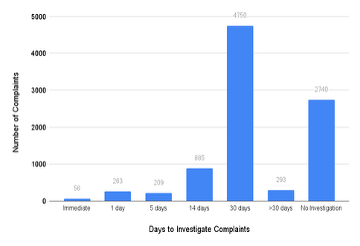
In FY 2025, TCEQ received 9,200 complaints. Of those:
- Investigators responded to just 300 complaints (3%) within one day.
- The agency took up to two weeks to investigate nearly 900 complaints (10%).
- The remaining 5,000 complaints (54%) took at least 14 days, but some took more than 30 days to initiate an investigation.
- The agency closed more than 2,700 complaints (30%) without ever investigating them.23
The agency reported that the most common environmental complaint was odor or dust, an air quality concern.24 The likelihood that a reported air quality matter results in a confirmed violation (and mandate to remedy it) depends on the investigator’s observation of the violation, which can only happen if the investigator responds. By waiting 14-30+ days to investigate, the agency almost guarantees it cannot confirm a violation or take enforcement action. Weather and conditions at the facility are likely to change over such a long period, resulting in closure of the complaint until the neighbor experiences the issue again and files another complaint. Neighbors in communities across the state have told us they’ve stopped reporting complaints to the TCEQ because it either does not respond or does not take action to resolve the issue.
In one of the most egregious public nuisance cases in Texas in recent years, it took the TCEQ years to address pervasive odors that neighbors described as “festering dog vomit on fire,” emanating from the Darling Ingredients animal rendering facility in Bastrop County.25 According to local elected officials, the smell was regularly observed in communities as far as 15 miles from the plant.26
It took 1,440 complaints before the TCEQ took additional steps to enforce the facility’s permits and refer the case to the Attorney General.27 One neighbor testified in the state’s civil suit that, “If my neighbor was outside burning tires, I would actually go over there and thank them because I didn’t have to smell Darling Ingredients anymore, it’s that bad.”28 And it was not just a bad odor. The TCEQ investigator found that on multiple occasions, Darling Ingredients emitted extremely toxic hydrogen sulfide gas at “levels that far exceeded the emissions allowed by state regulations,” and reported smells of decaying animals, burned cooking grease and sewage onsite.29
The TCEQ told Public Citizen that once a facility goes to enforcement for a violation, its policy is not to initiate additional enforcement of the same violation while the existing case was pending. But it takes the TCEQ a year and a half on average to process a single enforcement case – in many cases, much longer.30 This meant that Darling Ingredients was granted a pass for ongoing, pervasive emissions violations. At the same time, TCEQ processed its enforcement case, leaving residents to endure emissions that prevented them from enjoying their own yards and community spaces – for years.
On-Site Investigations
In FY 2025, agency data shows that while the TCEQ conducted 101,000 investigations, only 63,000 were conducted on-site.31 This is the fewest on-site investigations the agency has reported in eight years, including years when the COVID-19 pandemic made in-person investigations challenging. The number of 2025 investigations was 3,600 fewer than in 2024 and 5,200 fewer than in 2023.32,33,34,, The TCEQ also conducts record review investigations, where an investigator requests copies of records via email without visiting the facility. TCEQ conducted 38,000 such investigations.35
Table 1: TCEQ On-Site Investigations by Fiscal Year
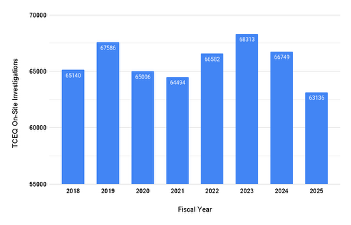
Of the 63,000 investigations, just 6,400 (10%) were for air quality, 5,400 (8.6%) were for petroleum storage tanks, 3,900 (6%) were for public water supply, 3,000 (4.7%) were for water quality, 1,400 (2%) were for on-site sewage and 1,000 (1.6%) were for municipal solid waste.36 The majority of on-site investigations were for water rights – 38,470 (61%).37
The TCEQ has not investigated a facility with an “unclassified” Compliance History ranking in the preceding 5-year period. According to the TCEQ’s 2025 Compliance History report, 273,700 (53%) of 521,000 regulated facilities that are subject to the Compliance History program in Texas had not been investigated in the preceding 5-year period.38 This figure does not include the 313,000 facilities not subject to the program, but highlights just how large the problem is.
In August 2025, TCEQ staff told Public Citizen that the agency had no intention of reducing the number of uninspected or unclassified entities because the Sunset Commission did not recommend, and the legislature did not mandate, that it do so.
The lack of a mandate to adopt procedures that meet the goals of TCEQ and of the Sunset Commission does not prohibit doing so. The TCEQ (and the Compliance History program) cannot function as intended unless the agency addresses the volume of facilities it has failed to inspect in the preceding 5-year period.
Potential Legislative Remedies
- No regulated entity should be left to self-monitor for more than 5 years. The TCEQ should be mandated to implement a performance metric and goal to reduce uninspected and unclassified entities.
Enforcement
TCEQ issued just 1,170 enforcement actions in FY 2025.39 The agency’s Annual Enforcement Report states that it aims to issue just 1,000 administrative orders each year and reports that it “consistently meets” that goal.40 But there are 834,000 regulated entities in Texas, according to TCEQ’s most recent Legislative Appropriation Request.41 This means that only 0.14% of all polluters in Texas received any formal enforcement action in 2025.
Despite the agency’s failures to promptly respond to reported environmental complaints and to conduct thousands of on-site investigations, in April, the agency posted a message to its social media channels thanking industry and making a false correlation between high compliance rates and the agency’s inability to sufficiently investigate and enforce environmental laws.42
Enforcement Backlog
Meanwhile, the TCEQ struggled to process its extensive backlog of enforcement cases. The TCEQ started the 2025 fiscal year with a backlog of 1,490 cases and ended the fiscal year with 1,480 cases.43,44, At that rate, the backlog will take 148 years to resolve, not including any new enforcement cases. The backlog is almost entirely of the agency’s own making – a failed enforcement policy among many that continue to erode public confidence in the agency.45
Agency enforcement staff disclosed during a public meeting in September 2025 that it had recently ended its long-standing practice of arbitrarily delaying enforcement cases for years to process them in batches, creating the complex backlog the agency is now struggling to work through.46
Enforcement delays often result in ongoing, unremediated pollution and harmful public health outcomes. We’ve asked TCEQ leadership to make a serious, expeditious effort to address the backlog in our TCEQ Year in Review report, in press, on social media and in recent public comments directly to agency leadership.
The enforcement backlog began steadily growing in 2021 and reached a peak of 1,700 cases in early 2024.47 The oldest case in the backlog is a ten-year-old case against Cal-Maine Foods for discharging approximately 8 million gallons of wastewater from a concentrated animal feeding operation into the waters of the state over 10 days, resulting in multiple documented fish kills.48
It doesn’t outwardly appear that the agency has taken a single step toward aggressive enforcement in this case, which has surpassed every compliance deadline outlined in the agency’s enforcement process. In fact, the TCEQ has renewed the facility’s wastewater permit twice since the incident – once in 2019 and again in 2024, despite TCEQ records showing it hasn’t conducted an on-site inspection of this facility since 2018.49,50,
According to agency data, it takes the TCEQ an average of 528 days to process a single enforcement case.51 TCEQ says it prefers to “promote and foster voluntary compliance with environmental laws and provide flexibility in achieving environmental goals.”52
The TCEQ doesn’t consider a case behind schedule until it’s been on the books for six months from the date it was referred for enforcement action.53 If the TCEQ hasn’t mailed the polluter a proposed agreed order – a template letter that details the alleged violation(s) and penalty – within that time, the agency counts the case as backlogged. But then TCEQ mails the agreed order, and the case is removed from the backlog list.54
According to staff, if, after 550 days (1.5 years) from the original enforcement referral date, the polluter still has not signed the agreed order and voluntarily agreed to come into compliance, the TCEQ returns the case to the backlog list.55
In some cases, years-long delays were caused solely by TCEQ’s inability to draft and mail the proposed agreed order to the polluter.56 To remove them from backlog status, all TCEQ did was stick a postage stamp on an envelope and mail a template letter. If a community is suffering from pollution, resolution doesn’t come in a template letter. It comes when pollution stops and fines are paid.
In other cases where TCEQ has issued a default order, it took the agency multiple years to mail an enforcement letter to the respondent.57 After many years, businesses have closed or changed ownership, contact information has changed, and respondents have become much more difficult to reach.
In response to our requests to address the backlog, in April 2026, TCEQ leadership told us that the TCEQ lacked the funding needed to address the enforcement backlog and that the public needed to advocate for more agency funding during the upcoming legislative session if they wanted to see it resolved.58
But just a few weeks later, TCEQ leadership reported it had a newly dedicated “strike-force” of five full-time attorneys in its Office of Legal Services specifically to address the enforcement backlog and that it had created a new team in the Office of Compliance and Enforcement who are focused on backlogged cases, “with the ultimate goal of appropriately managing all of these cases by the end of the fiscal year.”59 The TCEQ did not meet its goal, and as of August 2026, more than 900 backlogged cases remain.60
Closed or Non-Suited Enforcement Cases
Between January and July 2026, data obtained by public information request shows that the TCEQ closed or withdrew more than 100 backlogged enforcement cases, counting them as “resolved” in its monthly progress reporting, despite no agreed order, no compliance demonstration and no payment of any penalty.
The TCEQ told Public Citizen it doesn’t have to tell the public how the cases were closed, if the violation(s) were resolved, or if the pollution was remediated.
We reviewed each closed case, which have been removed from the agency’s most recent report of active enforcement actions and indicate a closed status in the TCEQ’s Commissioners Integrated Database.
Some closed enforcement cases involved serious environmental disasters.
In Fort Worth, the TCEQ alleged that in December 2019, the U.S. Navy spilled approximately 2,600 gallons of PFAS-containing 3% Aqueous Film-Forming Foam (AFFF) solution (a synthetic fire-fighting concentrate used to extinguish fuel fires) from an above-ground tank directly into the storm drain at the Naval Air Station Joint Reserve Base (NASJRB). The spill contaminated a local creek, but the Navy failed to contain it or respond. The TCEQ requested sampling of the impacted creek, but the Navy did not respond. The City of Fort Worth is suing the U.S. Department of Justice for contaminating the city’s drinking water with PFAS, which they allege also came from the use of AFFF for fire suppression at the Joint Reserve Base and a nearby Lockheed Martin site.61 TCEQ closed this enforcement case in February, after six years – seemingly without requiring sampling, remediation or payment of a penalty.62
The TCEQ closed cases against known repeat violators, including two air quality enforcement cases against the Chevron Phillips Cedar Bayou plant in Baytown and a wastewater enforcement case against the Formosa Plastics Corporation facility in Calhoun County.63,64,
While actively managing cases is progress, removing records and claiming victory on paper is not. Only the closure of resolved cases indicates that the TCEQ’s enforcement process is functioning as it should.
The TCEQ’s extensive enforcement backlog highlights the problems created by the agency’s lax enforcement approach. Voluntary compliance can still occur with strong agency-enforced deadlines and accountability to communities, but the TCEQ shouldn’t wait ten years for voluntary compliance. The agency should issue default orders – that come with fines and corrective action to stop environmental harm – and refer these significantly delayed cases to the Attorney General for civil enforcement in a court of law.
Potential Remedies
- The TCEQ should be mandated to implement a performance metric and goal to reduce the enforcement backlog by issuing agreed orders with penalties and compliance deadlines.
- The LBB should review if the funding proposed by TCEQ is sufficient to keep up with growth in Texas and effectively manage enforcement of environmental laws and permits to protect public health and the environment.
Public Participation
In 2023, the TCEQ was labeled a “Reluctant Regulator” by the Texas Sunset Advisory Commission, which found that “TCEQ’s policies and processes lack full transparency and opportunities for meaningful public input, generating distrust and confusion among members of the public,” among numerous other issues.65 The Texas legislature mandated the TCEQ to improve its public participation processes.66
In January 2026, as mandated by the TCEQ Sunset Bill (SB 1397) signed into law in 2023, the TCEQ adopted a rulemaking ostensibly aimed at improving public participation. Despite the bill’s clear intent, the TCEQ’s final rule fell short of the reforms lawmakers and the state’s Sunset Advisory Commission envisioned. The TCEQ received more than 50 comments from community and environmental advocates asking the agency to align the rule with the Sunset Advisory Commission’s recommendations, increase transparency and make participation less confusing. The agency rejected each of those 50 comments.67 Instead, the TCEQ modified this rule proposal after it was presented to the public, based on more than 30 comments from corporate interest groups.68
Data Centers
Texas is experiencing an influx of data centers, which the Texas Legislature must address in the 90th regular legislative session to better protect neighbors from the harmful pollution of co-located gas plants, backup diesel generators and wastewater discharges. The agency should anticipate this need and bolster funding for meaningful public participation and more extensive permit reviews. It should also consider funding needs to implement any rule projects, including public notice and participation in any such rules, as mandated by new legislation.
Conclusion
The TCEQ’s leadership has expressed little interest in our concerns that the agency’s enforcement resources are insufficient, approving a new Legislative Appropriations Request for FY 2028-2029 that failed to adequately increase agency funding for investigations and enforcement, despite the significant increase in the number of regulated entities across the state and the agency’s poor performance across its enforcement activities.69,70,71
Communities across Texas depend on the TCEQ to protect public health, our state’s natural resources and the environment. In many ways, the TCEQ seems determined to live up to its “Reluctant Regulator” title. Residents have expressed frustration with the agency’s inability to prioritize people over corporate profits and the agency’s unwillingness to improve, despite past legislative efforts.
We are hopeful that the Legislative Budget Board can begin to address these issues. We are available to discuss any of these issues further.
Kathryn Guerra
TCEQ Campaign Director | Public Citizen
309 E. 11th Street, Ste. 2, Austin, TX 78701
1 See https://www.tceq.texas.gov/downloads/agency/administrative/legislatively-mandated-reports/sfr-5525-annual-report-on-performance-measures-fy25.pdf
2 These are the goal numbers in the FY25 Annual Report on Performance Measures (fn.1 above).
3 Ibid.
4 Ibid.
5 Ibid.
6 See https://wayback.archiveit.org/414/20250908000018/https://www.tceq.texas.gov/downloads/agency/administrative/legislativelymandated-reports/sfr-55-21-annual-report-on-performance-measures-fy21.pdf
7 See https://www.tceq.texas.gov/agency/administrative/quarterly-reports-on-key-performance-measures
8 See https://www.tceq.texas.gov/downloads/agency/administrative/legislatively-mandated-reports/sfr-5525-annual-report-on-performance-measures-fy25.pdf
9 Ibid.
10 See https://www.sierraclub.org/texas/blog/2023/11/more-half-texans-live-areas-unsafe-ozone-levelswhich-rise-temperatures
11 See https://www.tceq.texas.gov/downloads/agency/administrative/legislatively-mandated-reports/sfr-55-25annual-report-on-performance-measures-fy25.pdf
12 Ibid.
13 Ibid.
14 Ibid.
15 See https://www.tceq.texas.gov/compliance/enforcement/enforcement-reports/historical
16 See https://www.tceq.texas.gov/downloads/agency/decisions/work-sessions/backup/2026/2026-0529mis.pdf
17 See https://drive.google.com/file/d/19ZbjWedE6YRkffNTTen791QhqgIA4LzW/view?usp=sharing
18 Ibid.
19 Ibid.
20 Ibid.
21 Ibid.
22 See https://www.tceq.texas.gov/downloads/compliance/enforcement/actions-reports/aer/fy2025/2025enforcement-report.pdf
23 Ibid.
24 Ibid.
25 See https://www.texasattorneygeneral.gov/sites/default/files/files/press/Darling-Petition.pdf
26 See https://www.facebook.com/share/p/195zDavy6J/
27 See https://www.texasattorneygeneral.gov/sites/default/files/files/press/Darling-Petition.pdf
28 Ibid.
29 Ibid.
30 See https://www.tceq.texas.gov/downloads/publications/sfr/srf-057-24/biennial-report-23-24.pdf
31 See https://www.tceq.texas.gov/downloads/compliance/enforcement/actions-reports/aer/fy2025/fy2025onsite-investigations
32 Ibid.
33 See https://www.tceq.texas.gov/downloads/compliance/enforcement/actions-reports/aer/fy2024/app-bon-site-investigations.pdf
34 See https://www.tceq.texas.gov/downloads/compliance/enforcement/actions-reports/aer/fy2023/app-bon-site-investigations-fy2023.pdf
35 See https://www.tceq.texas.gov/downloads/compliance/enforcement/actions-reports/aer/fy2025/fy2025onsite-investigations
36 See https://www.tceq.texas.gov/downloads/compliance/enforcement/actions-reports/aer/fy2025/fy2025onsite-investigations
37 Ibid.
38 See https://data.texas.gov/dataset/Texas-Commission-on-Environmental-Quality-Complian/michcjem/about_data
39 See https://www.tceq.texas.gov/downloads/compliance/enforcement/actions-reports/aer/fy2025/2025enforcement-report.pdf
40 Ibid.
41 See https://www.tceq.texas.gov/downloads/agency/decisions/work-sessions/backup/2026/2026-0529mis.pdf
42 See https://www.facebook.com/100064383503519/posts/1366441798845257/?rdid=J4rVSbT3yuDN47xl
43 See https://www.tceq.texas.gov/downloads/compliance/enforcement/actions-reports/2024/sep-2024.pdf
44 See https://www.tceq.texas.gov/downloads/compliance/enforcement/actions-reports/2025/aug-2025.pdf
45 See https://www.citizen.org/news/after-almost-10-years-the-tceq-imposes-financial-penalty-on-polluterin-what-the-agency-calls-an-expedited-settlement/
46 See https://www.youtube.com/watch?v=8tIubnR18hA&t=3945s
47 See https://www.tceq.texas.gov/downloads/compliance/enforcement/actions-reports/2024/feb-2024.pdf
48 See https://www2.tceq.texas.gov/oce/irod/index.cfm?fuseaction=home.viewinvrpt&invstnid=868514712016209
49 See https://www2.tceq.texas.gov/wq_dpa/index.cfm?fuseaction=home.permit_list_by_permit&permit_number= TXG921060
50 See https://www2.tceq.texas.gov/oce/irod/index.cfm?fuseaction=home.viewinvrpt&invstnid=102381852018208
51 See https://www.tceq.texas.gov/downloads/publications/sfr/srf-057-24/biennial-report-23-24.pdf
52 Ibid.
53 See https://drive.google.com/file/d/1uXKh9Oaa_uJaHxlvHaJViSO_STKSKgv4/view?usp=sharing
54 Ibid.
55 Ibid.
56 Ibid.
57 See https://www.tceq.texas.gov/downloads/agency/decisions/agendas/backup/2025/2025-0949-mswe.pdf
58 See https://www.youtube.com/watch?v=puYZ-EnE5rg&t=4650s (1:18:35 minute mark)
59 See https://www.youtube.com/watch?v=g_xCjsZm43A&t=4411s (1:11:45 minute mark)
60 See https://www.tceq.texas.gov/downloads/agency/decisions/agendas/backup/2026/2026-0012-mis.pdf
61 See https://www2.tceq.texas.gov/oce/irod/index.cfm?fuseaction=home.viewinvrpt&invstnid=907501952020255
62 Closed enforcement case against NASJRB – 2021-0288-MSW-E
63 Closed enforcement cases against Chevron – 2022-0624-AIR-E; 2025-0452-AIR-E
64 Closed enforcement case against Formosa – 2024-0742-IWD-E
65 See https://www.sunset.texas.gov/public/uploads/202308/Texas%20Commission%20on%20Environmental%20Quality%20Staff%20Report%20with%20Final%2 0Results_6-26-23.pdf
66 See https://capitol.texas.gov/tlodocs/88R/billtext/pdf/SB01397F.pdf#navpanes=0
67 See https://www.tceq.texas.gov/downloads/agency/decisions/agendas/backup/2023/2023-1506rula.pdf
68 See https://www.citizen.org/news/tceq-adopts-public-participation-rulemaking-while-rejecting-all-of-thepublics-participation/
69 See https://www.tceq.texas.gov/downloads/agency/decisions/work-sessions/backup/2026/2026-0529mis.pdf
70 See https://www.tceq.texas.gov/downloads/compliance/enforcement/actions-reports/aer/fy2025/2025enforcement-report.pdf
71 See https://www.tceq.texas.gov/downloads/agency/administrative/legislatively-mandated-reports/sfr55-25-annual-report-on-performance-measures-fy25.pdf
Stay Updated on Public Citizen
Follow Public Citizen
Support Our Work
2026 Austin Environmental City Council Candidate Forum
Watch the Recordings
By Kaiba White
Five of Austin’s City Council districts have elections this fall and we’re helping to keep environmental issues top of mind with the candidates. On Saturday, August 22, Public Citizen hosted the “Austin Environmental City Council Candidate Forum” in partnership with eleven other local organizations.
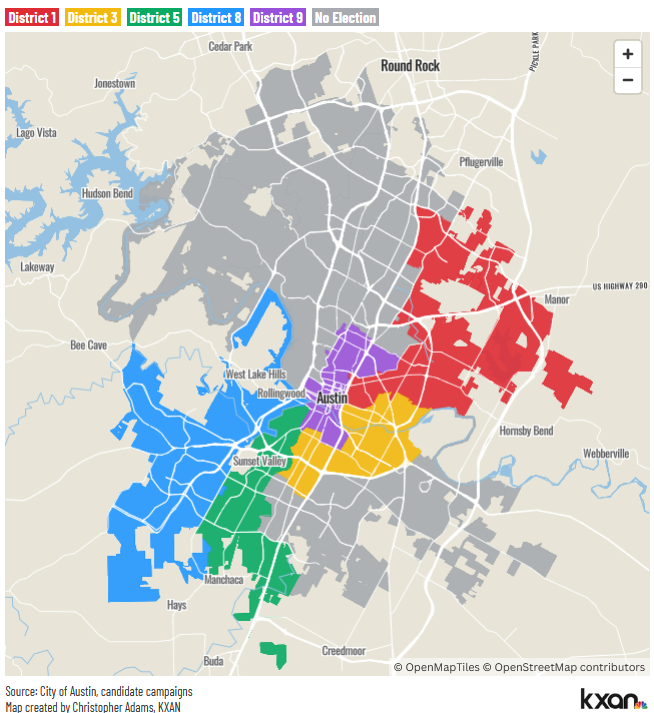 We worked together to build a list of some of the most pressing questions on local environmental and governance decisions that the upcoming Austin City Council may face. The esteemed Mose Buchele – reporter for KUT – moderated the forum.
It was great to see many Austinites at the event in person, but even if you couldn’t make it out, you may watch the recordings of the forum.
We encourage you to consider environmental and transparency issues as you head to the polls this fall.
If you aren’t sure which Austin City Council district you live in, you can look it up here.
Key Election Dates:
- Last Day to Register to Vote: Monday, October 5, 2026
- Last Day to Apply for Ballot By Mail: Friday, October 23, 2026
- Early Voting Starts: Monday, October 19, 2026
- Early Voting Ends: Friday, October 30, 2026
- Election Day: Tuesday, November 3, 2026
Travis County election information is here. And Williamson County election information is here.
Stay Updated on Public Citizen
Follow Public Citizen
Support Our Work
Testimony Before the Food and Drug Administration’s Molecular and Clinical Genetics Panel of the Medical Devices Advisory Committee
By Nina Zeldes, Ph.D.
I am Nina Zeldes, a Senior Health Researcher at Public Citizen’s Health Research Group. We have no financial or other conflicts of interest.
Public Citizen opposes the marketing authorization of the Galleri test because of the lack of data demonstrating that the test’s benefits outweigh its risks. The lack of convincing data is of particular concern because the test is likely to become widely used if it receives marketing authorization.
Our first specific concern is about the trial design. Only one of the two trials (NHS-Galleri) supporting the safety and efficacy of the Galleri test was a randomized controlled study. The second trial (PATHFINDER 2) did not include a control group.[1]
The primary endpoint of the randomized controlled trial, reduction of stage III and IV cancers, has been criticized because it does not directly measure whether the Galleri test had a meaningful effect on the survival of cancer patients.[2],[3] More importantly, however, the study did not even meet its prespecified primary endpoint.[4]
Our second specific concern is that between 81% (PATHFINDER 2) and 94% (NHS-Galleri) of trial participants were White and therefore not representative of the U.S. population,[5] which has a greater percentage of non-White individuals.
Our third specific concern is that the effectiveness of the Galleri test has not yet been established. Importantly, no follow-up data beyond several years are available. The Galleri test is proposed to be indicated for “the early detection of multiple cancers,” yet the sensitivity for new cancers detected in stage I and II combined ranged only from 21% to 25% across both trials.[6] The test’s sensitivity was also highly variable by cancer type, ranging across both trials from 1.6% for some skin cancers to 81% for liver and intrahepatic bile duct cancers.[7]
Based on the available data, it has not been established whether the benefits of the Galleri test outweigh its risks. False-positive results can lead to a cascade of unnecessary diagnostic tests and invasive procedures. Additional risks can include anxiety, delayed diagnosis and treatment, and other unintended harms. For instance, a higher demand for diagnostic testing can lead to increased wait times, additional time away from work, and increased out-of-pocket costs.[8], [9]
Importantly, there are currently no authorized devices indicated for the screening of multiple types of cancer. Granting marketing authorization to the Galleri test based on inadequate data is not in the best interest of patients and would establish a dangerously low bar for authorization for such devices going forward.
Given these important concerns, we urge the committee to vote “No” on all three voting questions.
[1] Food and Drug Administration. FDA executive summary for Galleri (GRAIL, Inc.) prepared for the September 23, 2026 meeting of the Molecular and Clinical Genetics Panel of the Medical Devices Advisory Committee. https://www.fda.gov/media/194909/download. Accessed September 23, 2026.
[2] Sullivan R, Booth CM. Multicancer detection tests: Promise, hype, and reality. JAMA. 2026 May 30.
[3] Bermúdez-Guzmán L. Signal-to-care gap in multicancer early detection. JAMA Intern Med. 2026 Jul 20.
[4] Swanton RC, Johnson P, Round T, et al. NHS-Galleri: primary results from a randomised controlled trial to assess the clinical utility of a multi-cancer early detection (MCED) test in population screening. J Clin Oncol. 2026 Jun 10;44(17_suppl):LBA100-.
[5] Food and Drug Administration. FDA executive summary for Galleri (GRAIL, Inc.) prepared for the September 23, 2026 meeting of the Molecular and Clinical Genetics Panel of the Medical Devices Advisory Committee. https://www.fda.gov/media/194909/download. Accessed September 23, 2026.
[6] Ibid.
[7] Grail. Galleri multi-cancer early detection test. Sponsor executive summary. Molecular and clinical genetics panel. https://www.fda.gov/media/194910/download. Accessed September 23, 2026.
[8] McCartneyM, Cohen D. Galleri promises to detect multiple cancers—but new evidence casts
doubt on this much hyped blood test. BMJ. 2024; 386:q1706.
[9] Bermúdez-Guzmán L. Signal-to-care gap in multicancer early detection. JAMA Intern Med. 2026 Jul 20.
You might be interested in
Stay Updated on Public Citizen
Follow Public Citizen
Support Our Work
California Air Resources Board is Proposing a Watered Down Corporate Emissions Disclosure Rule
The California Air Resources Board (CARB) is developing a corporate greenhouse gas (GHG) emissions disclosure program for all large companies doing business in the state, authorized by landmark legislation SB253. The law requires large businesses that make over $1 billion in annual revenue doing business in California to submit their total annual corporate GHG emissions to CARB starting in 2027. These emissions figures will be publicly disclosed.
Individual industries and trade groups have been pursuing aggressive legal and advocacy strategies to weaken the rules or obtain exemptions, so far unsuccessfully. The insurance industry nearly secured an exemption from emissions reporting, but after significant opposition, including from the bill’s author, State Senator Scott Weiner, the former California Insurance Commissioner Dave Jones, and the broader public, CARB reversed course. Now the agency is considering proposing a watered down emissions standard that would fail to meet the requirements of SB253; result in incomplete, incomparable, and potentially misleading data for users; and omit most emissions for major polluting industries, like oil and gas firms and financial companies.
SB253 requires complete GHG emissions reporting.
In the realm of corporate GHG accounting, “Scope 3” emissions are those created upstream and downstream of the company’s facilities, including those from suppliers, from the use and disposal of the company’s products, and other activities. Scope 3 emissions often represent the majority of a company’s overall emissions, its contribution to climate change, and its risks from environmental regulations, new technologies, and changing consumer preferences. For example, the majority of Exxon’s emissions are categorized as “Scope 3” because they are emitted by Exxon’s end customers (e.g., everyday automobile drivers), not by Exxon itself. Comprehensive Scope 3 emissions reporting is essential for meaningful corporate GHG emissions data.
The standard underpinning SB 253 is the Greenhouse Gas Protocol (GHG Protocol), the global standard for corporate emissions accounting. The GHG protocol makes it clear that upstream and downstream emissions must be disclosed in corporate GHG inventories, stating that “companies should not exclude any activity that is expected to contribute significantly to the company’s total scope 3 emissions.” In other words, to take Exxon as an example, to comply with SB 253, the company would need to account for its fossil fuel product emissions.
CARB’s initial proposal, if finalized, would let high-emitting sectors off the hook.
The GHG Protocol outlines 15 categories of Scope 3 emissions and requires companies to account for all significant emissions categories and activities for their business.
Rather than requiring companies to disclose their emissions under all categories, as the statute requires, CARB recently outlined a plan to select only five of 15 Scope 3 categories for mandatory reporting in 2027. CARB justified its proposal not based on the guiding principles of the GHG Protocol—which include relevance, completeness, consistency, transparency, and accuracy—but rather on purported prevalence of the categories in current voluntary reports. The five categories CARB selected are purchased goods and services (category 1), fuel and energy-related activities (3), waste generated during operation (5), business travel (6), and employee commuting (7). Business travel and employee commuting are often trivial compared to overall company emissions footprints, representing about 0.1 percent and 0.2 percent of companies’ Scope 3 inventories, respectively, according to the Carbon Disclosure Project.
If finalized, this abbreviated version of the GHG Protocol standard would result in uneven emissions coverage across different sectors, letting many high emitting sectors off the hook from measuring and disclosing the majority of their emissions. Many sectors would need to disclose less than a quarter of their overall corporate emissions, including real estate companies (21 percent), oil and gas companies (16 percent), car manufacturers (13 percent), and financial institutions (0.02 percent). For oil and gas firms, the proposed Scope 3 reporting requirements would exclude sold fuel product emissions, and for banks, private equity firms, and insurance companies, it would exclude all of the emissions stemming from their investments, underwriting, and operations of portfolio companies. Meanwhile, cement and steel companies, transportation service providers, and food and beverage companies would be required to disclose the majority of their corporate emissions, over 80 percent each.
CARB’s proposed Scope 3 approach would yield incomplete data that misleads users.
CARB’s proposed approach to Scope 3 emissions reporting would by definition provide data users with incomplete and misleading GHG inventories. It will be impossible for users to make cross-sector comparisons, and difficult even to make comparisons of companies within the same sector due to the substantial omissions of emissions categories and activities. For example, CARB’s proposed standard would omit 99.8 percent of finance sector emissions and not only present a misleading view of the role that these companies play in creating climate risk for the California people and the government, but effectively preclude any analysis of the sector and its firms’ progress on reducing emissions.
Selecting only five emissions categories—a one-size-fits-all abbreviated approach— also ignores the flexibility that GHG Protocol has thoughtfully incorporated into its rules and guidance to elicit the most meaningful data from sectors with different emissions profiles. The vast majority of large companies already have experience working with the GHG Protocol and its guidance for determining categories of emissions that are significant, and thus must be included in their accounting. For example, some oil and gas companies already disclose category 11 emissions from the use of their sold products, because they recognize they are their most significant category, and the methodology to calculate those emissions is relatively straightforward. If category 11 emissions are omitted from the rule, these companies might discontinue disclosing them voluntarily.
This significant divergence from the GHG Protocol runs counter to the requirements of SB 253. In addition, CARB’s proposed approach raises a variety of significant questions, such as the following:
- What is the rationale for selecting only five categories, as opposed to four or six?
- How would excluding category 11, the use of sold products, align with the statutory requirement to yield complete GHG inventories, particularly when the category represents a significant source of emissions for many companies and is relatively straightforward to calculate?
- Has CARB considered that certain categories may be often omitted from voluntary reports precisely because companies are seeking to conceal them?
- Does CARB have a plan to require all categories of emissions by some future date?
The GHG Protocol shares extensive guidance to help companies identify and then disclose their significant Scope 3 categories of emissions. The selection of these five is arbitrary and uneven, as likely would any other selection of a subset. Following the GHG Protocol to the letter by including all categories of Scope 3 emissions is the best way for CARB to produce meaningful categories of emissions for different actors and be in accordance with the letter and intent of SB253.
The California Air Resources Board (CARB) is developing a corporate greenhouse gas (GHG) emissions disclosure program for all large companies doing business in the state, authorized by landmark legislation SB253. The law requires large businesses that make over $1 billion in annual revenue doing business in California to submit their total annual corporate GHG emissions to CARB starting in 2027. These emissions figures will be publicly disclosed.
Individual industries and trade groups have been pursuing aggressive legal and advocacy strategies to weaken the rules or obtain exemptions, so far unsuccessfully. The insurance industry nearly secured an exemption from emissions reporting, but after significant opposition, including from the bill’s author, State Senator Scott Weiner, the former California Insurance Commissioner Dave Jones, and the broader public, CARB reversed course. Now the agency is considering proposing a watered down emissions standard that would fail to meet the requirements of SB253; result in incomplete, incomparable, and potentially misleading data for users; and omit most emissions for major polluting industries, like oil and gas firms and financial companies.
SB253 requires complete GHG emissions reporting.
In the realm of corporate GHG accounting, “Scope 3” emissions are those created upstream and downstream of the company’s facilities, including those from suppliers, from the use and disposal of the company’s products, and other activities. Scope 3 emissions often represent the majority of a company’s overall emissions, its contribution to climate change, and its risks from environmental regulations, new technologies, and changing consumer preferences. For example, the majority of Exxon’s emissions are categorized as “Scope 3” because they are emitted by Exxon’s end customers (e.g., everyday automobile drivers), not by Exxon itself. Comprehensive Scope 3 emissions reporting is essential for meaningful corporate GHG emissions data.
The standard underpinning SB 253 is the Greenhouse Gas Protocol (GHG Protocol), the global standard for corporate emissions accounting. The GHG protocol makes it clear that upstream and downstream emissions must be disclosed in corporate GHG inventories, stating that “companies should not exclude any activity that is expected to contribute significantly to the company’s total scope 3 emissions.” In other words, to take Exxon as an example, to comply with SB 253, the company would need to account for its fossil fuel product emissions.
CARB’s initial proposal, if finalized, would let high-emitting sectors off the hook.
The GHG Protocol outlines 15 categories of Scope 3 emissions and requires companies to account for all significant emissions categories and activities for their business.
Rather than requiring companies to disclose their emissions under all categories, as the statute requires, CARB recently outlined a plan to select only five of 15 Scope 3 categories for mandatory reporting in 2027. CARB justified its proposal not based on the guiding principles of the GHG Protocol—which include relevance, completeness, consistency, transparency, and accuracy—but rather on purported prevalence of the categories in current voluntary reports. The five categories CARB selected are purchased goods and services (category 1), fuel and energy-related activities (3), waste generated during operation (5), business travel (6), and employee commuting (7). Business travel and employee commuting are often trivial compared to overall company emissions footprints, representing about 0.1 percent and 0.2 percent of companies’ Scope 3 inventories, respectively, according to the Carbon Disclosure Project.
If finalized, this abbreviated version of the GHG Protocol standard would result in uneven emissions coverage across different sectors, letting many high emitting sectors off the hook from measuring and disclosing the majority of their emissions. Many sectors would need to disclose less than a quarter of their overall corporate emissions, including real estate companies (21 percent), oil and gas companies (16 percent), car manufacturers (13 percent), and financial institutions (0.02 percent). For oil and gas firms, the proposed Scope 3 reporting requirements would exclude sold fuel product emissions, and for banks, private equity firms, and insurance companies, it would exclude all of the emissions stemming from their investments, underwriting, and operations of portfolio companies. Meanwhile, cement and steel companies, transportation service providers, and food and beverage companies would be required to disclose the majority of their corporate emissions, over 80 percent each.
CARB’s proposed Scope 3 approach would yield incomplete data that misleads users.
CARB’s proposed approach to Scope 3 emissions reporting would by definition provide data users with incomplete and misleading GHG inventories. It will be impossible for users to make cross-sector comparisons, and difficult even to make comparisons of companies within the same sector due to the substantial omissions of emissions categories and activities. For example, CARB’s proposed standard would omit 99.8 percent of finance sector emissions and not only present a misleading view of the role that these companies play in creating climate risk for the California people and the government, but effectively preclude any analysis of the sector and its firms’ progress on reducing emissions.
Selecting only five emissions categories—a one-size-fits-all abbreviated approach— also ignores the flexibility that GHG Protocol has thoughtfully incorporated into its rules and guidance to elicit the most meaningful data from sectors with different emissions profiles. The vast majority of large companies already have experience working with the GHG Protocol and its guidance for determining categories of emissions that are significant, and thus must be included in their accounting. For example, some oil and gas companies already disclose category 11 emissions from the use of their sold products, because they recognize they are their most significant category, and the methodology to calculate those emissions is relatively straightforward. If category 11 emissions are omitted from the rule, these companies might discontinue disclosing them voluntarily.
This significant divergence from the GHG Protocol runs counter to the requirements of SB 253. In addition, CARB’s proposed approach raises a variety of significant questions, such as the following:
- What is the rationale for selecting only five categories, as opposed to four or six?
- How would excluding category 11, the use of sold products, align with the statutory requirement to yield complete GHG inventories, particularly when the category represents a significant source of emissions for many companies and is relatively straightforward to calculate?
- Has CARB considered that certain categories may be often omitted from voluntary reports precisely because companies are seeking to conceal them?
- Does CARB have a plan to require all categories of emissions by some future date?
The GHG Protocol shares extensive guidance to help companies identify and then disclose their significant Scope 3 categories of emissions. The selection of these five is arbitrary and uneven, as likely would any other selection of a subset. Following the GHG Protocol to the letter by including all categories of Scope 3 emissions is the best way for CARB to produce meaningful categories of emissions for different actors and be in accordance with the letter and intent of SB253.
You might be interested in
Stay Updated on Public Citizen
Follow Public Citizen
Support Our Work
Testimony to the Food and Drug Administration’s Public Hearing on Considerations for Potential Future Therapeutic Use of Psychedelic Drugs
By Marie Ezran, M.D.
I’m Dr. Marie Ezran, a family medicine physician and a fellow with Public Citizen. Public Citizen is a nonprofit consumer advocacy organization with over one million members. We have no financial conflicts of interest related to this topic.
Public Citizen supports research on potential psychedelic treatments for serious psychiatric conditions. There is a need for therapies that are more effective and provide faster relief for conditions such as treatment-resistant depression, post-traumatic stress disorder, and substance use disorders.
Public Citizen also appreciates the Food and Drug Administration’s (FDA’s) consideration of patient safety when studying the potential future therapeutic use of psychedelic drugs. The most effective ways the FDA can protect patients are by requiring rigorous and well-designed clinical trials that enroll adequate numbers of participants and by conducting a thorough review of a new drug application prior to any potential approval.
We are concerned about the use of the Commissioner’s National Priority Voucher (CNPV) pilot program for three psychedelic drugs currently in clinical trial or under review. Public Citizen has previously outlined our concerns about the CNPV pilot in a public comment.[1] A 2017 study demonstrated that new drugs reviewed under accelerated pathways “are associated with increased safety related label changes after approval, particularly for the types of changes representing the highest risk warnings.”[2] At the time of the study, the one- to two-month review timeline of the CNPV pathway had not been established. For a class of medications that remains relatively new to the FDA, there should be careful and complete review of the benefits and harms of each therapeutic, which is impossible to accomplish within a one- to two-month review time frame.
In the July 2026 guidance for industry about psychedelic drugs, the FDA stated that careful consideration of the selection of placebo is important for determining the drug’s efficacy.[3] Use of an inert placebo would create unfunctional blinding that can bias results. Thoughtful choice of placebos in clinical trials of psychedelics therapeutics is essential to ensure the efficacy of drugs that are eventually approved. Moreover, long-term studies, of at least 12 months duration, are also needed to evaluate the potential lasting effects of psychedelic therapeutics.
For any approved psychedelic therapeutics, we support the use of the Risk Evaluation and Mitigation Strategies (REMS) program with elements to assure safe use (ETASU).[4] Because psychedelics have serious dissociation and hallucinogenic potential as well as cardiovascular side effects, use of the REMS program would allow for appropriate administration and monitoring.[5] We support the following safety precautions, many of which are part of the REMS program for esketamine (SPRAVATO), a medication for treatment-resistant depression and a drug that raises similar safety concerns.[6]
- The psychedelic therapeutic should be prescribed by a licensed psychiatrist that provides ongoing treatment to the patient. The prescriber should receive REMS training and certification prior to prescribing and dispensing the medication.
- The patient should have a separate evaluation prior to medication administration to ensure there are no contraindications to treatment. Patients should give written consent after demonstrating an understanding of possible side effects in addition to the potential transformative and irreversible effects of these medications.
- The medication should be administered only at a REMS-certified outpatient or inpatient health care setting. There should not be doses to take home. Two licensed providers should monitor the patient during the entire treatment session: “a health care provider with graduate-level professional training and clinical experience in psychotherapy, licensed to practice independently, serving as the lead monitor” and “an assistant monitor with a nursing or bachelor’s degree and at least 1 year of clinical experience in a licensed mental health care setting.”[7] The session should also be video recorded for the safety of the patient. The patient should be monitored for a specified number of hours after treatment with vital sign checks to ensure return to a baseline state.
- Finally, to support safe use of the medication, patients taking this therapeutic should be enrolled in a registry to monitor clinical outcomes and adverse effects.
We recognize that needed safety measures to protect patients can also make a medication harder to access and increase administrative work for prescribers. Nonetheless, if or when the FDA approves psychedelic therapeutics, the agency must prioritize ensuring patient safety. Part of the approval of any new psychedelic therapeutic should be requirements for strong patient protection measures that can be promptly updated when new evidence develops.
The FDA can best serve and protect patients by upholding quality clinical trial standards; conducting thorough reviews of drug applications prior to approval, regardless of the approval pathway for the drug; and requiring robust post-market surveillance for adverse events, misuse, and abuse.
[1] Steinbrook R, Kowalik AM. Comments to the FDA about the Commissioner’s National Priority Voucher Pilot Program. June 29, 2026. https://www.citizen.org/article/comments-to-the-fda-about-the-commissioners-national-priority-voucher-pilot-program/. Accessed September 17, 2026.
[2] Mostaghim SR, Gagne JJ, Kesselheim AS. Safety related label changes for new drugs after approval in the US through expedited regulatory pathways: retrospective cohort study. BMJ. 2017;358:j3837. Published 2017 Sep 7. doi:10.1136/bmj.j3837
[3] Food and Drug Administration. Psychedelic Drugs: Considerations for Clinical Investigations Guidance for Industry. July 2026. https://www.fda.gov/media/169694/download. Accessed September 17, 2026.
[4] U.S. Food & Drug Administration. What’s in a REMS? January 26, 2018. https://www.fda.gov/drugs/risk-evaluation-and-mitigation-strategies-rems/whats-rems. Accessed September 17, 2026.
[5] Romeo B, Kervadec E, Fauvel B, et al. Safety and risk assessment of psychedelic psychotherapy: A meta-analysis and systematic review. Psychiatry Res. 2024;335:115880. doi:10.1016/j.psychres.2024.115880
[6] U.S Food & Drug Administration. Approved Risk Evaluation and Mitigation Strategies (REMS): Spravato (Esketamine). June 24, 2026. https://www.accessdata.fda.gov/scripts/cder/rems/index.cfm?event=IndvRemsDetails.page&REMS=386.
Accessed September 17, 2026.
[7] Food and Drug Administration. Psychedelic Drugs: Considerations for Clinical Investigations Guidance for Industry. July 2026. https://www.fda.gov/media/169694/download. Accessed September 17, 2026.
You might be interested in
Stay Updated on Public Citizen
Follow Public Citizen
Support Our Work
Public Citizen FOIA Reveals That Pharma, Not Patients Are Favored In Trump’s Drug Pricing Deals
Key Takeaways
- Copies of Pfizer and Eli Lilly’s “most-favored nation” (MFN) agreements obtained by Public Citizen through the Freedom of Information Act are heavily redacted, making it difficult for the public to assess the true impact of the secret deals made with the Trump White House. The redactions reflect the administration’s disdain for the transparency and accountability the American people deserve.
- The agreements reveal concerning terms that will help facilitate pharma companies charging more for drugs abroad or discontinuing supplying drugs in other countries so that they can continue to charge U.S. customers high prices, suggesting that the Trump team may be doing more to protect pharma profits than patient pocketbooks.
- The White House has called out its work to get GLP-1 diabetes and obesity treatments at lower price points under MFN deals as one of the highlights of these agreements. But Lilly’s deal contains a loophole that insulates it from providing a true MFN price point for its GLP-1 drugs. If the loophole is applied to all GLP-1 drugs, it could cost Medicaid $1.7 billion in savings.
- The documents contain information that calls into question the veracity of previously communicated information on the MFN agreements. Pfizer’s agreement states that its terms supersede the Centers for Medicare and Medicaid Innovation Center’s GENEROUS model, which outlines how state Medicaid programs can get MFN pricing, if there are conflicts.
- The perks to pharma are not public in the documents. Understanding the scope of the industry perks is particularly important given that some of the benefits to industry have already been realized while there remains considerable skepticism that other parts of the agreements that would benefit U.S. patients will ever get off the ground.
Sham Deals
President Donald Trump has for months claimed he got American’s the world’s lowest prices on prescriptions drugs, but his administration has repeatedly refused to provide the public with the text of the “most-favored nation” (MFN) agreements reached with 27 pharmaceutical companies to effectuate those prices.[1]
American patients pay far too much for drugs and should be able to purchase their medicines at similar prices to the lower costs paid in peer countries. But health policy must be made publicly, not through confidential deals with powerful corporations like Big Pharma, which has a vested interest in keeping American drug prices high. Drug company and investor statements that indicate they do not anticipate major financial impacts from the deals, and evidence that Trump has exaggerated his recent drug pricing achievements, along with Trump’s past failures in implementing his drug pricing policies and achieving lower drug costs, make it even more important to assess whether his rhetoric matches reality.
Public Citizen sued to gain access to MFN deals struck with pharma giants Pfizer and Eli Lilly after the Trump administration failed to respond to our Freedom of Information Act requests (FOIA) for the agreements and any connected contracts or documentation
Nearly six months after the lawsuit was filed, and ten months after the White House announced the first of these agreements with Pfizer, the Trump administration provided copies of the so-called “most-favored nation” (MFN) agreements to Public Citizen that continue to reflect the administration’s disdain for the transparency and accountability the American people deserve as large quantities of information remain hidden from public view due to redactions.
The dates of the documents provided to Public Citizen also indicate that the government was not fully transparent about the progress it had made in negotiating MFN deals. For both Pfizer and Eli Lilly, the government appeared to publicize its commitments with the companies as final deals, months before it ironed out crucial details and secured binding commitments. For example, Pfizer’s deal with the White House was announced Sept. 30, 2025, but the letter of agreement reached between the parties on this date was only the precursor to definitive agreements that still needed to be negotiated and executed to effectuate the MFN deal. Pfizer’s letter of agreement said that it was “intended only to create the obligation between the parties to engage in diligent and good faith negotiations on the terms of future Definitive Agreement(s),” and that neither party was obligated to enter into a future Definitive Agreement(s). Pfizer entered into a definitive MFN drug pricing agreement on Feb. 23, 2026, nearly five months after the administration told the public its goals were achieved. The Pfizer and Lilly documents also include indications that other parts of the MFN agreements would be finalized in documents not yet received by Public Citizen. These parts appear to have not been complete as of March 16, 2026, as the government told Public Citizen it was provided with all the final documents responsive to its FOIA in the government’s custody as of March 16, 2026. The Pfizer and Lilly documents we received do not include all parts of the MFN agreements that the documents themselves indicate need to be executed in order for the agreements to take effect.
Still, despite the redactions and missing documents, the text obtained by Public Citizen reveals details never previously disclosed, including some concerning giveaways to pharma companies that could harm U.S. patients and those overseas, such as a loophole for GLP-1 obesity drugs that could cost Medicaid nearly $1.7 billion in savings.
Blacked Out Text Trumps Radical Transparency
Key Terms Obscured
The Pfizer MFN agreement is redacted such that it leaves the public unable to extract the most important pieces of information necessary to assess the agreement’s impact and to know whether, as the Trump administration has called for, Congress should attempt to permanently codify these deals. The redactions obscure what Pfizer drugs are covered under the deal, how an MFN price is determined, and make it difficult to predict if these are likely to be fair price points for American consumers. These details are critically important as drug companies have come up with creative ways to make net positive achievements for the companies sound like MFN price concessions. For example, Pfizer and Bristol Myers Squibb lowered the list price of Eliquis in context of the MFN price negotiations, a move that actually helped Pfizer achieve higher net pricing and 25% more revenues on the drug in the U.S. in the second quarter of 2026 compared to the second quarter of 2025. In other cases, drug companies have revealed just one or a handful of their drugs are covered under their deals despite implications from the White House the pledges were more inclusive.
Redactions Complicate Assessment of Previously Public Information
Pfizer’s agreement also says that its terms supersede the Centers for Medicare and Medicaid Innovation Center’s GENEROUS model, which details how state Medicaid programs can get MFN pricing, if there are conflicts. This makes the redactions even more problematic as the public can’t use already available documents on the model to fill in the missing pieces. It also makes it impossible for states to make informed decisions regarding GENEROUS participation if they cannot rely on the accuracy of publicly communicated information from CMS. And it raises concerns that there may be other redacted information in these documents that calls into question the public’s understanding of facts previously made public about the MFN-connected programs.
Lilly’s agreement indicates a definition for manufacturer-reported net international price that is slightly different from GENEROUS. Lilly’s agreement defines the price at the active ingredient level, versus the more specific nine-digit National Drug Code (NDC)-9 level specified in GENEROUS. This distinction could impact the price point selected for an MFN price. Unlike in the Pfizer agreement, there is no indication in the unredacted text of Lilly’s agreement as to what happens if there is conflict between the agreement and the GENEROUS model.
Both Pfizer and Lilly’s agreements offer no detail on how the Centers for Medicare and Medicaid Services will negotiate the coverage criteria for drugs with MFN pricing for Medicaid under GENEROUS. These details are critical for states in deciding whether they want to participate in the program and for understanding which patients may benefit from these MFN deals. GENEROUS forces states to utilize the coverage criteria negotiated by the federal government and pharma, which impacts who is qualified to receive a drug and what if any steps they will have to go through to get the product such as prior authorization or step therapy. It is possible that CMS could negotiate coverage criteria for a drug that forces states to provide a significantly larger patient population with treatment, without receiving a corresponding significant decrease in price. Or GENEROUS could force states to adopt step therapy, making it harder for some patients to access a drug than the state previously made it. Pfizer’s agreement suggests more specifics on its GENEROUS commitment were to be detailed in another GENEROUS participation agreement reached separately with CMS that would be entered into by March 31, 2026. March 31, 2026, is six months after President Trump announced the administration had entered its MFN deal with Pfizer. As of Sept. 17, 2026, the government has not provided Public Citizen with Pfizer’s GENEROUS participation agreement.
Durability Questions
Moreover, there are some worrying signs about the durability of the agreement due to the redactions. Page 21 of Pfizer’s MFN agreement signed by the company on Feb. 23, 2026, says that “Pfizer shall have the right to terminate this Agreement immediately if,” and then redacts the information that can trigger the termination. There is no information on what remedies HHS has if Pfizer terminates the deal, or if there are any penalties for non-compliance.
Also blotted out is language that explains what happens if Pfizer “licenses, transfers, or sells the rights to a Covered Product in the U.S. to any other person,” making it impossible to know whether Americans are protected from industry gaming tactics, like transferring drug ownership to a connected entity to get out of price cuts.
Manufacturing, Tariff Info Missing
Nearly all the pages of Lilly’s initial Nov. 6, 2025, letter of agreement with the White House are redacted. In many cases, so much text is blacked out, including headers, that we cannot determine what issue that text covers. But we know from previous public announcements key portions of the deal are missing, as even Lilly’s more public Feb. 23, 2026 agreement does not provide any detail on the domestic manufacturing commitments the drug company reportedly made as part of the deal, nor do Lilly’s documents speak to the tariff relief the Trump administration said the company has received. Public Citizen received documents from the Department of Commerce that discuss Pfizer’s manufacturing commitments and tariff exemptions, but crucial information like the total manufacturing investment required of Pfizer is not public and the Pfizer-Commerce agreements provided are not the definitive agreement, as all are dated before an April White House document listed Pfizer as not having a final tariff agreement with the company. Public Citizen was provided with a draft, but not final, tariff agreement for Lilly, despite the April White House documents indicating a final tariff agreement with Lilly was signed Feb. 23, 2026, and should have qualified for production under our FOIA.
No Sign Of GLOBE, GUARD Carve Outs
In both Lilly’s and Pfizer’s documents, there is no obvious language addressing the exemptions drugmakers who signed these MFN agreements were given from other Trump efforts to bring down the cost of drugs in Medicare known as the GLOBE and GUARD demonstration projects. Without this information, the public cannot verify the effectiveness of the government in achieving lower drug prices. Excluding all of the initial 17 companies that agreed to MFN deals from GLOBE and GUARD would reduce the potential savings from those pilots by 71%, Thomas Hwang, director of the Cancer Innovation and Regulation Initiative at Harvard Medical School, predicts. Excluding all 27 companies would mean there would be few drugs left that would qualify for GLOBE and GUARD.
MFN Program with Most Projected Savings, Most Redacted
A particularly glaring omission in both Pfizer’s and Lilly’s documents is the definition of “newly launched” drug. The administration has implied that companies’ commitments to launch new medicines at MFN prices in the U.S. market are broad, but some drug manufacturers have disclosed key exemptions, such as for rare disease treatments, that suggest otherwise. The documents also do not provide any information detailing what U.S. health programs or U.S. patients get access to MFN pricing for newly launched drugs and how. The White House Council of Economic Advisers (CEA) analysis attributes the bulk of MFN savings to the newly launched drug provisions as these prices are supposed to apply to all U.S. markets, including private insurance. Yet Lilly’s initial press release on its MFN deal said its agreement “does not include pricing obligations in the commercial channel.” Moreover, given the complexity and fragmentation of the U.S. health system, it is important to understand how the Trump administration can require and enforce this provision. This is particularly important in absence of legislation. The documents do not publicly show how the Trump administration envisions both the U.S. health system and individual patients receiving benefits from the planned lower price points, as the U.S. system’s complexity can lead to situations where patients don’t directly benefit from lower drug prices. It is also not clear how Trump could set up such a program under the timeframe of his MFN agreements or deal with determining an MFN price point if a drug launches in the U.S. first, as is typical of many pharma products.
Arbitrary Omissions
The redacted information in one company’s agreement versus another appears inconsistent and often arbitrary, raising questions about whether the information truly meets the definition of trade secrets and confidential commercial or financial information that can be withheld. For example, Pfizer’s deal indicates it terminates on Jan. 20, 2029, the end of the Trump administration, confirming what many expected, that these were at most 3-year deals. In comparison, Lilly’s deal references a “covered period”, but the end date of the period is not provided in public text. An entire section on “termination” of the agreement is redacted.
Other information redacted from Pfizer’s agreement, such as the definitions of “covered product,” “MFN pricing”, “manufacturer-reported net price,” and “specified country(ies)” is visible in Lilly’s agreement. And some of these definitions like “MFN pricing” and “specified countries” were already publicly disclosed in the May CEA analysis of the MFN agreements. That some of this information was already at least partially made public in other documents connected to the deals raises additional questions about whether the redactions were done in a manner that complies with FOIA’s presumption of openness.
Pharma Perks Not Detailed
Neither agreement contains a publicly viewable mention of all of the benefits the U.S. government is providing in exchange for these price concessions, such as the tariff exemptions Trump promised in return for these deals or the lucrative Commissioner’s National Priority Vouchers for faster Food and Drug Administration product reviews companies like Lilly are reported to have received for entering into these MFN deals. The public needs to understand the full details of the incentives Big Pharma is getting for these deals to be able to evaluate whether science-based decisionmaking at FDA is being compromised or the pricing concessions industry may be making justifies these perks.
The details and connection between the MFN deals and the FDA vouchers are critical as the voucher program appears to have given FDA unprecedented and potentially illegal authority to base agency review timelines on a drug company’s pricing or manufacturing commitments, whereas FDA’s other expedited review authorities are based on a product’s likelihood to address an urgent health need or make a significant health advancement and were explicitly authorized by Congress. Concerns have emerged that the Trump team is trading pharma cooperation on one of his key political priorities – drug pricing – to allow companies to cut the FDA line and push back more important public health advancements to the end of the queue, while compromising public safety due to the speed of the reviews called for. The voucher program has also resulted in other concerns of political interference and corporate lobbying undermining a process that is supposed to be science-based to protect the safety of vulnerable consumers. Absent also are key details on how expansive the voucher benefits are. For example, how many vouchers did Lilly receive and can the same drug use a voucher for multiple speedy FDA approvals for different drug uses?
The agreements also don’t detail the scope of the U.S. government’s commitments to pressure foreign governments to raise their drug prices as the White House has indicated it is doing as part of its MFN strategy. In the case of the United Kingdom, the U.S. government both helped the drug industry achieve higher drug prices and ensured that when companies give the UK a good deal on a drug, that this lower price won’t be used as the U.S. reference price point. The pharma trade deal between the two countries published in April says that “the government of the United States commits that—consistent with the provisions of the GENEROUS Model—where the United Kingdom’s price for a New Medicine is the lowest in the reference basket of comparator countries, the Medicaid MFN price will not anchor on this lowest price.”
Understanding the scope of the industry perks is particularly important given that some of the benefits, like the FDA vouchers and foreign government commitments to raise drug prices have already benefited pharma companies, while there remains considerable skepticism that other parts of the agreements, like the Medicaid MFN program GENEROUS, will ever get off the ground or meaningfully impact Medicaid drug spending. After extending the time states have to apply, the White House announced on September 18 that all 50 states have filed applications. Filing an application does not obligate a state to participate in the pilot. It is not clear whether the government negotiated into these deals any protection for the patients and government if this or other hurdles persist to Americans getting lower drug prices, yet pharma already received some of the valuable incentives from signing the deals. Indeed, the HHS-Pfizer agreement makes explicit that Pfizer’s compliance is not contingent on any state’s participation in GENEROUS.
Giveaways To Big Pharma That Will Harm Americans and Patients Overseas
Despite the extensive redactions, Public Citizen was able to glean some important pieces of information about these pharma deals from the provided documents. Unfortunately, some of these details reveal concerning loopholes that exemplify why complete transparency is so critical. For example, the Trump administration agreed to conditions in the most-favored nation agreement with Lilly that will allow the company to avoid offering lower drug price points to Americans and hurt patients in other countries. Lilly’s agreement allows the company to stop supplying a drug to a reference country, notify the American government and in return get that country’s price point excluded from the calculation of MFN price. The drug industry has for months been using the Trump MFN deals as an excuse to threaten other countries that they will stop supplying drugs to their residents unless countries pay the industry more. In a few cases, pharma has already made certain drugs inaccessible.
By agreeing to terms that endorse and facilitate pharma companies discontinuing supplying drugs in other countries, so they can continue to charge U.S. customers more, the Trump team appears to be doing more to protect pharma profits than patients’ pocketbooks. The drug industry can afford to sell its medicines to Americans for less without harming people in other countries and without harming innovation.
If similar terms are part of the Pfizer deal, then they are redacted from public view. However, Pfizer’s agreement also includes a key disclosure that provides more evidence that these MFN agreements are often designed to do more to help drug companies make more money off patients in other countries than they are to get the U.S. the best prices currently available in these countries.
Pfizer’s agreement lays out a partially redacted framework that indicates Pfizer will share some portion of the increase in net revenue that Pfizer realizes from sales of ex-U.S. versions of drugs due to increased net prices of such drugs. Redactions make it unclear how many of the agreement’s covered products and what amount of net revenues will go to the U.S. government. We also don’t know what part of the U.S. government receives this money and what it can be spent on, making it impossible to know whether the money will be put to a positive public health benefit like increased drug affordability. Lilly’s agreement has a similarly titled section on returning increased revenues to American patients, but its entire contents are redacted. Despite the redactions, the overall harm is clear. Trump and the drug companies are agreeing to a scheme that explicitly pushes the raising of prices overseas, thereby inflating the reference price U.S. patients will receive and placing new financial strain on other governments. The winner in this situation is Big Pharma which, along with Trump, has been perpetuating a myth that the current premium prices paid in the U.S. are necessary to ensure continued pharmaceutical innovation, despite there being no link between drug prices and the costs of research and development and pharma spending only a minority of its revenue on R&D while spending more on self-enriching activities like stock buybacks and dividends and executive compensation.
Research by Mengyuan Fu and colleagues at Yale back up these concerns and raise the possibility that drug launches will be delayed overseas to keep U.S. prices high. Their findings suggest that, for newly approved novel therapeutics entering the GLOBE and GUARD models over time pricing benchmarks may “be vulnerable to strategically delayed launches or price increases by manufacturers, an impact seemingly aligned with the current administration’s goals.” Already, in Switzerland, about one-third of new innovative medicines were not submitted for coverage under Switzerland’s mandatory health insurance system between January 2025 and June 2026, due to concerns lower prices there could affect their U.S business under Trump’s MFN policies.
Instead of pushing drug prices overseas higher, the U.S. could pair measures to lower drug prices with increased support for biomedical research and development – to ensure innovation that meets our health needs.
Deals Rely Heavily On Pharma Price Reporting
Lilly: Potential Pricing Gaming?
The definition of “Manufacturer-Reported Net Price” in Lilly’s Feb. 23 agreement allows for the exclusion of the value of any patient financial assistance programs, free drug programs or “similar programs where no charge is made” for a drug from the net price received abroad. The exclusion of this financial assistance could help Lilly game the MFN system, by letting it raise the reference pricing points overseas and thus the MFN price used in the U.S., while insulating patients in reference countries from this change via financial assistance. Positively, the definition ensures that the U.S. should get access to the ex-U.S. prices of a drug even if Lilly doesn’t hold the marketing rights to the drug overseas and the net price must account for the value of discounts, rebates and other price concessions like manufacturer-level or portfolio-level discounts, rebates and claw backs, meaning manufacturers can’t provide the U.S. a list price. However, it’s not clear from the Lilly deal how the U.S. would get access to this net data, particularly if Lilly is not the company marketing the drug in a particular country or if contracts with foreign governments require that these discounts and rebates remain confidential.
Pfizer: Secret Out To Hide Data
The unredacted portions of Pfizer’s agreement suggest drug companies themselves are largely entrusted by the Trump administration to provide accurate information about the prices countries in the MFN reference basket pay for drugs, even though the agreement acknowledges Pfizer may be legally prohibited from providing much of this data. For example, one of the only details not redacted in the section “Calculating Net Effective MFN Price and U.S. Net Effective Price For Newly Launched Drugs,” in Pfizer’s Feb. 23 agreement says Pfizer “shall calculate net prices under this Section for Newly Launched Drugs using good faith, reasonable assumptions as determined by Pfizer.”
No information is available that publicly explains the type of “alternative, aggregated or anonymized information,” Pfizer is permitted to use to “substantiate Drug Prices,” if it is unable to provide the data required under the agreement due to restrictions imposed by foreign laws and regulations, and there is no information on what efforts will be taken by the federal government to ensure this is still reasonably equivalent to the MFN price points the U.S. is supposed to achieve. Other countries that utilize external reference pricing struggle to obtain the true price points received by other nations due to secret discounts given on top of public maximum reimbursement rates and employ other strategies to estimate these confidential discounts,
There also appears to be a redacted secret condition in section 8.4.1 of the Feb. 23 agreement that would allow Pfizer to withhold the international drug pricing information required under the MFN agreement. The provision reads: “If Pfizer is unable to provide international drug pricing data required under this Agreement due to restrictions imposed by applicable foreign laws, regulations, b4 redaction, as of the Effective Date, Pfizer shall promptly notify CMS in writing, describing the nature of the restriction, the legal authority, and the affected data.” This redaction makes it impossible to know how expansive the ability for Pfizer to get out of providing such data is.
Further, the confidentiality provisions negotiated in Section 13 of Pfizer’s agreement, appear to give the government and Pfizer broad authority to keep all of this information secret for long after the agreement is concluded.
Favoritism Could Cost More Than $1 Billion
The White House has often called out its work to get GLP-1 diabetes and obesity treatments at lower price points under MFN deals as one of the highlights of these agreements. But Lilly’s deal reveals that Trump may have insulated some GLP-1s from deeper discounts required of other drugs subject to his MFN agreements. The definition of “covered product, in Lilly’s Feb. 23 agreement excludes Lilly’s newest and most popular GLP-1 products meaning Medicaid programs that participate in GENEROUS cannot get the benefit of MFN price points for Lilly’s tirzepatide products Zepbound and Mounjaro.
The Lilly agreement lays out a different program, BALANCE, to get some patients in Medicaid and Medicare a lower price on Lilly’s GLP-1s’s negotiated by Trump. But BALANCE’s $245 price point is higher than the list prices paid for Mounjaro and Zepbound in some of the reference countries, indicating that Medicaid might do better using the MFN approach to lowering GLP-1 prices, not Trump’s special negotiated price point.
A post-hoc analysis conducted by Hwang and provided to Public Citizen found that GENEROUS would lose up to $0.3 billion in savings in its first model year if Lilly’s Zepbound and Mounjaro were excluded.
If Novo Nordisk’s GLP-1 products Wegovy and Ozempic are also excluded from GENEROUS — a reasonable assumption since the negotiated $245 price applies to products by both manufacturers — the impact would be even more dramatic: up to $1.3 billion in lost savings. Together, the exclusion of Lilly and Novo’s GLP-1s could lead to somewhere between $1 billion and $1.7 billion in lost savings in the first GENEROUS model year, or 12 to 20% of the $8.6 billion Hwang initially predicted GENEROUS could save. That’s a significant portion of the model’s savings lost, just from these products.
Lilly’s MFN deal also establishes terms for BALANCE that could make it more difficult for states to enact their own additional drug price control policies. The Lilly deal says that the company does not have to execute any state’s BALANCE supplemental rebate agreement, unless the state agrees to a waiver “of any Law applicable in such State that is inconsistent with or conflicts with the terms of this Agreement, including such Laws that impose specific most-favored-nation, reference pricing, or other price restrictions on the sale of GLP Products in such State with respect to Medicaid.” This could make it challenging for states to both participate in BALANCE and continue with other work that could get more affordable GLP-1s to patients who don’t qualify for BALANCE. For example, Maryland’s Prescription Drug Affordability Board voted in May 2026 to cap what state and local government health plans pay for Ozempic, at $274 for a month’s supply, starting in January 2027. This Maryland plan might need to be waived for the state to take part in BALANCE, negatively impacting some Maryland residents. A state should not be forced by the federal government to make drug prices more unaffordable for one segment of its population in order to assist another segment via BALANCE.
States had until the end of July to enter BALANCE and only one state, Indiana, has publicly said it opted in.
TrumpRx Loopholes
Pfizer’s agreement grants the company a significant loophole regarding its participation in TrumpRx, the administration’s website where companies striking MFN deals must offer discounts on some of their products directly to patients paying cash. Its deal says the company “has no obligation to offer Covered Products to patients enrolled in any federal health care program…through a DTP platform, though the company may voluntarily allow its DTP offerings to apply to all patients. In comparison, Lilly’s agreement says that it must offer its cash prices on GLP-1s to all patients regardless of their insurance status, including government insurance.
The Pfizer agreement redacts the list of products and prices Pfizer will offer on TrumpRx even though the company already has public information on that website. And the agreement indicates Pfizer has some authority to raise the prices of drugs on the website on an annual basis, though the criteria that permits such price hikes are not made public. Lillys agreement contains no public information on its direct-to-consumer price commitments beyond the GLP-1 products, even though other company drugs are on the website.
A Not So Favored Nation
The nearly 120 pages of heavily redacted documents Public Citizen received about Pfizer and Elil Lilly’s MFN deals obscure much of the critical information needed to assess the true value of these drug pricing agreements to the American public, including a full accounting of the perks Big Pharma obtained for striking these deals with President Trump. Many documents connected to Pfizer’s and Eli Lilly’s agreements have not been provided at all.
The information available suggests the public should be cautious about Trump’s claims regarding the savings and benefits achieved for the American people. Indeed, available information suggests the agreements may cause harm to patients in the U.S. and abroad. In the U.S., harm may come through potentially dangerous changes to the FDA approval process and distracting from real pricing reform. Patients abroad are also likely to be harmed as the deals are designed to help the drug industry raise the cost of some medicines and could lead to the unavailability of certain medicines overseas.
Americans pay far too much for drugs. Trump and Congress can change this, without harming patients in other countries or innovation. But instead of transparently pursuing such options, the Trump administration is largely engaging in policy theater, telling Americans he has gotten them the best deals in the world, while behind the scenes helping to boost Big Pharma’s bottom line and covering up the information needed for the public to fully appreciate reality.
[1] Incyte has announced it has reached an MFN deal with the White House, though the White House has not named the company.