Essential Changes Needed to the USMCA to Remove Impediments to Public Health
This brief is a collaboration of Public Citizen and Health GAP.
By Iza Camarillo and Celia Karpatkin with help from Peter Maybarduk and Brook Baker
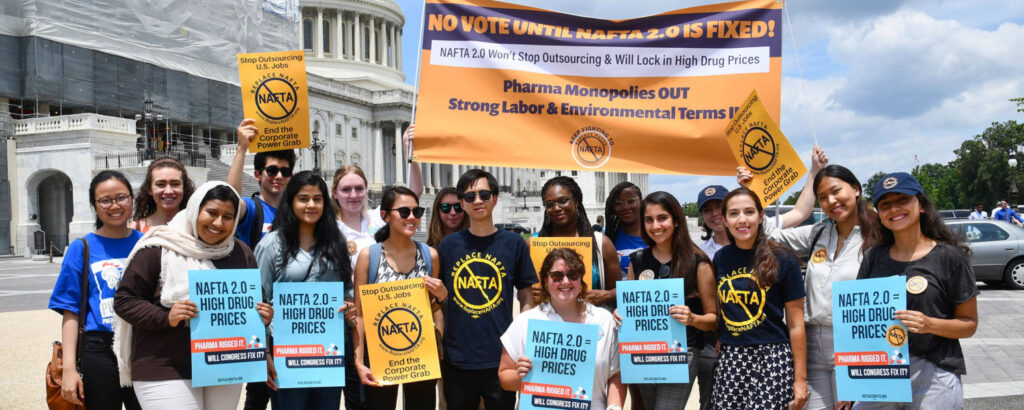
The Public Health Cost of Corporate-Driven Trade Rules
Trade agreements should not determine who lives and who dies. Yet, the current global trade system embeds intellectual property (IP) protections and other corporate giveaways in free trade agreements that do precisely that by locking in pharmaceutical monopolies that drive up drug prices, restrict access to affordable medicines, and undermine regional health security. These provisions reflect a global trade model that prioritizes corporate interests over public health.
At the heart of the global drug pricing crisis is the World Trade Organization’s (WTO) Agreement on Trade-Related Aspects of Intellectual Property Rights (TRIPS). TRIPS sets binding minimum standards for IP protection across all WTO member countries, including patents for medicines.[1] Countries must guarantee decades of patent protection for new pharmaceuticals, significantly shaping when and how lower-cost generics can enter the market. While TRIPS includes some flexibilities, such as the right to issue compulsory licenses, these tools are narrowly defined, politically sensitive, and often undermined by industry pressure.
The WTO’s prioritization of IP rights over human lives contributed to unnecessary death from the HIV/AIDS crisis in Africa, when brand-name pharmaceutical companies invoked these rules to block the sale and distribution of affordable generic versions of lifesaving medicines.[2] This tragedy should serve as a warning about the dangers of allowing trade agreements and the WTO to override public health priorities.
U.S. trade agreements, such as the United States-Mexico-Canada Agreement (USMCA), go even further. Through “TRIPS-plus” provisions, trade deals extend pharmaceutical companies’ protections beyond the requirements of TRIPS. These rules grant longer patent terms and exclusive rights over clinical trial data, impose patent linkage systems that can delay generic approvals,[3] and embed strong enforcement tools that empower corporations to protect their monopolies across borders. The result is even longer delays to access affordable medicines, restricted national policy space, and legal leverage for pharmaceutical companies to protect profits at the expense of public health.
The COVID-19 pandemic laid bare once again the consequences of these provisions. While the U.S. and Canada secured early access to vaccines and treatments, Mexico struggled with delayed shipments, limited supply, and inflated prices, and was unable to procure timely supplies of basic medical countermeasures.[4] Although Mexican manufacturers had some industrial capacity to contribute, restrictive IP rules meant that, even in the face of a global emergency, companies could not legally produce or distribute generic versions of tests, treatments, and vaccines without the express authorization from rights-holders through complex and delayed licensing arrangements. Donations of surplus doses, high-priced imports, and volatile international supply chains were no substitute for localized, sovereign production.[5]
This asymmetry of access not only prolonged the domestic crisis in Mexico but also heightened the risk of cross-border virus transmission and broader regional economic instability.[6] While there were many reasons for these disparities, including global supply chain challenges and wealth-based vaccine nationalism, the rigidity of IP rules played a key role.
With the USMCA under mandatory review in 2026, the stakes could not be higher. Policymakers face the choice of continuing to uphold a system that entrenches corporate power and weakens public health, or rewriting the terms of regional trade to serve the needs of people. This is not the time for cosmetic changes. The review is a rare opportunity to align trade policy with the realities of public health, regional resilience, and economic justice.
The Changes Needed to Remove USMCA’s Barriers to Access
The original NAFTA included various TRIPS-plus patent provisions and protections, including data exclusivity standards. But the first version of a renegotiated NAFTA that the first Trump administration sent to Congress was even more harmful, imposing strict standards to protect pharmaceutical companies from generic competition. During its negotiation, while public debate centered on tariffs and labor rules, behind the scenes, pharmaceutical giants lobbied aggressively to secure a wish list of IP protections to further extend their monopoly power.[7] After health advocates drew attention to the effects these provisions would have on access to medicines, congressional Democrats successfully used their leverage to remove some of the most extreme terms from the final agreement.[8] Had civil society and Democratic members of Congress not fought back during the original USMCA negotiations, the agreement would have contained even more noxious IP provisions.
There is still much more work to do to rebalance public health needs over corporate profits, however, as the provisions that remain continue to lock in pharmaceutical monopolies, constraining policy space and endangering the region’s public health crisis preparedness.[9] The IP terms in USMCA still disproportionately benefit Big Pharma while undermining health policy flexibility in all three countries. For the U.S., they lock in a broken pricing model that Congress is only now beginning to challenge domestically. For Mexico, these rules constrain the regulatory space needed to develop local manufacturing capacity and affordable medicine programs. And for Canada, they introduced barriers to pharmacare reforms aimed at cost containment.
The following provisions are particularly harmful for access to affordable medicines:
Patent Term Extensions (for Patent Examination Period) (Article 20.44)
The USMCA requires member states to provide extensions to patent monopolies for perceived delays in reviewing patent applications at the patent office. These extensions can significantly delay the market entry of generic competition, allowing the holders of patent monopolies to continue to charge unaffordable prices after the patent monopoly would ordinarily have run.[10] The provision provides member states with flexibility to not allow extensions for delays attributable to the patent holder or other actions not attributable to the patent authority.
Patent terms reached twenty years under WTO rules specifically because prescription drug corporations lobbied for that term, citing long review periods at patent offices as the reason. In other words, patent terms today already compensate the pharmaceutical industry for perceived long reviews. Patent term extensions beyond twenty years represent a windfall for Big Pharma.
Pharmaceutical companies have attacked Canada’s implementation of this provision, including the fact that Canada’s patent term adjustment regulations allow the adjusted term to run concurrently with any adjustments for delays in the regulatory review period.[11] Canada has, and should retain, the flexibility under the USMCA to treat these patent term adjustments concurrently. Mandating the independent treatment of all patent term adjustments would artificially extend patent monopolies, delay the entry of generic competition, and threaten access to medicines.
Patent Term Extensions (for Regulatory Review Period) (Article 20.46)
This provision requires member states to provide patent term extensions for perceived delays in market entry resulting from the marketing approval process. This requires member states to grant monopolies to pharmaceutical companies longer than the TRIPS twenty-year patent period, allowing Big Pharma to continue charging consumers high prices and block generic competition.
Pharmaceutical Data Protection/Protection of Undisclosed Test or Other Data (Market Exclusivity) (Article 20.48)
Data exclusivity rules delay generic drug approval by preventing generic manufacturers and regulatory authorities from using an originator company’s data to grant marketing approval for a generic drug. This provision allows for at least five years of market exclusivity for new pharmaceutical products in which member states shall not permit generic manufacturers to market cheaper versions of the product using the same clinical trial data.
TRIPS does not require the grant of exclusive rights over test data. Exclusivity protections reduce flexibility to introduce medicines needed to respond to health needs, including during pandemics that spread across borders.
Pharmaceutical Data Protection for New Combinations (Article 20.48.2)
Marketing exclusivity for new combinations of medicines can be a form of “evergreening”, in which a pharmaceutical company makes a change to a drug to justify additional years of monopoly control. Marketing exclusivity applies regardless of the drug’s patent status, so even off-patent medicines can block generic competition for five years if combined with a new chemical entity that has not been previously approved.
Patent Linkage (Article 20.50)
Patent linkage is a legal mechanism that can allow patent holders to block the registration of generic medicines for marketing approval. This provision requires member states to notify a patent holder before marketing a competing product and to provide an adequate opportunity for the patent holder to seek remedies. While this provision does not explicitly block registration of generic medicines, it can still delay generic market entry and facilitate patent abuse. Even spurious patents can be used to delay the introduction of generics, and the financial benefits of blocking generic competition often outweigh the risks of penalties.
Market Exclusivity and Term of Patent (Article 20.51)
This provision requires member states to treat market exclusivity and patent term independently. This prohibits countries from altering or ending market exclusivity when patent protection terminates. In cases where exclusivity outlasts patent protection, this provision extends originator companies’ monopoly control, preventing generic competition.
Enforcement Provisions
USMCA enforcement provisions further tilt the balance of power toward industry interests. Provisions such as Article 20.71 (criminal enforcement of trade secrets), 20.77 (sanctions for unauthorized disclosure by officials), 20.81(4) (enhanced damages), and 20.82 (border measures) grant pharmaceutical corporations broad tools to suppress generic competition and intimidate regulators. These mechanisms risk chilling legitimate policy actions aimed at expanding access to medicines.
Trump Doing Big Pharma’s Bidding
The Biden administration took some important initial steps to rebalance our trade policy in favor of public health by leaving IP chapters out of the trade frameworks it pursued and stepping back from the long tradition of U.S. bullying on behalf of Big Pharma. Each year, the USTR issues the Special 301 Report, a tool that “names and shames” countries seen as insufficiently protective of U.S. corporate IP based on complaints from U.S. Big Pharma corporations. The U.S. government wields this report as a soft-power mechanism to pressure countries into compliance. However, in its annual Special 301 report, Biden’s USTR removed mention of other countries’ use of compulsory licenses and explicitly recognized their right to use TRIPS flexibilities to protect public health.
But the second Trump administration has doubled down on pushing the monopoly interests of Big Pharma. In this year’s Special 301 Report, Trump’s USTR put Mexico on the “Priority Watch List,” a designation shared with only seven other countries, including China and Russia. The USTR included reference once again to compulsory licensing and cited “long-standing and significant unresolved IP concerns,” in Mexico, many of which are directly linked to compliance with USMCA pharmaceutical-related IP provisions.
Two weeks later, Trump issued an executive order on “Most-Favored-Nation” Drug Pricing,[12] which falsely blamed foreign price controls for high U.S. drug costs,[13] ignoring that countries like Mexico pay less because they regulate monopoly pricing. The order instructed trade officials to pressure foreign governments to raise drug prices to match U.S. levels under the guise of fairness, further entrenching corporate interests as a central pillar of U.S. trade diplomacy. It also falsely claimed that raising prices abroad would help American patients, contradicting both economic evidence and public opinion.
As Mexico continues to be scolded for not protecting monopoly rights more aggressively, U.S. patients continue to face rising drug costs, and Mexico’s population is still reeling from the consequences of being denied equitable access during the last health emergency.
Policy Recommendations
When trade agreements restrict countries’ policy space to respond to emergencies, regulate monopolies, or ensure affordability and supply chain resilience, they weaken our collective security. The COVID-19 pandemic revealed these vulnerabilities in stark terms. Without reform, the next crisis will once again expose the fragility of a trade system built to protect monopolies over human lives. Policymakers must:
Fix the USMCA
The statutorily mandated review of the USMCA provides an important opportunity to correct course so that U.S. trade policy no longer serves as a vehicle for rent-seeking by pharmaceutical monopolies at the expense of public health. Removing the intellectual property chapter entirely would be the most effective answer. Decisions regarding the balance between the rights of patent holders and the right to public health should be made through democratic policymaking, not through international trade agreements negotiated in secret.
If the intellectual property chapter remains in the agreement, the following rules must be eliminated through renegotiation or implementing legislation, as they serve no public interest purpose and function primarily to delay generic competition:
- Eliminate patent term extensions. Patent term extensions grant corporations additional years of monopoly beyond the TRIPS 20-year term. These rules inflate prices and delay access to generic medications.
- Remove provisions that grant additional monopolies through data and market exclusivity. Data exclusivity creates barriers to generic competition even in the absence of valid patents. This is especially dangerous during pandemics. U.S. trade policy should never prevent countries from utilizing existing clinical trial data to authorize the production of generics in emergencies.
- Eliminate patent linkage. Requiring governments to notify patent holders before marketing a competing product so that the patent holder can first seek remedies can lead to further delays in generics entry into the market, allowing for continued de facto monopolies.
- Eliminate TRIPS-plus enforcement provisions. Giving companies expanded remedies beyond the generous infringement remedies they already have is imbalanced and unfair.
Respect Existing Flexibilities
Countries have the right under the WTO TRIPS agreement to issue compulsory licenses and pursue public health safeguards. Trade agreements and U.S. policy must not impose additional constraints or retaliate—formally or informally—against governments that exercise these rights. The U.S. should commit not to challenge, pressure, or penalize countries for using TRIPS-compliant licensing. This includes rejecting efforts to include retaliatory provisions in trade agreements or threaten “Special 301” downgrades based on such actions.
Strengthen Regional Health Security Through Knowledge and Technology Transfer
Rather than enforcing rigid IP protections, the U.S. should invest in partnerships that promote regional co-production of medical countermeasures. Sharing manufacturing know-how and technology with trusted partners, such as Mexico, would reduce overreliance on distant suppliers and support faster, more coordinated responses to future health emergencies. The U.S. has extraordinary capabilities to support technology transfer and authority under existing law to do so. The U.S. government has traditionally supported many of the world’s leading research programs and can make information, training, and technology available to the betterment of the world.
[1] WTO, Pharmaceutical patents and the TRIPS Agreement, https://www.wto.org/english/tratop_e/trips_e/pharma_ato186_e.htm
[2] Oxfam, South Africa vs. the Drug Giants A Challenge to Affordable Medicines, (Feb. 2001), https://oxfamilibrary.openrepository.com/bitstream/handle/10546/620381/bn-access-to-medicines-south-africa-010201-en.pdf?sequence=1&isAllowed=y
[3] COFECE. https://www.cofece.mx/wp-content/uploads/2017/11/Studies-drugmarkets_vF-BAJA.pdf (Mexico’s Federal Economic Competition Commission found that generic drugs entered the market on average two years after patent expiration [longer than in the US and EU]. The study noted that the patent linkage system encourages legal disputes and abuse by patent holders seeking to delay competition).
[4] See, ‘It’s not fair.’ Mexico will file complaint at UN over unequal vaccine distribution, CNN, (Feb. 26, 2021), https://www.cnn.com/2021/02/16/americas/mexico-un-unequal-vaccine-distribution-intl
[5] Public Citizen, Mexico Vaccine Donations No Substitute for Increased Manufacturing, (Mar. 18, 2021),
[6] Jo Walker, Nathan D. Grubaugh, Gregg Gonsalves, Virginia Pitzer, & Zain Rivzi, One Million and Counting: Estimates of Deaths in the United States from Ancestral SARS-CoV-2 and Variants, (June 2, 2022), https://www.medrxiv.org/content/10.1101/2022.05.31.22275835v1 (tracking the amount of U.S. COVID deaths from variants, variants which may have been prevented by wider vaccine access).
[7] See, https://www.axios.com/2019/02/10/republcians-lobbying-nafta-replacement-usmca; https://www.statnews.com/2018/10/23/phrma-on-track-to-spend-a-record-sum-on-lobbying-this-year/
[8] Public Citizen published a guide in 2019 comparing NAFTA provisions with the proposed USMCA text to highlight the most harmful additions, including 10 years of data exclusivity for biologic medicines. This progress must be preserved in renegotiations of the USMCA text. See, Burcu Kilic, NAFTA 2.0, (Jan. 21, 2019), https://www.citizen.org/wp-content/uploads/nafta-2.0-pharmaceutical-related-patent-provisions.pdf and https://www.citizen.org/article/comparingnafta-side-by-side/; See also, , https://larson.house.gov/sites/evosubsites/larson.house.gov/files/Improvements%20to%20the%20USMCA.pdf
[9] Mariana Lopez, COVID-19 Vaccine Access vs. WTO Protections for Pharma, Public Citizen (Nov. 1, 2020), https://www.citizen.org/article/acceso-a-vacuna-de-covid-19-v-protecciones-comerciales-de-trump-para-farmaceuticas/.
[10] Australian Government Productivity Commission, Inquiry Report No. 78 on Intellectual Property Arrangements 18 (Sep. 23, 2016), https://www.pc.gov.au/inquiries/completed/intellectual-property/report/intellectual-property.pdf (finding that patent term extensions “have proven largely illusory, resulting in a costly policy placebo. Poor targeting means that more than half of new chemical entities approved for sale in Australia enjoy an extension in patent term, and consumers and governments face higher prices for medicines”).
[11] See PHARMACEUTICAL RESEARCH AND MANUFACTURERS OF AMERICA (PhRMA) SPECIAL 301 SUBMISSION 2025, at 80, https://www.regulations.gov/comment/USTR-2024-0023-0028.
[12] Public Citizen, Don’t be Fooled by Trump’s “Most-Favored Nation” Executive Order, (May 12, 2025),
https://www.citizen.org/article/dont-be-fooled-by-trumps-most-favored-nation-executive-order/
[13] Public Citizen, Raising Prescription Drug Prices Abroad Will Not Lower Prices in the U.S., (June 17, 2025), https://www.citizen.org/article/raising-prescription-drug-prices-abroad-will-not-lower-prices-in-the-u-s/