U.S. Prepares to Auction Off the Deep Sea, Despite Shaky Finances and Irreversible Risks
With a lease sale set for November 19 off American Samoa, the administration is moving ahead on mining that experts say is not economically viable and would be devastating to marine ecology.
By Mekedas Belayneh and Lois Parshley
The United States is set to auction its first ever offshore mineral leases, opening up 31 million acres off the coast of American Samoa to deep sea mining. Although the Samoan government banned the extraction of minerals from the seabed in 2024, the auction area lies beyond those boundaries, in waters under U.S. federal jurisdiction.
The deep ocean floor there contains small, rock-like nodules rich in metals such as iron, cobalt, manganese, nickel and copper, which are valuable for use in batteries and other electronics. The largest concentration of these nodules is found in the Pacific Ocean’s Clarion-Clipperton Zone, a vast region stretching between Hawaii and Mexico. Their extraction has raised international concerns about damage to these marine ecosystems, potentially reshaping a largely unexplored part of the ocean, disrupting marine food webs and threatening commercial fisheries.
The International Seabed Authority is still negotiating rules for deep sea mining in international waters, while more than 30 countries have called for a moratorium until the risks are better understood. Nevertheless, following a 2025 executive order from President Trump promoting deep-sea mining, the Interior Department’s Marine Minerals Administration is moving forward this week. Secretary Doug Burgum created the new office this summer, merging two offices whose responsibilities had been separated to ensure safety and regulatory enforcement after the 2010 Deepwater Horizon disaster.
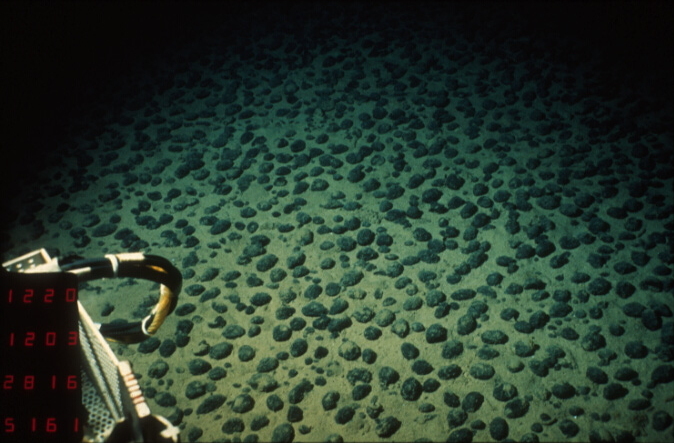
The sale will be an oral auction for two leases, each with a 20-year primary term and a minimum bonus bid of $3 million. The proposal has drawn opposition from American Samoa, where local opponents have questioned who will benefit from the leases, arguing that Samoa will bear the environmental and economic risks without any guaranteed revenue, or meaningful local input. “Our ocean sustains our food, our economy, and our identity,” wrote Sabrina Suluaʻi Mahuka, the founder of a local non-profit. “As Pacific peoples, we have witnessed the consequences when outside interests treat islands as mere extraction zones.”
Several companies have collapsed pursuing deep-sea mining, given the enormous capital requirements. Despite this, several companies with ties to the Trump administration—The Metals Company and Odyssey Marine Exploration—have seen stock prices soar for speculative projects after the president’s executive order. Michael Hess, son of Trump donor John Hess, joined The Metals Company’s board after his firm contributed $10 million to a $37 million financing round. A separate investment vehicle controlled by his parents contributed another $10 million. The company projects a rate of return from deep sea mining of between 28 percent and 36 percent, though most experts say the industry is currently neither technically nor economically feasible.
The company’s finances don’t leave much room for failure. It had only $3.5 million in the bank prior to Trump’s return to office, and has faced litigation over its financial disclosures. A shareholder class action lawsuit and an SEC allegation were recently dismissed, while a separate investor lawsuit over contractual claims remains pending.
The greatest cost of this gamble would not fall on its investors but ocean ecosystems. Scientists have recently discovered that deep-sea nodules produce “dark oxygen” through electrical charges, suggesting that removing them could eliminate a hidden source of oxygen for life on the seafloor. Little is known about deep-sea species, but they live in complete darkness, and roughly 80 percent of them create their own light through bioluminescence, like the anglerfish.
The production plans involve ships tethered to massive vacuum-like machines, which would suck up the seafloor and spew out the “waste,” including animals, flora, and sediment. Because of this, the International Union for Conservation of Nature has called for a moratorium on deep-sea mining, citing the biodiversity loss that extraction would inevitably cause. Major battery and EV manufacturers, BMW, Volvo, Samsung and Google, have also called for a moratorium on deep sea mining. Oceans lawyer Duncan Currie told Congress in 2025 that “irreversible damage is almost certainly imposed” on deep-sea habitats, and a test site from the 1970s still shows impacts.
Sediment plumes could disrupt food chains well beyond mining sites, with knock-on effects for fisheries like tuna and the communities that rely on them. Mining also strips the sediment layer where carbon is stored, potentially reducing the ocean’s ability to act as a carbon sink and adding to climate change.
This week, a federal court in Hawai’i ruled that the Trump administration violated the Endangered Species Act in its effort to lease the ocean off American Samoa. The U.S. District Court Judge found that the National Marine Fisheries Service failed to adequately evaluate the potential effects of mining on endangered species like sea turtles before concluding the sale was not likely to harm protected species. The decision could also affect other pending offshore mineral leasing proposals, including areas along the Commonwealth of the Northern Mariana Islands and Guam, Virginia, and Alaska. As of November 18, the Interior Department’s website continued to list the scheduled auction date.
The potential consequences of allowing deep sea mining stretch beyond just ocean ecosystems. Indigenous leaders in American Samoa and other U.S. Pacific territories have also rejected the idea that the U.S. should be able to unilaterally approve deep sea projects, arguing that decisions about the Pacific should be made with the people who live there. The November 19 lease sale marks a major step in the Trump administration’s push to open the deep ocean to mining. It is also a test of whether residents of U.S. territories have a meaningful say in decisions affecting their future.