TCEQ 2025: A Year-in-Review of the ‘Reluctant Regulator’
By Kathryn Guerra
 For communities across Texas, 2025 was another year of engaging with the Texas Commission on Environmental Quality (TCEQ) to address pressing environmental and health concerns, with limited success. The agency largely ignored and dismissed public input, making public participation a bureaucratic box the TCEQ checks off before issuing a rubber stamp.
In 2025, the agency struggled to respond promptly to environmental complaints and process its extensive backlog of enforcement cases. The TCEQ started the calendar year with a backlog of 1,432 cases and ended it with only 39 fewer. The backlog will take 35 years to resolve at that rate, not including any new enforcement cases. The problem is almost entirely of the agency’s own making – a failed enforcement policy among many that continue to erode public confidence in the agency.
Our TCEQ Watchdog Campaign summarizes the agency’s 2025 progress and shortcomings and outlines what it hopes to see in 2026.
Agency Leadership and Staffing Changes
The agency experienced several significant leadership changes last year:
- Brooke Paup was appointed Chair in January
- Tonya Miller, who succeeded former Commissioner Bobby Janecka, was appointed in October
- Kristi Mills-Jurach took over as the TCEQ director of compliance
Both Paup and Miller accepted invitations to meet with us but declined to identify their agency priorities when asked.
Investigations and Enforcement
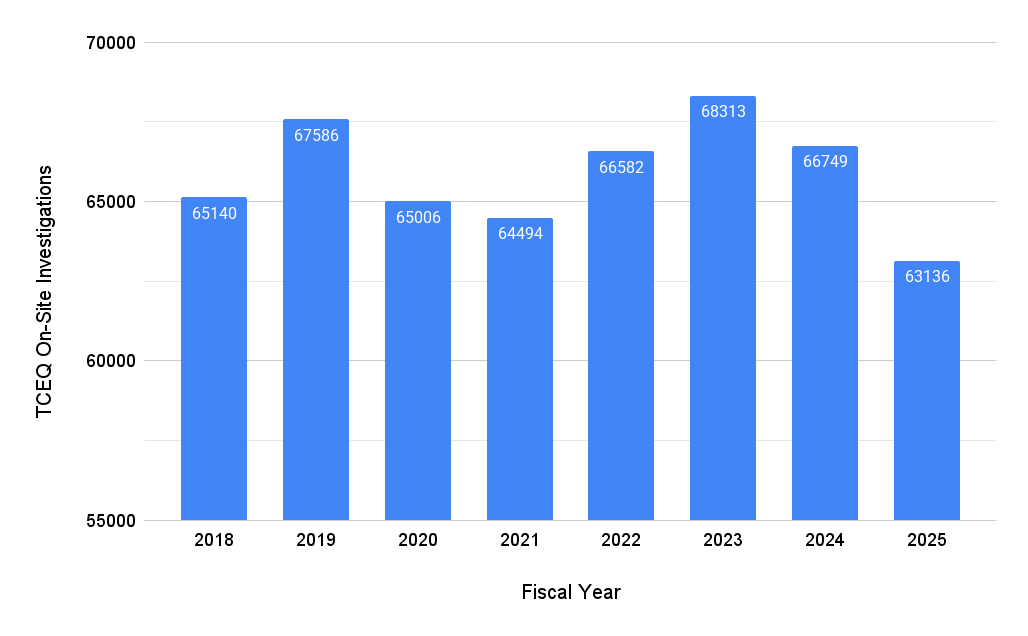
We’ve covered the TCEQ’s weak enforcement policies at length, but new data highlights those concerns. During the 2025 fiscal year, the TCEQ conducted the fewest on-site investigations the agency has reported in eight years, including years when the COVID-19 pandemic made in-person investigations challenging. The number of 2025 investigations was 3,600 fewer than in 2024 and 5,200 fewer than in 2023.
Table 1: TCEQ On-Site Investigations by Fiscal Year
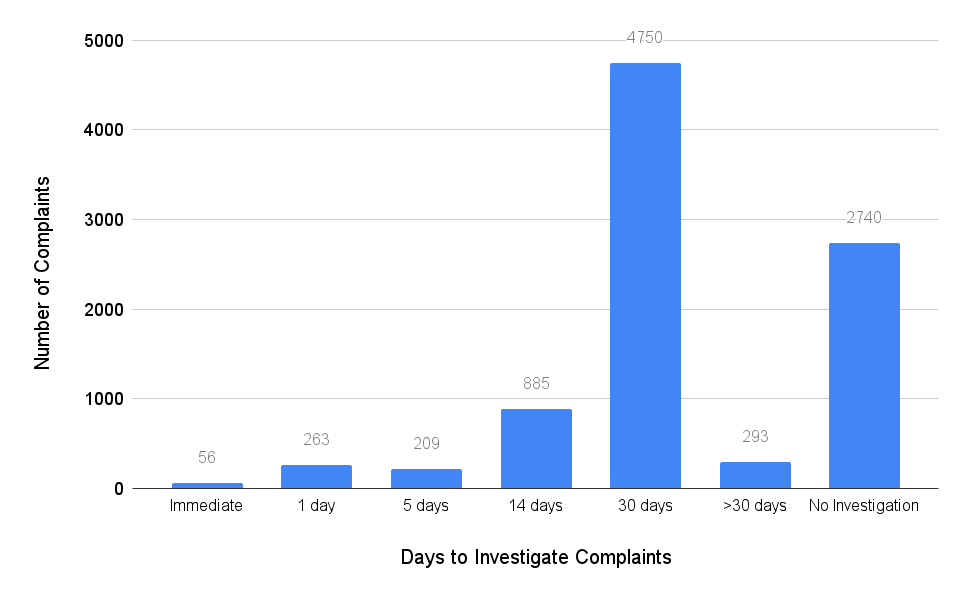
 Despite forgoing several thousand investigations, the agency’s response to reported environmental concerns remained significantly delayed, receiving 9,200 complaints. Of those, investigators responded to just 300 (3%) within one day. It took the agency two weeks to investigate nearly 900 complaints (10%), and the remaining 5,000 (54%) took at least 30 days to investigate. The agency closed more than 2,700 complaints (30%) without investigating them.
Table 2: 2025 TCEQ Complaint Response Times
 TCEQ issued just 1,170 enforcement actions in 2025. The agency’s Annual Enforcement Report states that it aims to issue at least 1,000 administrative orders each year and reports that it “consistently meets” that goal. There are 450,000 regulated entities in the state, according to TCEQ’s Sunset Advisory Commission report. This means that less than a third of a percent of all polluters in Texas received any formal enforcement action.
Another issue plaguing the TCEQ is its extensive enforcement case backlog. The TCEQ started the year with a backlog of 1,432 cases and resolved only 39. Agency enforcement staff disclosed during a public meeting last year that it had recently ended its long-standing practice of arbitrarily delaying enforcement cases for years to process them in batches, creating the complex backlog the agency is now struggling to work through. In September, commissioners approved 10 years of enforcement actions against a chemical manufacturing plant in Brazoria County under a single agreed order. The agency called it an “expedited” settlement and gave the polluter a $450,000 penalty discount.
Unfortunately for communities and the environment, approving an agreed order does not guarantee compliance. Compliance deadlines are not imposed immediately when a more serious enforcement-level violation is found. TCEQ reported that, during fiscal year 2024, the average time from initiation to completion of an enforcement action was 528 days. Deadlines are set for 30 to 45 days after this 1.5-year-long enforcement process, following a polluter’s agreement to the agency’s proposed legal terms to resolve the case, and after the agency’s commissioners vote to approve. However, our review found many proposed agreed orders that delayed TCEQ’s process from investigation to commission approval by several years. This included violations for operating without a permit. Instead of shutting these facilities down, the TCEQ simply included terms for lawful operation in the enforcement order until the facility obtained a permit, if it ever did, thereby de facto authorizing it and circumventing public notice and participation before construction.
Public Participation in Permitting
Contested Case Hearings are a public participation tool that allows communities to request that an Administrative Law Judge (ALJ) from the State Office of Administrative Hearings (SOAH) hear the facts and recommend approval or denial of a permit after the TCEQ’s Executive Director approves the draft permit. Contested Case Hearings are legal proceedings that often require residents to retain legal counsel, pay for expert testimony, and commit significant time. Despite this, TCEQ commissioners are not legally obligated to accept the ALJ’s recommendation at the conclusion of the process.
Being granted a hearing can be challenging. TCEQ commissioners considered 52 requests for Contested Case Hearings in 2025, denying 40% of them. The agency’s Office of Public Interest Counsel (OPIC), an office within the agency created to represent the public’s interest in environmental permitting and enforcement matters, recommended that commissioners grant Contested Case Hearings for 62% of the denied requests – meaning TCEQ commissioners ignored the recommendation to protect the public’s interest more often than not.
Commissioners frequently denied hearing requestor(s) affected party status, the legal status required to obtain a Contested Case Hearing. To determine if a person is an affected party, commissioners consider issues including the requestor’s distance to the permitted facility, the likely impact of the regulated activity on the health, safety, and use of property of the person, and the likely impact of the regulated activity on the use of the impacted natural resource.
Once an ALJ hears the case, it sends commissioners a Proposal for Decision (PFD) containing its findings and a recommendation to approve or deny. In 2025, commissioners received 18 PFDs from hearings granted in 2023 and 2024. Commissioners adopted all ALJ recommendations except one, which they approved without consensus from the ALJ or OPIC. Only one of those proposals was to deny a permit, which commissioners agreed to do.
Rulemakings
The TCEQ’s website lists 35 rule projects from last year, including rulemakings, non-rule projects, permit amendments or renewals, State Implementation Plan (SIP) revisions, and committee appointments.
The most significant rulemakings last year were initiated to comply with the TCEQ Sunset Bill, SB 1397. In 2023, the Sunset Advisory Commission labeled the TCEQ a “reluctant regulator” and found that “TCEQ’s policies and processes lack full transparency and opportunities for meaningful public input, generating distrust and confusion among members of the public”, among other issues. The legislature mandated 19 regulatory changes. In January 2025, TCEQ reported to the legislature that it had fully implemented 11 of those regulatory changes. Eight statutory provisions and one management action remained outstanding.
Section 185 Fees
The TCEQ adopted this rule program that failed its primary goal of improving air quality by using an accounting trick to forgive an obligation Congress imposed on industry and instead passing those costs on to Texans. Section 185 of the Clean Air Act is triggered when a region in severe or extreme nonattainment fails to meet federal deadlines to reduce air pollution. If air quality does not improve, Section 185 requires states to impose a financial penalty on certain large stationary sources that emit pollutants contributing to non-attainment. In Texas, for example, the Dallas-Fort Worth and Houston-Galveston-Brazoria areas are in non-attainment for ozone.
Commissioners approved using funds the agency already collects through the Texas Emissions Reduction Plan (TERP), which is funded by Texas drivers through vehicle title and registration fees, rather than creating a fund that polluters would pay into. The agency will count public dollars toward the debt owed by private industry, significantly reducing or eliminating that debt. This failed rulemaking is yet another example of how the agency serves industry interests. The TCEQ estimated that, as intended, the implementation of the Section 185 fee program would have generated over $200 million annually for the Houston-Galveston-Brazoria and Dallas-Fort Worth areas.
Compliance History Rule Revision
The Sunset Bill mandated revising the agency’s Compliance History program. Before the bill, TCEQ had largely relied on compliance history rankings to expedite permits and reduce penalties for polluters. The Sunset bill directed TCEQ to “review and update the agency’s compliance history rating formula to ensure it accurately reflects a regulated entity’s record of violations.” It also required TCEQ to “specifically consider major, moderate, and repeat occurrences of the same minor violations when calculating compliance history ratings.” (Emphasis added.) But the TCEQ proposed and adopted a final rule that largely excluded Notices of Violation and relied primarily on history formulas based on formal enforcement actions.
Despite numerous environmental advocacy organizations submitting relevant comments that would have further strengthened the agency’s Compliance History rule revision and aligned it with the Sunset Advisory Commission’s recommendation, the agency rejected or refuted all public comments. Instead, the agency amended the rule from its original draft to accommodate industry, which has proposed making it easier to avoid repeat-violator status. Those revisions came after the comment period ended, without any further opportunity for the public to have input considered in any meaningful way.
Additionally, the Sunset Commission quantified the percentage of “unclassified” regulated entities during FY 2021 as 89%. During the question-and-answer session at the August 2025 public hearing, TCEQ staff stated that the agency has no intention of reducing the number of uninspected or unclassified entities because the Sunset Commission did not recommend such a reduction, and the legislature did not mandate it. The lack of a mandate to adopt procedures that meet the goals of TCEQ and the Sunset Commission does not constitute a prohibition on adopting such procedures. The Compliance History program cannot function as intended – to make appropriate regulatory decisions based on compliance status – unless the TCEQ proactively and directly addresses the volume of facilities listed as “unclassified”.
Sunset Public Participation
The TCEQ also adopted its Sunset-required public participation rulemaking by rejecting all public participation. The agency opened a rulemaking project in June, ostensibly to increase public participation, but despite the bill’s clear intent, the final rule fell short of the reforms lawmakers and the state’s Sunset Advisory Commission envisioned. Despite the agency’s claims that it “engaged in an extended stakeholder process for this rulemaking” and that it had “received robust participation from stakeholders during this process, receiving many comments and suggestions for changes to improve the agency’s public participation rules,” staff inexplicably refuted and dismissed all 50 comments submitted by community and environmental advocates.
Instead, the TCEQ modified this rule proposal after it was presented to the public, based on more than 30 comments from corporate interest groups. TCEQ accepted 82% of the comments submitted by the Texas Industry Project, resulting in rule changes that reduced public notice, transparency, and clarity in the agency’s processes.
CBP Protectiveness Review
SB 763 (89R) required the TCEQ to conduct a protectiveness review at least once every 8 years for concrete batch plant standard permits, and we supported both the bill and the rulemaking. SB 2351, which pertains to concrete batch plant standard permits and those facilities with enhanced controls, was adopted in the same rulemaking and includes provisions that establish criteria where the commission may require operators of permanent facilities who have not begun construction under a prior permit and have requested an extension to update their construction plans to meet the new standards of the amended standard permit.
We noted in our comments on this rulemaking that the bill’s author, State Representative Armando Walle, told the agency that the legislature intended to require TCEQ to enforce this provision, rather than to make it permissive. We agreed that the TCEQ has clear authority to require compliance and believe that if a facility has not begun construction, the agency should require it to meet any revised standards. Like Representative Walle, we strongly believe that requiring permit holders to comply with the most up-to-date standards would better protect the health of Texas communities. We also urged TCEQ to incorporate this requirement into its rulemaking, but it rejected our comments, along with those of Rep. Walle and other advocates.
Community Victories
Two communities secured victories in their fights against the TCEQ, despite the agency’s efforts to prioritize industry and ignore residents’ needs.
A community in Houston celebrated a win late in the year with a legal victory on a challenge of the agency’s rulemaking for concrete batch plants, which the TCEQ designed to grant polluters a 10-year grace period to comply with more stringent air quality standards. The court found that the TCEQ’s proposed pollution grace period was “arbitrary and capricious and violated Texas law requiring the agency to protect human health”. TCEQ was instructed to revise the rule to fix the compliance delay.
In Bastrop County, a community fighting years-long nuisance odors from a Darling Ingredients chicken-rendering facility organized to pressure the TCEQ to issue follow-up enforcement action, submitting more than 1,400 air quality complaints. The agency initially said it wouldn’t pursue additional enforcement while the facility’s ongoing enforcement case was pending. Community pressure forced the TCEQ to find the facility in violation of its agreed order for emitting dangerous levels of H2S and nuisance odors, and to issue new violations for dumping wastewater into a creek. The matter was referred to the Attorney General in December. A lawsuit has been filed seeking both temporary and permanent injunctions and financial penalties.
TCEQ Funding and Staffing
A report by the Environmental Integrity Project, titled State of Decline, indicates that lawmakers cut TCEQ funding by 33% over the past 5 years, adjusted for inflation, while the number of polluting facilities the agency regulates has grown. These cuts have significantly impacted the agency’s effectiveness. Ultimately, communities pay for these cuts with their health.
In the agency’s 2026-27 appropriations request, TCEQ asked for an additional $60 million in funding, telling the legislature, “Without additional resources, it will be difficult for TCEQ to meet the increasing demands placed on the agency, including emerging technologies, and maintain state primacy for many of its programs,” It went on to say, “If TCEQ does not have sufficient resources, permit timeframes will lag and TCEQ’s ability to timely respond to the needs of regulated entities and the public will be hindered.” It received just $47 million of the $60 million requested.
At the same time, proposed cuts to federal funding for the Environmental Protection Agency would shift the financial burden of environmental regulation to states.
Although the TCEQ has also struggled to retain employees, staffing levels have improved since 2022, when the agency reported 427 vacancies (15% of its approved full-time positions) and an 18% turnover rate. The agency reported in 2024 that it still has more than 150 full-time vacancies. According to a TCEQ request to the legislature last year, 30% of its workforce has less than two years of experience, and half have less than five years.
While Public Citizen has historically supported increased funding for the agency, we remain unconvinced that even a fully funded agency would be responsive to the needs of communities, given the agency’s pattern of ignoring residents’ voices in permitting, rulemaking, and policymaking. To address those issues, the agency needs a holistic shift in its leadership’s approach, and the legislature must mandate clear reforms that the agency’s leadership cannot misinterpret or misapply.
Looking Forward: TCEQ in 2026
OPIC Rulemaking
A rulemaking to review the duties of the Office of Public Interest Counsel (OPIC) was discussed at the November Commissioners’ Agenda meeting during a review of OPIC’s annual report. Commissioners directed TCEQ’s general counsel to work with OPIC and the agency’s executive director to redefine performance measures and initiate a rulemaking to define OPIC’s role better.
While we welcome public input on OPIC’s role, functions, and annual performance metrics to improve the office’s effectiveness for communities, this review must conclude with OPIC maintaining independence. The agency will further erode what little public trust it has left if it implements changes at OPIC that make it less effective or less independent. The review of OPIC’s duties is the first in more than a decade. There is no timeline for when the review will begin or conclude. OPIC’s director, Garrett Arthur, resigned in early 2026, and interim director David Timberger will manage the division until commissioners appoint a new director. Timberger is the deputy director for the agency’s General Law division in the Office of Legal Services.
Supplemental Environmental Projects (SEP) Program
The SEP program is a bright spot among the TCEQ’s few meaningful opportunities to make positive changes in impacted communities. Penalties paid by polluters can be remitted directly to SEP program recipients, such as school districts, nonprofits, and local governments, to fund approved environmental projects. Examples of fundable projects include clean school buses, air-quality monitors, and energy-efficient building retrofits. The list of projects eligible for funding from the consistent stream of money polluters pay is relatively small, given Texas’s size. Our goal for 2026 is to increase the number of small school districts and non-profits approved to receive funding through the SEP Program, especially those closest to and most affected by large pollution sources in the heavily-industrial port communities.
Regulation of Data Centers and Other Resource-Intensive Industrial Activities
The state is experiencing a data center boom that poses long-term risks to water and air quality. Research by Public Citizen shows that across the state, the TCEQ is permitting massive multi-megawatt data centers with co-located gas plants with low-level air quality permit by rule (PBR) authorizations that do not have any requirements for public notice or public participation, only to then allow operators to seek large-scale Federal Operating Permits later to authorize hundreds (or millions) of tons of emissions per year after the facility is built. PBR authorizations are used by small sources of air pollution, such as autobody shops, and do not include site-specific operating terms to limit operating hours or pollution. TCEQ must require data center operators to accurately quantify all facility emissions and obtain the appropriate individual or case-by-case NSR permit that requires public participation before the facility is built, so nearby residents have time to provide meaningful input.
Looking Ahead: 2026 Biennial Report to the Legislature
TCEQ’s Biennial Report to the Legislature is published every December before a regular legislative session, as required by the Texas Water Code. We look forward to the 2-year look back in December 2026 at the TCEQ’s performance, which includes a review of all agency programs, enforcement levels, permit timeframes and progress implementing the statutory requirements of the Sunset Bill, and to the opportunity to engage with legislators about how TCEQ’s weak policies harm communities across Texas.
Kathryn Guerra is the director of Public Citizen’s TCEQ Watchdog Campaign