Trump Administration Signals Intent to Bypass Congress, Siphon Funding Away From Low- and Middle-income Countries
By Public Citizen, Partners In Health, PAI
Budget Document Signals Trump Administration Intent to Withhold Congressional Family Planning Appropriations and Siphon Funding Away From Low- and Middle-income Countries and into U.S. Companies
Following the decimation of U.S. global health assistance in 2025, the Trump administration is restructuring health funding through rapid rampdowns in U.S. assistance via three- to five-year bilateral health funding agreements (MOUs) in some countries and shorter term funding in others. In 2026, Congress rejected the administration’s proposed 60% cuts to global health funding. But it is still unclear how the Trump administration will spend Congressionally-mandated health funds. The preliminary fiscal year (FY) 2026 653(a) allocation report, a budget planning document sent by the Department of State to Congress in May 2026, shows the Trump administration’s near-term plans to spend global health funds across the full breadth of countries receiving U.S. support.
Key findings:
- The administration plans to withhold or divert effectively all international family planning and reproductive health (FP/RH) funds that Congress appropriated for this purpose. Across three FP/RH funding streams, the administration plans to set aside or repurpose: 1) nearly $524 million appropriated for bilateral global health programs, 2) $48.5 million for bilateral programs in strategically important countries “to support exigent energy security needs” and 3) $32.5 million originally appropriated for UNFPA and then further diverted from bilateral FP/RH spending requirements. This amounts to nearly $605 million out of $607.5 million in international family planning and reproductive health funds appropriated;
- The FY 2026 653(a) report shows dramatic increases in newer funding streams, including $888 million in an “innovation fund.” This is nearly 15 times as much as it planned to spend on the new fund in the prior year. At the same time, the administration cuts country-level funding by $1.66 billion compared to pre-Trump funding amounts, meaning the administration is moving nearly a billion dollars from low- and middle-income countries to a fund benefiting U.S. corporations;
- Of 79 countries listed in the FY 2024 or FY 2026 report, 69 have their funding reduced compared to pre-Trump (FY 2024) spending plans. Among these 69 countries, eight countries’ funding has been cut to zero.[1] In absolute dollars, the countries with the largest reductions compared to FY 2024 allocation plans are: South Africa ($437.1 million decrease), Tanzania ($137.4M), Zimbabwe ($126.1M), Zambia ($65.9M), Mozambique ($65.6M), Bangladesh ($54.1M), and Malawi ($51.9M).
The administration signals it will withhold or divert family planning and reproductive health funds.
For the past 16 fiscal years, Congress has appropriated $607.5 million for international FP/RH annually: $575 million for bilateral programs and $32.5 million for the U.S. contribution to the UN Population Fund (UNFPA). In FY 2026, $523.95 million of the bilateral funds went to the Global Health Programs account, and $51.05 million is under National Security Investment Programs (NSIP). The NSIP funding (previously provided through the Economic Support Fund for USAID) is for countries considered to be politically and strategically important.[2]
The 653(a) report has kept $523.95 million in family planning and reproductive health (FP/RH) funds unallocated. The report includes a line item titled “To Be Programmed,” which is exactly equal to the FY 2026 appropriation for bilateral FP/RH under the Global Health Programs account (figure 1). Office of Management and Budget (OMB) apportionment documents list the same amount as “unallocated,” suggesting the funds may not be available for the agency to spend.
Figure 1.

FY 2026 653(a) report, Global Health Programs
A longstanding provision included in annual foreign assistance appropriations legislation requires that any funding withheld from UNFPA “due to the operation of any provision of law, shall be transferred” to the Global Health Programs account for bilateral “family planning, maternal, and reproductive health activities,” subject to notification of the appropriations committees. (emphasis added). In May 2025, Secretary Rubio invoked the Kemp-Kasten amendment to deny future funding to UNFPA. The State Department acknowledges in the footnote to the 653(a) table its obligation to reprogram the withheld UNFPA funds but asserts that it will “determine appropriate, Administration-aligned uses for the funds,” despite the clear language of the statute on the types of activities for which the funds shall be used (figure 2).
Figure 2.
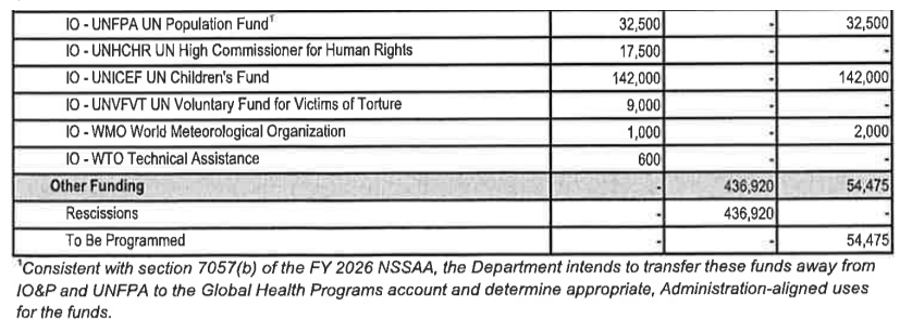
FY 2026 653(a) report, International Organizations & Programs
The administration has already demonstrated an unwillingness to adhere to congressional appropriations with prior year’s funding: In 2025, the administration clawed back $500 million in FY 2025 FP/RH global health funding as part of a nearly $9 billion rescissions package. An additional $23.95 million was included in the $1.35 billion pulled away from health programming and set aside for USAID “closeout costs,” and thus also remains unspent on international FP/RH as Congress originally intended.
The administration has signaled that it does not intend to spend FP/RH funds, despite Congressional mandates. In a FY 2026 budget hearing, Secretary of State Marco Rubio stated that “there is no plan to spend that money, we’re not going to be in that business globally … we’re not going to do it.” None of the administration’s bilateral health funding MOUs include family planning or sexual and reproductive health services. The administration used the same “To Be Programmed” tag in the FY 2025 653(a) report for the global health money that the administration held for “closeout costs,” rather than spending on health initiatives.[3]
In a separate action, on September 30, 2026, the State Department notified Congress that it intends to reallocate “up to $125 million” from the NSIP account, including $48.5 million in family planning funds.[4] The administration claims that shifting these funds from the world’s most vulnerable families is necessary to unleash “America’s energy abundance,” stating that “[r]esources are required to facilitate the development of secure and diversified energy resources and infrastructure to ensure partners have [access to] U.S.-backed energy sources.” While the notification does not clearly specify what the funds will be used for, the capital could potentially underwrite fossil fuel corporations, including those with political and financial connections to the Trump administration and the President’s family and associates.
Given the 653(a) set aside and the administration’s previous statements, it appears likely that the administration – under the leadership of Russell Vought, Office of Management and Budget Director – will attempt to unilaterally cut these funds, which expire on September 30, 2027, either by redirecting them or perhaps via another illegal “pocket rescission,” in which the President requests to claw back funds within 45 days of the expiration date, effectively causing funds to expire before they can be used for new obligations. Senate Appropriations Committee Chair Susan Collins and the Government Accountability Office have both deemed this action illegal and in violation of the Impoundment Control Act and the overarching constitutional framework. Moreover, between the 653(a) report set aside of FP/RH funds in the Global Health Programs account, the NSIP account reallocation for “energy security,” and the administration’s statement that UNFPA funds will be reprogrammed for “Administration-aligned uses,” effectively all of the international FP/RH funds that Congress appropriated in FY 2026 would be withheld or diverted from the use Congress originally intended.[5]
The reduction in FP/RH is also evident in obligations. International FP/RH makes up just 5-6% of all U.S. global health funding, and until recently the U.S. was one of the largest purchasers and distributors of contraceptives internationally. Total funding has been consistently around $600 million since FY 2011, including funding for both bilateral programs and UNFPA. Obligations have been more or less consistent as well, hovering around $500–600 million for bilateral programs over the eight years preceding the second Trump administration. During FY 2023, net obligations for bilateral family planning programs were $559.5 million.[6] No global health funding was obligated for FP/RH during FY 2026. Much of the FY 2026 reduction in obligations is a result of the $500 million rescission of FY 2025 FP/RH funds (as funds are typically obligated the year following their appropriation — see the appendix for more information). The preliminary 653(a) report indicates that the Trump administration’s State Department is resisting any spending for FP/RH in FY 2027.
The funding cuts are just the latest part in the administration’s attack on FP/RH support.
The Trump administration has held in storage nearly $10 million worth of contraceptives purchased during the previous administration for use in low-income countries, reportedly planning to burn them. Despite reported offers from the United Nations and others to buy and distribute the supplies, the Trump administration has kept the contraceptives in a warehouse, accruing hundreds of thousands of dollars in storage costs. Some experts believe that the administration is waiting for the supplies to expire to enable them to legally incinerate the birth control commodities.
In 2026, the State Department told embassies that it would abruptly shift all U.S. funded commodity procurement to the Global Fund to Fight AIDS, Tuberculosis and Malaria’s online platform, wambo.org. The Trump administration had earlier canceled the supply chain and procurement contract for family planning commodities. Wambo does not carry FP/RH commodities, with the exception of condoms which are listed as a part of their HIV/AIDS work, and does not replace the forecasting, warehousing and shipping, or country level distribution to health facilities previously carried out under the Chemonics-hosted global supply chain operation funded through USAID. After the initial news about the transition and vocal civil society opposition, some parts of the Chemonics contract were extended to 2027. Reproductive health commodities are not included in the extension. The sudden loss of this supply chain work has enormous implications for FP/RH, disrupting access to bulk procurement that dramatically lowers commodity costs and to services that ensure commodities are purchased in appropriate numbers and delivered to remote areas. While countries attempt to increase their domestic spending on health to meet the requirements of their bilateral MOUs with the United States, which do not include funding for FP/RH, they may simultaneously face higher commodity costs and a loss of forecasting tools, delivery trucks, and warehouses that would help those commodities make it to the people who need them.
The Trump administration’s actions are especially concerning given that the United States had been the largest donor to FP/RH, and other donor governments have also reduced their overseas development and humanitarian investments. Trump’s cuts have already led to significant disruptions. In 2024, U.S. international FP/RH funding was estimated to enable contraceptive services for 47.6 million women and couples, avert 17.1 million unintended pregnancies, and avert 5.2 million unsafe abortions; the withdrawal of this support could lead to an estimated 34,000 maternal deaths.
When it was originally reported that the State Department intended to burn nearly $10 million worth of birth control commodities, Ranking Member of the Senate Foreign Relations Committee, Senator Shaheen, and Senator Murkowski wrote to Secretary Rubio to object to the destruction and urge the State Department to reverse course. Shortly thereafter, the Democratic ranking members on the foreign aid authorizing and appropriations committees introduced the Saving Lives and Taxpayer Dollars Act in both the Senate (S. 2252) and the House (H.R. 4516), which seeks to prevent the destruction of U.S. government-purchase commodities, including food and medical supplies, unless every effort is made to sell, donate, or transfer the commodities before their expiration. More impactful in the short run, the FY 2026 appropriations bill includes a statutory notification requirement that the Secretary of State “promptly inform” the appropriations committees of the diversion or destruction of U.S. government assistance, including the type and amount of assistance, the circumstance of the occurrence, and the State Department’s response. Senators Shaheen and Murkowski later co-authored a letter to Secretary Rubio, urging him to release already purchased commodities in light of the Ebola outbreak. In the House, over 70 Members of Congress also sent a letter to Secretary of State Marco Rubio seeking answers about the status of contraceptive commodities. In numerous hearings, Members of Congress have sought answers on the record from Secretary Rubio, OMB Director Vought, and other senior administration officials.
Congress has taken steps to ensure funding is spent as appropriated. The bipartisan and bicameral FY 2026 funding bill included numerous guardrails intended to make certain that the administration reports regularly to Congress on planned and actual spending, delivers on reports required by Congress and posts those reports publicly, and more. These mechanisms were established to prevent the State Department from making unilateral decisions and to ensure that money is spent as Congress intended, and to maintain Congress’ power of the purse.
The administration plans to move $888 million into a fund for U.S. companies while it cuts country funding by $1.66 billion.
The administration plans to divert funding that formerly supported country health programs in part toward U.S. companies.[7] The FY 2026 653(a) report shows dramatic increases in certain funding streams, including $888 million in an “innovation fund.”[8] This is nearly 15 times as much as it planned to spend on the new fund from the FY 2025 set-aside level ($60 million). At the same time, the administration cuts country-level funding by $1.66 billion compared to pre-Trump (FY 2024) funding amounts.
The administration claims that it is building a more efficient system by shifting funds away from international non-profit organizations and giving partner-country health ministries more agency. The innovation fund does the opposite. It strips money from HIV, TB, malaria, and maternal and child health programs in low-income countries and redirects it to a growing pool that the State Department controls. This could scale by billions of dollars in the coming years, as the administration plans to reduce funding annually under its bilateral MOUs. For example, across 18 publicly available MOUs, the administration plans to cut funding to countries by 59% in 2030 compared to pre-2025 spending.
Additionally, the State Department has not clarified how it will solicit and review awards under the fund. Typically, USAID grants and contracts were awarded through a competitive process that required potential recipients to respond to detailed requests for proposals that were reviewed by a panel of experts. In contrast, the State Department is increasingly relying on non-competitive sole-source awards, reportedly including its $150 million grant to Zipline, a for-profit drone delivery company. Without a transparent and accountable process for new awards, funding could flow not to those with the best proposals for public health impact, but to those with direct, private access to the administration. Moreover, new technologies are not a substitute for direct support to countries. The administration’s cuts to country level programming takes away resources that support local health systems and services that deliver care and stop diseases from spreading. The simultaneous increase in resources for the innovation fund prioritizes commercial interests over these fundamental global health objectives.
The FY 2026 National Security, Department of State and Related Programs (NSRP) appropriations bill included report language that requires the Secretary of State to brief Congress on its activities related to the innovation fund. However, far more is needed to protect health programs and hold the administration accountable for its funding decisions. For example, Congress could require that at least 70% of global health funds flow to country-level programming, competitive requests for proposals for prospective contracts and grants, and public-facing transparency for the innovation fund’s award review process and award terms.
Most countries take sharp funding cuts.
The FY 2026 653(a) report shows sharp reductions in planned U.S. assistance across most countries compared to the allocation plans in the FY 2024 report. Sixty-nine of the 79 countries listed in the FY 2024 or FY 2026 report have their funding reduced (table 1).
Table 1. FY 2024 vs. FY 2026 653(a) report allocations for select countries, by absolute dollar change
| Country | FY 2024 653(a) | FY 2026 653(a) | Delta ($) | Delta (%) |
| South Africa | 437.1M | 0.0M | -437.1M | -100.00% |
| Tanzania | 475.2M | 337.9M | -137.4M | -28.90% |
| Zimbabwe* | 218.3M | 92.2M | -126.1M | -57.78% |
| Zambia | 399.4M | 333.5M | -65.9M | -16.50% |
| Mozambique | 484.8M | 419.2M | -65.6M | -13.54% |
| Bangladesh | 80.0M | 25.9M | -54.1M | -67.58% |
| Malawi | 234.8M | 182.9M | -51.9M | -22.11% |
| Nepal | 47.9M | 10.6M | -37.2M | -77.76% |
| Yemen | 16.5M | 0.0M | -16.5M | -100.00% |
| Afghanistan | 14.0M | 0.0M | -14.0M | -100.00% |
| The Gambia | 4.5M | 0.0M | -4.5M | -100.00% |
| Timor-Leste | 2.3M | 0.0M | -2.3M | -100.00% |
| Sudan | 2.0M | 0.0M | -2.0M | -100.00% |
| Kenya | 393.3M | 391.3M | -2.0M | -0.50% |
| Somalia | 1.5M | 0.0M | -1.5M | -100.00% |
| Central African Republic | 1.0M | 0.0M | -1.0M | -100.00% |
| Ethiopia | 240.6M | 275.0M | 34.4M | 14.29% |
| Nigeria | 486.1M | 523.8M | 37.7M | 7.74% |
| All Other Countries (61) | 2,947.1M | 2,238.7M | -708.5M | -24.04% |
| Total (All 79 Countries) | 6,486.4M | 4,831.0M | -1,655.5M | -25.52% |
FY 2024 653(a) report and FY 2026 653(a) report, Global Health Programs. For a comparison across all countries listed in the FY 2024 or FY 2026 report, click here. *Funding figures for Zimbabwe, along with at least one other country not shown in the table (Namibia), may now be out of date. The administration ended global health funding for Zimbabwe on September 30, 2026, suggesting the allocation would now be zero if the situation remains unchanged.
Eight countries (South Africa, Yemen, Afghanistan, The Gambia, Timor-Leste, Sudan, Somalia, and Central African Republic) have had their funding cut to zero since 2024, collectively amounting to a $478.8 million cut compared to FY 2024 levels. South Africa has the largest reduction in absolute dollars compared to FY 2024 planned allocations. At least two additional countries (Zimbabwe and Namibia)[9] are facing a loss of U.S. government funding after negotiations for their bilateral health agreements broke down. So while the FY 2026 653(a) report shows planned allocations to these countries, more recent State Department figures may reflect a planned funding loss. Including these two countries would raise the cut from zeroed out countries to $761.5 million compared to FY 2024. A third country (Ghana) rejected the Trump administration’s initial MOU proposal, but is reportedly considering a revised agreement. The outcome of consultations between the U.S. and Ghana could similarly change allocation plans in the 653(a) report.
Sixty-one countries that were slated to continue receiving U.S. funds at the time the 653(a) was produced (including Zimbabwe, Ghana, and Namibia) face cuts. Among these countries, cuts range from 77.8% (Nepal) to 0.5% (Kenya) compared to pre-Trump planned allocations. In absolute dollars, Tanzania ($137.4 million decrease), Zimbabwe ($126.1M), Zambia ($65.9M), Mozambique ($65.6M), Bangladesh ($54.1M), and Malawi ($51.9M) have the largest reductions compared to prior levels.
While the administration claims that its country-level funding changes were based on need,[10] it has not provided a transparent explanation for its decisions. In reality, the rapid decrease in U.S. government funding will be difficult for many partner countries to replace given already strained fiscal space, which threatens their ability to meet health goals. In several countries, cuts to U.S. health funding reflect the failures of the administration’s secretive process and transactional approach. The administration announced a phaseout of HIV funding in South Africa after the government did not meet its unrelated political demands. The administration proposed unreasonable data sharing terms, excluded experts and affected communities from the negotiation process, and mishandled the diplomatic talks, which contributed to the breakdown or stalling of new multi-year health funding agreements in Zimbabwe, Ghana, and Namibia. While Zambia ultimately signed a health funding agreement with the United States, the Trump administration attempted to use needed health funding to extract mining concessions and threatened to withdraw funds if its demands were not granted, jeopardizing the agreement during the negotiation process.
Rather than prioritizing health and continuity of care in partner countries, the administration is withdrawing U.S. funding at great risk to health. The country examples below illustrate the health impacts following the 2025 aid cuts and the potential impacts of further planned reductions if the Trump administration does not reverse course.
Zimbabwe
The Trump administration’s aid cuts and stop work orders in 2025 disrupted health services in Zimbabwe, reversing progress against infectious diseases including malaria and HIV. In the first three months of 2026, malaria cases and deaths in the country nearly doubled those reported one year earlier and nearly quadrupled the cases reported in the same period in 2024. U.S. HIV expenditures in the country dropped by 30% between 2024 and 2025, with the greatest cuts to prevention funding. As of September 30, 2026, the Trump administration has fully cut funding that supported 8,300 health care workers; laboratory services to detect disease threats in 1,900 health facilities; HIV, tuberculosis, and malaria testing and treatment services and commodities. Loss of HIV programs that detect disease, connect people with treatment and prevention, and prevent transmission from mothers to babies could lead to an estimated 75,000 new HIV infections in just one year if funding is not replaced.
South Africa
South Africa has the highest HIV burden globally, with 7.8 million people living with HIV. With sustained investment from the country and international partners, South Africa has made significant strides against HIV, reducing new infections by 37% over ten years. New HIV infections have declined among young people, a group U.S. prevention funding has prioritized (particularly adolescent girls and young women, who account for a disproportionate share of new infections in this age group). U.S. government funding has also supported community-based programs that keep people in treatment and data collection and surveillance systems to keep track of patients and progress against the epidemic. Trump’s cuts put this progress at risk. Modeling studies estimate the total loss of U.S. HIV funding could lead to as many as 296,000 new HIV infections and 65,000 AIDS-related deaths by 2028.
Nepal
In Nepal, more than $40 million in annual U.S. global health funding previously helped prevent child and maternal death and combat infectious diseases. Trump’s stop work orders and cuts in 2025 disrupted community health worker programs that connected HIV-positive individuals with treatment, heightening fears that the country, which has seen new HIV infections decline nearly 80% since 2010, could see cases rise, particularly among vulnerable groups. Health workers report that cuts to nutrition and reproductive outreach programs have led to increases in complications during pregnancy and deaths during delivery. In one village where U.S. government-supported programs helped reduce neonatal deaths to zero, deaths have begun to rise.
Afghanistan
Before the Trump administration took office in 2025, U.S. global health funding in Afghanistan trained health workers to prevent mothers and newborns from dying and helped detect and manage tuberculosis in the fragile setting. Since the 2025 cuts to global health and humanitarian programs, nearly 800 health clinics have reportedly closed, leaving six million people without access to local medical services. Loss of health services following the 2025 cuts have been linked with at least 161 deaths in the country, including 80 maternal deaths, 30 newborn or fetal deaths, 14 child deaths, and 26 adult deaths.
Appendix: Additional background about the 653(a) report
In May 2026, the Department of State transmitted to Congress its plans for spending global health funds appropriated in FY 2026. The planning document, called the FY 2026 Section 653(a) Allocation Report, is a statutorily mandated notification of the administration’s intended foreign assistance allocations to countries and international organizations. OMB reviews and clears the document before it is transmitted to Congress. Typically, the 653(a) report aligns closely with information provided by the State Department in an appendix to its Congressional Budget Justification, which details the administration’s plan to spend requested global health funds, broken down by country and disease area.[11] The administration did not produce this document for FY 2026 and Congress’ final appropriation differed significantly from the President’s budget request. The 653(a) report therefore provides a valuable indication about how the administration plans to allocate appropriated funds.
The report is not usually made public. The FY 2025 653(a) was made public through court filings.[12]
As the 653(a) report is a “preview” meant for discussion between Congress and foreign assistance agencies, the amounts shown are subject to change throughout the year. For this reason, previous 653(a) reports show estimated allocations alongside actual funds committed.[13] The FY 2026 653(a) report transmitted to Congress in May did not yet include “actuals” for FY 2025.
“FY 20XX 653(a)” refers to the fiscal year of the appropriation, not the fiscal year in which the funding is usually obligated (committed for spending on health programs). Typically, global health funds are obligated during the fiscal year following their appropriation (FY 20XX+1) and expended in the year following that (FY 20XX+2). For example, FY 2024 appropriations are largely obligated in FY 2025 and expended through programs in FY 2026.
The table below shows how each year’s 653(a) allocation report generally maps to the years in which funding is obligated and expended, and to the corresponding years in the administration’s bilateral health MOUs.
| 653(a) Title / Year of Appropriation | Primary Year of Obligation | Primary Year of Expenditure | MOU Years (tracks to expenditure) |
| FY 2024 | FY 2025 | FY 2026 | April-September of Year 1 (2026) |
| FY 2025 | FY 2026 | FY 2027 | October-December of Year 1 (2026)
January – September of Year 2 (2027) |
| FY 2026 | FY 2027 | FY 2028 | October-December of Year 2 (2027)
January – September of Year 3 (2028) |
| FY 2027 | FY 2028 | FY 2029 | October-December of Year 3 (2028)
January – September of Year 4 (2029) |
| FY 2028 | FY 2029 | FY 2030 | October-December of Year 4 (2029)
January – September of Year 5 (2030) |
| FY 2029 | FY 2030 | FY 2031 | October-December of Year 5 (2030) |
References
[1] South Africa, Yemen, Afghanistan, The Gambia, Timor-Leste, Sudan, Somalia, and Central African Republic. In two additional countries (Zimbabwe and Namibia), negotiations with the U.S. over renewed health funding have broken down, resulting in plans to stop U.S. funding. This suggests that more recent allocation plans could show funding for these countries reduced to zero.
[2] For example, Afghanistan and Jordan have received ESF funds for FP/RH activities in recent years.
[3] Global Health Council, et al., v. Donald J. Trump, et al., at 127, https://storage.courtlistener.com/recap/gov.uscourts.dcd.277336/gov.uscourts.dcd.277336.212.2_1.pdf (showing the FY 2025 653(a) report). The original amount of this set aside was $2 billion, but it was later reduced to $1.35 billion after $650 million in global health security funds were spent on the Ebola response, See,https://docs.google.com/document/d/10M3od8DgPAgF59oDZXbxwYBJ4GWvezCXbSztaqpIW8k/edit?tab=t.0
[4] Secretary of State Marco Rubio invoked authority under section 451of the Foreign Assistance Act Of 1961 and section 7034(f) of the FY 2026 National Security, Department of State, and Related Programs Appropriations Act to authorize the use of up to $125 million for “unanticipated contingencies.”
[5] In FY 2026, Congress appropriated $51.05 million in the NSIP account for bilateral FP/RH.
[6] PIH analysis of foreignassistance.gov obligations data tagged with the U.S. Sector Name of “Family Planning and Reproductive Health.” This includes bilateral funding provided under the Global Health Programs and National Security Investment Programs accounts.
[7] This is a key aim of the administration’s “America First Global Health Strategy,” which states that Congressional appropriations that “exceed funds needed to support bilateral agreements” will be spent in part on technologies made by American companies. See, America First Global Health Strategy, at 32, https://www.state.gov/wp-content/uploads/2025/09/America-First-Global-Health-Strategy-Report.pdf; State Department materials describe the innovation fund as supporting “American-led research, market-shaping and other dynamic advancements in global health”).
[8] Other line items added in the FY 2025 and FY 2026 653(a) reports include “Faith Initiatives,” which appears to refer to the $250 million grant under the administration’s “Faith and Community Initiative,” and the “Transition Reserve Fund,” which is allotted about $325.9 million in the FY 2026 report. A pre-existing line item, “HQ Supported Mechanisms” is allotted about $616 million in the FY 2026 report (an increase of about $434 million from the prior year). It is not clear what the new funding allotted to the transition reserve fund and HQ supported mechanisms lines will be used for.
[9] The U.S. government plans to stop funding HIV programs in Namibia after this fiscal year (FY 2027), during which it will provide $45 million for the country. As funds expended during fiscal year 2027 typically come from earlier appropriations, the planned FY 2027 funding would likely not come from FY 2026 appropriations. Following the announcement of the U.S. government’s phase out of support, the money allotted to Namibia in the 653(a) report for FY 2026 appropriations may no longer reflect the administration’s latest plans.
[10] Adam Taylor, Trump’s deals in Africa could cut U.S. health aid by more than half, analysis shows, The Washington Post (Aug. 31, 2026), https://www.washingtonpost.com/national-security/2026/08/30/trumps-deals-africa-could-cut-us-health-aid-by-more-than-half-analysis-shows/ (“the differing rates were based on a model that evaluated a range of factors, including the wealth of a country and its vulnerability to diseases, and analyses that looked at ‘the level of instability and conflict in a country.’”).
[11] See, e.g., Congressional Budget Justification Foreign Operations Appendix 2, Fiscal Year 2025, https://2021-2025.state.gov/wp-content/uploads/2024/04/State-and-USAID-Appendix-2.pdf (showing “FY 2023 and FY 2025 Category and Program Summary” and “Operating Unit by Objective, Program Area, and Account FY 2023 Estimate and FY 2025 Request).
[12] See, Global Health Council, et al., v. Donald J. Trump, et al., at 123-127, https://storage.courtlistener.com/recap/gov.uscourts.dcd.277336/gov.uscourts.dcd.277336.212.2_1.pdf (showing 653(a) global health programs account allocation plans).
[13] For example, the FY 2025 653(a) shows that the Philippines FY 2024 653(a) GHP allocation estimate and FY 2024 actual were $43m and $293m, respectively.