
The Secretive Commodity Traders Profiting from Trump’s Critical Minerals Agenda
The little-known firms selling the world’s oil and minerals have gained unprecedented White House access—and a front-row seat to the administration’s deals.
By By Mekedas Belayneh and Lois Parshley
Key Findings
- Commodity traders have spent over $2.75 million on lobbying in the first half of 2026, much of it through lobbying firms with direct ties to the administration, including the current White House Chief of Staff. That’s up from only $320,000 in lobbying in 2024.
- A former Mercuria executive now oversees the agency behind Project Vault, a $12 billion federal critical minerals stockpile that counts the company among its suppliers. The program’s conflict-of-interest rules and criteria remain largely opaque.
- Mercuria and many of the same trading houses are positioned to potentially pocket hundreds of millions after the administration chose to loan, rather than sell, oil from the Strategic Petroleum Reserve.
Source: Senate LDA filings;Public Citizen research.
On a gray day last November, a group of Swiss business leaders filed into the Oval Office for a meeting with President Donald Trump. Among them was Daniel Jaeggi, the president of the commodity trader Mercuria, a company that has stayed largely out of public view, despite playing a key role in many of the administration’s recent mining and energy deals.
Commodity traders’ influence is often hidden in plain sight. Historically, they rarely own the mines, oil fields, or refineries that produce the resources they distribute. Instead, trading houses operate in the middle of the global supply chain—arranging financing, logistics, storage, shipping, and marketing for some of the world’s most valuable raw materials. That’s no longer the full picture. In recent years, some of the largest trading houses have expanded beyond trading and logistics into owning or investing in physical infrastructure, including storage facilities, terminals, refineries, and, in some cases, mines and oil fields. Their ability to move commodities quickly across borders has made them indispensable partners for the Trump administration’s critical minerals agenda which has directed government-backed deals towards companies with close ties to the administration.
A month before last year’s White House meeting, Mercuria and Partners Group, Jaeggi’s private equity business, had announced more than $6 billion in investments in U.S. energy projects in a bid to lower tariffs on goods imported from Switzerland. Their sit-down with Trump appeared to build on that effort. The meeting drew little attention in the American press. In Switzerland, however, it quickly became a political firestorm. Reports that the delegation’s access to Trump had been accompanied by gifts—including a Rolex watch and a gold bar—led leaders of the Swiss Green Party to question whether the country’s anti-bribery laws had been violated. Ten days later, tariffs on Swiss goods were cut from 39 percent to 15 percent.
Companies like Mercuria have enjoyed an extraordinary level of access to this White House. According to Bloomberg, in his first year back in office, President Trump had more meetings with trading firms’ executives than all the presidents in the preceding quarter-century combined. After donating $100k to Trump’s second-term inauguration, Mercuria quickly gained a prominent role in the new administration’s mineral policies, and has been in regular conversation with the White House. Its 2026 lobbying disclosures, for example, indicate that the company directly lobbied the Executive Office of the President.
Table 1: Commodity Traders’ Federal Lobbying Spending (2023–2026) |
||||
| Company | 2023 Spending | 2024 Spending | 2025 Spending | 2026 Spending (through 2Q) |
| Gunvor Group | $0 | $0 | $1,350,000 | $1,630,000 |
| Mercuria Energy Group | $0 | $0 | $28,388 | $330,000 |
| Traxys | $0 | $0 | $390,000 | $310,000 |
| Hartree Partners | $0 | $0 | $0 | $160,000 |
| Vitol Group | $240,000 | $320,000 | $410,000 | $160,000 |
| Trafigura Group | $0 | $0 | $160,000 | $160,000 |
| Total Lobbying Spending | $240,000 | $320,000 | $2,338,388 | $2,750,000 |
Source: Senate Lobbying Disclosures
The relationship with the Trump administration has been mutually beneficial. Commodity traders profit from volatility, and Trump’s geopolitical brinkmanship has repeatedly created it. Before Trump’s return to office, the industry was in a slump. In 2024, global commodity trader Trafigura reported its weakest profits in years, with its net income falling 60 percent as pandemic-era supply disruptions eased and markets recovered.
The reversal after Trump returned to office was swift. Firms that were struggling rebounded sharply as trading opportunities expanded under a new wave of foreign conflict. Trafigura recovered from its downturn, while Mercuria’s profits climbed 122 percent over 2025 levels during the first nine months of this year, putting the company on track for one of its strongest annual returns. The company “profit[s] from the risk we take in price arbitrage,” Jaeggi told Swiss publication Die Volkswirtschaft. (Mercuria did not answer Public Citizen’s questions for comment). Last year, the company made $1.3 billion in profits, while paying only $1 million dollars in taxes.
But the relationship extends beyond simply profiting from market turmoil. Under Trump, these firms have moved closer to policymaking itself, gaining inside access to government decisionmakers who influence the markets they trade in. As a result, trading houses like Mercuria are positioned not only to capitalize on geopolitical shocks, but also to observe—and potentially anticipate—major, market-changing policy moves.
The Traders at the Table
White House access became even more consequential as the administration began reshaping global commodity flows through its haphazard foreign policy. During the U.S. standoff with Iran over the closure of the Strait of Hormuz in February, Treasury Secretary Scott Bessent brought executives from commodity trading houses Mercuria, Trafigura, and Vitol into the White House to discuss measures to stabilize energy markets. After the administration’s military operations and takeover in Venezuela in January, the White House met with representatives from Trafigura and Vitol to discuss the marketing of Venezuelan oil.
The Trump administration called on both companies to export oil out of the country, while Mercuria and brokerage firm Heeney Capital were given offtake agreements–a binding contract that secures advance purchases–of bulk Venezuelan commodities like gold. Mercuria’s managing director of investments attended the ceremony at the presidential Miraflores Palace in Caracas, with the Trump administration delegation that brokered unlocking $2.2 billion in mineral exports for Mercuria. These trading houses became among the first beneficiaries of the U.S. invasion, gaining access to previously sanctioned oil and minerals. As a result, this month Mercuria is preparing to ship roughly 30 million pounds of aluminum to the United States, the first such shipment in years.
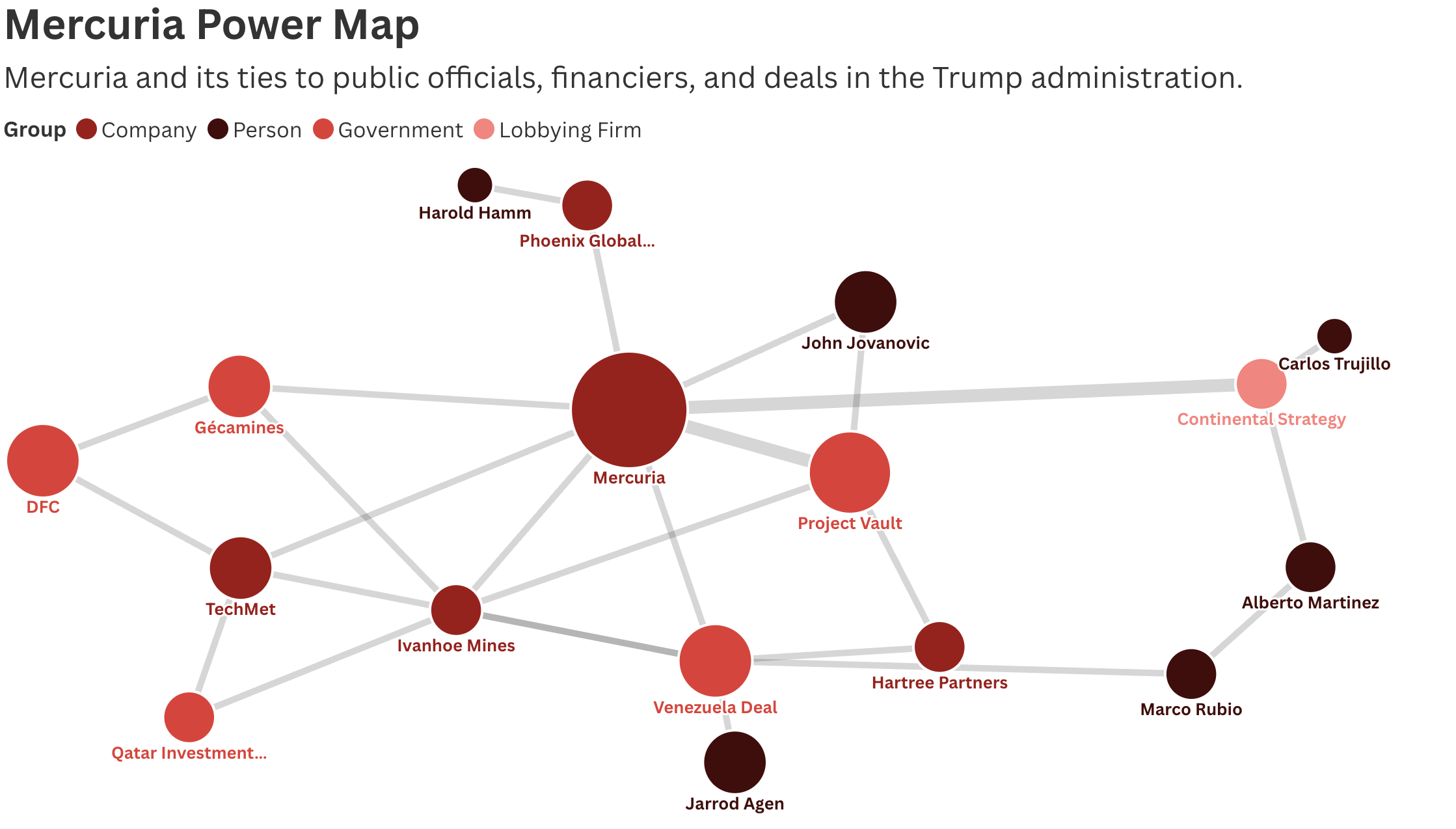
The Venezuela agreements also helped accelerate consolidation among the industry. Eni, the largest Italian oil and gas company, participated in the White House’s January discussions on marketing Venezuelan oil. In the months that followed the invasion, Eni entered into a joint venture with Mercuria to combine their global energy trading operations. The partnership concentrates influence among a small group of firms with privileged access to the administration’s resource deals. More recently, Harold Hamm, an oil tycoon who advises Trump and donated over $2 million to his campaign, emerged as another beneficiary of the president’s push into Venezuela. In September, Hamm’s company Continental Resources announced a partnership with Venezuela’s state-owned petroleum company to develop an oil field in the Orinoco Belt. The same network of players tied to the administration has also expanded into Argentina: In August, Continental Resources purchased a 50 percent stake in Phoenix Global Resources, an oil and gas firm also controlled by Mercuria, to boost oil and gas production in Vaca Muerta. The deal came months after the Trump administration intervened in Argentina’s currency markets in support of President Javier Milei.
At the same time, Mercuria and other commodity traders have positioned themselves to advance the administration’s agenda. As the Trump administration sought to reduce Chinese and Russian influence over strategic supply chains, Mercuria ended a decade of Chinese state-linked ownership, shortly before receiving a lucrative federal contract. In February 2026, the company bought back the roughly 5 percent stake that the Chinese state-backed fund CNIC Corp had held. The buyback came several weeks before the Trump administration selected Mercuria, along with Trafigura, Vitol, and others, to participate in a Strategic Petroleum Reserve (SPR) release after its attack on Iran.
Following the closure of the Strait of Hormuz, the DOE released 172 million barrels from the SPR. Unlike past SPR releases, this involved loaning the companies oil from the reserve, meaning these traders can sell at current high prices and potentially buy cheaper oil to replace it later. According to energy consultant Hal Connolly, if oil prices drop to pre-Iran-war levels, Trafigura, Vitol, and Mercuria stand to make $453 million, $101 million, and $56 million, respectively.
Mercuria’s Man on the Inside
The Trump administration is now building a new federal program for critical minerals, modeled off of the Strategic Petroleum Reserve. Commodity traders, including Mercuria, are also at the center of its operation.
Mercuria’s former investment director, John Jovanovic, currently serves as president and chairman of the U.S. Export-Import Bank (EXIM). Under his leadership, EXIM launched Project Vault, the administration’s flagship critical minerals initiative, to build a strategic reserve of materials. It is providing a $10 billion loan, the largest in the bank’s history, to purchase and store critical minerals through an independently governed public-private partnership named VaultCo. The federal financing will be supplemented with $2 billion of private investment. The bank has said it has two existing financing programs and a private-sector structure. It has not been authorized by Congress to manage government-owned reserves.
The reserve is intended to give manufacturers access to critical minerals during periods of market disruption, but the details on who will be able to draw from the stockpile, and on what terms, has not been disclosed. Jovanovic’s former employer was one of three companies initially selected to develop the stockpile this spring, along with Traxys and Hartree Partners. EXIM did not disclose the criteria it used in the closed-door selection process. In April, Jovanovic told Bloomberg that Mercuria helped “brainstorm and stress test” Project Vault during its development.
As a procurement partner, Mercuria will help determine where these minerals are sourced, when they are purchased and sold, and which suppliers gain access to the federally backed market. Although the initiative claims to support U.S. production and shift away from Chinese resources, no sourcing requirements have been disclosed. During a recent Council on Foreign Relations event, Jovanovic described the role of traders like Mercuria in Project Vault as “a very boring, vanilla business. ” VaultCo is structured as a pooled supply buffer, meaning commodities from multiple suppliers are aggregated rather than kept as individual traders’ inventories. The structure is intended to prevent market manipulation, such as traders using the stockpile to unload older inventory at inflated prices. But the administration’s trade policies have made the routine commodity transactions envisioned under Project Vault potentially lucrative for traders.
Haphazard tariffs and foreign policy have widened price gaps between U.S. and international markets, creating unique arbitrage opportunities. The clearest example is copper. In summer 2025, Trump announced a 50 percent tariff on copper imports, minutes after copper prices surged 13 percent. As a result, U.S. copper prices on New York’s COMEX exchange traded roughly 28 percent higher than prices on the London Metal Exchange, factoring in a tariff premium. For traders who could source copper globally and deliver it to the United States to capture the difference, that price gap was a boon. Commodity traders moved large quantities of copper into the United States to capture the spread. According to the Financial Times, Mercuria shipped in nearly 488 million pounds of copper last summer before tariffs went into effect.
The episode illustrates the commercial opportunity created when government policy causes commodity prices to diverge across markets. A trader that can source metal internationally, arrange transportation and sell it into the higher-priced U.S. market is positioned to profit from the gap. Mercuria is positioned to do exactly that with Project Vault.
Mercuria’s reach extends beyond trading the metal. The company is also helping build the overseas supply chains that the administration wants to redirect toward the United States through offtake agreements.
One partner is Robert Friedland, who stood alongside President Trump at the launch of Project Vault. He was an outspoken supporter of the administration’s copper tariff policy. Friedland frequently posts on social media about rising copper prices and the bullish market outlook for the metal. In one X post, Friedland wrote, “Copper’s uber bull predicts new record on most-profitable-ever trade… I agree with my friend Kostas on this,” referring to Kostas Bintas, the Global Head of Metals & Minerals at Mercuria. This shoutout isn’t just friendly, Ivanhoe Mines and Mercuria are business partners in the Democratic Republic of Congo (DRC). Mercuria is working with Ivanhoe Mines to supply critical minerals from its Kipushi mine in DRC to supply Project Vault.
After decades of conflict, Rwanda and the DRC signed an agreement negotiated by the Trump administration in June 2025. Without congressional consultation or transparency, the administration secured an American right of first refusal to critical minerals from the DRC, granting the U.S. the ability to claim critical minerals from the DRC before other countries and companies. This is one of several international critical minerals trade deals by the Trump administration that are under scrutiny.
Production, meanwhile, is racing ahead. In December 2025, the U.S. International Development Finance Corporation signed a letter of interest to make an equity investment in a copper-cobalt joint venture between Gécamines and Mercuria—adding yet another layer to the company’s growing network of government-supported financial relationships. Mercuria is contracted to ship 220 million pounds of copper from the DRC’s state mining company Gécamines. This year, copper sales doubled to the U.S. and Europe from 2025.
The government support surrounding Friedland’s ventures links him to a broader network of commodity traders and public financing. Trump recently announced that EXIM is also “working to provide” Ivanhoe Electric with over $1 billion in financing for the company’s Santa Cruz copper project in Arizona. Last month, another Friedland venture, I-Pulse Inc., which develops semiconductors and pulsed-power technology, received a $250 million equity investment from the Department of Commerce’s CHIPS program. Govind Friedland, Robert Friedland’s son, also participated in Interior Secretary Doug Burgum’s visit to Venezuela.
The Access Machine
Trump has repeatedly taken direct government equity stakes in mining and tech companies. As of early September, there are at least 32 such investments to date. That approach has created apparent conflicts where the same companies stand to benefit both from Trump administration decisions and federal financing. Government equity stakes may create incentives to favor those companies when approving permits, enforcing regulations, or awarding contracts. Mercuria, for example, is now a government contractor with access to market-making information, a potential recipient of federal investment, and a firm whose former investment director leads the institution financing policy that affects its business.
Mercuria’s hired lobbying firm, Continental Strategy, has deep ties to the Trump administration. Its lobbying team includes Carlos Trujillo, the former U.S. ambassador to the Organization of American States during Trump’s first term, and Alberto Martinez, former chief of staff to Secretary of State Marco Rubio, both officials with extensive experience with the administration’s foreign policy decisions. Among Continental Strategy’s other clients are Elemental Fuels, an upstart America First Refining project backed by Trump Jr., and cryptocurrency stablecoin company Tether, whose close financial relationship with Commerce Secretary Howard Lutnick’s former firm, Cantor Fitzgerald, has drawn congressional scrutiny over potential conflicts of interest. Mercuria’s U.S. lobbying disclosures cite “license process, energy markets, and oil/mineral development projects” but do not list specific legislation or regulatory interactions.
The network of influence extends to foreign sovereign investors with their own ties to the U.S. government. Qatar Investment Authority, which has drawn scrutiny over its ties to Trump’s business and political network, is a major shareholder of TechMet, a critical minerals company also backed by a $105 million equity stake during the first Trump administration, along with an investment from the U.S. government’s International Development Finance Corporation, and $68 million from Mercuria. QIA separately acquired a $500 million equity stake in Friedland’s Ivanhoe Mines.
Mercuria’s Growing Network
Conclusion
Massive commodity trading firms, which employ thousands of traders based in Geneva Switzerland, are no longer simply facilitating the machinery of global energy markets and trade. They have become central beneficiaries of the Trump administration’s resource decisions. Commodity traders have repeatedly parlayed access to the administration into lucrative financing deals, turning federal forays in Africa and Latin America into private gains. In Trump’s chaotic critical-minerals policy, which favors short-term gains in an industry that requires long-term investment, commodity traders can prioritize speed and getting deals done ahead of transparency, accountability, and other safeguards. This offers a way to produce quick results without making the responsible investments needed to build a sustainable mining supply chain.
If taxpayer dollars are being used for private gain, the public has a right to understand who is making and benefiting from these decisions. The administration’s critical-minerals strategy increasingly relies on public financing to support private companies and projects, through funding from EXIM, OSC, and DFC. When government-backed loans, equity investments, or other forms of public capital are deployed, Congress and the public should be able to see who is receiving the money, on what terms, what obligations and safeguards apply, and how the government will protect taxpayers if projects fail or generate private gains. With the reauthorization of the EXIM Bank this year, Congress has an opportunity to establish financial guardrails for Project Vault and clarify EXIM’s authority over VaultCo to implement stronger governance structures to prevent corruption.
At a minimum, EXIM should disclose the identities and qualifications of Project Vault’s board members, including any government or commodity affiliations. The selection criteria for any private partnerships within the Vault program should be made public, along with details of its governance, including its sourcing decisions and triggers for releasing reserves. EXIM should also disclose its terms governing potential losses, including whether the bank or private partners will absorb any shortfalls. The bank should also adopt a formal conflicts-of-interest policy, including a cooling-off period barring board members from participating in decisions involving their former employers for a set number of years. Finally, there should be transparent accounting of how and when EXIM funds have been committed or disbursed, and under what conditions future funding will be released.
Currently, no public record exists to allow the public or Congress to evaluate Project Vault’s performance, risks, or safeguards against conflicts of interest. Meanwhile, vast opportunities are being handed out to trading houses, raising broader questions about whether federal policy is rewarding cronyism rather than fostering competitive markets.
Appendix: Commodity Traders Benefiting From Trump Administration
| Vitol Group · Energy & Commodity Trading | |
| Headquarters | Geneva, Switzerland |
| Access | Senior Vitol trader John Addison donated $6 million to Trump’s campaign. Addison attended the January 2026 White House meeting on Venezuela oil marketing.In 2025, Vitol spent $360k and $50k to BGR and Crossroads Strategies, respectively, for lobbying. |
| Outcomes | Vitol received one of the first U.S. Treasury licenses to import and export Venezuelan crude following the U.S. military operation that removed Nicolás Maduro. It bought Venezuelan oil from state-owned PDVSA at a steep discount of $15 below Brent benchmark, and resold it into the market at only an $8-9 discount. Also, Vitol received releases from the Strategic Petroleum Reserve, and is set to profit over $100 million if prices return to pre-Iran War levels. |
| Trafigura Group · Energy & Commodity Trading | |
| Headquarters | Geneva, Switzerland |
| Access | In 2025, Trafigura paid $160k to Ragnar Group to retain lobbyist Robert Wasinger. During Trump’s first term, Wasinger held positions in his campaign and transition team as director of Senate and gubernatorial outreach. Trafigura’s non-ferrous metals division posted record profits for its fiscal year ending September 2025. CEO Richard Holtum attended a White House meeting at the White House in January 2026. |
| Outcomes | Trafigura secured a license to lift and resell Venezuelan crude in January. Trafigura also received oil releases from the Strategic Petroleum Reserve to control prices from the Iran War; they are set to profit over $400 million if prices return to pre-Iran War levels. |
| Mercuria Energy Group · Energy & Commodity Trading | |
| Headquarters | Geneva, Switzerland |
| Access | Mercuria spent $100,000 for Trump’s 2025 inauguration. It reportedly bought back shares previously held by an entity linked to the Chinese state just in time to participate in the Strategic Petroleum Reserve releases. John Jovanovic, a previous investment director at Mercuria, was appointed as head of EXIM Bank. So far, in 2026, Mercuria has spent $330,000 on lobbying via Continental Strategy. Its lobbyists include Carlos Trujillo, former OAS ambassador, and Alberto Martinez, former chief of staff to Marco Rubio. Katie Wiles, the daughter of Trump’s chief of staff, Susie Wiles, is a partner at Continental Strategy. |
| Outcomes | Mercuria is one of the three commodity houses initially picked to run the $12 billion national strategic stockpile of critical minerals, Project Vault, funded with an EXIM bank loan. Mercuria is set to profit $56 million from SPR releases if prices reach pre-Iran War levels. After the US’s military campaign in Venezuela, Mercuria also was one of the companies that received over $2.2 billion in oil and mining contracts. |
| Traxys · Energy & Commodity Trading | |
| Headquarters | Strassen, Luxembourg |
| Lobbying | In 2025 and 2026 to date, Traxys has spent $700k on lobbying on critical minerals issues via Ballard Partners. Ballard Partners is deeply entwined with the Trump administration: Brian Ballard is a major MAGA fundraiser, and current White House chief of staff Susie Wiles previously worked as a lobbyist at Ballard Partners |
| Outcomes | Selected alongside Mercuria and Hartree Partners to help source materials for the U.S. government’s $12 billion critical-minerals stockpile Project Vault. |
| Hartree Partners · Energy & Commodities Trading | |
| Headquarters | New York, United States |
| Lobbying | In 2026 to date, Hartree spent $160k on lobbying via the Transnational Strategy Group. |
| Outcomes | Selected alongside Mercuria and Traxys to help source materials for the U.S. government’s $12 billion critical-minerals stockpile Project Vault. |
| Gunvor · Energy & Commodities Trading | |
| Headquarters | Geneva, Switzerland |
| Lobbying | One of Ballard Partners’ biggest clients so far this year has been Gunvor USA which has paid the firm $1.5 million in lobbying fees, compared with $500,000 last year. To “promote interests and transparency,” according to its lobbying disclosure, the company retained Micah Ketchel, the former chief of staff to then-U.S. Rep. Michael Waltz, now serving as U.S. ambassador to the United Nations. |
| Outcomes | Gunvor will profit $97 million from SPR releases if oil prices reach pre-Iran War levels. |