Public Citizen Testimony to the Texas House Environmental Regulation Committee Regarding the Texas Commission on Environmental Quality
To: Chairman Brooks Landgraf and the Members of the House Environmental Regulation Committee
CC: Vice Chair Rep. Claudia Ordaz, Rep. Rafael Anchía, Rep. Keith Bell, Rep. Ben Bumgarner, Rep. Penny Morales Shaw, Rep. Tom Oliverson, Rep. Ron Reyolds, and Rep. Steve Toth
From: Kathryn Guerra, [email protected]; Adrian Shelley, [email protected].
Re: Agency Oversight, the Texas Commission on Environmental Quality (TCEQ)
Dear Chairman Landgraf and Members of the Committee:
Public Citizen is a nonprofit consumer advocacy organization with over one million members and supporters (including 30,000 in Texas) that champions public interest in the halls of power. On behalf of its members and supporters in Texas, Public Citizen appreciates the opportunity to testify before this committee on the Texas Commission on Environmental Quality (TCEQ).
In 2025, Public Citizen launched the TCEQ Watchdog Campaign to hold the TCEQ accountable to Texans and build the capacity of communities to engage effectively with the agency.
This committee is charged with ensuring that the TCEQ supports economic growth in Texas while environmental safeguards remain in place. This testimony summarizes many, but not all, of the issues our campaign has identified that fail the latter part of that mission. In some instances, TCEQ has expressed a need for a legislative remedy.
Summary of TCEQ Issues and Concerns
- The TCEQ’s own data shows that the agency issues more authorizations than it can effectively investigate or enforce.
- TCEQ’s performance metrics indicate failures to enforce environmental rules and protect the air and water. This includes reaching just 42% of a goal for all Texans to breathe clean air and 54% of a goal for clean water across Texas.
- TCEQ’s response to reported environmental concerns is significantly delayed – taking between two weeks and 30 days for an initial response in 54% of 9,200 complaints.
- In 2025, the TCEQ conducted the fewest on-site investigations the agency has reported in eight years, including years when the COVID-19 pandemic made in-person investigations challenging. The number of 2025 investigations was 3,600 fewer than in 2024 and 5,200 fewer than in 2023.
- More than half of the facilities the TCEQ regulates have not been investigated once in the past 5 years.
- TCEQ issued just 1,170 enforcement actions in FY 2025. The agency regulates 834,000 entities. This means that only 0.14% of all polluters in Texas received any formal enforcement action.
- TCEQ has an extensive enforcement case backlog of more than 900 unresolved cases. While this number has decreased from 1,480 cases since the beginning of the 2025 fiscal year, TCEQ closed more than 100 cases without an agreed order, without any demonstration of compliance, and without any penalty.
- Data centers are misusing Clean Air Act permitting to circumvent public notice and public participation, and the TCEQ is letting it happen.
- TCEQ canceled two public meetings on air permits for data centers in Amarillo and San Antonio without rescheduling them and refuses to tell the public why they were canceled.
- The TCEQ has taken liberties in its implementation of required rulemakings, including the Public Participation, Compliance History and the Section 185 rules.
Public Citizen has presented this information to the TCEQ in a good-faith attempt to collaboratively address the concerns we are hearing from communities across Texas. However, agency leadership has taken very few demonstrative actions to address these issues.
The data in this testimony was published by the TCEQ in fiscal year 2025 or prior. We anticipate agency reports for fiscal year 2026 and the 2025-2026 biennium will become available in the coming weeks, and we will provide our assessment of that data prior to the start of the 90th regular legislative session.
TCEQ Annual Performance Metrics
The TCEQ sets incredibly modest goals to reduce pollution or improve air and water quality, which it often fails to meet. Conversely, the TCEQ met or exceeded most of its goals for issuing permits. TCEQ issued 8,917 new authorizations in fiscal year 2025.
Air Quality
In 2025, the TCEQ reportedly met 112% of its annual performance goal to issue state and federal New Source Review air quality permits (1.2.1 EX 1), issuing 7,855 authorizations. In addition, the agency issued nearly 600 federal operating permits (1.2.1 EX 2). But the TCEQ’s performance of its core functions – to investigate and to enforce permits and environmental rules – was mediocre.
The TCEQ’s failures translate to poor outcomes for clean air and clean water in Texas. The TCEQ has a key performance measure: the “Percent of Texans living where the air meets federal air quality standards” (1.1 OC 3). The TCEQ’s target was just 43%. It achieved 42% of that goal. This agency must take responsibility for upholding the air quality standards for the other 58% of Texans who also deserve to breathe clean air.
In 2021, the agency’s target for clean air across Texas was 100%. Over the past decade, the agency has not achieved greater than 45% of this goal for clean air. So instead of continuing to work toward actions that would help the agency meet that goal for Texans, TCEQ simply lowered the bar for itself.
Similarly, in 2025, TCEQ failed to meet another key performance measure regarding the “Percent of stationary and mobile source pollution reductions in ozone non-attainment areas” (1.1 OC 1). TCEQ had a meager 3% reduction goal. Instead, TCEQ achieved -147% of its goal, meaning air pollution increased.
The TCEQ failed its goal to conduct more than 1,000 on-road mobile source air quality assessments (1.1.1 OP 3), conducting just 360 (36%). Between 15 and 18 million people – representing well over half of the total population of Texas – live in designated federal ozone non-attainment areas, where the air quality fails to meet National Ambient Air Quality Standards. On-road mobile source air quality assessments are one of the main tools to combat ozone precursor pollution in Texas.
Water Quality
The TCEQ issued approximately 760 water quality permits last year. That was approximately 90% of its target for that goal. TCEQ has a key performance measure to determine the “Percent of Texas classified surface waters meeting or exceeding water quality standards” (1.1 OC 5). TCEQ almost met its unimpressive target of 54%. The other 46% of Texas surface waters that fail to meet clean water standards do not seem to concern the agency.
TCEQ also failed to meet its modest goal to reduce pollution from permitted wastewater facilities discharging to waters of the state by 0.10% (1.1 OC 4). Instead, wastewater pollution increased.
Enforcement
The TCEQ reported in 2025 that it met just 58% of its key measure for “Percent of identified noncompliant sites and facilities for which timely and appropriate enforcement action is taken” (3.1 OC 4). Delays in enforcement have a tremendous impact on communities, which we discuss below in greater detail.
Potential Legislative Remedies
- The TCEQ’s performance goals must be robust and reflect measures that actually protect the health of all Texans through clean air and water.
- The TCEQ must decenter permitting as its primary objective and instead balance it with other core functions, such as enforcement and compliance.
- The TCEQ must seek adequate funding for staffing resources to meet the agency’s dire enforcement needs.
TCEQ Response to Reported Environmental Concerns
A report published by Public Citizen’s TCEQ Watchdog Campaign using the TCEQ’s own publicly available data shows that in fiscal year 2025, the TCEQ’s response to reported environmental complaints was significantly delayed.
Table 2: 2025 TCEQ Complaint Response Times
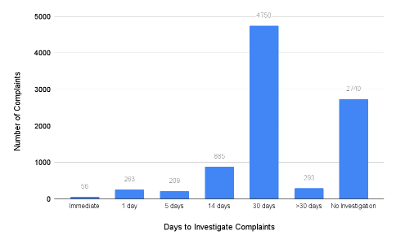
In FY 2025, TCEQ received 9,200 complaints. Of those:
- Investigators responded to just 300 complaints (3%) within one day.
- The agency took up to two weeks to investigate nearly 900 complaints (10%).
- The remaining 5,000 complaints (54%) took at least 14 days, but some took more than 30 days to initiate an investigation.
- The agency closed more than 2,700 complaints (30%) without ever investigating them.
The agency reported that the most common environmental complaint was odor or dust, an air quality concern. The likelihood that a reported air quality matter results in a confirmed violation (and mandate to remedy it) depends on the investigator’s observation of the violation, which can only happen if the investigator responds. By waiting 14-30+ days to investigate, the agency almost guarantees it cannot confirm a violation or take enforcement action. Weather and conditions at the facility are likely to change over such a long period, resulting in closure of the complaint until the neighbor experiences the issue again and files another complaint. Neighbors in communities across the state have told us they’ve stopped reporting complaints to the TCEQ because it either does not respond or does not take action to resolve the issue.
In one of the most egregious public nuisance cases in Texas in recent years, it took the TCEQ years to address pervasive odors that neighbors described as “festering dog vomit on fire,” emanating from the Darling Ingredients animal rendering facility in Bastrop County. According to local elected officials, the smell was regularly observed in communities as far as 15 miles from the plant.
It took 1,440 complaints before the TCEQ took additional steps to enforce the facility’s permits and refer the case to the Attorney General. One neighbor testified in the state’s civil suit that, “If my neighbor was outside burning tires, I would actually go over there and thank them because I didn’t have to smell Darling Ingredients anymore, it’s that bad.” And it was not just a bad odor. The TCEQ investigator found that on multiple occasions, Darling Ingredients emitted extremely toxic hydrogen sulfide gas at “levels that far exceeded the emissions allowed by state regulations,” and reported smells of decaying animals, burned cooking grease and sewage onsite.
The TCEQ told Public Citizen that once a facility goes to enforcement for a violation, its policy is not to initiate additional enforcement of the same violation while the existing case was pending. But it takes the TCEQ a year and a half on average to process a single enforcement case – in many cases, much longer. This meant that Darling Ingredients was granted a pass for ongoing, pervasive emissions violations. At the same time, TCEQ processed its enforcement case, leaving residents to endure emissions that prevented them from enjoying their own yards and community spaces – for years.
Potential Legislative Remedies
- The TCEQ’s budget for staff resources – specifically for investigations – should be increased, as proposed in the agency’s FY 28-29 LAR base request.
- The TCEQ should prioritize response to reported environmental complaints, especially because agency data shows a decrease in proactive on-site investigations (below).
On-Site Investigations
In FY 2025, agency data shows that while the TCEQ conducted 101,000 investigations, only 63,000 were conducted on-site. This is the fewest on-site investigations the agency has reported in eight years, including years when the COVID-19 pandemic made in-person investigations challenging. The number of 2025 investigations was 3,600 fewer than in 2024 and 5,200 fewer than in 2023.,, The TCEQ also conducts record review investigations, where an investigator requests copies of records via email without visiting the facility. TCEQ conducted 38,000 such investigations.
Table 1: TCEQ On-Site Investigations by Fiscal Year
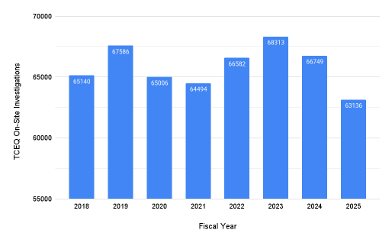
Of the 63,000 investigations, just 6,400 (10%) were for air quality, 5,400 (8.6%) were for petroleum storage tanks, 3,900 (6%) were for public water supply, 3,000 (4.7%) were for water quality, 1,400 (2%) were for on-site sewage and 1,000 (1.6%) were for municipal solid waste. The majority of on-site investigations were for water rights – 38,470 (61%).
The TCEQ has not investigated a facility with an “unclassified” Compliance History ranking in the preceding 5-year period. According to the TCEQ’s 2025 Compliance History report, 273,700 (53%) of 521,000 regulated facilities that are subject to the Compliance History program in Texas had not been investigated in the preceding 5-year period. This figure does not include the 313,000 facilities not subject to the program, but highlights just how large the problem is.
In August 2025, TCEQ staff told Public Citizen that the agency had no intention of reducing the number of uninspected or unclassified entities because the Sunset Commission did not recommend, and the legislature did not mandate, that it do so.
The lack of a mandate to adopt procedures that meet the goals of TCEQ and of the Sunset Commission does not prohibit doing so. The TCEQ (and the Compliance History program) cannot function as intended unless the agency addresses the volume of facilities it has failed to inspect in the preceding 5-year period.
Potential Legislative Remedies
- No regulated entity should be left to self-monitor for more than 5 years. The TCEQ should be mandated to implement a performance metric and goal to reduce uninspected and unclassified entities.
Enforcement
TCEQ issued just 1,170 enforcement actions in FY 2025. The agency’s Annual Enforcement Report states that it aims to issue just 1,000 administrative orders each year and reports that it “consistently meets” that goal. But there are 834,000 regulated entities in Texas, according to TCEQ’s most recent Legislative Appropriation Request. This means that only 0.14% of all polluters in Texas received any formal enforcement action in 2025.
Despite the agency’s failures to promptly respond to reported environmental complaints and to conduct thousands of on-site investigations, in April, the agency posted a message to its social media channels thanking industry and making a false correlation between high compliance rates and the agency’s inability to sufficiently investigate and enforce environmental laws.
Enforcement Backlog
Meanwhile, the TCEQ struggled to process its extensive backlog of enforcement cases. The TCEQ started the 2025 fiscal year with a backlog of 1,490 cases and ended the fiscal year with 1,480 cases., At that rate, the backlog will take 148 years to resolve, not including any new enforcement cases. The backlog is almost entirely of the agency’s own making – a failed enforcement policy among many that continue to erode public confidence in the agency.
Agency enforcement staff disclosed during a public meeting in September 2025 that it had recently ended its long-standing practice of arbitrarily delaying enforcement cases for years to process them in batches, creating the complex backlog the agency is now struggling to work through.
Enforcement delays often result in ongoing, unremediated pollution and harmful public health outcomes. We’ve asked TCEQ leadership to make a serious, expeditious effort to address the backlog in our TCEQ Year in Review report, in press, on social media and in recent public comments directly to agency leadership.
The enforcement backlog began steadily growing in 2021 and reached a peak of 1,700 cases in early 2024. The oldest case in the backlog is a ten-year-old case against Cal-Maine Foods for discharging approximately 8 million gallons of wastewater from a concentrated animal feeding operation into the waters of the state over 10 days, resulting in multiple documented fish kills.
It doesn’t outwardly appear that the agency has taken a single step toward aggressive enforcement in this case, which has surpassed every compliance deadline outlined in the agency’s enforcement process. In fact, the TCEQ has renewed the facility’s wastewater permit twice since the incident – once in 2019 and again in 2024, despite TCEQ records showing it hasn’t conducted an on-site inspection of this facility since 2018.,
According to agency data, it takes the TCEQ an average of 528 days to process a single enforcement case. TCEQ says it prefers to “promote and foster voluntary compliance with environmental laws and provide flexibility in achieving environmental goals.”
The TCEQ doesn’t consider a case behind schedule until it’s been on the books for six months from the date it was referred for enforcement action. If the TCEQ hasn’t mailed the polluter a proposed agreed order – a template letter that details the alleged violation(s) and penalty – within that time, the agency counts the case as backlogged. But then TCEQ mails the agreed order, and the case is removed from the backlog list.
According to staff, if, after 550 days (1.5 years) from the original enforcement referral date, the polluter still has not signed the agreed order and voluntarily agreed to come into compliance, the TCEQ returns the case to the backlog list.
In some cases, years-long delays were caused solely by TCEQ’s inability to draft and mail the proposed agreed order to the polluter. To remove them from backlog status, all TCEQ did was stick a postage stamp on an envelope and mail a template letter. If a community is suffering from pollution, resolution doesn’t come in a template letter. It comes when pollution stops and fines are paid.
In other cases where TCEQ has issued a default order, it took the agency multiple years to mail an enforcement letter to the respondent. After many years, businesses have closed or changed ownership, contact information has changed, and respondents have become much more difficult to reach.
In response to our requests to address the backlog, in April 2026, TCEQ leadership told us that the TCEQ lacked the funding needed to address the enforcement backlog and that the public needed to advocate for more agency funding during the upcoming legislative session if they wanted to see it resolved.
But just a few weeks later, TCEQ leadership reported it had a newly dedicated “strike-force” of five full-time attorneys in its Office of Legal Services specifically to address the enforcement backlog and that it had created a new team in the Office of Compliance and Enforcement who are focused on backlogged cases, “with the ultimate goal of appropriately managing all of these cases by the end of the fiscal year.” The TCEQ did not meet its goal, and as of August 2026, more than 900 backlogged cases remain.
Closed or Non-Suited Enforcement Cases
Between January and July 2026, data obtained by public information request shows that the TCEQ closed or withdrew more than 100 backlogged enforcement cases, counting them as “resolved” in its monthly progress reporting, despite no agreed order, no compliance demonstration and no payment of any penalty.
The TCEQ told Public Citizen it doesn’t have to tell the public how the cases were closed, if the violation(s) were resolved, or if the pollution was remediated.
We reviewed each closed case, which have been removed from the agency’s most recent report of active enforcement actions and indicate a closed status in the TCEQ’s Commissioners Integrated Database.
Some closed enforcement cases involved serious environmental disasters.
In Fort Worth, the TCEQ alleged that in December 2019, the U.S. Navy spilled approximately 2,600 gallons of PFAS-containing 3% Aqueous Film-Forming Foam (AFFF) solution (a synthetic fire-fighting concentrate used to extinguish fuel fires) from an above-ground tank directly into the storm drain at the Naval Air Station Joint Reserve Base (NASJRB). The spill contaminated a local creek, but the Navy failed to contain it or respond. The TCEQ requested sampling of the impacted creek, but the Navy did not respond. The City of Fort Worth is suing the U.S. Department of Justice for contaminating the city’s drinking water with PFAS, which they allege also came from the use of AFFF for fire suppression at the Joint Reserve Base and a nearby Lockheed Martin site. TCEQ closed this enforcement case in February, after six years – seemingly without requiring sampling, remediation or payment of a penalty.
The TCEQ closed cases against known repeat violators, including two air quality enforcement cases against the Chevron Phillips Cedar Bayou plant in Baytown and a wastewater enforcement case against the Formosa Plastics Corporation facility in Calhoun County.,
While actively managing cases is progress, removing records and claiming victory on paper is not. Only the closure of resolved cases indicates that the TCEQ’s enforcement process is functioning as it should.
The TCEQ’s extensive enforcement backlog highlights the problems created by the agency’s lax enforcement approach. Voluntary compliance can still occur with strong agency-enforced deadlines and accountability to communities, but the TCEQ shouldn’t wait ten years for voluntary compliance. The agency should issue default orders – that come with fines and corrective action to stop environmental harm – and refer these significantly delayed cases to the Attorney General for civil enforcement in a court of law.
Potential Legislative Remedies
- The TCEQ should be mandated to adhere to clear timelines regarding the issuance of agreed orders, issuance of default orders and the referral of a case to the Attorney General.
- A mandate or time limitation requiring the TCEQ to draft and send an agreed order within 30-60 days would resolve the self-made problem that often leads to default orders and backlogged cases.
- The TCEQ should be mandated to report its progress toward resolving its extensive enforcement backlog and to limit its use of discretionary closure of unresolved backlogged cases without an agreed order or payment of a penalty.
- The TCEQ must end its enforcement policy of not issuing subsequent enforcement action while an enforcement case is pending. Each violation must count as an actionable enforcement case until the issue is resolved.
- TCEQ should develop a policy that prohibits new permits to be issued while outstanding enforcement actions remain unresolved because the respondent is unwilling to voluntarily settle the matter.
Public Participation
In 2023, the TCEQ was labeled a “Reluctant Regulator” by the Texas Sunset Advisory Commission, which found that “TCEQ’s policies and processes lack full transparency and opportunities for meaningful public input, generating distrust and confusion among members of the public,” among numerous other issues. The Texas legislature mandated the TCEQ to improve its public participation processes.
In January 2026, as mandated by the TCEQ Sunset Bill (SB 1397) signed into law in 2023, the TCEQ adopted a rulemaking ostensibly aimed at improving public participation. Despite the bill’s clear intent, the TCEQ’s final rule fell short of the reforms lawmakers and the state’s Sunset Advisory Commission envisioned. The TCEQ received more than 50 comments from community and environmental advocates asking the agency to align the rule with the Sunset Advisory Commission’s recommendations, increase transparency and make participation less confusing. The agency rejected each of those 50 comments. Instead, the TCEQ modified this rule proposal after it was presented to the public, based on more than 30 comments from corporate interest groups.
Data Centers
An increasing number of data centers are obtaining TCEQ air quality authorizations that do not require public notice or public participation. Data centers with onsite power generation in the form of gas turbines or diesel generators are obtaining low-level permit-by-rule authorizations for back-up diesel generators and standard permits for electric generating units. Both are pre-construction permits that grant the facility permission to build before the public has any right to object or weigh in. Permits-by-rule are issued quickly through an administrative process that typically takes 1-2 days. Some facilities are obtaining major-source air permits, which include public opportunities, such as notice and comment, public meetings, and the opportunity for a contested case hearing.
Through our review of permits and permit applications by data centers, we are concerned that some facilities are underpermitted. If a company can avoid a major source designation, it can get permitted more quickly without public involvement. There is a significant incentive to do this by undercounting potential emissions, understating the project’s true scale, or segmenting the project. We don’t believe the TCEQ is equipped to determine when data center developers are under-permitting their facilities.
We have seen data center developers request permit-by-rule registrations with emissions limits right under the federal major source threshold (see attached slides). Often, their representation that they are a minor source is based on a stated maximum number of operating hours. If the backup power runs too long, these facilities may emit pollutants beyond the public notice threshold. Registrations and permits-by-rule do not require TCEQ staff to analyze or confirm compliance. We are concerned that facilities might regularly exceed their permit limits without being detected.
In recent interim hearings, it has been said that federal regulations require backup generators to operate for about 50 or 100 hours per year. EPA regulations state that RICE engines may be operated for 100 hours per year for maintenance and testing, including 50 hours of that for non-emergency purposes. 40 C.F.R. § 63.6640(f)(2)(i).
However, EPA guidance is clear that generators used for backup power can be assumed to be operated for as much as 500 hours per year. In a letter explaining this guidance, the EPA said:
EPA determined that 500 hours was a reasonable and realistic “worst-case” estimate of the number of hours that an emergency generator could be expected to operate per year. However, the guidance is only applicable to a generator “whose sole function is to provide back-up power when electric power from the local utility is interrupted.”
Air permits are issued based on a source’s potential to emit. Backup power generators at a data center fall within this EPA guidance and should therefore be permitted based on 500 hours of operation.
We know that data centers generally do not act like other large loads that respond to price signals and curtail load when ERCOT demands. Additionally, even a few minutes without power can be incredibly undesirable for a data center. We are concerned that future grid emergencies will cause data centers to run backup power as long as needed to stay online, even if that means going beyond their emissions limits. We believe this scenario could happen, especially as our grid faces increasing strain from the growing demand of interconnecting data centers.
We understand that to a data center developer, the penalties for breaking their emissions limits are a slap on the wrist compared to the penalty of going offline and not providing AI or cloud services. To fenceline communities, though, the threat of data centers violating their emissions limits means exposure to toxic chemicals in violation of the law and their rights as Texans.
We believe a policy is needed to protect Texans from the dangers that under-permitted backup generators for data centers pose.
TCEQ seems to apply site aggregation rules inconsistently for data centers, allowing some data centers and their collocated power plants to be permitted separately, as two smaller authorizations instead of together as one site.
Lastly, the TCEQ recently canceled two public meetings for hyperscale AI data centers – seemingly without any reason., These meetings were opportunities meant for communities to voice opposition to the pollution in their neighborhoods from gas plants that would power those facilities.
The TCEQ canceled the August 17 public meeting for the Vantage Data Center in San Antonio and the August 24 public meeting for the Fermi Data Center near Amarillo. The meetings have not been rescheduled as of the date of this testimony.
Initially, the TCEQ wouldn’t tell us why those meetings were canceled or when they would be rescheduled. But the agency told the press the meetings were canceled “Due to high public interest.” That is the same reason given by the agency as justification for holding the meetings in the first place. The TCEQ could have added additional meetings to the calendar instead of canceling the meetings the public was already planning to attend.
Emails obtained via public information request show that a week before the August 17 public meeting for the Vantage Data Center in San Antonio, a TCEQ staffer in the Chief Clerk’s office emailed agency staff.
“Leadership has asked us to cancel this hearing and reschedule for a later date.” Moments later, he sent the same email to the staff organizing the August 24 public meeting on the Fermi America Project Matador permits near Amarillo.
TCEQ refused to disclose whether the agency’s own leadership or higher state leadership made the call to cancel. Instead, it sought a ruling from the Texas Attorney General under the Texas Public Information Act to withhold all remaining communications from the public.
In a letter to the Attorney General, TCEQ seeks to hide the names of staff it says met with agency attorneys for legal advice and help with the legal justifications and implications of canceling and rescheduling public meetings.
Meanwhile, neighbors arrived at empty meeting venues. And while TCEQ said its “normal precedent” is to send agency staff to canceled meeting locations if the public didn’t receive notice, it decided in emails it didn’t need to show up to redirect residents. “My vote is that mailing out the notice and updating calendars must be good enough. We can’t afford to go all the way to Amarillo just to say it is cancelled,” the Chief Clerk told her staffer. “I agree,” the staff responded.
Potential Legislative Remedies
- Create a new permit/registration for data centers with public notice required at a lower emissions level for NOx, VOCs, Particulate Matter, etc., than the existing permit-by-rule and standard permit limits so that the public has meaningful opportunities to participate before the facility is built.
- Create a new permit class for data centers with significant penalties for exceeding limits.
- Require minor permit holders to submit proof of backup-generation operating hours and emissions calculations.
- TCEQ should require source aggregation determination for every data center and collocated power plant.
Rulemakings
Compliance History Rule Revision
The Sunset Bill mandated revising the agency’s Compliance History program. The Sunset Bill directed TCEQ to “review and update the agency’s compliance history rating formula to ensure it accurately reflects a regulated entity’s record of violations.” It also required TCEQ to “specifically consider major, moderate, and repeat occurrences of the same minor violations when calculating compliance history ratings.” (Emphasis added.) But the TCEQ proposed and adopted a final rule that largely excluded Notices of Violation and relied primarily on compliance history formulas based on formal Notice of Enforcement actions.
Despite numerous environmental advocacy organizations submitting relevant comments that would have further strengthened the agency’s Compliance History rule revision and aligned it with the Sunset Advisory Commission’s recommendation, the agency rejected or refuted all public comments. Instead, the agency amended the rule from its original draft to accommodate industry, which has proposed a 5-tier classification system that makes it easier to avoid repeat-violator status. Those revisions came after the comment period ended, without any further opportunity for the public to have input considered in any meaningful way.
While the agency noted that this rulemaking considered the duration of the appeal window for regulated entities, it did not include any measures for transparency for the appeals process. The public should be granted access upon request to any documentation or reasoning submitted to or considered by the TCEQ when determining whether to grant a requested appeal of a Compliance History or Repeat Violator Designation.
A public information request response found that the agency’s Executive Director used discretion to change the assessed 2025 compliance history rankings for two entities: ConocoPhilips and Brushy Creek Wastewater Treatment Plant., But the agency refused to provide more information about the changes, including staff communications, saying they were protected under attorney-client privilege or deliberative process privilege. ConocoPhilips’ ranking went from a 75 (unsatisfactory) to a 55 (satisfactory). If the agency cannot transparently explain the reason for changing a Compliance History ranking, it should not be granted the discretion to do so.
Section 185 Fees
Section 185 of the Clean Air Act is triggered when a region in severe or extreme nonattainment fails to meet federal deadlines to reduce air pollution. If air quality does not improve, Section 185 requires states to impose a financial penalty on certain large stationary sources that emit pollutants contributing to non-attainment. In Texas, for example, the Dallas-Fort Worth and Houston-Galveston-Brazoria areas are in ozone non-attainment.
The TCEQ adopted this rule program, which failed its primary goal of improving air quality by using an accounting trick to forgive an obligation Congress imposed on industry and instead passing those costs on to Texans. Commissioners approved using funds the agency already collects through the Texas Emissions Reduction Plan (TERP), which is funded by Texas drivers through vehicle title and registration fees, rather than creating a fund that polluters would pay into. The agency will count public dollars toward the debt owed by private industry, significantly reducing or eliminating that debt. This failed rulemaking is yet another example of how the agency serves industry interests. The TCEQ estimated that, as intended, implementing the Section 185 fee program would have generated over $200 million annually for the Houston-Galveston-Brazoria and Dallas-Fort Worth areas.
Potential Legislative Remedies
- TCEQ should be mandated to implement the Section 185 fee program as Congress intended without balancing industry’s debt against the public’s dollars.
- TCEQ should not be allowed to eliminate its annual TERP report, by consolidating it with its biennial report, as requested, because it should be required to publicly disclose how much of industry’s debt it wipes clean each year.
Legislative Appropriations Request for Fiscal Years 2028-2029
The TCEQ’s leadership has expressed little interest in our concerns that the agency’s enforcement resources are insufficient, approving a new Legislative Appropriations Request for FY 2028-2029 that failed to adequately increase agency funding for investigations and enforcement, despite the significant increase in the number of regulated entities across the state and the agency’s poor performance across its enforcement activities.
TCEQ’s 28-29 LAR proposes funding just $78,402,500 for Field Inspections and Complaints each fiscal year, a decrease of $36,430,800 from FY 2025. The TCEQ proposes just $21,743,950 for Enforcement & Compliance Support, a modest increase of $1,321,350 from 2025, despite the agency’s significant needs.
In an Exceptional Item Request, the agency asks for $9,175,110 for Front Line Support, including funding for staffing necessary for compliance and enforcement. This funding is not guaranteed, and the agency’s core functions will suffer without it. It should have been included in the agency’s base request. We plan to present our concerns to the Legislative Budget Board during the upcoming hearing.
Conclusion
Communities across Texas depend on the TCEQ to protect public health, our state’s natural resources and the environment. In many ways, the TCEQ seems determined to live up to its “Reluctant Regulator” title. Residents have expressed frustration with the agency’s inability to prioritize people over corporate profits and the agency’s unwillingness to improve, despite past legislative efforts.
We are hopeful that this committee can begin to address these issues. We are available to discuss any of these issues further.
Kathryn Guerra
TCEQ Campaign Director | Public Citizen