Public Citizen Testimony to the Texas House Committee on State Affairs for Interim Hearing on Data Centers
To: Chairman Ken King and the Members of the House Committee on State Affairs
CC: Rep. Ana Hernandez, Rep. Rafael Anchía, Rep. Drew Darby, Rep. Yvonne Davis, Rep. Charlie Geren, Rep. Ryan Guillen, Rep. Lacey Hull, Rep. John W. McQueeney, Rep. Will Metcalf, Rep. Dade Phelan, Rep. Richard Peña Raymond, Rep. John T. Smithee, Rep. Senfronia Thompson, Rep. Chris Turner
Via hand delivery and by email.
From: Adrian Shelley, Public Citizen, [email protected], 512-477-1155
Re: Data Centers – invited testimony by Public Citizen
Dear Chairman King and Members of the Committee:
Public Citizen appreciates the invitation to provide testimony to this committee on the subject of data centers. Our mission is to be the voice of the people in the halls of power. We have one million members and supporters across the United States and 30,000 in Texas.
Summary of our testimony:
We support the following changes to the current approach:
- An immediate moratorium on new data centers and a special session to address issues of public concern.
- Steps to ensure that data centers and collocated power plants get the right air permits and do so through robust public participation.
- Eliminate policies that incentivize building gas plants to power data centers and minimize the use of backup generators.
- End the state sales and use tax exemption for qualifying data centers.
- End or limit data centers’ use of local tax breaks such as JETI and local development agreements.
- Grant counties more authority to regulate data centers so that they don’t have to use local development agreements or other financial incentives as leverage.
I. There is no “moratorium” on data centers in Texas, and action is still needed to protect communities.
Governor Abbott has released many statements in recent weeks in response to the overwhelming public opposition to data centers in Texas. Although we appreciate that the Governor’s statements are a response to public sentiment, we disagree that anything he has said or done amounts to real change.
ERCOT’s pause of “Batch Zero” will slow down some projects. But it doesn’t apply outside of ERCOT or to facilities that are smaller than 75 MW. It also doesn’t address collocated gas-fired power plants, particularly those that will be behind the meter. Perversely, the Batch Zero pause could incentivize the construction of behind-the-meter plants.
Only Governor Abbott can call a special session to begin addressing the problems caused by data centers in communities across Texas. And a true moratorium would immediately suspend each of the following:
- All construction of data centers across Texas.
- Land acquisition and zoning changes.
- Environmental permitting for data centers and collocated power plants.
- The state sales and use tax exemption and local tax breaks and incentives including Chapter 312, Chapters 380 and 381, and JETI (for collocated power plants).
- All interconnections of facilities in ERCOT and the other grids that serve Texas.
II. The legislature must ensure that data center companies are not skirting Clean Air Act major source permitting requirements.
Public Citizen’s research on data center air permits raises serious concerns that they are not getting the correct air permits. Some facilities are likely getting minor source air permits for facilities that are or will become major sources of air pollution. This is a concern because minor source permits include fewer pollution controls, fewer monitoring and compliance measures, and no requirement to offset pollution in nonattainment areas.
Minor source permits also limit opportunities for public participation. Major source permits offer an opportunity for a public meeting and a contested case hearing. Many elected officials across Texas are concerned that data centers are locating in their communities without sufficient public input. This is one reason why. This problem will be worsened by a current EPA rule proposal to further limit public notice and comment opportunities in minor source permitting.1
There are at least two ways that data centers are under-permitting themselves. First, they are taking a phased approach in which they permit only part of their facility under a minor source permit. This is a problem because a minor source permit allows construction with no public notice.
Take a recent example: the Vantage data center proposed at 14720 Omicron Dr. in San Antonio had a public hearing scheduled for last Monday, August 17.2 Last week, the Texas Commission on Environmental Quality (TCEQ) postponed that public hearing and another for Fermi Equipment Holdco in the Panhandle, which was scheduled for August 24.3 The TCEQ stated that these public meetings were postponed “due to high public interest.” But if public interest is high, shouldn’t the agency opt for more public meetings, not fewer? We understand that the process is delayed while the public meetings are on hold, but it is burdensome for community members to accommodate cancellations and moving opportunities.
The governor announced last week that Vantage, among others, would comply with his new standards for data centers.4 But there are two significant reasons why Vantage is still falling short of the Governor’s directives. First, the company—which is building two data centers in San Antonio—already got minor source air permits for a portion of their backup generators. Minor source permits do not come with public notice or public participation opportunities. Vantage permitted a portion of its planned backup generators on minor source permits, then applied for more permits later, once the facility was already being built. The first opportunity for public engagement (May 28 for the other Vantage facility at 5207 Rogers Road) came after the facility was built and operating. That’s not an authentic public process.
Second, Vantage seems to have contrived its air pollution emission calculations to stay under major source thresholds.5 The company chose an arbitrary number for its hours of operating its backup generators that is well below the EPA’s guidance on backup generators. When it doubled the size of its generator fleet, it halved that arbitrary number in a move that seemed calculated to stay under the threshold. It offered no justification for this.
Third, Vantage is treating its collocated gas plant as a completely separate facility. Nowhere in its discussion of the data center permits does Vantage mention the collocated gas plants owned by VoltaGrid. Vantage has asked the TCEQ to treat its on-site power plants as completely different sources of air pollution. The TCEQ has done so. This seems to be intended to frustrate public participation. At the May 28 public meeting on Vantage at 5207 Rogers Rd—a facility that was already built and operating on minor source permits before any public notice occurred—comments about the collocated power plant were “outside the scope” of the public meeting.
We believe, based on criteria in state law,6 that data centers and collocated power plants should be considered as a single source for air permitting purposes. If this is not already clear in state law, the legislature should make it so.
III. Texas cannot meet air pollution and climate goals while building gas plants and diesel generators to power data centers.
Winding down the burning of fossil fuels is essential to meeting public health and climate goals in Texas. An estimated 17,000 Texans die every year just from particulate matter pollution from burning fossil fuels.7 Texas also has many regions in nonattainment for various National Ambient Air Quality Standards, including ozone, with local economic consequences reaching billions of dollars.8 Half of the children in Texas breathe unsafe air.9
Texas is ground zero for new and expanded gas plant proposals to fuel data centers. The largest air pollution permit in history was recently approved by the TCEQ for a 7.65 GW gas plant.10 Another permit for 5 GW of gas was approved for Fermi America in the Panhandle, with TCEQ denying all contested case hearing requests, even though 300 people submitted comments.11
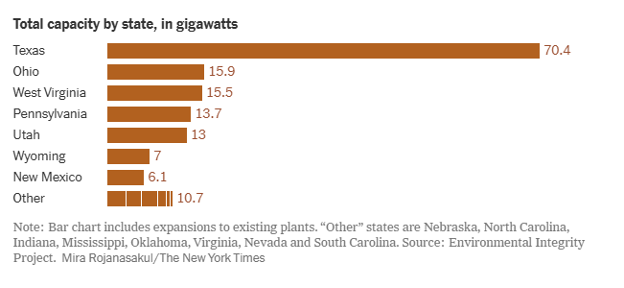
According to a recent report by the Environmental Integrity Project (EIP), there are at least 39 gas plants proposed in Texas to power data centers.12 The vast majority of new gas plant proposals across the United States are in Texas, as this graph from a New York Times story on the EIP report shows:13
The amount of pollution that will be emitted by the 39 gas plants EIP is tracking is frightening. If built, all of these plants would emit:
- 14,991 tons of fine particulate matter, which causes heart attacks, strokes, and death.
- 21,932 tons of nitrogen oxide, which causes lung damage and will prevent Texas from meeting ozone pollution standards.
- 308 million tons of greenhouse gases, which will worsen global climate change and the extreme weather events Texas faces because of it. 14
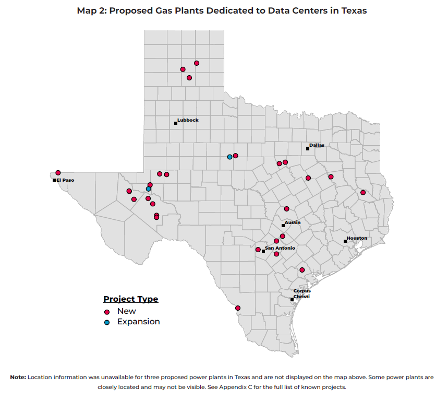
As this map from the EIP report shows, these plants are spread across Texas:15
Texas lawmakers should seriously consider whether this is the future they want for Texas. The ERCOT grid has shown that a mix of energy generation sources is the best option for clean, inexpensive, reliable power. Data center developers are not motivated by anything other than an immediate need for continuous power. If Texas relies on the “bring your own power” approach to addressing the strain on our grid from data centers, then virtually all of them will build their own gas plants. These plants will have devastating consequences for public health and the climate.
Texas leaders should not sacrifice public health for the needs of a single industry. If data centers cannot be powered by the increasingly clean mix of energy found on the Texas grid, they shouldn’t be allowed to invest in fossil fuels at the expense of our air and our health.
We encourage lawmakers not to pass laws that encourage or incentivize building gas plants to power data centers. We also caution that the large number of backup diesel generators being installed at data centers across Texas should not be viewed as a grid resource. Diesel generators are a dirty, inefficient way to produce power and they should only be used in emergencies. We encourage the legislature to pass a law that prohibits the use of diesel generators at data centers for anything other than actual loss of power.
IV. The legislature should eliminate the state sales and use tax exemption for data centers.
The state sales and use tax exemption cost Texas taxpayers $1.1 billion in 2025.16 It is estimated to cost $3.2 billion during the 2026-2027 biennium. By 20230, it is expected to cost $1.7533 billion every year, although that number is probably low because it is based on a January 2025 report from the Comptroller that likely does not account for the explosive growth of proposed data centers since then.
It’s not true that the United States is in a data center or artificial intelligence “war” with China.17 The U.S. has around 5,000 data centers. China has about 500. Furthermore, AI investment from U.S. tech companies has outspent China for years, with the U.S. spend 4 or 5 five times more in recent years.18
The sales and use tax exemption was passed in 2013 (HB 1223 (83R)) at a time when lawmakers felt we needed to attract data centers to Texas.
This worked. It worked so well that we now have more data centers trying to locate in Texas than we can possibly accommodate. In fact, the Dallas-Fort Worth area is considered to be the largest market for data centers in the world.19
Texas is already home to at least 334 data centers, with at least another 248 planned.20 More than 160 data centers take advantage of the state sales and use tax exemption.21 The exemption is applied to certain equipment purchased to build and operate a data center, as well as the energy used in the data center. Long term, for an individual facility, the energy tax break may prove to cost more, as data centers have a continuous demand for lots of energy.
Data center water and energy demand is unrealistic and unsustainable.
All of these energy-hungry projects have led to growth projections for demand on the ERCOT grid that are completely unrealistic and unsustainable. The current large load projection in ERCOT is 438,595 megawatts, around 90% of which are data centers. This is 4.8 times ERCOT’s demand record (set last Wednesday) of 91,308 MW. Even the recently approved “Batch Zero” is reckoning with some 100 GW of projects.
The water demand from data centers is also unsustainable. Water demand from data centers in 2025 exceeded 25 billion gallons.22 Although it is true that many new data centers are planning to use closed loop cooling that will reduce water use, many do not. And new closed loop system require more energy, which is also water hungry if it comes from fossil fuels. A data center powered by a gas plant is using perhaps two-thirds of its water for energy production.
The United States is currently experiencing a bubble in the Artificial Intelligence (AI) and data center industries. No one believes that 400+ gigawatts of data centers will be built in Texas. But the question of how to “separate the wheat from the chaff” is currently taxing the resources of ERCOT, the PUC, and local governments across Texas. Eventually, when the bubble pops, Texans will foot the bill for abandoned projects and facilities.
Industry leaders are not optimistic about the future. According to a recent survey of data center company executives, two out of three shared a negative outlook on the industry’s future.23
Data centers are not significant employers.
The exemption is found at Tax Code Sec. 151.359 and 151.3595. The size requirements for qualifying data centers and qualifying large data centers demonstrate that data centers are not big employers. The requirements are, for a “qualifying data center”:
- single-occupant facility,
- at least 100,000 square feet,
- 20 qualifying jobs, and
- $200 million in investment over a five-year period.
For a “qualifying large data center”:
- single-occupant facility,
- at least 250,000 square feet,
- with at least 20 megawatts of transmission capacity,
- 40 qualifying jobs, and
- $500 million in investment over a five-year period.
Forty jobs for a “large” data center with half a billion dollars of investment is not that significant.
V. The legislature should also eliminate or limit data centers’ use of local tax abatements and financial incentives.
Public Citizen opposes tax cuts for wealthy corporations. Many big tech companies pushing data centers on Texas communities are among the largest companies in history. In addition to ending the state sales and use tax exemption, we also suggest ending local tax breaks and financial incentives.
Right now, local governments rely on local development agreements to gain leverage over projects in their jurisdiction. We recommend the legislature give counties additional authority to regulate data center developments so that they won’t be forced into Chapter 381 agreements. Counties should have authority to regulate such local issues as:
- Distance between data centers and certain land uses including homes, schools, places of worship, licensed day-care centers, hospitals, or medical facilities.
- Restrictions on the use of potable water, storm water, and wastewater.
- Limiting the use of polluting diesel engines for backup power.
- Noise level at the fenceline, including sounds with a frequency below 20Hz (infrasound).
- Requirement to post a bond or other financial assurance sufficient to decommission the facility, return the land to its original state, and/or repair road damage.
We have identified thirty-one counties that have passed resolutions asking for more authority from the legislature: Anderson, Andrews, Angelina, Austin, Bell, Bosque, Brazoria, Caldwell, Cameron, Clay, Cooke, Delta, Ellis, Fannin, Fayette, Grayson, Hays, Henderson, Hill, Hood, Hudspeth, Hunt, Johnson, Karnes, Lampasas, Lubbock, Morris, Parker, Polk, Somervell, Tom Green, Wise. Appendix A attached to these comments is a list with more information and links to these resolutions.
Chapters 380 and 381: Local Development Agreements
Local development agreements are tax breaks or incentives offered by cities and counties. Counties do not generally have authority to regulate development. A Chapter 381 agreement is a county’s only option to gain leverage over a proposed project.
Public Citizen has spent several months visiting communities impacted by data centers. We have spoken at rallies, town halls, and county commission meetings. Some of the county commissions we have visited include Johnson, Hood, Medina, and Somervell. We have heard the same thing repeated by county leadership: they don’t want to give away their tax base, but otherwise they have no authority. A data center can do anything it wants when locating in the county. A 381 agreement is the only leverage the county leadership has to ask for terms beneficial to the community.
Section VI of this testimony (below) includes a deeper look at Chapter 380 and 381 agreements. A list of thirty-three agreements we found for data centers is attached as appendix B.
The Jobs, Energy, Technology and Innovation Act (JETI)
The Jobs, Energy, Technology and Innovation Act (JETI) was passed by the 88th legislature (HB 5, 88R) to replace the former “Chapter 313” program for property tax abatements from school districts. Chapter 313 applications were no longer processed after December 31, 2022. Some Chapter 313 projects do not even begin until 2043 and can continue for ten years, so some Chapter 313 tax breaks will be in place for another three decades.
JETI was effective on September 1, 2023. As of January 2026, there are 15 active JETI projects. At least two of these projects are likely for data centers:
- J0021 in Brazoria County is for Stone Creek Peaker LLC, a 200 MW natural gas simple cycle power plant that will likely have “a commercial offtake contract that is yet to be put in place.”24
- J0022 in Reeves County is for Energy Forge One LLC, a 2 GW gas power plant proposed to power data centers.25
Chapter 312: The Property Redevelopment and Tax Abatement Act
Tax Code Chapter 312 allows local taxing entities—cities and counties—to offer property tax abatements for up to 10 years. Chapter 312 agreements are available in the Local Development Agreement Database.26 At least two data centers with Chapter 312 abatements are listed in the database:
- Crusoe Energy System, LLC in Wilbarger County
- Compass Datacenters DFW LLC in Allen City
The Texas Enterprise Fund
A few data centers have also received Texas Enterprise Fund (TEF) money. Applications to the TEF are decided upon by unanimous agreement of the Governor, Lieutenant Governor, and Speaker of the House.27 There are at least three data centers that have received Texas Enterprise Funds:28
- A Hewlett-Packard data center in Austin or Houston received a $3 million award in FY 2006-2007. This project has been completed.
- QTC Management, Inc. in San Antonio has received $308,750 as of July 2023 on a TEF award of $558,250.
- Digital Realty Trust, L.P. in Dallas has received $1,060,000 as of August 2024 on a $2,000,000 award.
VI. Public Citizen research on Chapter 380 and 381 agreements shows that counties need more authority to secure beneficial terms for their communities.
Public Citizen staff combed through the Comptroller’s database of around 4,100 local development agreements29 and identified 33 for data centers—20 of them for cities and 13 for counties. This research led us to conclude that counties need more authority to negotiate with data center developers to secure terms that meaningfully address concerns raised by community members.
This testimony concludes with a deeper look at 380/381 agreements. A list of all of the agreements we found is attached.
Each local development agreement can cost taxpayers tens of millions of dollars, or more. A typical data center might reach a valuation of $200 million in five years, 30 with a steady increase in value of $40 million per year. If this data center has a ten-year, 100% tax break in a jurisdiction with a 2% tax rate, then that tax break would cost $32 million in 10 years.
Do data centers provide more than $32 million in value to their communities?
Going back to the tax code, a data center of this size might have 20 jobs. The local jurisdiction—and its taxpayers—are paying $1.6 million for each of those jobs. A typical minimum salary for a qualifying job is $67,000 (see below). The taxpayers are paying twenty-four times the salary of that job. That doesn’t seem like a good deal.
Another conclusion we reached in our research of local development agreements is that they tend not to include terms that would benefit community members. When you talk to people in communities, you hear concerns about water availability first, then energy prices and grid security, then local impacts such as noise, light pollution, and road disruption. But these issues aren’t typically addressed in local development agreements. The agreements include terms about employment, infrastructure spending, and payments in lieu of taxes. They don’t tend to address problems of concern to neighbors. This reinforces our belief that counties should be given authority to regulate issues that do matter to communities.
This testimony concludes with a few examples of terms we noticed in local development agreements. A more thorough list is attached. Here are a few things we noted in our research:
- The largest agreement is between SSDC1, LLC and the City of Sulphur Springs, which contemplates a total value of $18.7 billion by the time the agreement concludes.
- A minimum salary of $67,000 for qualifying jobs is common.
- Many agreements require the use of local contractors and vendors when commercially reasonable.
- Some agreements waive local fees such as permit fees, impact fees, and inspection fees.
- Some cities require an investment in wastewater infrastructure that is eventually repaid by the city, which then stakes custody of the infrastructure. The City of Lancaster has such an agreement for a $1.5 million investment in 5,000 feet of sewer lines designed with stubs that allow other buildings or houses to connect in the future.
- The City of Temple has an agreement for 13,000 feet of wastewater main and associated infrastructure, with the reimbursement paid with 4% interest. Temple also agreed to sell 350,000 gallons of water per day and notify the developer if it were not available.
- The City of Garland has two very different agreements entered into between 2015 and 2024.31 The 2015 agreement includes a fixed rate for electricity ($0.048/kWh through 2017) in exchange for the city providing estimates of its usage and maintaining a “lagging power factor” of 0.97. The city agreed to build a substation at its own expense. The agreement also included a $1.5 million “Fiber Optic Incentive” in its 2015 agreement but not its 2024 agreement. The city also moved from waiving fees up to $550,000 to offering a $500,000 fee rebate once certain targets were met.
- The City of Lancaster offered to add 10% to the abatement if the company, called Sl DFW02A, LLC or “Stack,” moved its regional headquarters to Lancaster, or 15% if the company moved its global headquarters.
- The City of Sulphur Springs offered a land grant of an old landfill property and disclaimed any responsibility for hazardous material or environmental conditions.
- An agreement in Fort Worth included a requirement to spend $50,000,000 on construction costs with Fort Worth companies.
- Sometimes one company enters into similar agreements with a city and its county at the same time.
- Lancium with Fort Stockton and Pecos County on Sept. 7, 2021.
- Wurldwide LLC with City and County of El Paso in December 2023.
- Wiwynn technology with City of Socorro and County of El Paso in May/June 2025.