Texas Data Center Policy Guide
Confronting Big Tech's Strain on Texas Communities
Texas Data Center Policy Guide
 EXECUTIVE SUMMARY: TAKING ACTION ON DATA CENTERS IN TEXAS
The biggest challenge in effective opposition to a proposed data center is learning about it soon enough to influence decision-making. Unfortunately, there is no single resource in Texas to identify proposed or pending data center projects. In section II of this guide, we have included several lists of projects—both proposed and completed.
Finding proposed data centers in your community may require paying attention to property sales, local government meetings, and relevant regulatory bodies. You should begin by identifying a company name and address, if possible. County property search databases are a good place to start.
Cities have the authority to stop data center proposals through zoning. Counties do not, unless they have been explicitly granted zoning authority from the state. Section IV of this guide discusses these approaches. Section IV also covers state environmental permitting. Although state permitting rarely offers an opportunity to directly stop projects, it can significantly slow them down. Public involvement in the permitting process can also lead to a better relationship between a facility, its neighbors, and its environment.
Texas is running out of water. Slowing or stopping water rights allocations is one way of stopping a data center. Section IV of this guide discusses water allocations by groundwater conservation districts and municipal utilities. There are several other very good guides on water and data center use listed as resources at the end of this guide.
Tax breaks and other financial incentives are often used to attract development projects, including data centers. Section V of this guide covers these incentives. There are two opportunities to stop tax breaks for a data center in your community. First, check with your local school board if your school district is considering offering a Jobs, Energy, Technology, and Innovation Act (JETI) tax break. Second is your city or county, which may offer Property Redevelopment and Tax Abatement Act (Tax Code Ch. 312) breaks, or Local Development Agreements (Local Government Code Chs. 380 and 381). Following city and county agendas and notice postings can help you identify these opportunities. PUBLIC CITIZEN Texas Data Center Policy Guide March 2026 4
Your community’s advocacy against a data center does not have to happen alone. There are groups forming throughout Texas and the United States, with new resources published every day. This guide concludes with a list of some of these resources.
Public Citizen is a founding member of the Texas Data Center Rebellion, which is bringing together community activists across Texas. Please contact us at Public Citizen’s Texas office, or through the Texas Data Center Rebellion, to join in shared advocacy. Good luck!
I. DATA CENTERS AND THEIR USE
a. What Are Data Centers?
A data center is a facility that houses computer hardware and related infrastructure. Data center uses include cloud computing, cryptocurrency mining, and artificial intelligence (AI). The rapid growth of generative AI has led to a profusion of new proposed data centers in Texas. Within two years, our state could become home to more data centers than any other state in the nation. This has led to a desperate need for regulation and awareness of the environmental impacts of data centers and the AI tools they support.
Data centers are housed in commercial buildings that look like warehouses. A mid- sized data center will be a few hundred thousand square feet and employ a few dozen people. The energy demand for a data center’s computers ranges from tens to hundreds of megawatts. Because data centers must operate continuously, they are often built with onsite backup power to stay operational during grid power outages. Backup power usually takes the form of diesel generators or gas turbines for larger facilities. The computers inside data centers must be cooled, either with fans or liquid cooling systems that often use significant amounts of water.
Very large data centers are referred to as “hyperscalers.” Some of the larger proposed hyperscale data centers in Texas could demand several gigawatts of electricity. Data centers this large typically propose on-site power generation, most often gas plants.
b. The Dangers of AI
Data centers are the physical infrastructure behind the development of generative AI. There are two categories of artificial intelligence: traditional AI and generative AI. Traditional AI is reactive, analyzing data, identifying patterns, and making predictions according to a set of predefined rules. Examples of traditional AI at work in our day-today lives include credit card fraud alerts, traffic estimates from Google Maps and Waze, and spam email filters.
Generative AI can create something new using learned data patterns. Examples include autoregressive models that are used in large language models and transformer based text models, variational autoencoders such as image generators and data augmentation, and multimodal generative models, which can create text, image, audio and video simultaneously. As generative AI has improved, its investment in the U.S. has skyrocketed, with $252.3 billion in 2024 alone being used to help solidify its market.
Today, generative AI shows up everywhere in our lives: school, work and social media. With it come real and practical risks, including fake social media content, fake photos and videos, fake news articles, and “intimate deepfakes” that depict nonconsenting individuals in sexual situations. These AI tools are often used to produce child sexual abuse material.
AI is also used in the service of the surveillance state, often with disastrous results. The U.S. Border Patrol is making broad use of AI tools to monitor drivers and identify those with “suspicious” patterns. Flawed facial recognition technology has led to the arrest of innocent people for crimes they didn’t commit. The federal government and law enforcement agencies also monitor citizens through partnerships with social media monitoring companies such as Whooster, Penlink, and Fivecast.
Mistakes made by AI can have serious consequences for health and safety. Rick Claypool, a researcher with Public Citizen, found AI to be dangerously inaccurate when identifying edible mushrooms. In his words, “Individuals relying solely on AI technology for mushroom identification have been severely sickened and hospitalized after consuming wild mushrooms that AI systems misidentified as edible.”
II. DATA CENTERS IN TEXAS
As of March 2026, Texas already hosts 605 data centers. This number is growing all the time and Public Citizen is working to track new proposals. You can view our live map of data center proposals in Texas and use our online form to share information about data center proposals that aren’t on this map.
In addition to the map of pending projects, Public Citizen has a working list that includes data centers with air permits, data centers that have qualified for the state sales and use tax exemption, and data centers that have signed local development agreements. These lists are available here.
There are several maps of data centers available online:
- Baxtel’s Global Data Center Map: https://baxtel.com/map
- Data Center Map: https://www.datacentermap.com/
- Houston Chronicle’s Texas data center tracker: https://www.houstonchronicle.com/projects/2026/tx-data-centers-map
III. ENVIRONMENTAL IMPACTS OF DATA CENTERS
Data centers create significant environmental impacts in several ways. Massive energy use adds to climate and local air pollution. Cooling and energy needs result in huge water needs. Land cleared for data centers adds to biodiversity loss.
Energy Use Driving Air Pollution
Data centers are energy hogs. The frenzy of the “A.I. race” has resulted in hundreds of data centers demanding immediate access to electricity. Even the less intensive AI applications are significantly increasing energy use for daily activities. For example, a ChatGPT search uses 10 times as much electricity as a Google search. In addition to AI energy use, there’s the even more pointless waste of energy for crypto “mining.” The Bitcoin system uses 204.44 terawatt-hours of electricity per year. If Bitcoin were a country, it would rank 23rd in electricity use. This excessive energy use is especially troubling, given that 99% of it is wasted on meaningless calculations. One of Bitcoin’s main competitors, Ethereum, cut its energy use by 99.99% by switching from “proof of work” mining to “proof of stake” mining. There is nothing preventing Bitcoin from switching to this model, which would dramatically reduce its energy consumption.
By 2030-2035, data centers could account for 20% of global electricity use. In the U.S., data centers are on course to account for more than half the growth in electricity demand between now and 2030. By 2030, the AI data centers in the U.S. are expected to consume more electricity than is used for the manufacturing of all energy-intensive goods combined (aluminum, steel, cement and chemicals). More than 220 gigawatts of big projects have been asked to connect to the Texas grid by 2030, and more than 70% of those projects are data centers.
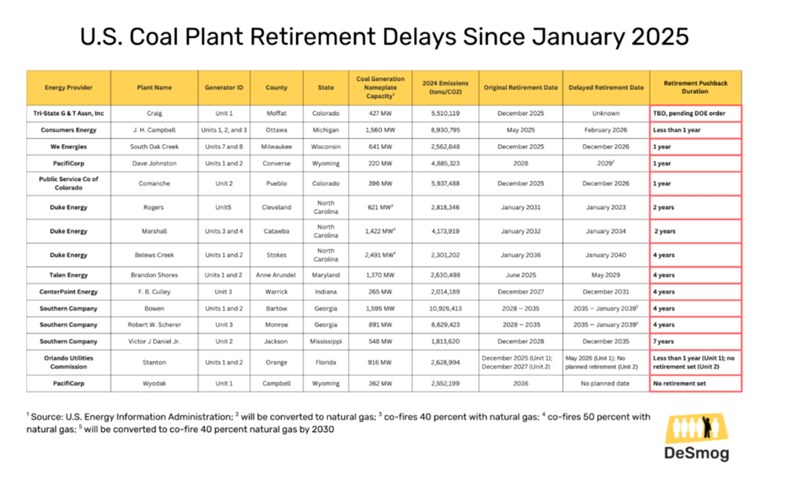
Data center demand is a major factor driving the expansion of methane gas power plants and the return of coal and nuclear power plants from retirement. 56% of the electricity used to power data centers comes from fossil fuels. The retirement of at least 15 coal-burning plants has been pushed back since January 2025.
In addition to driving up demand for fossil fuel generation on the grid, data centers are also installing a large number of diesel backup generators. Data centers – especially those used for cloud computing – demand consistent access to electricity. So even if ERCOT or other grid operators force data centers to temporarily stop drawing energy from the grid during times of peak demand, those data centers will switch to using large diesel generators for backup power to remain operational. Diesel generators are extremely polluting and are able avoid the same sort of permitting restrictions as most power plants because they’re designated for backup power production only, but those permits lack restrictions on the number of hours they can run, leaving communities vulnerable to being exposed to large amounts of dangerous air pollution. Diesel generators produce particulate matter (PM), volatile organic compounds (VOCs), nitrous oxide (Nox) and other pollutants that create smog and exacerbate respiratory issues. Air pollution isn’t just a nuisance; it’s deadly, and it’s a drain on our economy. By 2030, air pollution from data centers is expected to result in as many as 1,300 premature deaths per year, as well as health costs from cancers, asthma, and other diseases, and missed work and school connected to air pollution, totaling $20 billion per year.
Climate Change Impact
Data centers are putting significant pressure on the climate crisis. According to research by the Union of Concerned Scientists, “Without stronger clean energy policies, the additional fossil fuel generation used to power data centers results in an increase in annual US power plant emissions of carbon dioxide (CO2) of 19 to 29 percent (229 to 342 million metric tons—MMT) by 2035.” Rapid clean energy deployment is needed to mitigate the climate crisis, even without the data center rush. Ramping up the manufacturing and installation infrastructure needed to meet existing greenhouse gas reduction targets and also power new data centers is a challenge. Renewable energy resources that are deployed to power data centers may have otherwise been used to decarbonize the electric needs of millions of residents and other businesses. The effects of climate change are already being felt around the world, including in Texas. Historic wildfires, persistent drought, more dangerous heat waves, flooding and rising property insurance rates are some of the ways that Texans are feeling the pain from global climate change. Increasing emissions will only exacerbate these existing challenges.
Water Use
Data centers consume large quantities of water for cooling the computer equipment and indirectly from energy demand. This is particularly problematic given that many parts of Texas have been experiencing persistent drought and lack near-term or long-term water supplies to meet existing needs. Texas already has a 4.8-million-acre-foot water shortage. In 2023, U.S. data centers directly consumed 66 billion gallons of water. Large data centers can consume up to 5 million gallons of water per day (1.8 billion gallons annually), equivalent to approximately 20,000 Texas households.
Just as using AI has an energy impact, it also has a water impact. The University of California-Riverside estimates that a 100-word AI prompt uses more than a pint of water. When multiplied by billions of prompts daily, even these seemingly minor uses add up. And of course, there are even more data-hungry AI demands by the technology sector, including large language models and AI vehicles.
Data centers have several cooling options, depending on the facility’s scale. Some technologies use less water, but there are tradeoffs. Most options that use less water use more energy. And technologies that rely on synthetic coolants, especially polyfluoroalkyl substances (PFAS), can lead to water pollution and associated health and environmental harms.
IV. LOCAL AND STATE PERMITTING
a. Local Municipal Zoning
Local zoning decisions offer the clearest opportunity to defeat a proposed data center. Almost all incorporated municipalities in Texas—both home-rule cities (population over 5,000) and general-law cities—have the authority to adopt zoning regulations under Chapter 211 of the Local Government Code. Most major metropolitan areas, except for Houston, utilize zoning. Texas counties do not have zoning authority unless explicitly granted by the state legislature (Local Government Code Chapter 231).
Zoning is a land use tool that defines appropriate uses while considering adjacent land uses. Zoning decisions are often made during public hearings by zoning commissions or boards, with recommendations for approval or denial sent to the city council.
b. County Authority: Bans and Moratoriums
Land use designation and zoning are two different things. Some counties have zoning rights under Chapter 231 of the Local Government Code. This includes Lake Somervell in Hood County, which residents have been using to enforce regulations on data centers and gas plants.
In February 2026, two counties—Hood and Hays—considered development moratoriums aimed at limiting development to protect water and other resources. On the eve of a vote in Hood County, Houston-area Senator Paul Bettencourt submitted a letter to the Attorney General stating his interpretation of HB 2559 (89R) as pre-empting counties from imposing development moratoriums. Faced with the strong possibility of a lawsuit against them, neither county voted for a moratorium. See the Texas Tribune (Hood) and KVUE (Hays).
There are a few recent examples of counties forming so-called “regional planning commissions” under Chapter 391 of the Local Government Code. See Erath & Somerville and Hood & Somerville. Although these commissions are intended to foster regional planning across counties that share a common interest, Chapter 391 does not appear to grant any additional regulatory authority beyond that held by counties. A 391 Commission might help counties to communicate with the Public Utility Commission.
At this point, it appears that a county without explicit statutory authority to regulate development will not be able to stop a data center development within its borders. However, counties and other local governments can influence state policy, including by passing resolutions requesting a statewide moratorium and/or other restrictions to protect communities and natural resources.
c. State Environmental Permits
The Texas Commission on Environmental Quality (TCEQ) has delegated authority from the United States Environmental Protection Agency (EPA) to implement rule programs and enforce environmental regulations in the State of Texas. The TCEQ has been labeled a “reluctant regulator” by the Sunset Advisory Commission, whose policies and processes lack full transparency and meaningful opportunities for public input, generating distrust and confusion among the public.
As many environmental and community advocates have found, the TCEQ typically issues permits despite any community opposition. In fact, the agency takes the position that it lacks statutory authority to deny an air permit for any reason other than a deficiency in the permit application. In other words, if the permit is complete, the TCEQ MUST issue it, according to the agency’s own interpretation of its authority. See Health and Safety Code Sec. 382.0518(b), “shall grant.”
The TCEQ is responsible for regulating multiple aspects of data centers, including issuing and enforcing air emissions permits for sources such as generators, stormwater and wastewater discharge permits, and storage of large quantities of hazardous chemicals or petroleum products.
Air Quality Permits
TCEQ issues air permits by emissions quantity under two programs: New Source Review (NSR) permits, and Title V Operating permits. Emissions sources from data centers are largely attributed to supplying power to the facility and whether the facility includes natural gas turbines for power and generators for back-up power.
On-site power generation for data centers emits the most air pollution compared to limited-use backup generators. Back-up power for data centers is used to keep the facility online during a power outage and is often diesel-fueled.
Pollutants emitted by data centers with gas-powered turbines include nitrogen oxide, carbon monoxide, volatile organic compounds, particulate matter 2.5 and 10 microns in size, sulfur dioxide and formaldehyde.
New Source Review permits are pre-construction permits for a vast range of minor sources up to defined emissions thresholds. The most common types of air permits obtained to authorize emissions from data centers include:
- De Minimis: negligible sources of emissions from a list of specific activities that do not require a permit application or approval, but that must meet certain conditions and require recordkeeping. No public input opportunity. Regulated under 30 TAC 116.119.
- Permit by Rule authorizes industry- or activity-specific emissions below the thresholds defined in 30 TAC 106.4. Some require registration and a fee. Must meet certain conditions exactly and require recordkeeping. PBRs do not expire. No public input opportunity.
- Standard Permit: authorizes construction for defined processes and minor emissions sources, such as Electric Generating Units for data centers. Requires an application, a fee, Best Available Control Technology (BACT) and approval by TCEQ staff. Must be renewed every 10 years.
- Minor NSR Permit authorizes emissions that cannot meet PBR or standard permits and are also called individual or case-by-case permits. Requires an application, fee and technical review by TCEQ staff, which includes Best Available Control Technology (BACT) and an impacts evaluation. Minor NSR permits are subject to public participation rules, including public notice and comment, and contested case hearings for affected parties. Must be renewed every 10 years.
- Major NSR Permit: these include Nonattainment and Prevention of Significant Deterioration (PSD) permits that have additional requirements. The state has several non-attainment areas that require additional controls for pollutants such as NOx and Volatile Organic Compounds (VOCs).
Federal Operating Permits are regulated under Title V of the Clean Air Act and are for major sources that emit or have the Potential to Emit (PTE) greater than 100 tons per year (TPY) of any pollutant or greater than 10 TPY of a single Hazardous Air Pollutant or greater than 25 TPY of a combination of Hazardous Air Pollutants.
Title V permits are obtained in addition to NSR authorizations through the TCEQ. There are three types of Title V permits:
- Site Operating Permit (SOP)
- General Operating Permit (GOP)
- Temporary Operation Permit (TOP)
Other air permitting considerations:
- National Emissions Standards for Hazardous Air Pollutants (NESHAP)
- New Source Performance Standards (NSPS) for criteria pollutants
Public Participation Permitting
A community member wishing to engage in environmental permitting must look for notices from the TCEQ of public participation opportunities. You can subscribe to the notice list for an entire county, but this will result in a large volume of physical mail from the agency.
The nonprofit organization Air Alliance Houston has created AirMail, a tool that sends weekly pollution permit notices by county. You can subscribe to AirMail for as many counties in Texas as you want.
Companies are required to place public notices in several locations. A sign with the notice must by physically placed at the proposed location of the facility. Unfortunately, community members report that these signs are often inconspicuous, difficult to read, or poorly maintained.
Companies are also required to publish a notice in a nearby newspaper. But again, community members report difficulty in finding published notices. Which paper is used is not always clear, and published notices take the form of brief, nondescript text publications near the back of printed newspapers.
Given the challenges in seeing these forms of local notice in a timely fashion, we recommend AirMail or the TCEQ’s notice lists. If you know the specific company or project, you can contact the TCEQ and request to be added to the notice list for that company or project. We recommend reaching out to the Office of the Chief Clerk for this. If you submit a comment, request a public meeting, or request a contested case hearing, you will automatically be placed on the notice list.
Two Notice Opportunities: The NORI and NAPD
Most major permit applications include two opportunities for notice. First is the Notice of Receipt of Application and Intent to Obtain (NORI). Here is an example of the NORI for the Longhorn Data Center. The NORI is issued once the application is administratively complete. It opens the public comment opportunity and offers the first chance to comment, to request a public meeting, and to request a contested case hearing.
Next comes Notice of Application and Preliminary Decision (NAPD). Here is an example of an NAPD for Fermi’s Project Matador in Amarillo. The NAPD is issued once the TCEQ has completed its review of the application and has reached a preliminary decision to issue the permit. The NAPD sets a 30-day deadline for comments after it is published in the local newspaper. Note that newspaper publication often takes a few days more than the date of issuance of the NAPD, so the actual comment deadline might be a few more days than 30 days after the Notice Issuance Date at the bottom of the NAPD. To find the exact comment deadline, we recommend contacting the TCEQ.
Other Environmental Permits
Both underground and aboveground Petroleum Storage Tanks (PSTs) are regulated by the TCEQ. Underground storage tanks require thorough daily recordkeeping to protect against leaks.
If a data center has on-site generators for backup power, it may have diesel fuel storage tanks that require a PST permit.
Data centers might also require hazardous waste permits for the storage of large quantities of hazardous chemicals on site.
Water Quality Permits
Like air quality permits, the TCEQ has delegated EPA authority to implement and enforce the Clean Water Act. The TCEQ issues water quality permits for data centers during both the construction and the operating phase.
The Stormwater General Permit for Construction Activities regulates the discharge of stormwater to any surface water in the state and disturbs an acre or more of soil. To protect water quality, construction site operators must develop and maintain a Stormwater Pollution Prevention Plan (SWP3) prior to beginning construction.
Data centers can consume large quantities of water for cooling. The TCEQ regulates the discharge of industrial wastewater from data center operations under Texas Pollution Discharge Elimination System (TPDES) permits. Before discharging wastewater, data centers must obtain a wastewater permit and comply with pretreatment standards.
d. Water Rights
Data centers require vast amounts of water, whether for cooling equipment (via air or liquid cooling) or for cooling natural-gas turbines co-located with data centers. There are different ways that data centers can acquire this water in Texas. Data centers (or co-located gas plants) looking for water can get it from:
- A nearby city (municipal water and wastewater service through a city utility).
- A groundwater district, if it’s located in one.
- A county water district or authority.
- Or from reclaimed water.
Municipal Water and Wastewater
If a data center is located within a municipal water utility’s service area, or very close to it, the data center can make an agreement with that utility to serve it with water. If the water utility is public, this can allow for pressure on city council members.
Groundwater Conservation Districts (GCD)
Groundwater Conservation Districts (GCDs) are created under the authority of the Texas Constitution and are used to manage water resources. Approximately 70% of the state lies within a GCD.
If a data center is proposed within a groundwater conservation district, then it must obtain a permit from the GCD before digging its own on-site groundwater wells. If there is no GCD, then they can drill an on-site well at any time they wish. The process a developer must follow to acquire water from a GCD varies by GCD rules. But, under Chapter 36 of the Texas Water Code, there are general rules that must be followed:
- At least 10 days before a hearing, the GCD board must post notice that includes the date and time, location, contact info for the person/entity requesting water, and information on how the public may submit comments.
- Some Districts have spacing rules, and some of those Districts require notice to nearby landowners for Hearings on spacing exceptions. Texas Water Code 36.404 lists the notice requirements for Permit Hearings.
- The GCD must post to the county clerk and have it readily displayed.
When a developer approaches a GCD with a proposal, they may be required to obtain at least one permit (this varies by GCD). The GCD may have rules about how close neighboring property lines and neighboring wells can be (called spacing requirements) and whether they will allow exceptions to those rules. Some GCDs may not have spacing requirements. To have their permit(s) granted, the general manager of the GCD will recommend to the GCD board whether to approve or deny the permit(s), and the board will either decide or table it for the future.
Anyone in the GCD can apply for a contested case hearing (CCH). The GCD decides if there are grounds to hold the contested case hearing, which then takes place at the State Office of Administrative Hearings (SOAH). A CCH is an administrative hearing overseen by an Administrative Law Judge who makes a recommendation to the board about the proposed permit. The board makes the final decision with this recommendation in mind.
The board determines whether any person requesting the contested case hearing has standing to make that request and whether a justiciable issue related to the application has been raised. If the board determines that no person who requested a contested case hearing had standing or that no justiciable issues were raised, the board may deny the contested case hearing request and take any action that is authorized.
If a CCH is granted, how long the process takes depends on a number of variables (whether they have in-house hydrological services or need to contract, how big the proposal is, what the requirements are to meet, etc.), and it is difficult to estimate how long it can take from the proposal stage to the confirmation. Participants in CCHs often hire lawyers and experts and the full cost of participation can easily exceed tens of thousands of dollars. However, it is possible for a concerned community member to participate “pro se” without any legal or technical assistance.
One preventative measure that people can take is to verify their groundwater wells with their GCD so that the GCD understands how much water is being withdrawn annually and how many wells are in each area. A GCD may have production limits, spacing requirements, or may not have a full picture of how much water is being withdrawn from a particular part of the aquifer. By giving your GCD the best picture of the state of the groundwater, they can make the most informed decision about how water should be allocated.
The most important preventative measures an individual can take are to reach out and develop a relationship with their local groundwater conservation district. They should be more than willing to spell out the rules they must follow in their specific GCD so that your community can be best prepared to protect your water. They will also give you a better idea of how long the timeline is for a proposal that is before them. It’s vital to do this as soon as possible.
County Water District and Water Authority
A data center can make an agreement with a water authority or authorities to secure water. These include river authorities, special utility districts, and water control and improvement districts. River authorities control more than 70% of the state’s surface water resources, and can sell water directly to consumers (both residential and commercial) as well as other suppliers of water. Water from a river authority does not need to be treated, though, so this may have a lower likelihood of being used.
Reclaimed Water for Data Centers
Data centers can enter agreements to use reclaimed water for cooling. Amazon uses reclaimed water at over 20 sites in Virginia and California. It is probably the most expensive option for attaining water, but it has the lowest impact on local water resources of all the options.
If one entity denies selling water, the developer can obtain water from another source farther away and then pipe it in, although this would be more expensive and take longer. Challenging based on water does provide a good opportunity for community members and local officials to fight data centers. Water is often finalized later in the process than air permits and land designations. Additionally, water is a galvanizing issue for many Texans. People do not want their water taken, and it’s easily understood that once water is gone, it’s difficult to get more of it. Lastly, water and its permits offer people more ways to challenge a data center than zoning/land-use change or air-quality permits, which are both difficult to stop. With coordinated efforts, surrounding water districts, groundwater districts, and other potential water sellers can be lobbied to stop the sale of water.
Site-Specific Water Permits
It seems that if a data center is located within a floodplain, it must obtain a County Flood Hazard Permit. FEMA develops flood hazard maps known as Flood Insurance Rate Maps (FIRMs). These maps serve as a basis for a county’s floodplain management program. The Cloudburst facility in Hays County is an example of a project that needs a County Flood Hazard Permit.
Other site-specific water permits include wetlands determinations and roadway drainage interface requirements.
It is often difficult to define exactly how much water a particular data center will need; information can be hidden behind non-disclosure agreements and cooling methods can be proprietary information. When it comes to water, though, liquid cooling is generally considered more water-efficient than air cooling because it uses coolants rather than water. Air cooling can use evaporative cooling, which is water-intensive. Air cooling can also use industrial-sized fans, but these require greater power.
V. FINANCIAL IMPACTS OF DATA CENTERS
a. Impacts to Utility Rates and Customer Bills
Data Centers are the main driver of new demand on the Texas grid. There are several ways this new demand increases prices for energy consumers in Texas. These include price increases due to scarcity, new investments in generation resources, necessary investments in transmission and distribution infrastructure, and increased costs from participation in energy arbitrage and ancillary service markets (as we have seen with crypto mining).
Texans are already paying more for electricity. A recent report by the Texas Energy Poverty Institute found that Texans are paying 30 percent more for electricity than they did in 2021, with another 29 percent increase likely by 2030.
Researchers at the Texas A&M University Department of Atmospheric Sciences quantified energy price increases from crypto demand. “A quantification of how much crypto-miners are driving up the wholesale cost of energy in Texas,” Jangho Lee, Lily Wu, and Andrew E. Dessler, Department of Atmospheric Sciences, Texas A&M University, College Station, TX, USA (Feb. 2023), see https://arxiv.org/pdf/2302.02221. They found that an additional gigawatt of demand could increase prices by 2.2 percent. An additional 5 GW of demand could increase prices by 8-11 percent. These price increases did not account for the additional costs incurred by crypto mining’s participation in the demand response program. It is unlikely that data centers will participate in demand response programs to the extent that crypto mines have. A New York Times analysis of crypto demand in 2023 found that 1.8 GW of crypto demand could be increasing electric bills by 5 percent.
Senate Bill 6 (89R), passed in 2025, attempted to address some of these issues. This new law requires larger demand sources (over 75MW) to pay for their own transmission and distribution infrastructure. SB 6 also requires certain large loads to curtail their power demand during times of electricity scarcity. Rulemaking to implement SB 6 is ongoing and it is unclear now how much it will slow electricity price increases.
b. Tax Breaks and Financial Incentives
Data centers received more than $1 billion in tax breaks in Texas in 2025. Members of the public have opportunities to challenge tax breaks and other financial incentives before they are approved.
Texas law allows local taxing entities—counties, cities, and school districts—to offer financial incentives to induce companies to locate within their boundaries. Financial incentives such as tax breaks are intended to encourage economic growth and job creation. Tax breaks deprive local governments of revenue and increase the tax burden of everyone else within that jurisdiction.
There are a few opportunities for local opponents to challenge proposed tax breaks for data centers before they are approved. Applicants for the Jobs, Energy, Technology and Innovation Act (JETI) can be challenged in a public meeting held by the school board. Applicants for the Property Redevelopment and Tax Abatement Act (Chapter 312) can be challenged via local city or county procedure, typically in open meetings.
Local Government Code Chapters 380 and 381 authorize cities and counties, respectively, to award loans or grants. Although there is no state law requirement to publish guidelines, the award of 380 or 381 loans or grants is typically done through a public process by the city or county.
A detailed description of all potential financial incentives for data centers follows. Most of these programs offer an opportunity for public input.
The Jobs, Energy, Technology and Innovation Act (JETI)
The Jobs, Energy, Technology and Innovation Act (JETI) was passed by the 88th legislature (HB 5, 88R) to replace the former “Chapter 313” program for property tax abatements from school districts. Chapter 313 applications were no longer processed after December 31, 2022. Some Chapter 313 projects do not even begin until 2043 and can continue for ten years, so some Chapter 313 tax breaks will be in place for another three decades.
JETI was effective on September 1, 2023. As of January 2026, there are fifteen active JETI projects. Two of these projects may be for data centers:
- J0021 in Brazoria County is for Stone Creek Peaker LLC, a 200 MW natural gas simple cycle power plant that will likely have “a commercial offtake contract that is yet to be put in place.”
- J0022 in Reeves County is for Energy Forge One LLC, a 2 GW gas power plant proposed to power data centers.
Communities have an opportunity to comment on a JETI application at a public hearing. Once an application for a JETI tax break is filed, the school district has 30 days to decide whether to grant the tax break. Government Code. Sec. 403.611. During that 30-day period, the governing body of the school district—typically a school board—is required to hold a public hearing.
Data center opponents always have an opportunity to comment in a public forum against the granting of a property tax break by their school district. Communities can organize opposition to a proposal around this public meeting. If you believe a data center proposal near you might apply to a JETI tax break, you should monitor the public notices of your local school board. In addition to attending a public meeting, you should consider direct outreach to the members of the school board who will vote on the JETI tax break.
Chapter 311: The Tax Increment Financing Act
Chapter 311 allows cities and counties to designate areas within their jurisdiction as Tax Increment Reinvestment Zones or “TIRZs.” A TIRZ takes a certain amount of property or sales taxes collected within its borders and reinvests them in improvements within the TIRZ. State law requires local governments to hold a public hearing on any proposed TIRZ. Tax Code Sec. 311.003(c).
The local taxing entity (city or county) is also authorized by state law to offer property tax abatements to any property owners located within the TIRZ. Tax Code Sec. 311.0125.
A database of TIRZs is available here. The database includes more than 2,200 TIRZs across Texas with a combined fund balance of more than $11 billion. Unfortunately, this database does not list the companies within a TIRZ or indicate whether any property tax abatements have been offered. Although each city or county with a TIRZ is required to produce an annual report (Tax Code Sec. 311.016), that report is not required to state whether any property tax abatements have been offered.
Chapter 312: The Property Redevelopment and Tax Abatement Act
Tax Code Chapter 312 is the Property Redevelopment and Tax Abatement Act, which allows local taxing entities—cities and counties—to offer property tax abatements for up to ten years. Chapter 312 agreements are available in the Local Development Agreement Database. This database was created in 2021 (HB 2404 (87R)) to list all Chapter 380 and 381 agreements and expanded in 2023 (SB 1340 (88R)) to include Chapter 312 agreements.
At least two data centers with Chapter 312 abatements are listed in the database. They include:
- Crusoe Energy System, LLC in Wilbarger County
- Compass Datacenters DFW LLC in Allen City
Cities and counties that participate in the Chapter 312 program are required to issue guidelines and criteria for the issuance of agreements. If you believe that your local jurisdiction may offer a tax break to a proposed data center, you should find the guidelines and criteria that govern that process. A typical process will include presentation and debate of the proposed tax break at a regularly scheduled city council or county commission meeting. Actual procedures vary, so you should find the guidelines for your jurisdiction before you believe a tax break might be offered. A few examples of city guidelines follow:
Chapters 380 and 381: City or County Loans and Grants
Local Government Code Chapters 380 and 381 authorize cities and counties, respectively, to award loans or grants. Chapter 380 agreements are available in the Local Development Agreement Database. There are more than 4,100 agreements in the database, dating back to the 1990s.
The City of Lancaster in Dallas County offers one example of a Chapter 380 agreement for a data center. Lancaster entered into an agreement with Sl DFW02A, LLC, effective from 2024 through 2040 and valued at $5,120,000. The summary of the agreement in the database is as follows: “Sl DFW02A, LLC will build a data center campus with at least 350,000 sq. ft. and a taxable valuation of $250M by January 1, 2027. The City provides tax rebates up to 45% and infrastructure reimbursements up to $1.5M if conditions are met.”
Unfortunately, these agreements are only required to be reported to the public database after they are entered. This means that, although the database offers a complete list of active agreements, it does not provide an opportunity to identify pending agreements that the public can still comment on. Familiarity with a city or county’s procedure for approving Chapter 380 & 381 agreements is required to identify pending opportunities.
The City of Austin provides an example of procedures to follow when awarding a Chapter 380 agreement. Austin considers Chapter 380 agreements at two separate city council meetings, both of which offer an opportunity for public comment. For agreements above a certain threshold, Austin follows the following procedure:
- The Chapter 380 proposal is placed on the Council agenda as a time-certain agenda item with a staff presentation on the proposal. The public is allowed to comment on the Chapter 380 proposal at this Council meeting.
- The Chapter 380 proposal, application, evaluation documents, analysis, information on any requested exception and proposed contract are announced in a press release and made available to the public no later than the sixth day before the Council agenda item with the staff presentation. All this information is posted to the Economic Development Department’s page on the City’s website.
- An online comment portal is set up to collect public comments. All comments received are forwarded to the Council prior to the second Council meeting.
- The second City Council meeting includes a public hearing and City Council action.
City of Austin Economic Development Chapter 380 Policy at pdf p. 20 available at https://services.austintexas.gov/edims/document.cfm?id=308996.
Sales Tax Exemption for Qualified Data Centers
By far the largest tax break for data centers in Texas is the exemption from the state sales and use tax. In 2025, the value of the sales tax exemption for data centers is estimated at over $1 billion and is expected to increase to $1.75 billion by 2030. See also here.
Data centers can receive an exemption from the 6.25% state sales and use tax for certain purchases. To receive the exemption, data centers must register as a “qualifying data center” under Tax Code Sec. 151.359 or a “qualifying large data center” under Tax Code Sec. 151.3595. Purchases eligible for the sales tax exemption include electricity, electrical systems, cooling systems, backup generators, hardware and software, and more.
In order to register as a “qualifying data center,” projects must meet the following criteria:
- single-occupant facility,
- at least 100,000 square feet,
- 20 qualifying jobs, and
- $200 million in investment over a five-year period.
Qualifying large data center projects must meet the following criteria:
- single-occupant facility,
- at least 250,000 square feet,
- with at least 20 megawatts of transmission capacity,
- 40 qualifying jobs, and
- $500 million in investment over a five-year period.
Qualifying data centers and qualifying large data centers are also not eligible to receive Chapter 313 incentives (it is unclear whether this applies to JETI incentives).
A list of all qualified data centers is available on the Comptroller’s website. As of this writing, the list includes 62 qualifying data centers and 105 registered qualifying large data center projects.
Qualifying data centers and qualifying large data centers are also exempt from gas and electricity taxes under Tax Code Sec. 151.317(a)(9).
The Texas Enterprise Fund
The Texas Enterprise Fund (TEF) is a statewide fund that provides financial incentives to companies deciding whether to locate in Texas or another state. Texas Government Code Sec. 481.078. Applications to the TEF are made on a rolling basis and decided upon by unanimous agreement of the Governor, Lieutenant Governor, and Speaker of the House.
The list of projects given TEF awards is available here and is current through November 2025. There are at least three data centers that have received TEF funding:
- A Hewlett-Packard data center in Austin or Houston received a $3 million award in FY 2006-2007. This project has been completed.
- QTC Management, Inc. in San Antonio has received $308,750 as of July 2023 on a TEF award of $558,250.
- Digital Realty Trust, L.P. in Dallas has received $1,060,000 as of August 2024 on a $2,000,000 award.
VI. OTHER RESOURCES
- “Data Center Site Fight Guide”Data Center Working Group (March 2026).
- “Thirsty Data and the Lone Star State: The Impact of Data Center Growth on Texas’ Water Supply”Houston Advanced Research Center (Jan. 2026).
- “Data Centers and Water Usage: A Community Guide”Hill Country Alliance (4 Dec. 2025).
- “Reining in Big Tech: Policy Solutions to Address the Data Center Buildout”Public Citizen (3 Dec. 2025).
- “Texas Data Centers: What Filings Are Actually Required?” Trey Wilson, San Antonio Real Estate Lawyer