Public Citizen Comments Regarding Minor New Source Review Program Air Permitting Public Participation Requirements for State Implementation Plans
VIA ELECTRONIC SUBMISSION
U.S. Environmental Protection Agency
EPA Docket Center
Docket ID No. EPA-HQ-OAR-2025-1212
Mail Code 28221T
1200 Pennsylvania Avenue NW
Washington, DC 20460
RE: Minor New Source Review Program Air Permitting Public Participation Requirements for State Implementation Plans (Docket No. EPA-HQ-OAR-2025-1212)
Public Citizen is a nonprofit consumer advocacy organization with over one million members and supporters that champions public interest in the halls of power. On behalf of its members and supporters in Texas, Public Citizen and its partners, Air Alliance Houston, City of Dallas Environmental Commission, Sunrise Movement Dallas, Texans for Responsible Aggregate Mining and Texas Campaign for the Environment, appreciate the opportunity to comment on the proposed rulemaking “Proposal”.
Public Citizen and its partners oppose the Proposal, which would eliminate long-standing minimum federal public participation requirements for minor air pollution sources and instead grant State and local air pollution agencies the discretion to significantly reduce or eliminate public participation in minor source air pollution permitting. As explained in these comments, this Proposal is based on inadequately supported and unreasonable assertions, and EPA has failed to make the underlying data used as the basis for these assertions publicly available.
I. EPA Fails to Acknowledge and Adequately Consider the Reliance Interests of the Public, Who Would be Significantly Harmed by EPA’s Rule Change
In its proposed rule, the EPA asserts that because the final rule does not require States to amend existing State Implementation Plans (SIPs) with respect to minor New Source Review (NSR) public participation, but rather allows States to amend their SIPs, that the “EPA does not believe that this change impacts legitimate reliance interests on the part of States, regulated parties, or the general public.” [1]
The public holds profound reliance interests in EPA air permitting processes. Public participation is a foundational cornerstone of the federal Clean Air Act (CAA). The Act explicitly grants the public in every state the right to receive notice and to submit formal feedback that State and local air pollution agencies are legally obligated to consider before issuing permits.[2]
The EPA promulgated the public participation requirements set forth in 40 CFR 51.161 in June 1973, shortly after the Environmental Protection Agency itself was established in 1970.[3] For many decades under these rules, the public has maintained the practical expectation that the EPA would require public notice and the opportunity to participate in permitting decisions – for both minor and major sources of air pollution.
40 CFR 51.161(a) establishes the basic requirement that State and local air agencies must provide an “opportunity for public comment on information submitted by owners and operators” on the new construction or modification of any stationary source. “The legally enforceable procedures in §51.160 must also require the State or local agency to provide opportunity for public comment on information submitted by owners and operators. The public information must include the agency’s analysis of the effect of construction or modification on ambient air quality, including the agency’s proposed approval or disapproval.” [4]
40 CFR 51.161(b) provides an “opportunity for public comment” consisting of three required elements: (1) “Availability for public inspection in at least one location in the area affected of the information submitted by the owner or operator and of the State or local agency’s analysis of the effect on air quality. This requirement may be met by making these materials available at a physical location or on a public Web site identified by the State or local agency,” (2) “A 30-day period for submittal of public comment; and (3) “A notice by prominent advertisement in the area affected of the location of the source information and analysis specified in paragraph (b)(1) of this section.” [5]
An “opportunity for public comment,” i.e., public notice, typically contains basic information about the draft permit or other preconstruction authorization, such as the permit number, the name and physical address of the facility, and the name and contact information of a person from whom interested persons may obtain additional information on the draft authorization.[6]
These components of public participation are essential safeguards that allow residents to raise site-specific concerns, identify potential permit deficiencies, and provide local knowledge that may not otherwise be considered.
EPA states in its Proposal that it does not believe that minor source public participation is generally “necessary to assure that the National Ambient Air Quality Standards (NAAQS) are achieved” in the context of developing a program for the “regulation of” minor source construction and modification.[7]
This contradicts EPA’s own website on Air Quality Public Participation, which states: “Public participation is viewed as integral to effective air quality management. Citizens have greater access to information and are demanding to be more involved at early stages of the policy development process. Citizens can use that information to influence governmental entities or the industry directly. Educating the public and ensuring their participation in the air quality management process is a critical aspect of governmental responsibility. Air quality has a tremendous impact on sensitive populations. These populations need to understand how they are affected, how they can minimize these impacts, and how they can influence decision makers for the benefit of all society.” [8]
These long-standing public participation rules and EPA’s current guidance for air quality public participation have created the public expectation that local air quality will not be degraded without community awareness or input. The public has a justified expectation of continuous, transparent opportunities to receive notices and to review, provide comments and legally challenge air permits that impact local health, property values and environmental quality under current federal standards. The EPA’s allowance of the elimination of public participation by States would cause significant harm to public health and to the environment, a direct contradiction of EPA’s stated mission.
Whether states are allowed or required to amend SIPs by the EPA’s rule, the harm to the public by undoing these established expectations would be directly caused by the EPA’s abandonment of its federal oversight role.
II. EPA’s Rule Proposal is Flawed
A. EPA’s Proposal is Based on Inadequately Supported and Unreasonable Assertions Made with Information it Fails to Disclose to the Public
The EPA primarily relies on a Minor New Source Review Public Participation Early Outreach Workgroup Outcome to justify the Proposal. Public Citizen employs former EPA staffers who inquired of current EPA staff about the Minor NSR Public Participation Early Outreach Workgroup “Workgroup”. EPA staff told Public Citizen that this Workgroup did not reach any consensus supporting the elimination of public participation for minor NSR sources, and that EPA staff who participated in the Workgroup, which ceased its work three years prior, were surprised to learn that their work was being used as the basis for this rulemaking.
The Proposal summarizes vague statements EPA asserts were made during meetings between State and local pollution control staff and EPA’s Workgroup, but EPA fails to attribute any statements to the agency or staff who made them. The Rationale significantly generalizes purported Workgroup outcomes, saying “many air agencies,” “many state governments,” and “most” or “some air agencies” to assert its claims.[9]
As of the date of the submission of these comments, the EPA has failed to produce records requested in a Freedom of Information Act (FOIA) request submitted by Environmental Defense Fund and Southern Environmental Law Center on July 16, 2026, requesting:
All records in EPA’s possession, custody or control related to the Agency’s “minor new source review public participation early outreach,” referenced by EPA in its rulemaking proposal, Minor New Source Review Program Air Permitting Public Participation Requirements for State Implementation Plans, 91 Fed. Reg. 41,591, 41,600 (July 7, 2026), Docket ID No. EPA–HQ–OAR–2025–1212.
Such records include, but are not limited to:
- EPA’s decision to initiate, design, or conduct the early-outreach process;
- the objectives, scope, participants, schedule, format, and methodology of the outreach;
- EPA’s identification, selection, or invitation of outreach participants;
- communications between EPA and prospective or actual participants concerning the outreach;
- agendas, invitations, presentations, questionnaires, interview protocols, discussion guides, participant lists, meeting notes, summaries, recordings, transcripts, and materials provided to or received from participants;
- comments, recommendations, concerns, data, examples, or other information provided or received through the outreach;
- EPA’s compilation, characterization, analysis, evaluation, or consideration of information obtained through the outreach;
- internal or external communications discussing the outreach or its results;
- EPA’s consideration or use of the outreach and its results in developing the proposed rule published at 91 Fed. Reg. 41,591; and
- decisions regarding whether records relating to the outreach would be included in Docket ID No. EPA–HQ–OAR–2025–1212 or otherwise made publicly available.
EPA responded to the FOIA request with its own request for an extension, which the requestors agreed to on the condition that EPA also extended the public comment period. EPA neither produced the response nor extended the public comment period. Without this disclosure, EPA cannot transparently support any asserted Workgroup outcomes, on which this Proposal is primarily based.
Furthermore, the opinions of a handful of state or local agency employees, who EPA described in its Proposal as “surprised” to learn that the public participation rules in 40 CFR 51.161 exist, are the very last resource the EPA should rely on to inform a rulemaking that would eliminate the fundamental rights of 349 million Americans.
B. EPA Falsely Asserts that Public Participation Overwhelms the Public with Inconsequential Information About Minimal-Impact Pollution and that Social Media is Sufficient Public Participation
EPA states its support for the idea, which it claims – without proof or attribution – originated in the meetings with state and local pollution control agencies held by the Workgroup, that public participation, “overwhelms the public with inconsequential information about minimal-impact pollution which could discourage public participation in the overall NSR decision-making process instead of promoting it.” [10] The assertion that the public is too stupid to effectively participate in permitting is not only false, it is also deeply offensive to the communities the EPA is tasked with protecting.
The EPA’s assertion that minor sources are inconsequential is a dangerous oversimplification that ignores reality. Minor sources have major, cumulative impacts on local air quality and public health outcomes. Each minor source can emit up to 99.99 tons per year of any criteria pollutants and are allowed to be located in close proximity to other major and minor sources, without any consideration or assessment of the cumulative impact of pollution from existing sources.[11]
Far from being ‘inconsequential,’ minor sources include substantial facilities, including the fossil-fuel burning power plants collocated with AI data centers, many of which in Texas are major sources of air pollution, claiming synthetic minor status or piecemealing authorizations with sham permits to exploit a regulatory loophole and avoid triggering public participation requirements.[12] Minor sources also include concrete batch plants, rock crushers, chemical manufacturing facilities and many other uses incompatible with communities.
EPA also included in its Workgroup observations the assertion that the public participation afforded to communities through minor NSR rules is “redundant with public participation opportunities and public awareness provided through other venues, such as zoning, watch groups, and social media”.[13]
We strongly disagree and contend that social media affords the public no meaningful public participation or public notice comparable to that of the federal Clean Air Act. The assertion that they are in any way redundant or similar is absurd, false and demonstrative of the EPA’s poor attempt to translate thoughtless, baseless statements into codified national rules that will harm the health of millions.
C. EPA Incorrectly Asserts Discretion to Attain the NAAQS
The CAA requires EPA to set National Ambient Air Quality Standards for criteria pollutants that are considered harmful to public health and the environment.[14] The CAA also mandates that states submit State Implementation Plans (SIPs) to the EPA to demonstrate how each state will reach, maintain and enforce clean air standards for major pollutants.[15]
If a state fails to implement an acceptable SIP, the EPA is legally required to implement a Federal Implementation Plan and can also apply federal sanctions, such as withholding federal highway funds or imposing stricter emissions offsets from industrial pollution sources.[16]
The NAAQS were set to ensure public health is protected, yet in the Proposal, the EPA asserts its discretionary authority to modify federal rules in a way that would blatantly disregard public health outcomes. EPA’s Proposal seeks to eliminate the most appropriate and impactful opportunity for the public to disclose public health harms caused by the EPA’s failure to enforce attainment of the NAAQS and the potential public health harms caused by the further degradation of air quality during the process to consider permitting of additional sources of pollution.
The EPA’s Proposal states, “the EPA is proposing to recognize in regulation that State and local air quality regulatory authorities determine…whether, when, and to what extent public participation in minor NSR programs is necessary to assure the National Ambient Air Quality Standards are achieved,” (emphasis added). The EPA also states in its rule proposal: “The Clean Air Act… delegates discretionary authority to EPA to determine whether an agency’s minor source programs…are sufficient to assure maintenance and attainment of the NAAQS” (emphasis added). [17]
However, according to the agency’s own data, the EPA fails to assure attainment or maintenance of the NAAQS in 30 of 50 states and in the District of Columbia.[18] EPA fails to demonstrate how it has any discretion to eliminate any requirements of any air permitting programs in any areas where EPA fails to assure that State or local air agency programs are sufficient for NAAQS attainment.
EPA has no discretion as to whether it must assure attainment of the NAAQS – it is mandated by the Clean Air Act. EPA should preclude states and local agencies from modifying their air quality programs in any way, except to strengthen pollution rules and achieve compliance with the established air quality standards.
D. EPA Fails to Comply with Executive Order 13045: Protection of Children From Environmental Health and Safety Risks
In its Proposal, the EPA says Executive Order 13045, Protection of Children From Environmental Health and Safety Risks, applies only to those regulatory actions that concern environmental health or safety risks. EPA asserts that this action does not concern human health and that the EPA’s Policy on Children’s Health also does not apply to this action, despite the clear implications that limiting public participation would have on public health.[19]
We find it both sad and ironic that we need to explain to the Environmental Protection Agency how pollution works. We contend that this proposal to eliminate public participation especially harms children. Children are more susceptible to pollution because they breathe more air relative to their body weight and their developing bodies absorb higher doses of pollution. They spend more time outdoors and are more physically active.[20]
Executive Order 13045 was issued by President Clinton in 1997.[21] When promulgating a rule of this description, EPA must evaluate the effects of the planned regulation on children and explain why the regulation is preferable to potentially effective and reasonably feasible alternatives. Children are disproportionately impacted by even minor source pollution because it is authorized closest to where they live, next to their schools and near their places of worship. EPA’s Proposal seeks to hide the fact that these minor pollution sources would exist and preclude the guardians of children from taking any actions to protect them from those harms.
More information about how pollution affects children’s environmental health can be found by visiting the EPA’s own website on Children’s Environmental Health Facts, which links childhood exposure to pollution to asthma, cancer and neurodevelopmental disorders using data from EPA’s America’s Children and the Environment (ACE) and provides information about the economic impacts of childhood health concerns.[22] ACE provides national trends on children’s environmental health, built on data collected by the federal government, including the Centers for Disease Control and Prevention’s National Health Interview Survey, National Hospital Ambulatory Medical Care Survey, National Health and Nutrition Examination Survey, and the National Cancer Institute’s Surveillance, Epidemiology, and End Results Program. The economic impact data is from the Agency for Healthcare Research and Quality’s Medical Expenditure Panel Survey.[23]
E. EPA Claims State Agencies Face Budgetary Limitations and that Eliminating Public Participation Will Somehow Ease Those Burdens
A report by the Environmental Integrity Project, titled State of Decline, found that more than half of states (27) cut their environmental agency budgets over the last 15 years. Seven states, including Texas, reduced their pollution control funding by at least a third from 2010 through 2024, when adjusted for inflation. The steepest cuts were led by Mississippi’s decision to slash its environmental agency by 71 percent, South Dakota’s 61 percent cut, and Connecticut’s 51 percent reduction.[24]
These cuts have a significant impact on the effectiveness of these agencies, yet EPA attempts to push additional costs to States, claiming they can take on more responsibility for environmental oversight. Ultimately, communities pay for these cuts with their health.
In its Proposal, the EPA argues eliminating public participation will somehow ease State budgetary burdens. State agencies have the authority to design their own air permitting programs and fee structures. If funding is insufficient for public participation, the solution is very simple. The expense of permitting is the applicants’ cost to bear – not the taxpayers’.
Instead of working to dismantle federal oversight, the EPA should secure adequate federal resources to help states maintain and improve public engagement infrastructures.
F. EPA Proposes to Delegate Authority to the TCEQ, a State Agency Unwilling to Regulate Pollution or Protect Public Health
In Texas, the Texas Commission on Environmental Quality (TCEQ) has delegated authority from the EPA to implement Clean Air Act programs and the State Implementation Plan. Under this rule, TCEQ would receive discretionary authority to eliminate public participation for minor NSR permitting.
Public Citizen requested and was granted a nation-wide public hearing by the EPA on this rulemaking, which took place on July 22, 2026.[25] Of the more than 100 registered speakers, nearly half were from Texas or spoke about the failures of the TCEQ to sufficiently regulate pollution, protect public health and allow meaningful public participation in agency decision-making.[26]
In 2023, the TCEQ was labeled a “Reluctant Regulator” by the Texas Sunset Advisory Commission, which found that “TCEQ’s policies and processes lack full transparency and opportunities for meaningful public input, generating distrust and confusion among members of the public,” among numerous other issues.[27] The Texas legislature mandated the TCEQ to improve its public participation processes.[28]
In January 2026, as mandated by the TCEQ Sunset Bill (SB 1397) signed into law in 2023, the TCEQ adopted a rulemaking ostensibly aimed at improving public participation. Despite the bill’s clear intent, the TCEQ’s final rule fell short of the reforms lawmakers and the state’s Sunset Advisory Commission envisioned. The TCEQ received more than 50 comments from community and environmental advocates asking the agency to align the rule with the Sunset Advisory Commission’s recommendations, increase transparency and make participation less confusing. The agency rejected each of those 50 comments.[29] Instead, the TCEQ modified this rule proposal after it was presented to the public, based on more than 30 comments from corporate interest groups.[30]
As a result of the TCEQ’s reluctant regulatory approach, Texans already face significant barriers to meaningful participation in the permitting process. EPA’s further reduction of these opportunities would weaken transparency, accountability, and achievement of the National Ambient Air Quality Standards in Texas, where approximately 15 to 18 million people – representing well over half of the total population of Texas – live in designated federal ozone non-attainment areas.[31]
In 2025, the TCEQ reportedly met 112% of its annual performance goals to issue air quality permits, issuing 7,855 authorizations.[32] But the TCEQ’s performance of its core functions – to perform investigations and to enforce permits and environmental rules – was mediocre.
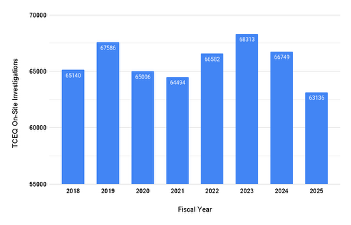
A report by Public Citizen’s TCEQ Watchdog Campaign using the TCEQ’s own publicly available data shows that in fiscal year 2025, the TCEQ continued a downward trend, conducting the fewest on-site investigations the agency has reported in eight years, including years when the COVID-19 pandemic made in-person investigations challenging. The number of 2025 investigations was 3,600 fewer than in 2024 and 5,200 fewer than in 2023.[33]
Table 1: TCEQ On-Site Investigations by Fiscal Year
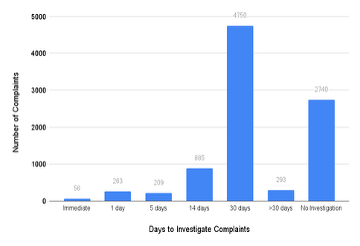
Despite foregoing several thousand investigations in 2025, the agency’s response to reported environmental concerns remained significantly delayed. TCEQ received 9,200 complaints. Of those, investigators responded to just 300 (3%) within one day. The agency took up to two weeks to investigate nearly 900 of the complaints (10%), and the remaining 5,000 (54%) took 14-30+ days to initiate an investigation. The agency closed more than 2,700 complaints (30%) without ever investigating them.[34]
Table 2: 2025 TCEQ Complaint Response Times
TCEQ issued just 1,170 enforcement actions in 2025. The agency’s Annual Enforcement Report states that it aims to issue just 1,000 administrative orders each year and reports that it “consistently meets” that goal.[35] But there are 830,000 regulated entities in Texas, according to TCEQ’s most recent Legislative Appropriation Request.[36] This means that only 0.14% of all polluters in Texas received any formal enforcement action.
In 2025, the TCEQ struggled to process its extensive backlog of enforcement cases. The TCEQ started the year with a backlog of 1,432 cases and resolved only 39. At that rate, the backlog will take 35 years to resolve, not including any new enforcement cases. The problem is almost entirely of the agency’s own making – a failed enforcement policy among many that continue to erode public confidence in the agency.[37]
The TCEQ’s failures translate to poor outcomes for clean air and clean water in Texas. The TCEQ has a key performance measure to determine the “Percent of Texans living where the air meets federal air quality standards.” The TCEQ’s target was just 43%. It achieved 42% of that goal.[38] In 2021, the agency’s target for that goal was 100%.[39] Over the past decade, the agency has not achieved greater than 45% of this goal for clean air.[40] So instead of continuing to work toward actions that would help the agency meet that goal for Texans, TCEQ simply lowered the bar for itself.
Similarly, in 2025, TCEQ failed to meet another key performance measure regarding the “Percent of stationary and mobile source pollution reductions in ozone non-attainment areas.” Instead, air pollution increased.[41]
The TCEQ issued approximately 760 water quality permits last year.[42] That was approximately 90% of its target for that goal. TCEQ has a key performance measure to determine the “Percent of Texas classified surface waters meeting or exceeding water quality standards”. TCEQ almost met its unimpressive target of 54%.[43] TCEQ failed to meet its goal to reduce pollution from permitted wastewater facilities discharging to waters of the state. Instead, wastewater pollution increased.[44]
The TCEQ’s leadership expressed little interest in concerns that the agency’s enforcement resources are insufficient, approving a new Legislative Appropriations Request for FY 2028-2029 that failed to increase agency funding for enforcement to account for the significant increase in the number of regulated entities across the state or to improve the agency’s poor performance across its enforcement activities.[45]
Texans don’t trust the TCEQ to protect the environment, to protect public health or to protect their right to be heard. And despite laws mandating agency reforms of public participation, communities continue to fight the TCEQ for meaningful opportunities to participate.
For these reasons, we believe that the TCEQ’s discretion is an inadequate substitute for the enforceable federal protections presently afforded to the public by the Clean Air Act.
III. Conclusion
EPA’s Proposal fails to acknowledge or consider the legitimate reliance interests of the public, contains inadequately supported assertions purportedly based on information EPA fails to disclose to the public, and contains baseless and offensive statements EPA fails to support with any factual information. EPA asserts its discretionary authority to modify federal rules in a way that blatantly disregards public health outcomes, despite EPA’s clear mandate in the CAA that EPA assure maintenance and attainment of the NAAQs for the protection of public health.
By restricting community participation to favor polluting industries, the rule abandons the EPA’s core mandate, threatens public health and undermines environmental protections. In a press release posted to EPA’s website several days prior to the rule’s publication in the Federal Register, EPA stated that this rule’s intent is to “speed up permitting” and to “support American economic development and energy dominance.” [46]
EPA mischaracterizes necessary public oversight as an obstacle to economic growth. Rather than seeing public participation as a necessary tool to strengthen the permitting process, EPA has framed it as a hindrance to industry’s ability to profit more and faster.
This Proposal is nothing more than a shameless surrender to polluters, intended to fast-track permits for industry by silencing community voices at the expense of clean air and public health.
The EPA should withdraw this proposal.
Kathryn Guerra
TCEQ Campaign Director | Public Citizen
[email protected]
309 E. 11th Street, Ste. 2, Austin, TX 78701
www.citizen.org/texas
Jennifer M. Hadayia, MPA
Executive Director
Air Alliance Houston
2520 Caroline St. #100, Houston, TX 77004
airalliancehouston.org
Cliff Kaplan
Secretary
Texans for Responsible Aggregate Mining (TRAM)
PO Box 90293, Austin, TX 78709
tramtexas.org
Tracy Wallace
Vice Chair
City of Dallas Environmental Commission
1500 Marilla St, Room 7A North
Dallas, TX 75218
dallasclimateaction.com
Jeffrey Jacoby
Co-Executive Director
Texas Campaign for the Environment
8627 North MoPac Expy, Ste 250
Austin, TX 78759
texasenvironment.org
Liz Mendoza
Dallas Co-Coordinator
Sunrise Movement Dallas
hubs.sunrisemovement.org/dallas
[1] See https://www.federalregister.gov/documents/2026/07/07/2026-13667/minor-new-source-review-program-air-permitting-public-participation-requirements-for-state
[2] See https://www.govinfo.gov/content/pkg/FR-1996-10-08/html/96-25469.htm
[3] See https://www.ecfr.gov/current/title-40/chapter-I/subchapter-C/part-51/subpart-I/section-51.161
[4] Ibid.
[5] Ibid.
[6] Ibid.
[7] See https://www.federalregister.gov/documents/2026/07/07/2026-13667/minor-new-source-review-program-air-permitting-public-participation-requirements-for-state
[8] See https://www.epa.gov/air-quality-management-process/managing-air-quality-public-participation
[9] See https://www.regulations.gov/document/EPA-HQ-OAR-2025-1212-0006
[10] See https://www.federalregister.gov/documents/2026/07/07/2026-13667/minor-new-source-review-program-air-permitting-public-participation-requirements-for-state
[11] See https://www.ecfr.gov/current/title-40/chapter-I/subchapter-C/part-70/section-70.2
[12] See https://environmentalintegrity.org/news/environmental-groups-take-legal-action-against-illegal-data-center-and-power-plant-projects-in-san-antonio/
[13] See https://www.regulations.gov/document/EPA-HQ-OAR-2025-1212-0006
[14] See https://www.govinfo.gov/content/pkg/USCODE-2013-title42/html/USCODE-2013-title42-chap85-subchapI-partA-sec7410.htm
[15] Ibid.
[16] See https://www.epa.gov/air-quality-implementation-plans/basic-information-about-air-quality-fips
[17] See https://www.federalregister.gov/documents/2026/07/07/2026-13667/minor-new-source-review-program-air-permitting-public-participation-requirements-for-state
[18] See https://www.epa.gov/green-book
[19] https://www.federalregister.gov/documents/2026/07/07/2026-13667/minor-new-source-review-program-air-permitting-public-participation-requirements-for-state
[20] See https://www.epa.gov/children/childrens-unique-vulnerabilities-environmental-hazards
[21] See https://www.epa.gov/children/executive-order-13045-protection-children-environmental-health-risks-and-safety-risks
[22] See https://www.epa.gov/children/childrens-environmental-health-facts
[23] Ibid.
[24] See https://environmentalintegrity.org/reports/state-of-decline
[25] See https://www.youtube.com/live/FbRcm9ScsVc
[26] See https://www.epa.gov/system/files/documents/2026-07/pre-registered-speaker-list-in-approximate-order.pdf
[27] See https://www.sunset.texas.gov/public/uploads/2023-08/Texas%20Commission%20on%20Environmental%20Quality%20Staff%20Report%20with%20Final%20Results_6-26-23.pdf
[28] See https://capitol.texas.gov/tlodocs/88R/billtext/pdf/SB01397F.pdf#navpanes=0
[29] See https://www.tceq.texas.gov/downloads/agency/decisions/agendas/backup/2023/2023-1506-rula.pdf
[30] See https://www.citizen.org/news/tceq-adopts-public-participation-rulemaking-while-rejecting-all-of-the-publics-participation/
[31] See https://www.sierraclub.org/texas/blog/2023/11/more-half-texans-live-areas-unsafe-ozone-levels-which-rise-temperatures
[32] See https://www.tceq.texas.gov/downloads/agency/administrative/legislatively-mandated-reports/sfr-55-25-annual-report-on-performance-measures-fy25.pdf
[33] Ibid.
[34] Ibid.
[35] Ibid.
[36] See https://www.tceq.texas.gov/downloads/agency/decisions/work-sessions/backup/2026/2026-0529-mis.pdf
[37] https://www.citizen.org/news/tceq-2025-a-year-in-review-of-the-reluctant-regulator; https://www.tceq.texas.gov/downloads/compliance/enforcement/actions-reports/aer/fy2025/2025-enforcement-report.pdf
[38] https://www.tceq.texas.gov/downloads/agency/administrative/legislatively-mandated-reports/sfr-55-25-annual-report-on-performance-measures-fy25.pdf
[39] See https://wayback.archive-it.org/414/20250908000018/https://www.tceq.texas.gov/downloads/agency/administrative/legislatively-mandated-reports/sfr-55-21-annual-report-on-performance-measures-fy21.pdf
[40] See https://www.tceq.texas.gov/agency/administrative/quarterly-reports-on-key-performance-measures
[41] See https://www.tceq.texas.gov/downloads/agency/administrative/legislatively-mandated-reports/sfr-55-25-annual-report-on-performance-measures-fy25.pdf
[42] Ibid.
[43] Ibid.
[44] Ibid.
[45] See https://www.tceq.texas.gov/downloads/agency/decisions/work-sessions/backup/2026/2026-0529-mis.pdf
[46] See https://www.epa.gov/newsreleases/epa-proposes-streamline-state-and-local-permitting-process-minor-sources