Civil Wrongs: Meet the Attorneys Harmeet Dhillon Installed to Turn the Civil Rights Division Against Its Mission
By Zach Everson
Introduction
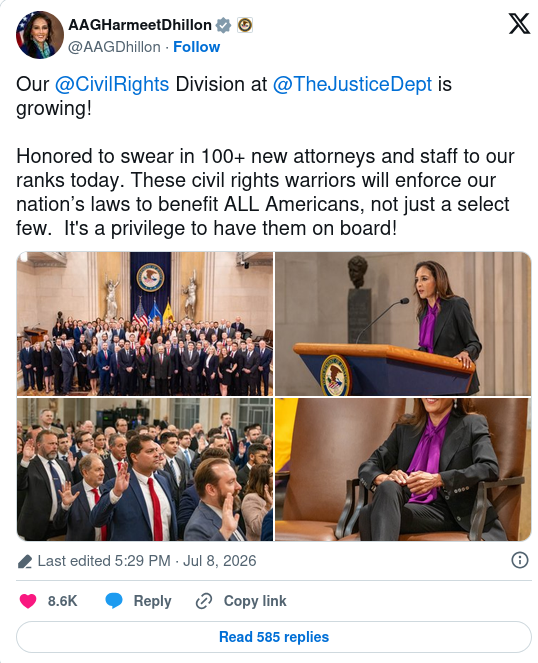
On July 8, 2026, Assistant Attorney General Harmeet Dhillon tweeted that she had sworn in more than 100 new attorneys and staff members in the Justice Department’s Civil Rights Division, which is responsible for protecting “the civil and constitutional rights of all persons in the United States by enforcing anti-discrimination laws.” Alongside two portraits of herself presiding over the ceremony, Dhillon posted two group shots of her new charges.
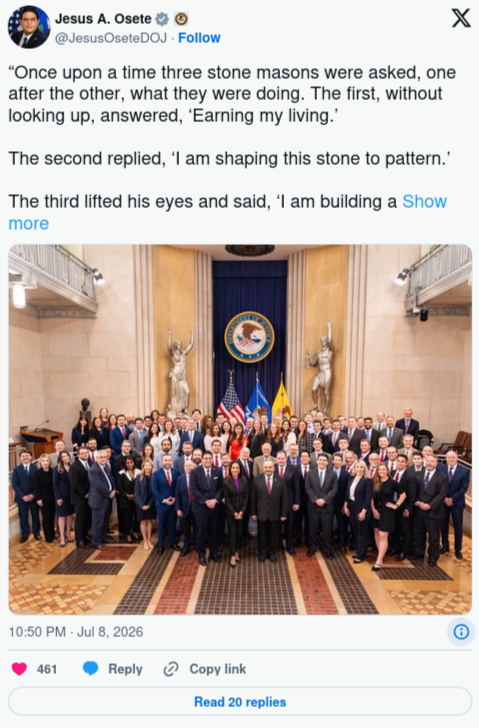
Her top deputy, Jesus Osete, marked the occasion by likening the new hires to stonemasons building a cathedral.
These hires aren’t in addition to existing staff, but rather they are replacing employees in a division that has been decimated under Trump. By July 2025, 98 attorneys or other staff members resigned or retired while another 270 accepted deferred retirement, according to the Justice Department.
Beyond calling them “civil rights warriors,” though, Dhillon did not identify any of the almost all-white, mostly male group that she said would “enforce our nation’s laws to benefit ALL Americans, not just a select few.” But the division’s court filings shed some sunlight on who’s been tasked to implement President Donald Trump and Project 2025’s civil-rights agenda.
Between the published photo and the department’s court filings, Public Citizen identified 11 of the attorneys Dhillon has installed to remake the division. This report profiles those 11, along with Dhillon herself. Of the 11, at least five arrived with documented records of misconduct, controversy, or extraordinary hiring irregularities.
Leadership
Harmeet Dhillon, assistant attorney general for the civil rights division
While Dhillon isn’t a new hire, she is the one who administered their oath. Having overseen both the hollowing out of the division’s career ranks and the installation of those refilling them, she is the architect of everything that follows.
Dhillon was confirmed in April 2025 in a near-party-line 52–45 vote, with one Republican crossing over. Dhillon founded the Dhillon Law Group in 2006 in San Francisco. There, her firm represented former Google engineer James Damore after the company fired him for penning a 10-page screed against the company’s diversity efforts; the Republican National Committee, alleging Google discriminated against it in the runup to the 2022 midterms; and descendants of the first chief justice of the state of California’s Supreme Court, Serranus Clinton Hastings, after UC Hastings College of the Law in San Francisco removed his name amid revelations that he had “support[ed] atrocities against Native Americans.” Other clients included President Donald Trump, Project Veritas, and Tucker Carlson.
Dhillon also founded the Center for American Liberty, which purports to defend “the civil liberties of Americans left behind by civil rights legacy organizations.” Weeks after Dhillon took over, the Civil Rights Division moved to tear up consent decrees with prejudice in Minneapolis and Louisville, reached after the murders of George Floyd and Breonna Taylor. It also retracted Biden-era findings of unconstitutional policing in those cities, and closed similar investigations into six more police departments.
Jesus Osete, principal deputy assistant attorney general for civil rights
Osete was sworn in to the division’s second-highest job in August 2025. Previously he served in Missouri’s attorney general offices, where he personally argued the state’s challenge to the federal healthcare-worker COVID vaccine mandate before the Supreme Court (Biden v. Missouri, 2022). Osete also attended meetings, beginning in fall 2025, of lawyers whom Trump tasked to reinvestigate his 2020 loss, according to ProPublica. Those meetings preceded the FBI’s seizure of approximately 700 boxes of election records from Fulton County, Georgia in January 2026.
Jeffrey Morrison, deputy assistant attorney general for civil rights
Morrison was a career Justice Department attorney whose status has skyrocketed under Trump. After Trump’s 2024 election, Morrison, with help from the anti-union National Right to Work Foundation, filed a challenge at the Federal Labor Relations Authority in early 2025 to block his colleagues from unionizing. His challenge went nowhere, but his status did: by August 2025, he had been tapped to serve as acting chief of both the Civil Rights Division’s Employment Litigation and Educational Opportunities Sections. And by May 2026, he had been elevated to Deputy Assistant Attorney General and is listed as counsel on the department’s Title VI suit against the University of California.
Eric Sell, deputy assistant attorney general for civil rights
Sell followed Dhillon to Justice from the Center for American Liberty, where he had spent almost three years as an associate litigation counsel and served as counsel for a Chico, California mother who sued her daughter’s school district over a policy that allowed students to socially transition without notifying parents. At the Justice Department’s Civil Rights Division, he has worked on its Title VII suit against Minnesota’s affirmative-action program.
Matthew Zandi, chief of staff and special counsel
Zandi’s specialty—the False Claims Act, an 1863 law that says anyone who submits false claims to the government is liable for three times the government’s damages, plus penalties—has become one of the division’s sharpest new tools under Trump. In May 2025, the Justice Department announced its “civil rights fraud initiative”—which then-Deputy Attorney General Todd Blanche said would target “inherently divisive policies like DEI” among recipients of federal funds—by using the False Claim Act to launch investigations and pursue claims for violating civil rights laws.
Section Chiefs and Senior Counsel
Barry Arrington, acting chief of the Second Amendment section
Arrington leads the new Second Amendment Section, as the Civil Rights Division under Trump has expanded its mission to “ensure that law-abiding American citizens may responsibly possess, carry, and use firearms.” To that end, Arrington’s section investigates law-enforcement agencies and searches for litigation opportunities, working to “advance a broad interpretation of the Second Amendment.” Previously, in private practice, Arrington represented Rocky Mountain Gun Owners in its 2019 lawsuit seeking to overturn a Colorado law banning large-capacity gun magazines; served as co-counsel for the plaintiff in Chiles v. Salazar, the challenge to Colorado’s conversion-therapy ban that the Supreme Court decided in 2026; and represented a Colorado charter school that refused to let the class valedictorian deliver a graduation speech in which he came out as gay. He also represented Sidney Powell in the defamation suit brought by former Dominion Voting Systems executive Eric Coomer over 2020 election conspiracy theories.
Eric Neff, acting chief of the voting section
Neff came from the Los Angeles County District Attorney’s office, where in October 2022 he charged the CEO of the election-software company Konnech, Eugene Yu, with storing information about Los Angeles poll workers on Chinese servers. The investigation had been sparked by the election-conspiracy group True the Vote. Within weeks, the District Attorney’s office moved to dismiss the charges, citing potential bias in how the evidence had been presented. Neff was placed on administrative leave, and Los Angeles County paid $5 million to settle Yu’s civil-rights lawsuit and publicly declared his innocence. He now oversees the section of the Civil Rights Division that “enforces the civil provisions of the federal laws that protect the right to vote” and signs the division’s lawsuits demanding voter rolls.
Gregory Dolin, senior counsel
Dolin comes out of the conservative legal movement’s campaign against the administrative state, having served as an adjunct scholar at the Cato Institute and on the executive committee of the Federalist Society’s administrative law and regulation practice group. Before the DOJ, he was senior litigation counsel at the New Civil Liberties Alliance—an anti-regulatory group backed by Charles Koch and entities tied to Leonard Leo, according to Bloomberg Law. There he represented suspended Federal Circuit Judge Pauline Newman, a Reagan appointee in her late 90s, whose colleagues barred her from hearing cases in 2023, after she refused cognitive testing—in her unsuccessful argument that she could be removed only by impeachment. Dolin, who condemned the administrative removal of a judge without due process, now serves an administration that has driven out officials and career staff en masse. Dolin is listed as counsel on the division’s Title VII suit against Minnesota’s affirmative-action program.
Daniel Flickinger, senior counsel, educational opportunities section
In 2020, Flickinger was forced to resign from a Birmingham, Alabama, law firm over his Facebook post about the murder of George Floyd. According to the Alabama Supreme Court’s opinion in a defamation suit Flickinger later filed, the post read,
“Things I think about: If I were a seven-time felon, with my most recent prison stint stemming from robbing and holding a pregnant woman at gunpoint in her home, would I choose to die in a fentanyl and methamphetamine numbed strangulation if it meant being worshipped in a nationwide funeral and my family receiving millions of dollars? Purely hypothetical.”
He now helps run the federal office that polices civil-rights compliance on campuses.
The Rank and File
Greta Gieseke, attorney
Gieseke has drawn congressional scrutiny for how she was hired. According to Sen. Peter Welch, D-Vt., she was brought on as a career trial attorney with just 11 months of non-clerkship legal experience and then immediately detailed to Dhillon’s office in August 2025—despite an internal policy requiring three years of service before being eligible for detail to another section. She has been counsel on the department’s Title VII suit against Minnesota’s affirmative-action program and its intervention in California’s voter-approved congressional redistricting.
David Goldman, trial attorney
A 2019 University of Virginia law graduate and clerkship chair of the school’s Federalist Society chapter, Goldman clerked for two Trump appointees to the federal courts of appeals—Judge David Stras and Judge Amul Thapar, who has appeared on Trump’s 2016 Supreme Court shortlist. As a Civil Rights Division trial attorney, he is one of the lawyers representing the United States in its intervention against California’s voter-approved congressional map, which the department is challenging as an unconstitutional racial gerrymander.
Joshua Zuckerman, trial attorney
Zuckerman helped run his law school’s Federalist Society; clerked for Judge Diane Sykes, a conservative on the Seventh Circuit; and spent four years at the law firm Gibson Dunn before joining the division as a trial attorney in August 2025. Within months he was staffing its most politically charged cases: he signed the department’s Title VI suit against Regents of the University of California, and was among the counsel on its intervention to overturn California’s voter-approved congressional map and its admissions-records suit against Harvard.
Conclusion
The 11 attorneys profiled here are a fraction of the more than 100 Harmeet Dhillon swore in, but their records point in a single frightening direction: A division created to protect America’s most vulnerable has been gutted and refilled with lawyers drawn largely from the conservative legal movement, several carrying documented histories of controversy, others with limited experience. They are implementing the division’s new mission by suing states for voters’ personal data; intervening to block a voter-approved congressional map; and turning anti-discrimination laws against DEI programs, transgender people, and universities. Meanwhile, as Public Citizen has documented, the division has walked away from its traditional calling, for example, freezing its case against SpaceX and other corporate defendants in the administration’s first days.
What’s happening at the Civil Rights Division follows the Project 2025 playbook Public Citizen has traced across the government: the record purge of inspectors general and the installation of industry insiders in the agencies meant to police them. Who these 12 people are matters. The work they do will outlast this administration. Congress, the courts, and the public can hold accountable only those they can name.