Trump Administration Global Health Agreements: Negotiation Tracker
By Emily Bass, author of the “To End A Plague: Again” Substack and Public Citizen
Following the dismantling of USAID and large-scale disruption to US foreign assistance programs that supported HIV/AIDS, tuberculosis, malaria and more, the Trump administration is restructuring health aid according to its America First Global Health Strategy (AFGHS). Under the strategy, the US Department of State is signing multi-year Memoranda of Understanding (MoUs) with dozens of countries. The administration is negotiating these agreements on rapid timelines, with limited transparency and minimal stakeholder engagement, despite their significance to the operation of future health funding.
The Public Citizen “Negotiation Tracker” is a living document analyzing the available MoUs. The Tracker is based on analysis of current publicly-available MoUs (and, where relevant, available specimen and data sharing agreements) and will be updated as more agreements become available. Each MoU is based on a standard template, created by the US Department of State, that includes prespecified requirements and stipulations ranging from process and outcome metrics to changes in national regulatory policy to consequences for missing milestones and performance incentives.
The Tracker identifies areas where the standard template terms have been changed in the agreement with a specific country. It is designed to support country-level advocacy and action for more equitable agreements by identifying the areas where countries appear to have been able to negotiate changes that are less stringent or extractive and/or more tailored to country contexts. It may be possible to re-negotiate MoUs and to update approaches during the implementation planning phases.
The Tracker is also designed to identify potentially adverse consequences of the US approach to implementing the America First Global Health Strategy. Setting variable terms for information sharing, performance incentives and consequences through individually-negotiated, non-transparent agreements can undermine regional capacity for coordination on cross-border public health and health systems strengthening activities.
- Countries are not being held to the same standards or receiving comparable benefits;
- Variation in process and outcome metrics complicates regional harmonization and evaluation of the America First Global Health Strategy’s efficacy and impact;
- Country-by-country terms and definitions for global health security collaboration differ, which may undermine regionally and globally coherent disease response; and
- Variation across MoUs shows that countries have opportunities to negotiate improved terms, additional benefits or revised metrics.
Each publicly available MoU was independently reviewed by two researchers, using the template MoU as a reference. The review focused on areas where pre-specified language was substantively altered or removed. Narrative elements responsive to MoU template questions and requests for explanation were not included in the analysis. By definition, each country’s narrative answers will vary. Reviewers did include instances of entirely new language that was not responsive to any question, and for which there was no analogous content in other MoUs. These instances included additions to the process and outcome metric tables, and in the body of the text. Each reviewer’s analysis was entered into a shared document, with differences in interpretation discussed and analyzed.
A review of nine America First Global Health Strategy (AFGHS) MoUs, comparing the standard template with finalized country agreements, reveals extensive variation across multiple domains—often without any clear or consistent rationale tied to epidemiology, national health budgets, or other objective criteria. Across issues including co-financing penalties, data and specimen sharing requirements, evaluation frameworks, and process and outcome metrics, country-level agreements diverge significantly from the template and from one another. In some cases, these differences appear arbitrary; in others, they reflect deliberate country-led modifications that introduce flexibility or align provisions more closely with national priorities and contexts.
For example, penalties for failing to meet co-financing commitments range from no specified consequence to 1:1 or even 2:1 funding reductions, with no transparent logic guiding their application across countries. Similarly, while most agreements retain strict language around termination for failure to comply with data and specimen sharing requirements, some countries have successfully softened this language, framing termination as a “last resort.” Countries have also consistently reduced the duration of data and specimen sharing agreements from the 25-year template to shorter timeframes, often with renewal provisions. Variability extends to evaluation: funding for outcome surveys ranges widely, and inconsistent approaches risk undermining the ability to assess overall program impact. At the same time, countries have actively adapted process and outcome metrics—adding indicators, refining age disaggregation, or removing irrelevant measures—demonstrating responsiveness to local epidemiological and system realities.
Two overarching conclusions emerge. First, by structuring these agreements as opaque, bilateral deals, AFGHS architects are not only missing an opportunity for alignment, standardization, and shared learning—they are actively limiting it. Immediate public release of all MoUs, along with the associated data and specimen sharing agreements, is essential to enable transparency, cross-country comparison, and the identification of best practices that could strengthen both country outcomes and the overall return on global health investments.
Second, the agreements demonstrate that countries do have some degree of agency within this process. Governments have secured more favorable and/or flexible terms, even as others have adopted more stringent conditions. Key provisions including areas for investment beyond the MoUs, domestic manufacturing and purchase of locally manufactured goods were introduced in some instances, and omitted in others.
Both findings underscore the importance of continued, strategic engagement to identify and leverage entry points where country priorities can be asserted, including those that reflect the public health needs and evidence-based program approaches for people most impacted by health inequities.
The Tracker below shows changes across several content areas in the finalized country agreements compared to the standard template.
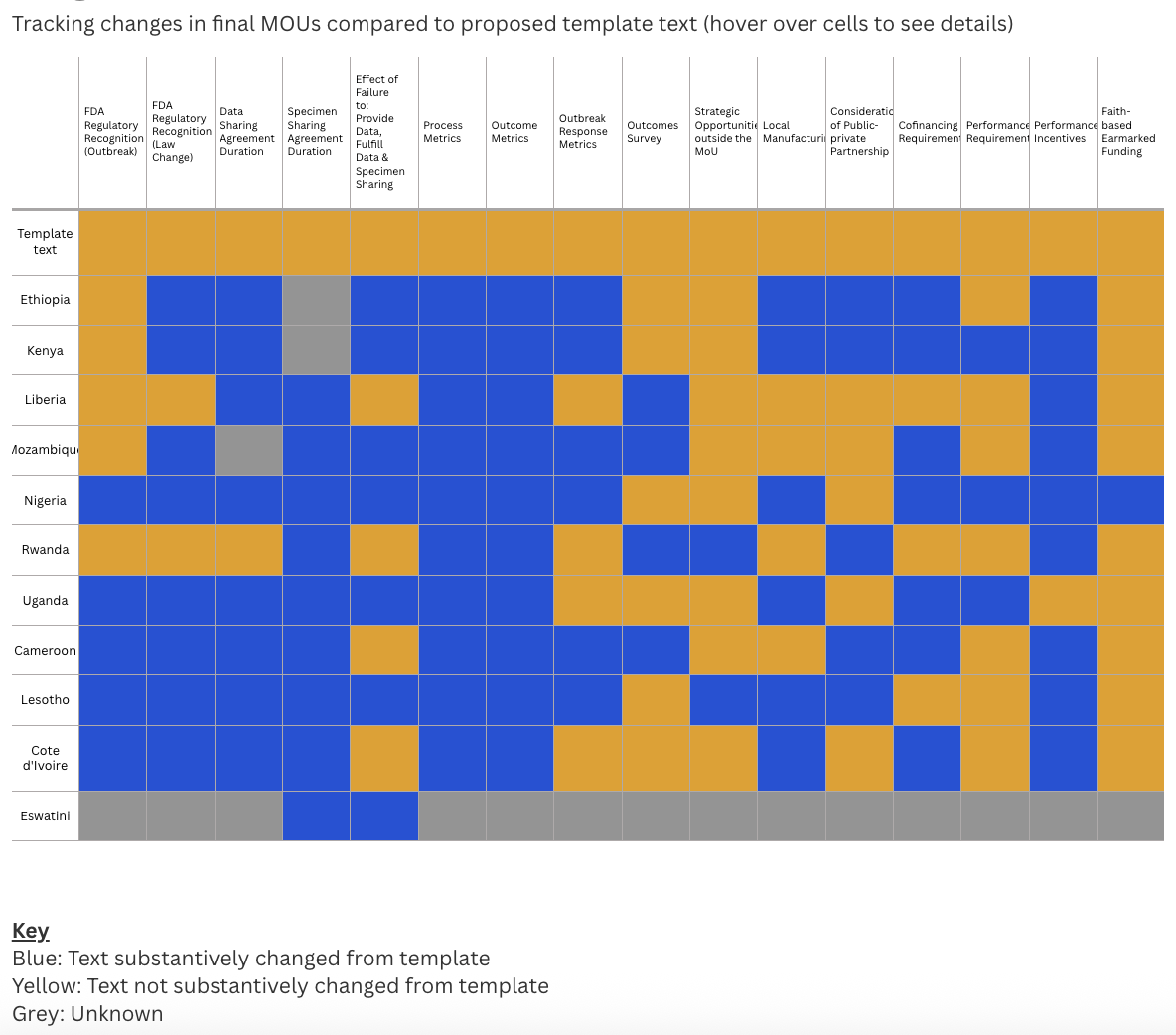
The interactive version of the Tracker is also available here.
Summary by Content Area
- Regulatory Recognition
Countries are drawing distinctions between outbreak, public health emergency and routine regulatory recognition.
Most countries accepted the template provision related to recognition of US Food and Drug Administration (FDA) approval in the context of outbreak responses, when countermeasures might need to be deployed with speed; more countries made adjustments in the template language related to broad regulatory recognition of US FDA approval.
Background: Many low and lower-middle income countries signing MoUs under the America First Global Health Strategy rely on or consider regulatory approvals from robust regulatory authorities such as the US FDA, the European Medicines Agency, and the South African Health Products Regulatory Authority, and on pre-qualification by the World Health Organization. These approvals often inform in-country approval and product registration. There is no precedent for the US requiring countries receiving global health foreign assistance to also recognize US FDA approval. The provision is non-reciprocal, unlike a Mutual Recognition Framework approach in which the US establishes agreements with other countries and each party agrees to recognize and use information gathered by the other’s regulatory reviews. Accelerated approval in the context of outbreaks and public health emergencies can support swift deployment of medical countermeasures newly identified for the health emergency (e.g., SARS CoV-2 vaccine) or not previously deployed in a particular country for a specific indication (e.g., MVA-BN vaccine for mpox). A requirement of regulatory recognition for all US products (versus, for example, products relevant to the activities in the MoU) effectively ensures that US companies have market access, and this may be the intention of the broad provision, given that the guidance document that accompanied the template MoU clarified that this provision should be included for countries with “large domestic markets” or “for which there are other strategic reasons.” The US government’s recent attempts to compel countries to automatically accept all US regulatory approvals, as shown in the MOU template and in similar provisions in recent trade agreements, raises concerns about US pressure on countries’ regulatory autonomy and about the potential for automatic acceptance of US authorizations to over-emphasize less-rigorous accelerated review pathways and undermine locally-manufactured products.
What we found: Countries largely accepted the proposed provision providing for recognition in the context of outbreak response; though some countries that accepted the provision also added references to coherence with local laws (Kenya, Mozambique, Ethiopia) or “mutual recognition and reliance” (Rwanda). Additionally, while the template sought a separate provision providing for the modification of regulations or laws to allow for broader recognition of US FDA approvals for medical products, several countries removed this commitment, often removing the provision entirely or altering the template language to add references to reliance frameworks, collaboration to expedite reviews and approvals, and coherence with local laws and processes.
- Data and Specimen Sharing Agreements and Compliance
A. Variability in the effect of failing to share data and meet terms of data and specimen sharing agreements.
While most country MoUs retained the template text that failure to meet these terms could result in termination of the MoU, two contain wording that provides countries with more flexibility, that is, stipulating that termination is a last resort. Additional countries have added similar flexibility in their separate Specimen Sharing Agreements, even if this flexibility did not appear in the related MOU text.
Background: Countries signing MoUs also develop and sign separate data and specimen sharing agreements. The templates for these separate agreements are publicly available, and each specifies sharing for 25 years, whilst also stating that the sharing is solely for the purposes of auditing and monitoring the activities in the MoUs. The agreements are separate documents, and only a few are in circulation at present; civil society has raised serious concerns regarding the provisions in the template versions of these agreements. However, each MoU does have a section on the consequences of failing to meet the terms in the separate data and specimen sharing agreements. The boilerplate language states that failure to fulfil the commitments could result in changes to the planned assistance and/or discontinuation of the MoU.
What we found: Where the language was edited or removed, the changes introduced flexibility and/or softened the consequences of non-compliance with the agreements. Countries that negotiated changes in the duration of the data and/or specimen sharing agreements did not uniformly negotiate changes in the consequences section.
B. All of the countries for which data are available reduced the duration of the specimen sharing agreement; the majority of countries for which data are available reduced the duration of the data sharing agreement.
Background: All countries signing MoUs are required to develop and sign agreements related to US government access to a specified set of data systems related to the functioning of the MoU, and to specimens, sequences and other data collected as part of public health surveillance. These agreements stand apart from the MoU itself, and most are not available in wider circulation. The template specified 25 year durations for both agreements, even though the text of these agreements tied access to the implementation of the MoUs, which last for five years or less.
What we found: For both agreements, reductions from the 25 year duration in the template include 10 year and seven year agreements, sometimes with an opportunity for renewal.
- Process and Outcome Metrics and Assessments
A. Variability in funding levels and plans for outcome surveys.
Funding amounts and plans for conducting surveys to assess health outcomes related to investment vary between countries. Without equity and some standardization in approach, these surveys, which total roughly $156 million, will not provide clarity on the efficacy and impact of the America First Global Health Strategy.
Background: Evaluation of the impact of health-related investments has been one of the hallmarks of the US President’s Emergency Plan for AIDS Relief (PEPFAR) and the President’s Malaria Initiative. These evaluations complement the collection and analysis of health data through government systems. They can include household surveys and sample collection, as in the case of the Population-based HIV Impact Assessments (PHIAs), site level sampling and other methodologies. The new approach to funding health activities includes a dramatic shift in the level and scope of data to be collected as process and outcome metrics. Surveys of impact conducted that are both context-specific (reflecting country priorities and capacities) and, in some respects, standardized and/or comparable, would be highly valuable. Cross-comparison of outcomes in countries receiving support under the AFGHS could identify areas of best practice and areas where a given approach needs to be revisited.
What we found: Most countries’ agreements retained template language of $10 million per round for two survey rounds. In Liberia, funding per round dropped to $1.5 million per round; in Mozambique a total amount of $35 million is allocated for assessments. Cameroon’s MoU includes additional language about joint protocol development and protection of information related to the military and national security.
B. Countries have added process and outcome metrics that improve the template set, including age disaggregations, coverage of health insurances, and frequency of stock outs.
Failure to transparently share and align approaches, for instance by providing co-signatory countries and regional public health entities the opportunity to identify a core set of common indicators, weakens the ability to tie investment to impact and identify best practices.
Background: The process and outcome metrics tables in the MoU template propose a set of measurable indicators for tracking the progress and success of each MoU. “Unmeasurable and Unaccountable,” an amfAR analysis of these metrics, details the extent to which the template metrics are ill-defined, problematic or manipulable. For example, in the instance of new diagnoses of children living with HIV, “targets” that decline year on year for the duration of the MoU could be inadequate if the rates of testing coverage for children are low. Increasing testing coverage could result in increased numbers of diagnoses. The standard metrics also include two age bands: 0-12 months and 12 months and older, a departure from decades of evidence-based epidemiology that tracks rates of new HIV infections, initiation on treatment and virologic suppression by gender, granular age bands, and other characteristics, in order to tailor and target programming.
What we found: Every country made changes to the process and outcome metrics, including, in some instances, re-introduction of age bands, addition of new metrics such as uptake of health insurance or stock outs, and removal of others, such as malaria cases, in geographies where malaria is not endemic. The addition of new metrics is very likely a reflection of countries’ priorities and contextual considerations. Exclusively bilateral planning without transparency and opportunities for alignment of approach and exchange of ideas between countries undermines the potential impact of the investment.
- Strategic Opportunities, Beneficial Provisions and Market Access
The MoU template did not include specific language on opportunities beyond the scope of the MoU, preferential purchase of locally manufactured goods, or support for local manufacturing. These and other provisions were added to select countries’ MoUs.
Background: The architects of the America First Global Health Strategy have explicitly stated that the new era of foreign aid for global health will be transactional, with countries committing to co-financing, market access, and data and specimen sharing in the text of the MoUs and annexes, and committing to mining concessions and mineral rights in agreements signed in proximity to the MoUs, though the conditions are not specifically mentioned in the health agreements (however, Zambia’s draft agreement, which has yet to be signed, included mining rights in the MoU text as a condition of funding). The baseline premise of the MoUs is that foreign aid for health is the primary offering from the United States. Other benefits or favorable provisions, or strategic linkages, for countries have not been specified as part of the overarching strategy.
What we found: Benefits and/or beneficial provisions appear in a limited selection of MoUs, with no clear rationale or criteria, and often with reference to the involvement of private sector companies or interested parties that remain unnamed. Selected commitments to purchase or support local manufacturing do not appear to relate to larger strategies or approaches for building regional capacity, and there are no consequences stated for the US if it fails to honor these commitments.
- Penalties and Incentives
Variability in consequences of failure to meet the co-financing requirement.
Consequences include 1:1, 2:1 reductions in funding, with a ratio related to funding shortfall.
Background: In the context of foreign aid for global health, “co-financing” refers to a government’s commitment to contribute its own resources to health activities or systems for which it is also receiving external funding. Co-financing has been a requirement for Global Fund and PEPFAR resources for many years without consequences related to failure to meet this requirement. The America First Global Health Strategy MoUs state the amount of funding the co-signatory government is expected to contribute for each year of the agreement. The MoUs also state that the co-investment may not include funding from other donors or multilateral organizations, but must be funds “raised directly” by the country in question.
The MoU template also lays out consequences for countries that do not meet this commitment. The template language says that the US “may unilaterally reduce or cease providing funding” if the co-investment is not made within the specified calendar year. This language is amended in individual country agreements, with variations including the penalty of reducing US spending by $1 for every $1 (or equivalent) of shortfall, or of a 2:1 reduction—in which the US would reduce funding by twice as much as the shortfall.
What we found: This tracker contains detailed information and analysis on the co-financing requirements as they fluctuate over time, and in relation to the country’s overall spending on health. There is no clear logic related to the imposition of specific penalties in different countries. In the absence of clarity and transparency about the rationale and criteria for establishing a specific approach to consequences, the US is creating the appearance, if not the reality, of preferential or lenient treatment for some countries and stringent, potentially punitive terms for others.
- Earmarks
Only one MoU (Nigeria) contains language specifying that a percentage of AFGHS funds will go to faith-based groups.
Background: Legally-binding earmarks for US-government funding can only be established through language in Congressional appropriations bills or other statutes—for example the law that established the President’s Emergency Plan for AIDS Relief (PEPFAR), which specified percentages of funding for orphans and vulnerable children programming, antiretroviral treatment and other areas when passed in 2003 and in subsequent reauthorizations. PEPFAR country planning letters (detailed directives sent from headquarters to country programs) and program-wide initiatives introduced “soft” earmarks that do not technically carry the force of law but which may be read as requirements by the co-signatory government nonetheless.
What we found: The Nigeria-US MoU states, “[t]he US government plans to allocate 10% (approximately $208M) of funding within this MOU to faith-based service delivery providers to compliment (sic) implementation…to the maximum extent permitted by US law.” The wording appears to reflect awareness of the constraints on Department of State earmarks of Congressionally appropriated funds. Use of faith-based groups to deliver services is emphasized in template language retained in other country plans. The introduction of the additional earmark language for Nigeria occurred in the context of President Trump singling out this country (across co-signatories) as the site of an ongoing “Christian genocide,” a claim used to justify US military action in late 2025.
In a detailed comparison of nine signed America First Global Health Strategy MoUs with the standard MoU template, we observe variation across a range of provisions that, taken together, introduces apparently arbitrary differences between countries—including those within the same region. Across domains such as co-financing, data and specimen sharing, evaluation frameworks, and process and outcome metrics, there is no clear or consistent rationale for these differences in relation to epidemiology, national health budgets, or other objective parameters. More than 30 MoUs have been signed to date, which the US Department of State has refused to make publicly available. It has also failed to timely disclose the agreements pursuant to Freedom of Information Act (FOIA) requests (Public Citizen filed a lawsuit to compel the Department of State to release the requested MoUs).
In the absence of clarity about how these negotiations transpired and what criteria were used to establish bespoke provisions and revisions, we are left with unexplained heterogeneity that seems to substitute public health best practices for deal making in ways that could undermine both impact and accountability.
COUNTRIES ARE NOT BEING HELD TO THE SAME STANDARDS.
We find that countries are not being held to the same standards. For example, Kenya and Uganda share a border, yet Uganda has the most stringent penalty for failure to meet co-investment requirements—a 2:1 reduction in US government funding in relation to any shortfall; Kenya’s penalty is 1:1. Three countries (Ethiopia, Kenya and Uganda) amended language related to the consequences of failure to adhere to specimen sharing agreements to introduce more leniency; one (Lesotho) removed the consequences altogether.
COUNTRIES ARE NOT RECEIVING THE SAME (OR COMPARABLE) ECONOMIC OR LOCAL MANUFACTURING COMMITMENTS.
We also find that countries are not being afforded the same benefits or special considerations. Rwanda is unique across all of the agreements in that its MoU notes more than $1.5 billion in soft commitments from unnamed private sector investors. Commitments to local manufacturing range from support in Lesotho for local assembly of HIV self test kits to a commitment to purchase 30% of commodities from local Nigerian manufacturers. It is not clear whether these commitments align to an Africa CDC, AFGHS, or other pre-existing, comprehensive strategy or plan for scaling local and regional capacity. In the past, for example, PEPFAR, under the leadership of Ambassador John Nkengasong, made commitments to scale regional manufacturing. Without additional context, it is difficult to assess whether the assorted commitments in the MoUs will contribute to a regionally cohesive, coordinated approach to locally-sourced commodities and regional pooled procurement.
VARIATION IN PROCESS AND OUTCOME METRICS COMPLICATES REGIONAL HARMONIZATION AND EVALUATION OF AMERICA FIRST GLOBAL HEALTH STRATEGY EFFICACY AND IMPACT.
Every country made adjustments to process and outcome metrics. Some countries, like Uganda, re-introduced age disaggregates. Others, like Ethiopia and Nigeria, included coverage rates of national health insurance schemes. It is encouraging to see instances that appear to reflect adaptation of the rigid, simplistic metrics tables to local circumstances or priorities. Unfortunately, countries did not have opportunities to compare approaches, exchange insights about priority indices, or harmonize a revised set of metrics to better support regional progress. In addition to variability across metrics, the MoUs also reflect variation in funding for outcomes assessments.
COUNTRY-BY-COUNTRY TERMS AND DEFINITIONS FOR GLOBAL HEALTH SECURITY COLLABORATION VARY.
Several countries adjusted template language requiring US notification of outbreaks of “epidemic” potential to better align with international norms established by the World Health Organization and supported by the International Health Regulations, both of which outline responsibilities for reporting outbreaks of diseases that pose national security threats and/or in the context of declared public health emergencies of international concern. Countries also adjusted and amended language relating to “collaboration and coordination” with the US government following notification. For the most part, these adjustments affirm that countries will use pre-established channels, national or international algorithms and/or definitions of notifiable events to structure their outbreak response actions, including in relationship to the United States. Reporting burdens are unevenly distributed. Countries that did not make these adjustments are committed to a more granular reporting (outbreaks of any type) and bilateral collaboration with the United States. This heterogeneity undermines AFGHS’s stated goal of making America ‘safer’ through robust attention to global health security following its departure from the World Health Organization.
By definition, secrecy works against standardization. The America First Global Health Strategy has sacrificed opportunities for harmonization to support regional objectives and American interests in favor of close-hold negotiations that yielded subtly but materially different arrangements with countries. While AFGHS architects have been unapologetic about deal-making as the new driver of global health aid, many of the differences do not benefit the American people and the people in the countries where these funds will be spent. Indeed, variations in what is measured and reported with regard to health security risks undermine American and regional safety and security.
OPPORTUNITIES EXIST FOR COUNTRY AGENCY AND ADAPTATION.
The level of modification across the MoUs shows a notable level of country agency in negotiating improved terms, additional benefits or revised metrics. These shifts affirm that space exists within the AFGHS for country-driven adjustments, including after the MoUs have been signed. It is essential that this space be maintained and made available to individuals and civil society organizations impacted by health inequities, stigma and discrimination, including people living with HIV, young people, sex workers, key populations including gay men and other men who have sex with men and transgender women.
- Immediately release all of the MoUs and Specimen and Data Sharing Agreements;
- Align country-by-country local manufacturing commitments and procurement approaches with relevant regional strategies and mechanisms to mitigate deleterious competition;
- Design and implement a process for revisiting process and outcome metrics to identify a core set of measurable, relevant, rights-based metrics to be assessed across all countries;
- Allow all countries that have not already done so to align all health security and surveillance commitments to WHO and IHR standards to minimize reporting burdens and disruption in the event of an outbreak of pandemic potential, or national or regional concern; and
- Build MoU adjustments into ongoing implementation planning processes that are open to communities impacted by health inequities, including civil society organizations with experience working with the Global Fund, PEPFAR, and national pandemic prevention, preparedness and response processes.