Billions Over Budget: LNG Projects Routinely Blow Past Cost Estimates
The U.S. natural gas boom faces costly delays and overruns, and banks big on demand.
By Lois Parshley and Mekedas Belayneh
The United States is now the fastest-growing exporter of liquefied natural gas. Though it did not export any liquified gas before 2016, the country now anchors the global trade as the largest producer in the world.
According to the U.S. Energy Information Administration, North America’s LNG export capacity is on track to more than double in the next three years. There are eight LNG export terminals currently operating, all concentrated in the Gulf Coast. Eight more are under construction, while nine additional facilities have been approved by the federal government but are not yet underway.
The money involved is staggering: tens of billions of dollars for the export terminals, thousands of miles of new pipeline, and an armada of specialized tankers that can cost upward of two hundred million dollars each.
Propping up this expansion is a powerful alignment of political and economic interests. The Trump administration has made LNG a cornerstone of its “energy dominance” agenda — exploiting American gas for political influence and corporate profit. On his first day back in office, Trump ordered the Department of Energy to end the Biden administration’s pause on new LNG export approvals, and resume considering pending applications. Since then, federal regulators have approved a string of major projects, including Venture Global’s CP2 terminal in Louisiana. By early 2026, the White House was celebrating record LNG shipments as evidence of its strategy’s success.
But this boom is occurring in a volatile global market. The war in Iran and the resulting disruption of shipping routes through the Strait of Hormuz unexpectedly removed about 20 percent of global LNG this spring, leading to a short-term supply crunch. Long-term, however, global LNG supply is still expected to outpace demand before 2030, well before many approved U.S. projects will come online.
Market forecasts are only one side of the equation. The other is whether the projects being approved can actually be built for the prices their developers promise. Before reaching a final investment decision, every LNG project requires a set of forecasts: how much it will cost to construct, how long it will take to complete, and what price its gas will sell for. Those assumptions determine whether financiers are willing to commit billions of dollars in capital. Because LNG terminals are among the most expensive industrial facilities in the world, even modest changes in construction costs can significantly alter their economics. A project that costs more than expected—or enters service later than planned—must generate additional revenue simply to achieve the returns promised to investors, making accurate cost estimates key to their viability.
The industry’s history suggests those estimates often bear a tenuous relationship to reality. In many cases, multi-billion-dollar cost overruns have materially changed the expected financial returns of these projects, creating risks for investors, local communities, and ratepayers alike.
North American LNG Cost Overrun Analysis
Public Citizen analyzed more than twenty terminals currently operating or under construction across the U.S., Canada, and Mexico. Project data was compiled from public filings, industry news, regulatory disclosures, and company announcements.
Among available data for operating terminals, the average cost overrun was 59.7 percent. Projects exceeded their initial estimates by a range of 8.1 to 169.2 percent. In the case of New Fortress Energy’s Fast LNG project in Altamira, Mexico, this led costs to soar from initial estimates of $1.3 billion to $3.5 billion, along with construction delays. Credit rating agency S&P later downgraded the company after it failed to make interest payments on its debts. New Fortress was forced into a sweeping restructuring in March of 2026, splitting the company in two, and transferring its Brazilian assets to creditors while diluting existing shareholders. This underscores how cost overruns in a single LNG project can cascade into larger corporate distress.
Cost pressures are not confined to completed terminals or past markets. Projects still under construction are also seeing substantial budget expansions. Among projects still being built, several have issued updated cost disclosures allowing initial overruns to be assessed prior to completion.
These range from 15 to 72.5 percent over budget, with an average overrun of 38.1 percent. For example, Venture Global’s Plaquemines terminal reached a final investment decision in 2022. Two years later, while still under construction, the company announced costs had jumped $2.35 billion over budget and could still rise. Wood Fibre LNG in British Columbia has similarly seen costs jump from $5.1 billion to $8 billion, and Cedar LNG, also in British Columbia, has risen from $4 to $5.9 billion before construction is complete.
Construction delays are also common, particularly on larger and more complex facilities. These ranged from approximately 1 to 3 years behind schedule, often accompanied with associated costs.
These numbers are consistent with historical norms for large-scale infrastructure projects. Oxford professor emeritus Bent Flyvbjerg previously found that over nine out of ten megaprojects go over budget, over schedule, or both, and that cost overruns “over 50 percent in real terms are common.” He dubbed this tendency the “Iron Law of Mega Projects.” Flyvbjerg also explained that the 50 percent figure understates the high-end risk of any given project: As cost overruns can be extreme, catastrophic overruns happen more often than standard distribution would predict. He identified the primary drivers of these increased costs were labor market conditions, contractor underperformance, supply chain disruption, and design immaturity at the time of estimations.
This leads to a systemic underestimation of project costs and an overestimation of benefits at the project approval stage, which already provides structural incentives to produce projects that look good on paper.
Within the oil and gas sector specifically, in 2014 consulting group EY found that 58 percent of North American projects faced cost overruns, while 55 percent of projects faced delays. When looking just at LNG projects globally, they found projects ran over budget by an average of 70 percent, more than other categories of oil and gas megaprojects.
The financial hazards in the LNG sector aren’t anomalies; they’re built into the business model. Yet political support for LNG and related infrastructure asks taxpayers to shoulder that risk, shifting it away from developers. Through tools like loan guarantees, export credit financing, accelerated permitting, and public-private investment vehicles, governments are effectively helping underwrite projects that remain highly exposed to cost overruns and construction delays.
While profits are privatized during periods of strong prices, subsequent losses are socialized through public financing mechanisms. For example, in Texas, Glenfarne Group’s proposed LNG terminal secured a local property tax abatement from Cameron County in 2024. Its construction will destroy Indigenous burial grounds, harm one of the last non-industrialized habitats on the Gulf Coast, and worsen climate impacts like flooding. Nevertheless, the county agreed to waive 40 percent of the project’s taxes, saving the company an estimated $34 million. The Sierra Club totaled the value of tax abatements through a similar state program for LNG terminals in Texas at $2.1 billion. Another terminal to benefit from Texas subsidies was Golden Pass LNG, a joint venture between QatarEnergy and ExxonMobil, which secured tax breaks from Jefferson County and the Sabine Pass Independent School District. Since then, its costs have grown from $9.25 billion to $11.6 billion, and it received a three-year schedule extension after its lead construction contractor filed for bankruptcy in 2024. The cost-shifting required to cover these abated taxes often falls disproportionately on lower-income residents through higher sales and property taxes.
Case Study: The Alaska LNG Project
The Alaska LNG project is an approximately 800-mile pipeline and export terminal designed to transport liquified natural gas from the state’s North Slope to Nikiski for export to Asian markets.
In 2025, the state gave a development contract to Glenfarne Group through a confidential, no-bid deal. Glenfarne has never operated a commercial LNG export terminal, and despite being authorized by FERC for years, its previous two LNG projects do not yet have final investment decisions, and have not started construction.
In 2018, state officials with the Alaska Gasline Development Corporation suggested that the Alaska LNG project would cost $43.4 billion, including a pipeline connected to the facility. Until the spring of 2026, Glenfarne claimed that was still an accurate assessment. It hired a consultant in 2025 to revisit these calculations, but refused to release these numbers publicly.
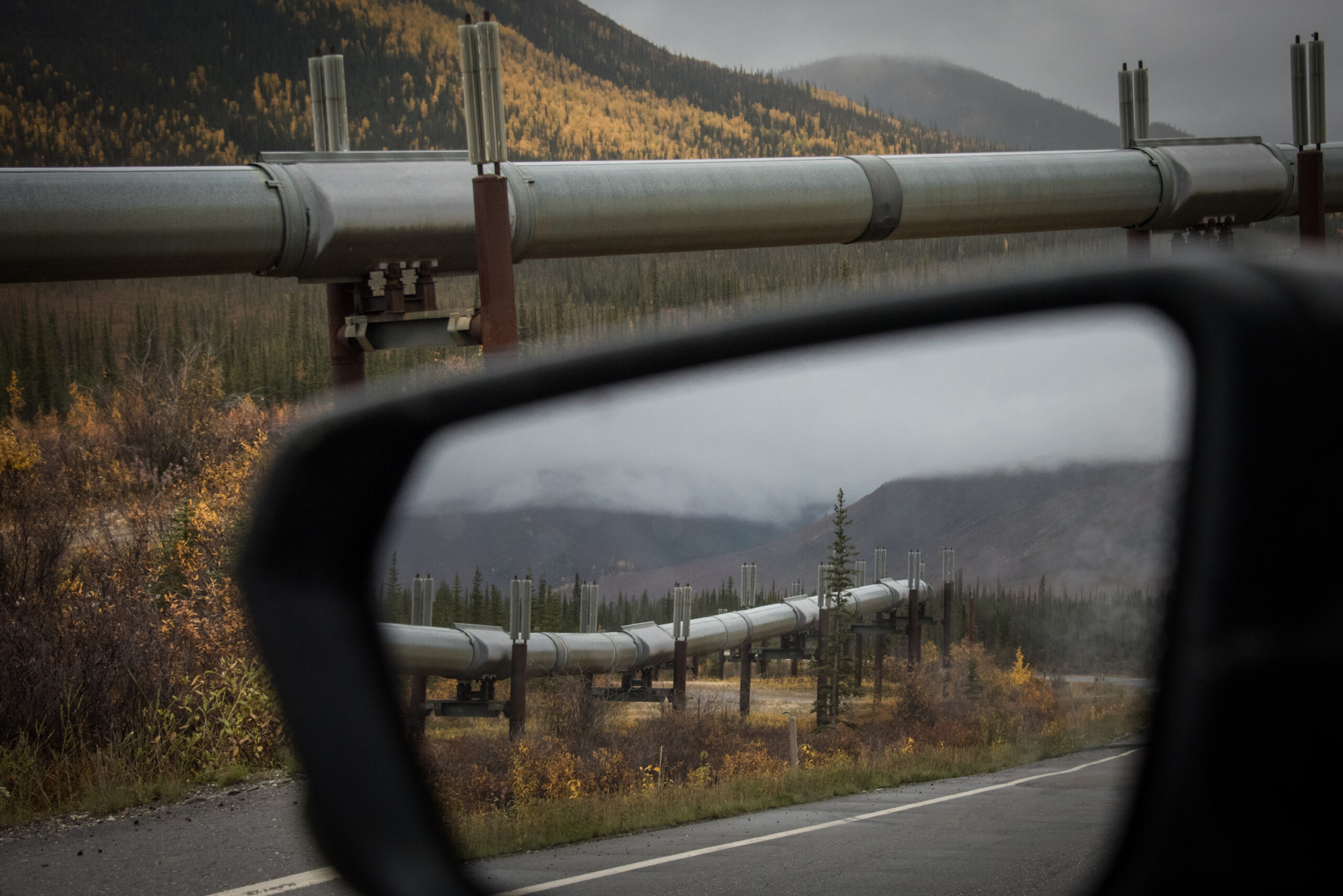
Caption: A photo of the existing Trans-Alaska Pipeline, which carries oil across the state. The proposed LNG gasoline route will partially parallel it. Photo Credit: Lois Parshley
The Alaska Department of Revenue recently updated its cost estimate to $46.2 billion, derived by inflation-adjusting an assessment originally produced during previous iterations of the project — work completed under materially different design assumptions, with a different project scope, in a different cost environment, and some nearly a decade old. State Senator Bert Stedman called the estimate “complete garbage.”
One day after stonewalling the Alaska House Finance Committee, Glenfarne president Adam Prestidge finally acknowledged the company’s internal cost range was $44.5 to $54.5 billion, with the first phase of building a pipeline across the state estimated at $13.2 to $16.9 billion. Even that is not the product of a detailed engineering analysis, and the cost estimates for the liquefaction plant and the gas treatment facility — items expected to account for the majority of project costs — are still at the conceptual level. The planning metrics scale used for this estimate suggests the project’s costs are only 1 to 15 percent defined, and the range does not include any contingency percentages, a standard typically added to cover unforeseen costs that may arise during this kind of project. During the state legislative session, the developers told the state its cost estimates could potentially be off by as much as one hundred percent.
Applying Public Citizen’s average historical cost overrun to Glenfarne’s project estimate suggests a potential total cost of up to $87 billion, or $103.9 billion with an additional 20 percent contingency standard. A 70 percent overrun, consistent with previous LNG industry averages and projects like Wood Fibre LNG in British Columbia, would bring the total to roughly $92.6 billion, or $111.8 billion with a 20 percent contingency standard. This analysis suggests the project’s initial cost estimates may be significantly understated.
Table 1: Alaska LNG cost estimates by scenario
| Scenario | Low Estimate | High Estimate | Range Spread |
|---|---|---|---|
| Glenfarne June 2026 range | $44.5B | $54.5B | $10.0B |
| Glenfarne 2026 range with 20% contingency standard | $53.4B | $65.4B | $12.0B |
| With contingency standard and Public Citizen average 59.7% overrun | $84.9B | $103.9B | $19.0B |
| With EY average 70% overrun | $90.78B | $111.8B | $21.02B |
The project’s actual costs may exceed Glenfarne’s estimates by as much as $67 billion. Depending on upstream gas prices, consultants told the state legislature that the project could only tolerate somewhere between a 20 and 40 percent cost overrun, or just $53.4 billion to $62.3 billion, if considering the lower end of the company’s range.
Despite these uncertainties, Governor Dunleavy has doubled down on a state property tax break for the project, replacing the existing 2 percent tax with a volumetric tax that would reduce the project’s burden by 90 percent. Even with this subsidy, the project will struggle to be cost-competitive. According to global management consulting firm McKinsey & Company, to be marketable an LNG project’s breakeven price must not exceed $7 per million British thermal units. This project has not yet secured gas from the North Slope at the rates required to be viable.
The LNG Canada project in Kitimat, British Columbia offers a cautionary example for Alaska. It is a similar LNG export terminal with a purpose-built pipeline in a remote northern location designed for Asian export markets. Its pipeline, which was also built in a separate phase, ran more than 130 percent over budget. The company blamed a shortage of skilled labor, contractor underperformance, and unanticipated construction challenges. Alaska’s proposed pipeline route traverses a longer distance, and more severe terrain, in a labor market that is structurally thinner.
Nevertheless, its developers are also seeking unprecedented federal subsidies. The Bipartisan Infrastructure Law made the Alaska LNG project eligible for a Department of Energy loan guarantee covering up to $30.25 billion in project debt. This would be the largest federal loan guarantee in the program’s history. It may also be considered for an additional $7.41 billion in tax credits. Interior Secretary Doug Burgum has even publicly floated the possibility of direct federal investment or equity in the project.
Backstopping this project would leave taxpayers effectively assuming one of the largest fossil-fuel infrastructure bets in American history, taking on its considerable financial risk. As Stedman said, “That’s the line of razzle dazzle they gave us.”