How the WTO Fails to Protect Public Interest Laws
Executive Summary
Policymakers, scholars, along with consumer, environmental, health, labor and other civil society organizations around the world have raised alarms about the way in which the “trade” rulebook has been expanded to establish new corporate privileges and limits on government regulatory measures that undermine public interest policies, including those protecting the environment and public health.
Over and over again, negotiators and government trade officials responded that “general exceptions” found in Article XX of the GATT and added to other pacts would ensure that signatory-country governments would be able to balance their “trade” obligations with the need to pursue public policy goals.
However, in practice, in the WTO’s 31 years of existence, there have been only two successful defenses of the general exceptions of the GATT (Article XX) and the General Agreement on Trade in Services (GATS Article XIV), in 2001 and 2018, out of 56 general-exception claims addressed by WTO adjudicators to defend domestic policies challenged as illegal under WTO rules.
Even successful Article XX and XIV defenses are not enough if there are other, separate WTO violations that the exceptions do not cover. This analysis is not a comprehensive account of every claim or defense raised in the disputes examined, only an examination of the general exceptions that served as a set of affirmative defenses under WTO law.
The dismal record of the WTO general exceptions that are supposed to preserve countries’ policy space so that “trade” obligations do not impede other societal objectives is, by itself, strong evidence that the system requires reform. This report breaks down the most significant obstacles for respondents that invoke general exceptions and identifies which thresholds have proven the most difficult for respondents to pass. It also describes how the complexities countries face in trying to defend a domestic measure vary depending on the specific defense raised.
The two successful exception defenses both relate to the conservation of exhaustible natural resources: Attempts to use the other policy objective defenses, such as human health and life and public morals, have been totally shut down. This is largely due to the development of stringent tests and interpretations by the WTO Appellate Body and panels that have created an inflexible framework that is often alien to the realities of domestic policymaking.
WTO adjudicators must first accept the use of the exceptions as relevant or inadmissible before governments are even able to invoke the public-interest exceptions.
The use of GATT Article XX or GATS Article XIV exceptions then successfully requires passing three successive steps of legal analysis. All three thresholds must be met for the defense to succeed. The first two thresholds relate to the subparagraphs under Article XX or Article XIV that the respondent cites as the basis for the defense, while the third threshold relates to the introductory clause or chapeau language found in both GATT Article XX and GATS Article XIV.
Of the 56 occasions in which WTO adjudicating bodies substantively analyzed GATT Article XX and GATS Article XIV defenses, only two resulted in a measure being deemed justified under a general exception. Among its most relevant findings are:
- Of the 56 analyzed exception defenses, 48 were deemed admissible.
- Thirty-seven defenses passed the subject matter/scope threshold.
- Eighteen defenses passed the “necessary” or “related to” threshold.
- Only two defenses ultimately passed the chapeau and succeeded overall.
The Pathway for the Two Instances of Respondents Successfully Invoking the General Exceptions Defense
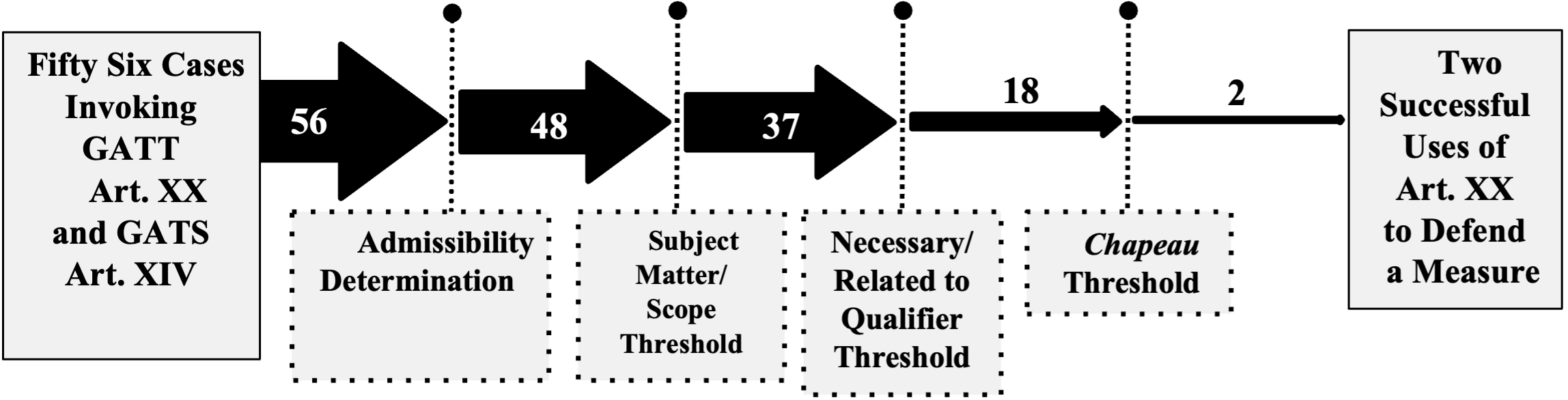
Source: Public Citizen’s Global Trade Watch WTO General Exceptions Database, an analysis of the rulings posted by the WTO.
The defenses that are most often invoked and assessed in the WTO dispute settlement system are subparagraphs (b) and (d), especially, and (g) of GATT Article XX. These subparagraphs relate to the following policy objectives: (b) protection of human, animal or plant life or health, (d) the use of measures to ensure compliance with laws or regulations that are not in themselves inconsistent with GATT rules, and (g) conservation of exhaustible natural resources. Respondents have also tried to justify their public interest measures by claiming that they are necessary to protect public morals (GATT Art. XX (a) and GATS Art. XIV (a)) or, in addition, with respect to services, maintain the public order (GATS Art. XIV (a)) or that they are essential to acquire or distribute products in short supply (GATT Art. XX (j)).
The respondent has lost both the defense and the case in 96% of the instances in which WTO adjudicators considered the general exceptions defense. This failure rate exceeds even the overall 91% “loss” record of respondents in WTO dispute resolution.
Before a government can even attempt to satisfy the three steps in a general exception, WTO adjudicators may outright dismiss the use of the exceptions as irrelevant or inadmissible, meaning governments were denied any meaningful opportunity to invoke the exceptions to defend public-interest measures. Of the 56 exception defenses analyzed in this report, eight were deemed irrelevant or inadmissible.
After that initial determination, the first legal test a respondent must pass when it invokes an exception is the subject matter/scope threshold, which assesses whether the policy measure in question is connected to the issue named in the subparagraph. While GATT Article XX(d) now accounts for roughly one-third of the exceptions raised and analyzed in WTO dispute settlement, it represents nearly 60% of cases lost on the subject matter/scope threshold. Conversely, despite representing almost half of the exceptions raised and analyzed, defenses under GATT Articles XX(b) and (g) have failed this threshold in only two instances.
The second legal test, the qualifier threshold, requires that the policy measure be “necessary” for the subparagraph’s named policy objective (e.g., a measure for which GATS Article XIV (a) is invoked must be “necessary to protect public morals or to maintain public order”), or that the policy measure be “relating to” the objective (e.g., measures for which GATT Article XX(g) is invoked must be “relating to the conservation of exhaustible natural resources”). The “necessary” standard has proven much more difficult to fulfill than the “related to” test. Respondents failed to establish necessity in 17 of 23 claims, or 74%. By comparison, respondents failed the Article XX(g) “relating to” requirements in four of eight claims, or 50%.
Lastly, the introductory clause of GATT Article XX and GATS Article XIV, called the chapeau, requires a policy not to be applied in an arbitrary or unjustifiably discriminatory manner between countries where the same conditions prevail or in a way that ends up being a disguised restriction on trade. (This is in addition to demonstrating a certain degree of connectedness to the policy objective specified in each subparagraph.) Respondents that have reached the arbitrary/unjustifiably discriminatory or disguised restriction thresholds have had an extremely low success rate. The reasoning exhibited by the Appellate Body in these exception claims on the chapeau frequently disregards the domestic constraints and dynamics that typically underpin public interest policies.
This analysis underscores the urgent need to reform the general exceptions regime of the WTO and related general exceptions language in free trade agreements and should inform the policy discussion about how to do so. There are four critical changes that would be necessary to construct effective general exceptions, whether in the context of a broad reform of the WTO Agreements or in new agreements.
1. Widening the scope of coverage:
The subject matter of domestic policies that could be implicated by existing and new trade agreements is vast. Additionally, as shown by the wide array of policy measures that have been discussed under GATT Article XX(d), the subparagraph covering policy objectives related to compliance with laws and regulations not themselves inconsistent with the GATT, the current scope of GATT Article XX and GATS Article XIV is too narrow. As a priority, subparagraphs (b) and (g) of the GATT, related to the protection of public health and the conservation of exhaustible natural resources respectively, should be amended to include explicit reference to multilateral environmental agreements, and subparagraph (e), which covers measures related to the fight against forced labor, should be expanded to cover more core international labor standards. Additionally, new subparagraphs should be added to give room to policies related to the rights of indigenous people, and human rights in general, culture, including by clarifying that countries’ obligations under treaties on such matters, as well as on public health, including tobacco and toxics controls, and labor rights take precedence to the extent of conflict.
2. Limiting panel or Appellate Body discretion with respect to what domestic policies are necessary:
WTO jurisprudence on the “necessary” threshold has not been consistent, with rulings ranging from judgments about whether a policy itself is necessary to whether the degree to which it restricts trade is necessary. The best way to limit adjudicating bodies’ discretion would be to make the “necessary” element of the general exceptions self-judging, as has been done in some free trade agreements. Another approach recently used in investment agreements that include general exceptions inspired by GATT Article XX is to replace the “necessity” standard with a “designed and applied to” threshold for all exceptions. A less fulsome alternative would keep part of the necessity test but remove its most problematic element, i.e., the trade restrictiveness analysis.
3. Adjusting the chapeau terms to the realities of domestic policymaking:
Limiting the discretion of adjudicating bodies to define what is required to meet the chapeau tests would also be critical. In this vein, some scholars have proposed a “predominant motive test,” under which public interest measures would be deemed justified under the exceptions as long as their primary objective is one of those permitted by GATT Article XX or GATS Article XIV.
4. Placing the burden of proof on the complaining party with regard to the thresholds established in the chapeau:
Any general exception with a “specific exception-general requirements” structure should include clear rules of burden of proof where the responsibility to demonstrate that a public interest policy is applied in an arbitrary or unjustifiably discriminatory fashion falls on the country challenging the measure. As articulated in this brief, this approach would be consistent with the core tenets of public international law.
This report carefully documents the 31-year record that shows the WTO general exceptions are largely useless in their current form. Consequently, it highlights the urgent need for changes to “trade” rules and exceptions to ensure governments have the policy space needed to address the major challenges of our times.