Trump Pathogen Agreements and Global Equity Proposals
By Emily Bass, author of the “To End A Plague: Again” Substack and Public Citizen
Summary
Public Citizen reviewed the six US bilateral specimen sharing agreements (SSAs) shared publicly by the US State Department, and an additional agreement accessed independently. These are agreements signed in conjunction with health funding agreements (memoranda of understanding, or MoUs) negotiated between the US government and partner country governments as part of the Trump administration’s America First Global Health Strategy. The US is entering these specimen agreements separate from ongoing negotiations among World Health Organization (WHO) member states for the creation of a multilateral pathogen access and benefit sharing (PABS) system, which is the linchpin of the recently-adopted WHO Pandemic Agreement, aiming to remedy COVID-19 inequity by establishing a mechanism to ensure equitable access to health tools in future pandemics. The Africa Group plus Egypt, Somalia and Sudan (Africa+ Group), which includes all of the countries for whom SSAs are available, and many others that have also signed MoUs, is working to negotiate a stronger PABS system. We also reviewed the Africa+ Group’s PABS proposal, comparing it with the United States’ template bilateral specimen sharing agreement.
Civil society organizations and other experts have commented that these bilateral deals could undermine the foundation of the multilateral PABS system still under development, prioritize routing pathogen data to the US to satisfy bilateral requirements, and undermine sovereignty.
Our analysis of seven US bilateral specimen sharing agreements finds that there are inequities within countries that signed the agreements including in terms of recognition of authorship and contribution to publications, the right, on the part of the co-signatory government, to be informed when specimen data have been shared with non-US government entities, such as private sector companies, and the number of such entities with whom specimen data can be shared. All of the agreements retain the majority of language from the previously-published template text, whose provisions differ from virtually every substantive aspect of the “federated model” proposed by the Africa+ Group for the PABS annex to the Pandemic Agreement. Negotiations on the PABS annex have occurred over the past year, and the final text has yet to be reached. The bilateral agreements signed by several countries that are also involved in the Africa+ Group underscore the need to finalize a PABS annex that establishes standardized, fair, and reciprocal terms related to access and benefit sharing for pathogens with pandemic potential.
Background
What the US calls “specimen sharing” and the World Health Organization terms “pathogen access” includes provision of isolated viruses or pathogens, genetic sequencing data, and biological samples (e.g. blood or tissues). Associated “metadata” is also often shared with these samples, which may include the geographic location where the sample was collected, and the age and sex of the person it came from. Such information is vital for identifying outbreaks of new and existing disease threats, and mutations or changes in circulating pathogens that could make available tests, vaccines or treatments less effective.
Many of the most effective drugs, vaccines and tests for a given disease threat can only be developed and tested by entities that have access to pathogen materials and/or genetic sequence information.[1] Access to pathogen materials and data is, therefore, access to invaluable information that can be used to create lifesaving health products.
Medical countermeasures (the vaccines, treatments, diagnostics, and other health tools used to respond to health emergencies) are global public goods. But as SARS-CoV-2, HIV, mpox and scores of other health issues show, pharmaceutical companies that originate health products used to combat epidemics and pandemics often keep a close hold on the technology and intellectual property associated with the products, setting prices that high-income countries alone can afford and focusing supply on well-resourced buyers. This can happen even when the specimen or sample used to develop a vaccine, test or treatment came from a low or lower-middle income country, despite that country’s contributions and investments of its health workers, scientists and government in making those pathogens available for research and development.
The urgent need for global governance of viral samples, genomic sequences and associated information was brought into focus in December 2006 when the government of Indonesia decided to stop sending influenza virus specimens to the World Health Organization’s Global Influenza Surveillance Network (GISN). At the time, Indonesia was the country most affected by the H5N1 subtype of influenza A virus that epidemiologists anticipated could cause the next global influenza pandemic. Genomic sequences are vital to developing effective vaccines; influenza or “flu” shots are re-made every year with antigens (fragments of viral genetic material) selected by experts monitoring the genotypes of circulating virus. Without access to this genetic information, effective flu vaccines cannot be made. Indonesia maintained that GISN did not have provisions associated with pathogen sharing and access that would ensure equitable access to vaccines developed using the samples and genomic information of the H5N1 strains circulating within the country.
In 2011, in order to address these concerns, WHO member states adopted the Pandemic Influenza Preparedness (PIP) Framework — an international agreement to improve the sharing of influenza viruses with pandemic potential and increase global access to influenza pandemic-related health products using legal guarantees for the distribution of such products to affected and vulnerable populations based on public health need. In this period, the GISAID database — an independent platform for sharing genomic sequences and associated information — launched, which included provisions its developers say were designed to ensure that specimen contributors were credited for their scientific work; there are other platforms for uploading and sharing viral genomic sequences; but there is no single platform or database with a set of provisions that ensures equitable access to the benefits such as health products derived from those data, including for low income countries that did not contribute the specimens but have a public health need for the products.
The WHO Pandemic Agreement, a legally binding instrument designed to ensure preparedness for future pandemics, was adopted in May 2025 without finalized text for the PABS system. The PABS annex, without which the Pandemic Agreement cannot enter into force, is seen as the “grand bargain” of the Agreement, to remedy the inequity of COVID-19 through firm obligations for access to health products in exchange for pathogen sharing. The complexity of these negotiations, which have been largely closed to civil society, encompasses an array of entrenched and sometimes conflicting interests: between equity and intellectual property rights; profit and global public interest, and more. At the July 2026 Intergovernmental Working Group negotiating meeting for the PABS annex, the Africa+ Group advanced its “federated model,” while a bloc of European member states made an alternate proposal.
The United States withdrew from the World Health Organization in 2025, when President Trump took office, and is not participating in these negotiations. The US bilateral “Specimen Sharing Agreement” template text became publicly available in late 2025. It does not preclude sharing with current databases or future platforms such as may be established under the PABS annex. However, the SSA contains provisions that could undermine the power of any system implemented under a future agreement, since the US reserves the right to share specimens with non-US government entities who would not be bound by equitable access provisions associated with PABS annex-associated platforms.
More than 30 countries have signed memoranda of understanding with the US; it is not clear how many of these countries also signed specimen sharing agreements (the SSAs are separate from the MoU documents, which are also closely held), and in remarks at the 2026 International AIDS Conference (AIDS2026) conference in Rio de Janeiro, a senior State Department official suggested that a limited number of countries had done so. It is already known that at least eleven countries have signed SSAs, according to State Department disclosures.[2] An accurate tally of co-signatory countries with SSAs should be shared.
Specimen Sharing Agreements
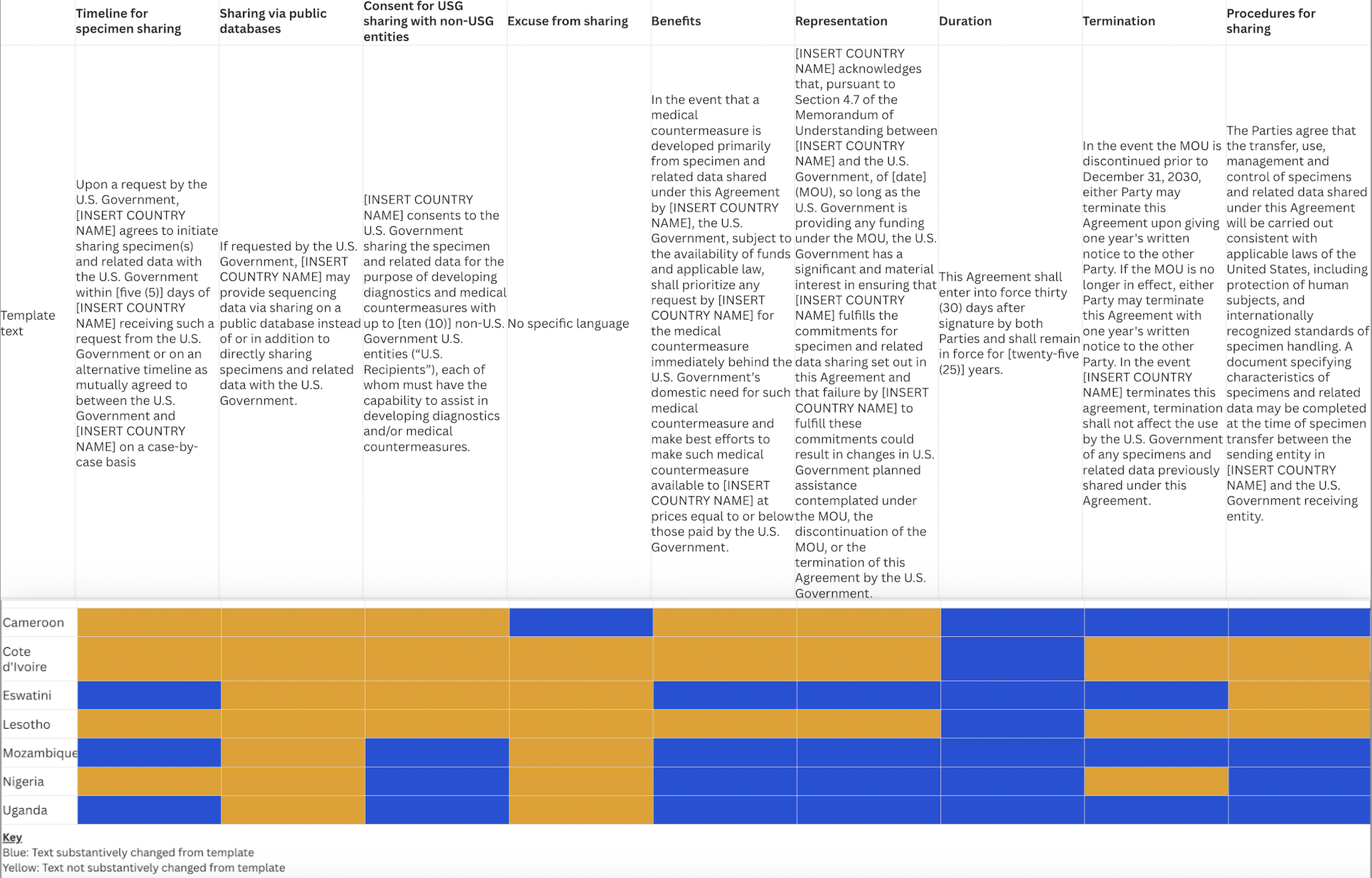
Figure 1 below tracks changes in the finalized bilateral specimen sharing agreements compared to the standard template. The interactive version of the tracker (showing individual agreement text changes) is available here.
Figure 1: US Bilateral Specimen Sharing Agreements Compared to Template
Minimal changes to weak State Department template text on benefit sharing
- Only three out of seven cosignatories negotiated updates to the template language benefit-sharing section, which included the weak, unenforceable US commitment to ‘prioritize’ access for co-signatory countries after the United States’ needs are met at prices equivalent to those paid by the US. These terms apply only to medical countermeasures based “primarily” on specimens shared by the co-signatory country. As the development of many health products, like vaccines, uses mosaic antigens or portions of different samples, the US could contest this provision’s applicability on the basis of other samples used from other countries. Uganda secured the provision that the US “will facilitate access proportional to country needs.” Nigeria, Mozambique and Uganda all added terms related to reallocation of MoU funds to purchase the commodities.
- Nigeria’s Specimen Sharing Agreement includes the provision that “The Parties recognize that analyses, discoveries, innovations, or other outputs resulting from the use of specimens or related data provided by the Federal Government of Nigeria may generate significant public health value. In recognition of the origin of these specimen and related data, the U.S. Government intends to share with the Federal Government of Nigeria relevant associated findings that may support public health objectives and capabilities.” It is unclear what those associated findings would be.
Minimal commitment to recognition of co-signatory government as contributor of specimen or sample
- Only two out of seven cosignatories (Nigeria and Uganda) negotiated terms that include US acknowledgement of those countries’ national contributions to publications and other materials resulting from use of specimen and related data.[3][4]
No improvement to template text that allows the US government to share samples with non-governmental (industry) partners of its choosing
- The State Department template text allows the US to share samples with up to 10 non-US government partners. This effectively means that the US government, on obtaining specimens under the SSA, can share this information with entities of its choosing, such as private sector companies and academic laboratories, who could then develop medical countermeasures based on this information without any legally binding commitments to share benefits. Under the proposed “federated model” for the PABS annex, parties accessing specimens would commit to provisions supporting access to pandemic-related health products developed using this data. Entities receiving specimen data from the US government would not be bound by these benefit sharing provisions; implementation of the SSA concurrently with a PABS annex-supported agreement could create conditions in which a US-selected entity develops a product that is needed for a global response, without any mechanism for ensuring equitable access. Three countries (Mozambique, Nigeria and Uganda) inserted provisions requiring the US to notify the government when a sample has been shared; these countries also removed the 10-partner limit.
Comparison with Africa+ Group PABS Proposal
First shared in September 2025, the template for the America First Global Health Strategy Specimen Sharing Agreement raised alarms about how such bilateral agreements could undermine the equity objectives of the multilateral Pathogen Access and Benefit Sharing annex of the WHO Pandemic Agreement, which aims to help prevent a recurrence of the death and inequity experienced during the COVID-19 pandemic by ensuring rapid sharing of pandemic-related viral samples is met with reciprocal sharing of medical tests, treatments and vaccines. The seven signed specimen sharing agreements analyzed reinforce this concern.
Differences between country agreements undermine regional cohesion and coordination, and all of the agreements contain elements inconsistent with the “federated model” for pathogen access and benefit sharing developed by the Africa+ Group and shared at the seventh PABS annex Intergovernmental Working Group negotiating session (July 2026). The model is reportedly endorsed by more than 80 percent of Africa+ Group members. While the terms of this proposal and alternative PABS proposals are fluid, key features of the Africa+ Group proposal reported at the conclusion of the seventh negotiating session were used to create the comparison with SSA provisions in Table 1.
Table 1. Side by Side: US Specimen Sharing Agreement Template versus African Group Federated Model Proposal
| Federated Model Proposal | US Government SSA Template |
|---|---|
| Materials and raw sequence data remain with the Provider States or with the hosts they choose. Sharing of materials and access to data occurs after users agree to certain terms. | Materials and raw sequence data shared with US government and non-US government entities selected by the US. |
| Benefit sharing happens through a common collective arrangement. The same benefit-sharing rules would apply to all hosts (Provider States’ national nodes, regional hubs, recognized international hosts or “federated workbenches”) used to hold the data. A 20% real-time product set-aside is activated during a public health emergency, comprising 10 percent as donations and 10 percent at cost. Coverage applies regardless of the resource’s origins, while distribution is based on public health need and coordinated by WHO. | Benefit sharing occurs bilaterally between the US and individual countries; benefit sharing terms vary between countries; access to the health products is restricted to those developed “primarily” on the basis of a co-signatory country’s specimens and data. Given that many MCMs use composite genomic sequences, and in the absence of a precise definition of “primarily,” the US government could use this wording as a loophole to evade obligations for benefit sharing with countries whose data were used alongside other countries’ information. |
| Pathogen access would occur via a common WHO-operated system, for which users register and receive a single credential–this includes researchers, public health users and manufacturers. Unique persistent identifiers (UPIs) attach to pathogen materials and data to enable traceability and accountability with respect to pathogens shared and accessed via the system. | Access can be direct to US government and then to non-US government entities selected by the US government. Use of a WHO (or other) central system is permitted but not required. Only three countries negotiated visibility into the recipients of the data. |
| Manufacturers would also conclude a separate legally binding benefit sharing contract with WHO. | Co-signatory countries have limited visibility into and no direct agreements or contracts with manufacturers. |
| Physical pathogen materials would move through the WHO Coordinated Laboratory Network under a standard Materials Transfer Agreement agreed before shipment and limited to a defined purpose. | Bilateral arrangements for physical pathogen materials to be developed, with variability possible between countries. |
Discussion
Our analysis of seven US bilateral specimen sharing agreements finds that there are inequities within countries that signed the agreements including in terms of recognition of authorship and contribution to publications, the right, on the part of the co-signatory government, to be informed when specimen data have been shared with non-US government entities, such as private sector companies, and the number of such entities with whom specimen data can be shared. All of the agreements retain the majority of language from the previously-published template text, whose provisions differ from virtually every substantive aspect of the “federated model” proposed by the Africa+ Group for the Pathogen Access and Benefits Sharing (PABS) annex to the WHO Pandemic Agreement, including regarding assurance of guaranteed benefits, traceability and accountability for data use and benefit sharing commitments, manufacturer obligations, and cross-country coordination.[5] Negotiations on the PABS annex have occurred over the past year, and the final text has yet to be reached.
Signed before the PABS annex negotiations have been completed, the seven SSAs also introduce bilateral processes that could be used to bypass the equity obligations of the potential WHO PABS system. For example, private sector companies could proactively seek to be selected by the US for onward sharing. The SSAs create an alternate ecosystem in which the recipients of specimens and data are not required to register prior to accessing pathogen information, or even to be identified to the provider countries. The SSAs, like the MoUs themselves, suggest that individual country leverage, negotiation skills, and priorities shape the final terms. Notably, at least two countries that have signed MoUs have reportedly refused to sign SSAs.[6]
The Africa+ Group working together to advance the PABS proposals could take steps, as a bloc, to bridge the gaps between bilateral and multilateral approaches. For example, countries could agree to exercise the SSA option to share specimens and pathogen information via common databases in all instances, rather than engaging in bilateral transfers; countries lacking a notification clause about the entities with whom the US shares this information could negotiate the inclusion of such language; countries could seek amendments so that there is regional alignment in areas where there are present differences, including but not limited to access to benefits, acknowledgement of national scientists’ contributions including listing as co-authors on publications based on data that they collected, access to associated findings that support the public health response and others. Regional alignment would be best undertaken in the context of full, transparent sharing of all specimen and data sharing agreements, along with the full texts of the memoranda of understanding.
Conclusion
As shown in seven countries’ specimen sharing agreements, the United States government’s bilateral approach to foreign aid for global health undermines regional and global cohesion and coordination. The SSAs reviewed to date introduce differences between countries’ bilateral agreements and reveal inconsistencies with the “federated model” for pathogen access and benefit sharing (PABS) recently introduced by the Africa+ Group at the PABS annex negotiations. While there is no simple solution for reconciling the bilateral approach with yet-to-be-defined multilateral alternatives, African countries and other co-signatories of these SSAs could develop a common approach to the SSA terms that mitigates harms, communicates coordinated standards for conditions related to pathogen sharing, and seeks to maximize benefits resulting from that sharing.
References
[1] Mpox is an example of a recent and ongoing outbreak for which an effective vaccine already existed: the MVA-BN vaccine, which reduces the risk of mpox infection or severe disease, had previously been developed for use against smallpox, another member of the orthopoxvirus family.
[2] Lesotho, Eswatini, Mozambique, Cameroon, Nigeria, Côte d’Ivoire, Rwanda, Uganda, Ethiopia, Malawi, and the Democratic Republic of the Congo.
[3] “The U.S. Government will explicitly acknowledge the contribution of the Federal Government of Nigeria and its relevant institutions in publications, presentations, and reports arising from the use of the specimen and related data.”
[4] “The U.S. Government will explicitly acknowledge the contribution of the Government of Uganda and its relevant institutions in publications, presentations, and reports arising from the use of the specimens and related data.”
[5] The potential multilateral PABS system will also have structural differences (such as WHO coordination for fair global distribution of health products and international governance mechanisms) from bilateral arrangements.
[6] A Kenyan ministry of health official stated that the country did not negotiate a specimen-sharing agreement, opting instead for an agreement to jointly test outbreak specimens. Tanzania’s health minister stated that the country did not enter into a specimen sharing agreement.