The Food and Drug Administration and ‘Gas Station Heroin’ — The Kratom Crackdown That Wasn’t
By Peter Whoriskey, Research Director, Health Research Group
Scores of people have died in recent years from products made from kratom, an evergreen tree native to Southeast Asia. Yet the Food and Drug Administration (FDA) has chosen not to regulate kratom products, often known as “gas station heroin,” and has even promoted them.
Among the deaths is a Florida man who consumed a kratom tonic sold by a company in which Homeland Security Secretary Markwayne Mullin held a stake. Mullin reportedly urged officials to remove language from the FDA’s website warning of kratom’s harms.
Public Citizen tracked down kratom’s victims.
On the morning of April 21, 2025, Kevin Oliveira, 32 (photo below), was found dead in his bedroom at his parents’ home in Tequesta, Florida. Found with him were more than a dozen small blue bottles of Feel Free Classic, a tonic made from the leaves of kratom, an evergreen tree native to Southeast Asia. Sold at gas stations and vape shops across the United States, Feel Free and other kratom products promise “energy” and “focus.” A musician who played at weddings and local bars, Oliveira had been buying Feel Free by the case — 12 bottles for more than $100, his family said. Weeks before he died, he checked into a rehabilitation facility to quit. He left after two days.
What killed him, according to the medical examiner, was high blood levels of mitragynine, the opioid most abundant in kratom leaf.
The leaves of the kratom plant have been used in traditional medicine for centuries. In smaller doses, kratom leaf acts as a stimulant. At larger doses, it acts as an analgesic and sedative.
Since the sale of kratom products began surging in the United States around 2015, authorities have counted scores of overdose deaths. Survivors of addiction to Feel Free post their stories on TikTok. On Facebook, groups have formed to allow mothers of the dead to express their grief. Some former users have published books, such as My Kratom Hell: A Users Guide to Quitting Kratom, a 2019 personal account written by a former kratom addict.
Yet efforts to regulate kratom products repeatedly have failed to overcome industry lobbying.
Then, in July 2025, Trump officials announced that they were acting to “protect Americans.” But a closer look at the measures they put forth reveals that they missed the target. They chose not to regulate the opioid in kratom blamed for the death of Oliveira and hundreds of others. Using toxicology reports, death certificates, lawsuits and other public records, Public Citizen found 26 deaths over the last five years that coroners attributed to that opioid, known as mitragynine, and toxicologists say there have been hundreds more that have received little attention. Today, to the bewilderment of survivors, kratom products remain on store shelves.
THE TRUMP ADMINISTRATION’S “BOLD STEP”
Three months after Oliveira’s death, the Trump administration staged a press conference to announce measures that were described as a “bold step” toward addressing the rising toll of kratom-related addiction and death. The nation’s top health officials, including HHS Secretary Robert F. Kennedy and then-FDA Commissioner Dr. Martin A. Makary spoke. Also present, for no apparent reason, was then-Senator Markwayne Mullin, Republican of Oklahoma, who praised Kennedy for having the “backbone” to act to restrict 7-OH.
“It’s an addiction that’s ruining lives,” Mullin said. “It’s an addiction that’s truly killing people.”
Yet nothing in the announcement acknowledged that deaths like Oliveira’s had occurred.
Federal health officials proposed no limits on mitragynine, the kratom opioid that killed Oliveira and many others, according to medical-examiner reports. Instead, the officials called for the Drug Enforcement Administration (DEA) to place restrictions on another opioid found in trace amounts in the kratom plant. That compound, 7-hydroxymitragynine, is commonly known as 7-OH and is sold in concentrated synthetic forms. FDA Commissioner Marty Makary branded it “a killer.” The FDA recommended that the DEA restrict 7-OH products by scheduling them under the Controlled Substances Act.
To the casual observer, it may have seemed like the Trump administration was getting tough on kratom. But the exclusive focus on 7-OH allowed the continued sale of kratom tonics and powders. Because 7-OH is present only in trace amounts in kratom, banning 7-OH products does not ban kratom or products made directly from it; the 7-OH levels are too low. In effect, the FDA recommendation allowed the continued sale of kratom and products derived from it, such as Feel Free.
Mullin at some point acquired a financial interest in kratom. According to March 2026 financial disclosures, Mullin has invested between $500,001 and $1 million in Botanic Tonics, LLC, of Broken Arrow, Oklahoma, the company that makes Feel Free Classic— the tonic found in Kevin Oliveira’s bedroom. Mullin filed the disclosures upon being nominated to be secretary of the Department of Homeland Security, but the documents do not include the date when Mullin made the investment.
Previously, Mullin had urged officials to remove language from the FDA website warning of kratom’s harms, according to New York Times reporting based on four people familiar with his efforts.
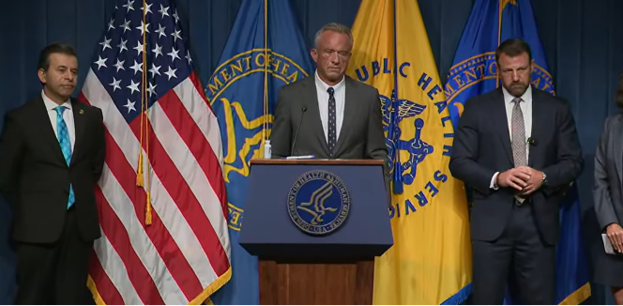
Makary, Kennedy and Mullin at the July 2025 press conference announcing a “bold step” to protect Americans from 7-OH products, but not mitragynine products.
At the press conference last July, federal officials even promoted kratom: A woman from Kalamazoo, Michigan, with chronic pain presented a testimonial about the benefits of kratom. She told the audience that kratom had given her back her life.
In the media, reports about the dangers of kratom typically cover single incidents, highlighting one overdose death at a time. The kratom industry has dismissed the cases as anomalies. But the trail of the dead now crosses the country. The deaths refute industry claims that kratom products are safe.
“It’s like we’re selling morphine at a gas station – that doesn’t make sense,” Carolina Panoff, a close friend of Oliveira, said at a meeting in 2025 with reporters and Oliveira’s weeping parents. “I don’t understand how this fell through the cracks.”
DEATHS BY MITRAGYNINE
Industry advocates tout kratom’s power to relieve pain, boost mood and relieve symptoms of opioid withdrawal, even though there are few clinical data and the hypothesized benefits of mitragynine have not been established.
Kratom users who are found dead often have ingested a variety of other dangerous drugs. In these so-called “polydrug” cases, the industry argues, the kratom products could be blameless or at least not considered the primary reason for the death.
But in many other cases, such as Oliveira’s, mitragynine is present alone, or in such high amounts that medical examiners classify the cause of death as mitragynine toxicity.
Wendy Chamberlain, the founder of Kratom Danger Awareness, a grassroots advocacy group, estimates that at least two hundred of the group’s members are families who lost someone to mitragynine toxicity alone. In Florida, for example, according to a 2023 Tampa Bay Times investigation, there had been over 500 kratom-involved overdoses, 46 of which were determined to be caused by kratom alone.
“Though kratom-related deaths are low when compared to its widespread use, the denial that kratom use does not result in fatalities is false and misleading,” according to an article by four scientists at NMS Laboratories, a Pennsylvania company that is one of the nation’s leading forensic testing labs. In an interview, Donna Papsun, the lead author of the study, estimated that there have been hundreds of deaths in the U.S. over time.
Here are a handful of the scores of people who, according to coroner and toxicology reports, died from mitragynine, along with quotes from official documents regarding the cause of death.
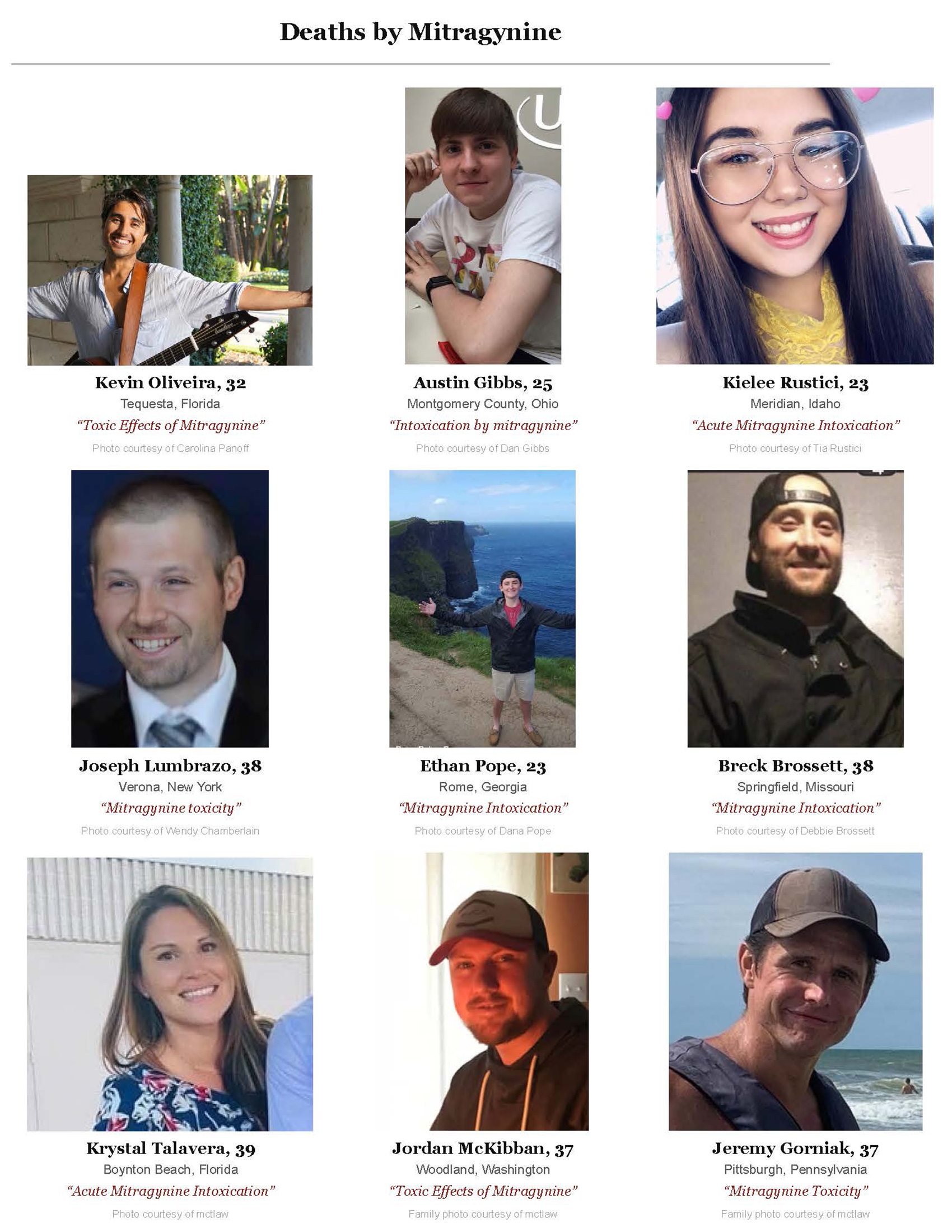
In 2021 the parents of 23-year-old Ethan Pope (photo above) found him dead on the kitchen floor of his apartment. The Georgia Bureau of Investigation found that he had died of “Mitragynine Intoxication.” It said the toxicology tests did not find alcohol or “non-therapeutic drugs.”
In 2022 Breck Brossett, 38 (photo above), a warehouse supervisor, was found unresponsive in his bedroom in Springfield, Missouri. His mother attempted CPR three times. The coroner blamed “Mitragynine Intoxication.”
In 2023 Robert Simmons, 34, of Greely, Colorado, collapsed near his truck after consuming kratom powder. He was a father of four. The coroner determined the cause of death to be acute mitragynine toxicity.
In 2024 Tyrell Trouville, 25, of Florida, a waiter at a waterfront restaurant, died after having a kratom seltzer. The coroner cited “mitragynine toxicity.”
In 2025 Kielee Rustici (photo above), 23, a college student from Idaho interested in forensic accounting, died of an overdose. The coroner blamed “Acute Mitragynine Intoxication.” She had no illicit substances in her body, the toxicology report said.
ORIGINS OF THE KRATOM FAD
The psychoactive power of kratom leaves comes from mitragynine, a compound that binds to mu-opioid receptors, the same receptors in the brain that are affected by heroin, fentanyl and other powerful opioids.

Kratom leaves. Photo by Manuel Jebauer, via Wikimedia Commons, CC BY-SA 3.0
General interest in kratom began to take off in the United States about a decade ago. Today, kratom products are commonly sold at convenience stores and online. An estimated 5 million Americans reported using kratom at least once during their lifetime, according to an analysis of survey data from the Substance Abuse and Mental Health Services Administration. From 2015 to 2025, kratom-related calls to poison control centers increased by approximately 1,200%, reaching more than 3,400 calls in 2025, according to a March 2026 article in a Centers for Disease Control and Prevention publication.
Botanic Tonics, whose products reach 30,000 stores across the United States, sells Feel Free Classic as a healthful herbal supplement. Sold in 2-ounce bottles, it contains 40 milligrams (mg) of mitragynine and no 7-OH, according to its label. The company enlisted health and wellness influencers to gain customers.
“Our original feel-good tonic is thoughtfully crafted with noble kava root and other functional botanical ingredients that have been used for centuries,” according to the company’s website. “Our unique blend is designed to create a state of chilled energy, helping to clear your mind and elevate your mood, so you can be more present and in the moment.”

A Feel Free display at a gas station in Washington, DC. Photo by Peter Whoriskey
The marketing appeals to the sense that natural substances are beneficial. “The branding was really great because it hooked somebody like Kevin who’s into wellness and into living a healthy lifestyle,” said Panoff, the close friend of Oliveira. “He was gluten free and organic food and all these things.”
KRATOM POLITICS
The American argument over kratom has two sides: those who say it helps people and those who say it kills them.
In an online survey conducted by researchers funded by the American Kratom Association, an industry group, 48% of respondents said they used kratom mainly for pain; 22% for anxiety, depression and post-traumatic stress disorder (PTSD); 10% for energy; and 10% to help cut down on opioid use and/or relieve withdrawal.
Since 2025, Trump administration officials have embraced the industry claims that kratom products may benefit people and resisted sales restrictions. Their stance may have been most obvious at the Kennedy-Makary press conference, when a kratom user and advocate was brought forward to speak.
Makary said that Melody Woolf, the chronic pain patient from Kalamazoo, “has experienced suffering looking for pain relief, and she is going to share a bit about her story.”
Before taking kratom, Woolf said, she had been using as many as 11 drugs at a time to treat her pain, including the highest doses of fentanyl. But her discomfort remained.
“I’m just so thankful that I found a botanical called kratom,” she said. “Right away my life improved…It was kratom only, the powdered leaf, that saved my life.”
The press conference did not present an opposing view from the advocates of kratom regulation or the families of kratom users who have overdosed.
Although kratom products are sold across the United States, political opinion about whether they should be legal is divided. Six states (Alabama, Arkansas, Indiana, Louisiana, Vermont and Wisconsin) have banned all kratom products, classifying both mitragynine and 7-OH as controlled substances, according to the Legislative Analysis and Public Policy Association.
As of 2022, more than a dozen countries had banned kratom, including Australia, Denmark, Finland, Israel, Japan, Malaysia, New Zealand, Poland, Romania, Russia, Singapore, South Korea, Sweden and Vietnam. Most kratom in the United States comes from Indonesia, where kratom exports are encouraged but its use as a health supplement within the country has been prohibited.
FEDERAL POLICY FLIP-FLOPS
In the United States, federal policy has flip-flopped between radically different views about kratom.
In August 2016 the DEA proposed to classify mitragynine and 7-OH as Schedule 1 drugs, in effect banning kratom products. Schedule 1 is the category for substances with no accepted medical use and a high potential for abuse, such as heroin. The DEA received immediate bipartisan opposition; two months later, the agency withdrew the proposal.
In February 2018, during the first Trump administration, FDA Commissioner Scott Gottlieb warned, based on academic research and other data, that there had been 44 reported deaths associated with the use of kratom. He recommended that the DEA classify both opioid substances in kratom leaf – mitragynine and 7-OH – as Schedule 1.
“Claiming that kratom is benign because it’s ‘just a plant’ is shortsighted and dangerous,” Gottlieb’s statement said. “After all, heroin is an illegal, dangerous, and highly addictive substance containing the opioid morphine, derived from the seed pod of the various opium poppy plants.”
Within months, however, Brett Giroir, then Assistant Secretary for Health, rescinded Gottlieb’s recommendation. Giroir later posted on X that Gottlieb’s recommendation had been dropped because of “embarrassingly poor evidence & data.”
Gottlieb’s statement is no longer available on the FDA’s website.
The flip-flops have continued. In March 2023, during the Biden Administration, U.S. Marshals and the FDA seized over $3 million worth of products containing kratom that were manufactured by Botanic Tonics and marketed under the brand name “Feel Free Plant Based Herbal Supplement.”
“This seizure underscores our commitment to taking aggressive action when companies distribute products that contain dangerous ingredients such as kratom,” Judy McMeekin, then the FDA’s Associate Commissioner for Regulatory Affairs, said at the time.
Botanic Tonics contested the seizure; for two years, the case was dormant.
Then, in another striking reversal, in December 2025 federal prosecutors under the Trump administration filed a motion to drop the seizure litigation, explaining that “it would not be a prudent use of government resources to sustain this action.”
A spokesperson for Botanic Tonics told a columnist from the Kansas City Star that since the seizure, the federal government’s stance on kratom had changed.
The “agency was still developing its understanding of kratom” when it seized the goods, the spokesperson said.
In March 2026, just months after the government dismissed the case, Botanic Tonics wrote a $500,000 check to the Make America Healthy Again (MAHA) PAC, a political group aligned with Robert F. Kennedy Jr. Its mission is to elect Republicans “who will champion the MAHA agenda.”
THE SCIENCE
Government scientists have begun to examine the use of kratom, but so far, the research record is sparse.
In 2024 a study led by FDA scientists considered the effects of a single dose of a powder made from kratom leaves in 40 recreational drug users. Doses in the trial ranged from 1 to 12 grams; surveys of kratom users had shown average consumption ranging from 3 to 8 grams per day. The most common side effects were sleepiness, vomiting and nausea. Researchers reported that increasing doses of kratom led to increases in subjects’ ratings of feeling high or drunk.
The subjects in the study described kratom’s effects “as resembling those of THC [the main psychoactive compound in cannabis], and being somewhat similar to opioids and benzodiazepines,” the authors reported.
There are two other kratom studies listed as completed in clinicaltrials.gov, the federal clinical trials registry. One study with fewer than 20 participants examined how the body metabolizes kratom; in another study, from 2022, researchers questioned kratom users about their use of the substance and obtained blood specimens.
In June 2026 the National Institutes of Health announced that it had initiated a new drug application for mitragynine, “the primary psychoactive compound” in kratom, as a potential treatment for opioid use disorder. As part of the phase 1 clinical trial, 32 healthy adults will receive one dose of mitragynine in varying amounts, ranging from 25 mg to 100 mg, or a placebo. The research uses a purified formulation of mitragynine, developed by researchers at the NIH and the University of Florida.
The study will help gather “important first information on [mitragynine’s] safety and tolerability” according to the NIH description.
DEATH, ADDICTION AND LAWSUITS
As federal regulators have dithered and kratom products have grown in popularity across the United States, allegations of death and addiction have piled up in lawsuits, coroner reports and on social media.
On social media, former users of kratom and drinks like Feel Free describe the addiction and warn potential customers of the dangers. So do their relatives.
“Three years ago, I unknowingly spiraled into a severe addiction to an herbal tonic called Feel Free,” according to one post by McKenzie Wisdom of Chicago. “What I ultimately thought was a wellness drink ended up being an opioid-like substance that completely derailed my life, destroyed my health and upended my career as a wellness entrepreneur – ultimately led me to rehab.”
In January 2024 the company updated the warning label on Feel Free to say, “This product contains leaf kratom which, like caffeine and alcohol, can become habit-forming and harmful to your health if consumed irresponsibly. Consider avoiding any potentially habit-forming substances if you have a history of substance abuse. If consumed in recommended quantities, feel free CLASSIC has not been shown to cause any serious physical or social harm.” The label warns against consuming more than one ounce a day.
Lawsuits across the country also reflect the rise of kratom use and its adverse effects.
One of the largest cases about kratom’s addictive properties was Torres v. Botanic Tonics, a class action lawsuit filed in 2023 over deceptive marketing and failure to warn consumers of the potential dangers. The plaintiffs alleged Feel Free was sold as a safe, sober alternative to alcohol, but was addictive because of the kratom content. The case settled for $8.75 million in 2024 with no admission of wrongdoing.
Dozens of lawsuits have involved people who died with only mitragynine and no other illicit substances in their bodies.
“Many companies’ position is that mitragynine alone doesn’t cause death,” said Tamara Spires of mctlaw, a national law firm that has handled dozens of kratom lawsuits. But “in a number of cases we’ve seen, death certificates and toxicology reports indicate that mitragynine was the cause of death, and that it was the only substance in the body at the time of death.”
CONCLUSION
In July the DEA announced that it was preparing to classify 7-OH as Schedule 1 as the FDA had requested, leaving kratom untouched by any new regulation.
The debate goes on, however. In March, eight U.S. Senators led by Pete Ricketts, Republican of Nebraska, and Richard Blumenthal, Democrat of Connecticut, wrote to the FDA urging the agency to act against all kratom products, not just 7-OH. The current focus on 7-OH, they wrote, leaves “these addictive products on the shelf and tacitly declared them safe for consumption.”
It’s true that kratom leaves have been used for centuries in Southeast Asia for energy and as a sedative, and clinical trials may one day establish whether mitragynine has a role in medical care. But currently there is no accepted medical use for mitragynine in the United States. The record of kratom has been marked by tragedies regularly documented in headlines and coroner reports.
Seeking to regulate only 7-OH, as the federal government is doing now, was presented as a responsible measure. It’s not. The continued sale of kratom products over the counter, as if it were just a Pepsi, will subject more consumers to addiction and death. The FDA and the DEA must act soon to regulate both mitragynine and 7-0H.