‘Thin Air,’ Real Money: Donald Trump’s Crypto Products Have Left Investors at Least $4.7 Billion Underwater
By Zach Everson
Introduction
“I am not a fan of Bitcoin and other Cryptocurrencies, which are not money, and whose value is highly volatile and based on thin air,” President Donald Trump tweeted in July 2019. “Unregulated Crypto Assets can facilitate unlawful behavior, including drug trade and other illegal activity.”
Seven years later, Trump has become the world’s foremost crypto salesperson, hawking nonfungible tokens, meme coins, governance tokens, stablecoins, and shares in a digital-asset treasury.
“Trump’s crypto schemes have left investors at least an estimated $4.7 billion underwater.”
— Public Citizen analysis
What changed? The president realized there were billions to be made hawking thin air to supporters, supplicants, and speculators.
Trump made at least $1.4 billion off crypto in 2025, according to his latest financial disclosure, released in June 2026. It does not appear that he put any of his own money into these ventures.
The profit Trump reaps from crypto, however, does not come out of thin air. It comes from foreign governments. It comes from pardon seekers, corporate interests, and targets of government investigations. It comes from retirement funds. It comes from MAGA supporters and other Americans, just looking to make some money and following the advice of our billionaire president.
According to Public Citizen’s analysis, Trump’s crypto schemes have left investors at least an estimated $4.7 billion underwater. These losses are largely unrealized and, in the case of his meme coin, reflect wealth transferred to a small group of early buyers rather than money that simply vanished.
Table 1: Estimated losses for investors in Trump’s crypto ventures
| Product | Estimated losses |
|---|---|
| Trump Digital Trading Cards | At least $9.3 million |
| $WLFI governance token | At least $1 billion |
| $TRUMP meme coin | $3.2 billion |
| USD1 stablecoin | $0 |
| Trump Media’s digital-asset treasury | $450 million |
| Total | At least $4.7 billion |
While the White House has said, “Neither the President nor his family have ever engaged, or will ever engage, in conflicts of interest,” make no mistake: Donald Trump still owns and has control over his business interests. Through a series of LLCs, Trump’s stakes in the Trump Digital Trading Cards, $TRUMP meme coin, World Liberty Financial’s $WLFI digital token and USD1 stablecoin, and Trump Media & Technology Group reside completely in his revocable trust, of which he is the sole donor and sole beneficiary, while Donald Trump Jr. is the sole trustee. The Trump Organization itself confirmed in an April 2025 regulatory filing in the United Kingdom that Trump retains control over his businesses while in office.
The U.S. dollar is backed by the legal authority and economic power of the United States government. The Trump family’s crypto products are backed by the word of Donald Trump—a man who admitted to misusing charitable funds, took six companies into bankruptcy, and was convicted of 34 felony counts of falsifying business records.
Here’s how Trump turns thin air into real money—and what it costs the rest of us.
Nonfungible tokens: Trump Digital Trading Cards
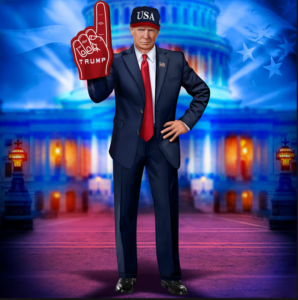
At a glance
- Definition: A blockchain-recorded token purportedly representing ownership of a digital asset
- Launched: December 2022
- Series produced: 4
- Total number of cards sold: ~175,000
- Each card’s original sales price: $99
- Total cost of cards initially sold (editions 1, 2, and 4): $12.3 million
- Current aggregate market value of cards (editions 1, 2, and 4): $3 million
- Trump’s haul: At least $7.2 million
- Estimate for what investors lost: $9.3 million
What is a nonfungible token?
A report to Congress by the U.S. Patent and Trademark Office and U.S. Copyright Office defines a nonfungible token (NFT) as “(i) a unique cryptographic token, (ii) the ownership of which is recorded to a blockchain (or another type of digital distributed ledger system), (iii) that provides the owner rights in or access to one or more assets or entitlements.”
Often, that asset takes the form of digital artwork that can be bought and sold. But while anyone can copy and paste the image (see Figure 1), the blockchain creates a permanent record of who owns the image’s underlying token. What that ownership actually conveys—copyright, reproduction rights, or simply a receipt—can vary and is often unclear, even to buyers, the report states.
Trump entered the NFT market as it was collapsing. The craze seems to have broken into the mainstream in March 2021, when the digital artist Beeple sold an NFT at Christie’s for $69.3 million. By September 2023, the crypto gambling site dappGambl estimated that about 95% of NFT collections—nearly 70,000 of the 73,000 it examined—had a market value of zero, leaving an estimated 23 million people holding worthless tokens. Art NFT trading volume, which peaked near $2.9 billion in 2021, had withered to about $23.8 million by early 2025, per DappRadar, a store for Web3 projects.
What’s the closest real-world equivalent?
Baseball cards. Both can be, and often are, mass produced. With NFTs, the underlying crypto token takes the place of physical possession of the card. Rarity, issuer, and the image on the front are main determinants of price on the secondary market. NFTs are often designed to evoke the look of a sports trading card, too—as Trump’s are, down to the name.
How are NFTs regulated?
No comprehensive federal law specifically regulates NFTs. Under the Trump administration, the Securities and Exchange Commission (SEC) has retreated from NFT enforcement actions begun under the prior administration, closing two investigations within weeks of his returning to office. In the CLARITY Act, the digital-asset legislation Trump and his administration support that is working its way through Congress, Republicans on the Senate Banking Committee have advocated for a clause explicitly stating NFTs are exempt from securities laws unless they involve an investment contract. At a minimum, the bill should ban the president from profiting on NFTs.
A brief history of Trump Digital Trading Cards
In a “MAJOR ANNOUNCEMENT!” on Truth Social in December 2022, just weeks after launching his third presidential campaign, Trump unveiled his NFTs. “These limited edition cards feature amazing ART of my Life & Career!,” he posted. The collection of 45,000 trading cards hit the market at $99 each. The cards—which showed stylized images of Trump, for example, ripping open his shirt to show a superhero outfit, wearing sunglasses and boxing gloves, or donning a duster amidst ducks in a meadow—sold out within about a day, generating roughly $4.5 million in sales. Some of Trump’s clothing in the NFTs appears to have been based on images from small clothing brands, Gizmodo reported, citing reverse image searches.
The cards are issued by NFT INT LLC, a Delaware company that licenses Trump’s name and likeness from CIC Digital LLC, an entity wholly owned by Trump that he created in 2022 to receive license fees from NFT sales. Until returning to the presidency, Trump served as CIC Digital’s manager, president, secretary, and treasurer. According to Bloomberg, the project was proposed to Trump by Bill Zanker, a longtime business associate who co-authored Trump’s 2007 book Think Big and Kick Ass in Business and Life. NFT INT LLC’s underlying ownership, however, is shielded behind a Delaware registered agent.
The partnership went on to release three more series of trading cards, with the latest, called “The America First Collection,” debuting in August 2024, a time Trump was also courting votes from crypto supporters. Despite a global downturn in the NFT market by that time, the sale still reportedly raked in $3.1 million. That series also included a physical aspect: each card featured a piece of fabric from the suit Trump wore in his June 2024 debate with President Joe Biden.
How Trump made out
Trump has reaped at least $7.2 million from the NFTs via licensing fees and royalties on sales on the secondary market, rather than any investment of his own capital, according to financial disclosures Trump is required to file as a candidate or president. The disclosures appear to cover overlapping or unspecified periods rather than clean calendar years, however, making it impossible to calculate accurate totals. So to be conservative, we’ll just use the $7.2 million from his August 2024 disclosure.
Table 2: Trump’s reported income from his NFTs
Disclosure filed Income Value of cash Income from bank account Value of crypto wallet Income from crypto wallet
August 2023 $4,866,832 $500,000 to $1 million $2,060,490 $1 million to $5 million $2,806,341
August 2024 $7,156,385 $500,000 to $1 million $5,000 to $15,000 $1 million to $5 million Less than $200
June 2025 $1,157,490 $1 million to $5 million $2,500 to $5,000 $1 million to $5 million Less than $200
June 2026 Less than $201 Unknown. Trump’s disclosure covering 2025 commingles this entity’s accounts with meme coin proceeds.
How other investors made out
Unlike the other crypto products in this report, the price of NFTs within a single series can vary widely. Factors like rarity (some cards exist as one-of-a-kind editions) and the imagery on the card can cause the prices of NFTs in the same series to have significant price differences.
Consistent with academic research finding that market liquidity and realized trade prices—rather than floor listings, which reflect asking prices unsupported by completed sales—are strong predictors of NFT value, Public Citizen valued each collection at its average sale price over the trailing 30 days. Because individual card values vary with rarity, the collection average is an aggregate measure rather than a price for any specific card. As the analysis measures current value, it relies on recent sales rather than an all-time average, which would be skewed by the elevated prices of the 2021–2023 NFT boom. As no trades could be found over the last 30 days for Series 3, we erred on the conservative side and omitted it from the totals. Overall, investors in the Series 1, 2, and 4 NFTs originally paid $12.3 million to Trump and his business partner; those cards now are worth about $3 million—a decline of $9.3 million, or about 76%.
Some buyers could have made out very well, but that was not the case for most of them. Series 1’s floor (the lowest value at which an NFT in a collection can be purchased) was around $900 in April 2023—around nine times the $99 original price—before collapsing when Trump released an additional series. Early buyers who sold before Series 2 hit the market, especially around the time of his 2023 indictment by the Manhattan district attorney’s office, may have captured substantial profits. Over the past 30 days, however, Series 1 cards have traded at an average of just $44.69, according to CryptoSlam, an industry data aggregator (see table 3). As of August 25, 2026, the 30-day trailing averages for NFTs Series 2 and 4 are $6.91 and $20.42, respectively. Meanwhile, Series 3 (the Mugshot edition) has effectively no secondary market; it recorded no sales in the past 30 days, and fewer than 500 people have ever bought one on the secondary market.
Table 3: Value of Trump NFTs on the secondary market
Series Original sales price Number of cards Total cost of cards initially sold Trailing 30-day average sale price, as of Aug. 25, 2026 Aggregate current value, as of Aug. 25, 2026 Current return (%)
1 $99 45,000 $4.5 million $44.69 $2 million -55%
2 $99 47,000 $4.7 million $6.91 $325,000 -93%
3 (Mugshot edition) $99 50,754 $5 million – - -
4 (America First edition) $99 31,740 $3.1 million $20.42 $648,000 -79%
Totals of editions 1, 2, and 4 123,740 $12.3 million $3 million -76%
Related products
Melania Trump announced her own NFT collection, Melania’s Vision, in December 2021, a year before her husband launched his line. The disclosure President Trump filed in June 2025 said her income was $217,000 from the venture (her NFT income was bundled with other products in the June 2026 disclosure).
Her first NFT up for auction went for the crypto equivalent of about $170,000. But, according to Vice’s analysis, and confirmed by Bloomberg, the money for the winning bid came from the entity that originally put the NFT up for sale. Melania Trump’s office told Bloomberg the transaction had been “facilitated on behalf of a third-party buyer.” (The NFT had attracted only a handful of bids, and the auction took place around the time of a greater crypto crash, causing the dollar value of some bids to drop after they were placed.)
Governance token: $WLFI

At a glance
- Definition: A token granting holders some voting rights in a crypto project
- Launched: September 2024
- Total supply: 100 billion
- Current circulation: 31.8 billion
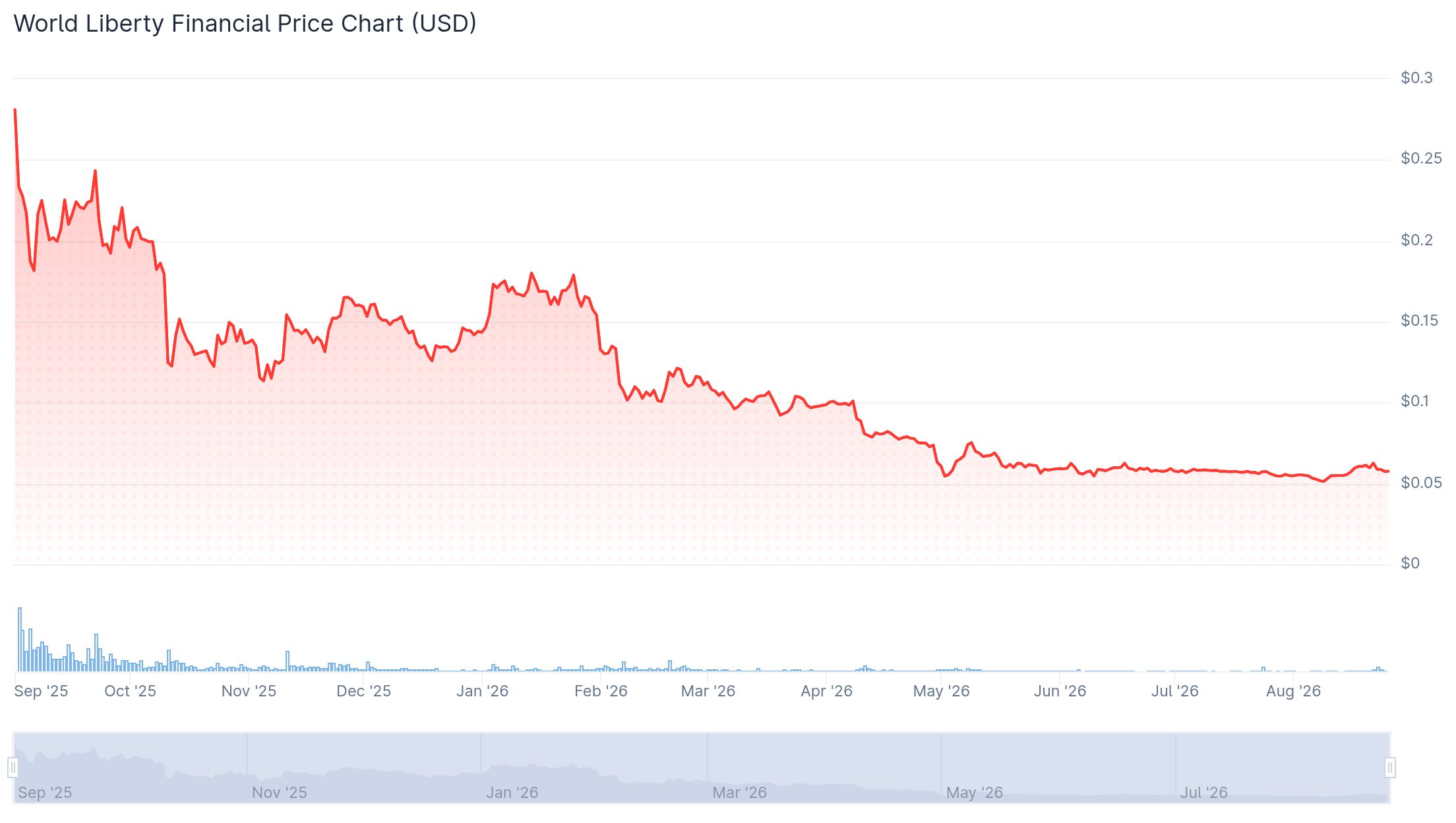
- All-time high: $0.3313 (Sept. 1, 2025)
- All-time low: $0.0508 (Aug. 9, 2026)
- Currently trading at: $0.05744
- Market cap: $1.83 billion
- Trump’s income from token sales: $557 million
- Value of Trump’s coins: Between $50 million and $905 million
- Estimated losses for investors, realized and unrealized: at least $1 billion
What is a governance token?
A governance token is a digital commodity that conveys to holders certain “rights with respect to the associated functional crypto system,” according to the SEC and Commodity Futures Trading Commission (CFTC). They typically allow “holders to vote on certain technical or governance matters, such as software upgrades and treasury expenditures.”
What’s the closest real-world equivalent?
Membership in a condo board—but without actually getting to vote on many issues or even own the condo.
How are governance tokens regulated?
No comprehensive federal law specifically regulates governance tokens, and the SEC has not formally classified $WLFI as either a security or a non-security. In March 2026, the SEC and CFTC indicated governance tokens may qualify as digital commodities outside federal securities laws—but only as long as there is no central party. Under the CLARITY Act, governance tokens would qualify as “digital commodities” and fall under CFTC jurisdiction—a lighter-touch regulatory regime than SEC oversight, and one that would benefit issuers like World Liberty Financial.
A brief history of $WLFI
With the mission to “leverage the global reach and recognition of the Trump brand” and Trump’s face splashed across the cover of the venture’s gold paper, World Liberty Financial was “inspired by the vision of Donald J. Trump.” Along with Donald Trump Jr., Eric Trump, Barron Trump, the president’s now-Special Envoy Steve Witkoff, and Witkoff’s sons Zach and Alex, Trump founded the venture, announcing it about two months before the 2024 election.
Trump owns 70% of an LLC that holds both 38.25% of the equity interest in the venture and all rights to its net protocol revenues, other than net proceeds from the sale of $WLFI tokens, for which it is entitled to 75% after some deductions, according to Trump’s latest annual financial disclosure, the fine print on World Liberty Financial’s website, and court filings. That LLC and Trump family members also hold 22.5 billion $WLFI tokens.
At first, the tokens were nontransferable and only available to accredited or foreign investors for $0.015 each. A second round priced tokens at $0.05, and by early July 2025, nearly 2,000 investors had bought in, according to an SEC filing. Later that month, token owners voted to allow limited trading, allowing them to sell 20% of their holdings, though founders—including Trump—remain locked out.
The actual governance function of $WLFI appears to be largely illusory. By World Liberty Financial’s own account, its token holders “are not members of WLF” and the company is “not controlled by $WLFI token holders,” who are only entitled to vote on “certain” protocol matters. World Liberty Financial screens all proposals prior to voting, only opening up those proposals when the outcome does not—in its own judgment—risk violating a law, contract, or terms of the corporation’s contract. The company’s decisions in those matters are final. World Liberty Financial can lengthen or shorten the typical one-week voting period based on its sole discretion. The timeframe for implementing the results of any passed vote is also at its sole discretion, as is adding protocol terms and policies. The company also selects, again, at its sole discretion, the signers of the wallet that administratively controls its governance platform and protocol. A lawsuit filed by crypto billionaire Justin Sun in April 2026 goes further, accusing World Liberty Financial of secretly freezing 3 billion of his tokens from trading, denying him voting rights to protest, and making changes to the protocol unilaterally.
In April 2026, World Liberty Financial pledged $450 million worth of its own $WLFI tokens as collateral to borrow $75 million in stablecoins, including about $65 million of its own USD1, from Dolomite, a lending platform run by one of its own advisers—a circular self-dealing structure that some observers compared to the one that brought down FTX.
In May 2026, World Liberty Financial token holders approved a proposal that created a path to unlocking the founders’ tokens, including Trump’s. If founders elect to unlock their tokens, they could lose up to 10% of them, but after two years, they’d be able to sell the remainder on a three-year vesting schedule. Based on Public Citizen’s analysis of on-chain transactions, it appears Trump and other founders took that step almost immediately. To track the movement, though, begin on September 29, 2024, when a single transaction from World Liberty Financial’s wallet sent one token to each of seven different addresses, likely as a test. On October 10-11, 2024, two more transactions delivered the balance, including 15,749,999,999 tokens to one wallet, and 2,249,999,999 to each of three others. Those four amounts split 22.5 billion tokens exactly 70-10-10-10, matching the disclosed 70% Trump stake in the LLC that holds the tokens, with the remaining 30% held by unnamed family members (divided here in three equal shares). None of the four moved their $WLFI until May 19, 2026, when each one moved its full balance into the vesting contract in the same transaction. Public Citizen could not independently confirm who controls the four wallets.
How Trump made out
According to his financial disclosures, World Liberty Financial took in $57 million in 2024—a period during which the company only existed for three months and Trump was out of office. About $30 million of that revenue was attributable to him. In 2025, with him back in the White House, Trump’s share jumped more than 17 times to $527 million, bringing his total haul from token sales to $557 million through the end of last year.
Trump also reported $65.6 million in income from selling an equity stake in World Liberty Financial in 2025.
He’s sitting on 15.75 billion $WLFI tokens, which he valued as worth more than $50 million. While they are trading at $0.05744—putting the stake’s nominal value near $905 million—that figure is theoretical: his tokens are locked up for now, and $WLFI’s daily trading volume is a fraction of the position, meaning any attempt to sell them at scale would almost certainly cause the price to plummet.
Trump’s stake did not come from any apparent investment of his own funds.
How other investors made out
Not well. On its first day of trading, $WLFI hit $0.3313. That price remains its all-time high, with the coin plummeting and now trading at $0.05744. The accredited and foreign investors who got in on the private sale paid $0.015 or $0.05, meaning they’re up anywhere from 15% to 283%. Almost everyone who bought the tokens on the public market, though, is down—possibly as much as 83%, if they bought at the peak.
Calculating the total amount $WLFI investors have lost is difficult because much of the token was distributed through its private sale and now trades largely on centralized exchanges—venues where losses are real but not visible in on-chain data, leaving the full toll unknowable. Public Citizen estimates $WLFI has cost investors at least $1 billion. That figure reflects roughly $1 billion in unrealized losses at a company called AI Financial Corporation (formerly ALT5 Sigma) at current prices, plus at least $54 million among losing retail buyers on decentralized exchanges—and excludes losses on centralized exchanges, which are real but not measurable from on-chain data and would likely push the total even higher.
AI Financial, a Nasdaq-listed company that remade itself into a World Liberty Financial treasury vehicle, acquired 7.28 billion $WLFI tokens at $0.20 each in August 2025 for a total of about $1.46 billion—a position it valued at just $421 million by the end of June 2026, a paper loss of $1.04 billion. Its $WLFI treasury had been subject to a lock-up provision, with its coins becoming transferable as of August 12, 2026, according to an SEC filing. About a week prior to that date, a wallet Arkham identifies as AI Financial’s moved roughly 1.8 billion tokens to other wallets.
At Public Citizen’s request, two blockchain analytics firms examined trading in $WLFI. Both looked only at decentralized exchanges—a limitation that captures only a fraction of the damage—since it excludes losses on centralized exchanges (such as Binance), where most $WLFI trading occurs, as well as among private-sale investors. Nansen, filtering to include only likely retail wallets, found that of 31,000 wallets that bought $WLFI on Ethereum decentralized exchanges, 25,000—82%—were underwater as of August 3, 2026. Those losing wallets were down $54 million, while winners were up $24 million, for a net loss of $30 million across all retail buyers. The median buyer was down $33. Bubblemaps, counting all addresses that traded $WLFI on decentralized exchanges, found 35,000 traders at a loss for a combined $365 million, against 23,000 traders up a total of $201 million. It counted 24 traders with losses exceeding $1 million, while 29 had profits of more than $1 million.
Putting aside any financial returns, however, some large backers made out quite well. Justin Sun bought $30 million worth of $WLFI tokens through his company, Blue Anthem, in November 2024, and another $15 million in January 2025, while his public statements have put his total investment at $75 million. In March 2026, Trump’s SEC settled the fraud case it had brought against him and his companies during the Biden administration, penalizing one of his firms $10 million and dropping the rest.
And in June 2025, Aqua 1 Foundation, an investment fund describing itself as based in the United Arab Emirates with no discoverable web presence before the deal, announced it had purchased $100 million of $WLFI “to participate in governance of the decentralized finance platform inspired by President Donald J. Trump.” (Reuters later reported the fund was connected to Guren “Bobby” Zhou, a Chinese businessman under investigation in Britain for money laundering. He has denied any wrongdoing.) Five months later, Trump’s Commerce Department allowed a separate UAE entity, G42, to import the equivalent of up to 35,000 advanced Nvidia AI chips that require U.S. government authorization to export.
Figure 3: Price of $WLFI since public trading started
Foreign connections
Before the tokens were unlocked, only accredited or foreign investors could buy them. And 2.8 billion tokens are currently held at Binance, which is barred from serving U.S. customers under the terms of its 2023 settlement with the Treasury Department. Meaning that if the rules are being followed, they are in foreign hands.
World Liberty Financial is also helping the Pakistani government integrate blockchain technology into its financial system. According to a government press release issued in January 2026, World Liberty Financial CEO Zach Witkoff “showed keen interest to engage with Pakistan” and “expressed keen desire to further deepen engagement.”
Related products
In August 2025, the aforementioned AI Financial (then still called ALT5 Sigma) announced plans to raise $1.5 billion and build a treasury of what turned out to be 7.28 billion $WLFI tokens. Since linking up with World Liberty Financial, the company has seen its share price fall 91%, from $7.04 to $0.642.
Beyond the stock price, AI Financial has had a tumultuous run since partnering with World Liberty Financial:
- It suspended and later terminated its CEO—reportedly giving the SEC the wrong date for when it placed him on leave.
- Nasdaq flagged it three times, including as recently as August 2026, as noncompliant for failing to file SEC reports on time.
- It’s at risk of being delisted by Nasdaq for having a stock price below $1.
- It changed its name from ALT5 Sigma to AI Financial Corp.
Under World Liberty Financial’s revenue split, the Trump family LLC was entitled to up to 75% of the net proceeds, of which Trump himself owns 70%—a theoretical maximum of roughly $394 million before any undisclosed deductions. (This sum is not in addition to the aforementioned $WLFI income, but rather is part of it.)
At first Eric Trump was slated to sit on its board of directors; instead he became a board observer. Then his name was removed from the website altogether. Now he’s apparently trying to distance himself from the company altogether—quite the retreat for someone who rang the opening bell at Nasdaq MarketSite in August 2025 to commemorate the deal, saying, “World Liberty and ALT5, we are the tip of the spear…we are really going to rewrite the whole playbook for the financial industry.”
Meme coin: $TRUMP
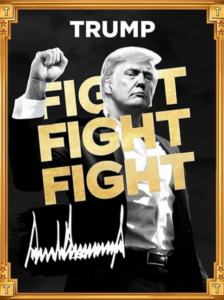
At a glance
- Definition: A speculative crypto asset driven by internet hype, with no underlying value
- Launched: January 17, 2025, three days before Trump’s inauguration
- Total supply: 1 billion
- Current circulation: 250.9 million
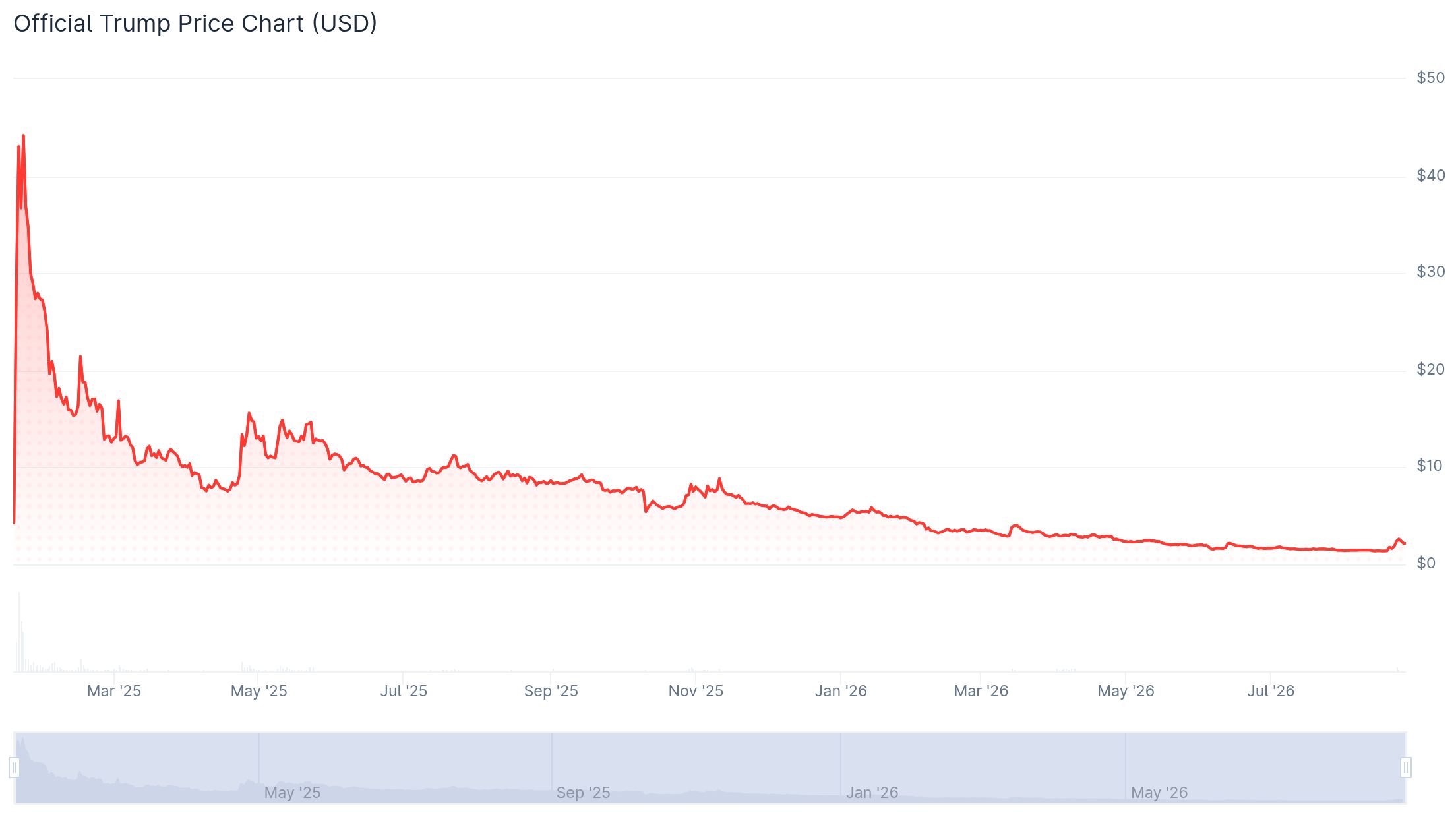
- All-time high: $73.43 (Jan. 19, 2025)
- All-time low: $1.37 (Aug. 13, 2026)
- Currently trading at: $2.22
- Market cap: $557 million
- Trump’s income from fees: $635 million
- Value of Trump’s coins: ~$271 million
- Losses, largely unrealized, of investors who ended up underwater: ~$3.2 billion
What is a meme coin?
In 2025, SEC staff called meme coins “a type of crypto asset inspired by internet memes, characters, current events, or trends for which the promoter seeks to attract an enthusiastic online community to purchase the meme coin and engage in its trading.” Meme coins are typically not backed by any underlying asset, nor do they represent ownership in any business or revenue stream. They often have no functionality, although occasionally they have utility in contests, access to chatrooms or games.
What’s the closest real-world equivalent?
Beanie Babies. Like NFTs, their value is based almost exclusively on hype and popularity. Their manufacturer, Ty Inc., even ran an “Official Club” in the late 1990s where ownership of a specific limited-edition Beanie Baby unlocked access to additional exclusive products. (Although Beanie Babies can be soft and cuddly, which meme coins are not.)
How are meme coins regulated?
No comprehensive federal law specifically regulates meme coins. In a statement made about six weeks after Trump became a meme-coin entrepreneur, SEC staff wrote that “meme coins are akin to collectibles.” In March 2026, the SEC and CFTC issued a final rule formalizing the position, stating “a digital collectible does not constitute any of the financial instruments enumerated in the definition of ‘security.’” The CLARITY Act’s definition of digital commodity excludes collectibles—which, combined with the SEC and CFTC’s guidance, puts meme coins outside the bill’s primary scope.
A brief history of Trump’s meme coin
Trump launched $TRUMP three days before he returned to the White House, by which time he had already announced who he planned to lead the SEC. Trump’s CIC Digital is partners in the venture with Fight Fight Fight LLC, which is also connected to Zanker, Trump’s co-author on Think Big and Kick Ass in Business and Life. The two companies retained ownership of 80% of the coins, which are scheduled to be released over the next three years, according to the coin’s website. The companies also collect revenue from trading activity.
Trump’s meme coin made headlines in May 2025 when the top holders were awarded a dinner with the president at his D.C.-area golf course and a White House tour. (Public Citizen held a rally outside the dinner with Sen. Jeff Merkley, D-Ore., and more than 100 demonstrators.) Trump threw a similar event in April 2026 at Mar-a-Lago.
In late 2025 and mid-2026, two other attempts to encourage utility—and therefore increase the value of Trump’s coins—were introduced: the “play-to-earn” Trump Billionaires Club game, which promises $1 million worth of crypto prizes, and $TRUMP Coin Club, which offers special rewards, discounted merch, and exclusive content and experiences.
How Trump made out
Trump made $635 million in licensing fees from his meme coin in 2025, according to his latest financial disclosure.
In March 2026, Forbes estimated the meme coins Trump is sitting on were worth $393 million. $TRUMP has fallen by about 31% since then, though, so it’s probably worth closer to $271 million now. Trump’s tokens were allocated to his company rather than purchased, and his other income from the meme coin came via licensing fees. Neither required any capital investment from him, meaning his proceeds should be nearly all profit.
How other investors made out
$TRUMP launched on January 17, 2025, when Trump announced it in a Truth Social post around 9 p.m. Eastern. Within about 90 seconds of Trump’s post, a single wallet—funded with roughly $1.1 million about two hours earlier—bought nearly 6 million tokens at around $0.18 each, roughly 6% of the coins then available, according to Bloomberg’s analysis. Over the next two days, as many of Trump’s millions of followers piled in, the price soared to an all-time high of $73.43. The earliest buyers were positioned for extraordinary gains; the far larger waves that bought during and after the surge were left holding tokens now worth a fraction of what they paid. In effect, the coin transferred billions of dollars from a large group of later buyers to a small group of early ones.
Two blockchain analytics firms examined $TRUMP trading at Public Citizen’s request. Nansen, filtering to likely retail wallets, found that of about 1.6 million wallets that bought $TRUMP on Solana decentralized exchanges, roughly 1 million—65%—are underwater, down a combined $3.2 billion. As with $WLFI, most of that is unrealized: only about $400 million was realized in sales at a loss. The gains were overwhelmingly concentrated: the top 1% of winning wallets captured about $2.7 billion—80% of all gains. And the wallets that bought in the coin’s first two days, roughly 45% of retail buyers, took nearly 90% of the gains. The median buyer was down $3.06, and almost 350,000 wallets were down more than $100. Bubblemaps, counting all addresses that traded $TRUMP on decentralized exchanges, found about 1 million losing wallets down $4.5 billion, with 36 traders reaping profits that exceeded $10 million.
Figure 5: Price of Trump’s meme coin since launch
Some investors really made out in ways that transcend a cash return on their investment. The aforementioned Justin Sun bought $100 million in $TRUMP. In March 2026, Trump’s SEC settled the fraud case it had brought against him and his companies during the Biden administration, penalizing one of his firms $10 million and dropping the rest. And while it’s unclear if it actually benefited from the purchase, the CEO of Freight Technologies, a Nasdaq-listed cross-border logistics company, announced his company had earmarked $20 million for buying $TRUMP, saying the purchase was “an effective way to advocate for fair, balanced, and free trade between Mexico and the U.S.” As of May 2025, the company has disclosed roughly $2 million in $TRUMP purchases.
Foreign connections
Bloomberg’s analysis in May 2025 found that 19 of the 25 top $TRUMP holders had registered through foreign exchanges that exclude U.S. customers, and that more than half of the top 220 holders had done the same. A New York Times investigation that traced specific attendees of the May 2025 dinner identified Chinese crypto billionaire Justin Sun as the leaderboard’s top holder, alongside He Tianying, a delegate to a district branch of the Chinese People’s Political Consultative Conference, which is “an advisory body that seeks to broaden the Communist Party’s influence and solicit support from influential people in Chinese society.”
Related products
Melania Trump launched her own meme coin, $MELANIA, two days after her husband. It’s even underperformed $TRUMP, currently trading at just $0.1037, down 99.2% from the all-time high of $13.05 it hit on its launch day. Her revenue from the venture is not broken out in the president’s financial disclosure but rather appears to be lumped in with the $6 million she made from “NFTs and other collectibles.”
Stablecoin: USD1

At a glance
- Definition: A dollar-pegged crypto asset backed by cash and Treasury reserves
- Launched: March 2025
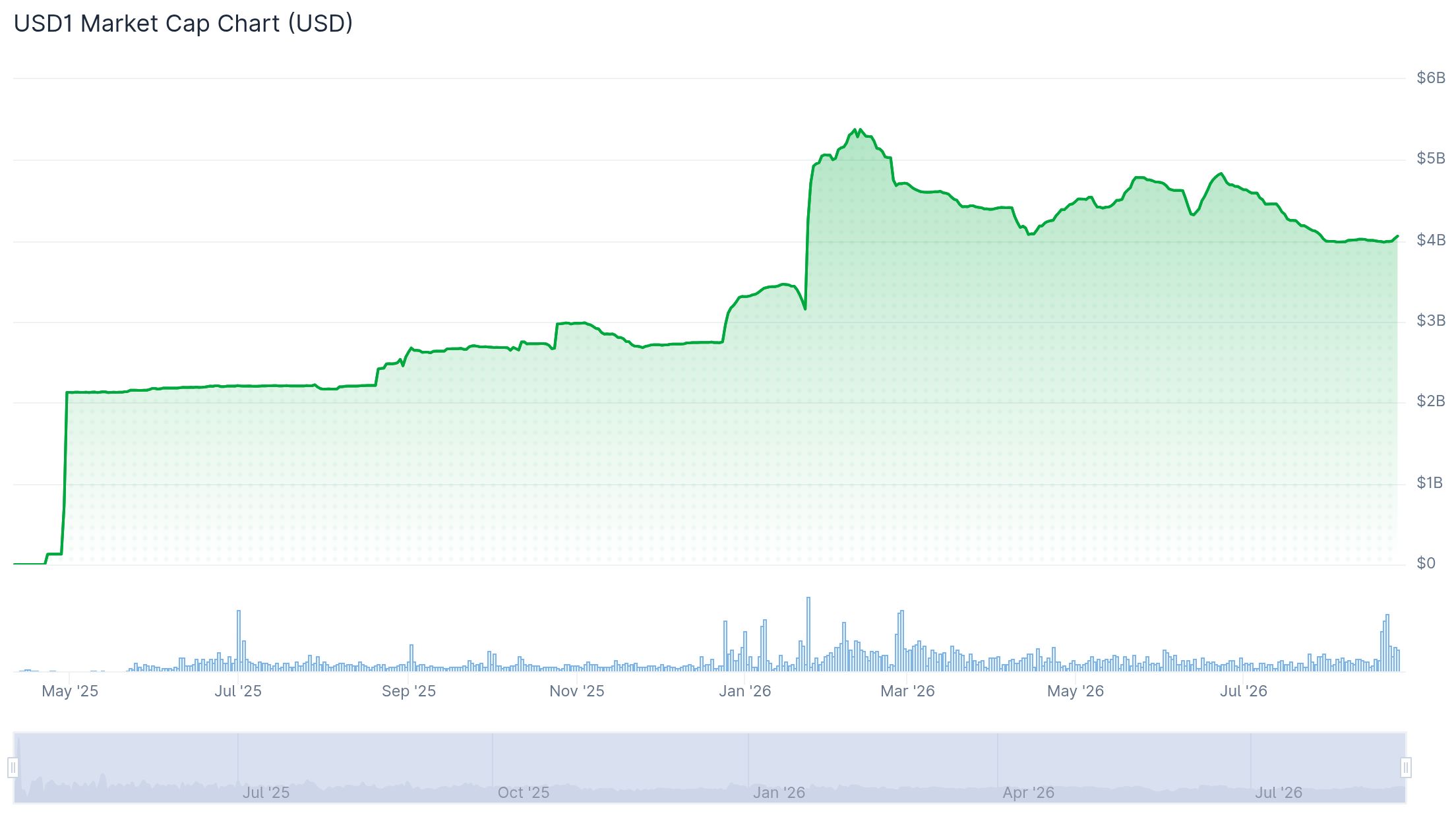
- Market cap: $4.1 billion
- Rank among stablecoins by market cap: Fourth
- Percent held by overseas interests if rules are being followed: At least 64%
- Trump’s revenue in 2025: $199.2 million
What is a stablecoin?
A stablecoin is a cryptocurrency designed to hold a steady value—usually pegged one-to-one to the U.S. dollar and backed by reserves the issuer promises to redeem on demand, according to a 2022 paper published by the Federal Reserve.
What’s the closest real-world equivalent?
An interest-free loan to the issuer. You hand over a dollar, the issuer invests it in short-term government debt (like Treasury bills), and the issuer pays you back a dollar whenever you ask—keeping the interest it earned on your money.
How are stablecoins regulated?
The GENIUS Act, which Trump signed into law four months after he launched USD1, provides a regulatory framework for stablecoins used for payments: Issuers must hold at least one dollar of reserves for every dollar of stablecoins issued; they are prohibited from paying any interest to holders; and reserves are restricted to cash, bank deposits, Treasury bills, government money market funds, and similar low-risk assets. The act also requires the president, vice president, and other senior executive branch officials to report personal stablecoin holdings exceeding $5,000. But it contains no new prohibitions on officials or their families from issuing or sponsoring a stablecoin, although it does state that existing ethics laws already bar officials from personally issuing a stablecoin while in office.
A brief history of Trump’s stablecoin
Four days before Trump’s inauguration, a company backed by Sheikh Tahnoon bin Zayed Al Nahyan—Abu Dhabi’s deputy ruler and the UAE’s national security adviser—purchased a 49% stake in World Liberty Financial, the Wall Street Journal reported. The investment, which was a secret for about a year, didn’t give the Tahnoon-backed firm rights to future WLFI token sales, leaving it “out of what was then [World Liberty Financial’s] only source of revenue,” the Journal reported. The sale of 49% of the businesses routed $187 million to Trump family entities, according to the Journal. (The Constitution states, “no Person holding any Office of Profit or Trust under them, shall, without the Consent of the Congress, accept of any present, Emolument, Office, or Title, of any kind whatever, from any King, Prince, or foreign State.”)
In March 2025, World Liberty Financial, which had already released the $WLFI governance token, announced plans for a second product: USD1, a stablecoin minted on the Ethereum and Binance Smart Chain blockchains.
In May 2025, World Liberty Financial revealed that MGX’s $2 billion investment in Binance would be settled in the fledgling USD1. MGX is a state-backed Abu Dhabi fund chaired by Sheikh Tahnoon. The move essentially allowed World Liberty Financial—and the Trumps—to make interest off the $2 billion for as long as that USD1 is in circulation. MGX said it chose USD1 stablecoin to settle its investment based on factors such as business suitability, the currency of the backing assets and “compliance history.” USD1 was brand new at the time.
That deal—and assistance from Binance—helped USD1 quickly rank among the top 10 stablecoins by market cap.
Since April 2025, USD1’s custodian, BitGo, has issued monthly attestation reports that purport to disclose its reserve holdings. In an “independent accountants’ examination report” dated July 31, 2026, KPMG found that BitGo’s assertion about the reserves was “fairly stated”—reporting roughly $4.6 billion in USD1 outstanding as of June 30, 2026, against reserves exceeding that by just $177,000, a margin of less than 0.01%. The market cap appears to have dropped, with two crypto trackers, Arkham and CoinGecko, listing it at $4.1 billion as of August 26, 2026.
Figure 7: USD1’s market cap since launch
How Trump made out
Trump reported $197 million in revenue from capital contributions from new partners in the venture. Net operating income from the stablecoin business came to $8.3 million, of which about $2.2 million was attributable to Trump. As mentioned previously, Trump’s stake in World Liberty Financial did not come from any apparent investment of his own funds.
How other investors made out
As planned, the stablecoin has retained its value. So, unlike Trump’s other crypto ventures, buyers of USD1 haven’t suffered major losses.
Tahnoon managed to come out ahead big time on his USD1 transaction. Two weeks after World Liberty Financial announced MGX was using $2 billion of USD1 to invest in Binance, the White House walked back a Biden-era policy and “agreed to allow the U.A.E. access to hundreds of thousands of the world’s most advanced and scarce computer chips,” the New York Times reported.
Trump also pardoned Binance founder, Changpeng “CZ” Zhao, and Trump’s SEC dismissed a lawsuit it had filed against the exchange during Biden’s term. Not only did Binance allow World Liberty Financial to profit off interest from the $2 billion of USD1 that MGX invested in the exchange, but Binance had also helped the stablecoin launch, reportedly offering prizes to generate demand and donating software.
Foreign connections
A firm backed by the UAE’s national security adviser owns 49% of the company that issues USD1. And between its own wallets and its customers’, Binance holds $2.63 billion of the $4.1 billion of USD1 in circulation. Binance is barred from serving U.S. customers under the terms of its 2023 settlement with the Treasury Department. So, if the rules are being followed, at least 64% of USD1 is held by foreign interests. World Liberty Financial appears to be looking to deepen its relationship with Binance, sponsoring promotions that encourage the exchange’s account holders to acquire and hold USD1.
Despite U.S. sanctions and Binance’s earlier pledges, “Iranian entities associated with the regime” have continued to use the exchange as recently as May 2026, according to the Wall Street Journal. (Binance disputes the Journal’s reporting on its sanctions compliance. In March 2026, the exchange sued the paper’s parent, Dow Jones, for defamation over an earlier article on the same subject.)
In August 2026, the Office of the Comptroller of the Currency—which is led by a Trump appointee—granted “preliminary conditional approval” to World Liberty Trust Company, a proposed national trust bank. Affiliated with World Liberty Financial, the bank would assume responsibility for issuing USD1. The bank’s investors include a Trump-family entity, DT Marks SC LLC, whose passivity commitment was signed by Eric Trump, and StringZ Holding RSC (DE) LLC, whose manager is listed as Hamad Khlfan Ali Matar Alshamsi. A businessman of that name is vice chairman of Ghitha Holding, a subsidiary of International Holding Company, the Abu Dhabi conglomerate chaired by Sheikh Tahnoon bin Zayed Al Nahyan.
World Liberty Financial is also collaborating with WorldClaw, a Hong Kong-based AI platform that accepts USD1 as payment. A Reuters review found that 43 of the 90 models available through WorldClaw’s website were developed by Alibaba, Baidu, Z.ai and other Chinese technology companies the Trump administration says pose national-security risks.
Digital-asset treasury: Trump Media & Technology Group

At a glance
- Definition: A public company that holds large cryptocurrency positions on its balance sheet
- Launched: Trump Media was formed in February 2021, went public via a merger in March 2024, and announced its crypto treasury on May 27, 2025
- Market cap when crypto treasury announced: $5.7 billion
- Current market cap: $2.6 billion
- All-time high: $175.00 (Oct. 22, 2021)
- All-time low: $6.96 (June 26, 2026)
- Price when crypto treasury was announced: $26.76 (May 27, 2025)
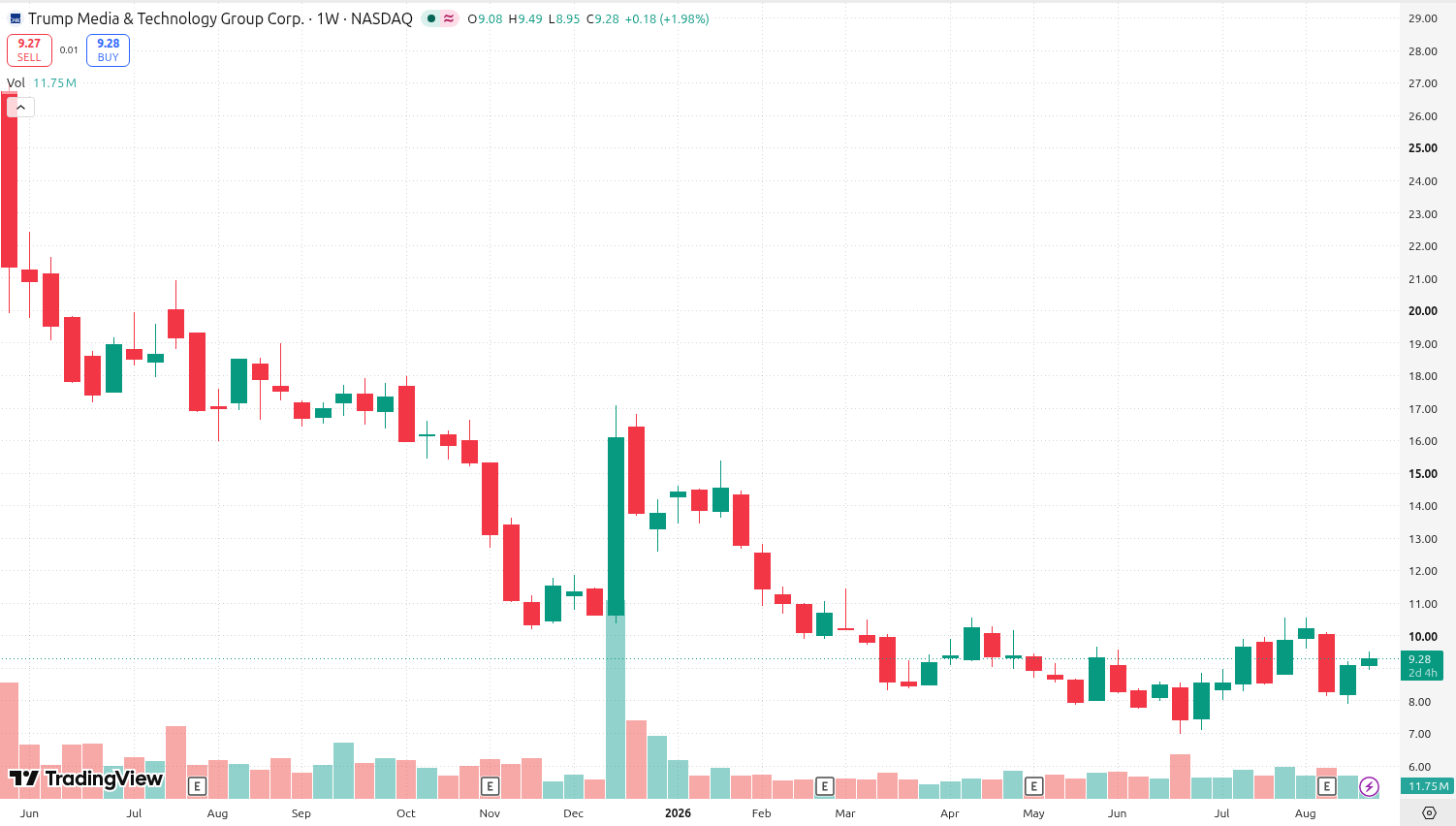
- Currently trading at: $9.31
- Value of Trump’s shares: $1.07 billion
- Company’s paper loss on bitcoin: $450 million
What is a crypto treasury?
No federal or state regulator appears to have formally defined a crypto treasury. Strategy Inc., which pioneered the concept in August 2020 when it was named MicroStrategy, says it “generate[s] value from our bitcoin holdings…[by] developing and issuing novel fixed-income instruments that provide investors varying degrees of economic exposure to bitcoin.” Essentially, crypto treasuries allow investors exposure to digital assets without actually buying any.
What’s the closest real-world equivalent?
A horse-racing syndicate. As one equine law firm describes it, that’s “a group of people who come together to purchase shares in a horse,” who become “co-owners of fractional interests in a racehorse” and share the cost of purchase and ongoing maintenance. Investors don’t directly own the horse; instead, they own pieces of an entity that does, and the value of each piece can rise or fall based on how the racehorse performs.
How are digital-asset treasuries regulated?
The same as other publicly traded companies.
A brief history of Trump Media’s digital-asset treasury
In May 2025, Trump Media, the parent company of the Truth Social platform, sold 55.9 million shares, raising $1.44 billion, and another $1 billion in convertible debt and used the proceeds to eventually buy more than $1 billion worth of bitcoin, approximately $630 million of bitcoin-related securities, and $114 million worth of Cronos, another cryptocurrency. The move essentially transformed it from a media company to a digital-asset treasury with a money-losing media side hustle.
How Trump made out
Trump’s 114.75 million shares were worth $3.07 billion when the company announced it was building a digital-asset treasury. They are currently worth $1.07 billion. Trump’s 41% stake in Trump Media comes from converting his founding interest when a merger took the company public, as well as some “earnout” shares issued at no cost after the stock price reached preset targets, not buying shares on the open market.
How other investors made out
Since trading opened the day the company unveiled its bitcoin strategy on May 27, 2025, Trump Media’s shares are down 65% and its market capitalization has fallen from about $5.7 billion to roughly $2.6 billion—erasing about $3.1 billion in shareholder value. Shares in Trump Media had been on a consistent downward trajectory since it finalized the merger that took it public, so not all of that loss can be attributed to its crypto treasury. But the strategy has not reversed it: as of June 30, 2026, Trump Media held 9,477 bitcoin that cost about $1.006 billion but were worth just $557 million—a paper loss for the company of around $450 million.
Isolating the treasury strategy’s responsibility for that $3.1 billion decline in the value of Trump Media shares is difficult: the company announced the strategy alongside a $2.4 billion capital raise, its stock was already on the decline, and it has made other moves since May 2025 that affected the price. For the purposes of this report, Public Citizen takes the conservative approach and attributes to the strategy only the $450 million paper loss on the bitcoin itself.
Figure 9: DJT’s stock price since announcing its digital-asset treasury strategy
Foreign connections
Trump Media’s digital-asset treasury is intertwined with Crypto.com, a Singapore-headquartered exchange founded in Hong Kong that operates its trading platform through an entity incorporated in the Cayman Islands. Trump Media announced Crypto.com as one of its two initial bitcoin custodians, and Crypto.com developed the blockchain behind the Cronos token, which Trump Media’s treasury also holds. As of August 2025, Crypto.com owned 2.8 million shares of Trump Media.
Related products
Donald Trump Jr. and Eric Trump are involved with another venture that allows investors exposure to bitcoin without owning it directly: American Bitcoin, which sells its own shares, using the proceeds to buy bitcoin, as well as mining it in its data center. The stock is down around 96% from its 52-week high. But Eric Trump, who has a bigger role with the company than his brother does, has “boosted his personal fortune from an estimated $190 million to $280 million,” Forbes reported in April 2026. In July 2026, American Bitcoin carried out a 1-for-15 reverse stock split, consolidating every 15 shares into one to keep its share price above Nasdaq’s minimum listing threshold of $1 per share.
Conclusion
The five Trump crypto products this report examines—the Trump Digital Trading Cards NFTs, $TRUMP meme coin, $WLFI governance token, USD1 stablecoin, and Trump Media’s digital-asset treasury—are a snapshot of a Trump crypto empire that has expanded sharply since the November 2024 election. Trump’s businesses continue to launch additional crypto products, with even more potentially on the way.
In February 2025—about a month into Trump’s second term—an LLC that manages the president’s trademarks applied with the Patent and Trademark Office to trademark “Trump” for possible use across dozens of crypto and tech-related products. Included are software for managing crypto transactions, a virtual reality game that uses crypto tokens, video memes verified by NFTs, an online marketplace for buying and selling digital goods and cryptocurrencies, and NFT-authenticated digital collectibles “authorized by the 45th and 47th President of the United States of America.” In October 2025, the president’s Patent and Trademark Office issued a notice of allowance for his company’s trademark application.
In October 2025, Trump Media also announced its involvement in a prediction market offered through Crypto.com. Even as the firms wound down part of their deal, the president’s firm is currently slated to promote Crypto.com’s markets to Truth Social users. While the president’s business is looking into expanding its relationship with the crypto exchange, his administration “intervened” to help prediction markets, including Crypto.com, the New York Times reported. Trump’s CFTC went so far as to put two officials who had raised questions about the companies on leave and began investigating them.
Every Trump crypto product, both launched and in the works, deepens the conflict at the heart of Trump’s administration: the president’s policy choices and personal portfolio cannot be separated. The Trump family peddles crypto, profiting from the market the president and his allies in Congress are writing the rules for. As the Senate takes up the CLARITY Act, lawmakers must—at a minimum—establish strong ethics rules barring the president, his family members, and senior administration officials from issuing, owning, sponsoring, promoting, endorsing, or profiteering from any digital assets they regulate. It also should require divesting from any existing crypto ventures. The latest version of the bill is insufficient. When the president engages in these ventures he is soliciting a gift, he is trading government services for personal gain, and he is accepting emoluments. A crypto framework that exempts the most-conflicted issuer in the country isn’t a guardrail. Instead, it signals a green light for massive corruption.