TCEQ Watchdog: Agency Enforcement Backlog Decreases, but the Cases Remain Unresolved
By Kathryn Guerra
For nearly a year, Public Citizen’s TCEQ Watchdog Campaign has tracked the enforcement case backlog of the state’s environmental regulator.
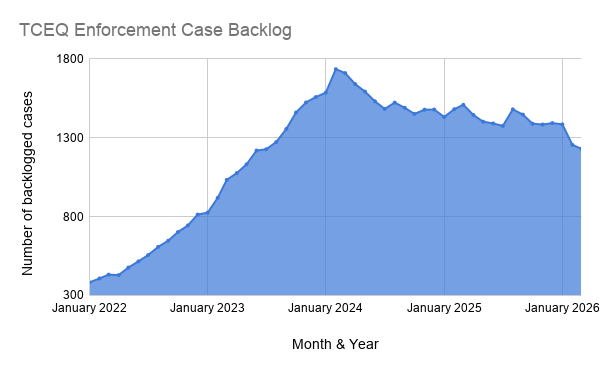
The Texas Commission on Environmental Quality (TCEQ) has an extensive backlog of delayed, unresolved cases alleging environmental harm spanning 10 years, leaving communities waiting for accountability that may never come. The enforcement backlog began steadily growing in 2021 and reached a peak of 1,700 cases in early 2024. It currently sits at over 1,200 cases.
As the state’s environmental regulator, the TCEQ issues permits that limit pollution of our air, water, and land. When sources commit environmental violations, such as emitting more pollution than the law allows or failing to obtain the proper environmental permits, the TCEQ can initiate legal proceedings that mandate corrective action and require the polluter to pay a fine. But it takes the TCEQ an average of 528 days to process a single enforcement case. TCEQ says it prefers to “promote and foster voluntary compliance with environmental laws and provide flexibility in achieving environmental goals.”
Enforcement delays often result in ongoing, unremediated pollution and harmful public health outcomes. We’ve asked TCEQ leadership to make a serious, expeditious effort to address the backlog in our TCEQ Year in Review report, in press, on social media and in recent public comments directly to agency leadership.
In response, the commission chair, Brooke Paup, expressed offense at our request that the agency step up enforcement and improve its performance, with commissioner Catarina Gonzales seconding Paup’s feelings. Paup also told us on April 1 that the TCEQ lacked the funding needed to address the enforcement backlog and that the public needed to advocate for more agency funding during the upcoming legislative session if they wanted to see it resolved.
But TCEQ may have acted on our request just a few weeks later. By April 30, TCEQ leadership reported it had a newly dedicated “strike-force” of five full-time attorneys in its Office of Legal Services specifically to address the enforcement backlog and that it had created a new team in the Office of Compliance and Enforcement who are focused on backlogged cases, “with the ultimate goal of appropriately managing all of these cases by the end of the fiscal year.” The TCEQ’s fiscal year ends in August – three short months from now. “It’s been a fundamental shift in how we’re approaching and how we’re operating our workload,” staff told commissioners.
Removing Cases from the Backlog
TCEQ commissioners then lauded staff for reducing the backlog by 130 cases in February 2026 – nearly double what the agency has ever resolved in a single month since the backlog began growing in 2021. While we commented in support of the agency’s progress, we now know that wasn’t the whole story.
In reality, TCEQ closed only 20 enforcement cases between February and March of this year, with signed agreed orders that mandate the polluter pay a penalty and remedy the violations by a certain date. The rest of the cases were simply removed from the backlog list, some without explanation of how they were resolved. We submitted a request under the Texas Public Information Act, and here’s what the data tells us.
In February and March, the agency removed approximately 260 enforcement cases from its backlogged case list. Of those, 67% still remain unresolved or were withdrawn despite the initial finding of an environmental violation severe enough to initiate enforcement:
- 129 cases – or half – are still active, ongoing enforcement cases without agreed orders;
- 15 cases were non-suited. Non-suit is the voluntary dismissal of an enforcement claim by the TCEQ, formally withdrawing allegations of environmental violations and dropping any penalties assessed against those polluters; and
- 30 cases were closed with no agreed order. The TCEQ refused to produce records in response to our Public Information Request, specifically asking how these cases were closed.
In addition to the 20 properly closed cases, TCEQ is tracking compliance on 65 active cases with a proposed or signed agreed order.
While actively managing cases is progress, removing records and claiming victory on paper is not. Only the closure of resolved cases indicates that the TCEQ’s enforcement process is functioning as it should.
When we submitted a follow-up request for more information about the cases that were closed without an agreed order or penalty, the agency’s External Relations director, Ryan Vise, responded that “the PIA [Public Information Act] does not require that governmental bodies answer questions or create new information when responding to requests for information, TCEQ has no records to provide in response to this inquiry.”
Vise did explain that the agency doesn’t consider a case behind schedule until it’s been on the books for six months from the date it was referred for enforcement action. If the TCEQ hasn’t mailed the polluter a proposed agreed order – a template letter that details the alleged violation(s) and penalty – within that time, the agency counts the case as backlogged. But then TCEQ puts the agreed order in the mail and that case is removed from the backlog list. According to Vise, if, after 550 days (a year and a half) from the original date of enforcement referral, the polluter has still not signed the agreed order and voluntarily agreed to come into compliance, the TCEQ returns the case to the backlog list.
In some cases, years-long delays were caused solely by TCEQ’s inability to draft and mail the proposed agreed order to the polluter. To remove them from backlog status, all TCEQ did was stick a postage stamp on an envelope and mail a template letter. If a community is suffering from pollution, resolution doesn’t come in a template letter. It comes when pollution stops and fines are paid.
Closed and Non-Suited Cases
We reviewed each of the nearly 45 cases that TCEQ closed either without an agreed order or by non-suit. All of the cases have been removed from the agency’s most recent report of active enforcement actions, and the TCEQ’s Commissioners Integrated Database shows that each case is now closed. But TCEQ says they don’t have to tell the public how they were closed, if the violations(s) were resolved, or if the pollution was remediated.
Some of the closed enforcement cases were for serious environmental disasters.
In Fort Worth, the TCEQ alleged that in December 2019, the U.S. Navy spilled approximately 2,600 gallons of PFAS-containing 3% Aqueous Film-Forming Foam (AFFF) solution (a synthetic fire-fighting concentrate used to extinguish fuel fires) from an above-ground tank directly into the storm drain at the Naval Air Station Joint Reserve Base. That spill contaminated a local creek, but the Navy failed to contain the spill or respond to the pollution. The TCEQ requested sampling of the impacted creek, but the Navy did not respond. The City of Fort Worth is suing the U.S. Department of Justice for contaminating the city’s drinking water with PFAS, which they allege also came from the use of AFFF for fire suppression at the Joint Reserve Base and a nearby Lockheed Martin site. TCEQ closed this enforcement case in February, after six years – seemingly without requiring sampling, remediation or payment of a penalty. (Enforcement case: 2021-0288-MSW-E)
In another example, in Montgomery County, north of Houston, TCEQ alleged in three separate enforcement cases during 2021and 2022 that the same individual operated an air curtain incinerator without an air permit, burned municipal solid waste and illegally disposed of solid waste. TCEQ non-suited, or withdrew, the cases and waived fines totaling $14,000. (Enforcement cases: 2021-0352-AIR-E; 2021-0427-AIR-E; and 2022-0449-MLM-E)
The penalty amounts that the TCEQ waived ranged from $500 for an individual operating a landscape business without a landscape irrigation license to $34,000 for a sludge hauler that failed to properly register all trip tickets. Sixteen closed cases across the state involved violations related to the mismanagement of underground petroleum storage tanks, including failures to report suspected releases and to investigate and confirm all suspected releases of regulated substances. The total penalties waived for all cases that advanced far enough in the enforcement process to have a penalty assessed was nearly $295,000.
Adding Cases to the Backlog
During the same period from February to March 2026, the TCEQ added more than 100 enforcement cases to the backlog list. These were not new enforcement cases – some of them go back to 2022, well beyond the agency’s 550-day rule. By the criteria Vise outlined to us (discussed above), the TCEQ should count all enforcement cases older than December 2024 as backlogged. Based on a Public Information Request response, it doesn’t appear that they are.
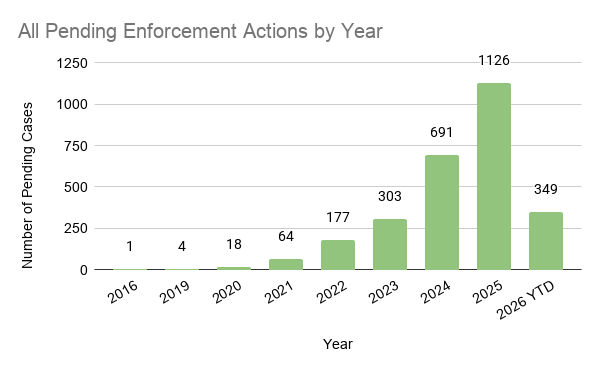
Backlogged enforcement cases are a subset of the pending enforcement actions issued by the TCEQ. In March, the TCEQ reported just over 2,700 pending enforcement cases, including 1,200 it considers backlogged and 1,500 it doesn’t.
TCEQ issued just 1,100 enforcement cases last fiscal year, many of them still active and pending agency resolution.
Accountability Delayed
The agency’s oldest backlogged case is from 10 years ago, against a company called Cal-Maine Foods, whose website claims it is “the nation’s largest egg producer”. They were sent to enforcement for discharging approximately 8 million gallons of wastewater from a concentrated animal feeding operation into the waters of the state over 10 days, resulting in multiple documented fish kills.
Cal-Maine operates multiple sites across Texas and boasts net annual sales of $4.3 billion. It doesn’t outwardly appear that the agency has taken a single step toward aggressive enforcement in this case, which has surpassed every compliance deadline outlined in the agency’s enforcement process. In fact, the TCEQ has renewed the facility’s wastewater permit twice since the incident – once in 2019 and again in 2024, despite TCEQ records showing it hasn’t conducted an on-site inspection of this facility since 2018.
Passive Enforcement is the Problem
The TCEQ’s extensive enforcement backlog highlights the problems created by the agency’s lax enforcement approach and the agency’s philosophy to “promote and foster voluntary compliance with environmental laws,” which it boasts in its most recent biennial report.
Voluntary compliance can still occur with strong agency-enforced deadlines and accountability to communities, but the TCEQ shouldn’t wait ten years for voluntary compliance. The agency should issue default orders – that come with fines and corrective action to stop environmental harm – and refer these significantly delayed cases to the Attorney General for civil enforcement in a court of law.
But these are not decisions agency staff can make – they must come from strong agency leadership and a willingness to hold polluters accountable. This enforcement problem, like several other failed agency policies, is one of the TCEQ’s own making. The agency previously had a long-standing practice of arbitrarily delaying enforcement cases for years, processing them in batches “for efficiency.” Instead, it created some of the most complex cases in the backlog, which the agency continues to struggle to resolve.
We applaud TCEQ’s new resolve to address its enforcement backlog, but the only real progress we’ll count is the resolution of these enforcement cases that results in a penalty for the polluter and a signed agreed order requiring compliance by a date certain. These are the measures that prevent pollution and compel companies to comply with the law. Taking cases off a list isn’t progress, and we’ll continue to monitor which cases the agency closes without resolution and which result in actual progress for communities and accountability for polluters.
Kathryn Guerra is the director of Public Citizen’s TCEQ Watchdog Campaign