Closing the Compost Gap in Austin
Simple shifts in collaboration can transform apartment waste into a resource
By Morgan Bart
In October 2024, the Universal Recycling Ordinance (URO) was amended so that all multifamily properties in Austin “are required to provide their residents with convenient access to composting collection.” Over the past couple of months, I set out to gain a better understanding of this program to see how it is, or isn’t, working by surveying properties across Austin.
Legally, every apartment complex must provide access to all three waste management services: trash, recycling, and compost. Every outdoor dumpster area and every indoor trash collection area (e.g., bins, chutes, valet, etc.) must have all three within at least 25 feet of each other. Multifamily properties are also required to provide residents with educational materials about how to use recycling and composting services.
Requiring multifamily housing areas to provide residents with the option to compost brings Austin one step closer to its 2040 Zero Waste Goal. However, adopting a policy is only the first step. My experiences visiting various multifamily properties in Austin revealed that reaching full compliance is a different story entirely. Of the 136 properties I visited, 101 Properties were not compliant (e.g., no bins, no convenient access, no education, etc.) with the URO upon visitation, and 23 Properties were. As for compost bins, only about half of the properties I visited had them.
It’s important to recognize why composting matters. When we compost, we divert organic waste from the landfill. It is estimated that this is “approximately 37% of [the total] material” that goes to the landfill. This means that our landfills will fill up far more slowly when we are all doing it. Given that no community is willing to host a new landfill, this is a significant benefit. Perhaps most importantly, when organic material is buried in a landfill, it breaks down anaerobically due to the lack of oxygen and creates methane. Landfills are the main source of human-caused methane—a powerful greenhouse gas—that traps heat 87 times more effectively than carbon dioxide when measured over 20 years. As such, it’s a significant driver of climate change. Additionally, if people divert their organic waste from the trash, the notorious dumpster smell is contained within a smaller, easier– to– clean bin. Since the adoption of the URO amendment, properties across the city have shown varying levels of compliance. It’s less common to find a property that doesn’t compost at all, but it’s even rarer to find one that does it correctly per the city’s regulations. More often than not, properties are compliant in some ways, but due to shortfalls in education or access, many residents aren’t using the services. This wide range of implementation makes it hard for the city to police the issue, and it makes it difficult for tenants, especially if they move between properties (which happens frequently). I believe that the role I have played during my internship — as a public citizen — has brought me a greater insight into the responsibilities of various parties.
Starting with the residents, they often don’t know how to compost or even whether composting is available at their complex. Oftentimes, compost bins fill up with trash and recycling as people are confused about what these new bins are even used for. Some of this can be attributed to the fact that, unlike single-family, duplex, triplex and quadraplex residential properties that get waste services directly from the City of Austin Resource Recovery (ARR) department, multifamily properties are served by third-party private haulers who have a great degree of control over the design of their bins. Instead of the familiar, consistent triage of brown, blue, and green that ARR provides to all its customers, gray and yellow enter the scene, and no color consistently represents the same category of service. Sometimes the composting bin is green, other times green is a recycling bin. It’s the worst when it’s both! Blue is used by at least a couple of companies for all sorts of bins and dumpsters. Labeling isn’t very consistent, either, past the usage of the words “compost” or “organics.” However, a big issue for residents is that there isn’t generally much consideration of where one’s waste is going in the first place. The property managers who care tell stories of having to constantly go and sort through the trash and recycling to avoid fees from their haulers. One even had a horror story about a newly arrived compost bin whose lid was busted open by a resident who decided to put their trash in it instead of the dumpster that was 20 feet away.
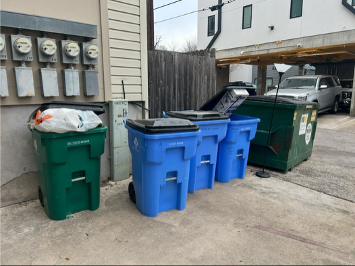
Many properties have management teams who are unaware of the ordinance and even the term “compost” in general. Leasing offices are often staffed with temps and floaters who focus on getting folks into apartments. This makes sense because their primary concern is selling their units, but they must also wear many other hats (e.g., maintenance, emergency management, amenities, etc.). Even the workers who were aware of composting often remarked that they didn’t fully understand the process or that the city considered valet access part of the convenient access provision. Unless residents complain, composting is often at the bottom of that priority list. It’s often easier to remain out of compliance and simply wait to see if the city forces the issue. After all, why spend the money on an additional or expanded hauling contract to include composting services if the city isn’t going to notice?
Education remains a significant barrier to composting at multifamily properties. Austin Resource Recovery sends informational mailers to residents it serves every couple of months to remind them of the importance of composting and how to do it. But for multifamily properties, the responsibility to educate residents falls to property managers who are required to provide educational materials to each resident upon signing a lease and once per year thereafter. Only the property managers receive educational materials from the city. Not only are residents stuck with a third-party hauler that’s detached from the city, but they are also removed from the city by another degree because the property managers are the only ones who will ever talk to ARR. Instead of getting educational information on composting and recycling from the city department that specializes in those activities, they’re getting it from property management, which may be underinformed itself and certainly has other priorities on its mind.
The city doesn’t enforce this ordinance to its fullest extent because it doesn’t have the capacity to do so and hasn’t dedicated any staff time to proactively inspecting properties. The only way city staff routinely collect information on whether a property has composting access is via the annual submission of the recycling plan. Each property must submit the hauler receipts and state the way that their waste management is set up. This online form is self-reported data and can be subject to inaccuracies. My visits highlighted this problem with inaccurate self-reporting. Only 34 properties I visited were listed as “compliant” on Austin Resource Recovery’s list, but weren’t complying with the ordinance. There also isn’t much incentive to fill out the form because the city doesn’t promptly take action against noncompliant properties. After all, ARR only has three code enforcement officers. Even when they do initiate enforcement of the URO at properties, the up to $2,000-per-day fine the URO allows them to levy against properties rarely comes into play. When it does, any revenue generated is deposited into the general fund, rather than spent on increasing URO enforcement. The city rarely has much contact with the property managers beyond email, but the tenants have almost no relationship with the City. Multifamily residents do have the option to anonymously request code enforcement against properties that don’t comply with the URO, though.
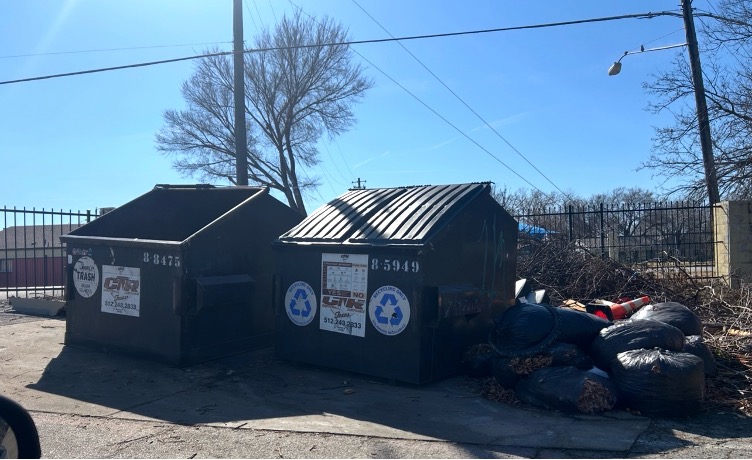
Looking forward, there are several things to consider to make positive changes. The role that I have been playing should be extended to more properties. I was only driving to properties roughly once a week for a couple of hours at a time, and I ended up looking at well over 100 properties and talking to leasing offices at some of them, too. Even just talking to the leasing offices, I met individuals who were passionate about composting in their own lives and wished the residents would do it. There were often workers who were happy to learn more about the ordinance and saw it as very important that they provide the best for their residents. This may not always translate into action as information climbs the corporate ladder, but the enthusiasm is there. Concerned residents who take the time to read blog posts about composting are another untapped source of activism, and anyone who lives in an apartment should feel free to speak with their leasing office about composting services and education at the property. The city is also home to many great employees who are open to exploring new avenues to experience greater participation. Spending limited dollars on outreach and community education through in-person conversations with property managers is probably more effective than running generalized advertisements. We hope staff will see the value in the work I have done and use it as a model. All around, there are individuals on all levels who have a part to play.
Besides just changing people’s behavior, policy could also use a change. Bin colors must be standardized to avoid confusion. When it comes to education, ARR should treat multifamily residents similarly to their single-family residents and send them educational mailers stressing the importance of composting and recycling, and keeping them updated on what can be composted or recycled. ARR would also benefit from a greater number of code enforcement officers, which could be sustained if fines on properties were more prevalent, and those revenues were used to pay the additional officers. Even fines less than $2,000 per day could be effective at spurring compliance.
If the city had people (staff or volunteers) performing random visitations, composting implementation would happen far quicker than under the currently sluggish complaints-based system. Other cities attribute their composting success to more visible enforcement, and Austin should as well.
Morgan Bart is studying Plan II Honors at the University of Texas at Austin with a certificate in Environment & Sustainability and in Core Texts & Ideas. He has been able to harness his passion for environmental policy through interning at Public Citizen and working on composting and data center issues.