The ‘Miracle Drug’ and the Peptide Craze Breaking the FDA
The HHS Chief Touts Peptides and the Agency Looks the Other Way on Retatrutide
By Peter Whoriskey
The Food and Drug Administration (FDA) has not approved retatrutide for human use outside of clinical trials. It is not supposed to be used in animals, either.
Yet injections of the investigational weight loss drug have become a craze among Americans obsessed with fitness and beauty. With the tacit acceptance of FDA leadership, the agency has allowed the fad for the unapproved peptide to overwhelm the safeguards that have long kept untested drugs off the American market, Public Citizen has found, even as a growing number of hospitalizations have been attributed to its use.
In hundreds of TikTok videos and Instagram posts, celebrity influencers, including one with millions of followers, openly tout retatrutide as “a miracle” and “better than Ozempic” – the blockbuster drug that has transformed treatment for obesity and diabetes.
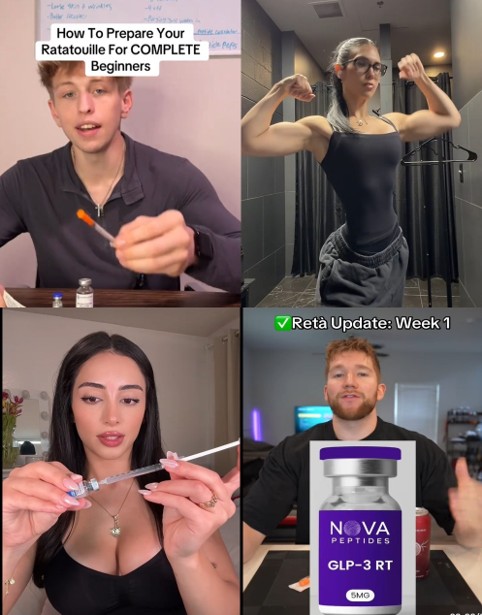
In their videos about retatrutide, the influencers advertise online suppliers, offer lessons on syringe use and dosing, and show themselves injecting the drug. Users refer to retatrutide as “ratatouille,” “r3ta,” and “GLP-3,” slang that helps evade the social media filters that block mention of the substance’s real name. Dozens of companies offer retatrutide for sale. Other companies promise to test and evaluate the vendors’ wares for purity. Many samples have been found to be impure, and others have been shown to be more or less potent than their label indicates, posing a danger to users.
Former FDA Associate Commissioner Peter J. Pitts has likened the booming trade and its online marketing to “digital-age bootlegging.”
Yet under Health and Human Services (HHS) Secretary Robert F. Kennedy Jr., the FDA has allowed the show to go on. The agency is empowered to halt the marketing and sale of unapproved drugs such as retatrutide, but it has not acted to stop the expanding market.
Kennedy has previously pledged to ease regulations on peptides, psychedelics, and other substances. Now the agency’s handling of retatrutide shows how he and a legion of influencers could topple a regulatory system built up over decades to protect Americans from quack cures and fraudulent health claims.
KEY FINDINGS
Among the key findings of this Public Citizen report:
- Since 2024, the FDA has sent 14 warning letters to companies that sold retatrutide and advertised its purported health benefits, but enforcement has been ineffective. As of May 2026, 11 of the 14 sellers that received letters continued to advertise retatrutide or other peptide drugs that the FDA has not approved. Eight have continued to sell retatrutide itself.
- The companies selling retatrutide are prohibited from marketing it for humans, and their websites conspicuously warn that their products are “for research use only” and “not for human or animal consumption.” But the companies also use social media influencers as sales affiliates who tell their followers just the opposite: how and why they should inject themselves with retatrutide. These influencers also post links to the websites of the companies where retatrutide is available for sale.
- Among the most prominent influencers is Braden Peters, better known as “Clavicular,” a well-known Gen Z figure who advocates “looksmaxxing” – the online term for maximizing physical attractiveness. Clavicular has more than two million social media followers and has posted videos in which he injects himself with retatrutide and touts the company that is his peptide source.
- Kennedy has expressed skepticism of federal laws forbidding the sale and marketing of unapproved drugs. He is an advocate of peptides and argues that the FDA should “end the war” on peptides – as well as other substances that are either not FDA approved or not approved for the purposes he advocates. On Joe Rogan’s podcast in February 2026, he declared himself a user and “a big fan of peptides.”
- Consumers injecting unapproved versions of retatrutide risk harming themselves either because retatrutide itself may turn out to be harmful or because of impurities and mislabeling in unapproved formulations. There have already been at least 14 reported hospitalizations connected to retatrutide, according to the FDA Adverse Event Monitoring System.[1]
THE BEGINNING OF THE RETATRUTIDE BOOM
Retatrutide is the “next generation” of weight loss drugs, according to its boosters, because it targets three receptors that regulate blood glucose levels. The first generation, semaglutide, sold as Ozempic and Wegovy, targeted one receptor. Tirzepatide, sold as Mounjaro and Zepbound, targeted two receptors. Retatrutide reaches three – GLP-1, GIP, and glucagon, a hormone in the pancreas. Retatrutide is being studied for obesity and overweight in people with at least one weight-related medical condition.[2]
Popular interest in the substance began after June 2023, when an Eli Lilly press release announced the results of a trial of 338 overweight adults.
The trial seemed a remarkable success for the company. It showed that weekly injections of the drug were more effective for weight loss than semaglutide. After 48 weeks of injections, subjects taking the highest dose of retatrutide studied lost an average of 24 percent of their body weight, or about 58 pounds.
Within months, hundreds of merchants were offering retatrutide to people in the United States. Many of the manufacturers were in China. [3]
“It’s unprecedented to see a drug that is in late-stage clinical trials being so flagrantly advertised for sale online,” George Karavetsos, a lawyer who formerly directed the FDA’s Office of Criminal Investigations, told the Wall Street Journal. [4]
But the retatrutide boom was just beginning. The Figure from Google search data indicates that interest in the peptide took off in early 2025, and now dwarfs interest in other prominent unapproved peptides, such as BPC-157, which is also popular among fitness enthusiasts. Among the other unapproved peptides pitched by influencers on TikTok and Instagram, retatrutide became the most searched.
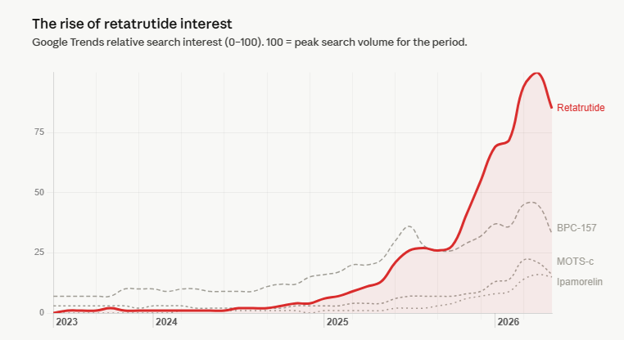
Retatrutide search interest has surged past competing peptides, hitting near-peak levels in early 2026. BPC-157 is a popular peptide among fitness enthusiasts; MOTS-c is used for weight loss; Ipamorelin has been marketed for muscle growth, recovery, sleep, and anti-aging.
Over the last six months, news of retatrutide has swelled to engulf mainstream media. USA Today, Good Morning America, and movie star Gwyneth Paltrow’s podcast have all featured the research about the drug. Other coverage has documented the enthusiasm of those already using it.
In December 2025, The Atlantic published “I Bought ‘GLP-3’: You’re not supposed to be able to buy the world’s most powerful weight-loss drug, but some people have found a way.” [5] In January 2026, a New York Magazine article, “Life on Peptides Feels Amazing,” [6] similarly chronicled the use of unapproved peptides. Although the author cited the potential dangers, he concluded by deciding to inject himself with retatrutide.
In an opinion article in STAT News,[7] another retatrutide user similarly defended the injections while also acknowledging the chaotic and potentially dangerous aspects of the unregulated market:
“I found a research supplier selling freeze-dried retatrutide labeled ‘not for human consumption.’ I mixed the powder myself using bacteriostatic water I ordered from Amazon. The first injection stung badly because I hadn’t ordered the right brand. But even the ‘good’ brand isn’t safe anymore. There are counterfeits now: off-color labels, wrong date formatting, faded text. I wouldn’t have known if strangers on Reddit hadn’t taught me how to spot them.
That was my first hint at just how fragile this whole system is — how much depends on crowdsourced trust and trial-and-error.”
THE DANGERS
It is difficult to gauge how dangerous the unregulated retatrutide market might be for consumers. But as retatrutide use has grown, the number of “adverse events” associated with its use and reported to the FDA has risen quickly. In 2025, there were 10 such reports, including cases of vomiting, tachycardia, and ketoacidosis. Four involved hospitalizations. In the first five months of this year alone, there were 26 such reports – eleven of them requiring hospitalization and three described as “life-threatening.”
On social media, some users of retatrutide have described adverse events, too. Adrian Crook, a bodybuilding influencer, posted a video about how retatrutide almost led him to the emergency room when his stomach became paralyzed. A recent article in New York Magazine [8] described the experience of another bodybuilder and influencer, Adam Katz. After several months of using retatrutide and experiencing increasing stomach pain, Katz “was diagnosed with acute necrotizing pancreatitis, a potentially fatal condition.”
The potential dangers of the popular peptide fall into two categories: risks related to the investigational drug itself and risks related to impurities or dosing problems with unapproved online versions.
The similarities between retatrutide and semaglutide, sold as Ozempic and Wegovy, are often cited as evidence that retatrutide is likely to be just as safe. Retatrutide, however, is a fundamentally different drug.
The available safety data from clinical trials suggest that retatrutide often causes gastrointestinal problems, such as nausea, diarrhea, vomiting, and constipation, and that some trial participants discontinue the drug, particularly at higher doses. However, the full safety profile of retatrutide is not yet known, including the frequency of more serious gastrointestinal conditions, such as pancreatitis, biliary disease, dysesthesia – an unpleasant burning or tingling in the skin – and urinary tract infections.
The purity of the “retatrutide” sold online poses another serious risk. Among the scores of online vendors of unapproved peptides, quality varies widely.
Finnrick is a testing company that provides consumers with information about the purity and potency of the peptides they buy online. The company advertises itself as a resource for peptide users who “increasingly seek products outside of regulated channels.” In May 2026, the company’s website noted that, since December 2024, it had tested 2,759 samples of retatrutide sourced from several vendors. Of 179 retatrutide vendors listed on its website, Finnrick rated 71 (39.6 percent) as “poor,” “bad,” or “fraud.”
In the last year, the FDA cited two factories in South Florida producing retatrutide and other products for selling adulterated or unsanitary goods.
THE MAGNITUDE OF THE MARKET
The magnitude and character of the retatrutide market might best be gauged by the advocacy of “Clavicular,” aka Braden Peters, an influencer with nearly two million followers on TikTok and Instagram combined, and hundreds of thousands more on X, Kick, and Twitch.
His audience is primarily young men interested in “looksmaxxing,” a radical form of self-improvement focused on appearances. Peters has said looksmaxxing is necessary for men to attract women.
Peters advocates extreme measures in the pursuit of physical beauty. Famously, he has claimed to have hit himself in the face with a hammer or fist to reshape his jawline. He has taken drugs for a variety of cosmetic reasons. Among them is “meth,” or methamphetamine, which he says he used to suppress his appetite. And his favorite peptide, he has said, is retatrutide.

In an April 2025 interview available on TikTok, Braden Peters names retatrutide among his favorite peptides.
In commercial plugs, Peters has also touted his peptide source, a company called Arcane Peptides. (Although online companies often pay influencers for such promotion, it is unknown what Clavicular may be receiving.)
Peters is far from alone in touting retatrutide. There are legions of influencers on social media platforms pitching it for weight loss. Many of them also advertise specific retatrutide suppliers through a link in their video or bio, as shown in the TikTok posts below, accessed in May 2026.
The FDA’s Role
Under federal law, the sale and marketing of unapproved drugs are prohibited. A website may claim that an unapproved substance is available for “research only.” However, it is clear to anyone paying attention that the people buying retatrutide and other unapproved peptides are not researchers.
“The number of companies that are selling these for research use is incredibly small,” said Gerard Olson, research director of LegitScript, an internet certification company that monitors high-risk industries to ensure websites and merchants operate legally.
In the past, federal prosecutors have charged vendors with serious crimes for selling unapproved drugs, even when the websites warn customers that the items being sold are for research purposes only.
For example, in 2019, the Department of Justice prosecuted the owners of All American Peptides (AAP) of New Jersey for introducing unapproved new drugs into commerce. [8]
“In order to avoid the FDA’s scrutiny, the [owners] included disclaimers … falsely stating that [the company’s] products were intended for research and/or laboratory use only, when, in reality, AAP’s Products were meant for personal use,” the indictment noted.
Similarly, in 2022, the FDA sent a letter to the owner of Paradigm Peptides, warning the company about making health claims regarding its products. Paradigm responded immediately, claiming that its products were not for human use. Two years later, the FDA issued another warning letter. Paradigm continued to operate, according to a criminal information filed in October 2025. Federal prosecutors charged the firm with introducing new drugs into interstate commerce. [10]
Despite retatrutide’s continued boom, the FDA has more recently issued only warning letters, with seemingly little follow-up. In February, the government did charge one Florida man with selling retatrutide, but there appear to be more than 100 companies openly doing so. [11]
“The FDA is clearly not addressing the problem,” Olson said. “Out on the internet you can’t throw a stone without hitting [a peptide vendor]. We see a lot of retatrutide.”
Since December 2024, the FDA has issued 14 warning letters to companies that sold retatrutide and advertised its purported health benefits.
The letters typically cite the life-threatening dangers of injectable products. They inform the companies that the FDA has reviewed their website and that “introducing or delivering these products for introduction into interstate commerce violates” federal law.
The letters also indicate that the FDA recognizes that unapproved drugs are intended for human use, regardless of any claims to the contrary.
“Despite statements on your product labeling marketing your products for ‘laboratory research purposes only’ and ‘[n]ot for human consumption,’ evidence obtained from your website establishes that your products are intended to be drugs for human use,” notes an FDA warning letter sent in March 2026 to a company called Pink Pony Peptides. [12]
Yet 11 of the 14 targeted retatrutide sellers continue to advertise retatrutide or other peptides lacking FDA approval, Public Citizen has found. Eight of those are selling retatrutide itself.
A month after the FDA warning letter was sent to Pink Pony Peptides, a woman associated with the company posted a video on TikTok, labeled “FDA Status Letter Update,” assuring customers that “We’re currently still in action.”
As of May 2026, it was still selling the unapproved peptides on its website.
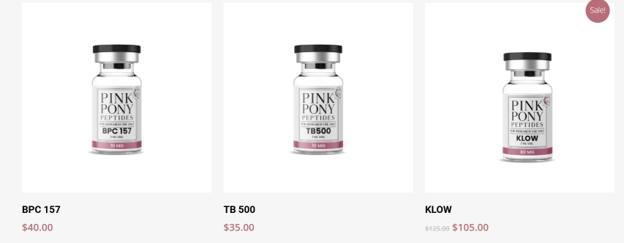
A May 2026 screengrab from pinkponypeptides.com showing unapproved peptides for sale.
WHAT COMES NEXT
There are several ways the FDA could crack down on the rampant sales of retatrutide and other unapproved peptides.
First, it could continue to send warning letters to the scores of retatrutide sellers.
“With certain exceptions not applicable here, a new drug may not be introduced or delivered for introduction into interstate commerce without an approved application from FDA in effect,” a typical letter to one of the retatrutide vendors reads. [13]
The FDA’s campaign of warning letters, however, has had little success in curtailing the retatrutide marketplace.
The agency’s approach has two fundamental problems.
First, the agency has sent only 14 letters that mention retatrutide. Yet there are scores of other vendors currently selling it – by some estimates, more than 100 have opened in recent years.[3]
Second, these warning letters appear to be backed by little credible enforcement. Most of the 14 retatrutide companies that received a warning continue to sell retatrutide or other peptides that lack FDA approval.
When warning letters fail, the agency has other measures at its disposal to enforce the rules. Through FDA coordination with the Department of Justice, those companies can be subject to seizures, injunctions, and criminal prosecutions.
“If there are violations of FDA statute, there are a whole suite of enforcement actions that are available,” said Patricia Zettler, a law professor at Ohio State University who previously served as an associate chief counsel in the FDA’s Office of the Chief Counsel.
Joseph Daval, a former FDA attorney and currently a researcher at the Program on Regulation, Therapeutics, and Law at Brigham and Women’s Hospital in Boston, likens the large number of companies selling retatrutide to a swarm of bees that has caught the agency unprepared. He argues that to have credible enforcement in such cases, the FDA must be granted more flexibility to act quickly and decisively – that is, without coordination with the Department of Justice. At a minimum, Daval said, “to create a credible deterrent, you’d need to hire a lot more lawyers.”
So far, there is little sign that the FDA is moving forward with any tougher sanctions to curb the vast, illegal retatrutide market. It should do so now. If Kennedy’s embrace of peptides and social media remedies goes unanswered, regulators will have handed the wellness industry a roadmap: flood the market, build an audience, and wait out enforcement. An era of snake oil and quack medicine won’t be far off.
References
[1] Eli Lilly and Company. “Lilly’s Triple Agonist, Retatrutide, Delivered Powerful Weight Loss in Pivotal Phase 3 Obesity Trial.” Press release, 21 May 2026, investor.lilly.com/news-releases/news-release-details/lillys-triple-agonist-retatrutide-delivered-powerful-weight-loss. Accessed May 22, 2026.
[2] Winkler, Rolfe. “This Drug Could Be the Next Ozempic. Bootlegs Are Already Selling Online.” Wall Street Journal, 20 Oct. 2023, www.wsj.com/health/pharma/the-next-hot-obesity-drug-wont-be-approved-for-years-online-sellers-hawk-it-anyway-e04d7cc3 Accessed May 20, 2026.
[3] Ibid.
[4] Zhang, Sarah. “Retatrutide’s Underground Market.” The Atlantic, Dec. 2025, www.theatlantic.com/health/2025/12/retatrutide-underground-market/685400/. Accessed May 20, 2026.
[5] Marcus, Ezra. “Life on Peptides Feels Amazing,” New York, 26 Jan. 2026, nymag.com/intelligencer/article/peptides-from-instagram-china-wellness-cure.html. Accessed May 20, 2026.
[6] Dothée, Nick. “Trump’s $150-per-Month GLP-1 Plan Won’t Reach People Like Me.” STAT News, 24 Oct. 2025, www.statnews.com/2025/10/24/glp-1s-weight-loss-addiction-cost/ Accessed May 20, 2026.
[7] ] Marcus, Ezra. “Life on Peptides Feels Amazing,” New York, 26 Jan. 2026, nymag.com/intelligencer/article/peptides-from-instagram-china-wellness-cure.html. Accessed May 20, 2026.
[8] United States v. Kovaleski, No. 2:19-cr-00476 (D.N.J. 2019)
[9] United States v. Kawa, No. 3:25-cr-00091 (N.D. Ind. 2025)
[10] United States v. Adam Taylor, No. 3:26-CR-28-MMH-MCR (M.D. Fla. 2026)
[11] United States, Food and Drug Administration, Center for Drug Evaluation and Research. Warning Letter to Susan Vega, Lovega LLC dba Pink Pony Peptides. MARCS-CMS 721088, 31 Mar. 2026, www.fda.gov/inspections-compliance-enforcement-and-criminal-investigations/warning-letters/lovega-llc-dba-pink-pony-peptides-721088-03312026 Accessed May 20, 2026.
[12] United States, Food and Drug Administration, Center for Drug Evaluation and Research. Warning Letter to Bernard Gramlich, Gram Peptides. MARCS-CMS 721806, 31 Mar. 2026, www.fda.gov/inspections-compliance-enforcement-and-criminal-investigations/warning-letters/gram-peptides-721806-03312026 Accessed May 20, 2026.