Letter to the AHRQ Director: Immediately Release the Months-Delayed National Healthcare Quality and Disparities Report
View as PDF
View press release
Roger D. Klein, M.D., J.D.
Director
Agency for Healthcare Research and Quality
5600 Fishers Lane
Rockville, MD 20857
Director@ahrq.hhs.gov
Re: 2024 National Healthcare Quality and Disparities Report, Missing
Dear Dr. Klein:
On behalf of Public Citizen, a consumer advocacy organization with more than 500,000 members and supporters nationwide, I am writing about the Agency for Healthcare Research and Quality (AHRQ) 2024 National Healthcare Quality and Disparities Report.
Mandated by the U.S. Congress (42 U.S.C. 299b-2(b)), the National Healthcare Quality and Disparities Report had been released by AHRQ through 2023 for 21 years in a row.[1],[2],[3],[4],[5]
The 2024 report should have been released in December 2024. As of mid-August 2025, however, the 2024 report has not been released.
Public Citizen respectfully requests that AHRQ immediately release the 2024 report, as mandated by Congress, and prioritize the subsequent release of the 2025 report in December 2025.
The National Healthcare Quality and Disparities Report provides annualized information about the overall performance of the U.S. healthcare system including the system’s record serving all Americans regardless of their age, race or ethnicity, and geography (e.g., urban/rural).
Annual release of the National Healthcare Quality and Disparities Report further serves as a public introduction and portal to a rich array of updated, taxpayer-supported, healthcare-related data compiled by AHRQ and other agencies within and outside of the Department of Health and Human Services (e.g., the Medical Expenditure Panel Survey and the U.S. Census).[6],[7]
The hundreds of quantitative and qualitative indicators in the report cover many topics, including:
- demographic (e.g., age, gender, race/ethnicity)
- economic (e.g., income, employment, housing)
- educational (e.g., day care, high school and university degrees)
- geographic (e.g., by state and county)
- infrastructure (e.g., roads, parks, public transport, schools, hospitals)
- specific healthcare resources (e.g., supply of primary care clinics, insurance coverage)
The exhibits in the appendix of this letter highlight some of the important information in the report.
The National Healthcare Quality and Disparities Report has long been a quintessential “report card” on the fairness and quality of the U.S. healthcare system, calling attention to specific inefficiencies and deficiencies that can and must be addressed.
Thank you for your prompt attention to this request.
Sincerely,
Michael T. Abrams, M.P.H., Ph.D.
Senior Health Researcher
Health Research Group
Public Citizen
Appendixes
Exhibit 1. Leading causes of death in 2021 by race/ethnicity
Exhibit 2. Deaths stratified by population density (urban to rural)
Exhibit 3. National map of race/ethnicity disparity scorecards by state
Exhibit 4. Bar graph depicting recent quality-of-care changes experienced by Black people compared with White people
Exhibit 5. Illustrative listing of indicators used in previous NHQDRs
Exhibit 1. Leading causes of death in 2021 by race/ethnicity, age-adjusted deaths per 100,000 of the population
| Race/ethnicity | Heart disease | Cancer | COVID-19 | Unintentional injury |
|---|---|---|---|---|
| NH-White | 180 | 154 | 94 | 70 |
| NH-Black | 226 | 167 | 136 | 80 |
| NH-AI/AN | 155 | 124 | 184 | 123 |
Source: 2023 NHQDR, Table 2; NH = non-Hispanic, AI/AN = American Indian/American Native
Exhibit 2. Age-adjusted deaths per 100,000 inhabitants, stratified by cause and population density, 2021

Source: 2023 NHQDR, adapted from Table 3
Exhibit 3. Race/ethnicity disparity scorecards (composite scores) by state, 2018-2021 (2023 NHQDR, Figure 46)

Exhibit 4. The number and percentage of measures for which Black people experience better, similar, or worse quality of care compared with White people for the most recent year available, 2019 to 2021(Source: 2023 NHQDR, Appendixes Figure 20)
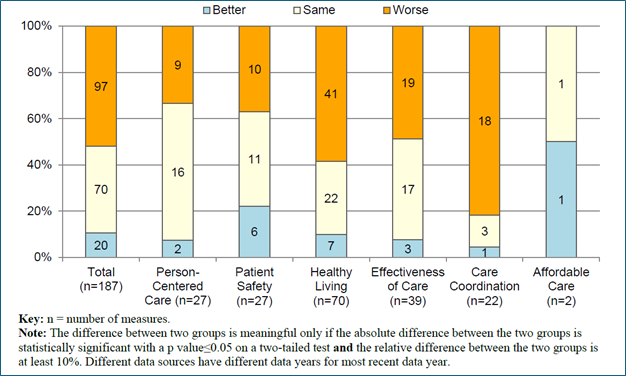
Exhibit 5. An illustrative listing of indicators included in recent National Healthcare Quality and Disparities reports, produced by the Agency for Healthcare Quality and Research
| Measure (indicator), brief description | Dataset/source | Year of data used for the 2023 NHQDR |
|---|---|---|
| Postoperative sepsis | HCUP | 2020 |
| Surgical-wound healing | OASIS | 2021 |
| Deaths per 1,000 elective surgeries | HCUP | 2020 |
| Pressure sores during nursing-home stay | MDS | 2021 |
| Urinary tract infection during nursing-home stay | MDS | 2021 |
| Neonatal injury per 1,000 live births | HCUP | 2020 |
| Falls in nursing homes, with major injury | MDS | 2021 |
| Adults who report home health providers always explain things in a way that is understandable | HHCAHPS | 2022 |
| Hospice patients whose care team always treats them with dignity and respect | HOSPICE_CAHPS | 2021 |
| Adult hospital patients who strongly agree that staff respected their preference regarding their discharge healthcare | HCAHPS | 2021 |
| Hospital admissions for diabetes per 100,000 of the population | HCUP | 2020 |
| Hospital admissions for asthma | HCUP | 2020 |
| Hospital admission for hypertension | HCUP | 2020 |
| Breast cancer deaths per 100,000 females | NVSS_M | 2021 |
| Colon cancer deaths per 100,000 of the population | NVSS_M | 2021 |
| Deaths per 1,000 coronary artery bypass surgeries | HCUP | 2020 |
| Patients with chronic kidney failure who received a transplant within three years of diagnosis | USRDS | 2017 |
| Diabetes patients annually screened for eye and foot issues | BRFSS | 2021 |
| New HIV cases | HIV_AIDSSS | 2021 |
| Adults with a major depression episode who received treatment | NSDUH | 2021 |
| Deaths from suicide | NVSS_M | 2021 |
| People treated for illicit drug use who received treatment at a specialty facility in the past year | NSDUH | 2021 |
| Emergency department visits involving opioids | HCUP_NEDS | 2020 |
| Infants who were breastfed for at least three months | NIS | 2020 |
| Nursing-home residents with moderate to severe pain | MDS | 2021 |
| Home health patients who improve regarding confusion frequency | OASIS | 2021 |
| Adults older than 65 who get annual flu vaccination | BRFSS | 2021 |
| Children 19-35 months who receive DTPV, polio, MMR, hepatitis B, and varicella vaccines | NIS | 2021 |
| Those on Medicaid (or Medicare managed care, fee for service) who had a routine care appointment and said that during the past six months they “sometimes” or “never” got such appointments. | NCBD | 2022 |
| Those who needed care urgently from an illness or injury in the last month who “sometimes” or “never” received such care | NCBD | 2022 |
| Adults who in the last six months “sometimes” or “never” found it easy to see a specialist | NCBD | 2022 |
| Overall rating of health care as greater than 7 on a 1-to-10-point scale, with higher numbers reflecting better care (Medicare, Medicaid) | NCBD | 2022 |
| Medicare/Medicaid-enrolled adults who got advice to quit smoking at least once | NCBD | 2022 |
BRFSS = Behavioral Risk Factor Surveillance System; HCAHPS= Hospital Consumer Assessment of Healthcare Providers and Systems; HCUP = Healthcare Cost and Utilization Project; HCUP_NEDS = HCUP Nationwide Emergency Department Sample; HHCAHPS = Home Health CAHPS; HIV_AIDSSS = National HIV Surveillance System; HOSPICE_CAHPS = Hospice CAHPS; MDS = Minimal Data Set for skilled nursing facilities; NIS = National Immunization Survey; NSDUH = National Survey on Drug Use and Health; NVSS_M = National Vital Statistics System—Mortality; OASIS = Home Health Outcome and Assessment Information Set; USRDS = Unites States Renal Data System
—
[1] 2023 National Healthcare Quality and Disparities Report. Rockville, MD: Agency for Healthcare Research and Quality; December 2023. AHRQ Pub. No. 23(24)-0091-EF.
[2] 2022 National Healthcare Quality and Disparities Report. Rockville, MD: Agency for Healthcare Research and Quality; October 2022. AHRQ Pub. No. 22(23)-0030.
[3] 2021 National Healthcare Quality and Disparities Report. Rockville, MD: Agency for Healthcare Research and Quality; December 2021. AHRQ Pub. No. 21(22)-0054-EF. [Note: in 2021 the agency changed the year-name to reflect the year of publication rather than the year of the most recently data used]
[4] 2019 National Healthcare Quality and Disparities Report. Rockville, MD: Agency for Healthcare Research and Quality; December 2020. AHRQ Pub. No. 20(21)-0045-EF.
[5] 2018 National Healthcare Quality and Disparities Report. Rockville, MD: Agency for Healthcare Research and Quality; September 2019. AHRQ Pub. No. 19-0070-EF.
[6] Agency for Healthcare Research and Quality. National Healthcare Quality and Disparities Reports. July 2024. https://www.ahrq.gov/research/findings/nhqrdr/index.html. Accessed August 3, 2025.
[7] Agency for Healthcare Research and Quality. AHRQ: a brief history. March, 2025. https://www.ahrq.gov/cpi/about/brief-history.html. Accessed July 31, 2025.