Hundreds of Lobbyists Hired to Undermine Drug Price Negotiations
In 2022, President Biden signed into law the Inflation Reduction Act (IRA), which for the first time empowered Medicare to negotiate drug prices directly with pharmaceutical manufacturers. Now Big Pharma is using its massive lobbying power to protect its profits and undermine this key mechanism to rein in profiteering, at the expense of patients and taxpayers.
Public Citizen analyzed lobbying activity through the first three quarters of 2025. This analysis focuses on each unique lobbyist-client relationship. That is, each lobbyist hired by a client (a company, trade group, non-profit, or other organization) to lobby for or against three bills that undermine Medicare drug price negotiations. Our key findings include:
- Through the first three quarters of 2025, there were 545 unique lobbyist-client relationships, wherein a client hired an individual to lobby on at least one of three bills that would impede Medicare price negotiations (the ORPHAN Cures Act, EPIC Act, and MINI Act).
- Over 90% (501) of the unique lobbyist-client relationships involved client companies, trade groups, non-profits, and other organizations supportive of the three harmful bills, outnumbering opposition 20-to-one. Supporters were either pharmaceutical companies, groups with pharmaceutical company members, or groups with ties to the industry.
- Aside from working to influence members of Congress on the three bills, clients also sent lobbyists to federal agencies, including the Centers for Medicare and Medicaid Services (CMS) and the Department of Health and Human Services (HHS), and the White House.
Bills that Undermine Medicare Price Negotiations
The IRA requires CMS to negotiate prices for the most costly drugs for Medicare and limits negotiation eligibility to drugs that Medicare spends over $200 million on annually.[1] Expanding loopholes—by adding exemptions or lengthening the already long delay period before drugs become eligible for negotiation—excludes expensive, even blockbuster, medicines from price-lowering negotiations. Through the first three quarters of 2025, lobbyists focused on three bills that seek to do just that.
The ORPHAN Cures Act (H.R. 946 / S.1862) expands the law’s “orphan drug exemption” to exclude from negotiation drugs approved to treat more than one rare disease or condition and delays negotiation for drugs first approved for rare conditions but later approved for non-rare indications, regardless of their cost to Medicare and patients or the billions of dollars in revenue a drug corporation has accrued through sales of the drug. The ORPHAN Cures Act was passed into law through congressional Republicans’ July 2025 budget reconciliation bill (H.R. 1).[2] If it remains law, it will delay and exempt from negotiations some of the most profitable drugs, representing tens of billions in annual Medicare spending, including cancer treatments Keytruda, Darzalex, and Opdivo.[3][4]
The EPIC Act (H.R. 1492 / S. 832) and the MINI Act (H.R. 1672) would lengthen the negotiation delay period by four years (from seven years to 11 years) for all small molecule drugs and for genetically targeted drugs, respectively. The new prices take effect two years after drugs are selected for negotiation, meaning that under these proposals negotiated prices would not be available until at least 13 years after a product first receives marketing approval. As small molecule drugs typically have 12–14 years of exclusivity before generic competitors enter the market, extending the delay period would effectively exclude many medicines from negotiations entirely or shorten the period patients have access to lower negotiated prices to only one or two years.[5] Had the delay periods in the EPIC Act been included in the Medicare drug price negotiation law at the outset, Medicare would have been prohibited from negotiating prices for more than half of the drugs that the program is negotiating this year, which represent more than $28 billion in annual gross Medicare spending. Negotiations would have been prohibited on five out of ten of the drugs selected in the first year of negotiations, which accounted for more than $37 billion in gross Medicare spending in 2023.[6]
More than 500 Unique Lobbyist-Client Relationships Were Made Involving Corporations, Trade Groups, and Non-profits Hiring Lobbyists to Lobby on Bills that Would Undermine Medicare Drug Price Negotiations
In total, there were 545 unique lobbyist-client relationships with lobbyists hired to lobby on one or more of the three bills to gut the Medicare drug price negotiation program in 2025. More than 90 percent of the lobbyist-client relationships (501) involved lobbyists hired by companies, trade groups, and non-profits supportive of the three harmful bills. Bill supporters outnumbered opposition 20-to-one. Supporters were either pharmaceutical companies, groups with pharmaceutical company members, or other organizations with ties to the industry.
Figure 1 – Number of Unique Lobbyist-Client Relationships with Lobbyists Hired to Lobby on at Least One of the Bills, Q1–Q3 2025
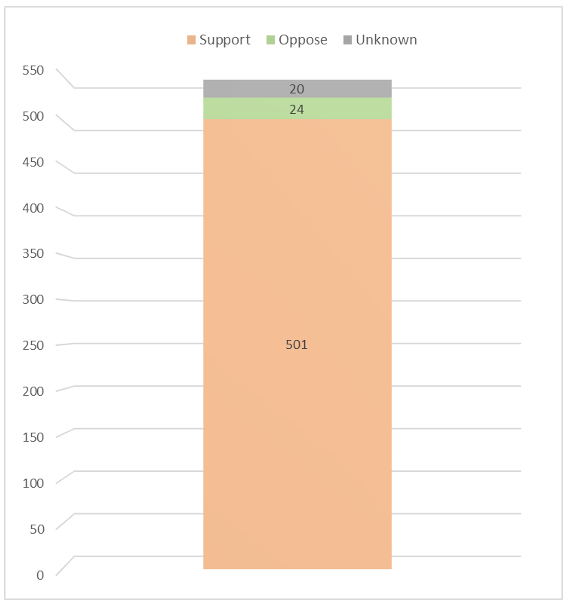
As noted in the introduction, the totals in Figure 1 and throughout this analysis show each unique lobbyist-client relationship, not each unique person, to more accurately show lobbyist activity (e.g., if the same lobbyist were hired by three different drug companies supportive of one or more of the bills, that lobbyist would be counted three times). In total, there were 394 unique individuals lobbying on these bills.[7]
The ORPHAN Cures Act was the subject of the most intense lobbying through the first three quarters of 2025, followed closely by the EPIC Act. The entities that hired the most lobbyists to lobby on one or more of the three bills were Novartis, the Pharmaceutical Research and Manufacturers of America (PhRMA), the Biotechnology Innovation Organization (BIO), Alnylam Pharmaceuticals, and Johnson & Johnson (Table 1).
Table 1 – Clients that Hired the Most Lobbyists to Lobby on at Least One of the Bills
| Entity | Position | Lobbyists* | Bills |
| Novartis[8] | Support | 68 | ORPHAN Cures, EPIC, MINI |
| PhRMA[9] | Support | 61 | ORPHAN Cures, EPIC |
| BIO[10] | Support | 33 | ORPHAN Cures, EPIC, MINI |
| Alnylam Pharmaceuticals[11] | Support | 21 | ORPHAN Cures, MINI |
| Johnson & Johnson[12] | Support | 20 | ORPHAN Cures, EPIC |
*The lobbyists total include those that lobbied on one or more of the three bills, but not necessarily all (i.e., the 68 Novartis lobbyists did not lobby on all three bills).
**Download PDF to view appendix with full list of clients.
Several groups claiming to represent patient interests also lobbied on these bills. Those supportive of the bills, however, had ties to the industry. For example, Patients Rising Now lobbied on the ORPHAN Cures Act.[13] The group counts PhRMA and several large pharmaceutical companies among its members.[14] Others have published accounts of the group’s ties to the pharmaceutical industry.[15] Another group, the Save Rare Treatments Task Force, is “convened and managed by” the consulting firm Leavitt Partners, counts BIO and several pharmaceutical companies among its members, and was created specifically to lobby on expanding the orphan drug exclusion in the Medicare drug price negotiation program.[16]
This analysis only captures those entities that disclosed lobbying on the three bills analyzed. However, beyond clients that disclosed lobbying on these bills, additional entities disclosed lobbying on the Inflation Reduction Act, including the drug price negotiation program. For example, the Chamber of Commerce disclosed lobbying on “implementation of the Inflation Reduction Act of 2022, Drug Price Negotiation Program (P.L. 117-169, subtitle B)” and on “[p]otential legislation amending the Inflation Reduction Act (P.L. 117-169)”[17] but did not specifically indicate lobbying on the three bills, and was thus excluded from this analysis.
Big Pharma Lobbied the White House, HHS, and CMS
Along with the Senate and House of Representatives, clients hired lobbyists to lobby HHS, CMS, and the White House on at least one of the bills (Table 2). Pharmaceutical companies and trade groups with pharmaceutical company members were responsible for sending the most lobbyists to the two agencies and the White House.
Table 2 – Number of Unique Lobbyist-Client Relationships with Lobbyists Hired to Lobby on at Least One of the Bills, by Federal Agency
| Position | HHS Lobbying | CMS Lobbying | White House Lobbying |
| Oppose | 21 | 20 | 18 |
| Support | 183 | 137 | 123 |
| Unknown | 20 | 19 | 5 |
| Total | 224 | 176 | 146 |
White House lobbying includes clients that sent lobbyists to the White House Office, the President, the Executive Office of the President (EOP), or named offices within the EOP. The majority of lobbyists hired by clients to target the White House lobbied the EOP or the White House Office. One entity (PhRMA) disclosed lobbying the “President of the U.S.”[18]
Big Pharma was successful in its push to pass the ORPHAN Cures Act through its inclusion in the reconciliation bill passed this summer and it is still pushing to lengthen negotiation delay periods. One of President Trump’s recent executive orders suggests that White House lobbying on the EPIC Act is having some degree of success. Through an April executive order titled “Lowering Drug Prices by Once Again Putting Americans First”, President Trump essentially endorses the EPIC Act, which would raise drug costs for patients and taxpayers by billions of dollars; in no way would it lead to lower drug prices.[19] The order directs the Secretary of HHS to “work with the Congress to modify the Medicare Drug Price Negotiation Program to align the treatment of small molecule prescription drugs with that of biological products….” The order relies on Big Pharma’s lobbying rhetoric and claims about protecting innovation for small molecule drugs, disregarding that the current law would have a negligible effect on new drugs developed.[20]
Big Pharma’s lobbying, the April executive order, and the embrace of pay-to-play[21] suggests a concerning trend in company efforts to influence policies meant to rein in corporate misdeeds like price gouging. Big Pharma stands to profit immensely from such efforts.
PhRMA and several pharmaceutical companies (all of which are also PhRMA members) that lobbied on at least one of the bills collectively gave $6.5 million to Trump’s inauguration fund.[22] Meanwhile, the ORPHAN Cures Act returns more than $8 billion to pharmaceutical corporations’ pockets,[23] and the EPIC Act would return tens of billions more.[24]
Big Pharma spends millions buying influence to protect its interests and diminish the government’s ability to lower drug prices for U.S. patients. Simply put, policymakers that support lowering drug prices should stand up to Big Pharma and work to expand and improve—not rollback—drug price negotiations.
References
[1] The negotiation eligibility threshold for initial payment applicability year 2026 was more than $200 million. In subsequent years, the threshold is increased by the annual percentage increase in the consumer price index for all urban consumers.
[2] After passage of H.R. 1 with the ORPHAN Cures Act included, Sens. Welch and Wyden introduced legislation (S. 2447) that would, in part, roll back the orphan drug exemption to its form prior to the passage of H.R. 1. More recently, Sens. Welch, Wyden, and Cortez Masto introduced the No Big Blockbuster Bailouts Act (NOBBBA) (S. 3019), which eliminates the additional negotiation delay for drugs first approved for rare conditions introduced by H.R. 1 and limits the expanded orphan exemption passed through H.R. 1 to drugs with less than $400 million in annual Medicare expenditures. Public Citizen urges members of Congress to support NOBBBA and go a step further by eliminating the orphan drug exemption entirely.
[3] Issue Brief: Protecting Medicare Drug Price Negotiations, Public Citizen (Mar. 7, 2025), https://www.citizen.org/wp-content/uploads/Issue-Brief-Do-Not-Undermine-Medicare-Drug-Price-Negotiations_final.pdf
[4] Kristi Martin, Emma M. Cousin, and Sean D. Sullivan, Blockbusters And Loopholes: Expanding Exemptions In Medicare Drug Price Negotiations (Aug. 29, 2025), https://www.healthaffairs.org/content/forefront/blockbusters-and-loopholes-expanding-exemptions-medicare-drug-price-negotiations
[5] Issue Brief: Protecting Medicare Drug Price Negotiations, Public Citizen (Mar. 7, 2025), https://www.citizen.org/wp-content/uploads/Issue-Brief-Do-Not-Undermine-Medicare-Drug-Price-Negotiations_final.pdf
[6] Delaying Drug Price Negotiations = More Big Pharma Price Gouging, Public Citizen (Apr. 4, 2025), https://www.citizen.org/article/delaying-drug-price-negotiations-enables-more-pharma-price-gouging/
[7] Running the same analysis with the 394 total instead of 545 reveals 89 percent of the individuals were hired by clients supportive of the bills.
[8] Q2 2025 Lobbying Report, Novartis, https://lda.senate.gov/filings/public/filing/b1f407e4-2cb3-4404-90f7-e2cfa338273c/print/
[9] Q2 2025 Lobbying Report, Pharmaceutical Research and Manufacturers of America, https://lda.senate.gov/filings/public/filing/05706bbb-39a8-4a45-91d5-151396fd20a1/print/
[10] Q2 2025 Lobbying Report, Biotechnology Innovation Organization, https://lda.senate.gov/filings/public/filing/69891cd6-56c3-43bf-8c8e-d2c8a23daf47/print/
[11] Q2 2025 Lobbying Report, Todd Strategy Group on Behalf of Alnylam Pharmaceuticals, Inc., https://lda.senate.gov/filings/public/filing/c773136d-7b83-4b50-939b-ab8141b2725e/print/
[12] Q2 2025 Lobbying Report, JOHNSON & JOHNSON SERVICES, INC., https://lda.senate.gov/filings/public/filing/0ebc24d0-e05d-4200-bc64-177d5c5f55ae/print/
[13] Q2 2025 Lobbying Report, Tidal Basin Advisors, Inc. on Behalf of YC Consulting, LLC on behalf of Patients Rising Now, https://lda.senate.gov/filings/public/filing/72e9d85d-e0c6-453b-b770-4e735ed18c6a/print/; Q2 2025 Lobbying Report, LONG STRATEGIES, INC. on Behalf of YC Consulting, LLC on behalf of Patients Rising Now, https://lda.senate.gov/filings/public/filing/af167e9e-6dcd-4918-92db-ddc6e3bd6c0e/print/
[14] Current Corporate Members, Patients Rising (last accessed Oct. 1, 2025), https://www.patientsrising.org/current-corporate-members/
[15] The Hidden Hand: Big Pharma’s Influence on Patient Advocacy Groups, Patients For Affordable Drugs, (July 2021), https://www.patientsforaffordabledrugs.org/wp-content/uploads/2025/02/Original-Hidden-Hand-Report-1.pdf
[16] New Task Force Endorses Legislation to Save Rare Disease Treatments, Leavitt Partners (Nov. 16, 2023), https://leavittpartners.com/new-task-force-endorses-legislation-to-save-rare-disease-treatments/; About Us, Save Rare Treatments Task Force (last accessed Oct. 1, 2025), https://saveraretreatments.org/about/
[17] Q2 2025 Lobbying Report, Chamber of Commerce of the U.S.A., https://lda.senate.gov/filings/public/filing/9540c35a-5726-45ad-aa09-89283b86b0c0/print/
[18] Q1 2025 Lobbying Report, Pharmaceutical Research and Manufacturers of America, https://lda.senate.gov/filings/public/filing/75a3fc67-1a86-4825-a3d0-d29f4b8b5fd6/print/
[19] Exec. Order No. 14273, 90 Fed. Reg. 16441 (Apr. 15, 2025).
[20] Letter from the Congressional Budget Office to Jodey Arrington and Michael C. Burgess (Dec. 21, 2023), https://www.cbo.gov/system/files/2023-12/59792-Letter.pdf (showing that over 30 years, an estimated 13 fewer will come to market out of 1,300 estimated new drugs—or 0.01%).
[21] Trump’s MAGA Inc. SuperPAC Donor List is Littered with Corporate and Billionaire Influence Buyers, Public Citizen (Aug. 4, 2025), https://www.citizen.org/news/trumps-maga-inc-superpac-donor-list-is-littered-with-corporate-and-billionaire-influence-buyers/
[22] Trump Administrations: 2025 Inauguration Donors, OpenSecrets (2025), https://www.opensecrets.org/trump/2025-inauguration-donors(showing a $500,000 donation from Amgen and $1 million donations from Bayer, Gilead, Johnson & Johnson, Merck, Pfizer, and PhRMA).
[23] Revised Estimate of Changes Under the 2025 Reconciliation Act for Exemptions From Medicare Price Negotiations for Orphan Drugs, Congressional Budget Office (Oct. 20, 2025),https://www.cbo.gov/publication/61818
[24] Negotiation Outcomes Calculator, West Health, https://westhealthmosaic.com/data-mosaics/negotiation-outcomes-calculator?tab=outcomes-calculator&policy_1_index=0