Generative Influence
More than one quarter of all federal lobbyists are now lobbying on AI issues
By Mike Tanglis and Eileen O'Grady
In 2023, former Google AI researcher Geoffrey Hinton, considered by some to be a “Godfather of AI,”[1] theorized that artificial intelligence made it “quite conceivable that humanity is just a passing phase in the evolution of intelligence.”[2] Just last month, Hinton warned that “rich people are going to use AI to replace workers” and that it will “make a few people much richer and most people poorer.”[3]
Many AI executives and experts including OpenAI’s CEO Sam Altman, Anthropic CEO Dario Amodei, and Google’s DeepMind CEO Demis Hassabis, signed on to a statement affirming their commitment to the idea that “mitigating the risk of extinction from AI should be a global priority alongside other societal-scale risks such as pandemics and nuclear war.”[4]
The risks of unregulated AI are not just fears about the future. AI chatbots have already been implicated in self-harm and suicide.[5] The technology has been shown to promote bias and discrimination, hallucinate falsehoods, and spread misinformation.[6] Job losses due to AI have already begun.[7]
Regulating a potentially extinction-inducing technology, already shown capable of producing real harm, would seem like a no-brainer. Yet, as of early 2026, Congress has failed to regulate AI in any meaningful way.
Making matters worse, and despite years of polling data showing the public overwhelmingly agrees that AI must be regulated,[8] one of President Trump’s marquee AI policies has been his 2025 executive order that attempts to bar states from regulating AI.[9]
For this report Public Citizen analyzed five years of lobbying data and found instances in which a lobbyist reported lobbying on artificial intelligence, data centers, and/or autonomous vehicles (hereinafter, AI issues).[10] Public Citizen released a similar report in 2024 with a slightly different methodology.[11] OpenSecrets has published multiple pieces on the increase in the number of companies and groups lobbying AI.[12]
This piece is focused on the unprecedented surge in AI lobbyists – the vast majority of which represent corporate interests – that has effectively throttled federal regulation of AI. Our key findings include:
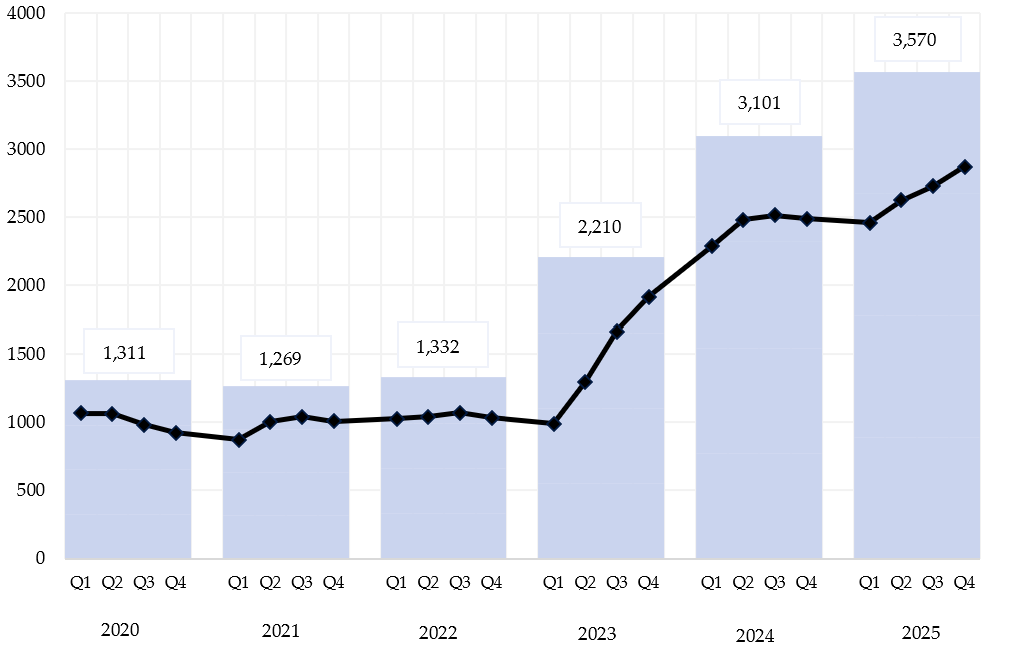
- More than 3,500 lobbyists – a quarter of all federal lobbyists – reported lobbying on AI issues at least once in 2025.
- Over the last three years, the number of AI issue lobbyists on Capitol Hill has grown by nearly 170 percent. The number of data center lobbyists – a subset of AI issues – has grown by nearly 500 percent.
- Companies, trade associations, and non-profits will often hire the same lobbyists. As such, focusing solely on the number of lobbyists (people) fails to capture the true scope of AI lobbying. Examining each unique lobbyist–client relationship (which multiplies lobbyists by the number of AI issue clients they have) reveals that lobbyist activity on AI issues has grown by 265 percent over the past three years.
- Clients across virtually every sector lobbied on AI issues in 2025. Companies in the Software & Services industry led the charge with 1,448 lobbyists (30% of total AI lobbyists) representing 200 corporate clients. The rest of the AI lobbying activity came from industries not traditionally associated with AI issues, like health care, media, finance, manufacturing, and defense, demonstrating the widespread permeation of the technology.
- The U.S. Chamber of Commerce hired the most AI lobbyists in 2025 – 91. The Chamber is followed by Microsoft (63), Meta (55), Intuit (51), and Amazon (48). All of the top 30 lobbying entities, as well as 91 of the top 100, are either corporations or corporate trade groups.
Methodology
Using lobbying data from the U.S. House of Representatives Office of the Clerk,[13] Public Citizen searched for lobbying on AI issues from 2020 through 2025. We flagged lobbying as related to AI issues if the disclosures mentioned at least one of the following items: 1) artificial intelligence, 2) autonomous vehicles and systems and/or 3) data centers.[14] The vast majority – 90 percent of the AI issue lobbyists in 2025 – matched our search by specifically mentioning artificial intelligence or a variation of the term (e.g. AI).
More Than 3,500 Lobbyists Lobbied on AI Issues in 2025, Accounting for 25 percent of All Federal Lobbyists
From 2020 through 2022, lobbying on AI issues was flat. But in 2023, the number of AI issue lobbyists rose sharply and has continued to grow since. In 2025 more than 3,500 lobbyists reported lobbying on AI issues at least once. The total amounts to a 168 percent increase from just three years ago. (Figure 1) [15]
Figure 1 – AI Lobbyists by Quarter and Year (2020 Through 2025)
 Source: Public Citizen’s analysis of House lobbying disclosure data.
According to OpenSecrets, there were 13,699 lobbyists trying to influence federal policy on all issues in 2025.[16] Our analysis found 3,570 of them lobbied on AI issues at least once.
The AI lobbyist total amounts to more than one quarter of all federal lobbyists in 2025. Just a few years ago, that number was just 11 percent.
Table 1: Percentage of all Federal Lobbyists Lobbying on AI
| Year | All Federal Lobbyists (Source: OpenSecrets)[17] |
AI Issue Lobbyists | % of Federal Lobbyists Lobbying on AI |
| 2020 | 11,530 | 1,311 | 11% |
| 2021 | 12,189 | 1,269 | 10% |
| 2022 | 12,663 | 1,332 | 11% |
| 2023 | 12,913 | 2,210 | 17% |
| 2024 | 13,028 | 3,101 | 24% |
| 2025 | 13,699 | 3,570 | 26% |
The lobbyists covered in this analysis lobby on many different issues, not just AI. But for more than a quarter of the federal lobbyists in 2025, AI was at least some part of their portfolio.
The fact that more than one quarter of all lobbyists are now lobbying on AI issues is striking. It is a fairly new issue, only becoming a topic known to most Americans over the last few years.[18]
Those filing lobbying disclosures are required to list a broad issue area for each of their lobbying activities. The issue list to choose from includes issues like “Taxes,” “Health Issues,” “Trade,” and “Defense,” among others.[19] OpenSecrets regularly tracks which issue areas attract the most lobbyists.[20] For the AI issue lobbying included in our analysis, the corporations, trade groups, and non-profits chose another broader issue category and wrote in that their lobbying included AI issues. [21]
As such, it’s not an apples-to-apples comparison to compare the AI issue lobbying we found to the broader issue areas included on lobbying forms analyzed by OpenSecrets.
Nonetheless, it is striking where AI issues lobbying would rank when compared to these broader issue areas. In 2025 for example, when there were 3,570 AI issue lobbyists, the issue would have ranked fourth on OpenSecrets’ top issue list, behind only the federal budget and appropriations, taxes, and health issues. And it would have been ahead of issues like defense, energy and nuclear power, and transportation.[22]
While lobbying specifically mentioning the phrases “AI” or “artificial intelligence” make up the bulk of the lobbying we found, lobbying on data centers – a subset of AI issue lobbying – is rising even more rapidly than overall AI issue lobbying.
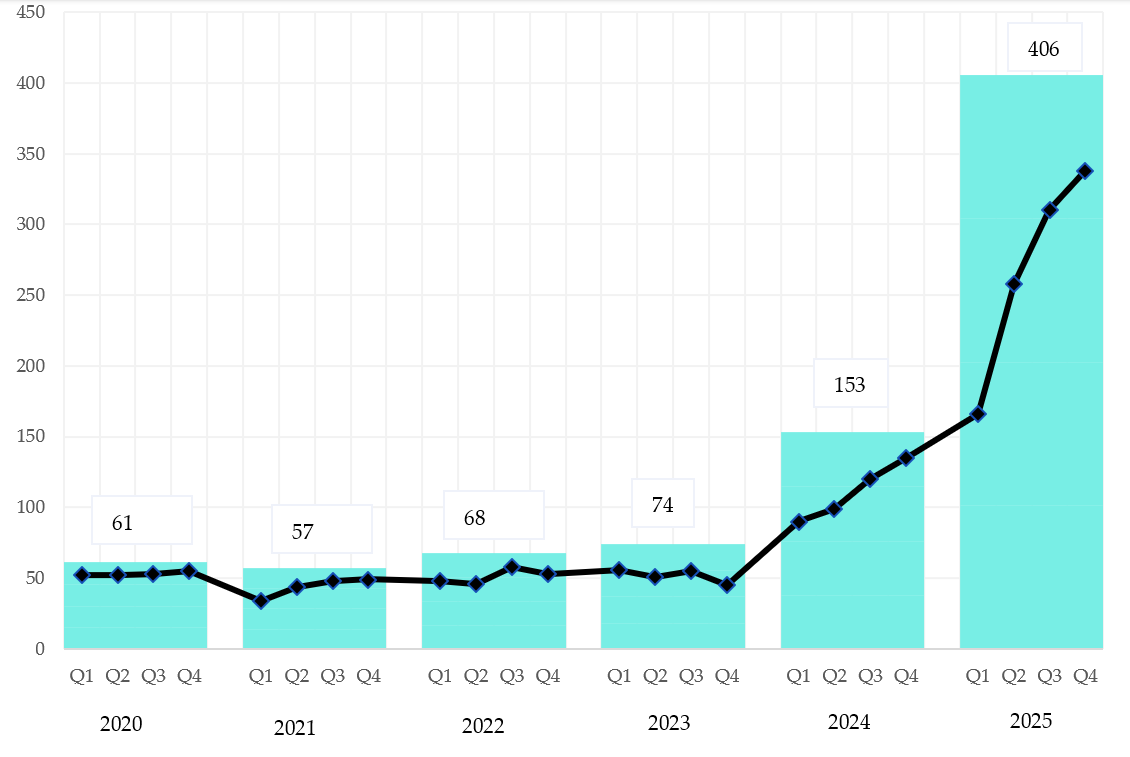
The number of data center lobbyists (e.g. lobbyists specifically mentioning “data centers” in their filings), has grown by 449 percent in the last three years, from 68 in 2022 to more than 400 in 2025. (Figure 2)
Figure 2 – Data Center Lobbyists by Quarter and Year (2020 Through 2025)
Source: Public Citizen’s analysis of House lobbying disclosure data.
Data center lobbying is likely to continue to increase as more entities jump into the data center “gold rush.”[23] Just a few months ago in November 2025, a new trade group, the AI Infrastructure Coalition, was announced.[24] The group aims to “collectively shape the future of AI infrastructure policy” by bringing together datacenter operators, private equity, energy providers and others to “ignite American economic prosperity” and “fortify our nation’s security in the AI race against China.”[25] Its membership includes: tech companies like Meta, Microsoft, and Google; energy and oil companies ExxonMobil and Duke Energy; private equity firm Andreessen Horowitz; and data center operator QTS (which is owned by private equity giant Blackstone)[26], among others.[27] The coalition is co-chaired by former Sen. Kyrsten (D-Ariz.) Sinema and former Rep. Garret Graves (R-La.).[28]
While the AI Infrastructure Coalition is new and has yet to appear in lobbying disclosures, other similar trade groups focused on data centers are already influencing federal policy. The Data Center Coalition, which includes many of the same member companies as the new AI Infrastructure Coalition along with OpenAI and Anthropic[29] hired lobbyists to lobby the White House on data centers in 2025, among other agencies.[30]
It is important to note that any analysis of lobbying disclosures focused on searching for specific phrases will result in an undercount of the lobbying that exists. For example, it is likely some entities writing that they lobbied on “energy infrastructure” were lobbying on data centers. But since energy infrastructure can cover a wide range of topics outside of data centers, that lobbying is not included in our totals.
There are also some efforts to influence data center policy that won’t show up in lobbying data. Data center companies and their proxies have increasingly turned their attention to the stakeholder process at the Federal Energy Regulatory Commission (FERC), the regulator that occupies the drivers’ seat on data center energy policy.[31] Former FERC Chairman Rich Glick’s consulting firm GQS represents the Data Center Coalition in the stakeholder process of the FERC-jurisdictional power market PJM Interconnection, [32] the organization that operates the wholesale electricity market at least in part for 13 states and Washington DC.[33] Other FERC commissioners have also gone through the revolving door to work at firms connected to the data center industry: Former FERC Commissioner Allison Clements is a partner with ASG, a consulting firm working to promote data centers;[34] and former FERC Chairman Neil Chatterjee serves on the advisory board of AiDASH, a company that makes tools used by electric utilities.[35]
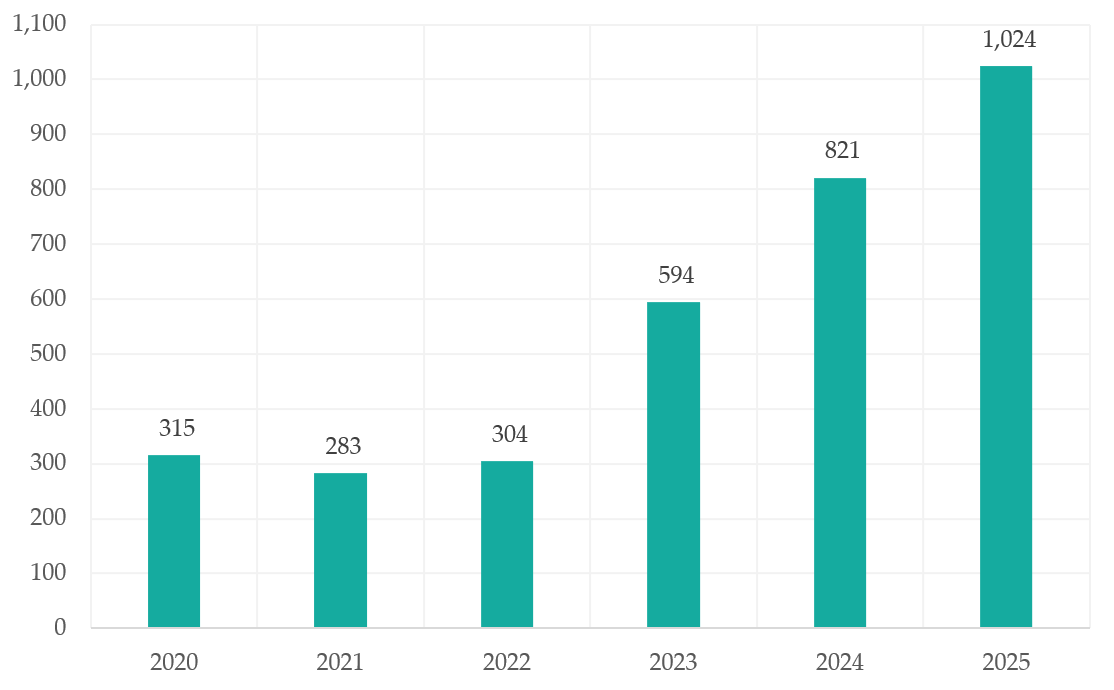
The number of clients disclosing lobbying on AI issues has also ballooned over the last few years. Overall, the number of clients – corporations, trade groups and other non-profits – that reported lobbying on AI issues has more than tripled since 2022, growing from just over 300 in 2022 to more than 1,000 in 2025. (Figure 3).
Figure 3 – Clients Lobbying on AI Issues Year (2020 Through 2025)*
Source: Public Citizen’s analysis of House lobbying disclosure data.
*Public Citizen combined some clients together when lobbying included both parent company and a subsidiary (e.g., Waymo lobbying was combined with Google, Red Hat lobbying was included with IBM, etc.)
Clients Hired 265 Percent More AI Issue Lobbyists in 2025 Compared to 2022
The sheer number of people (lobbyists) lobbying on AI issues in 2025 – more than 3,500 – is striking, as is the fact that the total represents more than one quarter of all federal lobbyists. But that number fails to capture the real magnitude of the AI lobbying boom, primarily because many companies hire the same firms and lobbyists to represent them on AI-related issues.
If the same lobbyist is hired by five companies in one quarter, then 10 companies in the next quarter, that lobbyist still counts as “one” in Figure 1 above. Thus, it fails to capture the increase in activity. If you were simply to look at the number of clients lobbying on AI (Figure 3), that too would miss changes in activity (if a client hired two lobbyists in one quarter, then 20 lobbyists in the next, a client-focused analysis by would show no change).
A better way to gauge changes in lobbying activity is to look at each unique lobbyist – client relationship (if the same lobbyist is hired by five clients in a year, that same person would be counted five times). We refer to these unique lobbyist – client relationships as “lobbyist activity.” This methodology is used throughout this section.
Here, the AI lobbying boom becomes even more striking. In 2022, clients hired 1,672 lobbyists to lobby on AI issues. In 2025, that number was 6,110 – representing an increase of 265 percent in three years. (Figure 4)
Figure 4 – Number of AI Lobbyists Hired by Clients by Quarter and Year (2020 Through 2025)*
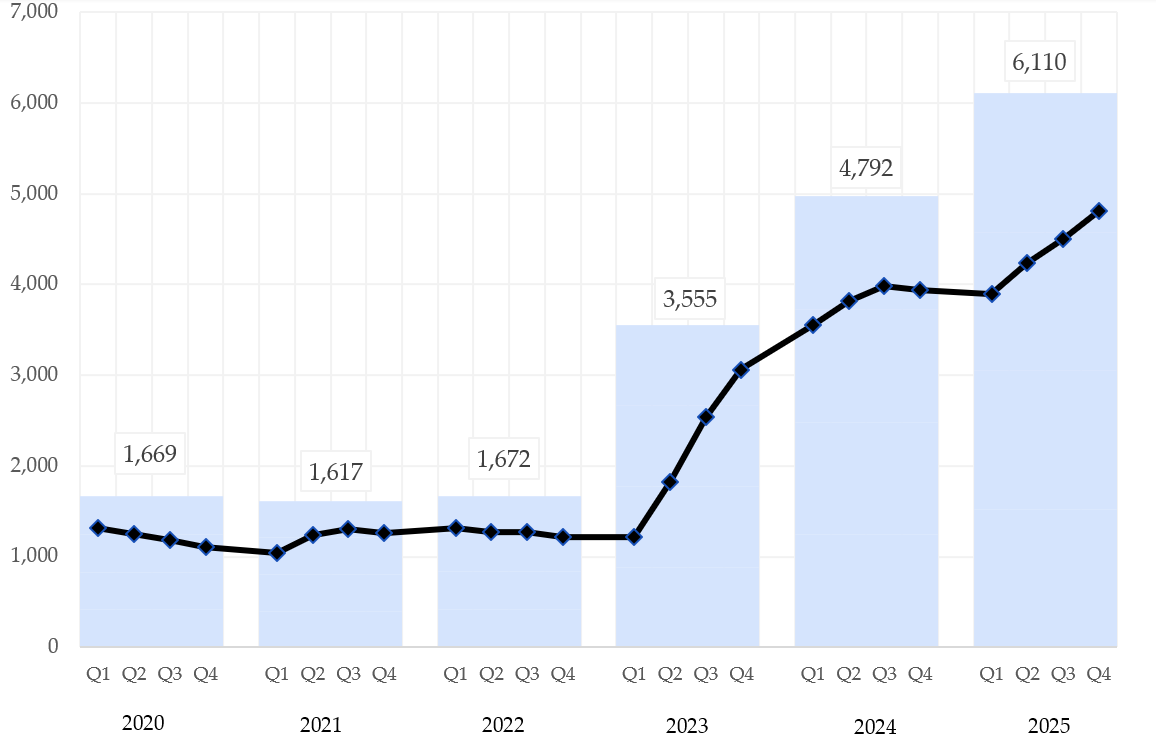
*Figure 4 shows both quarterly and yearly lobbyist activity. When showing year totals, each unique lobbyist – client relationship that occurred that year is counted only once, even if the relationship existed in multiple quarters. In the quarterly totals, each unique relationship is counted once in every quarter it occurred.
From 2020 through the end of 2022, AI lobbyist activity had remained largely flat. Between 2022 and 2023, it more than doubled and has continued to grow since.
AI Lobbying Extends Beyond Tech Industry
While the sheer number of lobbyists and scale of lobbying activity has ballooned, the breadth of clients lobbying on AI issues also stretches across virtually every sector. And as policy makers on Capitol Hill discuss potential AI regulation, nearly all the voices they are hearing represent corporate interests.
Corporations or corporate trade groups made up the lion’s share of all AI lobbying in 2025, with 5,016 lobbyists (82%) compared with non-corporate clients, such as unions, academic institutions, and advocacy organizations, which hired 1,094 AI lobbyists (18%).
All of the top 30 entities hiring the most AI issue lobbyists represent corporations or corporate trade groups. Of the top 100, 91 represent corporate interests. Many of these companies have billions of dollars invested in AI.
In 2025, the Chamber of Commerce deployed more than 90 lobbyists to Capitol Hill to influence AI policy among other issues, more than any other lobbying entity. The Chamber is followed by Microsoft (63), Meta (55), Intuit (51), and Amazon (48).
Table 2 – Companies, Trade Groups and Non-Profits Hiring the Most AI Lobbyists in 2025
| Client* | AI Issue Lobbyists** |
| U.S. Chamber of Commerce[36] | 91 |
| Microsoft[37] | 63 |
| Meta[38] | 55 |
| Intuit, Inc. and Affiliates[39] | 51 |
| Amazon[40] | 48 |
| Adobe[41] | 48 |
| Information Technology Industry Council[42] | 45 |
| Google[43] | 45 |
| Scale AI[44] | 44 |
| Advanced Micro Devices, Inc.[45] | 43 |
| Andreessen Horowitz[46] | 42 |
| Business Roundtable[47] | 42 |
| IBM[48] | 41 |
| Edison Electric Institute[49] | 38 |
| Samsung Electronics America[50] | 37 |
| CISCO Systems, Inc[51] | 36 |
| Anduril Industries[52] | 35 |
| Palo Alto Networks, Inc.[53] | 35 |
| Siemens Corporation[54] | 34 |
| Accenture[55] | 33 |
| SAP America Inc.[56] | 32 |
| National Venture Capital Association[57] | 31 |
| Retail Industry Leaders Association[58] | 31 |
| Oracle Corporation[59] | 30 |
| Medtronic, Inc.[60] | 30 |
| Netflix, Inc.[61] | 30 |
| PhRMA[62] | 30 |
| Comcast Corporation[63] | 29 |
| American Hospital Association[64] | 28 |
| NVIDIA Corporation[65] | 28 |
| Walmart[66] | 28 |
* The source for each client shows that the client is lobbying on AI issues. It is not to source the number of AI issue lobbyists. For some clients, the lobbyists may appear across many different disclosures and quarters. The lobbyist totals are calculated by analyzing House lobbying disclosure data.
** The lobbyists included in Table 2 lobby on many issues, not just AI.
To better understand the types of companies that hired AI lobbyists, we used the Global Industry Classification Standard (GICS) to classify clients according to their primary industry. The GICS structure consists of 11 sectors and 25 industry groups.[67] (Figure 5). While many clients could appropriately be assigned to more than one industry, we chose the primary industry a lobbying client operates within.
Clients ranged across all sectors and represented a variety of industry groups. The Software & Services industry was highest represented, with 200 corporate clients and 1,448 lobbyists (30% of total lobbyists). This includes companies like Microsoft, Intuit, and Adobe.
While it makes sense that lobbyists for software companies would make up the largest share of AI lobbying activity, it is also striking that the industry most closely associated with AI represents less than a third of all lobbying activity related to it. A handful of Big Tech companies do not fit neatly into the industrial classification system (e.g. Meta and Google are not in the Software & Services sector). Regardless of the challenges in classifying some companies’ primary industry, the majority AI lobbying activity is from companies outside of what is traditionally thought of as the tech sector.
The rest of the AI lobbying activity came from industries not historically associated with AI issues, like health care, media, finance, manufacturing, and defense.
Figure 5: Number of Lobbyists by Client Industry*
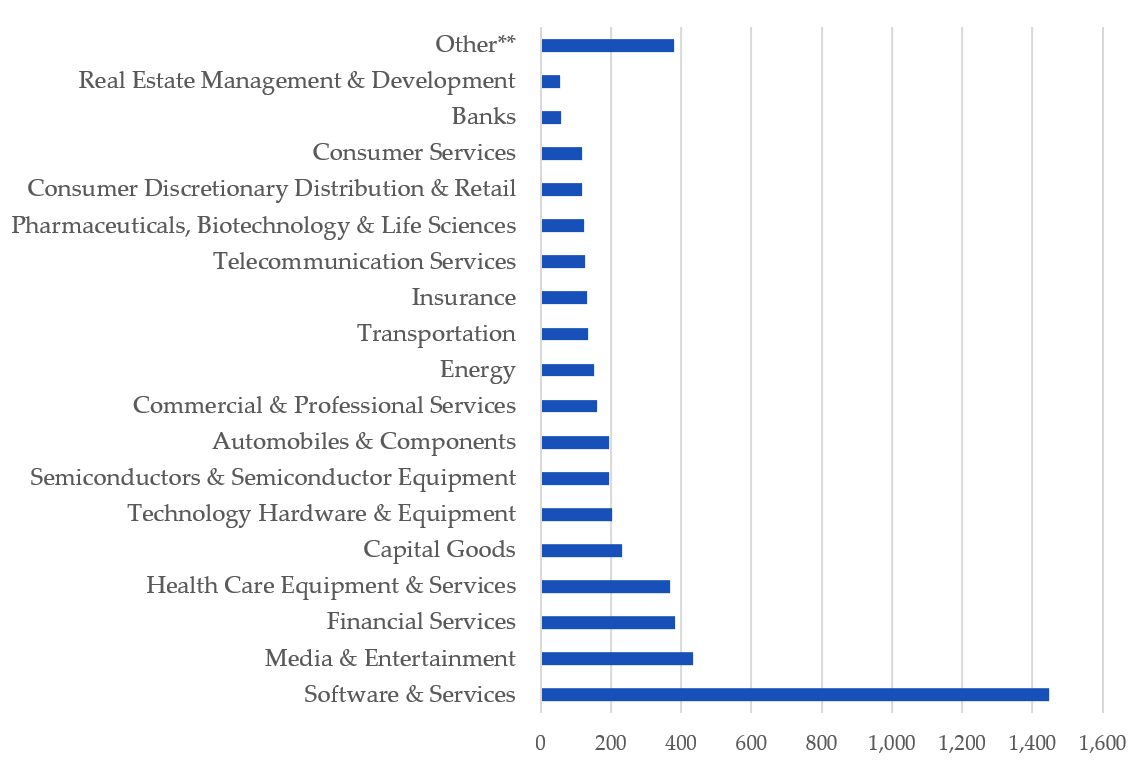
* The lobbyists included in Figure 5 lobby on many issues, not just AI. Only corporate clients are represented.
** Other = anything not classified or belonging to a category with fewer than 50 lobbyists
For example, Media & Entertainment made up the second largest share, with 434 (9%) lobbyists representing 54 clients. These clients include tech giants like Meta and Google, traditional media such as Murdoch-owned News Corp, and streaming platforms like Netflix and Spotify.
Financial Services clients, which include cryptocurrency companies, venture capital firms, and credit card issuers, had 382 (8%) lobbyists representing 58 companies. The industry group was dominated by the Trump-connected venture capital firm Andreessen Horowitz,[68] which hired 42 AI lobbyists.
Clients affiliated with aerospace and defense stretched across different industry groups, including Capital Goods, which includes companies that manufacture weapons systems, as well as Software & Services, such as companies that develop defense and surveillance software. We identified 259 lobbyists representing 57 clients operating in the broader defense industry.
The top defense-affiliated client was Anduril Industries, which builds AI-powered autonomous systems and defense technology such as drones and unmanned jet fighters and had 35 lobbyists working AI on its behalf in 2025. Anduril is backed by venture capital firms including Trump-allied Founders Fund and Andreessen Horowitz, as well as 1789 Capital, which is co-headed by Donald Trump, Jr.[69]
Palantir, which develops software used for surveillance and defense, had 16 lobbyists working on AI. Palantir’s primary clients are federal agencies—and racked up $1 billion in federal contracts in 2025[70]—as well as local law enforcement.
Defense contractor L3Harris had six lobbyists working on AI. The company’s Missile Solutions business is slated to be spun off and go public this year after receiving a $1 billion investment from the Pentagon.[71]
Conclusion
We already know AI is causing significant harm to children, our energy grid, the environment and the job market, among other things. AI-focused companies’ heavy reliance on each other for contracts and deals has heightened fears that the hyper-concentrated industry will collapse in on itself should a domino fall.[72] Despite this, Congress has yet to act. And the White House’s only action has been deregulatory.
J.B. Branch, Public Citizen’s Big Tech Accountability Advocate, testified before the House Financial Services Committee in December of last year on the issue of AI in financial services and succinctly described the situation we are in: “Congress now has a once-in-a-generation opportunity to decide whether AI becomes another chapter in the story of unchecked corporate power or a model for how democratic societies govern world-changing technologies responsibly.”[73]
AI regulation needs to reflect the public interest, not the influence of corporate lobbyists. More broadly, Congress should regulate AI with these principles in mind:[74]
- Reject blanket preemption and deregulatory sandboxes
- Build enforceable, sector-specific guardrails
- Invest in regulators’ technical capacity
- Protect workers, children, and communities
- And refuse to make taxpayers the backstop for speculative AI finance
Leaving a society-transforming technology completely unregulated could prove to be an enormous mistake with grave consequences. We cannot allow corporate interests to stop legislative and executive branch action. The stakes are too high.
Sources
[1] Jason Ma, ‘Godfather of AI’ says the technology will create massive unemployment and send profits soaring — ‘that is the capitalist system,’ Fortune (Jan. 12, 2026), https://citizen.short.gy/ID8Xe7.
[2] The Editors, Video: Geoffrey Hinton talks about the ‘existential threat’ of AI, MIT Technology Review (May 3, 2023), https://citizen.short.gy/l4izKp.
[3] Jason Ma, ‘Godfather of AI’ says the technology will create massive unemployment and send profits soaring — ‘that is the capitalist system,’ Fortune (January 12, 2026), https://citizen.short.gy/ID8Xe7.
[4] Statement on AI Risk, Center for AI Safety, https://aistatement.com/.
[5] Rhitu Chatterjee, Teens are having disturbing interactions with chatbots. Here’s how to lower the risks, NPR (Dec. 29, 2025), https://citizen.short.gy/mngWnX.
[6] AI Risk Repository, MIT AI Risk Initiative (accessed Feb. 2026), https://airisk.mit.edu/.
[7] Sawdah Bhaimiya, AI impacting labor market ‘like a tsunami’ as layoff fears mount, CNBC (Jan. 20, 2026), https://citizen.short.gy/Tb2xoG.
[8] Years of Polling Show Overwhelming Voter Support for a Crackdown on AI, Public Citizen (Nov. 21, 2025), https://citizen.short.gy/kCB5nG.
[9] The executive order came after Sen. Ted Cruz (R-Texas) tried to pass a similar legislative provision earlier in the year but failed. See Executive Order: Ensuring a National Policy Framework for Artificial Intelligence, The White House (Dec. 11, 2025), https://citizen.short.gy/Ykj4mj; and Anthony Adragna, ‘Not at all dead’: Cruz says AI moratorium will return, Politico (Sept. 16, 2025), https://citizen.short.gy/Ee2kBt.
[10] The vast majority of matches in our search were related specifically to “AI” or “artificial intelligence”.
[11] Luyi Cheng and Mike Tanglis, Artificial Intelligence Lobbyists Descend on Washington DC, Public Citizen, (May 29, 2024), https://citizen.short.gy/6OHUvK. The methodology in this piece includes lobbying on data centers. The 2024 piece did not. As such, the numbers in this report for previous years will be higher.
[12] Harshawn Ratanpal, Federal lobbying on artificial intelligence grows as legislative efforts stall, OpenSecrets (Jan. 4, 2024), https://citizen.short.gy/HUu7Yn; and Maia Cook, Lobbying on AI reaches new heights in 2024, OpenSecrets (June 27, 2024), https://citizen.short.gy/yhjPgr.
[13] Office of the Clerk of the House of Representatives Lobbying Disclosures. https://lobbyingdisclosure.house.gov/
[14] We also searched for variations of those words (A.I.) as well as a handful of other AI terms including large language model and facial recognition.
[15] Not every lobbyist will lobby every quarter each year. Yearly totals include all lobbyists that lobbied at least once that year.
[16] Lobbying Data Summary, OpenSecrets (accessed Feb. 9, 2026), https://citizen.short.gy/b4L8gn.
[17] Lobbying Data Summary, OpenSecrets (accessed Feb. 9, 2026), https://citizen.short.gy/b4L8gn.
[18] Though it existed in issues like autonomous vehicles prior to that, just not named.
[19] Open Secrets Federal Lobbying Top Issues, OpenSecrets (accessed Feb. 9, 2026), https://citizen.short.gy/n93Ck8.
[20] Id.
[21] Filers disclosing AI lobbying, did so in the free text lobbying activity field.
[22] Open Secrets Federal Lobbying Top Issues, OpenSecrets (accessed Feb. 9, 2026), https://citizen.short.gy/n93Ck8.
[23] Te-Ping Chen, Data Centers Are a ‘Gold Rush’ for Construction Workers, The Wall Street Journal (Nov. 29, 2025), https://citizen.short.gy/kKyTHS.
[24] Mike Allen, Exclusive: AI Infrastructure Coalition launches to push pro-AI policies, Axios (Nov. 19, 2025), https://citizen.short.gy/MdWQsl.
[25] AI Infrastructure Coalition, (accessed Feb. 17, 2026), https://aiinfrastructurecoalition.org/.
[26] QTS Realty Trust to Be Acquired by Blackstone Funds in $10 Billion Transaction, Blackstone (June 7, 2021), https://citizen.short.gy/a4Beii.
[27] Mike Allen, Exclusive: AI Infrastructure Coalition launches to push pro-AI policies, Axios (Nov. 19, 2025), https://citizen.short.gy/MdWQsl.
[28] AI Infrastructure Coalition, (accessed Feb. 17, 2026), https://aiinfrastructurecoalition.org/about/.
[29] DCC Members, https://www.datacentercoalition.org/members.
[30] Filings show lobbying of the Executive Office of the President, See Lobbying Disclosure, Crossroads Strategies LLC on Behalf of Data Center Coalition, Secretary of the Senate Lobbying Disclosure Database, (Q4 2025), https://citizen.short.gy/kV2r46.
[31] This is in part due to the emergency petition filed by U.S. Energy Secretary Chris Wright on October 2025 seeking expedited FERC action on data center interconnection. eLibrary, Filing Description for Accession Number 20251027-4001, Federal Energy Regulatory Commission (Oct. 2025), https://citizen.short.gy/rTyPbn
[32] Rick Glick, Principal, GQS New Energy Strategies, https://www.gqsenergy.com/rich-glick.html and Rambo Yalabong, Four Governors Whose States Rely on PJM Want Data Centers to Guarantee Their Own Power, Inside Climate News (Oct. 30, 2025), https://citizen.short.gy/sRuInf.
[33] PJM, Federal Energy Regulatory Commission, https://citizen.short.gy/SOcEo0.
[34] Our Team, Allison Clements, ASG, https://asg-team.com/our-team/.
[35] Leadership, Neil Chatterjee, AiDASH, www.aidash.com/our-leadership/.
[36] Lobbying Disclosure, Chamber of Commerce of the U.S.A, Secretary of the Senate Lobbying Disclosure Database, (Q4 2025), https://citizen.short.gy/56Slsb.
[37] Lobbying Disclosure, Microsoft Corporation, Secretary of the Senate Lobbying Disclosure Database, (Q4 2025), https://citizen.short.gy/eFmQY8.
[38] Lobbying Disclosure, Meta Platforms, Inc. and various subsidiaries, Secretary of the Senate Lobbying Disclosure Database, (Q4 2025), https://citizen.short.gy/21C8xn.
[39] Lobbying Disclosure, Intuit, Inc. and Affiliates (formerly Intuit, Inc.), Secretary of the Senate Lobbying Disclosure Database, (Q4 2025), https://citizen.short.gy/L2FBhX.
[40] Lobbying Disclosure, Amazon.com Services LLC, Secretary of the Senate Lobbying Disclosure Database, (Q4 2025), https://citizen.short.gy/ZDZNbv.
[41] Lobbying Disclosure, Adobe Inc, Secretary of the Senate Lobbying Disclosure Database, (Q4 2025), https://citizen.short.gy/obSmPK.
[42] Lobbying Disclosure, Information Technology Industry Council, Secretary of the Senate Lobbying Disclosure Database, (Q4 2025), https://citizen.short.gy/tBt0bc.
[43] Lobbying Disclosure, Google Client Services LLC, Secretary of the Senate Lobbying Disclosure Database, (Q4 2025), https://citizen.short.gy/cMDNBk.
[44] Lobbying Disclosure, Scale AI, Inc, Secretary of the Senate Lobbying Disclosure Database, (Q4 2025), https://citizen.short.gy/S9brpq.
[45] Lobbying Disclosure, Advanced Mico Devices, Inc., Secretary of the Senate Lobbying Disclosure Database, (Q4 2025), https://citizen.short.gy/PSZ0oM.
[46] Lobbying Disclosure, BGR Government Affairs on Behalf of A16Z Capital Management, L.L.C. (d/b/a Andreessen Horowitz) FKA AH Capital Mgmt., Secretary of the Senate Lobbying Disclosure Database, (Q4 2025), https://citizen.short.gy/ebqBbE.
[47] Lobbying Disclosure, The Business Roundtable, Inc., Secretary of the Senate Lobbying Disclosure Database, (Q4 2025), https://citizen.short.gy/dy0Rt8.
[48] Lobbying Disclosure, International Business Machines Corporation, (IBM) Secretary of the Senate Lobbying Disclosure Database, (Q4 2025), https://citizen.short.gy/InJzJE.
[49] Lobbying Disclosure, Edison Electric Institute, Secretary of the Senate Lobbying Disclosure Database, (Q4 2025), https://citizen.short.gy/htz19M.
[50] Lobbying Disclosure, Samsung Electronics America, Inc., Secretary of the Senate Lobbying Disclosure Database, (Q4 2025), https://citizen.short.gy/QgaGM9.
[51] Lobbying Disclosure, CISCO Systems, Inc, Secretary of the Senate Lobbying Disclosure Database, (Q4 2025), https://citizen.short.gy/WStNdt.
[52] Lobbying Disclosure, Anduril Industries, Secretary of the Senate Lobbying Disclosure Database, (Q4 2025), https://citizen.short.gy/16Yy7u.
[53] Lobbying Disclosure, Palo Alto Networks, Inc., Secretary of the Senate Lobbying Disclosure Database, (Q4 2025), https://citizen.short.gy/puaOGV.
[54] Lobbying Disclosure, Siemens Corporation, Secretary of the Senate Lobbying Disclosure Database, (Q4 2025), https://citizen.short.gy/xbXKs2.
[55] Lobbying Disclosure, Accenture Federal Services LLC, Secretary of the Senate Lobbying Disclosure Database, (Q4 2025), https://citizen.short.gy/QrpffW.
[56] Lobbying Disclosure, Origin Advocacy LLC on Behalf of SAP America, Inc., Secretary of the Senate Lobbying Disclosure Database, (Q4 2025), https://citizen.short.gy/A1OLS4.
[57] Lobbying Disclosure, National Venture Capital Association, Secretary of the Senate Lobbying Disclosure Database, (Q4 2025), https://citizen.short.gy/FgRbSo.
[58] Lobbying Disclosure, Retail Industry Leaders Association, Secretary of the Senate Lobbying Disclosure Database, (Q4 2025), https://citizen.short.gy/8CDBQc.
[59] Lobbying Disclosure, Oracle Corporation, Secretary of the Senate Lobbying Disclosure Database, (Q4 2025), https://citizen.short.gy/ONMWJp.
[60] Lobbying Disclosure, Medtronic, Inc., Secretary of the Senate Lobbying Disclosure Database, (Q4 2025), https://citizen.short.gy/3UnPUs.
[61] Lobbying Disclosure, Monument Advocacy on Behalf of Netflix, Inc., Secretary of the Senate Lobbying Disclosure Database, (Q4 2025), https://citizen.short.gy/ANUWVB.
[62] Lobbying Disclosure, Pharmaceutical Research and Manufacturers of America, Secretary of the Senate Lobbying Disclosure Database, (Q4 2025), https://citizen.short.gy/uxDc2J.
[63] Lobbying Disclosure, Comcast Corporation, Secretary of the Senate Lobbying Disclosure Database, (Q4 2025), https://citizen.short.gy/L18gN9.
[64] Lobbying Disclosure, American Hospital Association, Secretary of the Senate Lobbying Disclosure Database, (Q4 2025), https://citizen.short.gy/azVQgO.
[65] Lobbying Disclosure, NVIDIA Corporation, Secretary of the Senate Lobbying Disclosure Database, (Q4 2025), https://citizen.short.gy/qv58e8.
[66] Lobbying Disclosure, Walmart Inc., Secretary of the Senate Lobbying Disclosure Database, (Q4 2025), https://citizen.short.gy/3kJBOo.
[67] GICS: Global Industry Classification Standard, S&P Global, https://citizen.short.gy/DnCGwM.
[68] Jake Pearson, Tech Billionaire Marc Andreessen Bet Big on Trump. It’s Paying Off for Silicon Valley, ProPublica (Nov. 5, 2025), https://citizen.short.gy/daPdDK
[69] Anduril Raises $1.48 Billion in Series E Funding, Anduril Industries (Nov. 30, 2022). https://citizen.short.gy/nQJoXN ; Cristiano Dalla Bona, 1789 Capital targets breakout returns from late-stage US innovation – partner, ION Analytics (July 17, 2025), https://citizen.short.gy/NSEFHD; Oligarchs and the Trump Admin: Peter Thiel, Revolving Door Project, (Apri 8, 2025), https://citizen.short.gy/nzqFFs ; Jake Pearson, Tech Billionaire Marc Andreessen Bet Big on Trump. It’s Paying Off for Silicon Valley, ProPublica, (Nov. 5, 2025), https://citizen.short.gy/26l207; Don Trump, Jr., Partner, 1789 Capital (accessed February 10, 2026), https://citizen.short.gy/guHF6A.
[70] Palantir Technologies Inc, USA Spending (FY 2025), https://citizen.short.gy/mT5o3B.
[71] Press Release, Department of War Announces $1 Billion Direct-to-Supplier Investment to Secure the U.S. Solid Rocket Motor Supply Chain, US Department of War (Jan, 13, 2026), https://citizen.short.gy/hTCjfC.
[72] Magdalena Petrova, A guide to the $1 trillion-worth of AI deals between OpenAI, Nvidia and others, CNBC (Oct. 15, 2025), https://citizen.short.gy/BNvRzt.
[73] J.B. Branch, From Principles to Policy: Enabling 21st Century AI Innovation in Financial Services, Public Citizen, (Dec.10, 2025), https://citizen.short.gy/9udlGG.
[74] J.B. Branch, From Principles to Policy: Enabling 21st Century AI Innovation in Financial Services, Public Citizen, (Dec.10, 2025), https://citizen.short.gy/9udlGG.