
Corporate Money in the 2026 Midterms Surges to $650 Million
Current Cycle Contributions Exceed One Third of Disclosed Corporate Spending Since 2010’s Citizens United Ruling
Key Findings
- Federal corporate political spending in the 2026 midterm elections has reached an unprecedented $646 million – a 40% increase over the 2024 presidential election, the previous record-breaking year, when corporations spent $461 million.
- This means the 2026 total so far is already more than one third (38%) of the $1.7 billion that corporations have spent since the 2010 U.S. Supreme Court ruling in Citizens United v. FEC to allow direct corporate spending in federal elections.
- Cryptocurrency and online betting corporations are leading the surge along with Big Tech and businesses with interests in AI and data center development. Collectively, corporations in these sectors have contributed $344 million toward influencing the 2026 midterms – over half (53%) of the 2026 corporate spending surge.
- Crypto corporations have contributed $206 million;
- Online betting corporations have contributed $76 million; and
- Big Tech and others with interests in AI and data center development have contributed $62 million.
- The biggest beneficiaries of the corporate spending newly reported in the Federal Election Commission’s second quarter data are:
- Win for America, the online betting super PAC, which received an additional $29 million, mostly from DraftKings, FanDuel, and bet365 (bringing its total to $72 million);
- Americans for Prosperity, the group associated with the billionaire Koch brothers, which received $20 million from Koch Inc. (bringing its total to $92 million); and
- MAGA Inc., the Trump-aligned super PAC, which reported $17 million in additional contributions, mostly from the crypto corporation Gemini and tobacco company Reynolds American (bringing its total to $401 million).
Note: Findings are based on Public Citizen analysis of 2010-2024 data obtained from OpenSecrets and 2026 U.S. Federal Election Commission data documenting contributions of $5,000 or more by for-profit corporations to super PACs and hybrid PACs. Not all corporate spending is reported to the Federal Election Commission. The totals likely undercount the true total sum of federal corporate election spending, which Dark Money groups enable corporations to conceal.
Analysis
Months before Election Day, corporations have already collectively spent $646 million to influence federal midterm elections – a 40% increase over the $461 million corporations spent over the entire 2024 election cycle and more than triple the $184.1 million spent by corporations during the previous midterms in 2022.
Over one third of the total $1.7 billion in corporate spending to influence federal elections since the U.S. Supreme Court allowed such spending in 2010 has been made during the current election cycle (see Chart).
Chart: Corporate Political Spending in Federal Elections Since Citizens United
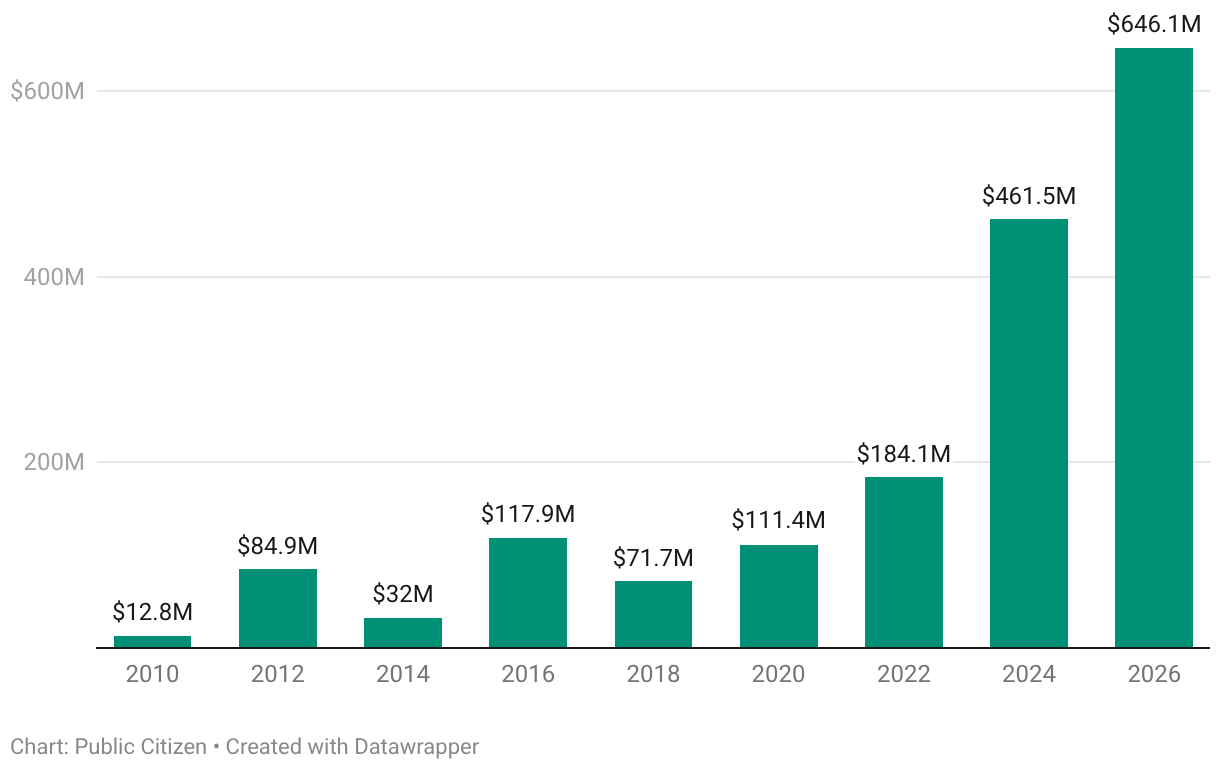
Source: Public Citizen analysis of OpenSecrets.org and FEC data through the second quarter of 2026
Most of the 2026 surge is attributable to technology corporations. Crypto, online betting, and tech corporations pushing AI and data centers contributed $344 million, or more than half (53%) of the corporate contributions disclosed to the FEC. The FEC’s second quarter of 2026 disclosures revealed an additional $129 million in corporate contributions over previous reports.
Table 1: Corporate Sectors and Corporate Supremacist Super PACs
| Corporate Sector | Total Corporate Contributions from Sector | Corporate Super PAC | Contributions to Corporate Super PAC |
|---|---|---|---|
| Cryptocurrency | $206 million | Fairshake | $83 million |
| Online Betting | $76 million | Win for America | $72 million |
| Big Tech / AI | $62 million | Leading the Future | $50 million |
| Total | $344 million | -- | $205 million |
Source: Public Citizen analysis of OpenSecrets.org and FEC data through the second quarter of 2026
An unprecedented aspect of the 2026 midterms is the proliferation of corporate supremacist super PACs, which are structured prioritize the interests of their business backers over either major political party or any candidate (see Public Citizen’s previous report on corporate spending in the 2026 midterms). These super PACs follow the crypto sector’s 2024 playbook of engaging in both Democratic and Republican primaries and to support or attack candidates of either major party in the general election.
Two of the main corporate supremacist super PACs – Fairshake, which prioritizes crypto sector interests, and Leading the Future, which prioritizes AI interests – received relatively few additional contributions in the second quarter of 2026. Leading the Future’s increase from $75.1 million to $75.8 million is attributable to interest income. Fairshake’s increase from $135 million to $137.4 million is attributable mostly to one million-dollar donation from a crypto corporation (Digital Currency Group) and interest income.
However, Win for America – the super PAC prioritizing the interests of online betting corporations – received contributions that increased its size by 70%, from $43 million in the first quarter to $72 million. This increase is attributable to contributions of $14.5 million from DraftKings, $7.5 million from FanDuel, $5.5 million from bet365 (Hillside Shared Services), and $1.5 million from Fanatics Betting and Gaming.
Additional corporate contributions in the second quarter of 2026 mostly favored partisan super PACs.
- Koch Inc., the privately held fossil fuel and manufacturing conglomerate long owned and managed by billionaire brothers Charles Koch and the late David Koch, gave $20 million to Americans for Prosperity, the Koch family’s primary political influence vehicle. Koch GA Inc., a subsidiary of the Koch business empire, gave $1.5 million – $750,000 each to the Congressional Leadership Fund, a self-described “super PAC dedicated to electing Republicans to the House of Representatives,” and the Senate Leadership fund, a super PAC dedicated to “maintaining and growing the Senate Republican Majority.” The Koch subsidiary has given $2.5 million and $2 million, respectively, to each of these super PACs over the 2026 cycle.
- Gemini, the crypto corporation controlled by the billionaire twins Tyler and Cameron Winklevoss, gave $10 million to the Trump-aligned MAGA Inc. super PAC. Additional notable corporate contributions to MAGA Inc. include $5 million from the tobacco company Reynolds American, $1 million from the private prison company GEO Group, and $1 million from Manzanita Management Group, a corporation controlled by WhatsApp co-founder and CEO Jan Koum.
- Cannabis corporations collectively gave $11.5 million to America First Agriculture Action, whose treasurer, Charles Gantt, is also the treasurer of MAGA Inc. Curaleaf, Trulieve, Verano Holdings, and Green Thumb Industries each gave $2.5 million, while Arboretum Bidco gave $1 million and Ascend Wellness gave $500,000.
- Tamarack Aspen., which was disclosed as having given $6.7 million to a “pop up” super PAC only after Campaign Legal Center filed a complaint. The super PAC, Kentucky 4th PAC, spent against Rep. Thomas Massie, an outspoken Republican critic of the Trump administration’s handling of the Epstein files. A subsequent complaint alleges Tamarack Aspen is a corporate shell used to illegally fund the PAC while concealing the true contributors’ identities.
- Polymarket, a controversial prediction markets platform, entered the political fray with contributions via its corporate parent, Blockratize Inc., of a $1 million to the Republican-backing Congressional Leadership Fund and $10,000 to V-PAC, a super PAC, with, in their own words, “one mission only: electing Vivek Ramaswamy,” the tech executive and former DOGE co-chair.
- While there were no additional contributions to Leading the Future, the super PAC set up to intervene in elections for AI interests and to oppose regulations, businesses with an interest in data center development reported a handful of contributions to Republican super PACs. Gaylor Electric, a self-described industry leader in designing and building data centers, gave $300,000 to American Leadership PAC, a super PAC affiliated with Jim Banks (R-Ind.) and which supported Trump-endorsed candidates in Indiana’s Republican primaries. Additionally, Republican Forward – a super PAC registered in Alabama but particularly active in South Dakota races – received $200,000 from Midcontinent Media, which operates data centers, and $100,000 each from Applied Digital Corporation and Muth Electric Inc, both of which are engaged in data center construction.
Table 2: Top 10 Corporate Super PAC Contributors for the Second Quarter of 2026
| Corporation | Contribution Amount | Recipient |
|---|---|---|
| Koch Inc. and subsidiary (Koch GA Inc.) | $20 million | Americans for Prosperity |
| $750,000 | Congressional Leadership Fund PAC | |
| $750,000 | Senate Leadership Fund PAC | |
| DraftKings (DK Crown Holdings Inc.) | $14.5 million | Win for America |
| $250,000 | New Leadership PAC | |
| Gemini Trust Company | $10 million | MAGA Inc. |
| FanDuel Inc. | $7.5 million | Win for America |
| Tamarack Aspen Inc. | $6.7 million | Kentucky 4th PAC |
| bet365 (Hillside Shared Services US LLC) | $5.5 million | Win for America |
| Reynolds American (RAI Services Company) | $5 million | MAGA Inc. |
| $100,000 | More Jobs, Less Government | |
| $100,000 | America One | |
| $50,000 | Leadership in Action | |
| Green Thumb Industries (Vision Management Services LLC) | $2.5 million | America First Agriculture Action |
| $2.5 million | Senate Leadership Fund PAC | |
| Jump Crypto Holdings LLC | $4 million | Jump PAC |
Source: Public Citizen analysis of OpenSecrets.org and FEC data through the second quarter of 2026
Conclusion
The unprecedented surge in corporate spending in the 2026 midterm elections follows the success of the cryptocurrency sector’s super PAC spending in 2024. This escalating spending by more and more corporate sectors threatens to crowd out the voices and interests of actual human voters from the already often out-of-touch electoral discourse.
Corporations want elected officials to prioritize their private profit-maximization over voters and the public interest. The interests of voters are far more diverse and dynamic. Their subordination to policies advanced solely to benefit corporate interests can and should be resisted every step of the way.
Nevertheless, the limits of corporate political spending are coming into focus. The crypto sector’s apparent electoral successes in 2024 led to cozy ties with the Trump administration and a collapse in enforcement against the sector – but has failed so far to translate into passage of crypto’s top legislative priority, the Clarity Act. Big spending by AI corporations in New York races, meanwhile, fueled further backlash against the sector.
Americans across the political spectrum are fed up with big money in politics. Despite the allure of campaign cash, it’s clear that candidates that are willing to defy corporate and big money interests have a strong advantage over those who pander to power.