Asleep at the Vial
FDA Looked the Other Way as Unapproved Peptide Sales Boomed
By Peter Whoriskey, Research Director, Health Research Group
In October 2026, U.S. Health and Human Services (HHS) Secretary Robert F. Kennedy Jr. announced that the government would no longer enforce rules barring pharmacies from selling six peptides popular in health and wellness circles.
The six peptides have been touted as ways to repair muscles and tendons, improve gut health, or extend life. But none has been approved as a drug by the U.S. Food and Drug Administration (FDA) and government scientists previously reported that they pose “significant safety risks.”
In explaining the suspension of the rules, Kennedy’s HHS said the new policy acknowledges the peptides’ popularity. Use of the peptides has become “widespread,” and the ability to purchase them at licensed compounding pharmacies could make them safer, according to the agency. The six injectable peptides, discussed at an FDA advisory committee meeting in July, are BPC-157, Epitalon, KPV, MOTS-c, Semax, and TB-500.
“Americans are going to be buying these anyway,” Kennedy said on Fox News.
But by tailoring FDA policy to accommodate the peptides’ popularity, Kennedy is aggravating a problem. Sales of unapproved peptides have boomed over the last two years in large part because the FDA looked the other way as hundreds of companies, many of them based in China, sold them to U.S. consumers. At least since the start of the second Trump administration, the agency has done next to nothing to crack down on this trade. Kennedy, meanwhile, declared himself a “big fan” of peptides.
The FDA has the authority to halt the marketing and sale of unapproved drugs. But as this Public Citizen report shows, the FDA abdicated its responsibility to stop this illicit trade and instead allowed it to flourish.
KEY FINDINGS
- One peptide warning letter in two years. Since the beginning of the second Trump administration, the FDA has issued more than 150 warning letters to companies marketing unapproved substances, according to the FDA Warning Letters database. The FDA warnings concerned the sales of, among other things, energy potions, “anti-aging” stem cell therapy, herbs for testicular and prostate cancer, and green tea to fight Alzheimer’s disease. Meanwhile, hundreds of peptide vendors continued doing business uninterrupted by FDA warnings. Only one of the warning letters went to a vendor selling one of the six unapproved health and wellness peptides, and that company had already agreed to shut down for other reasons.
- Warnings about weight-loss drugs, silence on the wellness peptides. Another comparison highlights the FDA’s hands-off approach. In at least 11 cases, the FDA investigated and sent warnings to companies selling unauthorized GLP-1 weight-loss drugs. Those same 11 companies were also selling at least one of the six peptides, but the warning letters did not mention those sales.
- Nonenforcement permitted the peptide industry to grow. The lack of FDA enforcement has allowed the trade in peptides to blossom. As the market has grown to hundreds of peptide vendors, it has matured enough that companies have sprung up to test peptides for purity and publish the results. Among them are Finnrick, Janoshik, and PeptideMeter.
- Make America Healthy Again (MAHA) leaders could benefit from enforcement discretion for unapproved peptides. Although the new HHS policy gambles with public health, there is one clear set of winners: MAHA movement leaders who have financial stakes in peptide sales or contributed to the MAHA political action committee.
BACKGROUND
Peptides are short chains of amino acids and are usually administered by injection; some, such as insulin and some glucagon-like peptide-1 receptor agonist (GLP-1) drugs, are FDA approved. The six health and wellness peptides, however, are not FDA approved, and yet the market for them has become large, even sophisticated. Hundreds of companies offer these peptides for sale, online influencers promote them muscle recovery and cosmetic enhancements, and other companies test the purity of the peptides that are sold and provide information to consumers.
Foremost among the peptide advocates has been Kennedy, who has argued that the FDA should “end the war” on peptides. On the Joe Rogan Experience podcast in February 2026, Kennedy also declared himself a user and “a big fan of peptides.”
In July 2026 the FDA’s Pharmacy Compounding Advisory Committee recommended that the six peptides now subject to enforcement discretion be placed on the FDA’s 503A bulks list, which would allow their compounding by certain pharmacies. The votes in favor of adding the peptides to the list were from committee members whom Kennedy recently appointed.
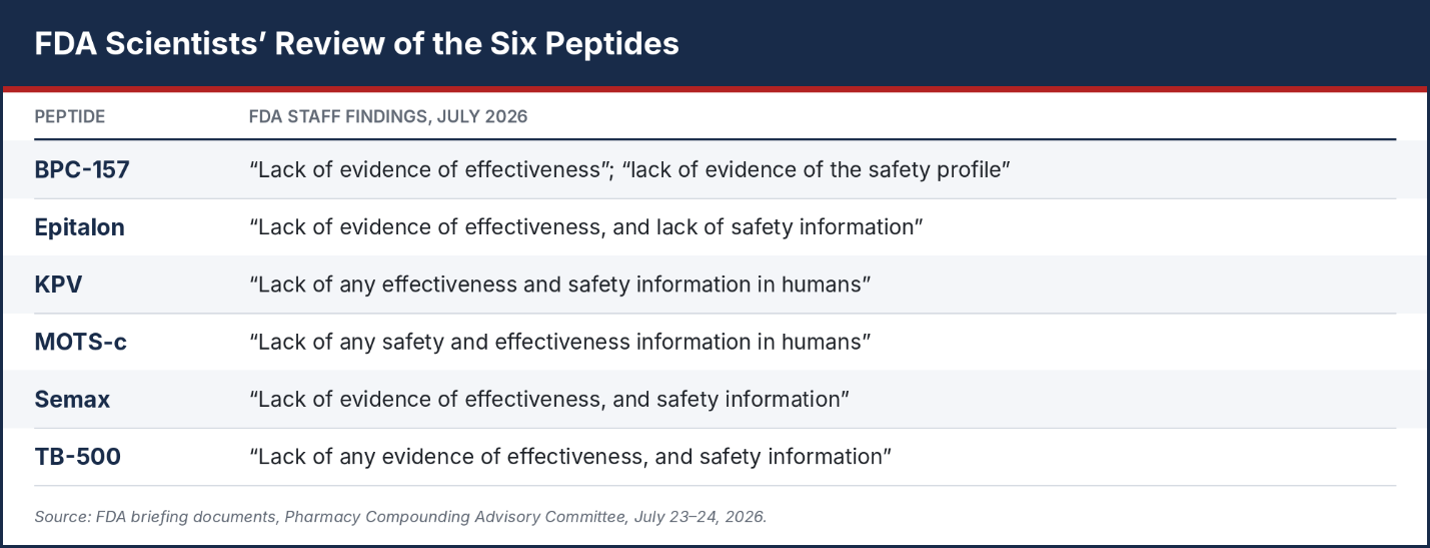
FDA staff scientists recommended against approval in each case, citing a lack of evidence for the safety and effectiveness of any of the peptides, (see Table).
Table
In October 2026, apparently frustrated because the FDA had yet to accept the committee’s recommendations, Kennedy bypassed agency scientists entirely. Acting on his own authority, the HHS Secretary announced that the six unproven and unapproved peptides could be made available and sold without threat of federal enforcement action.
GROWING POPULARITY OF ILLICIT PEPTIDES
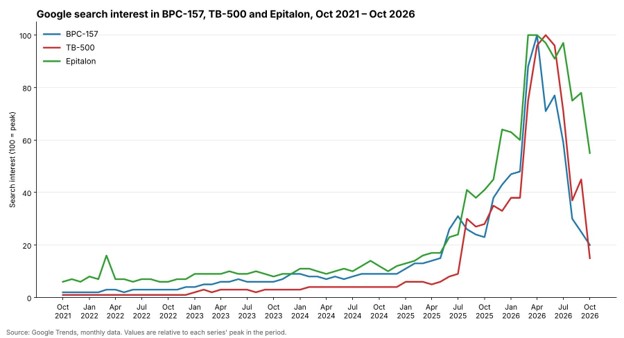
Although there are few sound statistics on the sales of illicit peptides, Google search data suggest that their popularity surged in early 2025, around the time that the U.S. Senate confirmed Kennedy as HHS Secretary. The Figure shows interest in three of the six wellness peptides discussed at the July 2026 FDA meeting.
Figure
Many of the peptides being sold in the United States appear to come from China, often from the same pharmaceutical companies that make the ingredients for fentanyl.
TRM Labs, a company that tracks cryptocurrency payments and criminal activity, reports that the peptide business overlaps with the trade in fentanyl, one of the opioids that have been involved in hundreds of thousands of overdose deaths. Of the 200-plus companies that have sold fentanyl precursors, about 100 have also sold peptides such as BPC-157, TB-500, and Epitalon.
“Americans Are Buying Peptides From the Same Chinese Chemical Vendors Selling Fentanyl Precursors,” TRM announced in October.
FDA PEPTIDE ENFORCEMENT WAS SCANT AT BEST, THEN STOPPED
The FDA could have cracked down on the booming peptide market long before the use of peptides became widespread. But it didn’t.
When the agency wants to stop the sale of unapproved drugs, it investigates and sends warning letters explaining that the company is violating the law.
The letters typically say something like this: “With certain exceptions not applicable here, a new drug may not be introduced or delivered for introduction into interstate commerce without an approved application from FDA…”
If a company persists in selling an unapproved drug, the FDA can pursue further measures. The agency may notify customs officials to detain imports or seize products, and it can seek a court injunction to stop sales.
The FDA and the Department of Justice have pursued and prosecuted a handful of companies for selling unauthorized peptides. A few examples:
- In 2020 a Kentucky company selling peptides received an FDA warning letter regarding the sales of unapproved and misbranded drugs. The company, Tailor Made Compounding, later pleaded guilty to one count of distributing unapproved new drugs. According to the plea agreement, the company unlawfully distributed some of the same peptides at issue in Kennedy’s order: BPC-157, Epitalon, and Semax. In connection with the plea, the company agreed to forfeit $1,788,906.82, representing its 2019 sales of these products.
- In 2022 the FDA sent a warning letter to the owner of a company called Paradigm Peptides for marketing unapproved drugs, including peptides. The investigation eventually was turned over to the Department of Justice for prosecution. In July 2026 the owner of the company was sentenced to 70 months in prison.
- In 2023 the operators of a website, pinnedaminos.com, were indicted in federal court for selling misbranded and unapproved drugs, including at least one peptide.
Since 2025, however, FDA enforcement actions against unapproved peptides have ground to a halt.
During the second Trump administration, the agency has sent more than 150 letters to companies warning that they were marketing drugs that the FDA had not approved, according to the FDA Warning Letters database. Of those, only one cited a company for selling one of the six peptides singled out by Kennedy for enforcement discretion, and even then as an add-on to other violations. The company that received that letter, GenoGenix of Boca Raton, Fla., was accused of an array of other failures, including unsanitary conditions and failure to report adverse events. By the time the FDA letter was sent, the company had agreed to shut down.
There is other evidence from the same period that the FDA was looking the other way on peptides. The FDA investigated and warned at least 11 companies that they were selling knockoff GLP-1 drugs. Those sales had outraged the brand-name pharmaceutical manufacturers. The same 11 companies were also selling one or more of the six unapproved peptides, but the FDA letters did not mention those sales. Among those companies were Nuscience Peptides, Pink Pony Peptides, Mile High Compounds, Prime Sciences and USAPeptide.com.
In other words, Kennedy’s October announcement that HHS would not enforce rules against the sales of unapproved peptides merely formalized the de facto approach that the FDA already had been taking.
Key Republican lawmakers had urged the rules suspension, known as “enforcement discretion.” Sen. Tommy Tuberville (R-Ala.) and Rep. Diana Harshbarger (R-Tenn.) both wrote letters asking the FDA to limit enforcement against peptides.
Others, however, have criticized the lack of enforcement, scoffing at the idea that refraining from enforcing FDA rules would create, as Kennedy claimed, a “regulated marketplace.”
“This proposal is essentially an end-around the formal regulatory process,” a former FDA attorney with experience in compliance issues said in an interview.
Another former FDA official said demand for the unproven peptides would likely increase. Consumers may assume that peptides granted enforcement discretion are being sold with the blessing of the federal government and that the FDA must have evaluated them. “When the FDA puts its imprimatur on something, the odds are that more people will be using it,” the official said in an interview.
WHO COULD BENEFIT FINANCIALLY FROM ENFORCEMENT DISCRETION?
A constellation of people within Kennedy’s MAHA orbit or otherwise aligned with Kennedy could benefit financially from HHS’s enforcement discretion policy for unapproved peptides.
Among them:
- OPS International, which operates Olympia Pharmaceuticals and in July 2025 donated $100,000 to the MAHA political action committee (PAC) aligned with Kennedy’s MAHA movement. The same month its chief executive, Mark Mikhael, joined the board of the MAHA PAC. Olympia Pharmaceuticals, which specializes in health and wellness products, is a pharmacy of the type (a so-called 503A pharmacy) that would be allowed to sell the peptides under Kennedy’s new policy.
- Brigham Buhler, founder of Ways2Well, a telehealth clinic that prescribes peptides and offers services such as stem cell and red-light therapies. Buhler has appeared on Kennedy’s podcast on health and medicine issues and is the coauthor of The Peptide Revolution, published in 2026.
- Gary Brecka, who has served as co-chair of the MAHA Action Committee and promotes peptides Brecka also talked up unapproved peptides on an episode of his podcast, the Ultimate Human Podcast with Gary Brecka, recorded last year at the White House.
CONCLUSION
Before the FDA approves a new drug, the sponsor must conduct clinical trials that establish that the drug is safe and effective for its intended use. The FDA has stringent regulatory requirements for a reason: to protect the public from drugs that are unproven or unsafe.
The FDA’s lack of enforcement against unapproved peptides began years before Kennedy’s “enforcement discretion” policy. By looking the other way on unapproved peptides ¾ with or without Kennedy’s blessing ¾ the FDA has established a dangerous precedent, abdicated its public-health responsibilities, and put Americans at risk.